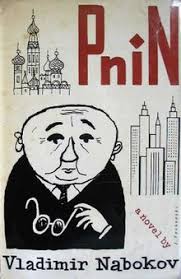
Goodreads tells us that Pnin is one Nabokov’s “best-loved novels” and that it “features his funniest and most heart-rending character”, comments that I have to say gave me pause for thought. Published just after Lolita, Pnin is apparently the novel which established Nabokov in the public mind, or at least that much of it that exists in America. It follows the titular Professor Timofey Pnin, a comically disorganised Russian émigré lecturer working at an American college in the 1950’s. Pnin is an everyman character struggling with the challenges of everyday life – driving a car, taking a bus, hosting a drinks party, and not least the complexities of the English language. As you would expect with Nabokov the novel features a slightly sinister narrator who is far more than just unreliable but who towards the end of the novel seems to be actively malevolent towards Pnin. By this stage the reader feels protective towards Pnin, but the peril dissolves without coming to a head.
Pnin was first serialized in The New Yorker and then published in book form in 1957. It is everything Lolita is not – gently comic, uncontroversial in its subject matter, and comparatively straightforward. There are some autobiographical elements – Nabokov was a refugee from Nazi-occupied France, arriving in the USA in 1940, and taught Russian at an American university. I am a massive fan of Nabokov’s transgressive, challenging novels, so there’s no point in trying to disguise the fact that I was a little disappointed in Pnin. I am sure the problem was that I was expecting or hoping for something in the same vein as Lolita (or Pale Fire, another wonderful novel), and the gentle comedy just took me unawares. On its own terms its a perfectly successful novel, it’s just not the Nabokov I expected.
There is an episodic character to the novel, without doubt deriving from its original publication format. Pnin is sensitive to noise and moves from house to house, hoping to find a noise-free environment, but finding each noisier than the last. He tries painfully to be a welcoming host at his little dinner party, but ends the evening with the devastating news that he is being fired. He fails, then passes, his driving test:
“…If he failed the first time he took his driver’s licence test, it was mainly because he started an argument with the examiner in an ill-timed effort to prove that nothing could be more humiliating to a rational creature than being required to encourage the development of a base conditional reflex by stopping at a red light when there was not an earthly soul around, heeled or wheeled. He was more circumspect the next time, and passed…”
It would take a harder heart than mine not to be touched when he throws away the football bought with some difficulty for his ex-wife’s son after finding out he is not interested in sport. Slowly the character of a kind, well-meaning man at odds with the modern world emerges. On its own terms it is engaging and entertaining – I can see how it would have worked in serial magazine form, where there wasn’t time for the understatement to become underwhelming.
I am not sure whether it is best to read Pnin as a companion piece to Lolita, a palette cleanser after the monstrosities of Humbert Humbert, or to try and isolate the two works and read Pnin entirely on its own merits. In practice I suppose the latter is impossible, so the former it is. It is clearly from the same hand as Lolita, showing a command of the subtlest nuances of English which from a non-native speaker is breath-taking. Here’s Pnin recovering from having all his teeth taken out for example:
“A warm flow of pain was gradually replacing the ice and wood of the anaesthetic in his thawing, still half-dead, abominably martyred mouth. After that, during a few days he was in mourning for an intimate part of himself. It surprised him to realize how fond he had been of his teeth. His tongue, a fat sleek seal, used to flop and slide so happily among the familiar rocks, checking the contours of a battered but still secure kingdom, plunging from cave to cove, climbing this jag, nuzzling that notch, finding a shred of sweet seaweed in the same old cleft; but now not a landmark remained, and all there existed was a great dark wound, a terra incognita of gums which dread and disgust forbade one to investigate. And when the plates were thrust in, it was like a poor fossil skull being fitted with the grinning jaws of a perfect stranger.”
What an extraordinary collection of imagery packed into that brief paragraph! I can’t quite forgive Pnin for not being another Lolita, but I know it deserves more than that. At just over 160 pages it is the briefest of reads, so perhaps I should return to it when feeling less locked-down and in need for something escapist?