
This incredibly authoritative not to say weighty biography of Britain’s greatest novelist left me with a renewed respect for Dickens the author, but some of the revelations left me equally disappointed with Dickens the husband and father.
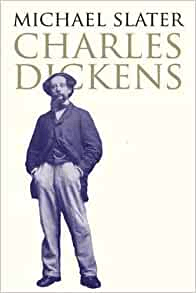
Slater’s biography follows the traditional format of all such works. Dickens’s early life is recorded in detail elsewhere, not least by Dickens himself in an autobiographical fragment published soon after his death by his close friend and first biographer, John Forster. Slater claims that the period when Dickens’s family went through hard financial times and had to withdraw him from school and send him to work, aged 14, in a blacking factory, was a key turning point in his life. It, Slater argues, haunted him for the rest of his life, and he constantly returns to it in his work, letters, and personal life. That point felt overstated, although I obviously defer to the author’s infinitely more detailed knowledge of Dickens’s life and work. Once these years are over, the text is focussed on composition of Dickens’s 14 novels which provide a structure for the text, although there is a vast amount of other works to be included, recorded, referenced and analysed.
Even if you know Dickens well this book will probably contain some surprises. I didn’t know for example that his early novels – including Pickwick, Oliver Twist, & Nicholas Nickleby – were essentially improvisational. While writing them Dickens had no clear plan where the plot was going, nor in the case of Pickwick whether the text was ever going to be printed as a novel at all, rather than remain as a serial, comparable to modern-day soap-operas. The idea of turning this series of stories with a common theme into a novel seems to have occurred to Dickens quite late in the day. As his work matured Dickens planned his novels more carefully with detailed notes on characters and plot-lines, but he rarely wrote more than a few weeks ahead of publication, sometimes cutting things very close indeed. Publishing his work in this way had an important impact on his plotting decisions. Any large scale editing is virtually impossible. Novelists who prepare their whole work prior to publication (i.e. virtually all of them today) can make substantial changes up until the last minute, deleting characters, going back to the beginning of the novel to provide subtle clues to the outcome, etc. While Dickens could fine tune his choice of words when the novels were published in volume form, major plot changes were impossible. (Authors who publish series of novels face a similar challenge – J K Rowling must surely have wanted to be able to go back to Philosopher’s Stone and add some more clues about Harry’s scar or tidy up the messy timeline of the first chapter, The Boy Who Lived?). This feature of his way of working imposed a discipline on Dickens’ plotting which he never seems to have worried about, but it would be interesting to read the novels in this light and look at his technique for avoiding painting himself into too many corners. One example which Slater points out is the strange opening to The Old Curiosity Shop, which begins in the voice of an unnamed first person narrator (“Although I am an old man, night is generally my time for walking” who quickly fades out of the text to be replaced by an omniscient narrator. According to Slater this is because the story started as a magazine sketch intended for only one or two editions, and when Dickens decided to adapt it as a longer form novel the switch in narrator was made at that point. The reader doesn’t really notice this switch in voice, but in retrospect is does appear unusual.
Dickens’s prodigious work ethic is another prominent feature of this biography. There was no point in his adult life when Dickens wasn’t working virtually flat out, at several points writing two novels at once. His novels are only a small part of his output: his collected journalism and letters run to many volumes, and he seems to take on major new projects even when he is completely overwhelmed with work. His was also a prodigious travellers, criss-crossing the country for his readings and popping over to France to see his young lady friend several times a month. In addition of course he also managed two major tours of the USA.
The weak copyright laws of the time meant that Dickens was openly plagiarised throughout his career, most typically in the form of stage adaptations. Slater tells us that “between March and December 1838 no less than five unauthorised adaptations of Oliver appeared in the London theatres.” (121 – for context, Oliver Twist was published in monthly instalments between February 1837 and January 1839). This issue only got worse – “no fewer than seventeen different stage versions (of his Christmas story The Cricket and the Hearth) appeared in London within a month of the book’s publication.“(239). There was an ironic twist to this plagiarism. In the rush to copy his work theatres would put on productions of his work before their serialisation had finished, forcing them to anticipate the novels’ endings. There is some evidence that Dickens used these versions of his works to give him ideas on how to end them – Slater cites evidence that in his composition of Little Dorrit Dickens “looked back for help with the plotting of an unauthorised dramatisation of the first part of the novel”.
This is an extraordinarily thorough account of Dickens’s life. Slater chooses to structure his text around his subject’s literary life, which his personal life less of a focus. His early romances, his marriage and ten children are all mentioned, as is the end of his marriage and his late romance with Ellen Ternan, but there is a sense of restraint in the narrative, a lack of speculation and a focus on the literary output and Dickens’s creative life. I did wonder whether the biography, structured as it is around the construction of the 14 principal novels, would have been such a compelling read if the reader was not familiar with Dickens’ work? But I guess no-one tackles a 600+ page biography without at least a certain familiarity with the novels.
I have written elsewhere about Dickens’ extraordinary consistency as a novelist. That comment was about his style – he seems to have landed on a discursive, dramatic and comic style of writing early on in his career and it remained with him largely unchanged throughout. My contention was that unless you knew the chronological sequence of his novels you would be hard pressed to tell, based on the writing alone, whether his work was early, middle or late period Dickens. But there is another way in which he was consistent, and that was in the length of his novels. All his novels were published in instalments – either weekly or monthly. The earlier novels did not have a predetermined plot nor number of instalments they were intended to fill, so their length varies significantly – Pickwick is almost twice as long as Oliver Twist. But once the format and number of instalments was settled down, the consistency of the length of the novels is extraordinary. Look at this list:
1.David Copperfield: 357,489
2. Dombey and Son: 357,484
3. Bleak House: 355,936
4. Little Dorrit: 339,870
5. Martin Chuzzlewit: 338,077
6. Our Mutual Friend: 327,727
7. Nicholas Nickleby: 323,722
8. The Pickwick Papers: 302,190
9. Barnaby Rudge: 255,229
10. The Old Curiosity Shop: 218,538
11. Great Expectations: 186,339
12. Oliver Twist: 158,631
13. A Tale of Two Cities: 137,000
14. Hard Times: 104,821
15. The Mystery of Edwin Drood: 96,178 (first 6 of 12 parts only)#
Yes, David Copperfield and Dombey and Son are almost identical lengths, to within 5 words in a total of over a third of a million. That’s an insane level of accuracy. Copperfield was published in 19 monthly one-shilling instalments, containing 32 pages of text and two illustrations, with the last instalment being a double-number (in other words, twenty instalments). Dombey followed the same pattern – 19 + 1 instalments, 32 pages, 2 illustrations. So it’s not surprising they are around the same length. But identical? The <10% variance in the top seven novels in this list can be explained by the length of the monthly instalments and the number of illustrations rather than any variation in Dickens’s plots or characterisations. Other authors were published in the same instalment formats as Dickens, indeed many of them in his magazines (Wilkie Collins and Elizabeth Gaskell, to name but two) and I would imagine their word length would be similar given the circumstances. But I confess I haven’t checked in any detail. (A quick look at the number of pages shown on Collins’s Goodreads page gives a range of 528 pages for The Moonstone to 672 pages for The Woman in White and 748 pages for No Name). There must surely be a strong case for arguing that no other author would have had Dickens’ discipline, to produce content week after week, month after month across almost all his adult life, to such a precise degree of accuracy.
I mentioned at the beginning of this review that I came away from this book feeling a little disappointed with Dickens the man. He discarded his wife with whom he had ten children, and ‘took up with’ a woman twenty years younger than him. We can’t be certain about the precise nature of this latter relationship but we can have a pretty good guess! He estranged his children from his wife, characterising her as a bad mother, and disrespected her in his will. His politics, particularly in relation to the trade union movement and issues of race, were not as progressive as they are often characterised. Slater is very open on this point – he doesn’t try to sugar-coat Dickens’s weak-spots, but neither does he over-emphasise them. Dickens was capable of change, and his approach to the way Fagin is characterised in Oliver Twist is a good case in point. He goes from being an openly hostile anti-Semitic caricature to in later editions a much more nuanced portrait, with far less emphasis on his race.
I’ve some way to go before I can claim to have read all of his novels, but this biography has given me a renewed appetite for continuing my tradition of an annual Dickens.
#(I found these statistics on the internet, and I haven’t separately verified them. I did a spot check of Copperfield and the word count was very close, with a small variation explainable by how you count the index, chapter headings, etc. )

