Book review

The Man Who Died Twice, by Richard Osman, 2021

Turn off Antiques Roadshow, put the kettle on and open a pack of hobnobs; the Thursday Murder Club is back!
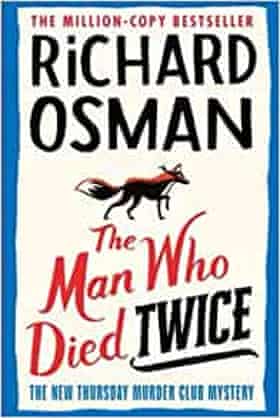
The Man Who Died Twice by Richard Osman

Richard Osman’s cosy mystery novel is currently smashing book sales records across the country. He seems to have found a winning formula and can’t be blamed for milking it for all it is worth. The question is: has he sustained the quality and originality of the first novel, or is this sequel already showing signs of repetition?

Not much time has passed since the events of first novel in the series. The four core members of the club – you will remember Elizabeth, the former spy, Joyce, a retired nurse, Ron, trade union leader and West Ham fan, and Ibrahim, a psychiatrist – are keen to get started on their next mystery to while away the hours that drag in their retirement community. The ‘not dead yet’ trope familiar from movies such as RED (retired and extremely dangerous) where elderly people draw on their years of experience to prove more than a match for their much younger enemies is quite well-worn by now, but Osman brings it to life by creating some very likeable and believable characters. Joyce in particular stands out – she is quite oblivious to some things going on around her (there is a long running joke about the personal messages she receives to her ambiguously named Instagram account) but her emotional intelligence gives her insights the others miss. It helps of course that she is one of the novel’s principal narrators. She enjoys the adventures even when at personal risk, managing a quick snooze in the back of a car while being held at gunpoint. For some reason I can’t shake the thought that Joyce is based upon Betty White’s character in – well, pretty much everything she is in.

There’s a comforting lack of peril in The Man Who Died Twice, despite the occurrence of several murders and appearances by gangland bosses and the Mafia. I thought it unlikely that Osman would allow plot armour – the phenomenon where the reader/viewer knows a character isn’t going to die however extreme the risk, because of their importance to the novel/film/franchise – to protect all of his characters, particularly given their advanced age, but they all make it through largely unscathed.

Because the novel is set close in time to the events of the first, there has been little progression in the lives of the foursome or their extended crime-fighting team. PC Donna is still feeling homesick for London and looking for love; her boss, Chris, is in the early days of a relationship with her mother, Patrice. Osman mines the agonies Chris goes through to wean himself off takeaways and onto carrot sticks for all the humour it is worth. Polish handyman Bogdan becomes a get out of jail free card for the team, always on hand to get them out of trouble. Women go weak at the knees around Bogdan which becomes very helpful when dealing with Connie Johnson, the local drug dealer. There’s a well-written and particularly comic scene when Bogdan calls on Connie to buy some drugs. The conversation is brief and perfunctory from Bogdan’s point of view, but when the narration switches to Connie’s perspective it is full of meaningful silences and erotic suspense.

Strangely for a murder-mystery, even a light-hearted one such as this, the plot is really not that important. An underworld boss has had some diamonds stolen by a Douglas Middlemiss, Elizabeth’s ex-husband. Douglas works for MI6, but is close to retirement. In one of an increasing series of improbabilities MI6 agree to hide Douglas and his guard Poppy, an inexperienced agent on her first field assignment, in Cooper’s Chase, the old people’s community where the Club members live. As I am sure is common spycraft practice. When this location is compromised they are moved to another ‘safe’ house which proves equally easy to discover. Instead of just giving the diamonds back or running off with them, Douglas leaves an elaborate trail of clues for Elizabeth to track them down and find the probable killer. In the process she also draws together the novel’s other threads, although the denouement requires everyone to behave incredibly improbably – going to a meeting without bodyguards for instance, or arriving in the country with a handgun without the need for any passport or customs checks – and the willing suspension of disbelief can be quite hard to maintain at times.

I am usually rubbish at solving the clues in mystery novels, but even I found the puzzles here very easy. Osman flags the clues without a lot of subtlety. A last message from Middlemiss to Elizabeth is left in a dead letter drop which he had earlier remarked on as an ideal place for a dead letter drop, and contains a simple acrostic puzzle using the first letters of each sentence. This wouldn’t have been that hard to solve anyway (and it is a red herring) but earlier in the paragraph Elizabeth explains how acrostics work and how she and Douglas used to use them to share jokey messages between themselves. The rest of the letter is phrased strangely with unusual repetition, and I am sure I can’t have been the only reader to scan it for clues – but it turns out the one simple clue it does contain is so obscure that only Elizabeth could ‘solve’ it using her shared past with Douglas. It’s all over-elaborate, improbable, and unconvincing, but I don’t think it matters a great deal – we know this isn’t John le Carre after all, more akin to one of the Famous Five or Secret Seven novels sixty years on.

Osman has put lockdown to good purpose, crafting a mystery novel that keeps the reader guessing to the last page, not least as to the identity of the man who died twice as described in the novel’s title. The jokes work well and are probably the best part of the novel. Checking back on the predictions I made for Thursday Murder Club 2 I probably got more wrong than right, and those that I did get right were fairly obvious – the format would remain unchanged for example – so credit to the author for avoiding some of the other more obvious choices. My mistake lay I think in my estimation of the length of the series – Osman is clearly here for the long haul, and we are going to be enjoying Thursday Murder Club novels for much longer than I imagined, if the progression here is anything to go by. And no complaints from me about that.

Standard
Book review

The Secret History by Donna Tartt, 1992

The Secret History was Donna Tartt’s debut novel. It opens ominously with the announcement of a murder, with this gripping first line:

“The snow in the mountains was melting and Bunny had been dead for several weeks before we came to understand the gravity of our situation.

Much of the rest of the novel is dedicated to describing the circumstances leading up to the killing, and to answer the question: how did five educated, cultured and relatively genial young people come to kill someone they once considered their friend?

The novel’s narrator is Richard Papen, a student from California who escapes an unhappy childhood home to go to university the other side of the country in Vermont. Richard becomes part of a close-knit group of classics students, taught almost exclusively by a charismatic professor, Julian Morrow. (Morrow is perhaps a nod to Dr Moreau, another creator of monsters, and suggests Julian may share the burden of responsibility for what happens in the novel). As a character Richard has strong echoes of Nick Carraway, the narrator of the Great Gatsby, witness to another tragic east Coast story of rich people and how their money spoils them. The novel is told several years after the event, and Richard’s testimony makes it clear that the group were never convicted for their involvement in the killing of their friend Edmund “Bunny” Corcoran.

Richard is in no hurry to rush to the details of the murder. This is a confessional, and he believes it is important we understand the full background to what happened, their ‘secret history’. We are introduced to Julian’s small group of students: twins Charles and Camilla Macaulay, Francis Abernathy, Henry Winter, and Edmund “Bunny” Corcoran. Francis and Henry are both independently wealthy, but while Bunny’s family has money he is always borrowing from his friends. The others are cultured intellectuals but Bunny is an outlier, crude and unsophisticated, who takes advantage of his friends and tells unfunny jokes at their expense.

For Bunny’s murder to be portrayed as something the group were forced to do, but for the reader at the same time to feel some sympathy for the victim and understand why he was initially their friend, Tartt has to have Bunny undergo something of a personality change over the course of the novel. Bunny’s faults, at first either not mentioned or tolerated as eccentricities, slowly become magnified to the point of being unbearable. Instead of just sponging off his friends for an occasional meal, he eventually forces them to spend thousands of dollars on him every week, to the extent that their families all think they have drugs problems. None of this would have mattered if Bunny did not know that the group – excluding Richard – had a dark secret which if exposed would ruin their lives. It is the knowledge that sooner or later he will deliberately or otherwise expose them which causes them to act.

The Secret History, front cover.jpg

Bunny’s murder – they push him into a ravine, breaking his neck – is described at the climax of the first half of the novel, and once the deed is done the pace of the narrative almost inevitably begins to flag. There is no suspense as to whether they are investigated or arrested – Richard’s narration has already made it clear that they get away with the murder. Because it appears Bunny has accidentally fallen to his death, and because the body is not discovered for ten days, the inquest finds that he died accidentally, and there is no murder investigation. Things don’t go entirely smoothly – the extended search leads to suspicions that Bunny has been kidnapped (at one point ‘arabs’ are implicated) or was involved in drugs. The FBI is called in, but any threat to the group quickly evaporates once his body is found.

Despite the lack of legal consequences, the impact of their involvement in the murder of their friend is felt by the group nonetheless.

But walking through it all was one thing; walking away, unfortunately, has proved to be quite another, and though once I thought I had left that ravine forever on an April afternoon long ago, now I am not so sure. Now the searchers have departed, and life has grown quiet around me, I have come to realize that while for years I might have imagined myself to be somewhere else, in reality I have been there all the time: up at the top by the muddy wheel-ruts in the new grass, where the sky is dark over the shivering apple blossoms and the first chill of the snow that will fall that night is already in the air.”

Charles begins to drink heavily (as to some extent do all the others), and he eventually becomes unstable and abusive towards his sister. Henry arranges for Camilla to move into a hotel to get away from Charles. It emerges that Camilla and Charles have had an on-off incestuous relationship, and jealousy of Henry causes Charles to threaten him. At the same time Julian discovers the group’s responsibility for Bunny’s murder when he receives an incriminating letter from Bunny that had gone missing in the university’s arcane internal post system. Instead of reporting the crime, Julian walks out of the college and leaves the students to their fate.

The classics – Ancient Greek and the authors of the period – play an important part in the atmosphere of the novel. The students consider themselves an elite because of the subject they study, and hold themselves accountable to a different set of standards from the rest of the student body. Mainly this comes across as pretentiousness:

“Mais, vrai, J’ai trop pleure! Les aubes sont navrantes. What a sad and beautiful line that is. I’d always hoped that someday I’d be able to use it.”

Richard remains something of an outsider because he has friends outside the group, “somehow despite my efforts, I am never able to blend myself in entirely and remain in some respects quite distinct from my surroundings, in the same way that a green chameleon remains a distinct entity from the leaf upon which it sits, no matter how perfectly it has approximated the the subtleties of the particular shade.” But while Richard can at least approximate the behaviour of his waspish friends, Bunny’s involvement in the group is a complete anomaly. Most of the time he behaves like a typical undergraduate, drinking, taking drugs, and generally being boorish, completely out of place amongst his cultivated ‘friends’.

The Secret History is an ambitious novel. It introduces the reader to a close and complex group of friends and I think we are supposed to find them fascinating – Henry the savant, the enigmatic twins, and so on. I struggled to identify with them – they are all dependent on prosperous parents, and the extent to which they rely on the bank of mum and dad is exposed when Francis, openly gay when with his friends, feels forced to agree to an arranged marriage to a woman he despises just so he can ensure his allowance and inheritance. The novel is slightly less than the sum of its parts – the discussions of Ancient Greek literature and philosophy feel more important and profound at the time than when recalled at the end of the novel – are they just pretentious, spoiled students showing off and attempting to justify their homicidal tendencies?

Tartt is clearly an accomplished writer. She publishes approximately one novel per decade which shows how complex and immaculately crafted her novels are. Why The Secret History has never been adapted for the cinema of television is one of those mysteries that will never make sense, because it is incredibly filmic (I can imagine Bunny and Henry’s Christmas break in Rome would translate particularly well to the screen) , but hopefully one day one of the streaming services will pick it up.

Standard
Book review

The Thursday Murder Club, by Richard Osman, 2020

If you enjoy murder mysteries but aren’t a fan of the more gory, bloody thirsty variety of the genre, you will love Richard Osman’s intelligent but ever so slightly sedate ‘The Thursday Murder Club’. Set in a retirement village, four friends gather once a week (“It was Thursday because there was a two-hour slot free in the Jigsaw Room, between Art History and Conversational French”) to discuss unsolved murder cases. One of the club members, Penny, has recently fallen seriously ill and is no longer unable to attend, so the club has decided to recruit a new member. Joyce is the voice of naivete in the narrative, breathlessly excited about her new adventures. (“I’m afraid I don’t know WTF. I only discovered LOL last week”). The other, more experienced members all bring their own particular set of skills to this most unlikely A-team. They are Elizabeth, who was an intelligence agent before never really quite retiring, Ibrahim, a psychiatrist, and Ron, a trade union leader.

The Thursday Murder Club: The Record-Breaking Sunday Times Number One  Bestseller: Amazon.co.uk: Osman, Richard: 9780241425442: Books

The cynic in me suspects that Osman has had some excellent advice on how to sell books. Rule one must surely be “know your audience”. I haven’t taken the time to look it up, but I am believe the main buyers of murder mystery novels written by television celebrities are senior citizens, and it looks as if Osman has constructed his story with that market in mind. The heroes of his novel are the club members who defy all negative stereotypes about the aged. They are energetic, intelligent, and navigate the modern world with ease. The murder club amateur detectives are always one step ahead of the police and break rules (and laws!) with impunity. Jokes about the challenges of modern technology are kept to a minimum. This adds up to create an immensely likeable story despite some of the more conspicuous evidence of its construction. At 377 pages across 115 chapters the pages slip by quickly, and the contrasting narrative voices and cliff-hanging endings all give the story considerable pace. All these elements make this a very easy novel to read. Is it patronising to suggest that this is all intended to make the book more popular with older readers?

I’m not going to summarise the plot, for the obvious reason of avoiding spoilers, but also because it is quite byzantine. There are lots of red herrings, sub-plots and other diversions which add to the page count but at times felt like padding. The ending won’t come as a massive shock, but I don’t think it is mean to – after a while there are only so many suspects left standing!

Despite some of the media coverage of this novel it is anything but ground breaking in its treatment of the old. Miss Marple is an obvious template for the senior citizen amateur detective, using her age to ensure people under-estimate and overlook her while she doggedly pursues her investigations. Having said that, the setting is original (so far as my limited knowledge of murder mysteries can account for). Osman acknowledges that many people living in a retirement home will either have lost a life-partner, or be in the process of losing them, to dementia or other illnesses. Grief is shown as part of everyday life for this community.

It’s hard to avoid the fact that even the very best murder mysteries are written within a fairly rigid set of conventions. It follows that it is not a criticism of this author to say that his first novel seems to be consciously laying down a template for future novels in the series to follow. Why wouldn’t it? I understand he has already written the sequel to this novel, and I think I can hazard a couple of guesses about what will happen in The Thursday Mystery Club 2. The central structure of a suspicious death being investigated by the club members will of course be retained. I think we will learn a lot more about the back-story of Elizabeth and Ibrahim, two key members of the club who so far we only know little about. There’s a lot more to come there if the history of some of the other residents is anything to go by. I also think one of the club members will die – my money is on retired trade union leader Ron – allowing fresh blood to join the club and new characters to be introduced. I also suspect there will be more explicit romantic complications between the retirement village residents, and that PC Donna De Freitas and her boss, DCI Chris Hudson will return for the next set of murders.

Just as an aside, the attitude to death in this novel is interesting. Of course murder mysteries by their nature need to confront death, and one set in a retirement village probably all the more so. But here two characters take their own lives in quite a casual manner, as if for the old death is less of an issue that it would be for younger characters. That might be the case but it doesn’t really square with the zest for life shown elsewhere in the novel. Some old people might be blasé about death and check out willingly when the time comes, but I suspect many others will fight it to the last – certainly Ron, Elizabeth, Joyce and Ibrahim would.

It’s good to see one of the more thoughtful, intelligent television personalities have success as an author. I await the inevitable television adaptations of his novels with interest.

Standard