Book review

Reaper Man (Discworld 11) by Terry Pratchett, 1991

As the reaction to my Facebook post about Pyramids (Discworld 7) attests, the Discworld novels are hugely loved by a community of readers across the world. People love the novels for many reasons, but I think one of the most common reason is the enormous empathy that Sir Terry shared with his readers. He knew our weaknesses and frailties, 220px-Reaper-man-coverand saw the inner strength in the most abject of us, the deluded, the vulnerable. No-one is so much of a misfit that they don’t have a place in Ankh-Morpork’s Watch; no-one is beyond redemption, as Moist von Lipwig’s story shows. And the weakest and frailest of us all know that one day we will face death, or perhaps Death. So it is his crowning achievement that he made Death such a human, kind character, and that novels such as Reaper Man which are all about Death and death, can be so warm and touching.
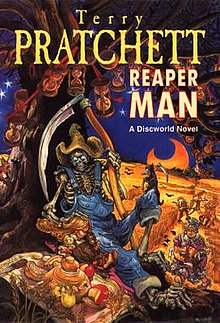
Ok, I get it, enough fan-boying, if that’s a word. In this the eleventh Discworld novel, the Auditors of Reality object to Death developing a personality, so decide to ‘retire’ him. In facing up to the death of Death he leaves his job collecting souls, and spends his remaining days working as a farm hand imaginatively named Bill Door for the elderly Miss Flitworth, another of STP’s astonishingly well realised older female characters.

But the absence of death is not entirely unproblematic. A ‘life force’ (of some kind, STP is vague on the detail) starts to cause poltergeist activity and lots of other weirdness. Windle Poons a senior wizard is disappointed not to be met by death on his passing, and becomes a charmingly polite but determined zombie, joining an undead-rights group. The ‘action’ scenes in which Ankh-Morpork is slowly invaded by a parasitic lifeform which evolves into a shopping centre are heavily cut between the Bill Door scenes, but this doesn’t effectively disguise their clumsiness as satirical comment on consumerism. In the novel’s touching climax Death is given a little more time and spends it on a last dance with Miss Flitworth.

One of the many joys of a Discworld reread is rediscovering the origin stories of some of Sir Terry’s wonderful characters. Reg Shoe, undead rights activist, first appears here, although it is not until much later in the glorious Night Watch that we discover how he came to zombiedom. The Death of Rats also first appears in this novel. But Death takes centre stage here, rightly so, and carried the novel on his bony shoulders. Another triumph Sir Terry.
Standard
Book review

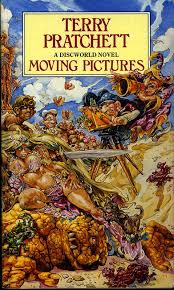
Moving Pictures (Discworld 10) by Terry Pratchett, 1990

Moving Pictures

At this point (1990) in his writing career, Terry Pratchett was producing two Discworld novels a year. He’d published Sourcery (Discworld 5) and Wyrd Sisters (DW 6) in 1988, Pyramids (DW 7) and Guards! Guards! (DW 8) in 1989, and Eric (DW 9) already in 1990, before he produced Moving Pictures for the Christmas sales at the end of the year. By any reckoning this is an extraordinary sustained level of output, all the more so given that Moving Pictures is such a rich and cleverly written novel.

I am fairly sure when Sir Terry was writing these novels there was no overall grand plan in his head. (I may have read that somewhere). People have retrospectively tried to impose some order on the novels, and grouped them around the principal topics – the Witches series, the City Watch series, and so on. Several of the Discworld novels use as their inspiration the coming of round world technology to the Disc – The Truth (printing), Going Postal (Clacks/telegrams), Raising Steam (trains) and so on. Monstrous Regiment is sometimes included in this group but I am not sure why – maybe it will become clearer when I eventually reread it!) These groupings can be contentious, but they do make the series more accessible to new converts to the cause of all things Pratchett, so are therefore a good thing. Moving Pictures is the first in the Industrial Revolution series of novels, and is a quite affectionate satire on the rise of cinema in the early part of the twentieth century, the Century of the Fruitbat.

Pratchett isn’t interested in subtly disguising his targets, so the small out of the way coastal area where movies begin to be made is called Holy Wood. Holy Wood is watched over by a guardian who performs strange rituals to protect the site from the strange spirits that are trapped in the hill. When the guardian dies, sand starts to trickle away from Holy Wood Hill, allowing the spirits or some kind of unpleasant entity to escape. It quickly infiltrates the vulnerable minds of the alchemists of Ankh-Morpork. Alchemists are a disgruntled group of marginalised not-quite wizards, best known for blowing themselves up and turning gold into less gold. Without quite understanding how, the alchemists quickly invent cinema – moving pictures – and decide to decamp to Holy Wood, starting a gold-rush of sorts as people head out to the coast in search of stardom, bedazzled by the glamour of Holy Wood. One such ingenue is Victor Tugelbend, the oldest student in the Unseen University, skilled at not passing his exams. He sets out to become a star, followed by numerous citizens of the capital including Cut My Own Throat Dibbler, Detritus, a troll bouncer from the Mended Drum, and Gaspode the Wonder Dog, who between them represent some of Discworld most popular secondary characters.

Victor breaks into the movies, literally, with the help of the talking Gaspode, and is introduced to Ginger, his co-star. All the while people are largely unaware of the strange magic that Holy Wood is casting over them. There’s a lot of scene setting as Pratchett lays the ground the novel’s finale, but it’s worth it. The pay off is a magnificent parody of King Kong and Gone With the Wind. Pratchett scatters funny references to movies throughout the novel – this is probably the richest novel for this feature, often with several clever little references to cinema or other aspects of popular culture on every page. This must make it a nightmare to translate!

Moving Pictures is of course much more than an affectionate parody of the film industry. Cinema is in any event something of a soft target – the early days of the movies in particular were ridiculous in so many ways, but they did give us some great films. They did cause people to behave out of character, but was there really any great harm done? So this is not a satire with any significant purpose, more a very light-hearted, at times even silly, commentary on the industry. There’s so much to enjoy here, from spotting the references to the wonderfully strong cast of characters, many such as Gaspode making their first substantial appearance in the series. There is a darker element to some of the Discworld novels, but it is almost completely missing here – whatever it is that escapes from Holy Wood Hill and infects the minds of men, women and animals, is ill-defined but relatively easily defeated.

Pratchett always has something interesting to say even when his is being at his most light-hearted, such as this wonderful paraphrasing of A Room of One’s Own:

“You know what the greatest tragedy is in the whole world?… It’s all the people who never find out what it is they really want to do or what it is they’re really good at. It’s all the sons who become blacksmiths because their fathers were blacksmiths. It’s all the people who could be really fantastic flute players who grow old and die without ever seeing a musical instrument, so they become bad plowmen instead. It’s all the people with talents who never even find out. Maybe they are never even born in a time when it’s even possible to find out. It’s all the people who never get to know what it is that they can really be. It’s all the wasted chances.” 

Eric was undoubtedly a blip, something that had all the hallmarks of a rush job, but Moving Pictures was equally obviously written with love and care. It’s wonderful, and a great place to start the collection if you have spurned the chances offered by Wyrd Sisters or Guards! Guards!

Standard
Book review

Eric, by Terry Pratchett, (Discworld 9) 1990

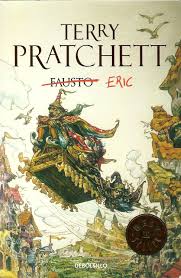
Eric, the ninth Discworld novel, was originally published as a Discworld story to distinguish it from its predecessors in the series. It came in a large format with illustrations throughout by Pratchett’s then cover illustrator, Josh Kirby.eric

This is going to make me hugely unpopular with Pratchett fans everywhere, but I have never been a big fan of Kirby’s work on the Discworld covers. For a start the emphasis seems always on under-dressed young women in various states of peril. If this was done tongue in cheek then he might have got away with it now and again, but the covers are essentially childish, and the books are not. I think this didn’t help Pratchett get the recognition his work deserved, and although a new illustrator took over when Kirby died in 2001, by then a lot of the damage had been done. Brandon Sanderson once famously wrote of STP (in an essay which described the Discworld novels as “the highest form of literature on the planet” which even I think it a bit of a stretch) that

“I’m embarrassed by how long it took me to discover Terry Pratchett. I avoided him during much of my early reading career”.

Could it be that Sanderson was put off by the covers perhaps?

(Incidentally, since writing this I have also found this quote from Sir Terry himself on LSpace.org, The Annotated Pratchett file:

The next UK paperback reprint of TCOM (they do a couple a year) will not have a Kirby cover. This is an experiment — there’s been feedback to me and to Transworld that suggests there are a large number of potential DW readers out there who think they don’t like fantasy and don’t get past the Kirby covers.”

Well there you have it.)

Anyway, Eric is now available widely without the art work, as are all the Discworld novels, so each to his own. Eric is a gently humorous retelling of the story of Faust, as the front cover of most editions with the word Faust struck through and replaced by the word Eric leaves little doubt about. It’s part of the continuing adventures of Rincewind, the original Discworld hero, who we left trapped in the Dungeon Dimensions at the end of Sourcery.

Rincewind is summoned out of these dimensions by a teenage demonologist, Eric, who like all teenagers wants to meet the most beautiful woman in the world, live forever, etc. Rincewind is compelled to play the part of the world’s least convincing demon, although strangely he does seem to have powers to fulfil Eric’s wishes. A very unfunny parrot provides a form of chorus as they travel to Klatch, followed shortly behind by the luggage, to Troy, or the Discworld equivalent Tsort, and finally Hell. There’s a ‘doing it by numbers’ feel to the plot, closely following as it does the source story, with only glimpses of the humour and thoughtfulness that characterises a typical Discworld novel. After they escape from Hell – of course – and go on their way, the story pretty much peters out rather than ending with any satisfying conclusion.

Normally I am falling over quotes to use in a post about a Discworld novel – with Eric that’s more of a challenge. For example:

“What’re quantum mechanics?”

“I don’t know. People who repair quantums, I suppose.”

just isn’t that funny, is it, let alone telling us something essential about life as the best STP quotes often do. Or take this below-par use of the word ‘horology’, I hesitate to call it a pun, which only Eric would be amused by:

“The Tezuman priests have a sophisticated calendar and an advanced horology,” quoted Rincewind.
“Ah,” said Eric, “Good.”
“No,” said Rincewind patiently. “It means time measurement.”

“Oh.”

I am not going to labour the point, this was a bit of a dud, and I am going to move swiftly on to the wonders of some of later novels.


Standard