Book review

Monstrous Regiment (Discworld 31) by Sir Terry Pratchett, 2003

Did I mention that Terry Pratchett was, amongst many other things, a brave writer? In his novels he tackles some of the most difficult subjects, and the fantasy settings can only provide so much “it’s only a story about vampires and trolls” cover. In Monstrous Regiment he addresses some seriously weighty issues – war, the status of women in the military and wider society, and fundamentalist religion.
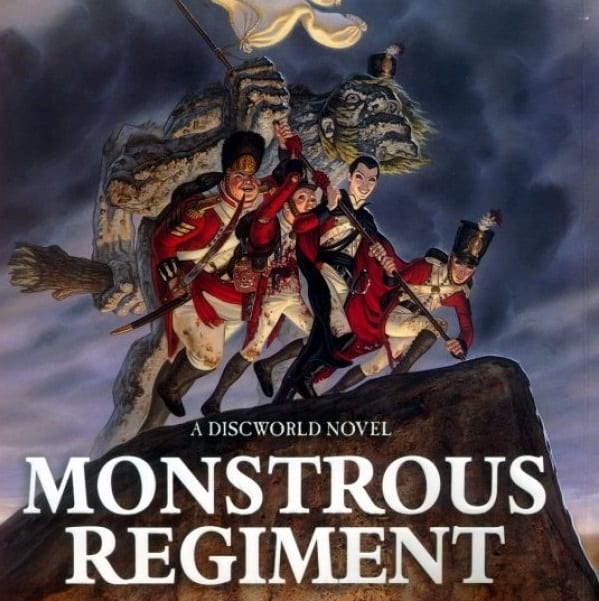
Dueling Book Clubs Review Monstrous Regiment - The Fandomentals

For much of the time he is on a tightrope, balanced finely between being preachy while also avoiding being insensitive – these are not laughing matters. Amazingly he pulls it off – there’s never a point in this novel where I felt spoken down to or where the material wasn’t treated with the respect it deserved, while all the time making a series of serious points about the issues discussed. It’s mature writing of the highest order, Pratchett at the peak of his powers.

Which begs the question – what’s the novel about? Monstrous Regiment is set in Borogravia, a deeply traditional country not far from Uberwald, and therefore a long way from anywhere else. Its people are followers of Nuggan, a weirdly strict deity who rules through his representative on earth, or in the part of it that is Borogravia, the Duchess, the country’s monarch, who is almost certainly long-dead. There is strong middle-European feel to this country, not least to its constant border disputes with its neighbours over who owes a particular field or tree.

The current war with Zlobenia is going badly for Borogravia, and we join the novel with recruiters scouring the countryside for anyone who can hold a gun. The narrator follows Polly Perks, who joins up to try and find her missing in action brother Paul. (This is not just sisterly love – if Paul cannot be traced the family pub will pass to her drunken cousin when her father dies. It is one thing to recognise the unfairness to women of inheritance law, and another to include such reference in a fantasy novel). Joining a long tradition of women in the military, Polly disguises herself as a man. Much fun is had with her attempts to adopt a male swagger, to occupy space, and to fart and belch convincingly. Other recruits sign up – Maladict, a vampire, a troll called Carborundum, an Igor, and Tonker, Shufti, Wazzer and Lofty. Without wanting to spoil the reveal, this unlikely bunch of recruits are not what you might expect of a group of young men and persons joining the army.

They set off for the front, led by Sergeant Jackrum, a corpulent and highly experienced recruiting officer and their commanding officer, Lieutenant Blouse. Their first encounter with an arrogant troupe of Zlobenian cavalry is surprisingly successful. even more so when their unlikely victory is reported on by war correspondent William de Worde, he of The Truth. They quickly become popular figures of interest followed back home, and elsewhere by Commander Vimes, sent from Ankh-Morpork to try to broker a peace and protect Ankh-Morpork interests. Vimes sees that a straightforward Zlobenian victory will lead to an imbalance of power in the area, so he wonders whether the small band of plucky recruits working their way to the war might prove more useful than just cannon fodder. Sergeant Angua keeps track of the recruits as they make their way to the front, occasionally providing help, such as an unexpected package of coffee when Maladict, a black ribboner, (a vampire who has foresworn blood) begins to suffer withdrawal symptoms. On their journey the links between the unlikely recruits grow stronger, and their various backstories and secrets slowly emerge.

When they reach the front the recruits realise that the war is at a stalemate – Borogravian troops are pinned down and unable to break out of a small area of land; Zlobenian and alliance troops holding the area’s principal fortress but are unable to press their advantage. Control of the castle is key, and in a highly risky plan (which is therefore guaranteed success) they decide to infiltrate the Keep disguised (of course) as washerwomen, free the prisoners, and end the war.

I can’t tell you much more without revealing some important plot points, and for once I don’t intend to do so. As always with Pratchett the plot is really secondary to the character development anyway, and the outcome is not really that much of a surprise.

This is one of my favourite later Discworld novels – it’s set in largely new territory with only a brief appearance of regular characters, but remains unquestionably Discworld in feel throughout. The sensitivity with which the material and issues are handled is impressive, and although the jokes as always are pretty basic, the central characters are fully rounded and utterly believable. There are no bad starting places in the series, but if you have preconceptions about fantasy novels as being full of dwarves and dragons, there are worse places to put you straight than this.

P.S. I am sure you will have spotted it, but just in case, the title is an ironic reference to this 16th century misogynist pamphlet against women in positions of authority.

P.P.S. Towards the end of the novel, Pratchett uses the haunting refrain “the world turned upside down” several times. You might recognise this phrase from the musical ‘Hamilton‘. But Wikipedia tells me that the phrase derives from a pamphlet published in the 1640s “as a protest against the policies of Parliament relating to the celebration of Christmas” and has an even earlier origin in Scripture:

These that have turned the world upside down are come hither also; Whom Jason hath received: and these all do contrary to the decrees of Caesar, saying that there is another king, one Jesus‘.” Acts 17:5-7

The Hamilton reference derives from a legend that the British army marched to this tune when they surrendered after the Siege of Yorktown. The British army would apparently have played an American or French tune in tribute to the victors, but General Washington refused them the honours of war and insisted that they play “a British or German march.” Like most good stories of this kind it is probably apocryphal – it first appears in the historical record a century after the surrender!

Standard
Book review

The Wee Free Men (Discworld 30) by Sir Terry Pratchett, 2003

Some books are harder to review than others. Sometimes it’s just difficult to find something interesting or original to say, and you don’t want to just summarise the plot and wrap it up with some platitudes about the author’s writing style. But this isn’t that kind of difficult. The Wee Free Men is so full of wonderfulness that it is impossible to capture it all – and to fail would be a disservice to the breadth of Pratchett’s skill as an author. It’s not perfect of course but it’s pretty damn close. For younger readers it is an ideal entry point into Discworld.

Nac Mac Feegle.jpg

The Wee Free Men features the magnificent nine-year old Tiffany Aching. She lives with her farming family, helps out around the farm, and looks after her irritating younger brother Wentworth. Tiffany is special – ferociously intelligent and with a thirst for knowledge and understanding.

I am careful and logical and I look up things I don’t understand! When I hear people use the wrong words, I get edgy! I am good with cheese. I read books fast! I think! And I always have a piece of string! That’s the kind of person I am!

Pratchett’s ability to create fully-rounded female characters always astounds me, and here he does it again, entering imaginatively into the mind of a precocious young girl and getting it pitch perfect. I can’t think of another author of his generation who writes such brilliantly fierce, independent and strong women as Pratchett. They are not just adornments to his novels, they are centralised and given distinctive voices which articulate the reality of their lives. Of course a man can never fully understand what it is to live the life of a woman, but Pratchett does an amazing job of trying. And he defies stereotypes at each turn, not in a self-conscious “I am going to create a gender-fluid character to show how progressive I am” way, but because such characters genuinely interest him.

Although this is a younger reader’s novel, there’s nothing patronising or simplified about the story – it is nuanced, layered, and contains several moments of genuine peril. The bad guys have grim-hounds, dream-stealers and things too scary to describe, and are led by a witch several times scarier than anything in Narnia.

Zoology, eh? That’s a big word, isn’t it?”
“No, actually it isn’t,” said Tiffany. “Patronising is a big word. Zoology is really quite short.

In the previous novels in the series Pratchett created many vividly imagined settings: the sprawling chaos that is Ankh-Morpork; the mountain kingdom of Lancre, the Unseen University, and so on. The Wee Free Men is set in the countryside, a sheep-farming area of grassland known as The Chalk. This small patch of Discworld is vividly evoked and drawn with so much reverence and respect – you have to wonder if Sir Terry grew up somewhere similar to The Chalk.

Anyway, back to the novel. One day while out for a walk with Wentworth, Tiffany sees what the reader knows are Nac Mac feegles, tiny blue kilted men speaking a chaotic and hugely entertaining form of Glaswegian. They warn her of a monster lurking in the river. Using Wentworth as bait, Tiffany bashes the creature with a frying pan. Without mentioning this supernatural experience to any other adult, all of whom are too busy to listen anyway, she seeks out Miss Tick, a visiting witch, who teaches Tiffany some important lessons:

“If you trust in yourself. . .and believe in your dreams. . .and follow your star. . . you’ll still get beaten by people who spent their time working hard and learning things and weren’t so lazy.”

She also tells her all about the Nac Mac Feegle. These riotous pictsies are at the heart of the novel, and are an inspired, vibrant creation. I particularly enjoyed their fear of lawyers – “We’ve got a cheap lawyer an’ we’re not afraid to use him!” In a nod to Tolkien, the Feegles’ swords glow blue in the presence of lawyers. The Feegles believe they are dead – this world is so full of wonders that it must be heaven. When they die therefore there is no cause for grief – you can’t die if you are already dead. That feels seriously profound to me – comforting and at the same time reminding one to appreciate the world as it is.

All of which is a prelude to Wentworth being kidnapped by the Queen of the Fairies, and Tiffany’s rescue mission. She is aided by the Nac Mac Feegles, including Rob Anybody (I confess I only got that joke (that he will steal from anyone) when I read the name out loud; before that I just thought it was a silly name. This might suggest that the novel was written to be read to younger children perhaps?) Big Yan, Daft Wullie, Hamish, the Feegle’s Gonnagle William. The Gonnagle is the Feegle’s battle poet, reciting poetry of Vogon severity that causes enemies to flee. Well I never said the jokes were going to be sophisticated did I?

Tiffany and the Feegles’ adventures in fairyland are scary enough. All through the novel Tiffany remembers her Granny, Granny Aching, an iconic figure of the Chalk who died a few years earlier but remains a crucial figure in her life. This is a touching tribute to the importance of grandparents in children’s lives, and I am sure would be a comfort to any younger reader going through a similar loss.

The novel ends with what is in effect a guest appearance by Granny Weatherwax and Nanny Ogg. In true fairy godmother style, Granny gives Tiffany an imaginary witch’s hat. Tiffany asks

Is it really there?”

“Who knows….It’s virtually a pointy hat. No-one else will know it’s there. It might be a comfort.”

“You mean it just exists in my head?” said Tiffany.

“You’ve got lots of things in your head. That doesn’t mean they aren’t real”.

The Wee Free Men, page 307

Surely it’s not just me who sees this line reappear in Harry Potter and the Deathly Hallows, when Dumbledore says to Harry:

“Of course it is happening inside your head, Harry. But why should that mean that it is not real?”

I’ve only scratched the surface of the wonders of this novel. If you haven’t read it before I am so jealous.

Standard
Book review

The Amazing Maurice and his Educated Rodents (Discworld 28) by Sir Terry Pratchett, 2001

My lock-down guilty pleasures Discworld series reread continues with another novel I have not read before.

Let me explain. I discussed at length in my previous post the fact that The Last Hero and Maurice were not originally considered part of the Discworld series of novels. The change, from them being Discworld stories to becoming part of the series happened around 2009 or thereabouts. The Amazing Maurice has even weaker claims to be part of the series than Hero – apart from the setting (Uberwald, although it really could be anywhere vaguely middle-European), a mention of the Unseen University, and a brief appearance by Death and the Death of Rats, this is very much a stand-alone novel. So although I religiously bought each Discworld novel as they were published, from as early as The Colour of Magic, I missed some of the Discworld stories, including, obviously, this one.

The Amazing Maurice is marketed as a children’s or younger reader’s novel. I don’t want to argue with that because what makes a children’s novel is a matter of authorial and publisher’s judgment that I am not in a position to question, But there are dark elements to the story that I will come back to later which could easily upset a younger audience.

The Amazing Maurice is a cat who has acquired the ability to talk. He did this by eating a rat who had the same ability, having lived on a rubbish dump outside the Unseen University, where lots of background magic had accumulated. Maurice works with a troupe of talking rats with the same powers, and their human, Keith, a piper. They travel around from town to town embezzling communities by a minor variation on the Pied Piper scam – the rats make a nuisance of themselves, and then for a modest fee Keith pipes them out of town. We join them as they arrive at a town in Uberwald called Bad Blintz. This, they promise themselves, is going to be their last heist before retirement, the set up line for so many unsuccessful adventures (and bad movies). Maurice is the brains of the operation, keeping the fairly gormless Keith out of trouble as best he can.

Bad Blintz turns out to be a troubled place. Rats have already impoverished the town, and while food continues to disappear there don’t seem to be many surviving rats left. Keith meets the mayor’s daughter Malicia who is obsessed with story-telling, and has a thin grasp on the difference between reality and fiction. For example, when she is searching the town’s rat-catchers’ hut for clues she keeps leaning casually on walls hoping false walls will open. The fact that they do find a hidden trapdoor, leading to a network of cellars full of stolen food and caged rats, naturally encourages this fantasy. Malicia learns about Maurice and the rats ability to talk but is unfazed by it – it’s the sort of things that happens in stories.

At the heart of the novel is the quest to work out what is happening in Bad Blintz – where all the food is going, and what has happened to the rats? In the course of that quest we are introduced to many of the rats in the ‘clan’ – their aging leader Hamnpork, Dangerous Beans a spiritual rat, his assistant Peaches, and Darktan, the trap expert, to name a few. In the nightmarish cellars of the town they meet and confront the sinister Rat King, Spider, who is able to control rats, cats and even humans with the powers of his mind.

Some of the scenes with the rats, caged and cannibalistic, are vivid and scary, and I can only imagine how a pre-teen reader would react to them. There are also some character deaths, not all of which are temporary, and while the happy-ever-after ending is well constructed and satisfactory, the scares and genuine sense of threat along the way contribute to that sense of darkness I mentioned earlier. Pratchett has learned from Roald Dahl and others that stories for children can be nasty.

Pratchett was a wonderfully thoughtful writer, always with something interesting and original to say about the big issues of life, so I should not have been surprised to read such insight and compassion in a children’s story about talking rats. Along with the ability to speak the rats (and Maurice) have developed consciousness, and dare I say it souls. They develop concepts such as the self, an awareness of evil, and debate moral issues such as whether to eat non-talking rats, and what happens to them after they die. The rats are not overly anthropomorphised, certainly not sentimentally. They still widdle on everything, can’t wear clothes because they get in the way, and take their names from the sides of tin cans. In case we miss the point the contrast is emphasised by the snippets from a children’s story which the rats carry around in a manner akin to a holy book. This gave Maurice and the rats a depth of character that you just don’t expect in a story about talking animals, and for a brief moment my lifelong aversion to rats was abated.

Storytelling is an important theme in the novel. Malicia think life is just a story, the kind in which there is always a happy ending. Speaking of endings, I think Maurice has one of the most satisfying and effective endings in the series. The rats work out a purpose in life, which isn’t to run away and live on an island, but to use the power of narrative force to shape their destinies;

“If you don’t turn your life into a story, you just become a part of someone else’s story.”
“And what if your story doesn’t work?”
“You keep changing it until you find one that does.”

The Amazing Maurice and his Educated Rodents

Maurice is an important link in the Discworld chain because it kept the franchise alive and fresh, introducing a whole new group of readers to Discworld, who would of course go on to read the ‘main’ series. It was awarded the Carnegie Prize in 2002. This was Pratchett’s first major award, and in acceptance he gave this wonderful quote reflecting on his ambivalent about the fantasy genre:

Stick in one lousy dragon and they call you a fantasy writer’

Standard
Book review

The Last Hero (Discworld 27), by Sir Terry Pratchett, 2001

I haven’t yet worked out why this matters to me, but for some reason it does. If you look up a list of Discworld novels on the internet today it will tell you there are 41, starting with The Colour of Magic and ending with The Shepherd’s Crown. There are many other Discworld books, from guides to the streets of Ankh-Morpork to Nanny Ogg’s recipe book.

The-last-hero.jpg

But it was not always thus. The list of Discworld novels used to run Thief of Time (26); Night Watch (27 – now 29), omitting The Last Hero (now 27) and The Amazing Maurice and his Educated Rodents (now 28), both of which at the time were firmly non-canonical “other” Discworld stories. By ‘the list of Discworld novels’ I am mainly referring to the list as published in each new instalment of the series. I have a first edition of Night Watch for example, which shows this order, and categorised The Amazing Maurice as a Discworld story. I can perfectly understand why, for marketing purposes, Pratchett’s publisher would want to differentiate the novels written for younger readers – essentially the Tiffany Aching books – although I am not convinced that the differences between the younger reader novels and the mainstream Discworld novels are all that significant. Over time this distinction might fade, and they will just be considered part of the golden thread of the series. The Sir Terry website maintained by his publishers lists the Tiffany Aching books both in the main series of novels and in the younger reader section (along with the carpet People, Truckers, Dodger etc) in classic having their cake and eat it fashion.

The only real difference between the Last Hero and (say) Thief of Time i.e. a conventional Discworld novel is that The Last Hero is illustrated. It’s not a comic book – there are no speech bubbles – but there are illustrations on every page, and it was always conceived as such. It could be published without the illustrations as a Discworld novella, but that would be ripping the heart out of the novel (or whatever it is) because the illustrations, by Paul Kidby add significantly to the text. Kidby was at this point (2001) just taking over as the principal Discworld illustrator from Josh Kirby who was to die the year The Last Hero was published.

The plot is a very conventional Discworld adventure. Cohen the Barbarian sets off with his Silver Horde to return fire to the home of the Gods, Cori Celesti. A message is received by Lord Vetenari, Patrician of Ankh-Morpork, warning him that if their quest succeeds, the world will end. He assembles an unlikely team to stop them –  Leonard of Quirm, Captain Carrot, and the world’s worst wizard, the irrepressible Rincewind, backed up by the wizards of the Unseen University. They travel into space and round/under the world in a contraption invented by Leonard, in scenes that combine multiple references to the Apollo missions with echoes of Jules Verne and Dan Dare thrown in, arriving just in time to save the day, inevitably. It’s great fun, and a wonderfully fresh addition to the series. I thought I had read all the Discworld novels already, but because of the issues I mentioned in the opening of this post (at far too great a length!) I had missed this one. It was a wonderful to discover another chapter in the Discworld story.

Standard
Book review

The Thief of Time (Discworld 26) by Terry Pratchett, 2001

In Thief of Time Terry Pratchett gives his by now bulging bag of Discworld characters, settings and scenarios a good shake, and comes up with an entertaining story about the end of the world. There are some distinct echoes of Good Omens along the way, but that’s not necessarily a bad thing.

The Auditors of Reality, who as we know from Hogfather want to end the world, finding humanity unnecessarily messy, are back. The Auditors had the potential to be fairly sinister, dementor-like figures, in their floaty grey hooded-cowls, but their susceptibility to explode when tasting chocolate is a bit of a weakness. They don’t seem to have learnt much from their previous encounter with Death and his grand-daughter, Susan Sto-Helit, who set out to stop their latest attempt. The Auditors’ dastardly plan this time is to hire a clockmaker Jeremy Clockson (yes, this is the standard of the jokes. If you don’t like them then don’t read the book, it’s quite simple really) to build a perfect glass clock. There is at this point what David Tennant’s incarnation of Dr Who called some “timey-wimey” stuff. We are asked to accept that a clock that can measure time perfectly will stop the universe. There are quite lengthy attempts to explain why this might be the case, and these have a sufficient veneer of plausibility to hold the rest of the plot together.

Another reappearing character is sweeper Lu-Tze of the History Monks. Lu-Tze first appeared in Small Gods but here the character is expanded significantly, as is the role and history of the History Monks themselves. Lu-Tze is the only known master of “déjà fu” a martial art in which the hands move in time as well as space. This leaves one’s opponent with ‘the feeling you’ve been kicked in the head this way before‘. Lu-Tze usually relies on the principle that no-one notices a sweeper, which allows him to go anywhere in the monastery, together with ‘Rule One’. Rule One states “Do not act incautiously when confronting little bald wrinkly smiling men”.

Pratchett spotted that as Westerners often draw inspiration from spiritual figures from the East, so seekers of enlightenment from the East may well look for insights into philosophy from the West. The Discworld version of this concept is Lu-Tze’s following of ‘The Way of Mrs. Cosmopilite’, drawn from the everyday sayings of Mrs Marietta Cosmopilite, his landlady when he lodged in Ankh-Morpork. For is it not written that ‘a penny saved is a penny earned’, ‘do you think I’m made of money’, ‘don’t make me come in there’, and ‘because’ and other pearls of wisdom.

To help him track down the doomsday clock, Lu-Tze takes a bright young apprentice, Lobsang Ludd. Lobsang is a relatively new recruit to the History Monks, having previously been raised by the Ankh-Morpork Thieves’ Guild. Lu-Tze quickly learns that Lobsang is (of course) no ordinary apprentice, having powers to manipulate time way ahead of anyone of comparable experience or age. Lu-Tze and Lobsang set out to find the maker of the glass clock, and in part to make repairs for the last time such a clock was made, which caused huge problems with the history of Discworld before breaking. Motifs from road-trip and master and apprentice stories are used as well as a slightly out of place reference to James Bond – they are equipped with special devices by a quartermaster called Qu!

Susan is against her better judgment called in to help Death. This involves her leaving her day job as a teacher (the scenes of Susan teaching her class Geography by magically transporting them to the country concerned are wonderful). She questions Nanny Ogg, given a guest appearance as the world’s best midwife, who eventually reveals she once helped Time herself have twins. As two young men in the novel, Lobsang and Jeremy, have already demonstrated a special relationship with Time, joining the dots by this point isn’t too difficult.

Thief of Time is also a Death novel. As well as commissioning Susan’s help, Death organises a reunion of the Four Horsemen of the Apocalypse, who are joined by the Fifth Horseman, Ronnie Soak, a personification of Chaos and now living in quiet retirement as the world’s most efficient milkman.

This is perhaps not Pratchett at his peak, but not far off. The jokes are, as always, wonderfully terrible, and the pop-culture references come thick and fast. The plot hangs together – just – and while there is little suspense we keep reading because we want to know how it is all resolved. There is even just a hint of romance for Susan, which is nice.

Standard
Book review

Feet of Clay (Discworld 19) by Terry Pratchett, 1996

This is Pratchett at the peak of his powers. Feet of Clay, often overlooked in any discussion of the best of Discworld, is sublime. it is a well constructed crime novel, but also a profound meditation on identity. It is also one of the City Watch series of the novels, and thus one of my favourites.

One of the less understood races of Ankh-Morpork are the golems. Usually treated as animate machines, they are awakened from their slumber and set off in search of the meaning of their existence. With the help of a priest and a baker they create a king golem, placing in his head instructions that go far beyond the simple mechanical phrases normally used. This experiment with creation goes badly wrong, which is how the Watch becomes involved. In a parallel plot sinister figures arrange for Lord Vetenari to be poisoned and replaced by a more malleable figure. Fortunately the Watch has a newly appointed forensics expert on the case, Constable Cheery Littlebottom.

Pratchett is often cited as a serious commentator on social issues (the Vimes Boots theory for instance) but in Feet of Clay he reaches Dickensian heights of commentary and analysis. On social housing for example he states:

“While it was regarded as pretty good evidence of criminality to be living in a slum, for some reason owning a whole street of them merely got you invited to the very best social occasions.

Sam Vimes is usually the calm centre of common sense in Discworld. Here he articulates openly republican ideas, and I can’t help but believe that this reflects Pratchett’s thinking as well:

“Royalty was like dandelions. No matter how many heads you chopped off, the roots were still there underground, waiting to spring up again. It seemed to be a chronic disease. It was as if even the most intelligent person had this little blank spot in their heads where someone had written: “Kings. What a good idea”. Whoever had created humanity had left in a major design flaw. It was its tendency to bend at the knees.”

I also like the sound of Vimes’s ancestor, kingkiller Stoneface Vimes, who tells us through the pages of his journal:

“In the Fyres of Struggle let us bake New Men, who will Notte heed the Old Lies”. 

We could do now with some New Men who can see through the old lies.

You would not expect to read a thoughtful discussion of what makes us human in the pages of a comic fantasy novel almost 20 books into a series, but that’s precisely what Pratchett offers here. There are no easy or glib answers, but some serious questions. The golems do the heavy lifting both literally and metaphorically, bearing the weight of these questions. They are treated as machines, but they can think and reason, and when they start to take their own lives in response to the wave of murders across the city we gain an insight into their developing sense of self-awareness. They are unable to live with the guilt of their shared responsibility for the deaths.

Sexuality is another area where Pratchett bravely is unafraid to tread. The sexual relationship between a human and a werewolf has already been accepted by the Watch, but an openly female dwarf seems at first a step too far. Cheery Littlebottom ground-breakingly confronts the sexual mores of her race and her profession but embracing her sexuality. Wearing lipstick and a skirt is a revolutionary step in dwarven culture. Is Pratchett here signalling support for the LGBTQ+ community, or is he having just a bit of fun with bearded ladies? Discworld preaches acceptance of difference and diversity, nowhere more so than in the Watch. Vimes even accepts a golem onto the payroll in a final and bold statement of understanding.

It would be a mistake if I gave the impression that this novel takes itself in any way seriously. It doesn’t, even while discussing serious issues with the respect they deserve. Like all great works of literature Feet of Clay works on many different levels – the discussion about identity and sexuality is there if you look for it, but so are the dad jokes about Nobby and Colon, the well-constructed murder mystery, the police procedural, and the character study. I would never choose a favourite Pratchett, but if I did, this would undoubtedly be on the shortlist. I suspect I have said that about most of the other 18 or more Pratchett novels I have reviewed thus far, and will say again more than once before The Shepherd’s Crown comes round again.

Standard
Book review

The Discworld Companion by Terry Pratchett and Stephen Briggs, 1994

By a wonderful act of synchronicity, I stumbled across this £1 charity bookstore treasure very shortly after completing Soul Music. This edition of the Companion (later editions being called the New Discworld Companion, followed by The Turtles Moves..The Discworld Companion…So Far) was published in 1994, ending with the publication of – and therefore fully describing the known Discworld up to – Soul Music.

This is much more than a guide to the Pratchett universe, although it is a very comprehensive one at that, obviously only comprehensive up to 1994 that is. This partiality is in itself is fascinating, as this snapshot of the DW universe reveal that at this point it is surprisingly complete – certainly all the main features you would expect – the Watch, Vetinari, the Witches, Death, a fully developed concept of how magic works, and so on – are all there, fully formed. In one sense the final 25 or so books were about filling in the detail and backstory rather than reinventing DW, and the genesis of several of the later novels are clearly present here. Examples of this include the references to the mysterious world of XXXX, later explored in the Last Continent (Discworld 22) or the writer William de Worde and the fact that moving type has not yet been fully embraced in Ankh-Morpork. de Worde’s entry in the Companion ends with the this sentence:

“It could well be that the future holds great things for young Mr de Worde…”

You really couldn’t ask for a clearer indication that Sir Terry had The Truth, the DW novel about the introduction of printing, planned out in his head, even though it wasn’t to eventually appear until 2000 as DW 25.

The Companion also has lots of canonical additional content found nowhere else – there is a very comprehensive description of the history, working and traditions of the Unseen University for example, in which Unseen Academicals is hinted at in the description of the DW version of football:

“UU records suggest that students from the University have no participated recently, but street football with various rules is still an Ankh-Morpork tradition”.

The sections on magic, DW units of measurement/standards, and Morporkian law, equally all give plenty of background to the DW universe only hinted at in the novels.

At the end of the Companion, after the A-Z section, is some fascinating additional content. In a chapter apparently written by Stephen Briggs, there is what I feel is one of the best summaries of the reasons why the novels are so loved:

“There is a certain quiet optimism (in the books). If there is a struggle, the good win – but not easily, and at some cost. There is a strong dislike of coercion of people, either by other people or gods or some concept of fate or destiny. There’s a very frequent theme which says that what people happen to be doing does not define what they actually are.”

Elsewhere a long and comprehensive interview with Sir Terry reveals that in the mid-90’s in response to the question:

“Do you see yourself still writing Discworld books in ten years’ time?”

he gave a very definitive

“No. Not even in five years time. Certainly not on a regular basis, anyway. There’s only so much I can do with it.”

I am so glad he changed his mind!

P.S. In the very final section of the Companion Briggs write about Pratchett fandom:

“Fan activity is available to anyone with a computer and a modem. There is a Pratchett forum on CIX….and a rather larger one known as alt.an.pratchett on the Internet (the huge worldwide computer network which shifts megabytes of information around the planet”.

Oh so that’s what the Internet is!! Gotta love 1995.

Standard
Book review

Soul Music (Discworld 16) by Terry Pratchett,1994

There’s a disappointing, cut and paste feel to Soul Music which for me makes it the weakest of the Discworld novels thus far (i.e. of the 16 published up to this point). And it is still wonderful! How come? I’ll come to the mitigation, but first this is the plot outline:

A young harpist, Imp Y Celyn, (bud of holly, get it?) from Llamedos seeks fame and fortune in Ankh-Morpork. He forms a band with Lias Bluestone (a troll percussionist) and Glod Glodsson (a dwarf hornblower) along the way acquiring a magical guitar with mysterious powers, more specifically an entity comprising the primordial music which brought the universe into existence. As one does.

Meanwhile, Death, upset at the death of his adopted daughter Ysabell and her husband, Mort, takes another impromptu break from his day job, leaving his granddaughter, Susan Sto Helit to fulfil his soul-gathering function. She fluffs her first job by failing to reap the soul of Buddy when he is scheduled to die while performing at the Mended Drum.

Thus the novel’s two primary threads are established – death takes a break and a family members steps in to cope as best they can, a plotline Pratchett had already used before (Mort and Reaper Man); and in a parallel storyline a new phenomenon/innovation (in this case rock music) takes the Discworld by storm, causing chaos and ultimately threatening the existence of the universe, a theme already explored in some detail in Moving Pictures.

That’s pretty much it – although there are a lot more events, they all fall within this basic template. And that was what I found disappointing by Soul Music, its writing by numbers feel. To be fair to Pratchett he was writing a phenomenal amount of Discworld novels at the time, feeding our voracious appetites for all things DW. (The Colour of Magic was published in 1986,  just 8 years and 15 DIscworld novels earlier. In addition to the eventual count of 41 novels there are also any number of books and other material including short stories, cookery books, maps, guides etc). So it is hardly surprising that to meet deadlines he had to dial it in from time to time.

Fans of dad jokes and clever popular culture references will be spoilt for choice here, beginning with the original cover illustration which echoes the Meat Loaf album Bat out of Hell, rapidly followed by a steady stream of allusions to groups and records, in particular cheesy examples from the seventies and eighties, such as “Pathway to Paradise” (“Stairway to Heaven”) and ”Sex and drugs and Music With Rocks In” (“Sex and Drugs and Rock and Roll“). At first the game of spot the reference is fun, but after a while it palls – it is after all essentially the same joke time after time, however cleverly done. Having said that even I had to applaud the way the groanworthy reference to “There’s a Guy Works Down the Chipshop swears he’s Elvish” is worked in.

Pratchett was at this point over a third of the way into the Discworld saga, and he was still refining his craft. This novel would not have disappointed any DW fan, but neither can it be said to take the series to a new height or in a new direction in the way books such as The Night Watch did. It’s fun, and the jokes consistently work, but I am not sure we care that much about the characters (except Susan perhaps), and the eventual happy-ever-after ending is never in any doubt. The scenes of the band on the road felt like padding, an effort to reach a minimum word-length target. So perhaps I need a Pratchett holiday – but I really don’t want one, because I know what great novels are coming up.


Standard
Book review

Lords and Ladies (Discworld 14) by Sir Terry Pratchett, 1992

“In the beginning there was nothing, which exploded”. I suspect most readers would identify this as something Douglas Adams wrote, rather than his successor in genius, Sir Terry Pratchett.  It sets the tone for this wonderful novel. But perhaps I shouldn’t use this term, because as Lords and Ladies points out

“Elves are wonderful. They provoke wonder.
Elves are marvellous. They cause marvels.
Elves are fantastic. They create fantasies.
Elves are glamorous. They project glamour.
Elves are enchanting. They weave enchantment.
Elves are terrific. They beget terror.
The thing about words is that meanings can twist just like a snake, and if you want to find snakes look for them behind words that have changed their meaning.
No one ever said elves are nice.” 

This is just one aspect of the genius of Sir Terry – his ability to use language creatively to make us think deeply about language and beyond, to a very serious discussion about power and responsibility within society.

Of course there is a lighter side to this novel. It includes one line much loved by Discworld fans:

“Nanny Ogg looked under her bed in case there was a man there. Well, you never knew your luck.”

I first read Lords and Ladies a long time ago. I have a vague memory of being slightly disappointed. But one of the many wonderful things about STP as a writer is his re-readability; I honestly can’t think of another writer whose novels retain their freshness and originality on multiple re-readings in the way Sir Terry’s do. In a word, I was wrong, Lords and Ladies is magnificent.

It follows chronologically immediately following the events of Witches Abroad. I could easily be wrong about this but I think this is one of the few times in the series that STP does this (The Colour of Magic/The Light Fantastic being the other example that springs to mind.) This gives the reader the impression that they are enjoying a continuing narrative, an adventure in real time. Granny Weatherwax, Nanny Ogg, and Magrat Garlick return from their adventure in Genua to find that while they have been away the people of Lancre have neglected their defence against the dark arts lessons. In particular the witches’s warnings about the Dancers, a mysterious stone circle outside the village have been ignored. With Lancre’s magical protections weakened and unguarded, a portal to the world of the elves is opened.

But as you will have seen above, these elves are not the noble creatures of MiddleEarth- they are amoral monsters that use “glamour” to alter human’s perceptions of them. The elves break into the Discworld and cause carnage at Magrat’s wedding, to be confronted (and OK, yes, spoilers, ultimately defeated) by a feat of magic that only Granny W could pull off. There is a sub-plot featuring a visit by the Arch-Chancellor and the Librarian to the wedding, but otherwise that is pretty much it – a fairly unsubstantial piece in terms of the plot. But reading STP for this plotting would be very much missing the point – you need to read him for his characterisation and his ideas.

STP really hit his stride at this point in the Discworld history, and never really took a misstep thereafter. So many great novels to come.


Standard
Book review

Witches Abroad, (Discworld 12) by Terry Pratchett, 1991

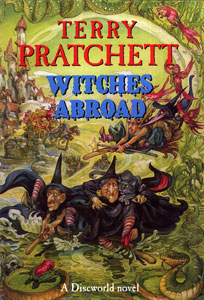
Is it possible to have two favourite Discworld books? I have three favourite children after all, so conceptually it should be possible. Were it to be deemed so by the powers that be, then ‘Witches Abroad’ would definitely be my joint favourite Discworld novel alongside Witches-abroad-cover‘The Night Watch’. Granny Weatherwax, Nanny Ogg, her perfect foil, and Magrat Garlick on a road trip across the Disc, travelling through a landscape of fairy stories brought to life by Lilith de Tempscire, Granny’s evil sister. Just perfect!

Granny and Nanny are two of my favourite Discworld characters – Magrat is a wet hen, and I can take her or leave her – and together they are wonderful. Nanny Ogg is sometimes overshadowed by Granny’s awesomeness, but her she is in full flow, a force of nature that bulldozes its way across the Disc, all the way to Genua. Genua is a coastal town with an annual celebration called Fat Lunchtime, a tradition of cooking based around gumbo and, and all in all bears a strong resemblance to New Orleans.

Witches Abroad also contains the greatest Discworld story Sir Terry never wrote. At the end of this novel, when the bad guys have been defeated and order restored, the witches have a choice – to go home, or to go and “see the elephant”, a colloquial expression for going home the long way, continuing their holiday as much as possible. They agree to see the elephant, and the reader is left to picture what a glorious, outrageous adventure that would have been. (If it turns out that this novel was actually written, and I have just forgotten it, which is quite possible, I will be both deeply embarrassed and hugely delighted).

So what is it about this novel that makes it so full of wonder? It can’t be the jokes, because they almost all qualify as ‘dad’ jokes – even the title is a pretty silly play on words (Witches Abroad = witches out and about, and also in foreign lands). Or try this schoolboyish fun with the fact that in some languages words have gender, which might be funny if you are 11

“‘S called the Vieux River.”
– “Yes?”
– “Know what that means?”
– “No.”
– “The Old (Masculine) River,” said Nanny.
– “Yes?”
– “Words have sex in foreign parts,” said Nanny hopefully.”

Or here’s another joke, when the witches see a stuffed lion’s head:

By gor’, that’s a bloody enormous cat.’
‘It’s a lion,’ said Granny Weatherwax, looking at the stuffed head over the fireplace.
‘Must’ve hit the wall at a hell of a speed, whatever it was,’ said Nanny Ogg.
‘Someone killed it,’ said Granny Weatherwax, surveying the room.
‘Should think so,’ said Nanny.  ‘If I’d seen something like that eatin’ its way through the wall I’d of hit it myself with a poker.”

OK, silly jokes yes, but slapstick can be funny?

Is it the ‘world building’? (“The process of constructing an imaginary world, sometimes associated with a whole fictional universe. The resulting world may be called a constructed world.”) I think this is getting closer. STP made no attempt to make the basic concept of Discworld anything other than fun, but over time he developed a geography and history for the world that within its own constraints – it is balanced on a turtle carrying four elephants after all – is believable. Is it the story-telling? Definitely not. One of the joys of rereading these novels is rediscovering (and then quickly re-forgetting) what happens, because what happens is usually not very important. We know the good guys are going to win, and the demons from the Dungeon Dimensions are going to be defeated in that somewhat vague way that most of these novels deploy to resolve matters. In the tradition of most great story writers STP borrows plot lines freely and openly, even going so far in this novel to make that borrowing itself part of the plot. Dracula, The Wizard of Oz, Little Red Riding Hood, Cinderella, – you name it, STP borrows from it.

So what’s left? It would be wrong to use the term “philosophy”, but the underlying humanism of the author’s perspective on the world shines out from every one of his novels. He has profound insights into the human (and dwarven, troll and other life-forms) condition. You really have to read the books to get this point properly, but for now how about this from Granny Weatherwax?

“You can’t go around building a better world for people. Only people can build a better world for people. Otherwise it’s just a cage.”

Lastly, there are the novel’s extraordinary, deeply loved, characters. I’ve written at length in previous Discworld reviews about Granny, Nanny and Sam Vimes in particular, so I am not going to repeat myself too much other than to say they are utterly magnificent, utterly believable, and full of the humanity that makes these novels some of my favourites on the planet. Sorry, roundworld.


Standard