
Recent reviews of Stanley Middleton’s novel Holiday all mention the same handful of things – his prodigious output of work (over 40 novels published in his life), the journalistic stunt when the first few chapters of the novel were sent to publishers and comprehensively rejected, and of course the joint award of the 1974 Booker Prize.
Holiday is worth more consideration than these easy references. It is a portrait of a man in the course of a mid-life crisis. Edwin Fisher, a lecturer in Educational Philosophy, has recently experienced the death of his two-year old son Donald. His wife has been unable to cope with the trauma of Donald’s death and their marriage has reached breaking point. Edwin responds bizarrely, as we often do when under great stress – he books a week at the seaside in a boarding house hotel.
His internal monologue gives few clues to his distress. Mundane activities fill his day – sitting on the beach, eating lunch, whiling away the hours until dinner, chatting to strangers, all the time avoiding the real reason for his presence in this depressing seaside town. Fisher is well educated and teaches at the local university, but he has no problem in mixing with the people he meets. He flirts with various women, at one point coming close to having a brief fling with one of the other residents of his boarding house.
Not much else happens. Seaside towns have rarely been more humdrum; whiling away the hours between meals seems the main challenge. Edwin’s parents-in-law arrive at one point to attempt to rescue his failing marriage, all the time insisting on the fact that they are not there to interfere. They engineer a reunion of sorts between Edwin and his wife, although without any attempt at resolving the issues that forced them to part there seems little prospect of the reconciliation being successful in the long term.
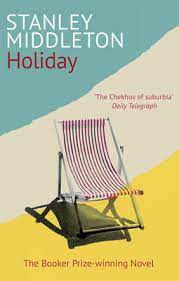
I am at a loss to explain why Holiday won the Booker Prize. As well as its fellow joint winner, Nadine Gordimer’s much more interesting The Conservationist, it was short-listed alongside novels by Kingsley Amis, Beryl Bainbridge and C.P. Snow. The cover of this edition quotes the Telegraph describing Middleton as “the Chekov of suburbia”, which is preposterous. Holiday is little more than an extended sketch showing how disappointing the English seaside can be, making this locked-down reader yearn all the more for a return to foreign holidays.
P.S. I don’t normally comment on the edition of the novel I am reviewing, which usually seems fairly irrelevant. But the quality of this Windmill edition was appalling. (Windmill appear to be an imprint of Penguin – why the need for the subsidiary I don’t know!) It was full of mistakes and littered with typos. I don’t faint at the site of an out of place apostrophe, but this was something else. It spoke of a carelessness and cheapness – did they employ a proof-reader or just use an automated transcription service of some kind to save costs? Either way it isn’t good enough.

