
A while back I wrote a blog post about the different ways one can read a book, trying to answer the question – what does it actually mean to say that you have read a novel? I found ten different flavours of reading, but I missed number 11- possibly the best way of reading a novel is to do so collectively. I don’t mean with other people in a book club (I suppose that would be number 12), where you get together at the end, admit you didn’t finish it, and then drink some wine. Nor do I mean a group reading in a big circle, taking turns (13). No, I am thinking of reading a novel at the same time as your friends, meeting them the next day, and comparing notes. That’s the way I first read The Lord of the Rings many years ago and I recall it as a special experience. My friends had spotted things I had missed, they had read chapters I was yet to reach, they interpreted events differently from one another, and of course we all made wild guesses about what was going to happen. We enthused about Tolkien’s world-building, his characterisation, his descriptive powers, moaned about his poetry, and disagree fiercely about things such as how irritating Tom Bombadil was. There was a freshness and authenticity to our reactions that was precious to me (see what I did there?)
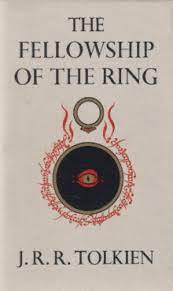
Chances are you are more familiar with the Peter Jackson films than the original Tolkien novels. The films are wonderful, respectful of their source material but at the same time making sensible changes so allow the films to run at a reasonable length. Certainly the film of Fellowship of the Ring is largely consistent with the novel, with the one significant change being the omission of any reference to the slightly creepy Tom Bombadil.
Lord of the Rings epic scale and themes ensure that it is often read as an allegory, but in the novel’s prologue Tolkien goes out of his way to dismiss the idea that it is anything other than a story. He specifically scotches the idea that the novel is about the Second World War, not least because it was conceived and largely written long before the war started.
A few things that struck me on this re-reading. First, it is quite striking just how often Gandalf goes missing. He flits in and out of the narrative time after time, usually for very long periods. He does exactly the same thing in The Hobbit of course, walking out on Bilbo and the dwarves just at the moment his presence is most needed, but here he is missing from the Shire while researching the origins of the ring for several years after Bilbo’s parting, missing again while the hobbits travel to Bree and beyond, only meeting up with them at Rivendell, then finally of course after that unfortunate incident with the Balrog in Moria.
The other thing that struck me, and this is probably because I have just finished re-reading the Harry Potter series, is how influential the Lord of the Rings seems to have been on J K Rowling. The Harry Potter novels borrow fairly relentlessly from a wide range of sources, and a series set in a school for wizards at first seems very dissimilar to an epic quest novel, but dig a bit deeper and the parallels begin to pile up. Dumbledore and Gandalf are almost interchangeable, the one ring seems a lot like Sauron’s one and only horcrux, Nazgul and Dementors look a lot alike, as do Dobby and Gollum.
In the unlikely event you are unfamiliar with the novel, Lord of the Rings is a three part quest novel set in a mythical Middle Earth peopled by Elves, dwarves, wizards, and halfling creatures of Tolkien’s own imagining, hobbits. It follows chronologically around sixty years after the events of The Hobbit. Bilbo has been enjoying the benefits of his comfortable wealth. He has never married, but he has adopted his nephew, Frodo, who now lives with him. On his 111th birthday he throws a party for the whole neighbourhood and announces he is leaving the Shire to go wandering. He leaves the invisibility ring to Frodo, completely unaware of the ring’s significance. Tolkien’s master-stroke is to take something that doesn’t play a major part in The Hobbit – it is a McGuffin to help Bilbo escape from Gollum and the goblin caves, but doesn’t play any significant role in the rest of teh story – and turn it into a powerful dark-magic object which can decide the fate of Middle Earth.
Gandalf eventually works out the ring’s significance, and tells Frodo he must take it away from the Shire. Gollum has revealed that the ring is in The Shire, being held by a hobbit named Baggins, and the Dark Lord Voldemort sorry Sauron has sent his Dementors sorry Nazgul to find it. Gandalf goes to consult the leader of his order, Saruman, leaving Frodo to set out in the company of his sidekick, friend and gardener Sam Gamgee, and his cousin Pippin Took. It is not long before they are intercepted by the Black Riders, but some passing Elves scare them off. Their journey is to be blessed with a series of such fortunate encounters. Meeting up with Merry Brandybuck they leave the Shire, taking a shortcut through the Old Forest, where they are again rescued, this time from the clutches of an aggressive Willow, by Tom Bombadil. In the net stage of their journey that get lost in a fog and caught by barrow-wights, but Tom is on hand to rescue them again.
In Bree they meet Strider who rescues them from the BlackRiders and takes them to Weathertop where they are again attacked by the persistent Black Riders. Although Frodo is wounded with a cursed blade, Strider fights off the Nazgûl, and after a series of close shaves which on the page aren’t repetitive but in summary certainly seem as such, they finally reach Rivendell, an elf-sanctuary and home of Elrond. Gandalf, having escaped the clutches of Saruman, is there to greet them. While Frodo recovers a Council is summoned to decide the fate of the Ring. We learn the history of Sauron and the Ring’s importance is confirmed. The Fellowship of the Ring is formed, nine walkers to mirror the nine Black Riders: Frodo, Sam, Merry, Pippin, Strider, now revealed as Aragorn, heir to the kingdom of Gondor, Gandalf, Gimli the Dwarf, Legolas the Elf, and Boromir, son of the Steward of Gondor.
This is an unusual quest – to destroy a found object, not to locate a treasure. Their first challenge is to cross the Misty Mountains. When they prove impassable they decide to go under the mountains, through the Mines of Moria. But these proves equally dangerous and orc-infested, with the added complication of a Balrog, a fire demon, which Gandalf tackles single-handedly. When I first read The Fellowship I was far less cynical than I am now – the usual rule of fiction, that unless you see someone die they aren’t dead, was not so well known in those days. Now I suspect few readers will think Gandalf is gone for good.
Next on the quest is a few days of refuge in the Elven forest of Lothlórien, where they meet the Lady Galadriel. Female characters in the trilogy are few and far between, but those who do appear are significant and powerful. Galadriel permits Frodo and Sam to look into her pensieve sorry fountain to see visions of the past, the present, and a possible future. They leave Lothlorien by river to the hills of Amon Hen. Here the Fellowship is sundered, setting in train the parallel storylines that are followed in the sequel, The Two Towers. It was a bold narrative choice Tolkien made here, having invested so much in creating the fellowship to then break it up before the quest is complete.
Tolkien’s absorption in his world is absolute, and this translates into a compellingly realistic fantasy (oxymoronic, I know) novel on the grandest of scales. His world-building is extraordinary. Some readers may not have the patience to invest so much time in the journey and I confess I often skipped the poems and songs that are such a persistent feature of the novel – does anyone enjoy these I wonder? Lord of the Rings came top of the poll conducted by the BBC in 2003 to find the UK’s most popular novel, helped I am sure by the popularity of Jackson’s trilogy of films. It requires a degree of commitment and the ability to suspend disbelief, but if you can get beyond those barriers Lord of the Rings deserves its place in that poll, and will leave you with memories of adventures in which the weak overcome evil, which after all is really all we ever want, isn’t it?

