
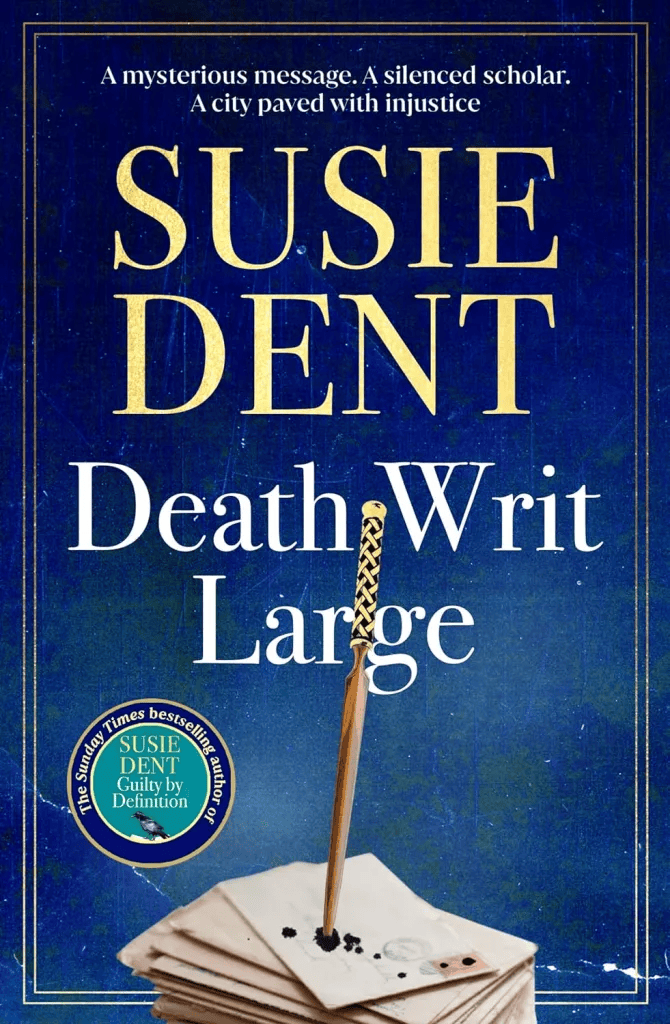
Death Writ Large by Susie Dent, 2026
For someone who is not that keen on the cosy crime genre I do seem to read quite a lot of it! Death Writ Large is the second book in the Clarendon Lexicographers series, in which a team of lexicographers based in Oxford work with the police to solve word-based murders.
You will not be surprised to hear that this is pretty formulaic stuff. The author has a template for her work and she sticks to it rigidly. Almost every page follows this pattern: description of Oxford landmark/scenery, reflected on with a somewhat wistful air by our chief lexicographer, Martha, or one of her colleagues; sweet treats and coffee are consumed and remarked upon (“Safi took a bite even before she sat down, giving a little groan of pleasure, as the fruity ganache spurted onto her fingers…”That is bloody lovely”); something pretty obvious is explained in detail to the reader in case they haven’t been paying attention (I particularly enjoyed the description of The Inklings which “counted among its members JRR Tolkien, whose Lord of the Rings trilogy had gone from literary success to cinematic juggernaut over the course of Martha’s childhood, as well as C S Lewis, creator of the world of Narnia” (Oh that JRR Tolkien and CS Lewis!) all culminating, inevitably, in a ‘dictionary corner’ explanation of the origin of some word or phrase used in the preceding paragraphs (“Martha looked across the view. The eye of the wind she thought; the literal meaning of ‘window’, a legacy of the Vikings.”) (To be honest I was surprised Dent was able to use the word ‘juggernaut’ in the previous sentence without mentioning its Indian origins – I think I detect an editor at work going “enough with the bloody definitions!”). And repeat. By the way, I think the fruity ganache spurting away was not intentionally smutty, but I could be wrong!
The mystery in this novel is straightforward enough. Dictionary editor Martha Thornhill and her team get involved in another mystery when university lecturer Spenser Lewis is found dead at the foot of a locked church tower. The crime scene is marked by cryptic, runic graffiti that the investigating officer, DI Oliver Caldwell realises only a linguist can decode. Luckily, he knows just the right person to help and coincidentally she is right there on the scene just when needed. Martha identifies the letters as a fictional runic alphabet created by a late fantasy author, Jerome Naylor. (We are never told more about this fictional language, which was fine to be honest). The killer is targeting “the Cabal,” an arrogant, privileged circle of former students. The coded messages, easily translated by the lexicographers, reveal that someone is trying to persuade the cabal to confess to an unspecified crime and threatening them with violence if they refuse to do so. Working alongside DI Caldwell, Martha uses her lexicographical expertise to trace the roots of the killer’s fury to an arson attack, culminating in (you guessed it) racing against time to decipher the final linguistic clues before the vengeful murderer wipes out the remaining members of the Cabal.
If I had my time again I would definitely try to be a lexicographer, because their workload is laughably light – they can take weeks off to investigate these crimes with no apparent concern for their output or anything as sordid as a target or deadline. They are given privileged access to crime scenes by the mildly amorous leading detective and his sidekick sergeant who does most of the real work. They ‘work’ in luxurious surroundings in Oxford, flirt with police officers, speak at conferences and all in all have a grand old time.
There are some problems with Death Writ Large, apart from the ‘not quite right’ title (Death is not written large other than perhaps the encoded runic graffiti). My main concern is why, if you want the Cabal to confess to a crime committed ten years ago, would you send messages to them in coded writing written on and in public buildings? Why encode the messages? There’s no reason to – just say ‘I know what you did”. Using Naylor’s invented language and some clumsy anagrams doesn’t do anything other than narrow the pool of suspects pretty dramatically. It’s not like only the Cabal will be able to understand the messages – and even if that were the case, why display them publicly? And when they refuse to confess, why then start killing them? Even the revenger logic breaks down when it is revealed that the mysterious source of the messages did not kill Lewis – it was one of his fellow Cabal members (which one is never fully confirmed – they get away with murder, which is largely passed over in the narrative). Overall it is best if you just go with the flow and don’t really engage with the puzzles you are being presented with and just accept that despite the clever bad people doing bad things, the clever good people will eventually overcome.
There is a strong hint of The Secret History about the central plot of Death Writ Large – the dark secrets of a crime committed by a tightly-knit group of students at university years earlier slowly unravel. When the killer/message sender is eventually revealed the solution is disappointingly unlikely, their motivations being mainly reduced to them being a bit unbalanced. This will sell well, but be read, forgotten and donated to charity before the Christmas decorations are down.

