
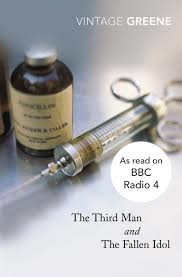
The Third Man, by Graham Greene, 1949
I’ve read plenty of novels that have been turned into films and I have even read one or two novelisations, but this is a one-off: Greene was commissioned to write a screenplay and given a location in which it should be set, but before writing the script he wrote the novel on which the screenplay was going to be based. It is almost as if he couldn’t cut out this initial part of the process. In the preface to the novel he explains:
“‘The Third Man’ was never written to be read….To me it is almost impossible to write a film play without first writing a story.”
That didn’t prevent him agreeing to the publication of the novel of course!
Does this mean that this novel is a draft, or in some way something less than Greene’s other novels? Perhaps, but if you hadn’t read the preface you would not have known that it wasn’t a stand-alone novel: it is complete in itself with no threads being left loose or other signs of incompletion if that is a word.
The novel is narrated by Colonel Calloway, an English policeman in the occupied city of Vienna, in 1949. After the war Vienna was divided into zones and controlled by four countries – Russia, France, the USA and the UK, with a central zone controlled in turns by each of the four. This unsettling structure reminded me of the parallel cities that China Meiville created in ‘The City and the City‘. Crime and racketeering is widespread, with shortages of basic supplies making essentials such as penicillin highly profitable. Rollo Martins, a womanising author of pulp westerns, comes to Vienna to meet his old school friend, Harry Lime, only to be told that Lime has died in a car crash a few days earlier. Calloway tries to tell Martins that Lime was involved in racketeering, but he doesn’t want to hear, and decides to investigate Lime’s death. Interviewing some of the witnesses to the ‘car crash’ he discovers that a mysterious third man was present when Lime died.
This is an extraordinarily atmospheric book, suffused with images of post-war Vienna, a wreck of its former self as capital of the Austro-Hungarian empire. Suspicion and paranoia are a feature of every encounter, every relationship in this divided city. The mysterious figure of Harry Lime, played so memorably in the film by Orson Welles, looms over all of the characters. Identity is a fluid concept in this city, with many of the characters having more than one. Anna Schmidt, Lime’s girlfriend, “claims to be Austrian, but I suspect she’s Hungarian…she calls herself Schmidt”. Martins is mistaken for a visiting author, Benjamin Dexter, and goes along with the mistake to the extent of attending a farcical question and answer session about ‘his’ works with an enthusiastic audience, who also confuse his admiration of fellow western author Zane Grey with eighteenth century poet Thomas Gray. Dr Winkler, part of Lime’s gang, is addressed mischievously by Martins as ‘Winkle’ (ironically becoming Winkel in the film version). Colonel Calloway is frequently referred to as Callaghan by Martins. In chapter 3, ostensibly being narrated by Calloway, Martins begins to doze off, and the narration is resumed by someone a lot more omniscient than Calloway, using the name Callaghan in a stream of consciousness portrayal of Martins’ thoughts as he reflects on the day’s events.
I enjoyed ‘The Third Man‘. It is a bit of a curiosity – a non-screenplay – but it works as a novel, with the short length making Green pack lots of detail onto every page. I just need to find a copy of the film now…

