
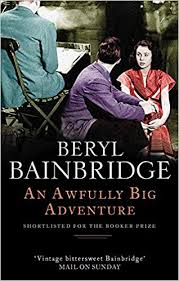
An Awfully Big Adventure represents three firsts for me – it is the first Beryl Bainbridge novel I have read; this is the first deliberately spoiler-free review I have written; and never before have I finished a novel and immediately gone back to the beginning and started again. I suspect from the way the novel is so cleverly constructed Bainbridge may have intended this to happen. What I do know is that it is wonderful, even with the one big issue which I have with the novel, which I will come to in a minute.
In 1950’s Liverpool, naïve but independently minded 16 year old Stella joins a theatre company as an unpaid assistant stage manager. The theatre folk are all larger than life, and Stella is swept away by the glamour of it all – for her it is indeed an awfully big adventure. Stella was described in one review as “a human catalyst who wills nothing evil, but whose character and history have shaped her to cause trouble.” Certainly she is the still centre of all the incident in the novel, an “intricate piece of emotional clockwork. Stella herself is the escapement by way of which, tick after tick, it unwinds.”
This novel was published before the Bad Sex in Fiction awards started in 1993. I’ve never been sure if these awards are for descriptions of bad sex, or for bad descriptions of sex, (or both) but the difference is a fine one. In this novel these are undoubtedly the former – there is no question the author knows what she is doing. Stella certainly has some unfortunate encounters, most of which seem to happen to her incidentally, catching her unawares. Today we would see these as sex assaults, but Stella is shown as having a more phlegmatic attitude towards them, seeing them as part of her ‘big adventure’. I am spoilt for choice for quotes, but this might be the most gruesome. Stella has been taken to the cinema by a reporter, who without warning has grabbed her hand and put it in his crotch, covering himself with his hat. After some moments….
“The reporter removed his hat and shoved a handkerchief at her. She wondered whether she had been sniffing; it was true she had the beginnings of a cold. Suddenly he let out a huge sigh, as though the air was being forced out of him. He seemed to grow smaller; certainly his thingumajig shrank. Almost at once he fell into a doze. She was left holding a jelly baby of shrivelled skin, her fingers glued together, webbed by a sticky emission.”
Eww.
I can’t recall ever having read a novel with what almost amounts to an obsession with motifs. Once you notice them they are everywhere. Flowers are strewn across almost every page, and it would take a PhD’s worth of time to work out why. Stairs feature at key points throughout the novel, suggesting I suppose that the novel is set in a time of significant transitional change for the characters and the country. Smells appear time and time again at key points; there are several sudden deaths; telephones play a key role, and there are more than one point at which letters go astray or are intercepted, suggestive of the lack of communication between the characters. Alcohol is disguised at several points; even skin diseases have their own understated but undeniable motif! This all amounts to an extraordinary level of skill by the author in the construction of this novel.
The comedy here is golden. Deadpan lines of dialogue, which I read in my head in the voice of Alan Bennett, include:
“It was inconvenient, Stella coming home and wanting a bath. As Uncle Vernon pointed out, it was only Wednesday.”
“Stella lounged against a cocktail cabinet whose glass frontage was engraved with the outline of a naked woman. I’m not going to be cowed, she thought. Not by nipples.”
“She was the sort of girl who, if there had been a meadow handy, would have been out there in a flash, picking cowslips”.
As an evocation of 1950’s post war Britain, still bearing the scars of the war, with its rationing, skin diseases and howling poverty, there is no finer portrait. I suspect the portrayal of the semi-amateur theatre group, with all its fractured relationships and off-stage drama, is almost certainly also accurate – Bainbridge suggested strongly that this novel was at least semi-autobiographical.
I haven’t touched upon another element which I hugely admired in this novel, which is the deft control with which Bainbridge controls her plot. All through the novel the point of view subtly shifts between characters, revealing only just enough for the reader to understand the overall direction of the plot, (and certainly more than poor Stella who never quite works out that her beloved Meredith is gay). But it is only on a re-read that some of this detail comes to light – we now understand references to nightlights for example, or why Stella is always looking for chances to use the phone. I also thought the portrait of Stella’s relationship with her Uncle Vernon was particularly touching – he all post-war inarticulate male, full of paternal feelings towards her but afraid to show any vulnerability at all, and she a typical teenager screamingly embarrassed at the existence of her step-parents.
I mentioned earlier that I had only one reservation about the novel. It deploys a plot device which I am not going to describe because I promised a spoiler-free review, but it is one I have complained about on many occasions, and is used as a ‘get out of jail-card’ by some novelists as a way of wrapping things up. I can see why Bainbridge used it here, but I think she could have managed things in this one particular aspect of the novel better. Apologies if that is a bit opaque.
‘An Awfully Big Adventure‘ was shortlisted for the 1990 Booker Prize. My initial reaction when reading that was that Bainbridge was robbed, but the eventual winner was A. S. Byatt’s ‘Possession’, which is a wonderful novel as well, even if I recall thinking a that time that it was a consciously more commercial than her previous work. So perhaps it was just bad luck that led to Bainbridge becoming the eternal Booker bridesmaid. Without doubt this is an accomplished, enjoyable and superbly clever novel, and I look forward to exploring more of her work.


Pingback: Winding Up the Week #37 – Book Jotter
Pingback: Book review: Possession, by A S Byatt, 1990 | The Reading Bug