
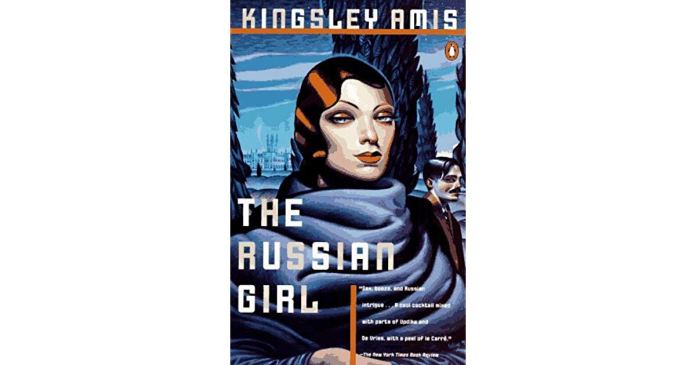
 This is late Amis: The Russian Girl was published in 1992, just three years before his death. Amis is one of those novelists who essentially wrote the same novel over and over again, with slight changes of character and the setting thinly disguised. But this novel was an exception to that rule – instead of the older cast of characters bickering, having tired affairs and drinking themselves to death, The Russian Girl’s central character, Dr Richard Vaisey, is in his forties, and vaguely behaves like it. His inevitable love interest, Anna Danilova, the titular Russian girl, is in her twenties. An older academic having an affair with an exotic Russian girl (note girl, not woman; Amis was never going be that up to date) – what an original plot? But the scenario isn’t what redeems this novel.
Novelists of Amis’s generation/period like to engineer moral dilemmas to provide the characters something to discuss and agonise over. This is an issues novel, not one dominated by things happening (when finally things do start to happen the novel suddenly becomes a lot more interesting). The moral dilemma Vaisey faces in The Russian Girl is what we would today call a first world problem (and in less enlightened times “not a problem at all”) although I am pretty sure the phrase had not been coined at the time. He has been asked to sign a petition calling for the release from Russian prison of Anna’s brother, a petty criminal. For reasons not fully explored the petitioners believe that the Russian authorities will listen to a group of English academics, artists and expatriates. The political and historic context – Russia is in turmoil as it transitions from Communist to a free market economy and all the other countries forming the USSR break away – is touched on but not explored in any detail. But here’s the quandary – the petition asks for Danilova’s release not because he is innocent, but because his sister is a celebrated poet. Of course that would be something the prison authorities in Russia would take seriously – don’t mess with the poets. But Vaisey thinks Anna is a lousy poet. How can he sign a petition that says otherwise? What would that do to his reputation as a writer on Russian literature? And if he tells Anna she is a terrible poet, will she still have an affair with him? Problems, problems.
Clearly that issue is a flimsy basis around which to construct a novel of almost 300 pages. Unoriginal central characters, an obvious plot, and an uninteresting moral issue at stake: what is it that made this novel much more interesting than I expected it to be?
The portrait of Cordelia, Vaisey’s appalling wife, certainly helped. She is a complete monster. Their relationship is a classic Amis marriage – superficially happy but underneath in a state of almost constant hostility:
“It had occurred to him then or later that at times of such intimacy couples were supposed to tell each other important things, quite likely not in so many words. He was not sure but he could not remember that happening between himself and Cordelia. In fact what he could remember quite clearly at the moment was reading of a wartime Resistance chief in German-occupied France and the local Gestapo commandant who, finding they shared a love of Mozart’s operas, had met periodically to play the gramophone records under a mutual guarantee of safe conduct that was never broken. Richard had before now seen something in that story that reminded him of his relations with Cordelia.”
When you find yourself comparing your wife to a wartime Gestapo chief, you should be able to work out that your marriage is in trouble. When Vaisey finally decides to leave her (and her money) for his terrible but sexy poet, she unleashes a furious revenge upon him, having him arrested, unscrewing a wheel on his car, emptying his bank account and destroying the book he is writing.
The other thing the paragraph above illustrates is the unavoidable fact that Amis could construct a sentence. His distinctive manner of making sentences awkward to read to force the reader to pause and reread remains a feature of his writing, but it didn’t irritate me as much as it usually does – it was less intrusive. Perhaps I have just got used to it. The novel also has an excellent portrait of a scene of drunkenness written from the perspective of the drunk. One of the funniest scenes in Lucky Jim forty years earlier is where Jim Dixon is recovering from a hangover – Amis returns to this theme almost nostalgically with a well-written first person description of Vaisey descending into afternoon drunkenness and incoherence.
If you like Kingsley Amis you will probably enjoy this novel – it is one of his better works even if not well known. He is definitely an acquired taste, and many readers will find him irritating. But the author of Lucky Jim retains the benefit of the doubt for me despite the many misfires in previous years.
P.S. If you are interested in some other reviews of this novel try this from the New York Times, which includes a hilarious American take on Amis’s vernacular (Call me a sucker for an English accent, but these shiny coinages are just bliss: “As far as I’m concerned, poetry packed up in 1928 when Hardy dropped off the twig.” “As for stick-in-the-muds, I’ve got a bit of a special thing about them. They make such a lovely plopping noise when you winkle them out.” There’s something irresistible about all this, even when you haven’t the foggiest notion of what they’re talking about: “He’s dead chuffed,” “Bob’s your uncle,” “It made Richard feel quite important and rather unreal and also a bit of a prat.” It really makes you wish that “bugger” were an American term. It’s such a useful word.) or thisfrom the late, great Christopher Hitchens in the London review of Books. Both reviewers are big fans of Amis and very respectful of his work, which makes a change.

