
There’s an immense power to DBC Pierre’s 2003 Booker Prize-winning Vernon God Little which with its troubled and intense fifteen year-old narrator has unavoidable echoes of Salinger’s The Catcher in the Rye. In style the novel owes an obvious debt to the energetic first-person participatory traditions of Gonzo journalism.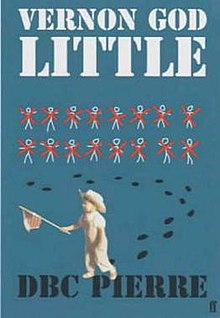
Any summary of the novel will smooth out the wrinkles in the plot and present it as a coherent narrative, one in which the reader knows what is happening at all points and in which the dots are joined up. People’s motivations are explained and secrets and lies are laid bare. Of course the reading experience is very different from that – Vernon is not interested in carefully explaining to us ‘what happened’. Instead he breathlessly tells us what ‘is happening’, as well as articulating his feelings about his experiences. This gives the novel an immediacy but also challenges the reader to construct a coherent whole out of what we are told. Sufficient information is provided to be able to piece things together, but we have to do a lot of the heavy lifting.
There has been a school shooting at Vernon’s school in Martirio, the ‘barbecue sauce capital of America’ in Central Texas. The killer is his friend Jesus, a Mexican student who was mercilessly bullied by the other students. Vernon was not involved in – in fact tried to prevent – the shooting, but he nevertheless is suspected by the local police. Vernon’s alibi – that he was running an errand for a teacher – is hard to prove as the teacher is in hospital, a victim of the attack. Things take a turn for the worse for Vernon when he meets Eulalio Ledesma, probably the most groteque monster of the many in the novel. Ledesma claims to be a reporter, and worms his way into the affections of Vernon’s single mother, promising to help Vernon tell his side of the story. But the chance of a sensational story is too good to miss, and Ledesma runs a story naming Vernon as a participant in the killings. Vernon is arrested and at his bail hearing the court orders a psychiatric assessment.
Vernon realises there is going to be no justice for him in Martirio, so he begins to make plans to abscond to Mexico, eventually rustling up sufficient funds to pay for the trip by blackmailing a local paedophile. This scene is essentially one of several bad taste jokes that have not aged well. Vernon’s journey to Mexico becomes a conventional road-trip across the South, which ends in disaster when he is tricked in a ‘honey-pot’ trap into confessing to involvement in the school shootings. He is dragged back to Texas for a show trial where he is convicted and sentenced to death. Ledesma’s influence has spread on the back of his coverage of Vernon’s story, and he is now able to organise televised executions as part of a reality show where people vote on which convict they want to see executed. Big Brother, just at that point taking off in the US, is referenced. Most of the novel to this point has been relatively realist, albeit with an absurdist element to many events, but this departure into dystopian satire might be perceived as unrealistic – but the pace of the novel at this point is such that for me Pierre gets away with it.
The climax to the novel is wonderfully contrived and enormously satisfying.
Pierre’s descriptive writing is intense, using imagery that only indirectly references its subject, as well as a lot of slang and a fair share of profanity. Combined the effect is often poetic and very effective:
Outside, a jungle of clouds has grown over the sun. They kindle the whiff of damp dog that always blows around here before a storm, burping lightning without a sound.
The angst of being a teenage boy in America is captured brilliantly. Vernon is constantly both aroused and confused, particularly by his sense of smell:
When the rubbing of her thighs has faded, I crane my nostrils for any vague comfort; a whiff of warm toast, a spearmint breath. But all I whiff, over the sweat and the barbecue sauce, is school—the kind of pulse bullyboys give off when they spot a quiet one, a wordsmith, in a corner. The scent of lumber being cut for a fucken cross.
It is strange that a novel which revolves around a school shooting, sadly now such a commonplace event in the USA, can be so joyful. It helps that there are plenty of really good jokes. At one point Vernon is promised help by a reporter:
“We could turn your situation around three hundred and sixty degrees…”
His response is to the point:
“Learn some fucken math.”
Later when Vernon is on Death Row, his mother tries to commit suicide:
“Mom closed up the house one day, turned the oven on full, and sat by its open door. Apparently, it’s still a Cry For Help, even though our oven’s electric.”
The novel’s satirical intent consistently hits its target. Consumerism in American society is mercilessly mocked. The tragedy of the school shooting is a business opportunity grasped by many in the town of Martirio. The poisonous Ledesma builds a media business out of it. Several of the women in town want to use the media focus on the shootings and Vernon’s trial to launch their own media careers. Even local children sell t-shirts darkly joking about the tragedy:
The Lozano boys are out hawking T-shirts on the corner of Liberty Drive. One design has ‘I survived Martirio’ splattered across it in red. Another has holes ripped through it, and says: ‘I went to Martirio and all I got was this lousy exit wound.’ Preacher Gibbons tuts, and shakes his head.
The local vicar is shocked, not by their tastelessness, but by the prices they are asking:
‘Twenty dollars,’ he says. ‘Twenty dollars for a simple cotton T-shirt.’
Vernon God Little stands out as one of the more unlikely Booker winners of recent years, a brave choice in a year when Brick Lane, Notes on a Scandal and Oryx and Crake were all on the short-list. For once I think the Booker judges called it right.


Great review – I haven’t read Vernon God Little but have always been intrigued by the story. It’s interesting to hear that some of the jokes haven’t aged well, I expect that might be the case with a lot of novels written around this time
LikeLiked by 1 person
Thanks for the comment. VGL is definitely worth a read – it’s a bit dark but the ending is great.
LikeLike
Loved this book! It is free-flowing and unusual like DBC Pierre himself 🙂
LikeLiked by 1 person