
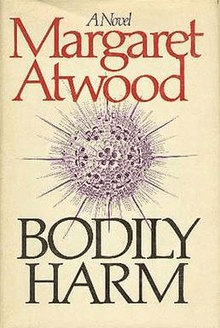
Bodily Harm felt strangely familiar: the premise of the novel echoed strongly with me, but I am struggling to pin down from where. In the novel Rennie Wilford, a Canadian ‘lifestyle writer and journalist’, suffers an upsetting relationship breakdown following surgery for breast cancer. In an attempt to escape she engineers an opportunity to travel to the small Caribbean island nation of St. Antoine to write a travel/holiday piece. Here she finds the island uncomfortable and alien, but slowly becomes embroiled in the febrile local politics. An attempted coup or insurrection goes badly wrong, and Rennie is caught up in the aftermath.
Frustratingly I can’t identify what book or books this reminds me of. It is possible that the cumulative effect of so many tropes is what is causing this ‘deja lire’ phenomenon.
The contrast between Rennie’s life in Toronto and her experience on the islands is striking. At home she was originally a political journalist specializing in unspecified ‘abuses’ but now writes about ‘lifestyles’:
“You write about something until people become tired of reading about it or you become tired of writing about it, and if you’re good or lucky enough it’s the same thing. Then you write about something else.”
Rennie lives with Jake, an unpleasant sexually aggressive and frankly abusive young man. He has a vacuous job as a label designer
“not just labels but the total package: the label, the container, the visuals for advertising. He was a packager. He decided how things would look and what contexts they would be placed in, which meant what people would feel about them”,
Canadian culture is portrayed as synthetic and superficial, and Rennie is profoundly unhappy without really realising it. Her breast cancer diagnosis brings this unhappiness to the fore, and shortly after Jake moves out Rennie comes home one day to find two policemen waiting for her, inspecting a sinister coil of rope left on her bed by an intruder. This is the catalyst for her getting out of Toronto, albeit temporarily. The Caribbean island state of St. Antoine is undeveloped and unwelcoming, and Rennie never takes her purported mission, to write a travel piece about the island, very seriously. She meets a number of ex-patriates including Paul, a drug smuggler who may or may not also work for the CIA and Lora, a fellow Canadian who has ended up in St Antoine with no real idea as to why. She also meets some locals including Dr. Minnow who is a candidate in St. Antoine’s elections, the first since independence from the British. What starts as a travelogue degenerates into a nightmarish experience as St. Antoine’s political factions go to war, and outsiders are all suspects.
Bodily Harm is not a comfortable read. St Antoine becomes a metaphor for Rennie herself, almost as if her vacation is a dream in which her various traumas are worked through and the characters represent aspects of her life back in Toronto. Her cancer is echoed in the rottenness of the island’s political corruption; the sado-masochism of her relationship with Jake is paralleled in the violence she encounters, and the novel’s conclusion in which she is imprisoned while her involvement with the island’s insurrectionists is investigated is (arguably) a metaphorical representation of her illness and slow recovery. Read this way Bodily Harm is a disquieting portrait of contemporary life rather than the superficial story of a journalist taking a vacation in the Caribbean that it initially promises to be.
Bodily Harm was the novel Atwood wrote immediately before The Handmaid’s Tale which was published four years later. Atwood is not a genre writer, and all of her novels that I have read thus far are significantly different, so it is difficult to find any trace of Handmaid’s in this novel. Having said that the theme of sexual violence being part of everyday life for women does indicate the lines the author was thinking on at the time and which were much more fully developed in the later novel.


I read this book in the 80s and had forgotten it. Thanks for the recap. I don’t recall loving or hating it but never felt compelled to read another book by Atwood. In her defense, however, I read mostly non-fiction.
LikeLiked by 1 person