
Hurry on Down by John Wain, 1953
I first read John Wain’s Hurry on Down in the early 1980’s, in a rather ragged Penguin edition that I still have. It left a very distinct impression and unlike many of the novels I have read over the years I vividly remember the plot, the set piece scenes and the extended cast of eccentric characters, such as Froulish, the undergraduate who establishes himself as a ‘character’ at the university by “carrying a grey parrot in a cage wherever he went, wearing a bowler hat indoors, standing motionless for hours on end in the exact centre of the quadrangle” (As a side observation, the idea that wearing a hat indoors, albeit a bowler, is on a level with carrying a parrot around everywhere, shows how radically social mores and conventions have changed since the 1950’s.)
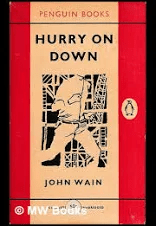
When first published in 1953 the novel was widely seen as culturally significant. It marked a change in style from the traditional narrative, often about middle class characters to something much looser, unstructured, even chaotic, but with a lot to say about the world. Even as late as the 1980’s Hurry on Down was still perceived as an important book, a milestone in the development of the post-War phenomenon labelled as the Movement, associated with writers such as Kingsley Amis (Lucky Jim, which shares a lot of its DNA with Hurry on Down) and John Osborne (Look Back in Anger, whose Jimmy Porter often sounds a lot like Charles Lumley, Hurry on Down‘s protagonist). Now it is almost completely forgotten. It has no separate Wikipedia entry and only 33 reviews on Goodreads (for comparison, Russell Brand’s self-consciously infantile ‘My Booky Wook’ has over 1600 reviews!).
So what happens, and more importantly, why does it matter? Charles Lumley has just graduated and is taking time to consider his next steps in the world. His family want him to get a job, his girlfriend expects him to marry her, the wider society has expectations about his future. He is even being cross-examined by his landlady as the novel opens. But Charles has no idea what he wants to do. So he rebels, breaks contact with his family and fiance, and rejects the idea of a white collar job, a mortgage and children. Instead he essentially runs away. Initially he makes money to survive by cleaning windows and lives in a dilapidated loft with an former university acquaintance, the afore-mentioned Froulish, an eccentric novelist, and his girlfriend, Betty. Betty supports their bohemian lifestyle with income from a ‘family member’ – but Charles soon finds out she is actually taking money from a lover and is essentially working as a prostitute.
From here Charles spirals downward, taking a breathless series of increasingly menial jobs. In a bar he sees a very attractive young woman, June, and becomes obsessed with her. He accepts a role in a criminal gang smuggling drugs simply so he can have enough money to approach June. Eventually they become lovers, but this doesn’t last long as the gang is exposed. Charles escapes capture because he is in a serious car accident. While recuperating he is informed that June is being kept by her much older ‘sugar daddy’ who poses as her uncle. His world collapses and when he is finally recovered from the accident he starts again with another series of menial jobs – hospital porter, chauffeur and night club bouncer. The novel ends on a cynical note suggesting that Charles was never going to be able to escape the expectations of society, and that surrendering to them might even be the best approach.
Published only eight years after the end of the second world war, the shadow of the war is rarely mentioned, but is there in the fabric of the society Charles tries to escape from. Too young to have served, Charles would still have had to do national service, despite going to university – this is not mentioned. Nor is rationing which was just ending, nor any other impact of the war, even though most older men he meets would have served in one form or another.
Wain was not just a picaresque author writing a series of loosely connected sketches about the world of work, and what it was like to be an aimless young man in the 1950’s. His writing is memorably impressive: “It was heavy and thundery outside; early August and beginning to get that washed-out feeling of high summer, when the freshness has gone from the leaves. Not that there were any leaves in the streets where he was walking, but outside, in the country, the leaves were drying slowly, and they had whispered their message to be heard in the backyards within the smoke-ring of the city.
Elsewhere: “He tried a pub near the hospital, but it was dirty and lonely. A few old men sat staring with red-rimmed eyes into their pints, making the beer look like tears they had dripped into their glasses and were saving for some purpose.”
It would be easy to read too much into Lumley’s rejection of the status quo. He is not a revolutionary, and the novel’s ending suggest that all his attempts to escape from the straightjacket of society have been futile.
‘He thought, as he leaned on the parapet of the town’s bridge and watched the tiny brown river drifting beneath it, of all the expensive young men of the thirties who had made, or wished to make, or talked of making, a gesture somewhat similar to his own, turning their backs on the setting that had pampered them; and how they had all failed from the start because their rejection was moved by the desire to enter, and be at one with, a vaguely conceived People, whose minds and lives they could not even begin to imagine, and who would, in any case, had they ever arrived, have made their lives hell. At least, Charles thought with a sense of self-congratulation, he had always been right about them, right to despise them for their idiotic attempt to look through two telescopes at the same time; one fashioned through German psychology and pointed at themselves, the other of Russian economics and directed at the English working class.’
If Hurry on Down was a television programme shown today it would be prefaced with one of those warnings about old-fashioned attitudes that were common in the time the book is set. There is an ugly scene at a party where Charles meets a gay young man who takes a fancy to him and won’t take no for an answer – “a young man in grey suede shoes; Charles caught sight of those shoes and decided that he now knew all he wished to know about one guest at least”. This was at a time when homosexuality was still a criminal offence and social signals such as suede shoes were used as a shorthand for sexual identity. Charles is quite comfortable about threatening violence against this persistent but otherwise inoffensive young man who is interrupting his efforts to talk to June. Later there is an example of the casual use of the n-word. This is used to criticise the imperialist mindset of some unpleasant rugby players he meets at another party: “I don’t want your silly Edwardian notions of an upper-class Herrenvolk thrown up at me either. By ‘letting the side down’ all you mean is that the n-driving sahib oughtn’t to do anything that reveals that he shares a common humanity with the n-s he drives. That idea’s dead everywhere in practice, and it only survives in theory in the minds of people like you” “God!” said Burge, in tones of sincere and utter loathing, “You’re talking just like a bloody Socialist.”
I wasn’t sure if Hurry on Down would be worth re-reading. Many novels age badly, and what was at the time ground-breaking experimentalism appears crass and clumsy. The fact that this novel is now largely forgotten (it doesn’t have its own Wikipedia entry!) would suggest I am in a minority on this but I think it stands up well to the passage of time. It is obviously of its era, but it’s an enjoyable read, the narrative structure works well and progresses the story forward at a fair pace. The improbable coincidences in which Charles always bumps into a former colleague to offer him his next job are forgivable and even become an in-joke which we know is coming. There is much to dislike about Charles – he is pretty amoral – but the point of view narration encourages the reader to see his point of view above others and to accept his rationalisations. Hurry on Down is worth rediscovering.


I must have read “Hurry on Down” around the time you did. I must see if I can still find my copy, I’d like to read it again – thanks for reminding me!
LikeLiked by 1 person
Would be interested in your thoughts as to why this novel seems to have faded from the cultural landscape so markedly.
LikeLiked by 1 person
I found my copy while I was looking for something else! It’s 3rd or 4th on my “to be read” list, but I’ll let you know when I’ve finished it.
LikeLiked by 1 person
Now that I’ve re-read “Hurry on Down”, I’m afraid I can’t be as positive about it as you. I have no memory at all of having read it before, so presumably it didn’t make much of an impression on me the first time.
It’s true that the story moves rapidly and keeps you reading, but at the end I was left with a feeling of “so what?”. Wain has a talent for writing about bizarrely unsympathetic characters (including Charles, protagonist), but not for making them interesting. And, unlike you, I cannot forgive the multiple improbable coincidences which suggest that England is such a tiny country that you keep bumping into people you’ve met before.
If the point of this novel is to make some deeper philosophical or social point, then I’m afraid I missed it. But I do think a good novel should at least leave the impression that that is what it is trying to do.
LikeLike