
“I first heard Personville called Poisonville by a red-haired mucker named Hickey Dewey in the Big Ship in Butte. He also called his shirt a shoit. I didn’t think anything of what he had done to the city’s name. Later I heard men who could manage their r’s give it the same pronunciation. I still didn’t see anything in it but the meaningless sort of humor that used to make richardsnary the thieves’ word for dictionary. A few years later I went to Personville and learned better.”
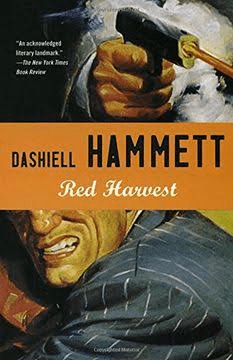
The first person narrator of Dashiell Hammett‘s Red Harvest, known only as ‘the Continental Op’ is called to Personville (known as “Poisonville” by the locals) a Californian mining town, by newspaper publisher Donald Willsson to help fight corruption in the town. Willsson is gunned down before The Op has a chance to meet him, establishing an early pattern of violence and murder that continues throughout the novel. The ‘red harvest’ of the novel’s title refers simply to the carnage which ensues, a vicious cycle of revenge murders, which even The Op loses track of eventually.
Personville/Poisonville is run by a number of violent gangs. The police and the civic authorities – the Mayor, City Councillors, etc – are all implicated in the various criminal enterprises the gangs run, not least of which is bootlegging (prohibition was a gift to the criminal fraternity). The Op has to decide early on his investigation whether he is going to abandon things – his client is dead, after all – and head back to San Francisco, or get his hands dirty and try to break up the gangs. He chooses option two, and realises that the only way he is going to achieve this is if he plays the gangs off against one another. This is a dangerous, high stakes game, with the prospect of little reward at the end of it other than a bullet. But The Op is stubborn and not scared of a gunfight or two.
He starts by meeting the dead man’s father, Elihu Willsson, an industrialist who originally ran the whole town, but has now lost control to the gangs he brought in to help run the city. The Op identifies Donald’s murderer as someone who is not a gang member at all, but a bank clerk. This establishes another pattern – each murder is committed by someone other than the obvious suspect. But by now the war has started and the bloodshed is not going to stop. The large cast of characters passes by with blistering speed and it can be hard for the reader to keep up with who is blackmailing who, who is double-crossing who, and so on. The gangsters are particularly bloodythirsty and vengeful – after The Op organises a ‘peace conference’, ostensibly to halt the slide into all out war, if anything the pace of the killings accelerates.
The Op manipulates all of the warring parties, feeding them information, sometimes false, sometimes not, to keep the antagonism at fever pitch. The outcome is, inevitably, a blood bath, from which The Op manages somehow to escape with his life despite being in the middle of several shootouts. Soon everyone who has played a part in the criminality of the town is dead. Poisonville might revert back to illegality and war in a few years, but for now the poison has been flushed out.
Reading Red Harvest I kept being struck, time after time, how similar the novel was to those of Raymond Chandler. Chandler took the template developed by Hammett and improved it significantly, to the extent that Red Harvest at times reads like a rough draft of a Chandler novel. Individual scenes such as a trip out of town to a shack used as a safe house by one of the gangs, a drunken dream ended by waking up to find a corpse spread-eagled on the floor, the client who wants to back out of the deal but can’t – every scene and every plot device has its later parallel in Chandler. Hammett’s sparse prose style, his plot structures, stock characters and just about every other element of the novel is echoed time and again. At times the slang tips over the edge into being unintelligible. See if you can work out what this means:
“somebody dynamited the floor out of the can. I dropped through the hole with the rest of them. There was some mugs standing off the bulls. I made the back-trotters with one bunch. Then we split, and I was figuring on cutting over and making the hills.”
There is no doubt that Chandler improved on his source material – Red Harvest is repetitive, and all problems are resolved in the same violent way. The secondary characters are two-dimensional and one could be forgiven for confusing Gangster A with Gangster B, C or D. The OP has some good lines – “The chief winked at me, an athletic wink in which all his facial muscles took part” – but he’s no Philip Marlowe. To be fair, Red Harvest was Hammett’s first novel, originally published in four instalments in a pulp magazine, Black Mask, so I shouldn’t expect too much in the way of literary flair, but enough of the bones are there to show that Hammett was to go on to become a great writer.


Interesting choice to read this – was there a particular reason? I think sometimes it is fun to read an authors first work to see what they learned between this and their later pieces.
LikeLike
I’ve always been a massive Chandler fan, and I know Hammett was a big influence on him, so this was an obvious choice for me. There’s a famous quote from Chandler about Hammett: ““Hammett gave murder back to the kind of people that commit it for reasons, not just to provide a corpse; and with the means at hand, not hand-wrought duelling pistols, curare and tropical fish. He took murder out of the Venetian vase and dropped it into the alley”
LikeLiked by 1 person
That is a wonderful quote.
LikeLiked by 1 person