Book review

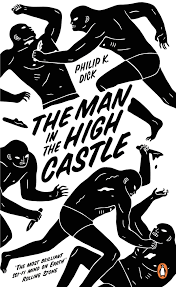
The Man in the High Castle, by Philip K Dick, 1962

The Man in the High Castle is an alternate history novel. Although the author Philip K. Dick is best known as a writer of science fiction, and despite the setting, the novel isDick 2 realistic in tone, and contains very few sci-fi elements. The scenario of the novel is chilling if not wholly original – the Nazis and their Japanese allies have won the Second World War. They rule over the former United States, where the novel is mostly set, as well as the rest of the world. In the novel’s alternate history, President Franklin D. Roosevelt was assassinated (as he very nearly was) leading to the continuation of the Great Depression and US isolationism during World War II. Without American involvement the Nazis conquer Europe and Africa, and then join with the Japanese to defeat America.
Life under the Nazis is as barbaric as one might expect, although by the time of the events of the novel America is slowly coming to terms with being a defeated and occupied country. Japan has occupied most the Western side of the US and Germany the east, with a buffer zone of the “Pacific States of America” between them and a small Nazi puppet regime to the south. 


While victory was shared by the Japanese and the Nazis, the peace is clearly being won by the technologically superior Germans, who are already (the novel is set in the 1960s) sending men to Mars. This disparity of technology is to prove dangerous. The narrative is told through the eyes of several citizens of occupied America. An antique shop owner sells romanticized and often fake American cultural artifacts to Japanese trade officials and tourists. A high-ranking official visits the shop looking for a gift to impress a visiting Swedish industrialist. Meanwhile Frank Frink (formerly Fink), a secretly Jewish-American veteran, has lost his job and sets up a handcrafted jewelry business with a former colleague. His ex-wife meanwhile now lives in the neutral buffer zone and begins a relationship with a truck driver. Slowly Dick draws these story lines together to reveal the Nazis’ sinister intentions towards their former allies. 

A popular novel, The Grasshopper Lies Heavy, depicting an alternative history in which the Allies won World War II. plays a key role in the narrative – a novel within a novel in which the central conceit is reversed. This inner novel haunts its readers with the suggestion that it in some strange way is actually a true representation of events, and the characters’s lives are themselves the fiction. In some ill-defined way the ‘truth’ is trying to impose itself on the fictional events portrayed. Dick leaves this idea unresolved at the end of the novel. 

It’s an intriguing if not particularly original central concept in the long tradition of invasion/alternate history novels. Not many works in this genre go so far as to imagining the US losing the war – even though Dick makes this plausible enough given the Nazis adapting nuclear technology before the Allies. Having set his scene, Dick seems a little lost where to go with it. This isn’t going to be a patriotic tale of valiant resistance fighters defeating the brutal invaders – in fact the Japanese seem perfectly civil, and there is no suggestion of their being an underground movement of any kind. The tensions between the remaining superpowers is well handled and convincing, and the descriptions of how Europe and Africa have suffered at the hands of the Nazis are chilling even if all-shown in passing references by the American characters. The eponymous Man in the High Castle is a bit of a disappointment – he is the author of the novel within the novel, but the High Castle ends up being just a suburban house, and the author only appears right at the end of the novel. He is not the omniscient, influential figure the title would suggest. 

I found the constant references to the prophetic powers of the I Ching quite irritating. Dick seems to take this nonsense seriously – certainly his characters do and there is nothing to suggest they are wrong to do so. The Japanese characters are all stereotypically inscrutable even when narrating the novel. All in all I couldn’t resist the feeling that there was a compelling story here trying but never quite succeeding to get out here, only appearing in flashes such as when the truck-driver is revealed as a German agent and is stopped by the plucky American judo-instructor. The television adaptation has wisely ignored almost all of the text, just using the central concept as a starting point, and as a result making a much richer, more interesting narrative.
Standard
Book review

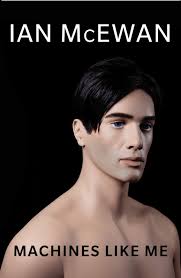
Machines Like Me, by Ian McEwan, 2019

Let’s start with that clever title.  The ambiguity lies between machines that are similar to ‘me’ and machines that feel a form of affection towards ‘me’. In Ian McEwan’s interesting latest novel it’s not clear in what sense if any the machines in question, robots, like the narrator.McEwan1

The narrative is relatively straightforward. Charlie Friend, the narrator, buys one of the earliest personal robots introduced onto the market. These robots are all called either Adam or Eve. His Adam is a very near simulacrum of a human being, although it costs more than the price of an average house (and Charlie still lives in a flat in London). Charlie is attracted to Miranda, his upstairs neighbour , and they soon begin a relationship. This quickly becomes a menage a trois, as Adam first has sex with, then falls in love with, Miranda. Yes, they are that kind of fully-functioning robot.

Charlie, Miranda and Adam are living in an alternate version of the 1980s, one where Alan Turing didn’t take the course of chemical castration ordered by the courts following his conviction for being gay. Turing is the key in this parallel universe to unlocking an extraordinary leap forward in technology in which self-driving cars are commonplace and robot technology has been perfected.

During my reading of Machines Like Me I kept experiencing a nagging sensation that something wasn’t quite right. Unquestionably the novel’s narrator wasn’t telling us the whole story, and I wondered whether there might be a hidden reason for this, in a similar fashion to McEwan’s earlier Sweet Tooth. In Sweet Tooth there are similar moments where things don’t quite add up, where the narrator is clearly getting things wrong or asking us to make intuitive leaps without sufficient reason. There is the same feel to the narrative here – the narrator presents us with a series of events which successively feel ‘wrong’, and asks us to take them at face value.

The sense that Charlie’s account is either misleading or disguising another, perhaps more serious or disturbing narrative, recurs throughout the novel. Things don’t quite add up. Early on Adam tells Charlie that Miranda, at that point only his potential girlfriend, is likely to hurt him. Charlie doesn’t follow this up – surely he would take the earliest possible opportunity to grill Adam on what he means, but he lets it slide, and apparently forgets about the warning, such is the strength of his attraction. The much later explanation of this warning is insufficient. Shortly after this incident Adam breaks Charlie’s wrist when he attempts to turn him off, a clear violation of Asimov’s first law which had been specifically referenced a little earlier in the novel. (1. A robot may not injure a human being or, through inaction, allow a human being to come to harm. Adam also ignores rule 2. (a robot must obey orders given it by human beings except where such orders would conflict with the First Law) freely throughout the novel – he is almost completely autonomous. After the attack, Adam threatens Charlie with the removal of his arm, which Charlie assumes is a joke, although he has little reason for doing – at any time this comment would be unfunny, but coming as it does just after he has broken his wrist, it is clearly a serious threat.

Charlie earns money speculating on the stock exchange. It takes him forever to work out that Adam, with his far superior if not god-like intelligence, might be a little bit better at this than he is. Once he sets him to work he quickly amasses thousands of pounds. While Adam’s intelligence is special, it isn’t unique. If he is able to manipulate the stock and commodities exchanges to swiftly earn thousands, is there any reason to think that others with access to this technology would not have had the same idea, and be using computers to make their trades? Of course they had that idea a long time ago, so the narrative as presented by Charlie loses another element of its credibility.

I thought we were edging towards a revelation during the scene when Charlie is taken for the robot and Adam for the human by Miranda’s father, during a much-delayed visit. Adam easily passes this version of the Turing test, but the mistake is unconvincing – while Charlie is dull, and his small talk is similar to that of an android, it would have been funnier if the mistake had been a deliberate put down by the prospective father-in-law. Was this scene hinting that Charlie is actually the android with implanted memories and Adam the human owner? Or that androids have now assumed their rightful place in ascendancy over man, and this is the method of control, fooling humans that they are the owners, while being in control all along (and therefore able to override the Asimov rules?

But sadly nothing ever come of this line of thought, and it turns out that Charlie isn’t a seriously flawed narrator after all. All the inconsistencies and “off” moments were just lapses in the construction of the narrative, nothing else. Which was a major disappointment.

Some of McEwan’s recent novels, I am thinking of Solar and The Children Act in particular, were weighted down by the extensive research behind them. There was a sense that McEwan had gone to a considerable effort to learn about the topic in question, and was reluctant to let it go to waste, so incorporated large chunks of his notes into the text. Sometimes it felt like I was being lectured and that a test was likely at some point. Machines Like Me has a similar feel – the life of Alan Turing is definitely fascinating but if I wanted to read a biography of the man I would have done so.

McEwan has some fun with the setting and the alternative history in which Britain loses the Falklands War and Tony Benn becomes Prime Minister, but it is hard to see the relevance other than providing a context for and explanation of the advances in technology. There is no real effort to flesh out this world in any detail – apart from the life-like robots and the self driving cars, everything else is familiar, down to the poll-tax riots and the Brighton bomb. It’s just the 1980’s with robots.

I’ve been quite harsh on Machines Like Me thus far, but I did enjoy reading it. I wanted to know what happened to the characters, and while Miranda never really came into focus, I was pleased she earned her happy ending. As a mediation on human consciousness and identity, I didn’t feel the novel had anything new to say – Never Let Me Go is an incomparably more interesting and engaging exploration of many of the same issues.

Standard