
The Man in the High Castle is an alternate history novel. Although the author Philip K. Dick is best known as a writer of science fiction, and despite the setting, the novel is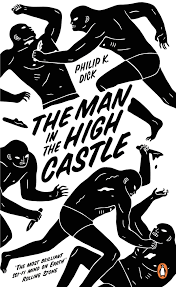 realistic in tone, and contains very few sci-fi elements. The scenario of the novel is chilling if not wholly original – the Nazis and their Japanese allies have won the Second World War. They rule over the former United States, where the novel is mostly set, as well as the rest of the world. In the novel’s alternate history, President Franklin D. Roosevelt was assassinated (as he very nearly was) leading to the continuation of the Great Depression and US isolationism during World War II. Without American involvement the Nazis conquer Europe and Africa, and then join with the Japanese to defeat America.
Life under the Nazis is as barbaric as one might expect, although by the time of the events of the novel America is slowly coming to terms with being a defeated and occupied country. Japan has occupied most the Western side of the US and Germany the east, with a buffer zone of the “Pacific States of America” between them and a small Nazi puppet regime to the south.
While victory was shared by the Japanese and the Nazis, the peace is clearly being won by the technologically superior Germans, who are already (the novel is set in the 1960s) sending men to Mars. This disparity of technology is to prove dangerous. The narrative is told through the eyes of several citizens of occupied America. An antique shop owner sells romanticized and often fake American cultural artifacts to Japanese trade officials and tourists. A high-ranking official visits the shop looking for a gift to impress a visiting Swedish industrialist. Meanwhile Frank Frink (formerly Fink), a secretly Jewish-American veteran, has lost his job and sets up a handcrafted jewelry business with a former colleague. His ex-wife meanwhile now lives in the neutral buffer zone and begins a relationship with a truck driver. Slowly Dick draws these story lines together to reveal the Nazis’ sinister intentions towards their former allies.
A popular novel, The Grasshopper Lies Heavy, depicting an alternative history in which the Allies won World War II. plays a key role in the narrative – a novel within a novel in which the central conceit is reversed. This inner novel haunts its readers with the suggestion that it in some strange way is actually a true representation of events, and the characters’s lives are themselves the fiction. In some ill-defined way the ‘truth’ is trying to impose itself on the fictional events portrayed. Dick leaves this idea unresolved at the end of the novel.
It’s an intriguing if not particularly original central concept in the long tradition of invasion/alternate history novels. Not many works in this genre go so far as to imagining the US losing the war – even though Dick makes this plausible enough given the Nazis adapting nuclear technology before the Allies. Having set his scene, Dick seems a little lost where to go with it. This isn’t going to be a patriotic tale of valiant resistance fighters defeating the brutal invaders – in fact the Japanese seem perfectly civil, and there is no suggestion of their being an underground movement of any kind. The tensions between the remaining superpowers is well handled and convincing, and the descriptions of how Europe and Africa have suffered at the hands of the Nazis are chilling even if all-shown in passing references by the American characters. The eponymous Man in the High Castle is a bit of a disappointment – he is the author of the novel within the novel, but the High Castle ends up being just a suburban house, and the author only appears right at the end of the novel. He is not the omniscient, influential figure the title would suggest.
I found the constant references to the prophetic powers of the I Ching quite irritating. Dick seems to take this nonsense seriously – certainly his characters do and there is nothing to suggest they are wrong to do so. The Japanese characters are all stereotypically inscrutable even when narrating the novel. All in all I couldn’t resist the feeling that there was a compelling story here trying but never quite succeeding to get out here, only appearing in flashes such as when the truck-driver is revealed as a German agent and is stopped by the plucky American judo-instructor. The television adaptation has wisely ignored almost all of the text, just using the central concept as a starting point, and as a result making a much richer, more interesting narrative.

