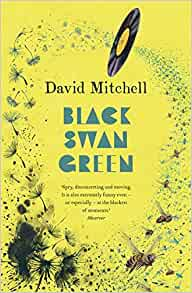
Set in the early 1980’s, Black Swan Green is the tale of a year in the life of 13-year-old Jason Taylor. Jason lives in a Worcestershire village and suffers from a stammer which makes his school life difficult – he is permanently afraid of it being discovered by his class-mates, and uses a variety of strategies to avoid words that might trip him up. The prospect of public speaking fills him with dread.
Jason gives different elements of his personality their own names and to an extent their own identities. Externalising these parts of his personality help him face his fears. His stammer is ‘the hangman’ for example, showing how fearful he is of having his condition ‘exposed’.
This is not just the story of Jason and his stammer. Much of the narrative revolves around his relationships with his peer group at school and time spent just hanging around the village. It quickly becomes apparent that the mundane challenges of day to day life as a teenager in a small English village in the 1980s are of quite limited interest, unless the nostalgic references to 80’s popular culture appeal. Jason has what are presented in his account as adventures (he falls over while skating, he is barked at by some fierce dogs, he goes for a long walk), and no doubt to him that’s what they seem, but they are not much more than everyday events with little in the way of drama. The only event that really stands out occurs when he meets an eccentric European woman Eva van Outryve de Crommelynck who robustly critiques his poetry but still encourages his aspirations to be a poet. Eva seems out of place in rural Worcestershire, and disappears from the narrative as abruptly as she appears, extradited as a result of her husband’s dodgy financial affairs.
Black Swan Green is a slightly less funny version of the Secret Diary of Adrian Mole aged 13 and 3/4. Admittedly there are a few differences between the two novels, in setting and tone, but the extent of the similarities is striking. The central characters are the novels’ naïve teenage narrators. They are the same age. Their parents are both splitting up, although Adrian/Jason comes to realise this a lot later than the reader. They both secretly write poetry. Both take a superficial interest in current affairs, in particular the Falklands War, and along with all teenage boys have crushes on young women. Both are embarrassed to be seen with their parents. Both their fathers are laid off. I could go on – but while Adrian Mole is played for laughs, while at the same time serving as an acute observation of the anguish of teenage life, Black Swan Green is a lot less funny.
So why did the author of the complex, modernist/experimental novels such as Cloud Atlas write a unfunny version of Adrian Mole? I am genuinely puzzled? Of course there is a strong autobiographical element to Black Swan Green, and the similarities with Sue Townsend’s creation may be coincidental (none of the dozens of reviews I read on Goodreads noticed the parallels, so maybe it’s just me?) but this was a surprisingly below par effort from Mitchell. I’ve been fairly critical of the tone of some of his other novels – Slade House for example was in part in poor taste – and the handling of the supernatural elements was unconvincing, but there was no question of his abilities as an author, in crafting compelling stories and characters. Black Swan Green isn’t a young adult novel, or at least it’s not marketed as such, but it might play better to that audience that to readers of his more mature fiction.
I thought Galgut’s The Promise showed sufficient – well, forgive me – promise to justify trying another of his earlier Booker contenders. In a Strange Room stretches the definition of novel to near-breaking point. It comprises three first-person (although more on that in a minute) narratives. The narrator is a South African writer named Damon. In the first section, The Follower, Damon is travelling in Greece when he meets a German tourist, Reiner. They strike up a strangely detached friendship which is renewed months later when they plan a walking trip together in Lesotho. Damon seems to be on holiday perpetually, and when back in South Africa couch-surfs without every needing to find a job. His trip to Lesotho is funded by Reiner, but the practicalities of a walking tour in a tropical African country with very limited infrastructure are never adequately addressed. Part-way through the tour an argument leads to Damon abandoning Reiner and the trip and returning to South Africa. Throughout the narrative there is a luke-warm sexual tension between the two men which is never acted upon.
The ‘novel’ thing to do would have been to have Reiner appear during the later narratives in the novel, but Galgut eschews this approach. Instead he is quietly forgotten as Damon moves on to his next adventure, this time a walking trip (initially solo) in Africa. This chapter, ‘The Lover’, appears to be set a few years after ‘The Follower’. Damon is older and a little wiser, but still listlessly travelling non-stop without the burden of a career or occupation to hold him back from his nomadic existence. In Zimbabwe he meets three Europeans – a French man and a pair of Swiss twins. Although they have different routes they keep bumping into one another, until eventually they decide to travel together. Damon is clearly attracted to one of the twins, Jerome, who has “a beauty that is almost shocking”, and changes his travel plans to he can join them. They crisscross Southern Africa with the expected complications with visas and passports, but not a lot happens. Damon doesn’t appear to enjoy his travelling – he really could be anywhere. Later he follows Jerome back home to Switzerland before moving on to London and beyond. The relentless travelling without destination or direction is obviously a metaphor for how Galgut sees his own life, but it gets a bit tedious.
The novel’s final section, ‘The Guardian’, features yet another unsuccessful journey. Damon accompanies Anna, a friend suffering from manic depression, on a recuperative journey to India. He is totally out of his depth in dealing with Anna’s illness – despite his best endeavours he cannot protect her from herself, and she ends up taking an overdose. The Indian hospital system struggles to give her the treatment she needs to survive, and the situation descends into a chaotic, distressing nightmare.
These three journeys have some thematic links, but they also had a strong personal memoir sense. On an ‘acknowledgments’ page at the end of the text, the author thanks the editors of the Paris Review ‘where these pieces first appeared, suggesting that they may not have been conceived as part of a larger whole at the time they were originally published, and have been welded rather uncomfortably together to create a text of sufficient length to justify publication in a book format. Although ostensibly they are all about journeys, the third section involves very little travelling, and is really focused on the serious issues regarding metal health and suicide. I don’t think they sat together well at all, and ‘three long short stories’ would have been a more honest representation of the text.
In a Strange Room is written in the third person, but occasionally often the narrative flips to the first person: he talks about the Damon character as if he is someone else, and then at other times, sometimes changing in the course of a single sentence, he will describe him as “me”. To me this was a slightly irritating device. After the initial confusion of working out what was happening – was there someone else present? – it just became an affectation. I assume it was a way of showing the unreliability of memory – when the memory was vivid ‘I’ was used because the narrator felt present, when it was less clear ‘he’ was used to indicate the lack of connection. That’s how I rationalised it anyway. But it emphasised all the more clearly that In a Strange Room is a memoir, albeit an unreliable one used as a creative springboard for a novel about rootlessness.
Periodically sitcoms (especially long-running ones) have clip-shows – episodes comprised principally of clips from previous episodes, put together mainly to maximise the use of content originally used elsewhere. I can’t shake the suspicion that In a Strange Room is the novelists version of that technique. There’s plenty of precedent for this approach – the one that springs to mind is Raymond Chandler who re-used short stories originally published in crime magazines as the components of novels such as The Big Sleep. But Chandler could get away with this, making the whole much larger than the parts. I’m not sure Galgut achieves the same effect.
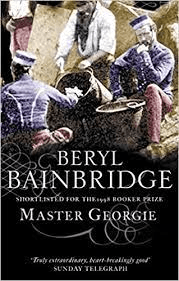
Beryl Bainbridge has been on my ‘must read more by this author’ list for a long time, particularly since I enjoyed her ‘An Awfully Big Adventure‘ back in 2018. It’s taken me until now to act on that resolution, and only then because I came across her Master Georgie, which was shortlisted for the 1998 Booker Prize, in a charity shop at a bargain price.
The novel is told in six brief chapters, which Bainbridge describes as ‘plates’, introducing the photography theme which provides a structure for the novel. The opening plate/chapter is told by Myrtle, a Victorian foundling who has been taken in (and is later adopted) by the Hardy family who are from Liverpool. Any echoes of another orphan child found in Liverpool and taken in by a family (Heathcliff?) seem coincidental. Myrtle is obsessively devoted to Master Georgie, the son of the household. Set in 1846 this introductory chapter tells the events of the day of Mr Hardy senior’s ignominious death of a heart attack in a brothel, and how his body is smuggled back into the family home in a cart (previously used to present a Punch and Judy show) to try to avoid any scandal.
Four years later we next hear from Pompey Jones, an Artful Dodger-like character who having helped with the removal of Mr Hardy’s body from the brothel to his bed has become another part of the extended Hardy household. Pompey is working with Master Georgie, now the master of the household. on his experiments with amateur photography. George is now married and a surgeon. There are also hints in Pompey’s narrative that his relationship with George has a sexual component.
Another time skip takes the novel to the outbreak of the Crimean War in 1854 Sevastopol. For reasons that are unclear (to me on a first read, I may have missed something by way of explanation) George having signed on as an army doctor, has been followed into the conflict by Myrtle, his brother in law Dr Potter, and their families. Pompey is also there as an assistant to a war photographer travelling in the trusty and multi-purpose Punch and Judy cart. This chapter is narrated by Dr Potter, and having checked it seems his explanation for travelling into the heart of a war-zone is that he needs to be there as an ‘observer’ which seems unconvincing at best.
The conflict gradually heats up and comes to dominate the narrative, ending in the bloody battle of Inkerman. These are the strongest scenes of the novel in which the horror of the conflict is captured in gory detail. Death, which has dominated all the sections of the book, almost overwhelms it.
One of the things that stood out from An Awfully Big Adventure was the author’s clever manipulation of point of view narration to slowly build the narrative. It’s the jigsaw building method of story-telling, where the final picture only emerges as the pieces are assembled by the different perspectives. Bainbridge uses the same technique here, although to much lesser effect. The narrators leave it to the reader to fill in many gaps in the narrative, but it is fairly easy to piece these together and work out the relationships between the characters with a little care and attention. When the final picture is assembled in An Awfully Big Adventure it is with a sense of revelation, something that is lacking here. Constructing the novel around the six photographs, one taken in each ‘plate’ was probably a clever idea, but it runs the risk of being over-pleased with the conceit without adding much to the narrative. Each chapter is a snapshot of events rather than part of a coherent narrative, and while piecing the connections between each ‘plate’ is a comfortable enough task for the reader, it didn’t feel as rewarding as I think the author may have intended.
Master Georgie is a lesser novel in other ways. Myrtle has the potential to be a central character, but her portrait is horribly one-dimensional. Apart from her slave-like devotion to Master George, to the extent of having his children and then giving them up to his wife to raise as her own, her character has no depth whatsoever. All she does is follow George around like a puppy dog. This is such a waste of a potentially interesting character – it would have been interesting to have seen her gradually come to realise that he didn’t deserve her devotion for instance, or for her to have found something to do other than hang around on the off-chance he might need her. Dr Potter is also problematic (although to a lesser extent). The amateur Victorian geologist is something of a cliché in the first place, but his role in the novel is unclear other than to provide a contrasting voice to the other narrators. Why does he follow George to war? I understand there was an element of war tourism in the Crimea, but Potter isn’t there for that. For the initial stage of the journey he is accompanied by his wife and children, as is George, even though it is clear that a serious conflict is brewing. It just makes no sense why they would all recklessly head off to the Crimea in the way they do. George seeks out the conflict because he believes he can help as a doctor, and possibly as some form of redemption for previous weaknesses or to prove himself (the novel’s title infantilises him, suggesting he needs to do some growing up), but the presence of the others is inexplicable.
Master Georgie has the beginnings of a great novel about the Crimean War, using that conflict to reflect on Victorian society, class and personal relationships. The structure of the novel, based around the six photographs, is cleverly designed. There are glimpses of what might have been, but only glimpses. It had an incomplete or draft feel to it. I have no issue with the reader being asked to do the heavy-lifting and sketch in the missing details of relationships between characters, for example, but here even when that work is done we are left with a picture with too many missing pieces.
Before you start to read any novel you have a set of expectations (sorry) about what it is going to be like, both in terms of the broad plot outline and some of the likely features. These ideas are informed by other novels and works you may have read by the author, the novel’s representation in popular culture, and smaller details such as the cover illustrations and comments on the blurb. You may also have read reviews and commentary on the text. All this adds up to a picture before you even start reading, and for classic novels such as Great Expectations that picture is fairly detailed. My perception of Great Expectations was something like this: I knew that the novel started with the central character, Pip, meeting an escaped convict in an isolated churchyard (the name Abel Magwitch is pretty unforgettable). I knew that the novel features a Miss Havisham who lives among the ruins of her wedding feast. I also knew that at some point Pip moves up in the world and becomes a young gentleman, presuming this to be related to his great expectations. Beyond that things were a bit hazier. I assumed, given that this was Dickens, that there would be long-lost relatives reunited with siblings or children at some point, evil villains plotting the downfall of the innocent hero or heroine, and that fortunes would be inherited and marriages arranged at the end of the novel to end with a happily-ever-after finale. Finally, I also assumed Pip would probably be the novel’s hero, and would exemplify all the positive virtues we expect of such a hero – kindness, loyalty, honesty etc. In short, I suspected the novel would be a reworking of David Copperfield or Oliver Twist.
Of course I was quite wrong. Pip is a flawed character who ends the novel with a redemption, of sorts, but spends much of it being disloyal and unkind to his relatives. At one point he receives a letter telling him he is going to receive a visit from his brother-in-law, the ever amiable blacksmith Joe Gargery. Pip is brutally honest about his reaction to this news:
“Let me confess exactly with what feelings I looked forward to Joe’s coming. Not with pleasure, though I was bound to him by so many ties; no; with considerable disturbance, some mortification, and a keen sense of incongruity. If I could have kept him away by paying money, I certainly would have paid money.”
This is not the reaction of a hero – but it is intensely human of Pip to admit to these feelings. Unlike the conventional plot of a traditional Victorian novel the hero here doesn’t inherit a fortune, he loses one (arguably two). The romance at the heart of the novel is painful and unrequited, as far from a traditional love story as it is possible to be. In other words this is a novel that confounds the readers expectations – the title becomes not a promise but almost a taunt. Pip’s expectations as to how his life is to develop may be great, but they are not realised. His life is not conventionally tragic but he is not really the hero of his own story, and his realisation that his life is not going to take the trajectory he anticipated is far from what the reader will have come to expect from Dickens. I once argued that Dickens an extremely consistent if not predictable novelist, and that it was hard to see much progression in his work. Great Expectations confounds that theory – it is clearly the work of a mature novelist who knows that some novels need more than a happy-ever-after ending in which all the loose ends are tidied away.
Pip’s redemption is the core concept of the novel, but it is also very much an adventure story. Dickens brilliantly captures the reader’s attention in the opening pages by diving straight into the novel’s key scene. Magwitch has Pip by the throat almost before Pip has had time to introduce himself:
My father’s family name being Pirrip, and my Christian name Philip, my infant tongue could make of both names nothing longer or more explicit than Pip. So, I called myself Pip, and came to be called Pip….
Ours was the marsh country, down by the river, within, as the river wound, twenty miles of the sea. My first most vivid and broad impression of the identity of things seems to me to have been gained on a memorable raw afternoon towards evening. At such a time I found out for certain that this bleak place overgrown with nettles was the churchyard; and that Philip Pirrip, late of this parish, and also Georgiana wife of the above, were dead and buried; and that Alexander, Bartholomew, Abraham, Tobias, and Roger, infant children of the aforesaid, were also dead and buried; and that the dark flat wilderness beyond the churchyard, intersected with dikes and mounds and gates, with scattered cattle feeding on it, was the marshes; and that the low leaden line beyond was the river; and that the distant savage lair from which the wind was rushing was the sea; and that the small bundle of shivers growing afraid of it all and beginning to cry, was Pip.
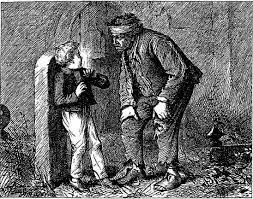
“Hold your noise!” cried a terrible voice, as a man started up from among the graves at the side of the church porch. “Keep still, you little devil, or I’ll cut your throat!”
A fearful man, all in coarse grey, with a great iron on his leg. A man with no hat, and with broken shoes, and with an old rag tied round his head. A man who had been soaked in water, and smothered in mud, and lamed by stones, and cut by flints, and stung by nettles, and torn by briars; who limped, and shivered, and glared, and growled; and whose teeth chattered in his head as he seized me by the chin.
“Oh! Don’t cut my throat, sir,” I pleaded in terror. “Pray don’t do it, sir.”
Notice how Magwitch appears to Pip almost as if risen from the dead. The sense of place evoked in these lines is extraordinary.
The novel is constructed in three parts, all three books being narrated by Pip from some distant point in his future. In book one Pip is a seven year old orphan living with his older sister and her blacksmith husband Joe Gargery on the coastal marshland of Kent. On Christmas Eve Pip meets Abel Magwitch, an escaped convict in the scene shown above. Magwitch scares Pip into stealing a file (to remove his chains) and some food and drink. Magwitch is swiftly recaptured, along with another convict with whom he has been fighting. This is an almost dream-like memory for Pip who has no idea of the significance it is going to have for his later life.
The other key childhood memory for Pip occurs when Miss Havisham, she of jilted at the altar fame, asks neighbour Mr Pumblechook to find a boy to visit her. (Out of context this seems a strange request – she takes little pleasure from Pip’s visits and instructs him simply to ‘play’. Pip sees nothing particularly unusual because he is a child and has yet to develop a sense of what is and isn’t strange. He is unphased by the fact that she still wears her old wedding dress and is surrounded by the detritus of her wedding day. Pip is smitten by Estella, Miss Havisham’s adopted daughter. Estella has been brought up by Miss Havisham to be hostile to all men, as a perverse form of revenge on the male sex. The regular visits to Satis House eventually end when Pip becomes as an apprentice blacksmith in Joe’s smithy. The final turning point of this stage of Pip’s life, and this book of the novel, comes when Mr Jaggers, a lawyer, tells Pip that he has been given a large sum of money from an anonymous benefactor, allowing him to leave the forge and become a gentleman.
The second book of the novel follows Pip’s experiences in London. He lives with Herbert Pocket, the son of his tutor, a cousin of Miss Havisham. Pip is convinced Miss Havisham is the source of his good fortune. He learns more about her story which cements that conviction. He sees little of Estella and even less of his sister and her husband. Despite his generous allowance he builds up some serious debts. For me this section of the novel lagged. Pip seems to waste most of his time trying to become a gentleman, although the precise nature of his tuition with Mr Pocket is never described (nor barely mentioned). Fortunately this period of his life comes to an end when he finally learns that his benefactor is not Miss Havisham but Abel Magwitch, who has made his fortune (we are never told how) in Australia. Pip is traumatised by this news – he feels any money he receives from Magwitch is compromised and must be returned. As Orwell rightly points out in his classic essay on Dickens, ‘Pip is conscious all along of his ingratitude towards Joe, but far less so of his ingratitude towards Magwitch. When he discovers that the person who has loaded him with benefits for years is actually a transported convict, he falls into frenzies of disgust…not because when Pip was a child he had been terrorized by Magwitch in the churchyard; it is because Magwitch is a criminal and a convict. But Pip’s sense of revulsion towards Magwitch slowly changes as he comes to realise that the convict may be a criminal but his instincts and intentions are far from evil.
The final book of the novel draws these threads together as everyone is given an ending suitable to their character. There are some dramatic incidents in which fate intervenes to ensure justice is served, and some long-lost secrets are revealed. I am as you can see trying to avoid too many spoilers. Pip matures significantly once he learns that his chance meeting with Magwitch in the churchyard all those years ago was the source of his great expectations. This seems to lead him to be determined to do the right thing regardless of the personal cost. He eventually comes to see Magwitch in a loving, dedicated way (feelings surely more due to Joe) and he dedicates himself to caring for the convict at the end.
While this is not a typical Dickens novel neither is it short on the things we expect and love from his work. The central characters are convincingly realised, even when they are eccentric or downright unpleasant. The plot is more compact and less byzantine than usual, and the cast of minor characters with strange names and idiosyncratic personalities – while still very much present – is shorter than in many of his earlier novels. The humour is often subdued – there aren’t many laugh out loud moments, although I did enjoy this description of a Saturday night at the Three Jolly Bargemen:
There was a group assembled round the fire … attentive to Mr. Wopsle as he read the newspaper aloud…. A highly popular murder had been committed, and Mr. Wopsle was imbrued in blood to the eyebrows. He gloated over every abhorrent adjective in the description, and identified himself with every witness at the Inquest. He faintly moaned, “I am done for,” as the victim, and he barbarously bellowed, “I’ll serve you out,” as the murderer. He gave the medical testimony, in pointed imitation of our local practitioner; and he piped and shook, as the aged turnpike-keeper who had heard blows, to an extent so very paralytic as to suggest a doubt regarding the mental competency of that witness. The coroner, in Mr. Wopsle’s hands, became Timon of Athens; the beadle, Coriolanus. He enjoyed himself thoroughly, and we all enjoyed ourselves, and were delightfully comfortable. In this cosy state of mind we came to the verdict Wilful Murder.
Great Expectations is commonly considered one of Dickens’s greatest works. It was ranked above Bleak House, David Copperfield and A Tale of Two Cities in the BBC Big Read survey back in 2003. I am not sure it merits that status – it goes without saying it is a great novel, but for me it didn’t have the depth of some of the others mentioned here. The fact that he changed the novel’s ending to allow readers the hope of a reconciliation between Pip and Estella suggests Dickens may have had his doubts as well.
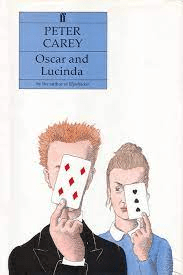
Peter Carey’s 1988 Booker-prize winning Oscar and Lucinda tells the parallel stories of its eponymous characters: Oscar Hopkins, a disgraced clergyman, and Lucinda Leplastrier, owner of a glass factory. The novel is narrated by one of the Oscar’s descendants several generations later, who is always keen to point out the role random chance seems to have in determining their fate. Although they eventually meet on board a ship headed to Australia, for a large part of the novel their stories are separate.
Oscar is raised in remote Cornwall by his father who is a preacher in the Plymouth Brethren, a harshly non-conformist group which believes in the literal truth of the bible.
He (Oscar) comes to believe that God wants him to convert to Anglicanism, despite his father’s conviction that this means he is going to hell. But his conversion is also, incidentally, a means for him escape from rural Cornwall and achieve an education. At Oxford while training to become a priest Oscar discovers gambling, a sin he is never subsequently able to escape from. Whilst at university Oscar is a social outcast. His poverty marks him out, as does his other-worldly appearance and his complete lack of social skills. By chance he meets a fellow student, Wardley-Fish (a larger than life character I wish we had seen more of) who introduces him to the joys of gambling. At first his horse-racing winnings provide him with the funds to stay at Oxford, but his gambling – even on the Sabbath – eventually gets him into trouble, to the extent that the church authorities decide to exile him to Australia.
Lucinda’s story is also dominated by her fascination (or perhaps it is an addiction?) with gambling. She is orphaned when she is a young woman. She inherits the large farm in Australia her parents bought following a move from the UK. Not really knowing what to do with either her inheritance nor the rest of her life she spontaneously decides to buy a glassworks. Making a success of the business isn’t easy – the fiercely misogynistic glassblowers don’t even allow her to enter her own factory. At a loose end, Lucinda falls into the wrong crowd, and begins gambling on cards. A trip to London isn’t the way of rebooting her life she is looking for, but on the way back she meets Oscar.
Oscar’s terror of the sea – and large bodies of water more generally – means he is unable to socialise or move freely around the liner taking them to Australia. Nevertheless they bond over their mutual hobby, and Lucinda eventually invites Oscar to stay with her in Sydney. Their friendship develops and society is scandalised when they live together seemingly as man and wife, although in fact entirely innocently. Their relationship falters as Oscar is convinced Lucinda is in love with Reverend Hassett, a glass expert she consulted on the acquisition of her factory.
The finale of the novel involves a dangerous and improbable bet – Lucinda challenges Oscar to deliver a glass church to Reverend Hassett in his new living in Boat Harbour. Yes, a glass church. If that were not improbable enough, instead of taking the church by sea, Oscar’s fear of water means he has to travel overland, through largely uncharted territory. This fanciful expedition inevitably extracts a high price from them all.
Oscar and Lucinda could have been the great Australian novel. Carey is recorded as having said of his writing “My fictional project has always been the invention or discovery of my own country“. The colonisation of the continent by the British and others, and the impact this had on the indigenous peoples, is a theme which ripples through this novel, but always as the background to the lives of the central characters rather than ever being foregrounded as an issue. In the novel’s opening introductory chapter the narrator tells the reader a little about the area where he grew up, including the following:
“I learned long ago to distrust local history. Darkwood, for instance, they will tell you at the Historical Society, is called Darkwood because of the darkness of the foliage, but it was not so long ago you could hear people call it Darkies’ Point, and not so long before that when Horace Clark’s grandfather went up there with his mates – all the old families should record this when they are arguing about who controls the shire – and pushed an entire tribe of aboriginal men and women and children off the edge.”
This shocking massacre is part of settler history, and no worthy of further exploration. While other writers might think this story worth telling, in this novel it is just window-dressing, local ‘colour’. Oscar and Lucinda are both European settlers, as is almost everyone else they meet or mix with, while the indigenous Australians are virtually voiceless. Towards the end of the novel there are some brief exceptions to this rule – Kumbaingiri Billy, for example, a friend of the narrator’s father, is introduced as the source of the story of the glass church – but overwhelmingly this novel is about the experience of colonial Australia, in which European settlers struggle to come to terms with the challenges of the new world. That settler experience is only part of the story of Australia. Australia wasn’t invented or discovered by Europeans – I am pretty sure it was there all along and had been inhabited by people for thousands of years. While Carey doesn’t ignore that fact he really doesn’t address it at any length either. It is only recently, in A Long Way from Home for example, that Carey has finally started to address face-on what he has called “the fundamental, bloody circumstance of my country”. In the promotional interviews for that novel Carey said that “You can’t be a white Australian writer and spend your whole life ignoring the greatest, most important aspect of our history, and that is that we – I – have been the beneficiaries of a genocide.” The fact is he managed to do just that in this novel. I know it might seem strange to critique the novel Carey hasn’t written, and I understand his reasons for not feeling qualified to write about the aboriginal experience, but I can’t help feeling it was a huge missed opportunity.
That’s a great start to a novel! Who is ‘she’, and why is her awakening so important, so ominous? Sadly, after that this never really gets any better.
The Leviathan is set in Norfolk and is told in two threads, one set in a time of relative peace in 1703, and one sixty years earlier during the English Civil War. The narrator of both tales, Thomas Treadwater reflects on his time serving in Cromwell’s army. During a seasonal break in the fighting he returned home to nurse his wounds. His return was hastened by a letter from his sister who suspected a new servant of ‘drawing our father into corruptions’, alleging she was using witchcraft to do so. By the time Thomas reached their remote farm his father had had a stroke, the farm was in chaos, and the servant had been arrested on suspicion of being a witch. Thomas recollects his struggles to come to terms with what had happened as events snowball beyond his control.
There are a number of issues with The Leviathan, some of which I can discuss avoiding spoilers, others, sadly not. If that is likely to be a problem for you, and if you are planning to read the book, (and I admit, the premise is intriguing) don’t read on.
For a novel set in North Norfolk, an area of the country with a very specific geography, a sense of place is almost completely lacking. Apart from the fact that the Treadwater farm is set in remote countryside, we could be almost anywhere. What is so frustrating about this is that this part of the world has such a haunting atmosphere – huge skies, towering flint churches that seem wildly out of scale with their villages, coastal marshes and crumbling cliffs. Although most of the drainage windpumps that survive to this day were built later, at this time (i.e. in the seventeenth century) there would have been windmills stalking over across the flat landscape. What a missed opportunity this was. The sense of the period is captured very effectively – the world turned upside down – with parliament challenging the supreme authority of the monarch, but the sense of place is missing.
The novel opens as a fairly conventional story of witchcraft and witch-finding. The sinister and zealous Witchfinder Rutherford is introduced, but any expectation that he is going to be the novel’s villain is confounded when he goes missing, shortly after having proposed to Thomas’s young sister Esther. No-one seems particularly troubled by his absence, and that storyline is quietly dropped, as eventually is the witchcraft thread of the novel altogether. Why Esther would have accepted Rutherford’s proposal when she is – we later find out – not in any position to do so, is unexplained. Certainly the engagement is short lived! (Just to be clear, it is later suggested Esther had a sinister motive in accepting Rutherford, or in getting close to him, but the presentation of her acceptance is completely at odds with this motive. It appeared very inconsistent characterisation).
The introduction of John Milton to the novel as a character who helps resolve the mystery of the Leviathan is unconvincing and strange. He seems shoe-horned into the novel to provide it with some period detail, although his future as one of England’s greatest poets as well as his role as a radical figure within the Commonwealth Government goes largely unmentioned. Using historical figures as detectives in popular fiction has become a bit of a cliché recently, but Milton’s contribution to resolving the novel’s central mystery is in any event marginal. His presence is a wasted opportunity.
Thomas eventually finds out that his sister, Esther, has become possessed by a devil or demon. Their father rescued her from a shipwreck sixteen years earlier, and all this time the demonic entity has been lying dormant, sparked into life by the envy Esther feels towards her father’s new (and attractive) young servant. This makes some sense – Wikipedia tells me that Thomas Aquinas described the biblical Leviathan as the “demon of envy, first in punishing sinners”. But it is never made clear what the relationship is between the demonic entity that possesses Esther and the Leviathan itself, an enormous ship-crushing sea-monster. If I found The Essex Serpent disappointing in its non-existence, the literal appearance of the Leviathan was in many ways even more disappointing, and certainly less convincing. For horror to be effective it has to be credible, and while the ideas of witchcraft and possession have some basis in historical fact and can be explained by reference to actual phenomena, real-life sea-monsters summoned from the deep by demons are harder to believe.
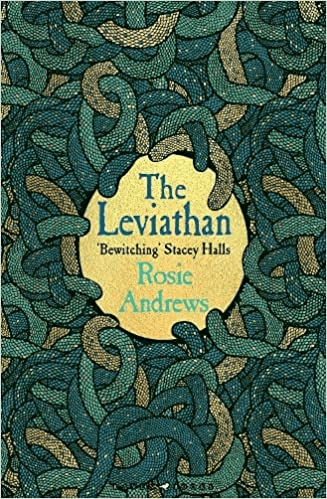
My theory is that there was no sea monster, no Leviathan in the first draft of this novel. It was a story about witchcraft and possession, about faith and scepticism. The appearance of the great sceptic Milton in that novel makes complete sense. But then I suspect an editor read the novel in draft and suggested some changes that would make it more marketable (which to be fair is their job!). The book trade must have been looking for a successor to The Essex Serpent for some time (in the same way that I am sure editors are considering at this very moment the first chapters of The Tuesday Lunchtime Homicide Association penned by a moderately famous television presenter!). The Leviathan’s marketing leverages its apparent similarity to The Essex Serpent, not least in the serpentine design of the book’s cover. It’s not a coincidence that it was displayed in my local Waterstone next to copies of the Perry novel, nor that Goodreads describes it as “perfect for fans of The Essex Serpent.”
So The Leviathan 2.0 was (my theory goes) born, in which a storyline about a sea-serpent was grafted clumsily onto a witchcraft/demonic possession gothic horror novel. The joints show and creak. The remaining elements of the original horror story show some fairly obvious borrowing from nineteenth century gothic. As in Jane Eyre a mad-woman kept trapped in the attic breaks free and destroys the family home with fire. There’s also more than a hint of Wuthering Heights in the storyline whereby a foundling is taken in by a family living in a remote farmhouse who grows up with destructive urges, undermining the adoptive family from within.
There are some other issues with the unevenness of the narrative. When Thomas first returns to the family farm he sees dozens of sheep lying dead in the fields. The illness that has swept through the herds is quickly forgotten (as is the unpleasant job of disposing of the carcasses) and was obviously just added for atmosphere. Thomas’s infected and agonising war wound quickly disappears after a poultice is applied and he has a few days bed rest. And the end of the novel is confused and ambiguous. Gothic horror is always going to struggle in this context – either the author can resolve matters with a naturalistic/scientific explanation (it was the crusty old janitor wearing a mask all along) or the supernatural is real, witches and magic exists, and the reformation was all a lie. I’m not sure there is a correct answer to that conundrum, but if an author is going to invite us to believe in monsters and demons then they need to be summoned with a little more conviction.
Anyone who has seen him wildly ad-libbing on Would I Lie to You will know that as well as being a wonderful comic Bob Mortimer is also a brilliant story-teller. It’s a pity therefore that his childhood provides such depressing material for the opening half of this his autobiography. His dad died unexpectedly when he was young, and his mum struggled to support the family of four sons in working class Middlesbrough. The sad clown trope in which the comedian’s childhood insecurities are compensated for by comedy voices and routines (impersonations of teachers being a favourite) is very often a feature of similar accounts. But Bob was too shy even for that role. He’s very frank about how difficult these years were for him, but what is surprising is how long he struggled with this aspect of his personality. I found it genuinely sad that his footballing abilities didn’t provide an outlet for him – although he played for the Middlesbrough boys team for several years he tells us he hardly shared more than a dozen words with his teammates off the pitch. He later describes his time at Sussex university as the most difficult years of his life and that “throughout my entire three years at Sussex I never spoke to another law student. I talked in tutorials but as soon as they finished I was away back to my room to listen to my records.”
The opening chapters of this absorbing autobiography are interspersed with an up-to-date chronicle of Bob’s heart problems, which brought a very sudden taste of his mortality. In childhood we have to come to terms with the inevitability of our own deaths, but we are able to treat it as sufficiently distant as to be an abstract concept, something that will happen one day but is not too frightening. But in later mid-life, with an unambiguous and critical diagnosis, it becomes a much more immediate reality. Bob response to the dawning realisation that he was not going to be around in ten or twenty years was to try to make the most of what time he had left. And to go fishing with his friend Paul Whitehouse. If you haven’t seen it Gone Fishing is wonderfully relaxing and contemplative comedy.
And Away… is admittedly fragmented. I got the impression that however hard Bob tried to be honest, he edits the story of his younger years to sanitise them. I can’t blame him for not wanting to dwell overly long on moments of his life best left behind, (not least because he would in doing so give away the ‘true or false’ answers to some of the more ridiculous anecdotes on Would I Lie to You) and he hurries on to the transformative moment when he meets his comedy partner, Vic Reeves. These are obviously the days Bob remembers with particular fondness, allowing him to leave behind a legal career he clearly wasn’t that interested in and to develop a stage persona in which he felt more comfortable than in his own skin. Imposter syndrome is possibly an exaggerated way of describing the common feeling that we don’t quite deserve the success we achieve and Bob certainly shares this feeling – it is almost as if he can’t quite believe his luck in getting to share the stage and screen with Vic, and would never want to emerge from his role as sidekick where he feels he belongs. He tells the story of their amazing success on television almost as a fan would describe it, a series of lucky breaks and undeserved second series, rather than the reward for hard work and comedic talent.
Bob comes across on television as a decent, genuinely likeable and yet humble man, someone who it would be wonderful to go for a beer with. This memoir confirms that impression without really giving the reader any new insights. Perhaps autobiographies are always going to hide as much as they reveal, which is why we wait for biographies for the real warts-and-all revelations.
Let’s get the elephant in the room out of the way first, because seemingly it’s mandatory for every review of Vikram Seth’s A Suitable Boy to mention its length. The paperback edition is over 1500 pages long, which makes it easily the longest single edition novel I have ever read (Clarissa was longer but came in 12 editions so isn’t a fair comparison). Apart from the fact that the book was slightly cumbersome to handle, for me this wasn’t really an issue. If you were reading it to a deadline for a review or coursework then I can appreciate the concern, but otherwise I am not sure why all reviews seem to obsess about the length. The impression I have is that Seth was determined to ignore the traditional ‘rules’ of novel writing, so if the novel ran to 1500 pages then so be it, not his problem (he displayed the same rule-breaking approach when he wrote his 1986 novel The Golden Gate entirely in verse).
A Suitable Boy is set in India in the early 1950’s, a few years after independence from the UK and the partition of the country into India and Pakistan. Partition was a traumatic and violent event for the people of the region, with tens of millions displaced and hundreds of thousands (on a low estimate) killed in communal violence. The immediate days and weeks of independence have been explored at length by writers such as Salman Rushdie (in Midnight’s Children), so the setting of A Suitable Boy in the early but not immediate post-colonial period provides a fresh perspective. The India described in A Suitable Boy is in the circumstances remarkably calm and law-abiding compared to that of a few years earlier. Partition has still left its mark – families are separated and communal violence remains a threat – but overall things are remarkably calm, even to the extent that a national election can take place. Hindu and Muslim families on the whole do not intermarry, but they mostly live alongside one another in relative peace.
To explore this world the novel follows the interwoven stories of four families: the Khans, Mehras, Chatterjis and Kapoors. Seth helpfully provides a detailed family tree at the opening of the book which I regularly referred to. If such a diffuse novel can be said to have a central narrative it is probably that of Mrs Rupa Mehra’s search for a ‘suitable boy’ for her daughter, Lata, an intelligent and independent 19-year-old undergraduate (to be honest, this storyline is usually deemed the central narrative simply because of its connection to the novel’s title rather than because it dominates the book or holds it together.) Rather than meekly accepting her mother’s decisions, Lata has her own views on whom she should marry. Her bullying brother, Arun, also tries to intervene and influence her choice. Three suitors emerge, all with various complications. Kabir Durrani is a cricket-playing student. He is charming and kind, and Lata quickly falls in love with him, but he is a Muslim so, according to her family, he is out of the question. Haresh Khanna is an ambitious young man employed by a local shoe-making company, but he has a former lover who remains in his heart, and he is dismissed by some members of Lata’s family as a ‘cobbler’. To complete the trio of suitors, Amit Chatterjee (Lata’s brother’s brother-in-law) is part of the extended Mehra family and therefore in many ways more suitable than the others. Amit is an acclaimed poet and author, clearly modelled on Seth himself. The novelist is brutally honest about Amit’s/his own failings and unsuitability as a potential husband.
This isn’t really a love story though. Lata’s romantic interests provide a narrative thread of sorts, but for long stretches the novel diverts into a wide variety of other topics and themes, from considerations of land reform, the Congress Party, elections, the Hindu/Muslim conflicts that continued throughout this period, as well as following the personal stories of a wide cast of peripheral characters. By ‘peripheral’ I mean that while they are not central to the core narrative, Seth doesn’t treat them as such, to the extent that the whole concept of a central narrative is flawed. All of these characters are brought to life and given time to develop their own stories. This seems part of Seth’s determination not to follow the traditional structures of the Western novel, but to write about what interests him. If it leads down a narrative rabbit hole then so be it; if the novel balloons to an incredible length, then it does.
Two of these ‘minor’ characters in particular stood out for me: Maan Kapoor, Lata’s brother-in-law (technically her sister’s brother-in-law) and Meenakshi Mehra nee Chatterji, wife to Arun and sister-in-law to Lata (and yes, in case you were wondering, I did just check the family trees to make sure I got this right). Maan is a playboy who becomes besotted with Saeeda Bai, a musical ‘courtesan’ – in other words a high-class prostitute. Through this storyline the reader is introduced to the complex sexual morality of India. While some women were kept virtually imprisoned in purdah, not allowed to show their faces to any man other than immediate family members, and forbidden from even going outside, other women such as Saeeda are allowed to sing at high-class social events without causing scandal, protected by the status of their customers. The double standards are shown, but Seth doesn’t moralise explicitly. Saeeda’s position is insecure – she knows that if she loses the patronage of some of her most senior ‘lovers’ she will be quickly ostracised by society. Later in the novel it is revealed that Maan had gay relationships while at boarding school and occasionally continues his long standing relationship with Firoz Khan, a school friend. He is in other words secretly bisexual. This secrecy is needed because being gay at the time in India in theory could lead to a life-long prison sentence, and would have been immensely damaging to his father’s political career. (His father is a minister in the Indian Government). Extraordinarily, homosexuality was only decriminalised in India in 2018 even though Hindu culture has a long tradition of recognising the complexity of human sexuality.
Meenakski is an interesting contrast to Saeeda and Maan. Although married she conducts a love-affair with one of her husband’s friends in which she is clearly the dominant party – she pressures him into liaisons and refuses to allow the relationship to lapse, apparently reckless or unafraid of the social stigma and other consequences that would ensue were they to be discovered. She is sexually liberated, and appears to enjoy her affair consequence-free – at one point she does fall accidentally pregnant, but loses the baby to a miscarriage and is secretly pleased at this outcome. The novel doesn’t pass judgment on Meenakski. As with Saeeda Bai her decisions are shown but not condemned.
Towards the end of the text Seth comes close to breaking the fourth wall when Amit, his avatar within the novel, is asked about the length of his own forthcoming novel. It is easy to imagine that this was a question Seth had to answer many times when his publishers released details of the page count of A Suitable Boy:
‘Do you believe in the virtue of compression?’ ‘Well, yes’, said Amit warily. The lady was rather fat.
‘Why then is it rumoured that your forthcoming novel – to be set, I understand, in Bengal, is to be so long? More than a thousand pages!’ she exclaimed reproachfully, as if he were personally responsible for the nervous exhaustion of some future dissertationist.
‘Oh, I don’t know how it grew to be so long’ said Amit. ‘I’m very undisciplined. But I too hate long books: the better, the worse, If they’re bad, they merely make me pant with the effort of holding them up for a few minutes. But if they’re good, I turn into a social moron for days, refusing to go out of my room, scowling and growling at interruptions, ignoring weddings and funerals, and making enemies out of friends. I still bear the scars of Middlemarch’. (Don’t we all?)
This is Seth’s response to the commentary about the novel’s lack of ‘compression’ – to mock his critics who are unable to bear the weight of the book or to read it without going into their own version of purdah.
Mostly the narrative is gently paced, following the lives of the characters wherever they end up. Periodically there are major events that in a traditional novel would be used to drive the narrative forward. I don’t think it is a coincidence that these dramatic incidents are used to end episodes of the television adaptation of the novel, providing cliff-hangers to ensure viewers return the following week. There is a tragedy at the annual pilgrimage to the Ganges (in the novel, the event is called “Pul Mela” instead of “Kumbh Mela”) which is based on a real event from 1954 in which hundreds of people were crushed to death. Although one of the novel’s minor characters is injured in the crush there are no long-term consequences – he recovers fully. Later another character is stabbed, but while at one point it is thought he might die, there are no long-term injuries and the attacker is cleared of any wrong-doing. Time and again events such as Meenakski’s pregnancy or Kabir’s declaration of love for Lata, which in other novels would be major turning points, turn out to be false starts, and things quickly return back to normal. I am not sure how to interpret this – it could be that Seth is making a broader point about Indian history and its future. Despite the many events that shook national life at the time the country quickly returns back to normality. It persists and survives.
Unsurprisingly, the novel contains a lot of detail about traditional Hindu festivals, traditions and ceremonies. Largely these are just shown to the reader – there’s no real attempt by the narrator to explain their purpose or background. This means the reader either heads off to the internet to do some background reading (making a long read even longer!) or goes with the flow and accepts the traditions as background colour which are important to some of the characters (others treat them with disdain) but not essential to an understanding of the plot.
Although the main story-lines are resolved by the end of the 1500 pages, much is left unsaid. This means the novel functions largely as a portrait of Indian life in the early 1950’s rather than a conventional story. When it was first published some reviews of A Suitable Boy compared it to epic nineteenth century novels such as War and Peace. I’m not sure such comparison are helpful. A Suitable Boy spans only around eighteen months, focuses on domestic rather than national events (national events without question feature in the novel, but they act more as a backdrop rather than as the focus of the narrative) and in some ways is closer to a soap-opera than a dynastic saga. I suspect it was this structure which made it an obvious choice for a television series rather than a film adaptation. Ultimately one has to admire the novelist’s determination to write the novel that he was interested in, rather than accepting the conventions of a genre which have developed over time (arguably in the interests of publishers rather than readers?). A Suitable Boy will reward the time you have to invest in it. It is an engrossing portrait of India which should not be rushed.
“People change,’ she said ‘Oh, no they don’t. Look at me. I’ve never changed. It’s like those sticks of rock: bite it all the way down, you’ll still read Brighton. That’s human nature.”
Greene’s 1938 novel of gang warfare in Brighton pulls off a rare achievement – it is at
once both an adventure story and a serious mediation on good and evil. I was blown away by it; not necessarily by the plot (the ending is largely predictable) but by the quality of the prose. Greene’s control of language is masterful throughout, and virtually every sentence is a gem.
Charles Hale comes to Brighton to distribute cards for a newspaper competition. Hale has somehow underestimated the antipathy felt for him by a local gang, a mistake he quickly comes to regret. The novel tells the reader as much with the ominous opening line:
“Hale knew, before he had been in Brighton three hours, that they meant to murder him”.
To avoid being isolated by the gang who begin tracking him through the crowds of day-trippers, Fred picks up Ida Arnold, visiting Brighton for the races. This helps keep the gang at arms length, but he is then briefly separated from her, long enough for them lead him away to his fate.
Pinkie Brown, (also known as The Boy), is the leader of the gang that murders Hale. Pinkie struggles through the remainder of the novel to avoid the consequences of this killing. Although he has carefully planned the timing of his alibi, things quickly unravel. One gang member, Spicer, is tasked with distributing Hale’s leftover cards around Brighton in order to confuse any investigation into the timing of his death. But a witness, Rose, the waitress at a café, sees him leaving one of Hale’s cards, and is able to identify him. Pinkie knows that the waitress’s evidence could reveal his complicity in Hale’s murder. Rose is an innocent and vulnerable 16 year old, a fellow Roman Catholic, and she falls into a destructive and abusive relationship with Pinkie.
Pinkie is the novel’s central character, and much of the story is told from his perspective. He is a highly damaged individual – only 17 years old and already a killer. We are told repeatedly that he doesn’t drink, doesn’t smoke, and is a virgin. He inherited control of the gang following the death of the original leader Kite in a fight on St Pancras station, and rules the gang through fear of his instability and propensity for sudden violence. As well as his weapon of choice, a razor blade, he carries around a bottle of acid (“vitriol”) with which he threatens Rose. He aims to silence her with fear, before later deciding to marry her, as wives were unable to testify against their husbands law at the time.
The police are peripheral figures in Brighton Rock – a gang fight at the races doesn’t merit an investigation; neither does Spicer’s obviously suspicious death. Pinkie is floundering with the challenges of his new role – his immaturity is emphasised by his diminutive nickname. The local police persuade a witness to an attack by the gang to withdraw his evidence, make a mess of the investigation into Hale’s death, if any, and encourage Pinkie to join forces with the mobster planning to take over his territory.
Hale’s death does not go completely uninvestigated however. Ida Arnold, who was with him moments before his murder, doesn’t believe the inquest verdict, and decides to try to discover how he came to die. The novel’s narrative voice consistently if gently mocks Ida, but she sets about the investigation in a very systematic manner, following up leads and persuading the local police to let her see the report into Hale’s death. She takes all the steps that one would expect a traditional investigator to follow, including starting at the scene of the crime and attempting to trace Hale’s contacts on the day. But we are encouraged throughout despite all the evidence to the contrary to see Ida as a clumsy, rather foolhardy figure.
Ida is a fascinating character. The narrator tells the reader that
“You thought of sucking babies when you looked at her”
says she has
“A touch of nursery and the mother”
and describes
“Her Guinness kindness”.
In other words she is the last person one would expect to bravely confront murderous gangsters and bring them to justice. But she does just that. I can’t think of any other character in fiction to can compare to Ida. Women in detective and thriller stories usually are given a subordinate role, and those that do feature are usually young and sexually attractive. The exceptions – Miss Marple for example – are usually shown as eccentric and devoid of sexuality. Ida’s actions consistently undercuts the narrator’s depiction of her as an ineffective slightly comic figure.
The novel also contains a serious discussion on the Christian concepts of good and evil, damnation and salvation, without being in any way didactic. Rose is terrified that she might be damned, but is prepared to lose her mortal soul for the sake of Pinkie; Pinkie is certain about the existence of hell, but less convinced about its counterpart:
“But you do believe, don’t you,” Rose implored him, “you think it’s true?” “Of course it’s true,” the Boy said. “What else could there be?” he went scornfully on. “Why,” he said, “it’s the only thing that fits. These atheists, they don’t know nothing. Of course there’s Hell. Flames and damnation,” he said with his eyes on the dark shifting water and the lightning and the lamps going out above the black struts of the Palace Pier, “torments.” “And Heaven too,” Rose said with anxiety, while the rain fell interminably on. “Oh, maybe,” the Boy said, “maybe.”
Pinkie is a Roman Catholic and knows that his crimes are sins for which a price will be paid at some point. Ida is the counterpoint to Pinkie in the novel. Her ideas about sin are in stark contrast to Pinkie’s – she says:
“It doesn’t do anyone any harm that I know of. It’s human nature…It’s only fun after all…fun to be human.
Reflecting on an afternoon of sex with her gentleman friend Corkery:
“She knew what was right and what was wrong. God didn’t mind a bit of human nature – what he minded – and her brain switched away from Phil in pants to her mission, to doing good, to seeing that evil suffered”.
All these elements come together in the climax of the novel with extraordinary pace and flair. The thriller element of the story is highly effective, and perfectly balanced with the ideas about morality – the two elements complement one another rather than providing a distraction. Without the discussion of good versus evil this would just be a quite limited detective story, albeit one that introduces a new kind of amateur detective to fiction. Without the detective element this would be a tedious debate about what makes people commit crimes. Together they form a compelling story.
There’s much else of interest in this novel. The prose is luxurious and complex without being in any way obscure. For his gangster characters Greene adopts a limited version of Polari – a slang dialect initially derived from travellers which in the 1950’s became popular within the gay community to allow ideas to be openly discussed without being overheard or understood by others.
The novel is crowded with vividly realised portraits of characters, especially Pinkie’s gang and their base at Frank’s. For example, Pinkie’s rival, Colleoni, is an aging Italian mobster
“in glace shoes, with a white slip to his waistcoat and a jewelled pin”
who stays at the Cosmopolitan, a world away from Frank’s, the seedy boarding house which acts as the base for Pinkie’s gang. Frank’s telephone number is 666, either Greene’s or Pinkie’s joking reference to Revelations and the number of the beast. There is also a strong sense of place about the novel – the streets of Brighton and the local landmarks are vividly captured.
At the close, Greene provides us with an understanding of the cruel events of the novel, in a line quoted in Jed Bartlett’s extraordinary Two Cathedralsspeech from the West Wing:
“You can’t conceive, my child, nor can I or anyone the…appalling…strangeness of the mercy of God.”
But there is still time for one last shock, as Greene allows Rose to discover Pinkie’s true feelings toward her, described as “the worst horror of all”.
Brighton Rock is a magnificent, rewarding, complex book that demands to be read and reread for a long time. It has its flaws, but in my view is one of the masterpieces of the twentieth century.
Orwell dismissed A Clergyman’s Daughter as “tripe” and more bluntly as “bollocks”, and prevented it from being reprinted during his lifetime. He thought it even worse than Keep the Aspidistra Flying, as “it was written simply as an exercise and I oughtn’t to have published it, but I was desperate for money”.
Is it really that bad, or was this simply false modesty?
Dorothy Hare, 28 years old and single, works tirelessly as an unpaid curate (vicar’s assistant) to her father, the rector of Knype Hill, a small town based (it is believed) on Southwold in Suffolk, where Orwell’s parents lived after they retired from service in India. Dorothy is run ragged by the responsibilities of the parish and her household. Her father is feckless and totally unsympathetic, so she takes the weight of the whole parish on her shoulders, from running the girl guides and Mothers’ Union, to typing up his sermons and visiting the sick. One day, following a particularly challenging day’s work, she is sexually assaulted by Mr Warburton, an aging lothario who casually attempts to seduce her (as he sees it). This assault triggers an episode of amnesia for Dorothy, who wakes up several days later in the Old Kent Road wearing a new set of clothes. How she got to London from Suffolk is never explained. Knype Hill society assumes she has eloped with Warburton, who has conveniently gone on a long European trip at exactly the same time.
Dazed, confused and extremely vulnerable, Dorothy joins a group travelling to Kent for the hop-picking season. Slowly her memory returns and she writes to her father explaining her situation and asking for help. When no reply comes she assumes she is persona non-grata and at the end of the hop season she travels back to London. Once her money runs out she ends up living on the street joining a group of tramps in Trafalgar Square. The chapter describing the night spent sleeping rough in Trafalgar Square is written experimentally, with a nod to Ulysses, in play format. As the cold worsens and lack of sleep leads to exhaustion, Dorothy enters an almost dream-like state which only ends when she is arrested and imprisoned for vagrancy.
Dorothy’s father meanwhile, has reached out to his well-to-do cousin, Sir Thomas Hare, to try and find Dorothy and help her. Bringing her home seems out the question, the implication being that the rector believes the rumours that she has eloped, despite her reassurances to the contrary. Sir Thomas has an efficient man-servant who quickly tracks Dorothy down – easily enough as she is in custody – and finds a job for her in a small private school run by the monstrous Mrs Creevy. At first Dorothy enjoys attempting to awaken her students’ dormant interest in learning, but these attempts are quickly quashed when parents protest about the lack of focus on practical learning, writing and mathematics. The children rebel, understandably, but the issue quickly becomes moot when Mrs Creevy dismisses her without notice when she finds a replacement.
There is just time for Mr Warburton to appear out of the blue as Dorothy’s unlikely saviour and to take her back to Knype Hill. Here she quickly resumes her old routine. Although she has now lost her faith she still retains a belief in the value of service to others and this is where the novel closes.
A key element of the plot of A Clergyman’s Daughter is Dorothy’s loss of memory. Orwell uses this plot device to send her on a journey round his old haunts – hop-picking in Kent, dossing down in Trafalgar Square, and teaching in private schools in the suburbs. We are invited to believe that exhaustion combined with her distress at Mr Warburton’s sexual assault triggers this amnesia. There’s no attempt to explain how she finds herself in London in a new set of clothes, or anything that happens to her in the meantime. What we do now know is that in an earlier draft of the novel Warburton’s attack is more explicitly described as an attempted rape. I think we would today see the surviving description as such an event anyway, but the point is that to an 1930’s audience the description could more easily be dismissed as a clumsy attempt at seduction.
This sentence jumped from chapter Chapter 5 (page 285 in the Penguin classic edition):
“It was one of those bright cold days which are spring or winter according as you are indoors or out.”
“It was a bright cold day in April, and the clocks were striking thirteen.”
The re-use of content from Orwell’s journalism is blatant. Reportage from Down and Out in Paris and London and Orwell’s hop-picking diaries are shoe-horned into the novel on only the flimsiest of pretexts. The later chapter on Dorothy’s time as a school-teacher is also largely autobiographical. Orwell certainly wasn’t the first writer to re-purpose some of his journalism into novel format – Raymond Chandler for example welded his shorter stories written for magazine publication into novels such as The Big Sleep – but this is clumsily done.
There are also some horribly out-dated attitudes on display in this novel. Of course there is always the defence that these are his characters’ views not the novelists, but that defence feels weak in a novel which relies so heavily on reportage, and where the same attitudes are reflected elsewhere in both his novels and his journalism. For example here is the narrator’s description of the travellers at the hop farm:
Quite half the pickers in the set were gypsies—there were not less than two hundred of them in the camp. Diddykies, the other pickers called them. They were not a bad sort of people, friendly enough, and they flattered you grossly when they wanted to get anything out of you; yet they were sly, with the impenetrable slyness of savages. In their oafish, Oriental faces there was a look as of some wild but sluggish animal—a look of dense stupidity existing side by side with untameable cunning. 118
Another troubling aspect of the novel is the views expressed on the working class. There is plenty of evidence here and elsewhere in his work to suggest that lower-upper-middle-class, privately educated, Old Etonian Eric Blair thought that working class people smell – not least because he tells us more than once that he did. This is a contentious view, I appreciate, and there has been a surprising amount written on either side of the issue. It was already a debate while Orwell was still alive and writing, used by his political opponents to undermine his arguments. But for someone who didn’t really think the working classes smell there’s an awful lot of references to the smelliness of the working class.
In The Road to Wigan Pier Orwell defined the attitude of his class towards the working class as “an attitude of sniggering superiority, punctuated by bursts of vicious hatred.” At times some of that approach emerges, perhaps subconsciously, in his work.
Consider this description from the first chapter of A Clergyman’s Daughter, while Dorothy does her parochial visits:
Dorothy knocked at the Pithers’ badly fitting door, from beneath which a melancholy smell of boiled cabbage and dish-water was oozing. From long experience she knew and could taste in advance the individual smell of every cottage on her rounds. Some of their smells were peculiar in the extreme. For instance, there was the salty, feral smell that haunted the cottage of old Mr Tombs, an aged retired bookseller who lay in bed all day in a darkened room…. In nearly all the cottages there was a basic smell of old overcoats and dish-water upon which the other, individual smells were superimposed; the cesspool smell, the cabbage smell, the smell of children, the strong, bacon-like reek of corduroys impregnated with the sweat of a decade.
Orwell addresses this issue face on elsewhere in The Road to Wigan Pier:
“Here you come to the real secret of class distinctions in the West–the real reason why a European of bourgeois upbringing, even when he calls himself a Communist, cannot without a hard effort think of a working man as his equal. It is summed up in four frightful words which people nowadays are chary of uttering, but which were bandied about quite freely in my childhood. The words were: The lower classes smell.
…..in my childhood we were brought up to believe that they were dirty. Very early in life you acquired the idea that there was something subtly repulsive about a working-class body; you would not get nearer to it than you could help. You watched a great sweaty navvy walking down the road with his pick over his shoulder; you looked at his discoloured shirt and his corduroy trousers stiff with the dirt of a decade; you thought of those nests and layers of greasy rags below, and, under all, the unwashed body, brown all over (that was how I used to imagine it), with its strong, bacon-like reek. “
You’ll notice the language from Wigan Pier, which was published in 1937, echoes much of that in the earlier passage from Clergyman’s – ‘bacon-like’, ‘sweat/dirt of a decade’ etc.
A Clergyman’s Daughter isn’t really a bad novel. But it shows every sign of being quickly thrown together: the characters are two-dimensional, the plot is a mess and the discussion on faith which closes the text is perfunctory at best, tacked on to give some much needed but unconvincing depth. Another one for Orwell completists only.




 The Reading Bug
.jpeg)