Book review

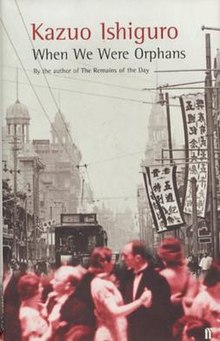
When We Were Orphans is very nearly a great novel. I am probably going to spend most of this post explaining why it is nearly great, and how it just falls short. But first, a quick plot summary. It’s important as always to understand that these summarises iron out the plot in a very unrepresentative way, particularly so in a novel such as this where the time structure is so complex. The narrator is Christopher Banks, who when we first meet him is an aspirational detective having recently graduated from

When We Were Orphans.jpg

Cambridge, ‘setting himself up in the world’ in London. Over the course of several chapters Christopher slowly tells the reader the story of his childhood in Shanghai. When he was ten his father, a businessman involved in the opium trade, went missing. Christopher was convinced (at the time, and remains so) that he was kidnapped. A few weeks later his mother, who had been vocally active in opposition to the opium trade, also disappeared. After weeks without any sign of them, he was eventually sent back to live with a maiden aunt in Shropshire, and from there on to public school. In the present, Christopher recounts several meetings with former school-friends as well as an attractive and ambitious young woman, Sarah Hemmings, who incidentally is an orphan, and comes to play an important role in his life.

Time passes, and we are told that Christopher has become a successful detective. His detection skills are such that he can visit the scene of a crime several months after the event, and still discern sufficient evidence to solve the crime. While are always told about these abilities by Christopher they are never demonstrated or explained in any detail – the crime are just solved. Despite any natural scepticism – is he really as good at solving crime as he thinks he is – his skills are widely recognised and lauded. This work is in preparation for his most important case, a return to China to solve the mystery of the disappearance of his parents. This return is much delayed, and matters are complicated when he – seemingly spontaneously – adopts a young Canadian orphan, but finally after several years he returns to Shanghai and begins to try to solve his parents’ case. His work is a matter of much public interest and his success is so much taken for granted that he is asked to confirm details of the arrangements for the ceremony when his successfully located parents are returned to freedom. However the deepening conflict between China and Japan makes the investigation even more complex than it would otherwise have been, and it is only at the last moment that the secret of what happened to his parents is revealed.

While reading When We Were Orphans – and I read it in one compelling sitting – two authors came to mind as comparators to help me make sense of what was going on (because at times, what was going on made no sense!). One obvious influence seemed to be Kafka. Christopher is disorientated, struggling through a world that increasingly no longer complies with the ordinary rules of behaviour, where strangers know more about him that he expects, and where the landscape becomes strangely fluid and confusing. Christopher is unable to satisfactorily explain what happens to him in the novel. Frequently his view of the world seems dramatically at odds with the people he meets. His memories of school vary wildly from former schoolfriends (to emphasise the point Ishiguro has this happen twice). People look at him strangely when he makes everyday comments. He gets angry when people misrepresent events from his past:

For gradually, from behind his cheerful anecdotes, there was emerging a picture of myself on that voyage to which I took exception. His repeated insinuation was that I had gone about the ship withdrawn and moody, liable to burst into tears at the slightest thing. No doubt the colonel had an investment in giving himself the role of an heroic guardian, and after all this time, I saw it was as pointless as it was unkind to contradict him. But as I say, I began to grow steadily more irritated.

There is a common perception among the people he meets that his investigation will in some unspoken way do more than locate his parents (who he unquestioningly believes are still alive) but also resolve the growing military and political tension between Japan and China which threatens to spill over into an international conflict.

The Kafkaesque atmosphere of the novel intensifies when the search for his parents reaches its climax. Working his way on foot through the ruins of a slum on the frontline between the Japanese and Chinese forces, he meets a badly wounded Japanese soldier who may or may not be his childhood friend Akira. They finally reach the building Christopher has become convinced is the place where his parents are being held, but inevitably he is wrong. He is whisked away by the Japanese forces and safely returned to the British consulate where he finds out the real fate of his parents.

Another type of unreliable narrator, where the author slowly and deliberately exposes the narrator’s delusions, and a more convincing ‘reality’ is shown, is more closely associated in my mind with Nabokov, and in particular with his extraordinary Pale Fire. For a long time I expected to find out that Christopher’s descriptions of his prowess as a detective, his childhood memories of his life in Shanghai, and his status within the ex-patriate community, were going to be revealed as delusional, (possibly as a result of an addiction to opium, which would have been ironic!). But while his account of his story is clearly flawed, the essential elements are apparently reliably narrated. He is, everyone agrees, an extremely successful detective, his prowess is widely recognised and appreciated, and he does survive the arduous journey along the front-line of the battle of Shanghai. Which leaves the many instances in which he is baffled by the behaviour of others around him, and they by him, unexplained. Ian McEwan does something similar in Enduring Love where the hints throughout the novel that the narrator’s account of the ballooning accident is flawed come to nothing, and the final chapters confirm that everything we have been told is true despite the many improbabilities and suggestions that ‘something’ is wrong with the account.

Why include scene after scene emphasising the unreliable nature of Christopher’s narration only to finally confirm its essential accuracy?

There are a couple of other issues I wanted to mention before closing. In a Guardian review of the novel, Philip Hensher focussed on the slightly awkward phrasing of much of Christopher’s narration:

“Ishiguro’s avoidance of phrasal verbs is a major problem here – it gives his narrator a circumlocutious, cautious air which isn’t really very helpful. More than that, it gives him a particular tone of voice which is not that of his social setting. It is bizarrely unconvincing as an idea of upper-middle-class London in the 1930s – I think Ishiguro will find that society beauties did not say ‘pardon’ then and do not now – and the inadequacy can be pinned down to the narrator’s voice, and his choice of verbs, as much as the details. “

This comment breaks a fundamental rule of reading, which is that if you notice something ‘off’ about a novel don’t just assume that it is a weakness in the author’s abilities as a writer (especially as we are talking about someone who had already won the Booker in 1989 with Remains of the Day). Instead ask the question – why? Why does it sound as if English is not the speaker’s first language? Could it be that Ishiguro is trying to convey the fact that Christopher lived for the first ten years of his life in China and is not convincingly part of the upper-middle-class world he circulates in? Is his fractured relationship with reality being conveyed here with his ‘circumlocutious, cautious air’? Giving a character a specific voice to illustrate their character wouldn’t be that revolutionary a technique would it?

Not wanting to end on too negative a note, but the novel’s description of the ‘fate’ of Christopher’s mother is grotesque and plays to very out-dated cliches about the Chinese. I’m not going to dwell on this or be more specific, and I am sure such things did happen occasionally, but it’s needlessly distressing.

So why ‘nearly great’? Even Ishiguro himself accepted that ‘it’s not my best book’. If he had been able to conclude the novel with an explanation that allowed the reader to make sense of Christopher’s confusion, his apparent ability to solve long-past crimes with the aid of just his slightly ridiculous, sub-Holmesian magnifying glass, and the many conversations where there is obviously a big gap between what he tells us and what is ‘actually’ perceived by the other characters, then the novel would have been an exciting mystery. I still enjoyed reading the novel, but I was so disappointed in the lacklustre ending where everything that had been promised failed to materialise.

When We Were Orphans, by Kazuo Ishiguro, 2000

Aside
Book review

I mentioned this novel in passing in my review of Howard Jacobson’s The Finkler Question earlier this month, so when I came across it in a local second-hand bookshop it seemed like fate. I’ve gone off Kingsley Amis over the years. I started out as a big fan – I loved Lucky Jim – but the more I read of him, and about him, the less I liked his attitudes to women and ethnic minorities and the more I saw those attitudes reflected in his novels, particularly those he published towards the end of his career. These novels, such as Stanley and the Women and Jake’s Thing often degenerated into self-parodies in which the central character bore a strong resemblance to Amis himself, who always wound up in bed with the young and attractive women characters.

TheAlteration(1stEd).jpg

I am glad to say The Alteration is an exception to that rule. It is an alternative history novel set in an England where the reformation never took place. Writers of alternative histories usually chose more recent historical events as the moment from which to diverge their timelines. Sarajevo 1914 perhaps, the various turning points of the second world war (for example, Philip K Dick’s The Man in the High Castle) or the rise of fascism in the 1930’s (for example Sinclair Lewis’s It Can’t Happen Here or Philip Roth’s The Plot Against America). Here Amis goes all the way back to Tudor England. Henry 7th first son, Arthur Tudor, Prince of Wales, married Catherine of Aragon in 1501 and died less than a year later, leaving Henry 8th to inherit the throne. Whether their marriage was ever consummated became a fierce point of contention after Arthur’s death and Catherine’s remarriage to Henry. Amis imagines that Arthur didn’t die prematurely and that he and Catherine went on to have a son who becomes king. This is the butterfly effect moment from which a whole series of changes to English and world history flow – no break with Rome, no Church of England, and no Reformation.

The world of 1976 is recognisable but very different to our own as these changes have rippled across the world. Catholicism is the dominant religion across Western Europe, with a muted version of Protestantism existing only in North America, now the Republic of New England. Ireland is “West-England” and Scotland “North-England”. The English Isles are a theocracy run by the priesthood with church law brutally enforced by the Holy Office, a secret police. In this timeline Himmler and Beria are mentioned as priests doing god’s work by suppressing dissent and punishing apostasy – Amis’s point being evil will always find means of coming to the surface.

Europe has emerged very differently without the Reformation. Royal families still rule Portugal, Sweden, France and Russia, and the Italian and Germany nation-states have not formed (due, it is implied, to the strength of the Papacy). Western Europe is in perpetual conflict with the Ottoman Empire, in a manner very reminiscent of both the wars of 1984 and the Cold War. This long-running conflict serves to give the people a common enemy and even more cynically acts as a way of keeping the population in check. The novel portrays the papacy as a brutal manipulator of geo-political forces, cynically engineering war to help keep the population under control when more direct biological warfare experiments have failed.

Culture and the arts have also developed very differently in this alternative world, although again Amis insists that the great artists would have emerged one way or another. Shakespeare’s plays are banned but survived and are performed in New England. Shelley, Mozart, Beethoven, Blake, Hockney and Holman Hunt are all named-checked but are now religious writers or musicians in the service of the Church. The other significant difference in this world is the approach to technology. “Science” is disapproved of by the church, electricity is banned, and planes are yet to be invented. Instead steam is the dominant technology – this is literally a steam-punk world.

This is all by way of background to the fairly slight plot. The title refers not simply to the altered world but also to one specific person in it, namely Hubert Anvil, a ten-year old chorister. He has the voice of an angel and the Church decides to preserve it from the predations of puberty by castrating him. The history of castrati and the involvement of the Catholic Church in the practice of castrating young men to preserve their high voices is a fascinating one – the last known castrati died only 100 years ago. This is not a novel where the pros and cons of allowing young boys to be castrated are weighed carefully – Amis is clear this is an abomination, a form of abuse derived from the Church’s distorted attitudes towards sex. (The vows of chastity taken by members of the church and its hierarchy are widely ignored.) The narrative core of the novel follows Hubert’s attempts to evade this fate, running away to London and seeking help from the New England ambassador. Amis deploys a crude deus ex machina to end the novel, suggesting that he loses interest in his characters once his points about the church and its damaging role in society had been scored.

Amis really commits to his concept, and paints a very detailed picture of life at all levels in his alternative timeline. It’s this exploration that seems to interest him and the narrative in which Hubert runs away is not that exciting or convincing. The author makes his views on the Catholic church’s attitudes towards sexuality very clearly and the reader is left in no doubt about the dangers of mixing church and state. The absence of adulterous middle-aged avatars for Amis and his friends was a bit of a relief, even if The Alteration was to prove a short term diversion from the main business of grumpily chronicling yet another alcoholic affair.

The Alteration by Kingsley Amis, 1976

Aside
Book review

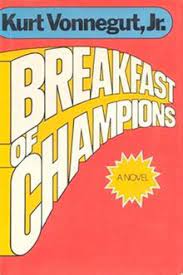
Breakfast of Champions has sat on my bookshelves for so long I somehow fooled myself into thinking I had read it. How it came to be there unopened and unread will remain a mystery. It is a chaotic novel about writing a novel, the most ‘meta’ work I think I have ever read. Vonnegut doesn’t just tell the reader they are reading a novel, he kicks down the fourth wall and dances on the rubble. It’s also illustrated on almost every page with very simple drawing that to be honest add little to teh narrative but fill in some space.

The narrative structure is based around a series of events that lead up to the meeting between one of Vonnegut’s regular characters, Kilgore Trout, a prolific and heroically unsuccessful and unappreciated science fiction writer, and Dwayne Hoover, a businessman who is slowly going insane.

But this is not really a novel that can accurately be described as being ‘about’ anything, certainly nothing as simple as a story of characters doing things in a linear ‘this, then this’ fashion. It’s far too anarchic for that. The time structure is random, even though the traditional ordering of cause and effect keeps trying to reassert itself. Ostensibly the novel tells how Trout travels to the Midland City Arts Festival. Even though his stories are usually published as filler in pornographic magazines, he has one supporter who also happens to be a sponsor the Arts festival and who arranges for Trout to be a guest speaker at the event. He travels there via New York where he gets beaten up by “The Pluto Gang” (I couldn’t work out why, it just feels like a scene inserted at random) and then hitchhikes to the festival. Meanwhile in Midland City Hoover’s mental health deteriorates. They finally meet at the Holiday Inn where Trout’s bizarre behaviour seems to trip Hoover over the edge. He goes berserk, attacking people at random, biting Trout’s finger off, and ends up being committed to an asylum. The novel ends with Trout meeting the narrator author, who demonstrates his omniscience by sending Trout through space and time.

This is a strongly political novel. Trout sees America from the point of view of an outsider. He is acutely aware of the ridiculous elements of society, its injustices and not least its obsession with sex (every male character is introduced with a description of the length and girth of their penis – every female character is introduced with a description of the dimensions of the husbands/boyfriend’s penis). This is Vonnegut’s/the narrator’s explanation for the obsessive description of every mundane object he encounters, the rejection of any element of traditional storytelling:

As I approached my fiftieth birthday, I had become more and more enraged and mystified by the idiot decisions made by my countrymen. And then I had come suddenly to pity them, for I understood how innocent and natural it was for them to behave so abominably, and with such abominable results: They were doing their best to live like people invented in story books. This was the reason Americans shot each other so often: It was a convenient literary device for ending short stories and books.
Why were so many Americans treated by their government as though their lives were as disposable as paper facial tis-sues? Because that was the way authors customarily treated bit-part players in their made-up tales.
And so on.Once I understood what was making America such a dangerous, unhappy nation of people who had nothing to do with real life, I resolved to shun storytelling. I would write about life. Every person would be exactly as important as any other. All facts would also be given equal weightiness. Nothing would be left out. 

Racism is a persistent theme in Breakfast of Champions. The black characters are treated appallingly (and upsettingly) by many of the white characters and are described as being used “for machinery, and, even after slavery was eliminated, because it was so embarrassing, they and their descendants continued to think of ordinary human beings as machines.” This is probably why Vonnegut casually and repeatedly uses the n-word in a way that writers working today simply would not consider. It makes it an uncomfortable read.

description

The other central theme in the novel is the concept that humans are all simply machines, all of us that is except Vonnegut or perhaps Trout or the narrator. This idea, that we are all really just meat machines without free will, is one of the oldest philosophical conundrums in existence. Vonnegut introduces the idea as a statement of fact rather than a debating point, and it underlines his sense of alienation from his characters – we the readers are all just characters without autonomy in a story told by an idiot who doesn’t really understand the world.

This is a very unconventional novel. It has some of the trappings of a traditional story – two characters destined to meet at the end of the novel, having adventures on the way – but the reader is consistently reminded the are just reading a story, that the characters and settings aren’t real, and that the author can capriciously change their fates whenever he so chooses. The insistent definitions of mundane objects underlines this pointlessness. It all combines to make Breakfast of Champions a challenging and interesting read, but not one I would be able to really recommend. It many ways it is not a novel at all, but a book of random thoughts and ideas, strung together round a storyline which even the author doesn’t find interesting.

Breakfast of Champions by Kurt Vonnegut, 1973

Aside
Book review

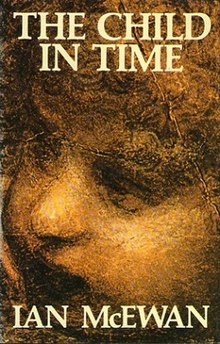
The Child in Time by Ian McEwan, 1987

Some time back in an earlier post I mentioned George Orwell’s essay Politics and the English Language. In that essay Orwell lists the many ways in which writers use ‘bad’ English, including ‘dying metaphors’:

“A newly invented metaphor assists thought by evoking a visual image, while on the other hand a metaphor which is technically ‘dead’ (e. g. iron resolution) has in effect reverted to being an ordinary word and can generally be used without loss of vividness. But in between these two classes there is a huge dump of worn-out metaphors which have lost all evocative power and are merely used because they save people the trouble of inventing phrases for themselves…Many of these are used without knowledge of their meaning (what is a ‘rift’, for instance?), and incompatible metaphors are frequently mixed, a sure sign that the writer is not interested in what he is saying. Some metaphors now current have been twisted out of their original meaning without those who use them even being aware of the fact.

Sketch of the face of a young child

The long-winded reason I have highlighted this quote is because Ian McEwan’s 1987 The Child in Time is very much a curate’s egg – and ‘a curate’s egg is a classic example of a dying albeit very specific metaphor which is invariably used incorrectly. Originally it meant ‘something that has good and bad parts’ but where the bad parts are so bad as to spoilt the overall effect’. Which would be the case where parts of an egg are bad. In other words the phrase is meant ironically – it suggests some parts of the egg (or whatever) are not bad, whereas in fact they are. So it’s quite a subtle phrase – far too subtle for some writers and speakers who adopt the phrase unthinkingly to mean ‘something with good and bad parts’. This usage is so widespread that many dictionaries have given up the struggle and now use the latter definition – so for example Wikipedia defines the phrase as

something described as partly bad and partly good. In its original usage, it referred to something that is obviously and entirely bad, but is described out of politeness as nonetheless having good features that redeem it. This meaning has been largely supplanted by its less ironic modern usage”.

Stephen Lewis is a fairly archetypical McEwan central character. He is a children’s writer and aspiring novelist, recently and moderately happily married, with a three year old daughter, Kate. The puzzling success of his children’s stories distresses him as he wants to be considered a serious writer – which is the classic definition of a first world problem if ever there was one. I don’t know if we are supposed to empathise with Lewis about this problem, or laugh at him, but he soon has much more serious concerns. On a routine visit to the supermarket Kate goes missing. Is Kate the ‘child in time’? Perhaps. Kate’s disappearance is obviously deeply traumatic and Lewis devotes all his time and energy to trying to find her, with no success whatsoever. The police investigation fizzles out quickly, and media interest in the case moves on. The search places an unbearable strain on his marriage, which slowly collapses.

Principally as a distraction once his search is finally abandoned, Lewis joins a government committee on childcare. He has no particular interest in the details of the committee’s work, but it gets him out of the house. He spends the rest of his days lying on the sofa drinking scotch and watching mindless TV programmes. His wife, Julie has by now moved away to the countryside and become a recluse.

Stephen occasionally visits his close friend, Charles Darke, also on the childcare committee. Darke who was in charge of publishing Lewis’s first novel and is now a junior Minister in the Government, and a rumoured future Prime Ministerial candidate. Darke’s wife, Thelma, is a quantum physicist who engages Stephen with her outlandish theories on time and space. At the behest of Thelma, who believes Stephen’s marriage with Julie is salvageable, he makes an effort to reconnect with Julie by visiting her. Although he has never visited the remote town where she now lives, he feels strangely familiar with the place – especially a pub he passes on the way. There he experiences an event that he cannot explain: he sees his parents as a young couple in a pub, before they were married, an event they later confirmed to have happened. This supernatural experience remains unexplained, but obviously is linked to the ‘in time’ theme of the novel’s title. Though Julie and Stephen temporarily reconnect during his visit and sleep together, Kate’s absence has become too great a divider between them and they part believing it impossible to overcome her loss.

The childcare report is finally published. The Government intervenes and ensures the recommendations are changed to suit its political agenda, and although this interference is exposed the Government brazens it out and ignores the criticism. Who would have known that politics is a dirty business? These scenes in the novel manage to be both very contemporary given the current Government’s manoeuvring to avoid one of its members being suspended for example and at the same time quite dated – we are now a lot more cynical about these things.

In the meantime Darke and his wife abandon their lives in London for seclusion in the countryside. Prompted by a comic encounter with the Prime Minister, Stephen goes to visit and finds that Charles has regressed into a child-like state, a form of infantilism. Intellectually he seems unimpaired, but he is childish and uninterested in the outside world or his previous life and responsibilities. Perhaps Charles is the child in time?

The novel ends with a death and a birth, which seems an almost traditional way of concluding a story. But I started this review by explaining why I thought the novel’s central flaw spoiled the overall impact. If you are going to use the supernatural (or time travel if you prefer) as a plot mechanism, you are going to have to have a good reason for doing so. Whatever A Child in Time is, it is not magical realism where the laws of nature are optional extras. If you have a hyper-realistic novel (and if this is not a realistic novel then why should we care about Kate’s disappearance or the anguish it causes her parents?) then why does it need the magical appearance of time-travel to progress the story. It just felt utterly redundant and more than a bit silly, like a weak episode of Doctor Who.

The opening chapters of the novel in which Kate disappears are very powerful, but once she has gone it seems McEwan wasn’t sure what to do with the novel, and grafted on the Darke storyline with its fairly heavy-handed political commentary. The whole is much less than the sum of its parts. This is still relatively early McEwan, and I want to avoid saying it shows promise, because that is obviously hindsight talking, but it does. But if you are interested in exploring his novels this is definitely not where I would start. Atonement is obviously wonderful, but my personal favourites are Sweet Tooth, a superbly clever variation on the traditional spy novel, and the extraordinary, exquisite novella On Chesil Beach.

Standard
Book review

ArthurRansome SwallowAndAmazons.jpg

Children’s novels read by adults often seem very different from one’s memories when you read them the first time around. Swallows and Amazons is no exception to this rule. In my memory the novel described a long summer spent messing around in boats – in fact it only lasts a little over a week. It features the four lively and imaginative Walker children – John, Susan, Titty and Roger. They camp out on a small island in a lake (the lake is never named but it is clearly based upon Lake Coniston, where Ransome once spent a summer teaching the children of some friends to sail) and have adventures. Later they are joined by the Blackett children, two girls (the Amazons) who they initially feud with but quickly befriend. Their island – Wild Cat Island – seems small to adult eyes – they can run from one end to the other in minutes – and is close to home. It is a tribute to the author’s ability to capture the children’s imaginative play so realistically that younger readers join in and are able to see the adventures through the children’s eyes.

Age and gender determines role of the crew of the Swallow – John is captain, Susan first mate (which seems mainly to involve cooking and washing up), Titty (renamed Tatty when the novel was dramatised for television recently) is able-seaman, and Roger is the ship’s boy. As the eldest John assumes a leadership role, and is stiff-upper-lipped even in moments of crisis. He gets upset when his integrity is challenged by an adult, but manages to suppress his emotions. A discrete word with his mother on one of her visits to the island helps him overcome this upsetting experience. Susan embraces the domestic role she is allocated, bossing the other children around and at one point declining to join in their play because she has too much tidying up to do. Titty is a stereotypical tom-boy, and it is no surprise that it is her adventurousness that helps the Swallows win their war. Roger the youngest is often told he is not allowed to do things (such as hold the matches) but he accepts these constraints without too many protests – he knows his place.

As is almost always the case in novels of this genre, parents are conspicuous by their absence. The Walker children’s father is in the Navy, in Malta on route to Hong Kong, although he remains in charge of the major decisions such as whether to allow the children to camp out on the island, answering in typically brusque fashion “Better drowned than duffers, if not duffers won’t drown.” The Blackett children’s father is never mentioned. But they aren’t left to run as wild as they believe – their Australian mother (who obviously is quite relaxed about the risks they take sailing on the lake) drops in on them regularly, and the people at the local farm where they get milk every day report back to her on their activities.

The Swallows challenge the Amazons to a war to decide leadership of their group. This is quickly won by the Swallows, due to Titty’s bravery, and they then agree to join forces against a common enemy – the Blacketts’ uncle Jim who they call Captain Flint. Hostilities with Captain Flint have been declared because he won’t play with them, deciding instead to write his memoirs. The Amazons start the war by letting off a firework on his houseboat roof, although the Swallows end up getting the blame for this. This was a more innocent time when an adult playing pirates with children was not a cause for concern or comment.

There is a lot of nautical detail in the novel, with long sections devoted to the minutiae of sailing which I make no apologies for skipping occasionally. Does this make much sense to you?

Nancy took a length of rope from the stern and made a noose at one end of it. Then she and Peggy hove up the barrel till it rested on the gunwale in the bows. John and Susan held it there, while the Amazons came ashore with the rope and one of the oars. Nancy fixed the rope round one end of the barrel and made it fast so that it could not slip. Then she took two turns of the rope round the oar and brought the rope down and through the loop, then along the top of the barrel and round it, to make another noose at the end, then twice round the oar and down again, and made it fast.”

The structure of the novel is strongly reminiscent of the Famous Five/Secret Seven books by Enid Blyton – rosy-cheeked English children roam freely across the idyllic countryside eating unpleasant pre-war food and drinking ‘pop’, yearning for adventure and eventually stumbling across it. Class prejudice is not as obvious as in the Blyton books, but is implicit in the children’s attitude towards the locals, who they refer to as savages. Fortunately there is none of the casual racism that often mars Blyton’s stories. There is some sexual stereotyping, particularly as regards Susan’s domestic role-playing, but this is offset by Titty and the Blackett’s tomboyish approach to play.

I always start these blog posts with the novel’s title, the author’s name, and the date of publication. If I am not sure of the date I will pencil in a guess, then check it and correct as required. My first guess at when Swallows and Amazons was published was 1905, 25 years earlier than when it came out. Why so badly wrong? The simple explanation is that the novel has a distinctly almost overwhelmingly Edwardian atmosphere. The children are all irrepressibly middle class, incredibly well spoken and highly independent. Their families are clearly prosperous – the Walker children’s baby sister, Vicky, is looked after by a nurse (aka a nanny), and the Blackett children (the Amazons) have a cook. Domestic servants were fairly common in middle class families in the nineteenth century, but by 1930 they were increasingly rare. The First World War and alternative work opportunities thereafter for women in retail and clerical roles led to a dramatic fall in numbers of servants, although the interwar slump had started to reverse that trend before the outbreak of the second World War ended it for good. Overall there is an old-fashioned feel to the novel, suggesting that it is set in an earlier age when children could run wild and be trusted with sail-boats, matches and axes without social services being called to investigate. It’s possible the novel is set in the pre-War period although there are no time references to indicate that – which in turn gives it a nostalgic timelessness.

Ransome went on to write a whole series of Swallows and Amazons novel. This might be unfair but I suspect they are all very similar – why change a winning formula? I was expecting something more nuanced and interesting from someone who spied for Britain in revolutionary Russia and who met some of the key protagonists personally, but I don’t think this was just a matter of Ransome writing children’s stories to pay the bills – it seems as if Swallows and Amazons was the book he always wanted to write, and his obvious affection for sailing and the Lakes shines through.

Swallows and Amazons by Arthur Ransome, 1930

Aside
Book review

John Ronald Reuel Tolkien was born in 1892 in what is now South Africa. His father died just four years later in 1896 and his mother not much longer after that in 1904. After university Tolkien served in the first World War in which he saw almost all his former school friends die. I rarely have much time for commentators who draw parallels between the personal experiences of authors and the events of their novels, but I am going to make an exception here. Orphaned at such an early age the appeal to him of fantasy worlds must have been compelling. I can picture Tolkien in the trenches of the First World War, covered in mud and lice, looking out at the devastation of no-man’s-land, and remembering spring back in England. This must surely have influenced this poignant scene in The Return of the King in which Sam and Frodo look over the wastes of Mordor and fondly remember the Shire.

“Do you remember the Shire, Mr. Frodo? It’ll be spring soon. And the orchards will be in blossom. And the birds will be nesting in the hazel thicket. And they’ll be sowing the summer barley in the lower fields… and eating the first of the strawberries with cream. Do you remember the taste of strawberries?”

The scenes as the hobbits return to the Shire after their adventures, changed physically and psychologically, and for Frodo never quite fully recovered, can also be seen as an allegory for challenges faced by the troops returning from the front after the war. All the hobbits survive the war, as do all their friends except Boromir and Theoden – in reality the cost of the Great War was far deadlier.

As with The Two Towers, The Return of the King consists of two separate books telling the parallel stories of Frodo’s journey into Mordor, and the battle of Minas Tirith, the principal city of Gondor, the kingdom of men in Middle Earth. These stories are told through the separate and diverging tales of the surviving members of the fellowship. Gandalf and Pippin travel to Minas Tirith to rally the defence of the city from the imminent storm from Mordor. The city is in chaos with Denethor the Steward having to all intents and purposes having abdicated his role, leaving it to Gandalf to rally the defence of the realm. Merry stays with Theoden while he raises the Rohirrim to ride to Gondor’s aid. Aragorn, Legolas, and Gimli, accompanied by the Rangers of the North, take the ‘Paths of the Dead’ to recruit the ghosts of Dunharrow, bound by an ancient curse to fight for the King of Gondor, to fight on their side. By this route Aragorn slowly reclaims his throne – the Return of the King. The Army of the Dead defeat the Corsairs of Umbar, Sauron’s fleet, and uses their ships to sail to the relief of Minas Tirith. The arrival of both the Rohirrim and the Southern forces turn the tide of battle against Sauron’s forces, but the critical blow is struck by Éowyn, who having travelled to battle in disguise, kills the Lord of the Nazgûl. There is a short pause for the dead to be buried. Gandalf and Aragorn call a war council, and announce an audacious plan to march on Mordor, to distract Sauron and give Frodo and chance of finishing his quest. It is before the Black Gates that this breathless chapter of the story closes,

In the parallel Ringbearers plot-line, Sam rescues Frodo from Cirith Ungol, where he has been taken after being paralysed by Shelob. Their journey across the barren wastes of Mordor is arduous and exhausting, and they are tracked every step by Gollum. This is where the novel is probably the hardest to read – Tolkien does an astonishing job of conveying the physical difficulties of crossing this wasteland, leaving the reader exhausted. But their luck holds, and the attack on the Black Gates clears their way to Mount Doom, which astonishingly is unguarded. At the last, Frodo is unable to resist the Ring and claims it for himself. Gollum has followed Sam and Frodo all the way, and chooses this moment to bite off Frodo’s finger with the Ring still on it. Celebrating wildly, Gollum stumbles and falls into the volcano, taking the Ring with him. Sauron power is switched off like a light, and is kingdom crumbles. His armies collapse and are swept away by Aragorn’s forces.

Finally the two parallel storyline can combine. Sam and Frodo are rescued from Mordor by the ever reliable eagles, and in the days that follow Aragorn is crowned King. He weds Arwen, daughter of Elrond. Éomer is crowned King of Rohan and Éowyn marries Faramir, Prince of Ithilien. While this might all seem a little trite and convenient, Tolkien handles the material well and it doesn’t seemed forced. The journey back to the Shire is a procession via some of the locations visited on the outward journey, including spending time with a now aged Bilbo in Rivendell. But when the hobbits finally arrive back in the Shire they find it has been taken over by men. Sam had had a vision of this happening when he was in Lothlorien. The hobbits raise a rebellion and scour the Shire of men, who it turns out had been organised by a spiteful and vindictive Saruman. This reveal is a little in the spirit of Scooby Doo, but the damage done to the Shire is easily put right. These final scenes are when the novel is at its most allegorical. The construction of houses and factories, and the cutting down of trees across the Shire are a clear metaphor for the industrialisation of rural England. But the damage done derives not from just Saruman’s evil but by the new comers to the Shire, foreigners with alien ways. It’s hardly surprising that a Oxford professor born in the reign of Queen Victoria would have old-fashioned views on development and immigration, and to be fair to Tolkien there are plenty of other moments in the novel’s where he takes a more progressive stance. In the novel’s final chapters Frodo, Bilbo and Gandalf join the last of the elves to set sail from the Grey Havens across the sea in a metaphor for death.

The Lord of the Rings has come in for some criticism for its portrayal of the role of women. The Fellowship is indeed an all-male boy’s club. You could try and explain this by seeing the LoTR as a dramatisation of the First World War – there were very few women in the front line. But Tolkien appears to notice that the earlier novels are dominated by male characters, and responds by introducing several strong women. Of these Eowyn is the most significant. She subverts the expectations of her family and her people by refusing to accept the submissive role allocated to her by Théoden and later Aragorn:

“A time may come soon,” said he, “when none will return. Then there will be need of valour without renown, for none shall remember the deeds that are done in the last defence of your homes. Yet the deeds will not be less valiant because they are unpraised.”

She answered: “All your words are but to say: you are a woman, and your part is in the house. But when the men have died in battle and honour, you have leave to be burned in the house, for the men will need it no more. But I am of the House of Eorl and not a serving-woman. I can ride and wield blade, and I do not fear either pain or death.”

What do you fear, lady?” he asked.

“A cage,” she said. “To stay behind bars, until use and old age accept them, and all chance of doing great deeds is gone beyond recall or desire.”

This passionate refusal to accept her traditional gender role of care-giver is moving, and not at all undermined by her eventual choice to become Faramir’s wife – she has by then done great deeds, including riding to war against the direct orders of her king, and slaying the Witch King of Angmar:

“But no living man am I! You look upon a woman. Éowyn I am, Éomund’s daughter. You stand between me and my lord and kin. Begone, if you be not deathless! For living or dark undead, I will smite you, if you touch him.”

Eowyn is admittedly not the complete feminist role-model. She pines after Aragorn, and at times seems more interested in following him that going to war, the latter being the way of remaining by his side. But this is high fantasy from the 1950’s after all, and a big step forward compared to the female-free zone that is The Hobbit.

I mentioned in my review of The Two Towers that some of the most moving, powerful lines from the Peter Jackson films were taken directly from Tolkien. The same applies to The Return of the King. Sam and Eowyn’s lines quoted above have a huge impact, and Theoden’s speech to the Rohirrim is a genuinely hairs on the back of the neck moment:

“Arise, arise, Riders of Théoden! Fell deeds awake, fire and slaughter! Spear shall be shaken, shield be splintered, a sword-day, a red day, ere the sun rises! Ride now, ride now! Ride to Gondor!”

It’s been a genuine pleasure to return to Middle Earth for a few weeks. I know the length of the novels (over 1500 pages) and the songs can be off-putting for some, but for anyone who has only seen the films the novels will be particularly worth the effort as whole new layers of depth are revealed.

Lord of the Rings: The Return of the King, by J R R Tolkien, 1955

Aside
Book review

The Two Towers, the second book in the Lord of the Rings trilogy, and sequel to The Fellowship of the Ring, is in effect two shorter novels – The Treason of Isengard, which follows Aragorn and the remainder of the fellowship in the battle against the forces of Saruman, and The Journey of the Ringbearers/The Ring goes East following Sam and Frodo as they travel further into the badlands beyond Gondor. In the Peter Jackson film these two storylines are intertwined, with regular cutting between the two – Tolkien took the bold choice of keeping the two entirely separate. I doubt if an author writing today would make this choice: it requires patience on the part of the reader who has to wait several hundred pages before finding out what is happening to the Ringbearer.

The Two Towers - Wikipedia

In the past I have been a little confused about which were the two towers in question, but that seemed a bit slow of me. On a re-read it is completely clear: the towers are Orthanc, Saruman’s base, and Barad-dûr, Sauron’s tower in Mordor. Or so I thought. But the internet tells me I am wrong. Apparently Tolkien invented the novel’s title whilst under deadline pressure and wasn’t happy with it, recognising its ambiguity – there are a lot of towers in Middle Earth! Eventually he settled on them being Orthanc (Saruman’s tower) and Minas Morgul (in Mordor, but not Sauron’s principal base). This is genuinely puzzling – there are two main bad guys in LoTR, Saruman and Sauron. They even have contrasting colour emblems – the white hand of Isengard and the black everything of Barad-dur. One is defeated in The Two Towers, the second in The Return of the King. Rather than just being Saruman’s servant, as I had originally supposed, Saruman plans to take the One Ring for himself, and challenge him for control of Middle Earth. So the two towers are the twin centres of evil in Middle Earth, and both have to be defeated. There’s a structural symmetry in having the two towers represented by Saruman and Sauron’s bases which is lost with any other allocation. Of course the defeat of Saruman ends up as a surprisingly straightforward affair, a warm-up act for the much trickier task of bringing down Sauron in The Return of the King. This tower-related ambiguity doesn’t matter a great deal one way or another, but the anomaly is surprising – Tolkien devised his world with such extraordinary detail that for this fairly significant issue to be left unresolved grates a little.

The Treason of Isengard

The first book in The Two Towers follows Merry and Pippin, who you will recall had been captured by orcs and are being taken to Saruman’s fortress in Isengard. Gimli, Legolas and Aragorn are running after them. The orcs’ journey is intercepted by some of the Riders of Rohan, and in the battle that ensues Merry and Pippin escape into nearby Fangorn forest. Here they meet Treebeard, leader of the Ents. Ents are a cross between trees and trolls, and when roused to anger they can be particularly dangerous, as Saruman is about to find out. He has been chopping down lots of trees down to fuel his furnaces, and the Ents, prompted by Merry and Pippin, decide to do something about it.

Aragorn, Gimli and Legolas are told by the Riders that the orcs they were following have been wiped out in battle. Unable to quite believe this includes the hobbits, Aragorn tracks them into Fangorn. The stage is set for the big reveal: in the forest they meet a white wizard who they initially believe to be Saruman, but who is in fact (spoiler alert) Gandalf. He tells them of his struggle with the Balrog, which seems to have given him even more magical powers – he is now Gandalf the White (it is suggested that this gives him a position of supremacy over the other wizards in Middle Earth, not least Saruman). Tolkien leaves the resurrection of Gandalf a daringly long time, making the impact of his return all the more powerful.

Leaving the search for the hobbits – they are reassured they are in safe Entish hands – they ride to Edoras, capital of Rohan. Theoden, king of Rohan, has been magically enslaved by Grima Wormtongue, who we later found out has been working undercover for Saruman. Theoden is restored by Gandalf and calls his army to war. Rohan’s armies and people fall back to Helm’s Deep while Gandalf goes to seek reinforcements. (Peter Jackson takes some liberties with this part of the storyline, but retains the essential spirit of the narrative.) The scene is set for a siege of Saruman’s army of orcs; the city nearly falls until Gandalf returns with said reinforcements. The victorious army of Rohan and our surviving Fellowship members now travel to Isengard, where they are reunited with Merry and Pippin. Saruman’s fortress has been destroyed by the Ents, but Saruman himself is refusing to leave his Orthanc. Gandalf counsels that he be left to rot there. But the victory is tainted by an unfortunate incident with a palantíri, another Middle Earth maguffin. Palantirs are magical crystal balls that allow people to communicate over long distances (mobile phones in other words). Pippin takes a peep into the palantir and is locked onto by Sauron, who can read his mind. Gandalf takes Pippin urgently to Minas Tirith capital city of Gondor, to prepare for war, leaving the Riders of Rohan to follow on as soon as possible.

The Ring Goes East

Book 4 is the sequence is also subtitled The Ringbearers go East. Note the interesting use of the plural – at this stage only Frodo and Gollum are ringbearers, although in The Return of the King Sam also wears the ring briefly. The narrative picks up immediately from the end of the Fellowship. Sam and Frodo are trying to find their way out of the hills they are stuck in, but are hopelessly and dangerously lost until they discover Gollum has been stalking them. They capture him and persuade him to lead them to Mordor. In Ithilien, the land that borders Mordor to the East of the Great River, they are captured by Faramir, brother of Boromir. Faramir is leading a raiding party trying to find out more about Sauron’s invasion plans. Although Faramir finds out about their quest, he forgoes the temptation to take the ring back to Gondor – he is stronger than his brother in that respect. Gollum leads them safely into the mountains that surround and protect Mordor, but his cunning plan is finally revealed – he has been leading them all this time into the lair of Aragog sorry Shelob, a huge, ancient spider. She stings or bites Frodo apparently killing him. Sam fights her off. Faced with the awful choice of staying with Frodo’s unresponsive body or pushing on with the quest, he decides to take the Ring himself and try to reach Mount Doom. It is not long before he finds out that Frodo was only paralysed by Shelob – she likes her meat kept fresh – and the novel closes with Frodo taken prisoner by the orcs guarding the pass into Mordor, and Sam’s position seemingly hopeless. He does have the ring safe in his possession though.

I know I keep coming back to the Peter Jackson films, but what struck me on this reread was that the moments the films really have an emotional impact is when the language is drawn from Tolkien’s original lines in the novel. For example, Aragorn’s song about the Riders of the Mark:

Where now are the horse and the rider? Where is the horn that was blowing?
Where is the helm and the hauberk, and the bright hair flowing?
Where is the harp on the harpstring, and the red fire glowing?
Where is the spring and the harvest and the tall corn growing?
They have passed like rain on the mountain, like a wind in the meadow;
The days have gone down in the West behind the hills into shadow.
Who shall gather the smoke of the deadwood burning,
Or behold the flowing years from the Sea returning

are given to Theoden in the film before the battle at Helms Deep. Or when Sam and Frodo reminisce about the Shire, and wonder if one day their tale will be remembered:

“Still, I wonder if we shall ever be put into songs or tales. We’re in one, of course, but I mean: put into words, you know, told by the fireside, or read out of a great big book with red and black letters, years and years afterwards. And people will say: “Let’s hear about Frodo and the Ring!” And they will say: “Yes, that’s one of my favourite stories. Frodo was very brave, wasn’t he, dad?” “Yes, my boy, the famousest of the hobbits, and that’s saying a lot.”
‘It’s saying a lot too much,’ said Frodo, and he laughed, a long clear laugh from his heart. Such a sound had not been heard in those places since Sauron came to Middle-earth. To Sam suddenly it seemed as if all the stones were listening and the tall rocks leaning over them. But Frodo did not heed them; he laughed again. ‘Why, Sam,’ he said, ‘to hear you somehow makes me as merry as if the story was already written. But you’ve left out one of the chief characters: Samwise the stouthearted. “I want to hear more about Sam, dad. Why didn’t they put in more of his talk, dad? That’s what I like, it makes me laugh. And Frodo wouldn’t have got far without Sam, would he, dad?”‘
‘Now, Mr. Frodo,’ said Sam, ‘you shouldn’t make fun. I was serious.’
‘So was I,’ said Frodo, ‘and so I am
.

Which is played out almost verbatim in the scene early in the film between Sean Astin and Elijah Wood. The touching relationship between Sam and Frodo is at the heart of the second book of The Two Towers (and even more so in The Return of the King). Tolkien handles this comradeship sensitively and honestly, not afraid to show the love and affection between the two hobbits.

As the novel that bridges the opening and closing of the story of the One Ring, The Two Towers inevitably runs the risk of lagging. If as a reader you are engaged in Tolkien’s world-building and mythologising, the novel can’t be long enough. If you are not it will probably drag. Certainly there are new elements – this is not just travelling, being rescued, more travelling – although I can’t deny there’s plenty of both, as you would expect in any quest epic. We know following Boromir’s death at the end of The Fellowship that Tolkien’s character’s plot armour is not impenetrable, so Gandalf’s return will be a genuine surprise for many less cynical readers, and we will fear for Frodo after his encounter with Shelob – perhaps Sam is the hero of the story after all? There is less incessant poetry in this novel than the first (perhaps Tolkien’s editor had a quiet word with him?) which is certainly an improvement. It is important to remember that Lord of the Rings is just one very long novel that for the sake of convenience was originally published in three parts, so judging the Two Towers on its merits alone is pretty unfair. I think Tolkien does a good job of keeping the plot moving even after having torn up the original fellowship goes to Mordor script. This allows him to explore Middle Earth in more depth, and to develop storylines for all the hobbits, Merry and Pippin in particular, rather than just having them for light relief.

Lord of the Rings: The Two Towers, by J R R Tolkien, 1955

Aside
Book review

A while back I wrote a blog post about the different ways one can read a book, trying to answer the question – what does it actually mean to say that you have read a novel? I found ten different flavours of reading, but I missed number 11- possibly the best way of reading a novel is to do so collectively. I don’t mean with other people in a book club (I suppose that would be number 12), where you get together at the end, admit you didn’t finish it, and then drink some wine. Nor do I mean a group reading in a big circle, taking turns (13). No, I am thinking of reading a novel at the same time as your friends, meeting them the next day, and comparing notes. That’s the way I first read The Lord of the Rings many years ago and I recall it as a special experience. My friends had spotted things I had missed, they had read chapters I was yet to reach, they interpreted events differently from one another, and of course we all made wild guesses about what was going to happen. We enthused about Tolkien’s world-building, his characterisation, his descriptive powers, moaned about his poetry, and disagree fiercely about things such as how irritating Tom Bombadil was. There was a freshness and authenticity to our reactions that was precious to me (see what I did there?)

Chances are you are more familiar with the Peter Jackson films than the original Tolkien novels. The films are wonderful, respectful of their source material but at the same time making sensible changes so allow the films to run at a reasonable length. Certainly the film of Fellowship of the Ring is largely consistent with the novel, with the one significant change being the omission of any reference to the slightly creepy Tom Bombadil.

Lord of the Rings epic scale and themes ensure that it is often read as an allegory, but in the novel’s prologue Tolkien goes out of his way to dismiss the idea that it is anything other than a story. He specifically scotches the idea that the novel is about the Second World War, not least because it was conceived and largely written long before the war started.

A few things that struck me on this re-reading. First, it is quite striking just how often Gandalf goes missing. He flits in and out of the narrative time after time, usually for very long periods. He does exactly the same thing in The Hobbit of course, walking out on Bilbo and the dwarves just at the moment his presence is most needed, but here he is missing from the Shire while researching the origins of the ring for several years after Bilbo’s parting, missing again while the hobbits travel to Bree and beyond, only meeting up with them at Rivendell, then finally of course after that unfortunate incident with the Balrog in Moria.

The other thing that struck me, and this is probably because I have just finished re-reading the Harry Potter series, is how influential the Lord of the Rings seems to have been on J K Rowling. The Harry Potter novels borrow fairly relentlessly from a wide range of sources, and a series set in a school for wizards at first seems very dissimilar to an epic quest novel, but dig a bit deeper and the parallels begin to pile up. Dumbledore and Gandalf are almost interchangeable, the one ring seems a lot like Sauron’s one and only horcrux, Nazgul and Dementors look a lot alike, as do Dobby and Gollum.

In the unlikely event you are unfamiliar with the novel, Lord of the Rings is a three part quest novel set in a mythical Middle Earth peopled by Elves, dwarves, wizards, and halfling creatures of Tolkien’s own imagining, hobbits. It follows chronologically around sixty years after the events of The Hobbit. Bilbo has been enjoying the benefits of his comfortable wealth. He has never married, but he has adopted his nephew, Frodo, who now lives with him. On his 111th birthday he throws a party for the whole neighbourhood and announces he is leaving the Shire to go wandering. He leaves the invisibility ring to Frodo, completely unaware of the ring’s significance. Tolkien’s master-stroke is to take something that doesn’t play a major part in The Hobbit – it is a McGuffin to help Bilbo escape from Gollum and the goblin caves, but doesn’t play any significant role in the rest of teh story – and turn it into a powerful dark-magic object which can decide the fate of Middle Earth.

Gandalf eventually works out the ring’s significance, and tells Frodo he must take it away from the Shire. Gollum has revealed that the ring is in The Shire, being held by a hobbit named Baggins, and the Dark Lord Voldemort sorry Sauron has sent his Dementors sorry Nazgul to find it. Gandalf goes to consult the leader of his order, Saruman, leaving Frodo to set out in the company of his sidekick, friend and gardener Sam Gamgee, and his cousin Pippin Took. It is not long before they are intercepted by the Black Riders, but some passing Elves scare them off. Their journey is to be blessed with a series of such fortunate encounters. Meeting up with Merry Brandybuck they leave the Shire, taking a shortcut through the Old Forest, where they are again rescued, this time from the clutches of an aggressive Willow, by Tom Bombadil. In the net stage of their journey that get lost in a fog and caught by barrow-wights, but Tom is on hand to rescue them again.

In Bree they meet Strider who rescues them from the BlackRiders and takes them to Weathertop where they are again attacked by the persistent Black Riders. Although Frodo is wounded with a cursed blade, Strider fights off the Nazgûl, and after a series of close shaves which on the page aren’t repetitive but in summary certainly seem as such, they finally reach Rivendell, an elf-sanctuary and home of Elrond. Gandalf, having escaped the clutches of Saruman, is there to greet them. While Frodo recovers a Council is summoned to decide the fate of the Ring. We learn the history of Sauron and the Ring’s importance is confirmed. The Fellowship of the Ring is formed, nine walkers to mirror the nine Black Riders: Frodo, Sam, Merry, Pippin, Strider, now revealed as Aragorn, heir to the kingdom of Gondor, Gandalf, Gimli the Dwarf, Legolas the Elf, and Boromir, son of the Steward of Gondor.

This is an unusual quest – to destroy a found object, not to locate a treasure. Their first challenge is to cross the Misty Mountains. When they prove impassable they decide to go under the mountains, through the Mines of Moria. But these proves equally dangerous and orc-infested, with the added complication of a Balrog, a fire demon, which Gandalf tackles single-handedly. When I first read The Fellowship I was far less cynical than I am now – the usual rule of fiction, that unless you see someone die they aren’t dead, was not so well known in those days. Now I suspect few readers will think Gandalf is gone for good.

Next on the quest is a few days of refuge in the Elven forest of Lothlórien, where they meet the Lady Galadriel. Female characters in the trilogy are few and far between, but those who do appear are significant and powerful. Galadriel permits Frodo and Sam to look into her pensieve sorry fountain to see visions of the past, the present, and a possible future. They leave Lothlorien by river to the hills of Amon Hen. Here the Fellowship is sundered, setting in train the parallel storylines that are followed in the sequel, The Two Towers. It was a bold narrative choice Tolkien made here, having invested so much in creating the fellowship to then break it up before the quest is complete.

Tolkien’s absorption in his world is absolute, and this translates into a compellingly realistic fantasy (oxymoronic, I know) novel on the grandest of scales. His world-building is extraordinary. Some readers may not have the patience to invest so much time in the journey and I confess I often skipped the poems and songs that are such a persistent feature of the novel – does anyone enjoy these I wonder? Lord of the Rings came top of the poll conducted by the BBC in 2003 to find the UK’s most popular novel, helped I am sure by the popularity of Jackson’s trilogy of films. It requires a degree of commitment and the ability to suspend disbelief, but if you can get beyond those barriers Lord of the Rings deserves its place in that poll, and will leave you with memories of adventures in which the weak overcome evil, which after all is really all we ever want, isn’t it?

Lord of the Rings: The Fellowship of the Ring, by J R R Tolkein, 1954

Aside
Book review

Left Out: The Inside Story of Labour Under Corbyn by Gabriel Pogrund and Patrick Maguire, 2020

For Labour Party supporters in the UK, the wounds of the 2019 General Election (and the equally disastrous local and European elections earlier that year) are still pretty raw. 2017 raised hopes that a significant left-ward shift in UK politics was possible. The journey from highs of 40% in the polls and the strains of “Oh, Jeremy Corbyn” at Glastonbury in 2017 to the losses of the Red Wall – possibly for a generation – and brutal defeat in 2019 was a collapse in slow time that looking back on is hard to bear. Revisiting the painful recent history of the end of the Corbyn era might even seem masochistic. But there are some important lessons for the Party which it needs to take on board more than ever as we start to navigate the post-Covid landscape, with a General Election widely forecast to be less than two years away, and with the Party still consistently lagging behind the Tories in the opinion polls.

Left Out was written by Pogrund and Maguire, two political journalists, in the aftermath of the 2019 election, and is based on hundreds of interviews with many of the key participants of the troubled period of the Party’s recent history. It specifically focusses on the 30-month period between the 2017 and 2019 elections. Although initially published in 2020, this edition was updated in summer 2021 with an epilogue covering the months after Jeremy Corbyn’s departure from the leadership of the Labour Party, touching briefly on the start of the pandemic, publication of the EHRC’s report into anti-Semitism within the party and Corbyn’s subsequent suspension and loss of the whip.

With all histories, it’s hard to find a precise starting point. The roots of Labour’s electoral disaster in 2019 go back a very long way. But the decline from 2017 to 2019 was dramatic. Labour performed better at the 2017 general election than just about anyone expected, coming very close to deposing Theresa May and forming a Government, albeit one that would have not had a working majority, even with the support of the smaller parties. It had campaigned on a platform which included acceptance of the result of the 2016 Brexit referendum. Logic therefore suggests it was the party’s change of policy on Brexit, to support a second referendum, that was responsible for its historic defeat. Furthermore, as Keir Starmer was Shadow Brexit Secretary and therefore responsible for the change of policy, it seems fair to conclude that he was wholly responsible for the party’s losses.

Left Out makes it clear this analysis is overly simplistic. Firstly, most Labour gains in 2017 were in remain-leaning university towns and in London. It made almost no progress in what were to later be called the Red Wall seats. The 2019 local and European elections emphasised that for Labour to embrace Brexit in the way it had in 2017 would be electorally calamitous – polling later in August 2019 showed Labour losing dangerously high levels of votes to the Liberal Democrats due to its apparent equivocation on Brexit/second referendum. (A short personal anecdote might fit here. While canvassing during the European elections I asked a colleague who worked in the Leader of the Opposition’s office what we should say on the doorstep if asked about Brexit, which of course was bound to come up. His reply was “As little as possible”). The pollster’s forecast was that Labour would drop to 138 seats. As it turned out the 200 seats it did win was therefore strangely a relief – it could have been a lot worse. In many cases the intervention of the Brexit Party (mentioned only in passing in this text) served to peel just enough votes away from the Conservatives to allow the Labour candidate to escape with their seat (Ian Lavery’s seat in Wansbeck, Northumberland being a good example of this).

It’s always tempting to try to find a single, simple solution to a losing party’s problems, but I am as sure as I can be that once the UK voted to leave the EU there weren’t any pain-free options for Labour: support Brexit and lose votes to the Greens and Liberal Democrats; oppose Brexit and lose votes to the Brexit Party and the Conservatives; try to sit on the fence (which was Corbyn’s tactic for a long time) and lose votes to both. So re-fighting the 2019 election with different Labour positions on Brexit is always going to be a losing game. That’s not to say defeat of the scale we saw was inevitable – there were clearly many catastrophic mistakes made along the way.

The picture that emerges from the minutiae of the factional and personal battles within LOTO (Leader of the Opposition) and Party HQ in Southside is one of little more than chaos, to which Corbyn struggled to bring some kind of order. He had a number of trusted deputies who kept things afloat for him for as long as possible, but even that couldn’t last. Personal criticisms of Corbyn himself here are fairly muted – this definitely isn’t a hatchet job – but at the same time it is impossible to read this account without getting the impression that he was out of his depth. Shadow Chancellor John McDonnell’s relationship with Corbyn was central to the initial success of ‘The Project’, the euphemistic name given to the ambitions of Corbyn and his core group of supporters. Once that relationship began to fray it was probably the beginning of the end for The Project. McDonnell seems to have been gradually distanced from Corbyn, firstly over the ever-problematic issue of Brexit (McDonnell was an early enthusiast for a second referendum and for Labour supporting Remain, despite the many claims that this policy shift was solely down to Starmer’s influence) and then subsequently over the role of individuals in LOTO’s office.

Left Out’s detailed accounts of the left’s favourite pastime, Judean People’s Front-style factional warfare, introduces us to many characters who now sit on the sidelines of political life, throwing stones via twitter at Starmer’s remodelling of the party. Director of strategy and communications Seumas Milne, Chief of Staff Karie Murphy, and an array of other characters who fought one another as hard as the Tories while the UK imploded crowd the pages. At the centre of it all sits Corbyn himself, worshipped by his followers (some of whom seemed to have joined the Jeremy Corbyn Party rather than the Labour Party), loathed by others who happily took the short walk to political oblivion via Change UK/The Independent Group rather than stay one minute longer in the same party as him. If you are in either camp then this book isn’t going to change your mind. Being pro-or anti-Corbyn seems a redundant exercise given the finality of the outcome of the election.

Inevitably given the context, the history of the Labour party 2017-2019 is one of mis-steps and missed opportunities. Certainly the response to the Shripal poisoning was a horribly mis-handled. When the news of the poisoning broke Corbyn suggested that the toxic substance that the police had gathered from the scene be sent to Moscow for testing. John McDonnell’s response is recorded here as “That’s fucking going to cost us the election! That’s fucking stupid. Who the fuck does stuff like that?” Another even darker theme was the issue of antisemitism. The many allegations against both him personally and against his supporters seems to have caused Corbyn much personal grief, but the presence in the party’s membership of people who were insensitive at best and plainly anti-Semitic at worst, combined with the leadership’s apparent tolerance anti-Semites, was condemned by first Jewish community representatives and subsequently the EHRC investigation. To his most fervent supporters Corbyn’s response to the EHRC, suggesting that the extent of anti-Semitism in the Party had been exaggerated and weaponised by his opponents, was principled and correct; to most others outside this group it looked insensitive and stubborn.

In the unlikely event you are undecided about Corbyn’s fitness for high office then this book, despite the attempts to be even-handed, will not have convinced you that he was the right man for the job, whether it be leadership of the warring factions of the Labour Party, or Prime Minister itself. This is not a book that attempts to understand the phenomenon that was Corbynism but to chart its defeat. Whether you can do one without the other is a fair question. But it is important to acknowledge that the polite revolution Corbynism threatened was not just what happened in Westminster. Corbynism was always more than that. The thousands of people that rushed into the Labour party before and after his election as leader were predominantly driven by a desire to make politics less cynical and unkind than previously. They joined for the best reasons; one of the tragedies of 2019 is how many have now left the party.

Perhaps the authors spoke too soon when they wrote in their epilogue: “Keir Starmer won power [if leadership of the Labour Party can accurately be said to wield any power] by embracing Corbynism rather than repudiating it. The Project’s legacy is a Parliamentary left that can no longer be ignored. “ (360). There are those that interpret Starmer’s every move since taking over as Labour leader as part of a careful plan to move the party away from Corbynism – certainly events at Labour Party conference 2021 and immediately after would suggest that he is now ready to make that break more definitely than previously.

Standard
Book review

Please Mr Postman, by Alan Johnson, 2014

Please, Mister Postman is the sequel to Johnson’s This Boy, the highly praised account of his childhood in the slums of 1950s West London. This Boy (2013) won the Royal Society of Literature Ondaatje Prize (2014) and the Orwell Prize. Please Mr Postman was possibly an attempt to cash in on the unexpected success of the first volume of his memoirs – certainly it appeared very quickly thereafter. It covers what he obviously saw as the second phase of his life, from the early start of his first marriage, aged 18, to its end (the marriage that is, not his life) in his mid-30s.

Reading Please, Mr Postman (the title is obviously a reference to Johnson’s occupation, but also a clever nod to the music of the time, which provides a backdrop to all his work and leisure) you get very few hints that Johnson was going to go on and become a Labour MP and eventually Home Secretary. His involvement with the local Labour Party is limited – his focus is more on a slow but steadily increasing commitment to the Postman’s Union, which was to become the UCW (Union of Communication Workers). This was good old-fashioned 1970’s closed shop trade unionism, where if someone broke a strike they were ostracised by their workmates indefinitely. I now know far more about the detail of postal work and the agreements of the time between management and unions governing all aspects of working life than I ever thought I would need. Johnson is rightly proud of his working class roots, but there is little to suggest that he has the political appetite or ability for Westminster. The political events of the day are mentioned, but mainly in passing as a backdrop to the more pressing detail of the latest change to postal delivery processes or the management of his sorting office.

While he devotes many pages to the detail of these issues and to anecdotes about his family, neighbours, friends and colleagues, all the time I got the impression that the real Alan Johnson was hiding in plain sight. We really get to know little about Johnson the man. At the end of the book he describes a distressing conversation with his wife when they agree to separate and divorce. This comes out of the blue – prior tot his there is no suggestion their marriage was in trouble, or the large amounts of time he was spending away on union business was causing them problems. The incident is used to close the book and bring down the curtain on this phase of his life, but is dealt with hurriedly in a few paragraphs – his discomfort at even sharing this level of detail is obvious.

For a brief period Johnson was a significant figure in the Labour Party. Ed Miliband appointed him as Shadow Chancellor of the Exchequer, a post he stood down from when his unsuitability and lack of appetite for the role became unavoidable. He came within a whisker of being elected Deputy Leader of the party, and was spoken of more than once as a candidate for the top job itself, although he quickly graduated to the role of senior statesman . All this is almost possible to imagine when reading about his inability at DIY, local elections in the postal workers union, or his nervousness when speaking at CWU conference. As with most memoirs he paints himself as usually being on the right side of most moments of history but at the same time is very understated and self-deprecatory.

Johnson’s authenticity, his working class roots and trade union activism were always his defining qualities. He makes the most of them here, although this is not a miserabilist memoir. Warned on arriving in Slough that the Britwell estate he was moving into was dangerous, Johnson and family instead experienced it as a welcoming community. His family grows as the seventies progress, and while they are never prosperous things slowly get a little easier, and one or two upgrades occur along the way – he moves from a borrowed bike, to a moped, a Post Office van, and finally a family car. His gratitude for the experience of social housing was obviously formative but it doesn’t prevent him from supporting the Thatcherite policy of selling council houses. Nevertheless his background is a world away from the affluent middle-class life of many New Labour MPs, and it gave him an authenticity when talking about welfare or housing that for others was purely theoretical. Little wonder he stood out – in 2010 a parliamentary report found that the number of former manual workers serving as MPs had fallen from 16% in 1979 to just 4% in 2010. Half of Labour’s candidates in marginal seats in the 2015 election were political insiders such as former special advisers or thinktank workers. The Conservatives had only two former manual workers as MPs post-2010; the Liberal Democrats had one. Johnson’s years as a postie were to prove invaluable in defining him as a Labour politician with first-hand experience of the issues he campaigned on.

Johnson is largely out of politics now, and seems happier for it. He stood down from Parliament in 2017, apparently disenchanted with the direction the Labour Party was taking under Jeremy Corbyn. His most recent career move saw him appear on The Masked Singer – I’d guess it will be Strictly next!

Standard