
Breakfast of Champions has sat on my bookshelves for so long I somehow fooled myself into thinking I had read it. How it came to be there unopened and unread will remain a mystery. It is a chaotic novel about writing a novel, the most ‘meta’ work I think I have ever read. Vonnegut doesn’t just tell the reader they are reading a novel, he kicks down the fourth wall and dances on the rubble. It’s also illustrated on almost every page with very simple drawing that to be honest add little to teh narrative but fill in some space.
The narrative structure is based around a series of events that lead up to the meeting between one of Vonnegut’s regular characters, Kilgore Trout, a prolific and heroically unsuccessful and unappreciated science fiction writer, and Dwayne Hoover, a businessman who is slowly going insane.
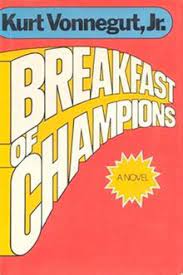
But this is not really a novel that can accurately be described as being ‘about’ anything, certainly nothing as simple as a story of characters doing things in a linear ‘this, then this’ fashion. It’s far too anarchic for that. The time structure is random, even though the traditional ordering of cause and effect keeps trying to reassert itself. Ostensibly the novel tells how Trout travels to the Midland City Arts Festival. Even though his stories are usually published as filler in pornographic magazines, he has one supporter who also happens to be a sponsor the Arts festival and who arranges for Trout to be a guest speaker at the event. He travels there via New York where he gets beaten up by “The Pluto Gang” (I couldn’t work out why, it just feels like a scene inserted at random) and then hitchhikes to the festival. Meanwhile in Midland City Hoover’s mental health deteriorates. They finally meet at the Holiday Inn where Trout’s bizarre behaviour seems to trip Hoover over the edge. He goes berserk, attacking people at random, biting Trout’s finger off, and ends up being committed to an asylum. The novel ends with Trout meeting the narrator author, who demonstrates his omniscience by sending Trout through space and time.
This is a strongly political novel. Trout sees America from the point of view of an outsider. He is acutely aware of the ridiculous elements of society, its injustices and not least its obsession with sex (every male character is introduced with a description of the length and girth of their penis – every female character is introduced with a description of the dimensions of the husbands/boyfriend’s penis). This is Vonnegut’s/the narrator’s explanation for the obsessive description of every mundane object he encounters, the rejection of any element of traditional storytelling:
As I approached my fiftieth birthday, I had become more and more enraged and mystified by the idiot decisions made by my countrymen. And then I had come suddenly to pity them, for I understood how innocent and natural it was for them to behave so abominably, and with such abominable results: They were doing their best to live like people invented in story books. This was the reason Americans shot each other so often: It was a convenient literary device for ending short stories and books.
Why were so many Americans treated by their government as though their lives were as disposable as paper facial tis-sues? Because that was the way authors customarily treated bit-part players in their made-up tales.
And so on.Once I understood what was making America such a dangerous, unhappy nation of people who had nothing to do with real life, I resolved to shun storytelling. I would write about life. Every person would be exactly as important as any other. All facts would also be given equal weightiness. Nothing would be left out.
Racism is a persistent theme in Breakfast of Champions. The black characters are treated appallingly (and upsettingly) by many of the white characters and are described as being used “for machinery, and, even after slavery was eliminated, because it was so embarrassing, they and their descendants continued to think of ordinary human beings as machines.” This is probably why Vonnegut casually and repeatedly uses the n-word in a way that writers working today simply would not consider. It makes it an uncomfortable read.

The other central theme in the novel is the concept that humans are all simply machines, all of us that is except Vonnegut or perhaps Trout or the narrator. This idea, that we are all really just meat machines without free will, is one of the oldest philosophical conundrums in existence. Vonnegut introduces the idea as a statement of fact rather than a debating point, and it underlines his sense of alienation from his characters – we the readers are all just characters without autonomy in a story told by an idiot who doesn’t really understand the world.
This is a very unconventional novel. It has some of the trappings of a traditional story – two characters destined to meet at the end of the novel, having adventures on the way – but the reader is consistently reminded the are just reading a story, that the characters and settings aren’t real, and that the author can capriciously change their fates whenever he so chooses. The insistent definitions of mundane objects underlines this pointlessness. It all combines to make Breakfast of Champions a challenging and interesting read, but not one I would be able to really recommend. It many ways it is not a novel at all, but a book of random thoughts and ideas, strung together round a storyline which even the author doesn’t find interesting.

