I’ve written quite a bit in the past about different categories of novel – most recently Newgate novels for example, nineteenth century stories about prisoners awaiting trial in Newgate. or the earlier Silver Fork novels about rich Regency people doing rich Regency people things. The problem is – where do you stop? Where do you stop creating ever finer more detailed sub-categories of novel? This problem occurred to me when reading John Lanchester’s 2023 novel Capital.
As well as obviously being about London and its inhabitants, Capital is more specifically a credit crunch novel, a literary response to the financial crash of 2008. It was published in 2012 which makes it a a relatively early response to the crash, when the full impacts of austerity had yet to be played out. In Capital people are still manically developing their houses with basements and loft extensions, even if the early seeds of doubt about the wisdom of this reckless spending are being sown; later post-Brexit crash novels (or are they a separate category?) see that this reckless spending is not without consequence. The worst that happens to a banker made redundant part way through Capital is that he has to sack his nanny and retire to the country with his money, confident that he will bounce back. Where am I going with this point? I suppose I am arguing that instead of simply being an ambitious survey of life in modern-day London, Capital is a more immediate response to political and economic circumstances that might not have the durability and longevity the author was obviously aiming for. It’s also a novel that addresses that very specific problem of gentrification, without having much to say about the issue other than vaguely suggesting it is not a good thing.
Capital follows the inhabitants of a south London street, Pepys Road, over the course of a year. The choice of name is obviously not coincidental – Pepys was a great chronicler of London-life, and it seems Lanchester aspires to do the same. Pepys Road is undergoing dramatic changes as London society responds to a influx of new residents from around the globe. As we are introduced to a series of immigrants – a Polish builder, a Hungarian nanny, a Senegalese footballer and a Zimbabwean traffic warden – one wonders whether these are much more than stereotypes? Their stories are juxtaposed with those of earlier residents, now undergoing their own diaspora as they are forced out of Pepys Road.
“Having a house in Pepys Road was like being in a casino in which you were guaranteed to be a winner. If you already lived there, you were rich. If you wanted to move there, you had to be rich. It was the first time in history this had ever been true”.
Another of the multiple threads of the novel follows stockbroker Roger Yount. Roger and family live a life of excess fuelled by the multi-million salaries and bonuses common in the City pre-Crash. Roger is an entitled and slightly thick public-school boy relying on nepotism to get along in a business he admits he does not really understand. His wife Arabella is a bit of a monster, spending her days shopping for designer nonsense and having long boozy lunches with girlfriends while her children are cared for by a series of nannies. We care little for Roger and Arabella, equally stereotypes in their own way, and celebrate their downfall as Roger first gets a disappointing five figure bonus, and is then sacked and has to rethink his life
Most of the storylines peter out – they have endings of sorts but I was insufficiently engaged with the characters to worry overly if they go on to live long and happy lives. Ends are tied up but with a conspicuous sense of ends being tied up so that the novel could finish rather than narratives being successfully concluded. A good example of this is the young African footballer who comes to the UK to play, suffers as career-ending injury, and goes back home with riches beyond imagination and still able to play football locally – a happy ending of sorts but hard to see where it fits in the overall narrative, other than being just another story of the residents of Pepys Road.
At over 600 pages this was harder work than it ought to have been. The years immediately after the Crash in which this novel is set seem a lifetime ago. If I had read Capital when it was first published it would have had an immediacy that it now lacks given how much has happened since then – it’s almost enough to make me nostalgic for 2012!
The Last Devil to Die: The Thursday Murder Club (4) by Richard Osman, 2023
I confess to being a lazy reader of murder mysteries. What I mean by that is that I am comfortable with learning whodunnit when the author is ready to let me know, and not before. Of course I spot the red herrings, the introduction of what appears to be a peripheral character who is actually a suspect, and so on. But I know that a well-written book – and Richard Osman is an author who takes care with his plot construction – will provide just enough information to make the resolution of the mystery almost impossible to guess in advance, but to appear fairly obvious once it is revealed. I don’t see mysteries as a battle between me and the author to prove who is the cleverest – the contract between us is for the author to entertain the reader, challenge them a little bit, maybe even educate them, while not making them feel inferior or stupid, and never ever cheating (untraceable poisons and the like).
I say this because I worked out ‘whodunnit’ in this, the fourth of Osman’s Thursday Murder Club series, fairly early on – avoiding spoilers, it is someone who falls into the category I describe above – and that the mystery we are presented with isn’t the real mystery after all. I explain this a little more in the section marked ‘SPOILERS’ below. But that doesn’t mean the novel wasn’t enjoyable. It is always pleasant to spend time with the club members, who Osman stubbornly refuses to kill off (despite my clear prediction in my review of the original novel in the series that he would do so early on in book two). If anything he has expanded his cast of characters, with other residents of Coopers Chase being introduced into the crime-fighting team, including an older person who knows how to use computers (bit of a patronising portrait I thought – not all old people are clueless when it comes to technology) and another who is the victim of a pretty transparent romance fraud. The relationships of the wider cast, police officers Chris and Donna, builder Bogdan and drug dealer Connie all make little or no progress – there is talk of an engagement, but nothing more. If you haven’t read the previous books in the series, or like me have a poor memory for novels read without the full beam of your attention, then you might struggle a little working out who is who – backstories are very lightly sketched.
I also struggled with the subplot involving former spy Elizabeth and her husband Stephen, as they face his advancing dementia. Again I can’t really write at any length about this thread of the novel without spoilers, so I again refer you to the text below.
As to what happens, well if you have read one Thursday Murder Club you have really read them all. Someone is murdered, other crimes follow, and the four pensioners solve the crime using unorthodox means and a considerable amount of tea and cake. Stereotypes about old age are both challenged and used as a source of comedy, particularly through the well-meaning character of Joyce, who is endlessly curious but a little adrift in the modern world.
It’s not uncommon for authors of long-running series to lose steam – Terry Pratchett being the obvious exception to the rule. I am sure there will be more Thursday Murder Club novels, but in an implicit acknowledgement of the diminishing returns from another outing of the feisty pensioners, Osman is writing about a father-in-law/daughter-in-law detective duo, which sounds sufficiently different to be interesting while in the same wheelhouse. Looking forward to it.
SPOILERSALERT
Don’t read this unless you have already read The Last Devil to Die or have no intention to do so. Early on we are told that the heroin which goes missing is being carried in a box. The box is not described in any detail, but there’s enough to pique a curious reader’s interest – why smuggle heroin in a box? I suspected this was an example of the wheel-barrow theft operation story (A man works on an building site. Every day he walks off the site with a wheelbarrow full of sand. The security guards are suspicious and look through the sand trying to find if he was stealing anything. When he retired a guard asked him “Alright, how did you do it? We knew you were stealing, what did you hide in the sand?” “I wasn’t hiding anything in the sand, I was stealing the wheelbarrows.”) The box is described as ‘a small terracotta box, made to look old, like a tatty piece of garden junk…a boring ornament’. The obvious incongruity of using a terracotta box to smuggle heroin caught my attention at the time, and while the author works hard to downplay its significance, I was reasonably confident that we hadn’t heard the last of that box.
I am not claiming this as an example of my powers of penetration, simply suggesting that the puzzles in this novel weren’t that hard to solve. Actually, worse than that, they were pretty obvious.
I found the Elizabeth and Stephen subplot difficult, if not even a little distressing. Stephen’s dementia is accelerating and Elizabeth is slowly realising she is unable to cope with him. She is unable to leave him alone for any length of time without him putting himself in danger. He is aware at moments of his decline – at others he barely recognises her. So to cut a long story short, he kills himself with her assistance. This is presented to us as a brave choice, but it felt like patient-assisted suicide to me (because it was) which is illegal. Elizabeth is not one to care about being on the right side of the law, but anyone making a case for euthanasia simply because someone’s memory is failing (Stephen is in no physical pain or discomfort, and while obviously upset at his increasing dementia does not spend his days in acute distress) will find little support from me. It left a bad taste. Osman has given old people some dignity in these novels, revealing their strength and resourcefulness and celebrating the positive aspects of old age, but here, for me, he drops the ball badly. Old people lose their memories, but don’t deserve to die for it. He takes care to tell us that Stephen takes his own life, and is fully aware of the choice he is making, but glosses over the illegality and subterfuge required to achieve this end without prosecution.
Osman also uses Stephen’s dementia as a key point in the main plot – Stephen is the only person alive who knows where the missing heroin that everyone is being killed for is hidden, and somehow through the fog of his dementia manages to tell Elizabeth, albeit in a confused way. Because that’s what people suffering from dementia do, isn’t it – they solve crimes and locate hidden contraband. This was clumsy and a bit distasteful if I’m honest.
Bodily Harm felt strangely familiar: the premise of the novel echoed strongly with me, but I am struggling to pin down from where. In the novel Rennie Wilford, a Canadian ‘lifestyle writer and journalist’, suffers an upsetting relationship breakdown following surgery for breast cancer. In an attempt to escape she engineers an opportunity to travel to the small Caribbean island nation of St. Antoine to write a travel/holiday piece. Here she finds the island uncomfortable and alien, but slowly becomes embroiled in the febrile local politics. An attempted coup or insurrection goes badly wrong, and Rennie is caught up in the aftermath.
Frustratingly I can’t identify what book or books this reminds me of. It is possible that the cumulative effect of so many tropes is what is causing this ‘deja lire’ phenomenon.
The contrast between Rennie’s life in Toronto and her experience on the islands is striking. At home she was originally a political journalist specializing in unspecified ‘abuses’ but now writes about ‘lifestyles’:
“You write about something until people become tired of reading about it or you become tired of writing about it, and if you’re good or lucky enough it’s the same thing. Then you write about something else.”
Rennie lives with Jake, an unpleasant sexually aggressive and frankly abusive young man. He has a vacuous job as a label designer
“not just labels but the total package: the label, the container, the visuals for advertising. He was a packager. He decided how things would look and what contexts they would be placed in, which meant what people would feel about them”,
Canadian culture is portrayed as synthetic and superficial, and Rennie is profoundly unhappy without really realising it. Her breast cancer diagnosis brings this unhappiness to the fore, and shortly after Jake moves out Rennie comes home one day to find two policemen waiting for her, inspecting a sinister coil of rope left on her bed by an intruder. This is the catalyst for her getting out of Toronto, albeit temporarily. The Caribbean island state of St. Antoine is undeveloped and unwelcoming, and Rennie never takes her purported mission, to write a travel piece about the island, very seriously. She meets a number of ex-patriates including Paul, a drug smuggler who may or may not also work for the CIA and Lora, a fellow Canadian who has ended up in St Antoine with no real idea as to why. She also meets some locals including Dr. Minnow who is a candidate in St. Antoine’s elections, the first since independence from the British. What starts as a travelogue degenerates into a nightmarish experience as St. Antoine’s political factions go to war, and outsiders are all suspects.
Bodily Harm is not a comfortable read. St Antoine becomes a metaphor for Rennie herself, almost as if her vacation is a dream in which her various traumas are worked through and the characters represent aspects of her life back in Toronto. Her cancer is echoed in the rottenness of the island’s political corruption; the sado-masochism of her relationship with Jake is paralleled in the violence she encounters, and the novel’s conclusion in which she is imprisoned while her involvement with the island’s insurrectionists is investigated is (arguably) a metaphorical representation of her illness and slow recovery. Read this way Bodily Harm is a disquieting portrait of contemporary life rather than the superficial story of a journalist taking a vacation in the Caribbean that it initially promises to be.
Bodily Harm was the novel Atwood wrote immediately before The Handmaid’s Tale which was published four years later. Atwood is not a genre writer, and all of her novels that I have read thus far are significantly different, so it is difficult to find any trace of Handmaid’s in this novel. Having said that the theme of sexual violence being part of everyday life for women does indicate the lines the author was thinking on at the time and which were much more fully developed in the later novel.
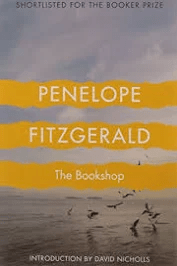
The Bookshop is set in the sleepy coastal Suffolk town of Hardborough — “an island between sea and river”. In 1959 the novel’s ‘heroine’ Florence Green opens a bookshop in the long-vacant property called Old House, one of the oldest properties in the town. There is surprisingly some local opposition to her venture. This opposition centres on local notable Violet Gamart who has been toying with “the idea of converting it (Old House) into some kind of centre — I mean an arts centre — for Hardborough“. Old House is an unlikely location for an arts centre – it has stood empty for years, is quite small (from what we can tell) and is riddled with damp, not to say that it also seems occupied by a ‘tapper’, the local word for a poltergeist. Is there something more to Mrs Gamart’s plans than meets the eye – what is problematic with the idea of a bookshop?
Florence ignores Mrs Gamart and goes ahead and opens her shop, employing a young assistant, ten-year old Christine Gipping, to help out. Christine is by far the liveliest and most interesting character in the novel, although the author’s continual reference to her pre-pubescent state is a little creepy:
“Christine replied that now the evenings were getting longer her elder sister would be up in the bracken with Charlie Cutts… ‘You don’t need to worry about anything like that with me” she added, “I shan’t turn eleven till next April. Mine haven’t come on yet.”’
Lightly comedic episodes ensue as Florence struggles to make a success of her venture. She secures the patronage (of sorts) of Edmund Brundish, who is the nearest thing Hardborough has to aristocracy, and turns to him for advice when trying to decide whether to stock Vladimir Nabokov’s Lolita.The novel is a best-seller but the usual suspects are horrified at both the book’s subject matter and the shop’s subsequent success. I was hoping that the novel might explore the explosive impact Lolita would have had on a small-minded English town in the late 1950’s, but that opportunity is passed by.
I was quite harsh towards The Gate of Angels, Fitzgerald’s 1990 novella about a fictional Cambridge college, not least because of its lack of authenticity. Novels don’t have to be realistic, of course they don’t, and the author can introduce elements of fantasy for many different reasons. But novels that purport to realistically portray a social setting and believable characters need to at least aspire to being authentic, or alternatively to have a really good reason why authenticity is departed from. And time after time Fitzgerald fails this simple test. The poltergeist that haunts the bookshop is an obvious example – perhaps it represents the town’s hostility towards Florence’s enterprise (although it pre-dates the shop’s opening). But there is no real attempt to integrate the ‘rapper’ into the narrative – it is just there, then it is not. Another example relates to the portrait of ten-year old Christine. While she is a well-developed character, are we really expected to believe she chipped/lost her two front teeth by them being hit by frozen washing on the laundry line? That’s just nonsensical and not in the least amusing. Possibly it is intended to show how hard life is for the Gipping family, and how resilient they are despite everything thrown at them – but teeth broken by frozen laundry is such a clumsy unconvincing way of showing this. Similarly we are invited to believe that Christine is the first child in her family to not pass the eleven plus. She is instead assigned to the local technical college, which her mother describes as “what we call a death sentence. I’ve nothing against the Technical, but it just means this: what chance will she ever have of meeting and marrying a white-collar chap ?” Only about one in eight children passed the eleven-plus, so the idea that bright Christine would have been the old child in their family not to pass is hard to credit. There’s also a description of a new housing development built on the edge of quickly eroding cliffs – another instance where the novel forfeits all credibility for the sake of a clumsy metaphor.
Probably most ludicrous proposition in the novel is the idea that a ‘stupid’ backbencher could draft, propose and pass through all its Parliamentary stages a major change to planning law, including late amendments which allow compulsory purchase orders in a wide range of circumstances, which is then implemented in a matter of months, simply to find a mechanism to lever Florence out of her shop. A generous buy-out proposal from Mrs Gamart would have been infinitely simpler. I understand that Fitzgerald wants to demonstrate that life and the powers that be are unfair to well-meaning people like Mrs Green, but this is an incredibly heavy-handed way of making that point.
There are moments in the novel which almost bring it to life. I did enjoy for example Mr Brundish’s encounter with Mrs Gamart, when his lack of an internal monologue leads him to speak his mind openly to her:
‘”You had better offer me something” he said loudly, and then, in precisely the same tone: “The bitch cannot deny me a glass of brandy.”‘
There’s far too little of this character, and Fitzgerald kills him off casually almost immediately after this encounter in order for her primary scheme – the compulsory purchase of the shop – to go ahead. Instead we see far too much of Milo North, a lazy dilettante whose purpose in the novel never really comes into focus.
Fitzgerald is highly thought of and considered by some critics to be under-appreciated. I can’t agree. When you compare this slight, unconvincing novel to J L Carr’s A Month in the Country for example, you can see the huge gulf between them. Both are sketches of life in rural England, but Carr’s characters come alive, are recognisable and have interesting stories to tell. It would be unfair to say Fitzgerald’s don’t come to life in the same way but they are light sketches compared to the vividness of Carr’s portraits.
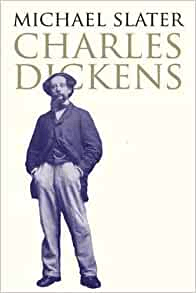
This incredibly authoritative not to say weighty biography of Britain’s greatest novelist left me with a renewed respect for Dickens the author, but some of the revelations left me equally disappointed with Dickens the husband and father.
Slater’s biography follows the traditional format of all such works. Dickens’s early life is recorded in detail elsewhere, not least by Dickens himself in an autobiographical fragment published soon after his death by his close friend and first biographer, John Forster. Slater claims that the period when Dickens’s family went through hard financial times and had to withdraw him from school and send him to work, aged 14, in a blacking factory, was a key turning point in his life. It, Slater argues, haunted him for the rest of his life, and he constantly returns to it in his work, letters, and personal life. That point felt overstated, although I obviously defer to the author’s infinitely more detailed knowledge of Dickens’s life and work. Once these years are over, the text is focussed on composition of Dickens’s 14 novels which provide a structure for the text, although there is a vast amount of other works to be included, recorded, referenced and analysed.
Even if you know Dickens well this book will probably contain some surprises. I didn’t know for example that his early novels – including Pickwick, Oliver Twist, & Nicholas Nickleby – were essentially improvisational. While writing them Dickens had no clear plan where the plot was going, nor in the case of Pickwick whether the text was ever going to be printed as a novel at all, rather than remain as a serial, comparable to modern-day soap-operas. The idea of turning this series of stories with a common theme into a novel seems to have occurred to Dickens quite late in the day. As his work matured Dickens planned his novels more carefully with detailed notes on characters and plot-lines, but he rarely wrote more than a few weeks ahead of publication, sometimes cutting things very close indeed. Publishing his work in this way had an important impact on his plotting decisions. Any large scale editing is virtually impossible. Novelists who prepare their whole work prior to publication (i.e. virtually all of them today) can make substantial changes up until the last minute, deleting characters, going back to the beginning of the novel to provide subtle clues to the outcome, etc. While Dickens could fine tune his choice of words when the novels were published in volume form, major plot changes were impossible. (Authors who publish series of novels face a similar challenge – J K Rowling must surely have wanted to be able to go back to Philosopher’s Stone and add some more clues about Harry’s scar or tidy up the messy timeline of the first chapter, The Boy Who Lived?). This feature of his way of working imposed a discipline on Dickens’ plotting which he never seems to have worried about, but it would be interesting to read the novels in this light and look at his technique for avoiding painting himself into too many corners. One example which Slater points out is the strange opening to The Old Curiosity Shop, which begins in the voice of an unnamed first person narrator (“Although I am an old man, night is generally my time for walking” who quickly fades out of the text to be replaced by an omniscient narrator. According to Slater this is because the story started as a magazine sketch intended for only one or two editions, and when Dickens decided to adapt it as a longer form novel the switch in narrator was made at that point. The reader doesn’t really notice this switch in voice, but in retrospect is does appear unusual.
Dickens’s prodigious work ethic is another prominent feature of this biography. There was no point in his adult life when Dickens wasn’t working virtually flat out, at several points writing two novels at once. His novels are only a small part of his output: his collected journalism and letters run to many volumes, and he seems to take on major new projects even when he is completely overwhelmed with work. His was also a prodigious travellers, criss-crossing the country for his readings and popping over to France to see his young lady friend several times a month. In addition of course he also managed two major tours of the USA.
The weak copyright laws of the time meant that Dickens was openly plagiarised throughout his career, most typically in the form of stage adaptations. Slater tells us that “between March and December 1838 no less than five unauthorised adaptations of Oliver appeared in the London theatres.” (121 – for context, Oliver Twist was published in monthly instalments between February 1837 and January 1839). This issue only got worse – “no fewer than seventeen different stage versions (of his Christmas story The Cricket and the Hearth) appeared in London within a month of the book’s publication.“(239). There was an ironic twist to this plagiarism. In the rush to copy his work theatres would put on productions of his work before their serialisation had finished, forcing them to anticipate the novels’ endings. There is some evidence that Dickens used these versions of his works to give him ideas on how to end them – Slater cites evidence that in his composition of Little Dorrit Dickens “looked back for help with the plotting of an unauthorised dramatisation of the first part of the novel”.
This is an extraordinarily thorough account of Dickens’s life. Slater chooses to structure his text around his subject’s literary life, which his personal life less of a focus. His early romances, his marriage and ten children are all mentioned, as is the end of his marriage and his late romance with Ellen Ternan, but there is a sense of restraint in the narrative, a lack of speculation and a focus on the literary output and Dickens’s creative life. I did wonder whether the biography, structured as it is around the construction of the 14 principal novels, would have been such a compelling read if the reader was not familiar with Dickens’ work? But I guess no-one tackles a 600+ page biography without at least a certain familiarity with the novels.
I have written elsewhere about Dickens’ extraordinary consistency as a novelist. That comment was about his style – he seems to have landed on a discursive, dramatic and comic style of writing early on in his career and it remained with him largely unchanged throughout. My contention was that unless you knew the chronological sequence of his novels you would be hard pressed to tell, based on the writing alone, whether his work was early, middle or late period Dickens. But there is another way in which he was consistent, and that was in the length of his novels. All his novels were published in instalments – either weekly or monthly. The earlier novels did not have a predetermined plot nor number of instalments they were intended to fill, so their length varies significantly – Pickwick is almost twice as long as Oliver Twist. But once the format and number of instalments was settled down, the consistency of the length of the novels is extraordinary. Look at this list:
1.David Copperfield: 357,489 2. Dombey and Son: 357,484 3. Bleak House: 355,936 4. Little Dorrit: 339,870 5. Martin Chuzzlewit: 338,077 6. Our Mutual Friend: 327,727 7. Nicholas Nickleby: 323,722 8. The Pickwick Papers: 302,190 9. Barnaby Rudge: 255,229 10. The Old Curiosity Shop: 218,538 11. Great Expectations: 186,339 12. Oliver Twist: 158,631 13. A Tale of Two Cities: 137,000 14. Hard Times: 104,821 15. The Mystery of Edwin Drood: 96,178 (first 6 of 12 parts only)#
Yes, David Copperfield and Dombey and Son are almost identical lengths, to within 5 words in a total of over a third of a million. That’s an insane level of accuracy. Copperfield was published in 19 monthly one-shilling instalments, containing 32 pages of text and two illustrations, with the last instalment being a double-number (in other words, twenty instalments). Dombey followed the same pattern – 19 + 1 instalments, 32 pages, 2 illustrations. So it’s not surprising they are around the same length. But identical? The <10% variance in the top seven novels in this list can be explained by the length of the monthly instalments and the number of illustrations rather than any variation in Dickens’s plots or characterisations. Other authors were published in the same instalment formats as Dickens, indeed many of them in his magazines (Wilkie Collins and Elizabeth Gaskell, to name but two) and I would imagine their word length would be similar given the circumstances. But I confess I haven’t checked in any detail. (A quick look at the number of pages shown on Collins’s Goodreads page gives a range of 528 pages for The Moonstone to 672 pages for The Woman in White and 748 pages for No Name). There must surely be a strong case for arguing that no other author would have had Dickens’ discipline, to produce content week after week, month after month across almost all his adult life, to such a precise degree of accuracy.
I mentioned at the beginning of this review that I came away from this book feeling a little disappointed with Dickens the man. He discarded his wife with whom he had ten children, and ‘took up with’ a woman twenty years younger than him. We can’t be certain about the precise nature of this latter relationship but we can have a pretty good guess! He estranged his children from his wife, characterising her as a bad mother, and disrespected her in his will. His politics, particularly in relation to the trade union movement and issues of race, were not as progressive as they are often characterised. Slater is very open on this point – he doesn’t try to sugar-coat Dickens’s weak-spots, but neither does he over-emphasise them. Dickens was capable of change, and his approach to the way Fagin is characterised in Oliver Twist is a good case in point. He goes from being an openly hostile anti-Semitic caricature to in later editions a much more nuanced portrait, with far less emphasis on his race.
I’ve some way to go before I can claim to have read all of his novels, but this biography has given me a renewed appetite for continuing my tradition of an annual Dickens.
#(I found these statistics on the internet, and I haven’t separately verified them. I did a spot check of Copperfield and the word count was very close, with a small variation explainable by how you count the index, chapter headings, etc. )
10 minutes and 38 seconds is estimated as the time it takes for a dying brain to shut down. The scientific basis for that estimate is neither here nor there. Shafak uses this as a starting point to explore the dying moments of sex worker “Tequila Leila”, whose body has been dumped in a bin on the outskirts of Istanbul. As her brain begins to shut down, Leila tells her life story in the ten minutes and thirty eight seconds she has left of consciousness.
She recalled things she did not even know she was capable of remembering, things she had believed to be lost for ever. Time became fluid, a free flow of recollections seeping into one another, the past and the present inseparable.
Here memories focus on the people who were important in her life. Along the way we find out how she became a sex-worker, coming from a rural, conservative Turkish family life where independent behaviour by women was severely curtailed, to live in the red-light district of Istanbul where she has a freedom, of sorts, and is able to develop a number of relationships and friendships. As the minutes of Leila’s life tick down we slowly learn more about her life, its tragedies and moments of joy. It’s a touching portrait of a difficult life where Leila’s ebullience manages to somehow overcome all that life can throw at her – until her brutal murder for being in the wrong place at the wrong time.
The second half of the novel has a very different tone and structure. Leila’s disparate group of friends who we have been introduced to in the first half – Sinan, with whom she grew up; Nalan, a trans woman who ran away from her family in Anatolia; Jameelah, a victim of human trafficking from Somalia; Zaynab, a Lebanese refugee with severe health issues; and Humeyra who was born in Mesopotamia and fled an abusive marriage – come together to rescue Leila’s body from the horrible cemetery were it has been effectively dumped, a place for only the poorest and most marginal members of society (a real location – as with most of the novel the places and events referred to are all real). They dig up her body and take it across Istanbul to be buried with proper respect. This part of the novel has a totally different feel to the first half – there’s almost a ‘mad-cap’ adventure aspect to the way the grave-robbing takes place with little planning or discussion of the risks.
This novel is a thought-provoking consideration of gender issues in modern Turkey. It comes as no surprise to read that Shafak has been investigated by Turkish prosecutors for addressing child abuse and sexual violence in her fiction writing, nor that she has moved to the UK recently in order to avoid this potential censorship. On that initial point, I’m not usually a great fan of trigger warnings, but if ever a novel needed a TW flag it’s ’10 minutes and 38 seconds‘. Early on it contains a description of child sexual abuse which plays an important part in the narrative structure of the novel, but which I found hard to read. This novel was shortlisted for the 2019 Booker Prize, and Shafak’s most recent novel The Island of Missing Trees is doing very well and has been shortlisted for the 2022 Women’s Prize for Fiction.
I think I need to reread Persuasion. The mood you are in and the time and care you dedicate to the process of reading can all have an impact on how you perceive a novel, and for whatever reason I was hugely disappointed with Persuasion, Austen’s last completed work, which I am sure says more about me than it does about this novel. But on this reading alone I’d go so far as to say the incomplete and hurried nature of the conclusion, and the short length of the work (around half the length of Pride and Prejudice, for example) is evidence of it being a late draft completed in the final months of her life (it was published after she died) which had she lived would have seen the extensive revision that was the hallmark of her methods of composition for earlier works.
Austen is unquestionably a writer of genius, her control of point of view and narrative technique is unparalleled, and not least critics love Persuasion, which all suggests the problem may have been with me, not the novel, and that I need to give it another chance.
The plot of Persuasion treads familiar romantic ground – young people in Regency England trying to find suitable partners to marry, but it has something of a new twist. Persuasion is about love the second time around. Anne Elliot, middle daughter of Sir Walter Elliot, baronet, lives in the shadow of her older sister Elizabeth, now in effect head of the household following their mother’s death, and Mary, her younger sister who has recently married a local minor aristocrat, Charles Musgrove. Charles had previously asked Anne to be his wife, and once rejected had moved on to the younger sister with that relentlessness and lack of sentimentality that characterised marriage making in this period. Anne is now 27, dangerously old for a woman of this era and at risk of spinsterhood. What is not widely known about Anne (within the novel) is that when she was 19 she had previously rejected an earlier marriage proposal, having been persuaded by her mother’s friend and her own confidante, the widow Lady Russell, that her suitor, Frederick Wentworth, was not good enough for her. Captain Wentworth, as he now is, was at the time without prospects or connections, and marrying for love was an improvident thing to do.
Wentworth re-enters Anne’s life when Sir Walter lets the family estate to Wentworth’s brother-in-law, Admiral Croft. Since their initial romance, Wentworth has fought in the Napoleonic Wars, been promoted to the rank of captain and amassed a significant fortune from capturing enemy ships – being in the Navy could at this time be a very dangerous but very well-rewarded profession. Once Wentworth is reintroduced it is clear he and Anne will end up together, but the only question is how they will be reunited, and which of the many available young women introduced into the plot he will mistakenly be thought to be in love with before the inevitable reconciliation. Visits to Lyme Regis and Bath feature along the way, where the plot’s false starts and red herrings are overcome and the multiple other threads quickly resolved, more in the manner of an early Shakespearean comedy than an elegantly plotted Austen romance.
There is an obvious temptation to see Austen using Anne’s story as a way of working through her own personal issues. Austen had been engaged at one point but hurriedly called it off, and it is possible she regretted choices made in her romantic life. For her there were to be no second chances, so writing a story in which a lost love is finally recaptured must have had at least some element of wish-fulfilment. Austen’s biographer Claire Tomalin described Persuasion as Austen’s “present to herself…. to all women who had lost their chance in life and would never enjoy a second spring.” I don’t find this way of looking at novels as semi-autobiography or therapy as particularly fruitful – Jane isn’t Anne any more than she is Elizabeth or Fanny.
So what are the concerns I have about the novel? It is clear from her correspondence that Austen wrote Persuasion during the illness which was to take her life. Her usual method of composition, working and reworking the text and plot, was simply not available to her – she didn’t have the time or the energy, and it shows. Plotlines are hurriedly disposed of without the usual care – the most obvious example being the way Mr William Elliot, Sir Walter’s heir, is introduced, courts Anne, and is exposed as a scoundrel. This Mr Elliot is a two-dimensional villain whose motivation is simply to ensure he inherits the ancestral home, which is due to do anyway, even without all the Machiavellian plotting. His precise role in the family structure – why he is the heir – is never clearly explained (unless I missed it!) and the way his deviousness and duplicity is exposed is clumsy in the extreme.
As a character, Anne is not as dull as Mansfield Park‘s Fanny Price, but she equally doesn’t come alive compared to an Elizabeth Bennet or Elinor Dashwood. At first she is described by the unsympathetic narrator as ‘faded and thin‘, as ‘haggard‘, and that ‘her bloom has vanished early‘. Captain Wentworth on his return to her company passes a similar devastating judgment, commenting (in a phrase Anne crushingly comes to hear) on ‘the years which had destroyed her youth and bloom‘. However, things aren’t as bad as these judgments might suggest, and some restorative sea air puts colour back into her cheeks. After a short while at Lyme (albeit in November) Anne is attracting the attentions of the passing William Elliott:
“As the passed, Anne’s face caught his eye, and he looked at her with a degree of earnest admiration, which she could not be insensible of. She was looking remarkably well; her very regular, very pretty features, having the bloom and freshness of youth restored by the fine wind which had been blowing on her complexion, and by the animation of eye which it had also produced. It was evident that the gentleman … admired her exceedingly.” (Chapter 12) (Sir Walter on the other had thinks ‘sharp winds‘ can make a women ‘grow coarse’, and on that basis decides not to buy his youngest daughter a new hat and pelisse in case it encourages her to go out in the wind!)
The chapters in Lyme and Bath had the feel of the characters treading water waiting for the reconciliation between Anne and Captain Wentworth. When this reconciliation finally happens it feels rushed – he overhears her speaking with a friend of his, and writes her a letter declaring his feelings, which she happily reciprocates. This was the one scene Austen is known to have re-written. The earlier version survives, in which Wentworth’s sister and brother-in-law take a much more active hand in engineering the couple’s reconciliation, which to me seemed a lot more believable and authentic.
Many of the other characters don’t step off the page. Anne’s younger sister Mary is better sketched than many, and while her hypochondria is a character trait Austen had used before, (with Mr Wodehouse) this is largely forgotten once the novel moves on. Elizabeth the older sister is barely two-dimensional and remains wooden and forgettable. Lady Russell, who advises Anne not to accept Wentworth’s original proposal, is equally and disappointingly weakly drawn. In fact none of the secondary characters are comparable to the wonderful sketches you see in earlier novels of characters such as endearing gossips such as Miss Bates, awful aristocrats like Lady Catherine de Bourgh or villains like Willoughby. Equally the plotting is disappointing. In the great Austen novels we are always aware of events ‘off-stage’, even when the central characters themselves are unaware. There are plenty of hints that there is more to Jane Fairfax and Frank Churchill’s relationship than Emma is aware of with a careful or second reading, and the way Austen charts Elizabeth Bennet’s journey from anger to love with Mr Darcy is utterly convincing, but there is nothing of comparable significance in Persuasion.
Or at least I didn’t find it on this read, which as I have said could easily be down to my reading of the novel rather than the novel itself. So I need to reread it. Of course I am not going to dive into it straight away, but find a time and place when I can give it the care it needs. Until then I would love to know whether you shared my concerns or can point me to where I have gone wrong.
“They burned down the market the day Vivek Oji died.” So begins the tragedy of Vivek Oji, a young man living a double life in modern-day Nigeria. Born on the day of his grandmother’s death, Vivek is seen by some of his family members as her incarnation, marked out by the same starfish-shaped scar.
Vivek’s death marks both the beginning and the end of the novel. It tells the story of his short life, using memories from family and friends alongside his own narration. The fragmented narrative and complex time structure slowly builds into a picture of a life that is brimming with potential but is also, as the reader knows throughout, doomed to be cut tragically short. The main figures in his life are his over-protective mother and his cousin, Osita. It’s hard to pinpoint the precise moment that Vivek’s life begins to unravel, but perhaps it is when he allows his hair to grow down beyond his shoulders. This is a breach of convention in his traditionalist home and community. It troubles his family and his neighbours. Vivek’s aunt becomes convinced that a demon is possessing him, and he is traumatised by a violent attempt at exorcism at her church. The unspoken fear of his parents is that it is an outward sign of femininity and that he is gay, which is taboo in Nigerian society. The context here is vital. Homosexuality is not just taboo in Nigeria, it is illegal. The Same-Sex Marriage (Prohibition) Bill passed in 2014 in response to the legalisation of gay marriage in the West, prohibits marriage between persons of the same sex, forbids any cohabitation between same-sex sexual partners and bans any “public show of same sex amorous relationship.” It imposes a 10-year prison sentence on anyone who “registers, operates or participates in gay clubs, societies and organization” or “supports” the activities of such organizations. Even having long hair is sufficient to spark suspicion, and suspicion is all that is needed.
Much of the novel is told through the eyes of Vivek’s mother, Kavita. Her grief drives her to relentlessly try to find out how her son died. At the novel’s climax she succeeds in this quest and finds some sort of peace knowing that he lived at least part of his life happily and on his own terms.
My initial reaction to this novel was that it was an example of the ‘bury your gays’ trope. But I was wrong, and it might be worth explaining why. My understanding of this trope was that gay people in literature, film, television etc are often denied happy relationships, and frequently die just at the point that a fulfilling relationship or personal happiness is in sight. This article discusses the trope in a lot more detail. While the trope originated as a means to allow gay relationships to be portrayed without overstepping social taboos, it developed over time and now more simply represents the expendability of gay characters, particularly in film and on television. At first it looks as if Vivek’s death might fall into this category. But there are a number of reasons why it doesn’t apply here. First, the author doesn’t explicitly describe Vivek as gay. He has sex with other men, but he also wears women’s clothing and make-up, and adopts a female gender identify at times. It is in these moments that Vivek seems happiest and most fulfilled. He doesn’t adopt a specific gender identity (or perhaps to be more precise, the author doesn’t mention one). This may be because he doesn’t have time to explore this aspect of his identity fully, but also because conservative Nigerian society doesn’t allow him the space to do so. For much of the novel the reader is led to believe that Vivek is murdered by a rioting mob because he is ‘caught’ in public wearing female clothes and make-up. The final revelation about his much more mundane death serves to undercut these expectations – what we think we know about people is wrong, and making judgments based upon those assumptions is equally wrong.
This was a thought provoking if somewhat sad novel about the challenges facing gay, non-binary and trans people in modern-day Nigeria. It’s great that authors such as Emezi are now finding their voices and publishers to promote their work.
Diary of an MP’s Wife: Inside and Outside Power, by Sasha Swire 2020
Diary of an MP’s Wife is a deliciously indiscrete and gossipy insider’s account of British politics spanning the second decade of this century. It opens with the election of the Cameron/Clegg coalition in 2010, followed by the Tory’s unexpected election win in 2015, the the unfolding tragedy that was the Brexit referendum, ending in the election of December 2019.
The whiff of entitlement coming of the pages of this text can at times be overpowering. The author is the daughter of John Nott, one of Thatcher’s Cabinet Ministers, and her MP husband is an old Etonian. She frequently expresses frustration at this paradox – being an Old Etonian was seemingly a disadvantage in securing a position in the coalition cabinet when the Old Etonian Prime Minister was looking to appoint a more diverse top team. The summary of the Cameron years 2010-2016 contains few surprises – it was always fairly obvious even at the time that this was a clique of close friends with a largely shared, broadly progressive but still old-school Conservative view of the world. The account of the times spent drinking and plotting with the Cameron set seems entirely authentic:
They are all here, the ones that eat, drink, party together, they are all intimately interlocked, some from university days, some from the research unit, some later, such as with us through the selection procedure. We all holiday together, stay in each other’s grace-and-favour homes, our children play together, we text each other bypassing the civil servants. There are old rows, forgiven betrayals and historic rivalries. This is a very particular, narrow tribe of Britain and their hangers-on. It’s enough to repulse the ordinary man, already angered by the continuing hold of the British class system.
It’s hardly surprising therefore that when the political system begins to take its toll, the personal relationships and friendships under-pinning the Government are also put under pressure. Friendships fray and are broken.
I can’t avoid the suspicion that even the frankest of political diaries have the tendency to edit out the more egregious mistakes and highlight comments that seem in hindsight perceptive. There is plenty of that going on here – at one stage Swire says:
“2020 may be a dim, far-off date in the diary (my note – the reference to 2020 is because at the time this was written, shortly after the election in 2015, it was assumed that the next general would be 2020 – in fact we were to have two elections before then!) but whichever side will win there’s going to be plenty of internecine warfare in the meantime. In fact, and manner of things could happen (watch Keir Starmer rise and rise)” (pg201)
All manner of things indeed.
Another thing you often see in political diaries is a loathing for the constituency activists that the MPs depend upon for funding raising and re-selection, but who can be shall we say ‘difficult’ characters. Swire writes of her husband’s East Devon Conservative Association activists:
“They hate, in equal measure, foreigners, Europe, defence cuts, gay marriage, Liberals, the BBC, Germans, the Japanese, the coalition, and garlic.” (140)
There is some suggestion that Swire had publication of these diaries in mind all along – some particularly scathing criticisms of fellow Tories is softened with an unconvincing concluding sentence or paragraph commenting on the general good intentions of them all. Swire seems not to have wanted to burn all her bridges with the Conservatives, but I don’t think the publication of these diaries will have done her much good. When extracts from the book appeared in the media it was reported that the author was upset by their presentation, suggesting that they had in some way been way been distorted. Is anyone really that naive? It’s easy to see how Tory feathers would have been ruffled – at one point Swire claims David Cameron said to her: “The scent you are wearing is affecting my pheromones. It makes me want to grab you and push you into the bushes and give you one.”
The troubling figure of Boris Johnson slowly emerges from these pages as the years pass. Initially he is a fairly distant, slightly comic figure, but his rise to the top of the Conservative Party is charted with precision. Swire is clearly attracted to his energy and his charisma, but has no illusions about his trustworthiness. His pivoting on Brexit as a political manoeuvre rather than on a point of principle is a matter of record, but it is still interesting to see reactions recorded at the time. David Cameron is recorded as saying that:
“Boris…had always been a supporter of Europe, free movement and migration…this whole episode was to do with his leadership ambitions, nothing else”. (242)
Well no shit Sherlock.
I’m not sure this book actually tells us much we didn’t already know. Hugo Swire was a relatively minor figure in the Cameron Governments, and his wife’s best stories are his, repackaged at second-hand. They may have socialised with the key figures but weren’t in the room when key decisions were made. It’s an interesting perspective from a minority grouping within the Tories – self-identifying as ‘Cameroons’ when the label no longer has any meaning, remaining loyal to the Tories largely over the issue of Brexit when so many others have long since parted ways. Hugo Swire stood down from Parliament in 2019 to spend more time with his money, but it is really hard to see him having any part to play in Boris Johnson’s Brexit Party-lite Conservatives.
Keneally was inspired to write the remarkable story of Thomas Schindler after a chance meeting with Poldek Pfefferberg, a Holocaust survivor. In some ways this novel is as much Pfefferberg’s as it is Kenneally’s – his persistence is trying to ensure Schindler’s story had a wider audience was remarkable. He was an advisor to Kenneally during the novel’s development and accompanied him to Poland during his research. Keneally dedicated Schindler’s Ark to Pfefferberg: “who by zeal and persistence caused this book to be written.” He was then also involved in persuading Steven Spielberg make the film of the novel.
Schindler’s Ark is in many ways more a history text than a novel. Kenneally has justified the designation of the text as a non-fiction novel (which I know is a recognised literary genre but still feels like a contradiction in terms) due to the inclusion of reconstructed conversations between participants. I take his point, but these are clearly an imaginative way of presenting some aspects of the narrative, and in no way undermine the exhaustive and detailed research that underpins the text. Further there is always a risk that presenting the text as fiction allows sceptical readers to distance themselves from the appalling brutality the novel exposes.
As I am sure almost all readers of this blog will know, Schindler’s Ark is the story of Oskar Schindler, a businessman and entrepreneur who during the Second World War helped save the lives of thousands of Polish Jewish men, women and children. They worked in his factories, and he protected them by insisting that their labour was essential in keeping his factories open, and that in turn the factories were vital to the German war effort.
As the war progressed that was a fiction that was increasingly hard to maintain. His workers were moved first into the Krakow ghetto, and subsequently into brutal labour camps. Those were the ‘lucky’ ones of course – many others were taken directly to the concentration camps. Schindler’s factories produced goods that had a very marginal impact on the war – usually just domestic goods – and any weaponry was very low grade. In any event the Nazi’s blood-lust was such that they were prepared to destroy any Jewish people they could find, irrespective of whether they worked in industries critical to the war. So how was Schindler able to protect his workers when millions of others were being taken to the death-camps? His approach was simple – bribery. He spent lavishly on all sorts of expensive and hard-to-find goods to buy influence and favours, and keep the local Nazis pre-occupied and distracted while all around millions of Jewish people were being slaughtered.
Schindler was clearly a flawed human being – a member of the Nazi party, a drinker, womaniser and a war profiteer – and Kenneally’s portrait is unsparing about Schindler’s weaknesses; he makes no attempt to disguise these aspects of Schindler’s personality. It is possible that it was his very unsaintliness that allowed him to make the difficult decisions he had to make every day to preserve the people under his protection.
Unlike any other novel, film or programme I have seen or read, Schindler’s Ark chillingly portrays the brutality of the Holocaust. You think you know what happened, and perhaps want to avoid some of the details. While Schindler’s Ark is unsparing in its descriptions of Nazi brutality it is the mundane aspect of the regime, its businesslike approach to the industrialisation of murder that is so terrifying. The novel also brought me closer than ever before to an understanding of why Jewish people felt and feel the need for an Independent Jewish state, where all aspects of society – the Government, the police, the media and so on – are under the control of Jewish people. Because during the Holocaust Jewish people felt and were powerless in the face of the German state and were unable to look to anyone – other than the rare exceptions such as Schindler himself – for help or protection. I know I am in deep water here and I in no way want to provide blanket justification for the actions of the Israeli state and its sometimes brutal treatment of Palestinian people, but understanding the mindset which leads to condoning that behaviour is for me a new way of looking at the Palestinian conflict.
Kenneally’s determination to do justice to Schindler’s story makes Schindler’s Ark a dense, and at times distressing read. There is a vast amount of detail to be absorbed, dozens of characters who appear briefly and move on, and minute analysis of minor details of the operation of the factory. These details are probably important when weighing the negative aspects of Schindler’s life against the more obvious positives, but a more ruthless editor might have made this an easier read. Not all novels need to be easy to read, of course, but I wonder how many readers will have given up at some point and watched the film instead? The novel’s retitling for its American publication and the subsequent film, List instead of Ark, is interesting. It’s reductive – it’s so much easier to write a list than build and protect an ark. Escaping the Holocaust wasn’t only a matter of whether you were on a list or not. The film’s title, if not the film itself, reduces Schindler’s heroism to a single act rather than the arduous and lengthy process of fighting every day to preserve the lives of the Jewish people under his protection.
Schindler’s Ark deservedly won the 1982 Booker Prize against a varied and interesting shortlist. The chair of the 1982 judging panel John Carey said “This book has behind it a powerful organising and speculative mind, exercising great tact and restraint in the presentation of its terrible story“. This quite in itself restrained compliment is interesting – the powerful organising mind of the author was an important factor in doing justice to the story, even if it does sacrifice some of the narrative drama for a more exhaustive detailed account of events. But the restraint and tact are equally important – it would have been easy to have presented this as an adventure/escape story, which would have been tasteless and disrespectful to those who didn’t survive. In the end it is a portrait of an almost unimaginable horror and a brief glimmer of hope.