
In my reviews of J K Rowling’s Harry Potter series I wrote at length about her decision to ‘age’ the novels with each instalment. As her readership passed through their teenage years the novels grew darker and featured more adult themes. In the seven-book Narnia series (which Rowling acknowledges was a significant influence on her work) CS Lewis adopted a different approach. Each novel in the series features teenage/pre-teen children of roughly the same age, and broadly have the same target audience. The element of peril remains comfortably and consistently low throughout. Although the children fight in battles there is never any possibility they will be harmed. None of the ‘good’ characters die in Narnia (okay, admittedly, I am ignoring The Last Battle here) and all the conflicts are relatively bloodless affairs. Finally, Aslan is always on hand to fix any problems with any witches, Telmarines or Calormen if required.
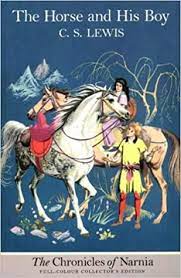
Which meant Lewis had to find a way to avoid the later books in the series becoming repetitive. The standard Narnia template – children find a magical way into Narnia, go on a quest, Aslan arrives to sort everything out – was getting a bit tired by The Silver Chair. The names of the children may change – the original characters, the Pevensie children, grow up, and are unable to return to Narnia too many times (to me this always felt like Lewis acknowledging that his readership may also grow up and feel reluctant to return to the Narnia stories – he is giving them permission to move on) but the essential components of the novels remained the same.
Or they did until The Horse and his Boy. Here Lewis changes structure and gives us a story set in Narnia (or more correctly in Calormen, a country to the south of Narnia) during the reign of the Pevensie children, shortly after the events described in the Lion the Witch and the Wardrobe. The Horse and His Boy opens with Shasta, a teenage boy living an impoverished, unhappy life with a Calormene fisherman, Arsheesh, who he believes to be his father. Shasta is effectively Arsheesh’s slave, although he only finds this out when he overhears himself being sold to a Calormene nobleman. He had been found as a baby washed up on the seashore in a boat, Moses-like. As readers we know that all babies found in this manner are likely to have interesting origins. Although we are not told this immediately, there is another important fact about Shasta we find out later on – he is very light-skinned, unlike the dark Calormenes. That fact, his foundling status, and his vague longing for the unknown north, are pretty heavy hints about his origins.
Shasta decides to run away, taking with him the nobleman’s horse, Bree. He discovers that Bree is a Narnian talking horse, captured as a foal and compelled to act as a normal horse to survive. In other words he is a slave, just like Shasta. They head north towards Narnia, travelling by night. On the way they meet another pair of runaways, Aravis, a young Calormene aristocrat, and Hwin, another talking horse. Aravis is running away to avoid another type of slavery, an arranged marriage with a much older, very ugly Vizier.
Runaway slaves, travelling north by night, to reach a country where slavery is banned and where they will be free, helped along the way by secret allies risking their own lives. Is it just me, or is this a parable about the Underground Railroad? It is also possible that Lewis’s inversion of the title – normally the horse would be seen as belonging to the boy, not vice-versa – is a comment on the slavery theme of the novel, or perhaps just a simple way of signalling to the reader that this is not a conventional novel about children and horses.
The runaways travel to Tashbaan, the capital city of Calormen. There, they meet some familiar characters – King Edmund and Queens Lucy and Susan. (High King Peter is off fighting giants, as always). The Narnian’s mistake Shasta for Corin, the boisterous prince of Archenland who is part of their ambassadorial party, and who went missing earlier that day. Yes, this is a story of mistaken identity and separated at birth twins. Shasta overhears the plan to escape from Calormen – their visit has become extremely uncomfortable and they fear that they might be prevented from leaving. Queen Susan has been considering marriage to the Tisroc (King or Emperor)’s son, and while she has decided against the idea, he is still keen, and they are worried they might not be allowed to leave without the marriage taking place. Another forced marriage in other words.
Aravis has her own adventure. She bumps into a friend Lasaraleen, and asks for help. Lasaraleen is empty-headed and think the whole thing is some kind of school-girl prank. She helps Aravis escape, but before they get away they overhear (why do all key plot points involve someone overhearing someone else? Lewis uses this trope twice in the same novel, and Rowling seems to use it every other chapter!) the Calormenes plotting to invade Narnia. The runaways race across the desert to take news of the planned invasion to Archenland (Narnia’s neighbour and ally). Spoiler alert – they make it, with some help from you know who, and the safety of Narnia is preserved. Rabadash, the Tisroc’s son and the novel’s antagonist, is transformed into a donkey by Aslan as punishment, and while he eventually retains his human form he goes down in history as Rabadash the Ridiculous. Shasta is reunited with his long lost father and twin, and all live happily ever after.
The religious component of The Horse and His Boy is lightly done, thankfully. Aslan intervenes strategically to help the runaways, but he is not needed at the battle between the Narnians and the Calormenes, returning at the end simply to humiliate Rabadash (although that punishment has the effect of bringing peace between the countries throughout his reign.) The story has some darker elements that are missing from the earlier novels – the prospect of Aravis’s arranged marriage with a much older man is quite disturbing, as is the possibility that Susan will be kidnapped and forced into marriage herself. Aravis’s slave is brutally punished for ‘allowing’ her to escape, a punishment cruelly Aslan inflicts on Aravis to help her understand her escape was not free from consequences.
I am reluctant to return to the discussion about the reading order of the books because I have a sneaking suspicion my passionate preference for the publication order as opposed to the chronological order derives from the fact that I first read/was read them in publication order. But The Horse and His Boy provides strong evidence for my preference nonetheless. In The Lion, the Witch and the Wardrobe Mr Tumnus, who makes a brief return appearance in The Horse and His Boy, is astonished to meet Lucy, a daughter of Eve. The suggestion is that humans have not been seen by Narnians for so long they have passed into legend or myth. This is what makes Lucy’s appearance so dramatic and significant. She is as much a source of wonder to the Narnians as they are to us, the reader. But in The Horse and His Boy we find out that Archenland, which borders on Narnia, has been ruled by humans for some considerable time. As it is possible to walk from Archenland to Narnia in an evening, it is pretty obvious that Lewis initially conceived of Narnia as a complete, self-contained world in the early novels, and only added further countries and races as his universe expanded. There’s nothing wrong with that process and if read in publication order it is not noticeable to readers, but it strikes one as glaringly odd if the stories are read in chronological order.
It is quite apparent therefore that Calormen is part of the extended world Lewis builds as the series progresses (much in the same way that Rowling introduces other wizarding schools and countries in Goblet of Fire and thereafter). Calormen had been briefly mentioned in earlier novels in the series, specifically in Dawn Treader, where Calormenes are described as having “dark faces and long beards. They wear flowing robes and orange-coloured turbans, and they are a wise, wealthy, courteous, cruel and ancient people”. They are also slave traders, as Caspian and crew discover early on in the Dawn Treader’s voyage. They are an amalgam of Arabic and generic middle-Eastern characteristics. Lewis’s portrait of the Calormenes is not openly racist but it is problematic. In Lewis’s world all foreigners are funny and untrustworthy, and boys and girls have neatly defined boxes to occupy, even if sometimes they step out of them. How easy it is to see beyond that, as to read this novel as a passionate anti-slavery tract, is another matter.
Abandoning the quest format of the novels and removing the English schoolchildren from the plot was a bold move for Lewis, and he seems to have a change of heart half-way through, giving the race across the desert to warn the Narnia’s about the planned attack greater purpose than if it were just an escape from slavery. The novel gives us a brief glimpse of Narnia under the reign of the adult Pevensie children, although we learn little more than the descriptions given in a few paragraphs at the end of The Lion, the Witch and the Wardrobe. A Narnian story set largely outside Narnia, with few of the magical creatures we have become used to, was equally a brave choice, and it’s hardly surprising that A Horse and His Boy is often perceived as out of place in the Narnian canon. Taken on its own terms its a fun, slight story but I can never quite escape the suspicion that it was a short story expanded to novel length to keep the annual publication sequence running.

