Book review

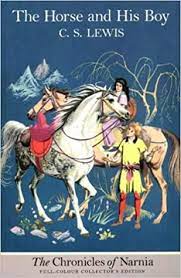
The Horse and His Boy, by C S Lewis, 1954

In my reviews of J K Rowling’s Harry Potter series I wrote at length about her decision to ‘age’ the novels with each instalment. As her readership passed through their teenage years the novels grew darker and featured more adult themes. In the seven-book Narnia series (which Rowling acknowledges was a significant influence on her work) CS Lewis adopted a different approach. Each novel in the series features teenage/pre-teen children of roughly the same age, and broadly have the same target audience. The element of peril remains comfortably and consistently low throughout. Although the children fight in battles there is never any possibility they will be harmed. None of the ‘good’ characters die in Narnia (okay, admittedly, I am ignoring The Last Battle here) and all the conflicts are relatively bloodless affairs. Finally, Aslan is always on hand to fix any problems with any witches, Telmarines or Calormen if required.
Which meant Lewis had to find a way to avoid the later books in the series becoming repetitive. The standard Narnia template – children find a magical way into Narnia, go on a quest, Aslan arrives to sort everything out – was getting a bit tired by The Silver Chair. The names of the children may change – the original characters, the Pevensie children, grow up, and are unable to return to Narnia too many times (to me this always felt like Lewis acknowledging that his readership may also grow up and feel reluctant to return to the Narnia stories – he is giving them permission to move on) but the essential components of the novels remained the same.

Or they did until The Horse and his Boy. Here Lewis changes structure and gives us a story set in Narnia (or more correctly in Calormen, a country to the south of Narnia) during the reign of the Pevensie children, shortly after the events described in the Lion the Witch and the Wardrobe. The Horse and His Boy opens with Shasta, a teenage boy living an impoverished, unhappy life with a Calormene fisherman, Arsheesh, who he believes to be his father. Shasta is effectively Arsheesh’s slave, although he only finds this out when he overhears himself being sold to a Calormene nobleman. He had been found as a baby washed up on the seashore in a boat, Moses-like. As readers we know that all babies found in this manner are likely to have interesting origins. Although we are not told this immediately, there is another important fact about Shasta we find out later on – he is very light-skinned, unlike the dark Calormenes. That fact, his foundling status, and his vague longing for the unknown north, are pretty heavy hints about his origins.

Shasta decides to run away, taking with him the nobleman’s horse, Bree. He discovers that Bree is a Narnian talking horse, captured as a foal and compelled to act as a normal horse to survive. In other words he is a slave, just like Shasta. They head north towards Narnia, travelling by night. On the way they meet another pair of runaways, Aravis, a young Calormene aristocrat, and Hwin, another talking horse. Aravis is running away to avoid another type of slavery, an arranged marriage with a much older, very ugly Vizier.

Runaway slaves, travelling north by night, to reach a country where slavery is banned and where they will be free, helped along the way by secret allies risking their own lives. Is it just me, or is this a parable about the Underground Railroad? It is also possible that Lewis’s inversion of the title – normally the horse would be seen as belonging to the boy, not vice-versa – is a comment on the slavery theme of the novel, or perhaps just a simple way of signalling to the reader that this is not a conventional novel about children and horses.

The runaways travel to Tashbaan, the capital city of Calormen. There, they meet some familiar characters – King Edmund and Queens Lucy and Susan. (High King Peter is off fighting giants, as always). The Narnian’s mistake Shasta for Corin, the boisterous prince of Archenland who is part of their ambassadorial party, and who went missing earlier that day. Yes, this is a story of mistaken identity and separated at birth twins. Shasta overhears the plan to escape from Calormen – their visit has become extremely uncomfortable and they fear that they might be prevented from leaving. Queen Susan has been considering marriage to the Tisroc (King or Emperor)’s son, and while she has decided against the idea, he is still keen, and they are worried they might not be allowed to leave without the marriage taking place. Another forced marriage in other words.

Aravis has her own adventure. She bumps into a friend Lasaraleen, and asks for help. Lasaraleen is empty-headed and think the whole thing is some kind of school-girl prank. She helps Aravis escape, but before they get away they overhear (why do all key plot points involve someone overhearing someone else? Lewis uses this trope twice in the same novel, and Rowling seems to use it every other chapter!) the Calormenes plotting to invade Narnia. The runaways race across the desert to take news of the planned invasion to Archenland (Narnia’s neighbour and ally). Spoiler alert – they make it, with some help from you know who, and the safety of Narnia is preserved. Rabadash, the Tisroc’s son and the novel’s antagonist, is transformed into a donkey by Aslan as punishment, and while he eventually retains his human form he goes down in history as Rabadash the Ridiculous. Shasta is reunited with his long lost father and twin, and all live happily ever after.

The religious component of The Horse and His Boy is lightly done, thankfully. Aslan intervenes strategically to help the runaways, but he is not needed at the battle between the Narnians and the Calormenes, returning at the end simply to humiliate Rabadash (although that punishment has the effect of bringing peace between the countries throughout his reign.) The story has some darker elements that are missing from the earlier novels – the prospect of Aravis’s arranged marriage with a much older man is quite disturbing, as is the possibility that Susan will be kidnapped and forced into marriage herself. Aravis’s slave is brutally punished for ‘allowing’ her to escape, a punishment cruelly Aslan inflicts on Aravis to help her understand her escape was not free from consequences.

I am reluctant to return to the discussion about the reading order of the books because I have a sneaking suspicion my passionate preference for the publication order as opposed to the chronological order derives from the fact that I first read/was read them in publication order. But The Horse and His Boy provides strong evidence for my preference nonetheless. In The Lion, the Witch and the Wardrobe Mr Tumnus, who makes a brief return appearance in The Horse and His Boy, is astonished to meet Lucy, a daughter of Eve. The suggestion is that humans have not been seen by Narnians for so long they have passed into legend or myth. This is what makes Lucy’s appearance so dramatic and significant. She is as much a source of wonder to the Narnians as they are to us, the reader. But in The Horse and His Boy we find out that Archenland, which borders on Narnia, has been ruled by humans for some considerable time. As it is possible to walk from Archenland to Narnia in an evening, it is pretty obvious that Lewis initially conceived of Narnia as a complete, self-contained world in the early novels, and only added further countries and races as his universe expanded. There’s nothing wrong with that process and if read in publication order it is not noticeable to readers, but it strikes one as glaringly odd if the stories are read in chronological order.

It is quite apparent therefore that Calormen is part of the extended world Lewis builds as the series progresses (much in the same way that Rowling introduces other wizarding schools and countries in Goblet of Fire and thereafter). Calormen had been briefly mentioned in earlier novels in the series, specifically in Dawn Treader, where Calormenes are described as having “dark faces and long beards. They wear flowing robes and orange-coloured turbans, and they are a wise, wealthy, courteous, cruel and ancient people”. They are also slave traders, as Caspian and crew discover early on in the Dawn Treader’s voyage. They are an amalgam of Arabic and generic middle-Eastern characteristics. Lewis’s portrait of the Calormenes is not openly racist but it is problematic. In Lewis’s world all foreigners are funny and untrustworthy, and boys and girls have neatly defined boxes to occupy, even if sometimes they step out of them. How easy it is to see beyond that, as to read this novel as a passionate anti-slavery tract, is another matter.

Abandoning the quest format of the novels and removing the English schoolchildren from the plot was a bold move for Lewis, and he seems to have a change of heart half-way through, giving the race across the desert to warn the Narnia’s about the planned attack greater purpose than if it were just an escape from slavery. The novel gives us a brief glimpse of Narnia under the reign of the adult Pevensie children, although we learn little more than the descriptions given in a few paragraphs at the end of The Lion, the Witch and the Wardrobe. A Narnian story set largely outside Narnia, with few of the magical creatures we have become used to, was equally a brave choice, and it’s hardly surprising that A Horse and His Boy is often perceived as out of place in the Narnian canon. Taken on its own terms its a fun, slight story but I can never quite escape the suspicion that it was a short story expanded to novel length to keep the annual publication sequence running.

Standard
Book review

The Voyage of the Dawn Treader, by C S Lewis, 1952

The Voyage of the Dawn Treader is the third story in the Narnia series (other numbering sequences are available, but ignore them and read these novels either to yourself or your children in publication sequence). To my mind it’s the last of the really great Narnia novels – I think the series divides into a) the first three novels, which are all quite magical, b) the next three novels, which are wonderful but mainly for existing Narnia fans, and not as well constructed or engaging as the first three, and c) the Last Battle, which is the Narnian equivalent of series 8 of Game of Thrones.

The Voyage of the Dawn Treader

Following the structure established in The Lion, the Witch and the Wardrobe and Prince Caspian, the Pevensie children are summoned into Narnia to help with a quest. This time it is only Lucy and Edmund, the two younger children, who make the journey – Peter and Susan were warned at the end of Caspian that they would not be returning because they were getting too old. At the time Lucy and Edmund are staying with their aunt and uncle Scrubb in Cambridge. These relatives are ‘progressive parents’, and there are lots of not so subtle comments on their parenting style. (I wonder whether Lewis, a long term Oxford academic, was having a little dig at Cambridge in making it the home of the appalling Scrubb family?) Peter is studying for an exam with Professor Kirke, the kindly old gentleman who featured in the first novel, and sister Susan, clearly her parents’ favourite, is travelling with them in America. Cousin Eustace Scrubb is a brat and a bully, and clearly needs some time in Narnia to grow up. I have quoted the novel’s opening line before, but it still packs a punch:

There was a boy called Eustace Clarence Scrubb, and he almost deserved it.

The magic obliges, and the children travel to Narnia through a picture of a ship at sea. The three children land in the ocean near the Dawn Treader, and are taken aboard.

TheVoyageOfTheDawnTreader(1stEd).jpg

And thus begins the adventure of The Voyage of the Dawn Treader. The ship belongs to Caspian the Tenth, King of Narnia, who the Pevensie children helped gain the throne in Prince Caspian. This time only three years has passed since the children were last in Narnia. In that time Caspian has brought peace to his realm, conquered the Ice Giants of the frozen North, and is now undertaking a quest to fulfil his coronation oath to sail east to find the seven lost Lords of Narnia. These lost lords were first mentioned in Prince Caspian, described as having sailed east on a voyage mainly to avoid King Miraz, Caspian’s evil uncle, showing the extent to which Lewis planned the series well in advance.

Eustace appears to not understand he is in Narnia, rejects the evidence of his own eyes in the form of talking animals etc, and asks to be put ashore at the nearest place that has a British consulate. Reepicheep, the magnificent talking mouse who I somehow forgot to mention in my notes about Prince Caspian, teaches Eustace some sharp lessons about politeness. Once the voyage is underway the novel becomes a fairly straightforward adventure story. The Dawn Treader sails steadily east, visits a series of islands, and on each the children and crew have an adventure and discover one or more of the missing lords. They are captured as slaves, attacked by a sea-serpent, meet mer-people, find a magic stream that can turn anything dipped in it into gold, and so on. On Dragon Island Eustace is transformed magically into (you guessed it) a dragon, and this transformative experience does much to turn him into a nicer person, helped by a personal encounter with Aslan. On Duffers’ Island Lucy removes an invisibility spell from the Dufflepuds, comic creatures with one foot. There’s an element of silliness about this chapter which will appeal to younger readers, although the subtext about colonialism – the Dufflepuds are too stupid to manage their own affairs, and need to be governed by a patriarchal wizard – is fairly uncomfortable. The religious symbolism in the novel remains largely under control, although it surfaces unambiguously once more at the end. Apart from the children’s instalment-friendly adventures on each island the main attraction of the novel is Eustace’s steady transformation under the positive influence of Narnia from an appalling brat and a bully to a much more thoughtful considerate young man.

Partly to justify my reading children’s stories I have been trying to work out why these novels were so compelling (and memorable) when I was a child, and why the remain popular to this day. Lewis’s world-building is wonderful – Narnia is utterly believable, and while it avoids being derivative it is immediately recognisable. The children are the heroes of each story, and behave and are treated as adults. Peter fights a king in Caspian, and almost wins. At the end of The Lion, The Witch and the Wardrobe the children grow up, reign as adults and the girls are courted by princes from other countries – adult experiences which seem quickly forgotten when they return to our world. What child doesn’t want to imagine a world in which they are the equal of adults, with no bedtimes, no school, and unlimited Turkish delight? The sense of peril in the novels is carefully contained – while the White Witch is a serious villain, she is swept aside when Aslan gets serious (prompting adults to wonder why it took him a hundred years to get round to returning to Narnia?) and later novels don’t have antagonists on the same scale. No-one dies in Voyage, and the battles in Prince Caspian go on for days with only bruises and cuts to show for it. (The account of one of the battles at Aslan’s How, before the children arrive, ends with the line “The best of the Bears had been hurt, a Centaur terribly wounded, and there were few in Caspian’s party who had not lost blood.”

There are many comic, slapstick moments in the series that will appeal to children, such as Mrs Beaver’s madcap approach to packing for a flight in the snow (insisting on taking her sewing machine!), or the comedy turn that is the Dufflepuds. There’s also a strong moralistic tone to the novels which children respond to (or should I say responded to?) – not least Eustace’s journey from being a nasty spoiled brat to where at the end of the novel “back in our own world everyone soon started saying how Eustace had improved, and how “You’d never know him for the same boy”: everyone except Aunt Alberta, who said he had become very commonplace and tiresome and it must have been the influence of those Pevensie children.

I wonder whether these novels have aged well? Are they still read with the same sense of wonder by children of the internet age? Is the Christian allegory just a bit too insufferable? It would be a bit sad if that were to be the case. Certainly they all remain in print, and the films of the first three novels few years back were reasonably successful, but part of me suspects they will have lost some of their shine.

Standard
Book review

The Lion, the Witch, and the Wardrobe, by C.S.Lewis, 1950

Many of the 24,000 reviewers of The Lion, the Witch and the Wardrobe on Goodreads share a common memory: of being read this book by an adult when they were a child, being utterly bewitched by it, and so happy to find out that there were other adventures in Narnia to explore. I am sure you will be familiar with the story of the children’s wartime evacuation to a mysterious country house, their discovery of a portal to a magic land bewitched by a wicked witch to be always winter but never Christmas, and their adventures there. Lewis created so many memorably iconic characters and scenes in this wonderful novel which it was a pleasure to revisit. This is not one of those childhood novels that transform into something else when read as an adult. Yes the Christian allegory will be more obvious, but at this stage of the series it remains a gentle introduction to Christian ideas rather than the insistent sermon some find it.

The novel has aged surprisingly well, but of course the attitudes to women are hardly progressive. Even though Lucy has a leading role and is usually the figure whose judgment is to be trusted, the girls are given more caring, supportive roles – for example it is Susan’s idea to take the fur coats from the wardrobe when exploring Narnia (“They immediately carried out Susan’s very sensible plan.”) When giving them their special gifts, Father Christmas bluntly warns them not to get involved in the coming battle with the witch’s forces:

“Last of all he said, “Lucy, Eve’s Daughter,” and Lucy came forward. He gave her a little bottle of what looked like glass (but people said afterwards that it was made of diamond) and a small dagger. “In this bottle,” he said, “there is a cordial made of the juice of one of the fire-flowers that grow in the mountains of the sun. If you or any of your friends are hurt, a few drops of this will restore you. And the dagger is to defend yourself at great need. For you also are not to be in the battle.” “Why, Sir,” said Lucy. “I think—I don’t know—but I think I could be brave enough.” “That is not the point,” he said. “But battles are ugly when women fight.”

Some of the influences of the Narnia series on J K Rowling’s Harry Potter books became more obvious at this rereading. The way Harry gets onto the platform at Kings Cross has echoes of the way the Pevensie children travel to Narnia, where magic is real, creatures can talk, and evil has to be confronted. Harry is a strikingly obvious Christ-figure – he is born to be sacrificed, he dies and rises again – while Aslan’s death and resurrection to absolve Edmund’s sins are central to this novel. Each series seem to have been planned well in advance – Lewis published seven novels in seven years in rapid succession, and sows seeds of later books in the series as early on as The Lion, the most obvious example being his future plans for Susan (see below – the problem with Susan). I found it interesting that while fundamentalist Christians had some serious problems with the Harry Potter books on the basis that they were seen to promote witchcraft, they had no such problems with the Narnia novels in which a talking lion brings statues to life.

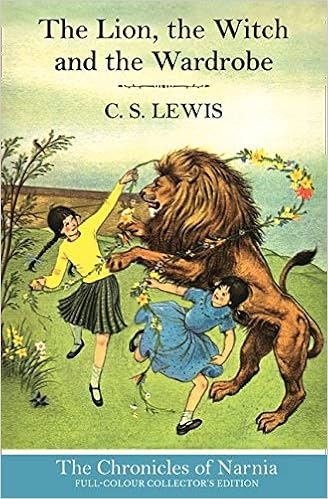
There’s a lot to enjoy in The Lion. The story is told with a breathless economy. We are in Narnia almost straight away, and from Aslan’s resurrection to the final battle and the return to the wardrobe is only a matter of pages. (From the death of the White Witch, the coronation at Cair Paravel, the tying up of loose ends and the return to England is all done in less than 2500 words). Superfluous description is stripped away, leaving the reader to imagine Narnia and the children for themselves, although I always enjoyed the wonderful illustrations by Pauline Baynes (see above). Lewis creates vividly memorable characters in the briefest of sketches. Mr Tumnus for example really only appears in chapter 2 (What Lucy Found There). He is mentioned in passing in chapter 4 (Turkish Delight) and reappears at the end of the novel when brought back to life by Aslan, where he gets precisely one line. And yet say the name Mr Tumnus to any adult of my generation and he will be brought vividly to life, with his mysterious parcels (where had he been shopping?) and guiltily nervous manner.

I like to think the mid-twentieth century equivalent of the Health and Safety Executive in some way got to Lewis and ensured that he didn’t encourage a generation of children to get trapped in wardrobes. The warnings to never close the door behind you if you do get into a wardrobe are repeated time after time, with an insistence that goes beyond paranoia. Forget about the dangerous creatures out to kill you in Narnia, just don’t shut that door!

I wanted to say a few words about what is now called “the problem with Susan”. In the final novel of the series, The Last Battle (spoilers – please don’t read on if you don’t want to know what happens) Susan is denied entry into Narnia because she has lost her faith and been seduced by earthly pleasures:

“My sister Susan,” answered Peter shortly and gravely, “is no longer a friend of Narnia.”

“Yes,” said Eustace, “and whenever you’ve tried to get her to come and talk about Narnia or do anything about Narnia, she says ‘What wonderful memories you have! Fancy your still thinking about all those funny games we used to play when we were children.'”

“Oh Susan!” said Jill, “she’s interested in nothing now-a-days except nylons and lipstick and invitations. She always was a jolly sight too keen on being grown-up.”

“Grown-up, indeed,” said the Lady Polly. “I wish she would grow up. She wasted all her school time wanting to be the age she is now, and she’ll waste all the rest of her life trying to stay that age. Her whole idea is to race on to the silliest time of one’s life as quick as she can and then stop there as long as she can.”

This decision – to portray faith as being something essentially childlike, and loss of faith due to the distractions of the flesh – nylons and lipstick – seems to many readers to be a punishment of Susan for discovering her sexuality. As well it may be. Certainly Lewis’s version of heaven means nothing if everyone can enter irrespective of their behaviour or ideas. Someone had to be left behind. But what is interesting to me is how early Lewis seems to have been planning this sacrificial role for Susan. She is consistently shown even in this novel as the one whose faith is not as steadfast as the others. Early on, when the weather closes in and they are not sure where to go, she is the first to suggest going back:

“I—I wonder if there’s any point in going on,” said Susan. “I mean, it doesn’t seem particularly safe here and it looks as if it won’t be much fun either. And it’s getting colder every minute, and we’ve brought nothing to eat. What about just going home?

In the sequel, Prince Caspian, Susan is the last one of the Pevensie children to be able to see Aslan when he reappears in Narnia (Lucy is the first, of course). I am sure Lewis always had it in mind for Susan to be the one who doesn’t make it to Narnia in the end.

Finally, just a word on the question, why read children’s books? I’ve addressed this question in previous posts, so I don’t want to go over old ground too much, but the simple answer to this is “Why not?”. The longer answer is to reject the whole concept of children’s books, although to be fair Lewis doesn’t make this argument any easier by sub-titling this novel “A Story for Children“! Suffice to say this is a novel that can be enjoyed by all ages, and the nostalgia value alone made it a wonderful read.

Standard