
I was pretty dismissive of ‘The Fall of the House of Usher‘ last month, but I thought I would give Poe a second chance. This is a collection of his shorter stories including:
a) The Murders in the Rue Morgue (1841) is best known for developing the template for the modern detective story. Two women are brutally murdered in a classic locked room mystery. Numerous witnesses overhear what they believe to be the murderers. An amateur detective, Monsieur Dupin, investigates, accompanied and narrated by a 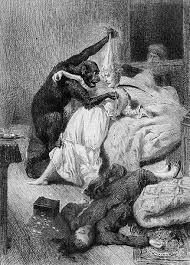 faithful sidekick on hand to record his powers of deduction. The mystery has a farcical and preposterous solution involving an orang-utang, but the features of the detective fiction, including the demonstration of analytical powers before the main crime occurs, the incompetent and bumbling police, deductive analytical processes, even the habit of remaining secluded when not on a case, they are all there. Conan Doyle acknowledges as much by explicitly referencing Dupin in an early Holmes story. This tale is full of holes – the room in which the deaths occur just happens to have a window with a secret catch allowing it to open undetected, for reasons never clearly explained, and the introduction of an orang-utang as the mystery killer made me laugh out loud.
Incidentally I know the illustration here is ridiculous as well (as being gruseome – as are all the others you can find online) but there isn’t a way of illustrating the story without being ridiculous.
b) ‘William Wilson‘ is a well-constructed portrait of schizophrenia. If it was published today it would be unsuccessful – modern readers schooled in the ideas of psychotherapy will recognise very early in the many clues that the two characters, with the same name, appearance, age etc are one and the same person, but to readers of the 1840’s the story’s conclusion may well have been shocking.
c) ‘The Masque of the Red Death‘ is by comparison a dud, in which the supernatural is used as a deus ex machina that we see coming a long way off, and has little else to commend it.
d) ‘The Pit and the Pendulum‘. In this story the narrator is thrown into prison by the Inquisition, and awaits death by means of either a – well, you can guess. The tension is built slowly and effectively, and the prison/torture chamber is ingeniously recreated. The outcome, the narrator’s survival, is ensured by his ability to tell the tale, but his escape from the Inquisition is well managed.
e) ‘Hop-Frog‘ returns to a more fairy-story theme begun in ‘The Masque of the Red Death’. Set in an unidentified European country in the Middle Ages, a cruel king is unkind to his court jester, and suffers revenge appropriate to his offences.
f) ‘The Case of Amontillado’. A collection of short stories within the horror genre would not be complete without a take featuring someone walled into their grave, and this is it. It is reasonably well done but takes a considerable effort to suspend belief long enough to be in any way disturbed by the outcome, given that it is flagged so early on.
g) ‘The Tell-Tale Heart‘. “I made up my mind to take the life of the old man”. This is a well-written short story in which a man commits a murder, but is betrayed by the sound of the still beating heart. It’s a convincing portrait of psychopathy, in which the speech patterns of the killer, the use of repetition
h) ‘The Man that was Used Up‘ is an extended shaggy dog story not worth the short time it would take to read; the joke falls very flat despite the prolonged set up, at least in part because the narrator is such a boor.
Overall these stories are interesting early examples of the horror genre, and are worth reading for the introduction to the model for Sherlock Holmes if nothing else. I am not sure to what extent Poe’s original readers would have found these stories scary or horrific; they have not aged well as our appetites for blood and guts has become more extreme. Usually attempts at humour fall flat, and it is the simpler stories such as ‘The Tell-Tale Heart’ which are the more effective.


I remember really liking Masque of the Red Death when I read it, but I remember it not as so much horror, but as an allegory for how readily people who are well off can close off and forget about awful things around them — things that have a very distinct chance of eventually coming around for them. The images of that one have always been very striking to me.
The Pit and the Pendulum is one that I remember the details of less well, but I do remember getting really invested and tense about the outcome.
Poe is interesting to me- he’s definitely more a poet than prose writer, I think, and yet every now and again he whips an image and rhythm that is breathtaking. Uneven writer to say the least, but every now and again he captures something striking.
LikeLiked by 1 person
Thanks, really good comments, in particular your point about the Red Death story being aa allegory – bit horrified I missed that!
LikeLike
Ha, thanks- though I can’t say for sure that’s what the Red Death is, to be fair! I actually went back and read it again to see how it matched up to my memory, and found lines like this: “They resolved to leave means neither of ingress nor egress to the sudden impulses of despair or of frenzy from within. The abbey was amply provisioned. With such precautions the courtiers might bid defiance to contagion. The external world could take care of itself. In the meantime it was folly to grieve or to think.”
There’s something about lines like that that seem like a jab at more than just the characters in the story. But I have no way of knowing if that’s what Poe had in mind.
The language is over-the-top to say the least, but for all the gaudy phrases, it seems to be kind of evoking something more than a strictly literal reading, especially since it opens with “the madness and horror of blood” and then the ball itself seems to bring the madness, with the horror coming soon after. Kind of how throughout history you can find elite classes that are perfectly happy, healthy (and sometimes decadent) in societies where most everyone else is ravaged.
LikeLiked by 1 person
Yes, completely OTT, but I still think your point about it being an allegory is completely on the money.
LikeLiked by 1 person