
(And more specifically, does her legal status within the Bertram household offer the reader any insight into her character?)
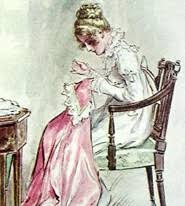
Was Fanny adopted? Strictly speaking, no. Adoption as a legal concept did not exist in the UK until the twentieth century. The first legislation relating specifically to adoption was not passed until the 1920s. Before then the legal status of anyone brought up as the child of another family was unclear. The construction of non-nuclear families was often a necessity given how common early death was in nineteenth-century Britain, but the law was rarely involved in the process.
Why does this matter? I think it’s because it introduces another way of looking at Mansfield Park. It can be read as a story of profound childhood trauma. A child is uprooted from her family home, her parents and many siblings and taken halfway across the country to live with an aunt, uncle and cousins she has never met before. Apart from periodic letters from her brother William she has no further contact with her family until she is eighteen. She is treated moderately well in her new home, but is never considered a full member of the family. When she does finally return to her family after eight years their poverty alienates her further (although even the Prices are not above having at least two servants! I have mentioned before the phenomenon whereby no matter how poor people become in nineteenth century literature they are always still able to employ a servant or two).
We are not told anything directly about Fanny’s feelings about her move to Mansfield Park, but there are some hints in the text about how traumatic it might have been. When considering her return to Portsmouth Fanny wonders at the reception she will receive from her mother “who had certainly shown no remarkable fondness for her formerly”. Fanny is sure this lack of maternal affection (and by extension the decision to send her away) must be her fault:
“She had probably alienated love by the helplessness and fretfulness of a fearful temper, or been unreasonable in wanting a larger share than any one among so many could deserve. Now, when she knew better how to be useful and how to forebear, and when her mother could no longer be occupied by the incessant demands of a house full of little children, there would be leisure and inclination for every comfort.” (Chapter 37):
In other words she has understood all this time that the decision to send her to live with her aunt and uncle was a rejection of her by her parents, a punishment for an unknown fault. She has carried the burden of this belief in her unworthiness since the age of ten. She has also had to live with constant reminders of her lack of intelligence, grace and attractiveness compared to her older cousins. This is how she is introduced at the opening of the second chapter:
“Fanny Price was at this time just ten years old, and though there might not be much in her first appearance to captivate, there was, at least, nothing to disgust her relations. She was small of her age, with no glow of complexion, nor any other striking beauty; exceedingly timid and shy, and shrinking from notice; but her air, though awkward, was not vulgar, her voice was sweet, and when she spoke her countenance was pretty.”
Fanny is defined here by a flood of negatives. From this point on she is treated as a second-class member of the family – whenever her cousins arrange an outing or activity, Fanny is left behind to sit with her docile aunt.
Fanny had no share in the festivities of the season…as to her cousins’ gaieties, she loved to hear an account of them, especially of the balls, and whom Edmund had danced with; but thought too lowly of her own situation to imagine she should ever be admitted to the same,
The details of her move from Portsmouth to Mansfield Park are arranged so hurriedly in the novel’s opening chapter that they are easy to overlook. Initially when Mrs Price approaches her sister for help she asks
Her eldest was a boy of ten years old, a fine spirited fellow, who longed to be out in the world; but what could she do? Was there any chance of his being hereafter useful to Sir Thomas in the concerns of his West Indian property? No situation would be beneath him; or what did Sir Thomas think of Woolwich? or how could a boy be sent out to the East?
It seems as if help is indeed given to find William a situation in the navy, but in addition:
“What if they were among them to undertake the care of her eldest daughter, a girl now nine years old, of an age to require more attention than her poor mother could possibly give? The trouble and expense of it to them would be nothing, compared with the benevolence of the action.”
Sir Thomas is more cautious about the idea of bringing an unknown child into his family. He has the foresight to see some of the potential complications, even if not the sense to act on his doubts:
Sir Thomas could not give so instantaneous and unqualified a consent. He debated and hesitated;—it was a serious charge;—a girl so brought up must be adequately provided for, or there would be cruelty instead of kindness in taking her from her family. He thought of his own four children, of his two sons, of cousins in love, etc.;—but no sooner had he deliberately begun to state his objections, than Mrs. Norris interrupted him with a reply to them all, whether stated or not.
“My dear Sir Thomas….you know I am a woman of few words and professions….I don’t say she would be so handsome as her cousins. I dare say she would not…do not you know that, of all things upon earth, that is the least likely to happen, brought up as they would be, always together like brothers and sisters? It is morally impossible. I never knew an instance of it. It is, in fact, the only sure way of providing against the connexion….. Breed her up with them from this time, and suppose her even to have the beauty of an angel, and she will never be more to either than a sister….
Of course these are prophetic words, in that the risk of an attraction between cousins is not ultimately negated by the children having been brought up together.
When Fanny finally returns to Portsmouth (in chapter 39), she finds herself alienated from her family, and can no longer consider it her home. The Price family home in Portsmouth is, in Fanny’s eyes, an “abode of noise, disorder, and impropriety. “ Fanny thinks her mother to be “a partial, ill-judging parent, a dawdle, a slattern, who neither taught nor restrained her children, whose house was the scene of mismanagement and discomfort from beginning to end, and who had no talent, no conversation, no affection towards herself; no curiosity to know her better, no desire of her friendship, and no inclination for her company that could lessen her sense of such feelings.”
Fanny’s status in Mansfield Park is profoundly ambiguous. There are few precedents for a relationship of this nature, and it is for Fanny and the Bertrams, with the ever-helpful advice of Mrs Norris, to negotiate. Bringing a young man into a family to inherit a family estate and name was not unknown, and long term fostering of a child was necessary from time to time, but always with a clear objective – either to provide an heir (in which case a name change was also necessary) or to provide respite to the child’s birth parents. Jane had first-hand experience of the former type of adoption – her brother Edward having been ‘adopted’ by the Knight family, changed his name, (although retaining the Austen as a middle name) and made their legal heir. Wikipedia describes this adoption of sorts rather bluntly
“When Edward was twelve years old he was presented to Thomas and Catherine Knight, who were relatives of his father and were wealthy. Thomas had given George Austen (jane’s father) the living at Steventon in 1761.They were childless and took an interest in Edward, making him their legal heir.”
Here the reasons for providing a home to Fanny are less clear-cut – essentially it is to help her parents financially, although offering some money would have done the job just as easily. This decision, so central to the novel, seems lightly done.
Mrs Norris attempts to delineate Fanny’s status in the Bertram household by her allocation of sleeping quarters:
I suppose, sister, you will put the child in the little white attic, near the old nurseries. It will be much the best place for her, so near Miss Lee, and not far from the girls, and close by the housemaids, who could either of them help to dress her, you know, and take care of her clothes, for I suppose you would not think it fair to expect Ellis to wait on her as well as the others. Indeed, I do not see that you could possibly place her anywhere else.”
Lady Bertram made no opposition.
Fanny is placed with particular precision, nearer the governess (Miss Lee) than the daughters, and close by the maids. She may not be a servant but neither is she a member of the family.
Sir Thomas also frets about the question of Fanny’s status in his household:
“There will be some difficulty in our way, Mrs. Norris,” observed Sir Thomas, “as to the distinction proper to be made between the girls as they grow up: how to preserve in the minds of my daughters the consciousness of what they are, without making them think too lowly of their cousin; and how, without depressing her spirits too far, to make her remember that she is not a Miss Bertram. I should wish to see them very good friends, and would, on no account, authorise in my girls the smallest degree of arrogance towards their relation; but still they cannot be equals. Their rank, fortune, rights, and expectations will always be different. It is a point of great delicacy, and you must assist us in our endeavours to choose exactly the right line of conduct.”
The novel’s silence on Fanny’s feelings about her move to Mansfield Park leaves it to the reader to construct this part of the narrative. Are we intended to assume that her distress at removal from her family is brief, and she easily comes to terms with the changes in her life? Or does it emotionally cripple her, causing her to withdraw into herself and become the passive observer of life we see her as?


I’ve read both your posts with great interest as Mansfield Park was the first Austen novel I studied, at university, and I’ve always liked it. I agree it’s difficult, and I wonder perhaps if that’s because of a tendency to approach it as if it were on the. same level as her other novels. I don’t think it is; in a way it’s a much broader social novel, with the huge changes taking place in English society during the Napoleonic Wars as a background. Austen casts her net so much wider in terms of characters, and herself said that it was a novel about ordination, which I think merits serious reflection. I do find Fanny a prig, but I don’t find her the central character in the same way that Emma is, for instance. And the ending does parcel everything up quickly, although I have struggled to see what else Austen might have done…
LikeLiked by 1 person
Thanks for your comments. For me, the reason Mansfield Park pales in comparison with Pride and Prejudice is quite simple. P&P is a wonderful romantic comedy, and MP isn’t. The romantic elements fall flat and are unconvincing. Austen may have claimed it was a novel about ordination – which actually plays a very small element in the novel overall – but it quickly reverts to what she wrote best – romantic entanglements between the young people. The fact that these romances all go astray rather than the happy-ever-after ending we all hoped for is what leads to the sense of dissatisfaction.
LikeLike
In a way, I have always felt that Austen was doing something rather subversive with her depiction of Fanny, as she was indeed rejected both by her immediate family, and by the Bertrams with the exception of Edmund, and possibly his father eventually. On the face of it, we should therefore pity Fanny for her experiences, yet she remains an aloof figure for the reader, and I wonder whether this is in fact the point. She was dull, introverted and withdrawn, but I don’t think it was an accident of creation. I have also never been completely convinced we were meant to see the marriage of Fanny and Edmund as containing the potential for ultimate happiness, but I would need to re-read it. I have been intrigued by your thoughts on this novel, as it is Austen’s least enjoyable, but has stuck in my mind perhaps more than any of the others for that reason.
LikeLiked by 1 person
I think it helps to see it in Shakespearean terms as a “problem” novel – one that subverts the traditional happy ever after expectations of the audience/reader, and leaves them feeling a little uncomfortable. Austen was definitely trying to do something different (as Shakespeare seems to have been doing in, for example, Measure for Measure) but whether she/he pulls it off is another matter. It’s completely normal to expect something similar to Pride and Prejudice and to be discomfited when the novel goes in a different direction. But that brings me back to what I think is my main point – the bits of the novel that really show Austen at her best are the traditional romantic comedy scenes eg the visit to Sotherton or the staging of the play.
LikeLike