
The Riverside Villas Murder by Kingsley Amis, 1973
The Riverside Villas Murder was written in the 1970’s, is set in the 1930’s, and is infused with the dominant social attitudes of the 1950s. Which all adds up to an uncomfortable mix. The story is told principally through the eyes of 14-year-old schoolboy Peter Furneaux. He is a typical 14 year-old, unable to go more than a few minutes at a time without thinking about sex. The mystery element of the story begins with a burglary at a local museum, where a mummified body and some Roman coins are stolen. Later, at a village dance, one of the Riverside Villas residents, a Mr Inman, provokes his neighbours by suggesting he has damaging information about them. During the dance, Mrs Trevelyan, a bored housewife, dances with Peter. Later she invites him to tea at her home, where she ‘seduces’ him. In the 1970’s this may have seemed comical, but fifty years on the scene is quite shocking in many ways. While it is Peter’s first sexual experience, Amis treats it as slapstick comedy: “What he had imagined so often and so long, and what actually happened on Mrs Trevelyan’s bed, resembled each other about as much as a fox-terrier and a rhinoceros.”
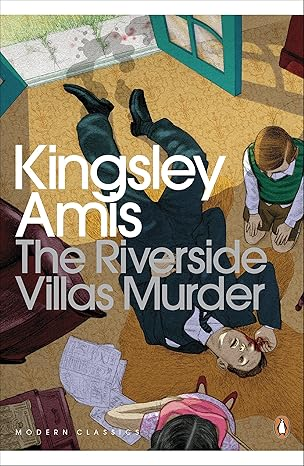
A few days later, Inman is murdered. He staggers into the Furneaux home, soaking wet from having fallen into a nearby river and bleeding from a head wound. Peter calls Mrs Trevelyan for help, but Inman dies shortly after. The rest of the novel comprises the police investigation, led by a cast of policemen who I think we are supposed to find comic but to me were one-dimensional and unconvincing and whose investigation is chaotic.
As a murder-mystery the novel is dull – the explanation as to whodunnit, when it is finally revealed, manages to be both predictable, because it follows the traditions of the genre, and at the same time impossible to deduce, given that the murder weapon turns out to be an improbable Heath-Robinson contraption that no-one could possibly have foreseen. The murderer’s motives are also transparently thin.
But there is a much more serious problem with the novel. Amis clearly set out to write a traditional detective novel, with the central character being a young teenage boy. It follows all the tropes of the genre quite carefully, as if the novel were an exercise in nostalgia. The 1930’s setting – Amis was born in 1922, so would have been a teenager himself in the thirties and therefore very familiar with the popular culture reference which litter the novel – allows him to wallow in nostalgia for an England where murderers are executed, housewives are almost invisible unless they are sexual predators and gay men are the object of scorn and disgust. The novel also contains a scattering of casual uses of the n-word and gay slurs, which, when placed in the mouths of old-fashioned men such as Peter’s father or the police provide the excuse of authenticity but at the same time allow Amis to break social taboos. In other words the novel is pointedly offensive. This isn’t social observation, it is autobiography.
Which poses two questions: why read a book with such objectionable ideas, and why review it? I loved Lucky Jim, and while I have developed a much better understanding of some of its problematic aspects, I still have a fondness for it. Amis can craft a striking phrase – the fox-terrier/rhinoceros quote above for example – and he did go on to win the Booker Prize. So it is hard to dismiss him as an author, and I still read him occasionally to see if he could ever recapture the brightness and humour of Lucky Jim. So far there have only been glimpses. As to the question of why one would review a book that deserves to go out of print and remain so, that’s more straightforward. These are not recommendations but posts noting what books I have read. No more no less. I don’t post about every single book I read (although I should according to my self-imposed rules) but I try to miss as few as possible. And if I have saved anyone the experience of reading the Riverside Villas Murder then it will have been worth it.

