Book review

Small Gods (Discworld 13) by Terry Pratchett, 1992

It feels appropriate (if unplanned) to publish this review on the sad fourth anniversary of Sir Terry’s untimely death.

By this point in the Discworld saga, he was really hitting the peak of his powers. This was a writer who is really confident with his material, able to tackle large themes and ready to take risks. And for any writer religion is arguably the biggest risk – you are always going to upset someone. Small Gods is a fascinating discussion of the nature of divinity. That makes it sounds very serious, but that was the author’s genius – to write about serious themes in a very funny way.

The novel is set in Omnia, a kingdom in the continent of Klatch, new to Discworld at this point I believe, and bearing an uncanny resemblance to a medieval Catholic country in the grip of a frenzied search for any trace of heresy. Pratchett has given Om a far-eastern name, and mixes up his religious references freely, but the use of torture by the Quisition to enforce religious conformity and stamp out free thinking, has only one true origin. In Omnia religion has become a distorted version of itself, with torture and fear being its dominant characteristic. In these circumstances true belief in the God Om himself has begun to wither, so much so that the God Om finds himself reincarnated in the body of a tortoise. It seems he is destined to return to the world of once great but now Small Gods who exist on the borders of reality, desperate for believers from whom they derive their existence.

By a million to one chance, and therefore a literary certainty, Om in his tortoise form encounters the novice Brutha, the only remaining true believer in Omnia. Brutha’s idetic memory is used Vorbis, the head of the ExQuisition, to memorise the way through a labyrinth used to guard the library of Ephebe. Vorbis is one of Pratchett’s scariest monsters, a psychopath so controlled and uncaring that he is able to retain his position at the head of the Omnian church by fear alone. An underground movement, reminiscent of the early Christian church, survives in secret, passing its belief in the Disc-shape of the word through its slogan “The Turtle Moves”. The scene is set for a clash of beliefs in which someone is going to die. Guessing who isn’t a challenge, but the journey – in this case a physical journey through the desert – is where the transformation of Brutha from a menial drudge to a prophet occurs.

As always with Pratchett his wit and wisdom shines through. Here he is on religious repression, for example:

“Fear is a strange soil. It grows obedience like corn, which grow in straight lines to make weeding easier. But sometimes it grows the potatoes of defiance, which flourish underground.”

or here on the miracle of our existence:

“Humans! They lived in a world where the grass continued to be green and the sun rose every day and flowers regularly turned into fruit, and what impressed them? Weeping statues. And wine made out of water! A mere quantum-mechanistic tunnel effect, that’d happen anyway if you were prepared to wait zillions of years. As if the turning of sunlight into wine, by means of vines and grapes and time and enzymes, wasn’t a thousand times more impressive and happened all the time…”

Sir Terry’s death was such a loss, but he left us a wonderful collection of novels that are a fine legacy.

Standard
Book review

Paris Echo, by Sebastian Faulks, 2018

Have you ever got the end of a novel and asked “What was the point of that, then?” In a sense I know this is a futile question – there is no ‘point’ to Van Gogh’s Sunflowers or Beethoven’s Fifth. Equally not all novels have a point – they exist as a work of the author’s creativity and can’t be judged for their utility. I can think of some exceptions to this rule – there is a very definite point to Gulliver’s Travels, for example, or Animal Farm, but most novels are not didactic – they just tell a story, introduce some characters, and tell us something about the human experience. Continue reading

Standard
Book review

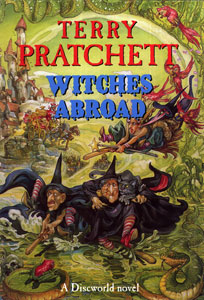
Witches Abroad, (Discworld 12) by Terry Pratchett, 1991

Is it possible to have two favourite Discworld books? I have three favourite children after all, so conceptually it should be possible. Were it to be deemed so by the powers that be, then ‘Witches Abroad’ would definitely be my joint favourite Discworld novel alongside Witches-abroad-cover‘The Night Watch’. Granny Weatherwax, Nanny Ogg, her perfect foil, and Magrat Garlick on a road trip across the Disc, travelling through a landscape of fairy stories brought to life by Lilith de Tempscire, Granny’s evil sister. Just perfect!

Granny and Nanny are two of my favourite Discworld characters – Magrat is a wet hen, and I can take her or leave her – and together they are wonderful. Nanny Ogg is sometimes overshadowed by Granny’s awesomeness, but her she is in full flow, a force of nature that bulldozes its way across the Disc, all the way to Genua. Genua is a coastal town with an annual celebration called Fat Lunchtime, a tradition of cooking based around gumbo and, and all in all bears a strong resemblance to New Orleans.

Witches Abroad also contains the greatest Discworld story Sir Terry never wrote. At the end of this novel, when the bad guys have been defeated and order restored, the witches have a choice – to go home, or to go and “see the elephant”, a colloquial expression for going home the long way, continuing their holiday as much as possible. They agree to see the elephant, and the reader is left to picture what a glorious, outrageous adventure that would have been. (If it turns out that this novel was actually written, and I have just forgotten it, which is quite possible, I will be both deeply embarrassed and hugely delighted).

So what is it about this novel that makes it so full of wonder? It can’t be the jokes, because they almost all qualify as ‘dad’ jokes – even the title is a pretty silly play on words (Witches Abroad = witches out and about, and also in foreign lands). Or try this schoolboyish fun with the fact that in some languages words have gender, which might be funny if you are 11

“‘S called the Vieux River.”
– “Yes?”
– “Know what that means?”
– “No.”
– “The Old (Masculine) River,” said Nanny.
– “Yes?”
– “Words have sex in foreign parts,” said Nanny hopefully.”

Or here’s another joke, when the witches see a stuffed lion’s head:

By gor’, that’s a bloody enormous cat.’
‘It’s a lion,’ said Granny Weatherwax, looking at the stuffed head over the fireplace.
‘Must’ve hit the wall at a hell of a speed, whatever it was,’ said Nanny Ogg.
‘Someone killed it,’ said Granny Weatherwax, surveying the room.
‘Should think so,’ said Nanny.  ‘If I’d seen something like that eatin’ its way through the wall I’d of hit it myself with a poker.”

OK, silly jokes yes, but slapstick can be funny?

Is it the ‘world building’? (“The process of constructing an imaginary world, sometimes associated with a whole fictional universe. The resulting world may be called a constructed world.”) I think this is getting closer. STP made no attempt to make the basic concept of Discworld anything other than fun, but over time he developed a geography and history for the world that within its own constraints – it is balanced on a turtle carrying four elephants after all – is believable. Is it the story-telling? Definitely not. One of the joys of rereading these novels is rediscovering (and then quickly re-forgetting) what happens, because what happens is usually not very important. We know the good guys are going to win, and the demons from the Dungeon Dimensions are going to be defeated in that somewhat vague way that most of these novels deploy to resolve matters. In the tradition of most great story writers STP borrows plot lines freely and openly, even going so far in this novel to make that borrowing itself part of the plot. Dracula, The Wizard of Oz, Little Red Riding Hood, Cinderella, – you name it, STP borrows from it.

So what’s left? It would be wrong to use the term “philosophy”, but the underlying humanism of the author’s perspective on the world shines out from every one of his novels. He has profound insights into the human (and dwarven, troll and other life-forms) condition. You really have to read the books to get this point properly, but for now how about this from Granny Weatherwax?

“You can’t go around building a better world for people. Only people can build a better world for people. Otherwise it’s just a cage.”

Lastly, there are the novel’s extraordinary, deeply loved, characters. I’ve written at length in previous Discworld reviews about Granny, Nanny and Sam Vimes in particular, so I am not going to repeat myself too much other than to say they are utterly magnificent, utterly believable, and full of the humanity that makes these novels some of my favourites on the planet. Sorry, roundworld.


Standard
Book review

If on a Winter’s Night a Traveller, by Italo Calvino, 1979

Post-modernist. There, I’ve said it. It’s impossible to review this novel without using this term, so I might as well get it out of the way, and hopefully not come back to its constraining definitions.

Published in the original Italian in 1979 and translated into English shortly thereafter, If on a Winter’s Night a Traveller is a boldly experimental novel that parades its cleverness, but tiptoes at times close to disappearing up its own narrative fundament.

It’s hard to describe what the novel is about, mainly because it is about itself. It begins with a discussion on what it means to read a novel, a discussion that continues intermittently throughout the book. What narrative structure there is concern events that the narrator describes as happening to the reader and your adventures in reading Italo Calvino’s novel, If on a Winter’s Night a Traveller. Got that? This self-consciously subverts every tradition of story-telling, even though novels about novels are actually not that new. The structure of the novel sees the hypothetical reader begin reading a series of texts, each abruptly brought to a close, followed by an attempt to find the next chapter, introducing a new text at each attempt.  This quickly settles down to a predictable formula – we know the text is going to be incomplete and a new one will start soon.

I found this a hard read. Yes, I managed to finish it, but I was hoping to be dazzled. I have had this novel on my shelves for literally decades, always trying to find the right time to read it, and never quite getting there. My mistake I believe was to try and read it in short bursts on my commute. This is a demanding novel that needs the full force of your concentration, preferably with a pen and notebook to hand, not snatched ten or fifteen minute reads over two weeks or more. It just doesn’t flow as easily as most novels, fragmented as it is. I kept hoping at one point the pieces would click into place and a whole would be revealed to be so much more than the parts. Perhaps if I had read it more carefully that would have happened, but as it was it felt predictable and at times even puerile. Commentary on the experience of reading is interesting, but on its own does not have enough substance to create a novel, however much you mix it with many brief introductions to stories. What probably seemed revolutionary and exciting in 1979 seemed dated and forced in 2019.

I have enjoyed many meta-narratives before now, such as David Mitchell’s Cloud Atlas to give one obvious example, so I am certainly open to the idea, but the funny, clever, intelligent novel I was hoping for never turned up. Perhaps my yearning for a story is childish. One day I hope to reread If on a Winter’s Night a Traveller again, this time with the care it demands, and maybe then I will eat my words.

Standard
Book review

Reaper Man (Discworld 11) by Terry Pratchett, 1991

As the reaction to my Facebook post about Pyramids (Discworld 7) attests, the Discworld novels are hugely loved by a community of readers across the world. People love the novels for many reasons, but I think one of the most common reason is the enormous empathy that Sir Terry shared with his readers. He knew our weaknesses and frailties, 220px-Reaper-man-coverand saw the inner strength in the most abject of us, the deluded, the vulnerable. No-one is so much of a misfit that they don’t have a place in Ankh-Morpork’s Watch; no-one is beyond redemption, as Moist von Lipwig’s story shows. And the weakest and frailest of us all know that one day we will face death, or perhaps Death. So it is his crowning achievement that he made Death such a human, kind character, and that novels such as Reaper Man which are all about Death and death, can be so warm and touching.

Ok, I get it, enough fan-boying, if that’s a word. In this the eleventh Discworld novel, the Auditors of Reality object to Death developing a personality, so decide to ‘retire’ him. In facing up to the death of Death he leaves his job collecting souls, and spends his remaining days working as a farm hand imaginatively named Bill Door for the elderly Miss Flitworth, another of STP’s astonishingly well realised older female characters.

But the absence of death is not entirely unproblematic. A ‘life force’ (of some kind, STP is vague on the detail) starts to cause poltergeist activity and lots of other weirdness. Windle Poons a senior wizard is disappointed not to be met by death on his passing, and becomes a charmingly polite but determined zombie, joining an undead-rights group. The ‘action’ scenes in which Ankh-Morpork is slowly invaded by a parasitic lifeform which evolves into a shopping centre are heavily cut between the Bill Door scenes, but this doesn’t effectively disguise their clumsiness as satirical comment on consumerism. In the novel’s touching climax Death is given a little more time and spends it on a last dance with Miss Flitworth.

One of the many joys of a Discworld reread is rediscovering the origin stories of some of Sir Terry’s wonderful characters. Reg Shoe, undead rights activist, first appears here, although it is not until much later in the glorious Night Watch that we discover how he came to zombiedom. The Death of Rats also first appears in this novel. But Death takes centre stage here, rightly so, and carried the novel on his bony shoulders. Another triumph Sir Terry.

Standard
Book review

Raffles, the Amateur Cracksman, by E W Hornung, 1899

Raffles: The Amateur Cracksman has not aged well. While his contemporary Sherlock Holmes has prospered in the twenty-first century, with films, television adaptation and yet more ‘inspired by’ novels, Raffles languishes largely forgotten. In this post I am going to explore the reasons for this neglect and suggest a possible way back into the stories.Raffles

Raffles, conceived by Hornung as a counterpoint to his brother-in-law Conan-Doyle’s master detective, is the archetypal gentleman thief. By day, he is a member of London society, and a noted cricketer. By night he is a burglar – a ‘cracksman’. His accomplice and biographer is Bunny Manders, who narrates these stories and looks up to Raffles, one might even say adores him. But more of the homo-erotic undertones of the stories in a moment.

In his wonderful essay Raffles and Miss Blandish, George Orwell compared the Hornung stories with a more contemporary detective tale which offended his sensibilities. He described Raffles as

still one of the best-known characters in English fiction. Very few people would need telling that he played cricket for England, had bachelor chambers in the Albany and burgled the Mayfair houses which he also entered as a guest.

That was in 1944, but the same could certainly not be said now. Orwell’s anatomy of Raffles centres on the acute observation that the

“truly dramatic thing, about Raffles, the thing that makes him a sort of byword even to this day… is the fact that he is a gentleman. Raffles is presented to us and this is rubbed home in countless scraps of dialogue and casual remarks — not as an honest man who has gone astray, but as a public-school man who has gone astray. His remorse, when he feels any, is almost purely social; he has disgraced ‘the old school’, he has lost his right to enter ‘decent society’, he has forfeited his amateur status and become a cad…In making Raffles a cricketer as well as a burglar, Hornung was not merely providing him with a plausible disguise; he was also drawing the sharpest moral contrast that he was able to imagine.

But this is not all, because with his laser-like precision on matters of class, Orwell identifies that while Raffles may be a gentleman, his position in society is less secure than a casual reader might think:

Raffles…is a story of snobbery, and it gains a great deal from the precariousness of Raffles’s social position. A cruder writer would have made the ‘gentleman burglar’ a member of the peerage, or at least a baronet. Raffles, however, is of upper-middle-class origin and is only accepted by the aristocracy because of his personal charm. ‘We were in Society but not of it’, he says to Bunny towards the end of the book; and ‘I was asked about for my cricket’. Both he and Bunny accept the values of ‘Society’ unquestioningly, and would settle down in it for good if only they could get away with a big enough haul. The ruin that constantly threatens them is all the blacker because they only doubtfully ‘belong’. A duke who has served a prison sentence is still a duke, whereas a mere man about town, if once disgraced, ceases to be ‘about town’ for evermore. 

Well, as we will see, there are different forms of disgrace.

Much, perhaps too much, has been made of Raffles’s relationship with Holmes. Hornung didn’t help this reflex reaction by dedicating this book to “ACD” and suggesting the stories were a form of flattery. A criminal version of Holmes would indeed have been fascinating, but Raffles doesn’t fit the bill. He is far too clumsy a thief, relying on crude strategems including violence, and is very nearly caught by the police, something that would never happen to Holmes. In the second story in this collection, ‘A Costume Piece” Raffles tries to steal jewels from the millionaire Reuben Rosenthall. He breaks into his house, only to be captured red-handed by the alert Rosenthall and companions who were waiting for him all along. He escapes by the simple strategem of running away, although he does come back later to rescue the hapless Bunny, disguised as a policeman. In another story, ‘Gentlemen and Players’, Raffles secures an invitation to a country house party. The rich visitors seem easy pickings, but a complicating factor involves a successful burglary by some professional thieves. Raffles takes the opportunity afforded by the theft of walking into the victim’s bedroom and taking her remaining jewels. No bravery, cunning nor skill required, just an invitation to the right kind of house party.

We are constantly told Raffles is a gentleman, but his code of ethics is not as clear cut as you would expect. He is quite prepared to murder his blackmailer for example, and only avoids doing so because someone has beaten him to it. In fact the scene where Raffles first contemplates murder is chilling in its amorality; Raffles seems alive with the thrilling prospect of the crime:

The biggest man alive is the man who’s committed a murder and not yet been fund out… Just think of it! Think of coming in here and talking to the men, very likely about the murder itself, and knowing you’ve done it; and wondering how they’d look if they knew! Oh it would be great, simply great! 

Bunny – and what a childish nickname for a grown man to have – adores him. The Wikipedia entry for Hornung  claims that Raffles and Bunny were “were based partly on his friends Oscar Wilde and his lover, Lord Alfred Douglas”. By 1898, the year the first Raffles story was published, Wilde had already completed his prison sentence for perjury, and was living in Paris. His name became synonymous with homosexuality, and it would have been a brave author who openly used Wilde’s relationship with Douglas as a model for his characters. But the homo-eroticism between Raffles and Bunny, albeit a somewhat one-sided attraction of the younger man for his hero, is undeniable. They first meet at school, where Bunny is Raffles’s “fag”; when the stories begin Bunny has lost all his money gambling, is facing disgrace, and is considering suicide. Raffles offers him a way out of his troubles – an exciting and seductive new life of sin and crime.

Once Raffles and Bunny’s ‘crimes’ are seen as a metaphor for gay love, the stories come alive as an “in plain sight” confession of “the love that dare not speak its name”. In fact it is hard to read many of their exchanges without spotting a gay sub-text.

I’ll do it again…I will…I’ll lend you a hand as often as you like! What does it matter now? I’ve been in it once. I’ll be in it again. I’ve gone to the devil anyhow. I can’t go back, and wouldn’t if I could. Nothing matters another rap! When you want me I’m your man.

Bunny repeatedly tries to break away (break up?) from Raffles – he knows what he represents is wrong, but finds it compellingly attractive, both hating and wanting it at the same time. When in “The Return Match” Raffles seeks him out, lays his hand on his arm and says “Come up to my place”, Bunny can’t resist:

“To me, at all events, there was never anybody in the world so irresistible as Raffles…I made my excuses …but his arm slide through mine…and even while I argued we were on his staircase in the Albany.”

Elsewhere Bunny is openly affectionate towards Raffles, and comes close to accepting his feelings:

It was Raffles I loved. It was not the dark life we led together, still less its base rewards; it was the man himself, his gayety, his humour, his dazzling audacity, his incomparable courage and resource. And a very horror of turning to him again in mere need of greed set the seal on my first angry resolution. But the anger was soon gone out of me, and when at length Raffles bridged the gap by coming to me, I rose to greet him almost with a shout.

This affection burns at its brightest when Bunny is tortured by jealously seeing Raffles flirt with a young Australian women on their ill-fated cruise in The Gift of the Emperor:

What he could see in her—but that begs the question. Of course he saw no more than I did, but to annoy me, or perhaps to punish me for my long defection, he must turn his back on me and devote himself to this chit from Southampton to the Mediterranean. They were always together. It was too absurd. After breakfast they would begin, and go on until eleven or twelve at night; there was no intervening hour at which you might not hear her nasal laugh, or his quiet voice talking soft nonsense into her ear. Of course it was nonsense! Is it conceivable that a man like Raffles, with his knowledge of the world, and his experience of women (a side of his character upon which I have purposely never touched, for it deserves another volume); is it credible, I ask, that such a man could find anything but nonsense to talk by the day together to a giddy young schoolgirl? I would not be unfair for the world.

I think I have admitted that the young person had points. Her eyes, I suppose, were really fine, and certainly the shape of the little brown face was charming, so far as mere contour can charm.

I admit also more audacity than I cared about, with enviable health, mettle, and vitality. I may not have occasion to report any of this young lady’s speeches (they would scarcely bear it), and am therefore the more anxious to describe her without injustice. I confess to some little prejudice against her. I resented her success with Raffles, of whom, in consequence, I saw less and less each day. It is a mean thing to have to confess, but there must have been something not unlike jealousy rankling within me.

References to their physical attraction for one another, the compelling nature of their relationship, the enjoyment of one another’s company, and the recognition that what they are engaged in is wrong by the moral code of society, but thrilling and rewarding nonetheless, crowd the stories’ pages. Raffles toys with Bunny’s affection, keeping him guessing at all times about his motivation. Bunny blindly follows wherever Raffles leads, even when it ends up in a prison cell.

I suspect the simple reason why Raffles is no longer read widely, is that despite this interesting element of modernity, the stories are just not very good. Raffles rarely has a cunning plan of any kind, and Bunny is so dim that the fun of understanding more than him about what is going on palls quickly. Raffles isn’t half as charming or interesting as he thinks he is. Add to that some appalling racism which yes, is of its time, but which Conan Doyle somehow managed to largely avoid, and these stories are not yet ready for a revival. Perhaps when this inevitably happens it will involve a degree of reinvention that they sorely need.

Standard
Book review

Moving Pictures (Discworld 10) by Terry Pratchett, 1990

Moving Pictures

At this point (1990) in his writing career, Terry Pratchett was producing two Discworld novels a year. He’d published Sourcery (Discworld 5) and Wyrd Sisters (DW 6) in 1988, Pyramids (DW 7) and Guards! Guards! (DW 8) in 1989, and Eric (DW 9) already in 1990, before he produced Moving Pictures for the Christmas sales at the end of the year. By any reckoning this is an extraordinary sustained level of output, all the more so given that Moving Pictures is such a rich and cleverly written novel.

I am fairly sure when Sir Terry was writing these novels there was no overall grand plan in his head. (I may have read that somewhere). People have retrospectively tried to impose some order on the novels, and grouped them around the principal topics – the Witches series, the City Watch series, and so on. Several of the Discworld novels use as their inspiration the coming of round world technology to the Disc – The Truth (printing), Going Postal (Clacks/telegrams), Raising Steam (trains) and so on. Monstrous Regiment is sometimes included in this group but I am not sure why – maybe it will become clearer when I eventually reread it!) These groupings can be contentious, but they do make the series more accessible to new converts to the cause of all things Pratchett, so are therefore a good thing. Moving Pictures is the first in the Industrial Revolution series of novels, and is a quite affectionate satire on the rise of cinema in the early part of the twentieth century, the Century of the Fruitbat.

Pratchett isn’t interested in subtly disguising his targets, so the small out of the way coastal area where movies begin to be made is called Holy Wood. Holy Wood is watched over by a guardian who performs strange rituals to protect the site from the strange spirits that are trapped in the hill. When the guardian dies, sand starts to trickle away from Holy Wood Hill, allowing the spirits or some kind of unpleasant entity to escape. It quickly infiltrates the vulnerable minds of the alchemists of Ankh-Morpork. Alchemists are a disgruntled group of marginalised not-quite wizards, best known for blowing themselves up and turning gold into less gold. Without quite understanding how, the alchemists quickly invent cinema – moving pictures – and decide to decamp to Holy Wood, starting a gold-rush of sorts as people head out to the coast in search of stardom, bedazzled by the glamour of Holy Wood. One such ingenue is Victor Tugelbend, the oldest student in the Unseen University, skilled at not passing his exams. He sets out to become a star, followed by numerous citizens of the capital including Cut My Own Throat Dibbler, Detritus, a troll bouncer from the Mended Drum, and Gaspode the Wonder Dog, who between them represent some of Discworld most popular secondary characters.

Victor breaks into the movies, literally, with the help of the talking Gaspode, and is introduced to Ginger, his co-star. All the while people are largely unaware of the strange magic that Holy Wood is casting over them. There’s a lot of scene setting as Pratchett lays the ground the novel’s finale, but it’s worth it. The pay off is a magnificent parody of King Kong and Gone With the Wind. Pratchett scatters funny references to movies throughout the novel – this is probably the richest novel for this feature, often with several clever little references to cinema or other aspects of popular culture on every page. This must make it a nightmare to translate!

Moving Pictures is of course much more than an affectionate parody of the film industry. Cinema is in any event something of a soft target – the early days of the movies in particular were ridiculous in so many ways, but they did give us some great films. They did cause people to behave out of character, but was there really any great harm done? So this is not a satire with any significant purpose, more a very light-hearted, at times even silly, commentary on the industry. There’s so much to enjoy here, from spotting the references to the wonderfully strong cast of characters, many such as Gaspode making their first substantial appearance in the series. There is a darker element to some of the Discworld novels, but it is almost completely missing here – whatever it is that escapes from Holy Wood Hill and infects the minds of men, women and animals, is ill-defined but relatively easily defeated.

Pratchett always has something interesting to say even when his is being at his most light-hearted, such as this wonderful paraphrasing of A Room of One’s Own:

“You know what the greatest tragedy is in the whole world?… It’s all the people who never find out what it is they really want to do or what it is they’re really good at. It’s all the sons who become blacksmiths because their fathers were blacksmiths. It’s all the people who could be really fantastic flute players who grow old and die without ever seeing a musical instrument, so they become bad plowmen instead. It’s all the people with talents who never even find out. Maybe they are never even born in a time when it’s even possible to find out. It’s all the people who never get to know what it is that they can really be. It’s all the wasted chances.” 

Eric was undoubtedly a blip, something that had all the hallmarks of a rush job, but Moving Pictures was equally obviously written with love and care. It’s wonderful, and a great place to start the collection if you have spurned the chances offered by Wyrd Sisters or Guards! Guards!

Standard
Book review

The Ballad of Peckham Rye, by Muriel Spark, 1960

Let’s look first at that title, The Ballad of Peckham Rye. In what sense is the novel a ballad, a “poem or song narrating a story in short stanzas; a slow or romantic song”? In using this formulation Spark is light-heartedly comparing her story to a Peckhamtraditional love song, where hearts are broken, women are done wrong by their menfolk, and strangers come to town for a showdown with the law. Juxtaposing this idea with the suburban location of Peckham Rye, an area of London traditionally ripe for mockery, undercuts the essential silliness of the idea. Incidentally, why is South London treated as comedy gold in this way – c.f. Citizen Smith of the Tooting Popular Front or the Trotters of Nelson Mandela House? The online dictionary I consulted goes on to further define a ballad as “typically of unknown authorship, having been passed on orally from one generation to the next.” The story of the central event of this novel, the jilting of Dixie Morse at the altar, complies with this definition and becomes a piece of local folklore, told and retold by the Peckham residents long after the central characters have moved on.

The Ballad of Peckham Rye opens with the aforementioned jilting by Humphrey Place of his bride Dixie at the altar with the immortal phrase “No, to be quite frank, I won’t”. His decision is widely ascribed to his friendship with Dougal Douglas, the novel’s central character. Spark then goes back to the point when Dougal arrives, apparently from out of the blue, in Peckham. He is employed by textiles manufacturers Meadows, Meade & Grindley to “bridge the gap between industry and the arts”. It’s never really clear what this means or what his duties are, other than they involve lots of off-site research among the working people of Peckham. Dougal has the ability to strike up close friendships very quickly, and he soon becomes close to a range of characters including the tragic Merle Coverdale, stuck in an unhappy, mechanical affair with her boss, and the reluctant groom to be, (or not) Humphrey Place. Others are more suspicious of Dougal, not least Dixie, concerned about the impact he is having on fiance Humphrey, and electrician Trevor Lomas leader of a local gang of youths, who think he may be a spy.

There’s a strong flavour of Joe Orton to this novel. A very confident stranger arrives from nowhere and causes havoc in the lives of a settled community, encouraging the breaking of taboos. Dougal embarks upon what Wikipedia accurately calls a “mission of disruption” across Peckham. His spurious “human research” on the “moral character” of the people of the area allows him to avoid going into work, and to take a second non-job at a local textile manufacturers. In his spare time he even more bizarrely also works as a ghost writer for retired actress Maria Cheeseman. This juggling act can’t last, and when his landlady has a stroke and Ms Coverdale is murdered by her lover, the scene is set for the wedding rejection we know is coming. Humphrey rejects marriage to the money obsessed Dixie because Dougal has introduced him to the idea that there is more to life than work and domesticity. Dougal leaves Peckham as suddenly as he arrived, and we are told continues his career of chaos elsewhere.

Spark flirts with magical realism in this novel, but always backs away. For example it is suggested that the crook-backed Dougal has two lumps on his head where horns have been surgically removed. The ideal that he is a devil sent to cause chaos in Peckham is hinted at elsewhere – for example he refers to his inability to cross water, and describes himself as “one of the wicked spirits that wanders through the world for the ruin of souls” – but we never really take this seriously, unlike in works such as Sylvia Townsend Warner’s much earlier Lolly Willowes where the devil really does arrive in the English countryside.

The novel captures the poverty of expectations of early 1960’s suburban London, and the possibility that there is more out there somewhere. It’s not a significant piece of work, and is understandably over-shadowed by the magnificent Prime of Miss Jean Brodie. I suspect it is the kind of novel that would reveal more depths if re-read, but for now I am going to look for more elsewhere.

Standard
Book review

The Machine Stops, by E M Forster, 1909

The Machine Stops is a strangely prescient Edwardian novella by an author better known for his writing on the delicate nuances of class behaviour amongst English people abroad. I tend to think of Forster as a modernist, but this text is closer to the Victorian science fiction of Wells and Verne than it is of the Bloomsbury authors Forster is commonly associated with. Forster

In The Machine Stops Forster describes a world set far in the future, where humanity lives underground, all their needs met by the omnisicient, all powerful, ‘Machine’. People live alone in isolated cells and only communicate using a version of skype (obviously Forster doesn’t call it that, he wasn’t that far-seeing, but that’s what it in effect is, even down to the fact that nuances of expression are lost on the video screens) and avoid all physical interaction with one another. They also appear scared of the sun, which I believe is intended to remind us of Wells’s troglodyte Morlocks in ‘The Time Machine’.

Vashti, a “swaddled lump of flesh”, is the character we follow through the eyes of an omniscient narrator. The story opens thus:

“Imagine, if you can, a small room, hexagonal in shape, like the cell of a bee.”

Who is it that is inviting us to imagine this room? Someone is telling us a story about a time set a long way in our future, but also I would suggest, in the past of his hypothetical audience, when cell-living, near universal in the time of the Machine, is no longer the norm, so much so that it has to be pictured rather than just known. Thinking of an hexagonal room requires no great feat of imagination unless it is or has become something out of the ordinary. Is this Forster inviting his 1909 readers to imagine a future, or the narrator looking back on the time of the Machine before its stopped?

Some of this writing is clumsy – ‘hexagonal in shape’ – is tautology surely? “Hexagonal” would have sufficed. However the room’s shape leads the narrator to the text’s first, complex, image – it is like both a cell and simultaneously like part of a beehive. The use of the word cell suggests that Vashti – and everyone else living in the control of the machine – is its prisoner, entirely dependent on it for food, water, light etc. At the same time the room is part of a hive community, in which everyone has a pre-determined role in life and little choice in their future.

Vashti is contacted unexpectedly one day by her son Kuno, who has a mysterious message he can only tell her face to face. Against her best instincts she travels by plane to his cell, where he outlines his concerns about the Machine and the soullessness of existence underground. He hints that the surface world is not, in fact, uninhabitable, as people have been led to believe.

Vashti rejects her son’s confidences, and returns to her empty life of routine and order. Rather than stopping suddenly the machine slowly begins to fail over a period of years, before an final cataclysmic collapse in which Vashti, Kuno, and everyone else living underground dies.

The topicality of Forster’s observations about the risks of mankind becoming overly dependent on technology need hardly be spelled out. We are now all highly reliant on machines, (rather than a machine), but we are still vulnerable to the kind of technical or mechanical failure Forster anticipates. We also live very sheltered, sedentary lives compared to our grandparents, and are retreating from nature. In other words technology is a mixed blessing. Forster also anticipates the rise of social media, and its impact on social relationships. He notes of Vashti that

“she knew several thousand people; in certain directions human intercourse had advanced enormously.”

But is the text ultimately anything more than a curiosity? Certainly it is that, without doubt, but I am not surprised Forster moved on to novels about middle class people and their subtle class distinctions, because as a story The Machine Stops is a failure. The two main characters are two-dimensional. The ending is sign-posted in the title, so hardly comes as a surprise. And as social commentary the story is a little preachy. When you compare what Wells was able to do with similar ideas one begins to appreciate how little Forster makes of his unquestionably original insights.


Standard
Book review

400 up

Eric, the post I published earlier today, was my 400th post as the Reading Bug. This is as good an excuse as any to be a bit self-indulgent and look back over the three years since I moved across from Blogger (best move ever). 400

Most popular post? By far the post that gets the most views is the one I wrote on Clothing in Jane Eyre. Why? I have no idea. It must tick some mysterious search engine optimisation boxes. I get very few comments on the post despite all the traffic, so I may never know why it attracts so many visits. Second but some way back is this post on whether the marriage of Dorothea and Casaubon, the mismatched couple in Middlemarch, was ever consumated. This was supposed to be a light hearted piece of speculation about the imaginary sex-lives of a fictional couple, but it got away from me a bit.

Most reviewed author? Terry Pratchett of course, with 14 separate novels reviewed, albeit some co-authored, and with many more to follow. Runner up? Ian McEwan, with seven novels reviewed.

Favourite review? Tricky one that. I think it’s a draw between this review of Frankenstein, which speculates that the monster was a figment of Victor’s disturbed mental health, and this review of J K Rowling’s The Casual Vacancy, which spotted a link between this novel and A Christmas Carol which at the time I thought was that rare thing, a genuinely original insight. Least favourite novel reviewed – it has to be Lionel Asbo I am afraid, which at the time I described as “Only Fools and Horses rewritten as torture porn”. Ouch. I actually think Amis can be a wonderful writer, but he got it spectacularly wrong that time.

It’s been fun, and if you have been, thanks for reading.

Standard