
For Labour Party supporters in the UK, the wounds of the 2019 General Election (and the equally disastrous local and European elections earlier that year) are still pretty raw. 2017 raised hopes that a significant left-ward shift in UK politics was possible. The journey from highs of 40% in the polls and the strains of “Oh, Jeremy Corbyn” at Glastonbury in 2017 to the losses of the Red Wall – possibly for a generation – and brutal defeat in 2019 was a collapse in slow time that looking back on is hard to bear. Revisiting the painful recent history of the end of the Corbyn era might even seem masochistic. But there are some important lessons for the Party which it needs to take on board more than ever as we start to navigate the post-Covid landscape, with a General Election widely forecast to be less than two years away, and with the Party still consistently lagging behind the Tories in the opinion polls.
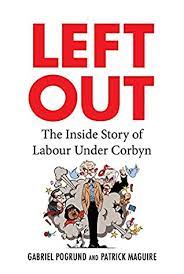
Left Out was written by Pogrund and Maguire, two political journalists, in the aftermath of the 2019 election, and is based on hundreds of interviews with many of the key participants of the troubled period of the Party’s recent history. It specifically focusses on the 30-month period between the 2017 and 2019 elections. Although initially published in 2020, this edition was updated in summer 2021 with an epilogue covering the months after Jeremy Corbyn’s departure from the leadership of the Labour Party, touching briefly on the start of the pandemic, publication of the EHRC’s report into anti-Semitism within the party and Corbyn’s subsequent suspension and loss of the whip.
With all histories, it’s hard to find a precise starting point. The roots of Labour’s electoral disaster in 2019 go back a very long way. But the decline from 2017 to 2019 was dramatic. Labour performed better at the 2017 general election than just about anyone expected, coming very close to deposing Theresa May and forming a Government, albeit one that would have not had a working majority, even with the support of the smaller parties. It had campaigned on a platform which included acceptance of the result of the 2016 Brexit referendum. Logic therefore suggests it was the party’s change of policy on Brexit, to support a second referendum, that was responsible for its historic defeat. Furthermore, as Keir Starmer was Shadow Brexit Secretary and therefore responsible for the change of policy, it seems fair to conclude that he was wholly responsible for the party’s losses.
Left Out makes it clear this analysis is overly simplistic. Firstly, most Labour gains in 2017 were in remain-leaning university towns and in London. It made almost no progress in what were to later be called the Red Wall seats. The 2019 local and European elections emphasised that for Labour to embrace Brexit in the way it had in 2017 would be electorally calamitous – polling later in August 2019 showed Labour losing dangerously high levels of votes to the Liberal Democrats due to its apparent equivocation on Brexit/second referendum. (A short personal anecdote might fit here. While canvassing during the European elections I asked a colleague who worked in the Leader of the Opposition’s office what we should say on the doorstep if asked about Brexit, which of course was bound to come up. His reply was “As little as possible”). The pollster’s forecast was that Labour would drop to 138 seats. As it turned out the 200 seats it did win was therefore strangely a relief – it could have been a lot worse. In many cases the intervention of the Brexit Party (mentioned only in passing in this text) served to peel just enough votes away from the Conservatives to allow the Labour candidate to escape with their seat (Ian Lavery’s seat in Wansbeck, Northumberland being a good example of this).
It’s always tempting to try to find a single, simple solution to a losing party’s problems, but I am as sure as I can be that once the UK voted to leave the EU there weren’t any pain-free options for Labour: support Brexit and lose votes to the Greens and Liberal Democrats; oppose Brexit and lose votes to the Brexit Party and the Conservatives; try to sit on the fence (which was Corbyn’s tactic for a long time) and lose votes to both. So re-fighting the 2019 election with different Labour positions on Brexit is always going to be a losing game. That’s not to say defeat of the scale we saw was inevitable – there were clearly many catastrophic mistakes made along the way.
The picture that emerges from the minutiae of the factional and personal battles within LOTO (Leader of the Opposition) and Party HQ in Southside is one of little more than chaos, to which Corbyn struggled to bring some kind of order. He had a number of trusted deputies who kept things afloat for him for as long as possible, but even that couldn’t last. Personal criticisms of Corbyn himself here are fairly muted – this definitely isn’t a hatchet job – but at the same time it is impossible to read this account without getting the impression that he was out of his depth. Shadow Chancellor John McDonnell’s relationship with Corbyn was central to the initial success of ‘The Project’, the euphemistic name given to the ambitions of Corbyn and his core group of supporters. Once that relationship began to fray it was probably the beginning of the end for The Project. McDonnell seems to have been gradually distanced from Corbyn, firstly over the ever-problematic issue of Brexit (McDonnell was an early enthusiast for a second referendum and for Labour supporting Remain, despite the many claims that this policy shift was solely down to Starmer’s influence) and then subsequently over the role of individuals in LOTO’s office.
Left Out’s detailed accounts of the left’s favourite pastime, Judean People’s Front-style factional warfare, introduces us to many characters who now sit on the sidelines of political life, throwing stones via twitter at Starmer’s remodelling of the party. Director of strategy and communications Seumas Milne, Chief of Staff Karie Murphy, and an array of other characters who fought one another as hard as the Tories while the UK imploded crowd the pages. At the centre of it all sits Corbyn himself, worshipped by his followers (some of whom seemed to have joined the Jeremy Corbyn Party rather than the Labour Party), loathed by others who happily took the short walk to political oblivion via Change UK/The Independent Group rather than stay one minute longer in the same party as him. If you are in either camp then this book isn’t going to change your mind. Being pro-or anti-Corbyn seems a redundant exercise given the finality of the outcome of the election.
Inevitably given the context, the history of the Labour party 2017-2019 is one of mis-steps and missed opportunities. Certainly the response to the Shripal poisoning was a horribly mis-handled. When the news of the poisoning broke Corbyn suggested that the toxic substance that the police had gathered from the scene be sent to Moscow for testing. John McDonnell’s response is recorded here as “That’s fucking going to cost us the election! That’s fucking stupid. Who the fuck does stuff like that?” Another even darker theme was the issue of antisemitism. The many allegations against both him personally and against his supporters seems to have caused Corbyn much personal grief, but the presence in the party’s membership of people who were insensitive at best and plainly anti-Semitic at worst, combined with the leadership’s apparent tolerance anti-Semites, was condemned by first Jewish community representatives and subsequently the EHRC investigation. To his most fervent supporters Corbyn’s response to the EHRC, suggesting that the extent of anti-Semitism in the Party had been exaggerated and weaponised by his opponents, was principled and correct; to most others outside this group it looked insensitive and stubborn.
In the unlikely event you are undecided about Corbyn’s fitness for high office then this book, despite the attempts to be even-handed, will not have convinced you that he was the right man for the job, whether it be leadership of the warring factions of the Labour Party, or Prime Minister itself. This is not a book that attempts to understand the phenomenon that was Corbynism but to chart its defeat. Whether you can do one without the other is a fair question. But it is important to acknowledge that the polite revolution Corbynism threatened was not just what happened in Westminster. Corbynism was always more than that. The thousands of people that rushed into the Labour party before and after his election as leader were predominantly driven by a desire to make politics less cynical and unkind than previously. They joined for the best reasons; one of the tragedies of 2019 is how many have now left the party.
Perhaps the authors spoke too soon when they wrote in their epilogue: “Keir Starmer won power [if leadership of the Labour Party can accurately be said to wield any power] by embracing Corbynism rather than repudiating it. The Project’s legacy is a Parliamentary left that can no longer be ignored. “ (360). There are those that interpret Starmer’s every move since taking over as Labour leader as part of a careful plan to move the party away from Corbynism – certainly events at Labour Party conference 2021 and immediately after would suggest that he is now ready to make that break more definitely than previously.
 First, I need to declare an interest – I know and have a huge amount of respect for the author, as well as a long term interest in the subject matter. I’d like to think this hasn’t affected my review, but that’s hard for me to judge.
