
The Ballad of the Sad Cafe is a quirky, unusual novella set in the Southern USA in the (I am guessing here) 1930’s. Miss Amelia Evans runs a small store in a town in the middle of nowhere, topping up her income with sales from her whisky still. One day a stranger arrives in town, the catalyst for many a story. The visitor is a hunchback who claims to be Amelia’s distant Cousin Lymon. Acting out of character Amelia takes him into her home, and they form an unlikely friendship and partnership. Under Cousin Lymon’s influence, the shop transforms into the café of the story’s title.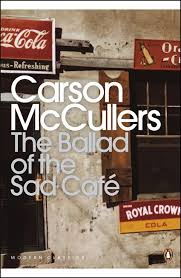
Miss Amelia was once briefly married to Marvin Macy, a local troublemaker. The fact that the marriage never worked and was over in ten days was probably due to the fact that Amelia clearly never intended it to be consummated. Rejected, Macy reverted to type and was eventually locked away in the state penitentiary. All this happened long before Cousin Lymon arrived but inevitably Macy is eventually released, and returns to shatter the peaceful relationship between Amelia and Cousin Lymon. What makes matters worse is that Cousin Lymon transfers his affections to Macy, hero-worshipping him. Macy is everything he is not, both physically and mentally. Together they beat Amelia and trash her house and business. She is a fighter but is defeated by this betrayal and closes the cafe for good.
This is a tragic tale of unhappy love and rejection. In many ways it is a classic representation of the Southern Gothic style of writing, using macabre events and characters to comment on the history and experience of the American South. Southern Gothic builds on the original European traditions of gothic writing, but moulds it to a specifically American purpose. The novel builds suspense slowly – much of the time Amelia and Macy are planning to fight one another, but the fight itself is delayed until the climax of the novel. The characters are grotesque – Cousin Lymon is a hunchback dwarf, Amelia is very tall and stronger than most men, and Macy is abusive and evil.
Decaying rural communities are the typical setting for Southern Gothic stories, and The Ballad of the Sad Cafe certainly fulfils that criteria. Some of the more traditional features of Southern Gothic such as references to the South’s history of slavery and racism are only briefly referenced – Amelia cuts up Macy’s klan robes when he first leaves – but the motif of having a villain disguised as an innocent certainly features. Both Cousin Lymon and Macy try and reform and be kind to Amelia, but in the end both turn on her.
This was my first reading of a text by McCullers, even though I have been aware of her work for a long time. The Ballad of the Sad Cafe is if nothing else a wonderful, evocative title, as is The Heart is a Lonely Hunter, her other best known work. McCullers’s personal narrative is in many ways as tragic as her stories, and she is obviously an important figure in 20th century American literature. ‘Ballad’ is a relatively slight work; I am not sure it will linger long in the memory. The characters are distant and keep their thoughts and feelings closely locked away. At times they behave irrationally and while I can accept this reflects their troubled personalities it makes the narrative more a thing of curiosity than a story I could personally engage with. While her ability to evoke time and place is unquestionable, I am still unsure whether I will follow up this read with more McCullers for now.

