Book review

The Ballad of the Sad Cafe, by Carson McCullers,1951

The Ballad of the Sad Cafe is a quirky, unusual novella set in the Southern USA in the (I am guessing here) 1930’s. Miss Amelia Evans runs a small store in a town in the middle of nowhere, topping up her income with sales from her whisky still. One day a stranger arrives in town, the catalyst for many a story. The visitor is a hunchback who claims to be Amelia’s distant Cousin Lymon. Acting out of character Amelia takes him into her home, and they form an unlikely friendship and partnership. Under Cousin Lymon’s influence, the shop transforms into the café of the story’s title.Sad cafe.jpg
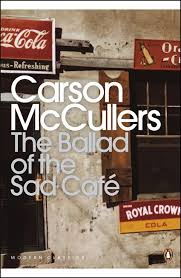
Miss Amelia was once briefly married to Marvin Macy, a local troublemaker. The fact that the marriage never worked and was over in ten days was probably due to the fact that Amelia clearly never intended it to be consummated. Rejected, Macy reverted to type and was eventually locked away in the state penitentiary. All this happened long before Cousin Lymon arrived but inevitably Macy is eventually released, and returns to shatter the peaceful relationship between Amelia and Cousin Lymon. What makes matters worse is that Cousin Lymon transfers his affections to Macy, hero-worshipping him. Macy is everything he is not, both physically and mentally. Together they beat Amelia and trash her house and business. She is a fighter but is defeated by this betrayal and closes the cafe for good.

This is a tragic tale of unhappy love and rejection. In many ways it is a classic representation of the Southern Gothic style of writing, using macabre events and characters to comment on the history and experience of the American South.  Southern Gothic builds on the original European traditions of gothic writing, but moulds it to a specifically American purpose. The novel builds suspense slowly – much of the time Amelia and Macy are planning to fight one another, but the fight itself is delayed until the climax of the novel. The characters are grotesque – Cousin Lymon is a hunchback dwarf, Amelia is very tall and stronger than most men, and Macy is abusive and evil.

Decaying rural communities are the typical setting for Southern Gothic stories, and The Ballad of the Sad Cafe certainly fulfils that criteria. Some of the more traditional features of Southern Gothic such as references to the South’s history of slavery and racism are only briefly referenced – Amelia cuts up Macy’s klan robes when he first leaves – but the motif of having a villain disguised as an innocent certainly features. Both Cousin Lymon and Macy try and reform and be kind to Amelia, but in the end both turn on her.

This was my first reading of a text by McCullers, even though I have been aware of her work for a long time. The Ballad of the Sad Cafe is if nothing else a wonderful, evocative title, as is The Heart is a Lonely Hunter, her other best known work. McCullers’s personal narrative is in many ways as tragic as her stories, and she is obviously an important figure in 20th century American literature. ‘Ballad’ is a relatively slight work; I am not sure it will linger long in the memory. The characters are distant and keep their thoughts and feelings closely locked away. At times they behave irrationally and while I can accept this reflects their troubled personalities it makes the narrative more a thing of curiosity than a story I could personally engage with. While her ability to evoke time and place is unquestionable, I am still unsure whether I will follow up this read with more McCullerfor now.

Standard
Book review

Where Angels Fear to Tread, by E M Forster, 1905

I first read Forster’s Where Angels forty years ago as one of my ‘O’ level texts. It was interesting to reflect on what I remembered and what had not survived the loss of brain cells over the years. The basic plot outline was still there, although the ending came as a pretty unpleasant surprise. Strangely one sentence about the novel’s protagonist, Philip, one of the fools rushing in where angels fear to tread, remained crystal clear:

“He might be a puppet’s puppet, but he knew exactly the disposition of the strings”.

This was the type of quote that we all were taught to underline and memorise, as a key to understanding Philip’s character. Looking back I am not so sure it works that way, although certainly Forster suggests as much by the heavy handed language (in what way is Philip a puppet’s puppet – who is the puppet who is controlling him – his mother? Hardly a puppet surely, more a very headstrong woman, another fool rushing in without thought or consideration. And ‘he knew exactly’ rather than ‘he knew the exact’ is a clumsy formulation which again serves to make the sentence stand out.)

‘Where Angels’ is a slight novel, chosen I suspect as an ‘O’ level text because of its length rather than any particular intrinsic literary value or its interest to teenagers. Lilia Herriton is widowed in her early thirties, and undertakes a Grand Tour of Italy at the suggestion of her in-laws, who appear keen to get rid of her for a while, despite the fact that she leaves behind a young daughter, Irma. Her travelling companion, Caroline Abbott, a younger single woman, is intended to act as a chaperone, but fails miserably to prevent Lilia from falling in love with and marrying a much younger Italian man, Gino. The Herriton’s suspect Gino is a Mediterranean cad – his father is a dentist for goodness sake!

“A dentist! A dentist at Monteriano. A dentist in fairyland! False teeth and laughing gas and the tilting chair at a place which knew the Etruscan League, and the Pax Romana, and Alaric himself, and the Countess Matilda, and the Middle Ages, all fighting and holiness, and the Renaissance, all fighting and beauty! He thought of Lilia no longer. He was anxious for himself: he feared that Romance might die.” 

(I recognise, of course, that this over-the-top reaction is supposed to be funny, pricking Philip’s pomposity. I am not sure it is though.)

Arguably this is the first of several instances of fools rushing in, but it is quickly followed as Lilia’s brother-in-law Philip hurries to Italy to try to prevent the marriage, arriving too late and leaving ineffectually empty-handed. Philip feels partly responsible for this inappropriate marriage – he was very enthusiastic about the idea of Lilia going on an Italian tour, being something of a connoisseur of all things Italian.

Lilia finds life in Italy much less romantic and interesting than she anticipated – Gino is a stereotypically unfaithful Latin lover, and she is effectively confined to her house in a small provincial town. Forster sometimes uses deus ex machina techniques such as a sudden death to inject drama to his novels, and he succumbs to this plot device again when Lilia dies in childbirth. This felt as if Forster was laboriously setting up the novel’s denouement, getting his pieces in play for the final scene, rather than an integral part of the narrative, and her death is announced casually. The reaction back in England is at first to ignore the new born (who is not a blood relative of the Herritons). Quixotically they change their minds – or more specifically Mrs Herriton, the family matriarch, changes her mind – when she hears that Caroline has decided to go back to Italy to ‘save’ the child from the horror of being brought up motherless, and worse, Italian. Philip follows Caroline accompanied by his scary sister Harriet aiming to gazump Caroline and effectively buy the baby from Gino.

Gino is not interested in selling his son, of course and is planning to remarry to provide him with a mother. In a melodramatic finale Harriet kidnaps the baby and flees for the coast. Racing to meet the train, their coach crashes and the baby is killed. The aftermath of the crash is painful to all. Philip eventually realises that he is in love with Caroline but she is still in love with Gino, having been so all along.

There is a soap opera element to the repeated overnight journeys to Italy and back, the sudden deaths and unsuitable and unrequited romances. In an otherwise positive essay for the Guardian back in 2002, Zadie Smith wrote “there is a lot in Forster that fails, is both cloying and banal” – which made me wonder what she would have said if she really didn’t like his work. I quote her here because this phrase resonated with me – there is a lot in Where Angels that doesn’t work, is sentimental, over-written and dull. When it was first published over 100 years ago the Guardian then called it (again in another not altogether hostile review) “a sordid comedy culminating, unexpectedly and with a real dramatic force, in a grotesque tragedy.” The two elements, humour and tragedy, sit uncomfortably together – the novel is neither a gentle comedy about silly English people and their class distinctions, nor a tragedy about how good intentions can go wrong. Ultimately I found it melodramatic and not in a good way.

Standard