
“Perry’s masterly piece of postmodern gothic is one of the great literary achievements of our young century and deserves all the prizes and praise that will be heaped upon it.”
That was the Guardian’s lavish view of Perry’s 2018 follow up to the extraordinarily successful The Essex Serpent, although the quote is edited slightly on the front cover of the paperback edition (“One of the great achievements of our century” (see below). See what they did there, cutting out the words “literary” and “young” – I bet they thought they would get away with that, because who would check? Me!). Nevertheless, the bar had been set.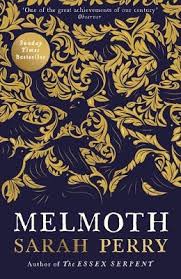
Helen Franklin, a translator of tedious technical articles, lives in exile in Prague, trying to put her mysterious past behind her and at the same time paying penance for her unspecified sin. Her social circle is very limited, in fitting with her ascetic life of isolation, but she has two friends Thea and Karel. Karel has been researching the folklore tale of Melmoth, a mythical figure who walks the earth witnessing sin. His collection of manuscripts has begun to haunt Karel, so he leaves Prague, Thea, and pretty much the novel, for a fresh start as an activist against immigration enforcement. Yep, that’s what people do. This is shoe-horned in to make a heavy-handed point – in life we should not just witness wrong being done, but do something about it. Being a passive witness is as bad as being a participant in the offence, as stories from Karel’s collection testify.
The individual stories in this collection are compelling – scenes from the German occupation of Czechoslovakia, and the subsequent retribution towards the occupying forces; memories of the Armenian massacres/holocaust in the first world war, and Helen’s own story, eventually revealed, of a terrible crime in Malaya. But these are relatively brief testimonies that create a fractured narrative. The over-arching story – Helen and her haunting by Melmoth – is not that interesting, and I found the novel only sparked into life when the stories within the story were being told. The supernatural element of the novel left me cold – horror when well done can be effective if it draws upon our deep-rooted fears of the real world, but here it becomes predictable and unthreatening very quickly. We know Melmoth is going to be lurking around somewhere, but don’t really care.
I came extremely close to abandoning this novel at around the three-quarter point, and it was really only the knowledge that I would have to confess to doing so here, together with a dollop of stubbornness, that kept me going. I am glad I did because Helen’s tragic story, revealed toward the end of the novel, and its denouement, was worth the wait, but the effort in getting there was considerable. This novel has none of the pace or compelling characters of the Essex Serpent. It’s not a bad novel, and Perry is not a bad writer, but this misfires and allows the message to drive the story, not the other way round as it surely should be. The experiment with structure is not the problem – it is an absence of characters we have any real interest in that lets the novel down badly. The discussion element of the novel – can we be a bystander in life, or do we have to actively resist oppression, because if we don’t we become complicit in it, however unwittingly – is a serious attempt to engage in this issue, and I am sure has sparked a lot of worthy book-club discussions (this edition had “suggested topics for your book club” as an endpiece) but for me wasn’t enough to redeem the novel or drive the narrative. Sorry! I feel a bit of a cad for being so negative about this novel because there are a lot of positives in there, but the heart of the novel – an interesting story – is missing.
For getting this far, here’s a couple of cookies:
- Melmoth the Wanderer is the name of Humbert Humbert’s car in Vladimir Nabokov’s Lolita
- Sebastian Melmoth was a pseudonym used towards the end of his life by Oscar Wilde
And finally, I found this spoof in a Goodreads review which I thought was exquisitely well done and pricks the pomposity of the original – apologies for the plagiarism!
“Melmoth the Wanderer meets Winnie the Pooh
It is I, Melmoth, known as Melmotka, wanderer of the centuries of man’s sufferings. My child, my Winnie, whom I have longed for, from whom my eyes have never wandered, at last I am come, as you knew I must, I who have watched over you from the hour of your birth until now, that you may be delivered from torment! I, Melmoth!
“Would you like some honey?” Said Winnie, known as The Pooh. “I found it, you see, so now I am… eating it. It is nice. You could have a bit. Just a little bit.”
Melmoth the Wanderer meets Mary Poppins
It is I, Melmoth, known as Melmotka, wanderer of the centuries of man’s sufferings. My child, my Mary, whom I have longed for, from whom my eyes have never wandered, at last I am come, as you knew I must, I who have watched over you from the hour of your birth until now, that you may be delivered from torment! I, Melmoth!
“Well now, Mrs did you say Melmoth? It’s an odd name you know. Please don’t stand there like a large fish with legs. You are welcome to accompany us to the Botanical Gardens but you’ll have to move a little faster than that.”
Melmoth the Wanderer meets Shrek
It is I, Melmoth, known as Melmotka, wanderer of the centuries of man’s sufferings. My child, my Shrek, whom I have longed for, from whom my eyes have never wandered, at last I am come, as you knew I must, I who have watched over you from the hour of your birth until now, that you may be delivered from torment! I, Melmoth!
“So let me get this straight. You’re jist gonna stand there and watch me? Well, are ye quite sure about that? Because your likely going to be seeing some pretty disgusting things if you do. You know, I knew a Melmoth once. Oh no, right, I knew Mel the Moth. He was a moth.”


