
I’m trying to read more authors I haven’t read before. Shirley Jackson is a writer I have heard about mainly through references to her chilling short story, The Lottery. As I understand it, The Lottery is widely read in American schools, although it is much less well known in the UK. We Have Always Lived in the Castle was Jackson’s final novel, published three
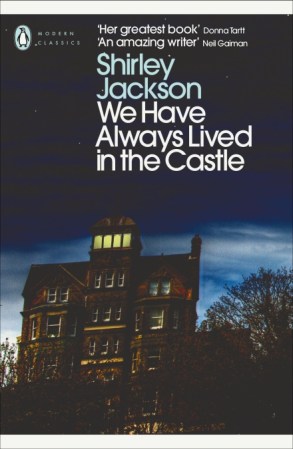
years before her death, and tells the story of two sisters, Mary Katherine (Merricat) and Constance Blackwood, who live with their aging and infirm uncle Julian in their isolated home in New England. The Blackwoods were and are a prosperous family. They remain aloof from the common people of the village and make them walk around their property to reach the main road rather than allowing them a short cut across their estate. This creates tension between the villagers and the Blackwoods, tension which turns ugly later in the novel.
Merricat narrates the tale, and it is clear from the opening that this is not a normal family:
“My name is Mary Katherine Blackwood. I am eighteen years old, and I live with my sister Constance. I have often thought that with any luck at all, I could have been born a werewolf, because the two middle fingers on both my hands are the same length, but I have had to be content with what I had. I dislike washing myself, and dogs, and noise. I like my sister Constance, and Richard Plantagenet, and Amanita phalloides, the death-cup mushroom. Everyone else in our family is dead.”
Older sister Constance never ventures further than the garden in the grounds of the family home. We soon learn why – she was tried and acquitted of murdering her family by poisoning their sugar bowl. Although sometimes described as a mystery, it doesn’t take Holmesian powers of deduction to work out who the real poisoner is – the character with the morbid obsession with death, who has sadistic fantasies about the people of the village who taunt her on her twice weekly shopping trips:
“I am walking on their bodies”
“I am going to put death in all their food and watch them die”
“I would have liked to come into the grocery some morning and see them all… lying there crying with the pain and dying”.
Merricat is a troubled young woman. She uses a primitive, childish form of witchcraft to protect her family, marking the boundary of their property with fetishes and totems. She is consumed with harmful thoughts and haunted by OCD rituals. At this point in the story Constance’s mental health, in particular her agoraphobia, appears to be recovering. She welcomes visitors and talks of going down to the village. Merricat feels threatened by this change, but this is nothing compared to her reaction when Cousin Charles, clearly more interested in the contents of the Blackwood family safe than the sisters themselves, comes to visit. Merricat’s murderous fantasies become even more vivid :
I wanted to stamp on him after he was dead, and see him lying dead on the grass.”
“I could wish him dead until he died. I could fasten him to a tree and keep him there until he grew into the trunk and bark grew over his mouth. I could bury him in the hole where my box of silver dollars had been so safe until he came; if he was under the ground I could walk over him stamping my feet.”
Charles’s arrival disturbs the delicate equilibrium of the house and Merricat’s mental health, and things quickly deteriorate. As Merricat desperately tries to drive him away she starts a fire which goes on to destroy much of the house, transforming it into the castle of the novel’s title, with an upper floor open to the elements like battlements. Uncle Julian dies in the fire and Charles flees. Merricat and Constance make a home in the ruins of their house, and this is where the story eventually leaves them, hidden from the rest of the world but finally accepted by the villagers.
We Have Always Lived in the Castle is a troubling tale which leaves the reader with many questions. Why did Constance not find her psychopathic sister the help that she so obviously needs? Why did no-one in the village work out the fairly simple puzzle about the identity of the family’s killer? How are the sisters going to survive in their ruins?
Merricat is an absorbing portrait of mental illness – but is We Have Always more than that? Does it have anything to say about American society, and about the way it treats outsiders? Merricat’s narrative voice is powerful, and can easily distract the reader into thinking that her account of the novel’s events, flawed though it is, is authentic, rather than seen through the distorting lens of her mental illness. We never get to know what precipitated her murderous attack on her family, but it is safe to say it was probably something trivial that lead to her being sent to her room that day. She certainly doesn’t see herself as a mass murderer; in many ways she is still a child, without any understanding of the consequences of her actions. She starts the fire that destroys their home, and although the volunteer firemen of the village put it out, saving the ground floor, they then go on to trash the house.
While the novel ends on a happy-ever-after note for Merricat and Constance, we can tell that their isolated way of life will not last long. Is this a parable for American society, that has survived the chaos and destruction of the second world war, but is living on borrowed time?


Agree with you that the book ends on a rather disturbing note. I’m not convinced it’s really a happy ever end.
LikeLiked by 1 person
Within the characters own very narrow terms of reference they are “happy”, but they are both pretty badly troubled, and their hiding away from the world while presented as being survivable is not going to last.
LikeLike
This is a wonderful review. I read The Lottery sometime back. It is creepy as hell, and I’ve not been able to bring myself to read another Shirley Jackson since then. But knowing a bit about We Have Always Lived in the Castle will help me read it in the future, I guess.
LikeLiked by 1 person
It’s very short, which always helps!
LikeLike
I think there are probably feminist messages fairly shallowly below the surface too, particularly in implied and actual treatment of the girls by both their father and his lookalike nephew. It’s heavily insinuated that Charles was trying – and succeeding- to woo Constance, with a view to separating her from Merrycat – another reason for M to hate him. But even though she teased him with poisoning, reciting the Latin names of toxic mushrooms in his presence, why didn’t she just go ahead & do that, rather than end up destroying her own home? Constance, meanwhile, is readily absorbed into Charles’ attentions without any thought to the possible consequences for Merrycat, indeed, hardly seems to notice his intolerance of Merrycat or Uncle Julian and we certainly hear no reprimand from her against his behaviour. That said, do we think Merrycat realised the consequences of tipping Charles’ burning pipe into the waste paper basket, or was it an accident? Once more, Constance has no reprimand, recrimination or judgement for Merrycat for the personal destruction she has caused and readily admitted to. So something missing – emotionally, intellectually – there too. Oh, and why did the sisters never close the gate again after the fire, to keep the villagers & others off their property, when they clearly wanted to be left alone? What is the significance of them letting those thieving marauding villagers cross through and picnic on their land? As for the “happy” ending, One does wonder how, with turrets open to the elements, the sisters would survive the winters? And how soon social services would have to be called in!
LikeLike
The comment above was not written by the author of The Reading Bug, but by his significant other.
LikeLike