
The Machine Stops is a strangely prescient Edwardian novella by an author better known for his writing on the delicate nuances of class behaviour amongst English people abroad. I tend to think of Forster as a modernist, but this text is closer to the Victorian science fiction of Wells and Verne than it is of the Bloomsbury authors Forster is commonly associated with. 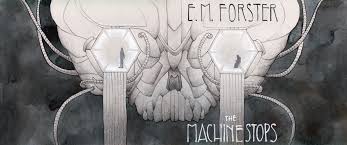
In The Machine Stops Forster describes a world set far in the future, where humanity lives underground, all their needs met by the omnisicient, all powerful, ‘Machine’. People live alone in isolated cells and only communicate using a version of skype (obviously Forster doesn’t call it that, he wasn’t that far-seeing, but that’s what it in effect is, even down to the fact that nuances of expression are lost on the video screens) and avoid all physical interaction with one another. They also appear scared of the sun, which I believe is intended to remind us of Wells’s troglodyte Morlocks in ‘The Time Machine’.
Vashti, a “swaddled lump of flesh”, is the character we follow through the eyes of an omniscient narrator. The story opens thus:
“Imagine, if you can, a small room, hexagonal in shape, like the cell of a bee.”
Who is it that is inviting us to imagine this room? Someone is telling us a story about a time set a long way in our future, but also I would suggest, in the past of his hypothetical audience, when cell-living, near universal in the time of the Machine, is no longer the norm, so much so that it has to be pictured rather than just known. Thinking of an hexagonal room requires no great feat of imagination unless it is or has become something out of the ordinary. Is this Forster inviting his 1909 readers to imagine a future, or the narrator looking back on the time of the Machine before its stopped?
Some of this writing is clumsy – ‘hexagonal in shape’ – is tautology surely? “Hexagonal” would have sufficed. However the room’s shape leads the narrator to the text’s first, complex, image – it is like both a cell and simultaneously like part of a beehive. The use of the word cell suggests that Vashti – and everyone else living in the control of the machine – is its prisoner, entirely dependent on it for food, water, light etc. At the same time the room is part of a hive community, in which everyone has a pre-determined role in life and little choice in their future.
Vashti is contacted unexpectedly one day by her son Kuno, who has a mysterious message he can only tell her face to face. Against her best instincts she travels by plane to his cell, where he outlines his concerns about the Machine and the soullessness of existence underground. He hints that the surface world is not, in fact, uninhabitable, as people have been led to believe.
Vashti rejects her son’s confidences, and returns to her empty life of routine and order. Rather than stopping suddenly the machine slowly begins to fail over a period of years, before an final cataclysmic collapse in which Vashti, Kuno, and everyone else living underground dies.
The topicality of Forster’s observations about the risks of mankind becoming overly dependent on technology need hardly be spelled out. We are now all highly reliant on machines, (rather than a machine), but we are still vulnerable to the kind of technical or mechanical failure Forster anticipates. We also live very sheltered, sedentary lives compared to our grandparents, and are retreating from nature. In other words technology is a mixed blessing. Forster also anticipates the rise of social media, and its impact on social relationships. He notes of Vashti that
“she knew several thousand people; in certain directions human intercourse had advanced enormously.”
But is the text ultimately anything more than a curiosity? Certainly it is that, without doubt, but I am not surprised Forster moved on to novels about middle class people and their subtle class distinctions, because as a story The Machine Stops is a failure. The two main characters are two-dimensional. The ending is sign-posted in the title, so hardly comes as a surprise. And as social commentary the story is a little preachy. When you compare what Wells was able to do with similar ideas one begins to appreciate how little Forster makes of his unquestionably original insights.


I’ve never heard of this one and I thought I knew all his work! It does seem quite a different kind of book from his usual fare.
LikeLiked by 1 person
i think it’s fairly well known because it is such a curiosity and because of the strange accuracy of its technology descriptions, but if you read it without knowing the name of the author you would never guess it was by Forster.
LikeLike
Pingback: Book review: Collected Short Stories, by E. M. Forster, 1947 | The Reading Bug
Where is the above illustration from?
LikeLike
The Machine stops has for many years been ingrained etched in my brain. I selected to read this short story in my last year of secondary school . What was written by this visionary is now becoming our reality . We all depend way too much on technology many forgetting that there actually is an outdoor to go to enjoy . Whilst we are not living underground we may as well be .
LikeLike