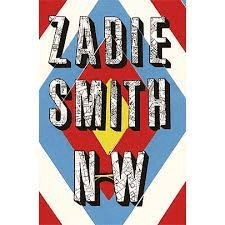
NW really divided critics when it was published in 2012. Smith’s first novel, White Teeth, (published in 2000) was garlanded with awards: it won the Whitbread First Novel Award, the Guardian First Book Award, the James Tait Black Memorial Prize, the Commonwealth Writers’ First Book Award, was included in Time magazine’s 100 best English-language novels published from 1923 to 2005, ranked 39th on The Guardian’s list of the 100 best books of the 21st century, and BBC News included it on its 2019 list of the 100 most influential novels. The reception for NW, following 2002’s The Autograph Man and 2005’s On Beauty was much more muted. But I thought it was outstanding – a complex, mature work that uses experimental structures and techniques without ever seeming to do so for the sake of it.
Set in and inspired by the northwest suburbs of London, NW follows the stories of two friends, Leah Hanwell and Natalie (originally Keisha) Blake. Leah and Natalie grow up in a rough working class estate, Caldwell*. When we are first introduced to her, Leah has not ventured far from her childhood roots, but best friend Natalie has managed to transform herself into a successful barrister. Natalie lives in a nearby but much more affluent neighbourhood. Both women are married, and are apparently content with life.
The novel opens with a vivid scene when Leah falls for a well-practised scam. A young woman knocks at her door asking for money; she is facing a family emergency and needs to get to the local hospital as soon as possible. Leah spends a short time with the woman, eventually giving her money for a cab. Leah’s family, when they hear what has happened, mock her for her gullibility, but she had a connection with the young woman that felt genuine, despite the deception. The incident causes Leah to wonder about her sense of belonging in NW. Has she without knowing it moved away from her working class origins?
The next instalment of the novel follows a former friend of Leah and Natalie’s, Felix Cooper. Although Felix is ostensibly one of the novel’s main characters, this section of the novel feels less engaged; I got the impression that the author was just less interested in Felix. We follow him as he meets a former girlfriend, telling her that he plans to end their residual casual relationship. He needs to put her, and her drug use behind him. On his way home he is mugged and stabbed, and the novel moves on leaving his fate uncertain.
After the Felix scenes, the novel’s focus moves to Natalie Blake. We learn more about her back-story and how she grew up with, and then away from, Leah. Against all expectations she fought her way into university and became a successful barrister. She marries a banker, has two children with him, and appears the ultimate success story. But Natalie/Keisha, as her name suggests, has a secret – she leads a double-life and enjoys clandestine casual sex with strangers, apparently in an attempt to fill the void in her life.
NW is an overtly modernist novel in terms of the various narrative techniques the author uses – but that is not really important. In interviews at the time of the novel’s launch the author explicitly mentioned Joyce and seen in that context his influence is obvious. But neither this fact nor any of the other techniques she uses are in any way intrusive – the reader (or this one at least) never stops to admire the author’s style, the fourth wall is never broken, so engrossing is the story and so accomplished is the writing.
It is possible that White Teeth set expectations so high that it was always going to be hard to follow, but I suspect that if NW appeared today it would be lauded. It is a powerful portrait of a complex city that the author clearly loves and knows intimately.
————————————————————————————————————–
*Some reviews of NW talk about it having four central characters – Leah, Natalie, Felix and Nathan Bogle, (a criminal character who illustrates some of the other life choices people from Leah and Natalie’s class may have taken). Others write about there being three main characters, discounting Nathan, even though he probably features at least as much as Felix. But I believe that this is Leah and Natalie’s novel, that’s where the author’s real interest lies, and the other characters – there are many more than just Felix and Nathan – are secondary. Whether this is a helpful generalisation or not I am unsure, but I think the heart of the novel is the relationship between these two women.
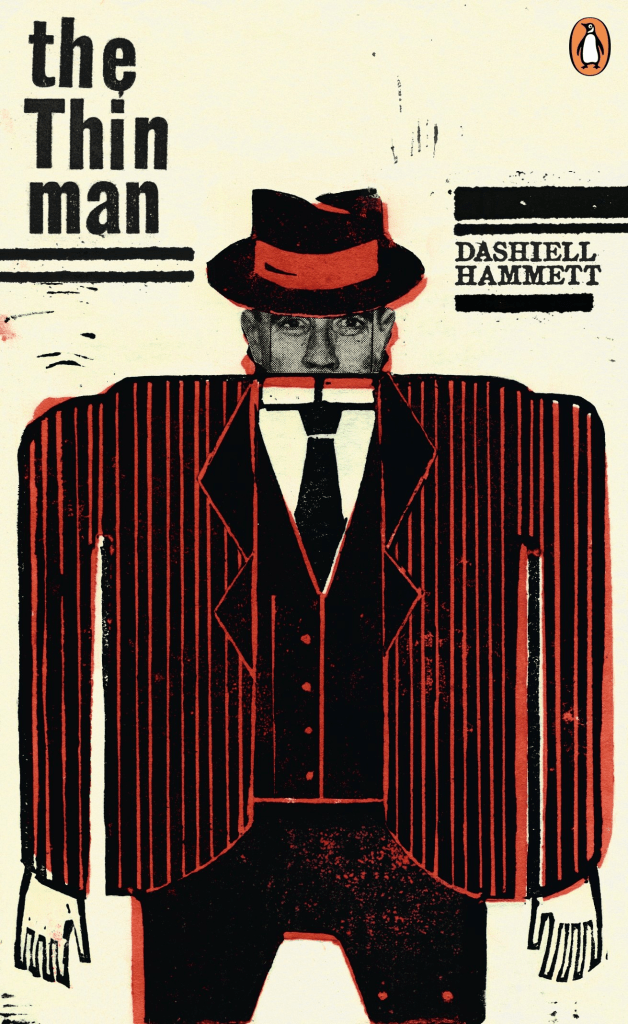
The Thin Man was Hammett’s last published novel, appearing initially in a magazine in 1934, although he went on to live until 1961. Hammett was a left-wing writer during a period of America’s history where this was very much going against the political grain, eventually finding himself blacklisted after refusing to testify before the House of UnAmerican Activities. Earlier he had gone to prison rather than reveal the names of contributors to a fund he set up to support eleven men appealing their convictions for “criminal conspiracy to teach and advocate the overthrow of the Government by force and violence.” It is fair to assume that it was these experiences which put him off novel writing, although of course he continued writing in other formats.
Hammett is widely credited with creating a new form of detective novel, the ‘hard-boiled detective’ genre. This was a world apart from the refined novels of writers such as Agatha Christie and Dorothy L Sayers, Raymond Chandler famously summarised the distinctive element of Hammett’s novels: that he “gave murder back to the kind of people that commit it for reasons, not just to provide a corpse; and with the means at hand, not with hand-wrought duelling pistols, curare, and tropical fish. He took murder out of the Venetian vase and dropped it in the alley“.The Thin Man is a fine example of this genre.
Anyone reading the novel without being aware of the setting will be shocked to find out that the story is set in December 1932 – that is to say in the last days of Prohibition. Given that it remained technically illegal to drink alcohol in the USA, Nick Charles, the novel’s principal character, drinks relentlessly, asking for alcohol at every opportunity like a man dying of thirst. Nick is a former private detective, having retired early following marriage to a wealthy socialite, and is visiting New York with his much younger wife, Nora, to celebrate Christmas and the New Year (and presumably the impending demise of Prohibition). He is reluctantly drawn into investigating a complex murder. A scientist, the titular thin man, has gone missing, and his assistant and former girlfriend is found dead by his ex-wife, on whom suspicion inevitably falls. Their children also act suspiciously and are candidates for the crime, but the police’s focus is on the missing scientist, Clyde Wynant. Together with the local police Nick and Nora drink heavily and talk smart as they try to crack the case.
The focus on drinking throughout the novel is relentless and eventually quite funny:
‘“How do you feel?”
“Terrible. I must’ve gone to bed sober.”’
……….
‘“Don’t you think maybe a drink would help you to sleep?”
“No, thanks.”
“Maybe it would if I took one?”
…….
‘“Why don’t you stay sober today?
We didn’t come to New York to stay sober.”’
The dialogue is the whip-smart wise-cracking we have come to expect from private detectives and their glamourous assistants, but which Hammett seems to have invented:
“She stared at him dully and said: “I don’t like crooks, and even if I did, I wouldn’t like crooks that are stool-pigeons, and if I liked crooks that are stool-pigeons, I still wouldn’t like you.”
Nick in particular has a great line in sarcasm, particularly when he is teasing his wife, who to be fair gives him as good as he gets:
“I’ll give you your Christmas present now if you’ll give me mine.”
I shook my head. “At breakfast.” “But it’s Christmas now.” “Breakfast.”
“Whatever you’re giving me,” she said, “I hope I don’t like it.”
“You’ll have to keep them anyway, because the man at the aquarium said he positively wouldn’t take them back. He said they’d already bitten the tails off the…”
……………
“Nora screwed up her dark eyes at me and asked slowly: “What are you holding out on me?”
“Oh, dear,” I said, ” I was hoping I wouldn’t have to tell you. Dorothy is really my daughter. I didn’t know what I was doing, Nora. It was spring in Venice and I was so young and there was a moon over the…”
The novel is fast-paced – Nick and Nora rarely seem to sleep, and think nothing of setting off at midnight to yet another party. The novel’s resolution seems a little hurried, with everything wrapped up in a few pages once the partying runs out of steam. The novel was very successful and spawned a film, a sequel, and a long-running television series. On its own merits the novel is enjoyable but slight – the reader’s enjoyment is mainly derived from the humour and the wide range of criminal characters, but the plot is almost an after-thought. The same could be said of many of Raymond Chandler’s novels, of course. Hammett was without doubt a profound influence on Chandler, and his style and technique can be found on almost every page of the latter’s work. At the same time I would argue (and I don’t think this is contentious) that Chandler evolved the genre to another level. The principal differences between the two are the latter’s extraordinary turn of phrase (“It was a blonde. A blonde to make a bishop kick a hole in a stained-glass window.”). Marlowe is also a much harder, more violent man than Nick, and the overall body-count in novels such as The Big Sleep is much higher. While Nick can shrug off a bullet wound with a light bandage and another slug of whisky, when Marlowe is beaten up we feel every blow.
P.S. I’ve written more here about the differences between Marlowe and Sam Spade, Hammett’s main character in novels such as the classic The Maltese Falcon.
The imbalance in my reading habits – more than three quarters of all the books I have reviewed over the last 10 years were written by men – has been nagging at me. I wanted to explore whether this was just a case of being a sexist reader, or a symptom of something else going on in publishing and literature.
In the field of literary prizes there is strong evidence that novels written by women are less well recognised than those written by men. Since 1969, 35 men and 18 women have won the Booker prize in its various incarnations. It was the absence of any women writers from the 1991 Booker shortlist that led to the creation of the Women’s Prize for Fiction (although the jury that year was evenly divided in terms of gender). This two to one ratio could be better, but it could be worse: the Pulitzer prize for ‘distinguished fiction by an American author’, has been awarded 70 times since 1948. By my calculation only 18 of these 70 awards have gone to women writers, including such greats as Harper Lee, Toni Morrison and Donna Tartt. The Nobel Prize for Literature is no better – only awarded to women 16 times out of a total of 118 awards. This is not just a phenomenon of old-fashioned attitudes – in the so-called progressive decades of the 60’s, 70’s and 80’s it was awarded only once to a woman. And only one woman has ever been Poet Laureate in the 400 years of the role’s existence!
Elsewhere the issue persists. In the BBC’s 2003 Big Read less than a third of the novels chosen by the public were written by women, and without JK Rowling and Jacqueline Wilson the ratio would have been far worse. Only 21 of the 100 best novels of all time written in English chosen by the supposedly progressive Guardian (which is where this blog began) were written by women. The issue is obviously endemic. Other than where specific action is taken to address the imbalance between men and women writers (for instance on some university courses), male writers predominate.
Which obviously begs the question as to why? In The Authority Gap Mary Ann Sieghart cites evidence that novels written by women are reviewed less often than those written by men, which starts the whole process of down-grading the value placed on books written by women. From what little evidence I have been able to track down, women are not published less frequently than men. But that’s not to say that women authors aren’t promoted less effectively by their publishers, placed less predominantly in book-shops, cited less often in academic works – it’s even possible that Amazon’s algorithms are sexist (stranger things have happened). To be clear, I have not identified any evidence of these things – but there is a pattern here!
It may be a statement of the obvious, but we shouldn’t have to accept this diminution of half of the population. All of the examples above are instances of people making decisions to exclude or downgrade women. So the solution is in some ways simple: all literary prizes should work towards being gender neutral. That means choosing to have a balance of women and men on judging panels (as many already do), choosing to long-list and short-list works by men and women evenly, and award prizes evenly, if necessary by having two different awards. As readers we can buy books by more women, review them as often as we review books by men, and try to avoid the discrimination, unconscious or otherwise, that has been going on before Gutenberg developed his printing press.
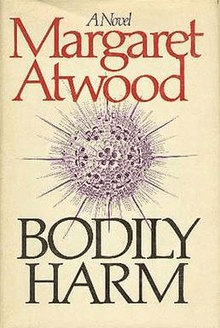
Bodily Harm felt strangely familiar: the premise of the novel echoed strongly with me, but I am struggling to pin down from where. In the novel Rennie Wilford, a Canadian ‘lifestyle writer and journalist’, suffers an upsetting relationship breakdown following surgery for breast cancer. In an attempt to escape she engineers an opportunity to travel to the small Caribbean island nation of St. Antoine to write a travel/holiday piece. Here she finds the island uncomfortable and alien, but slowly becomes embroiled in the febrile local politics. An attempted coup or insurrection goes badly wrong, and Rennie is caught up in the aftermath.
Frustratingly I can’t identify what book or books this reminds me of. It is possible that the cumulative effect of so many tropes is what is causing this ‘deja lire’ phenomenon.
The contrast between Rennie’s life in Toronto and her experience on the islands is striking. At home she was originally a political journalist specializing in unspecified ‘abuses’ but now writes about ‘lifestyles’:
“You write about something until people become tired of reading about it or you become tired of writing about it, and if you’re good or lucky enough it’s the same thing. Then you write about something else.”
Rennie lives with Jake, an unpleasant sexually aggressive and frankly abusive young man. He has a vacuous job as a label designer
“not just labels but the total package: the label, the container, the visuals for advertising. He was a packager. He decided how things would look and what contexts they would be placed in, which meant what people would feel about them”,
Canadian culture is portrayed as synthetic and superficial, and Rennie is profoundly unhappy without really realising it. Her breast cancer diagnosis brings this unhappiness to the fore, and shortly after Jake moves out Rennie comes home one day to find two policemen waiting for her, inspecting a sinister coil of rope left on her bed by an intruder. This is the catalyst for her getting out of Toronto, albeit temporarily. The Caribbean island state of St. Antoine is undeveloped and unwelcoming, and Rennie never takes her purported mission, to write a travel piece about the island, very seriously. She meets a number of ex-patriates including Paul, a drug smuggler who may or may not also work for the CIA and Lora, a fellow Canadian who has ended up in St Antoine with no real idea as to why. She also meets some locals including Dr. Minnow who is a candidate in St. Antoine’s elections, the first since independence from the British. What starts as a travelogue degenerates into a nightmarish experience as St. Antoine’s political factions go to war, and outsiders are all suspects.
Bodily Harm is not a comfortable read. St Antoine becomes a metaphor for Rennie herself, almost as if her vacation is a dream in which her various traumas are worked through and the characters represent aspects of her life back in Toronto. Her cancer is echoed in the rottenness of the island’s political corruption; the sado-masochism of her relationship with Jake is paralleled in the violence she encounters, and the novel’s conclusion in which she is imprisoned while her involvement with the island’s insurrectionists is investigated is (arguably) a metaphorical representation of her illness and slow recovery. Read this way Bodily Harm is a disquieting portrait of contemporary life rather than the superficial story of a journalist taking a vacation in the Caribbean that it initially promises to be.
Bodily Harm was the novel Atwood wrote immediately before The Handmaid’s Tale which was published four years later. Atwood is not a genre writer, and all of her novels that I have read thus far are significantly different, so it is difficult to find any trace of Handmaid’s in this novel. Having said that the theme of sexual violence being part of everyday life for women does indicate the lines the author was thinking on at the time and which were much more fully developed in the later novel.
Some reasons for reading (or re-reading) Helen Fielding’s Bridget Jones’s Diary:
it’s the perfect ‘guilty pleasure’ novel
it doesn’t take itself seriously
the pop culture references are fun
the jokes work
Bridget is highly believable and relatable.
Bridget Jones’s Diary originally appeared as a weekly column in the Independent. Bridget is in her early thirties and when the novel opens she is single and looking for a partner. These are the mid-nineties, long before online dating, so she has to find a boyfriend the old-fashioned way – at work or through family and friends. While she rejects the concept of a ticking biological clock, being single into old age is something that preys on her mind.
She doesn’t remain single for long however. Her mother’s attempts to set her up with a family friend, Mark Darcy, at Una Alconbury’s New Year’s Day turkey curry buffet fall flat, but she succumbs instead to the charms of her lecherous boss Daniel Cleaver (the casting of the film version of the novel was inspired in giving this role to Hugh Grant, who is name-checked in the novel, and the role of Mark Darcy to Colin Firth, who of course played Darcy in the television adaptation of Pride and Prejudice, also mentioned in Bridget’s diaries). Daniel is the universal bad boy, who ignores Bridget, insults her, refuses to take their relationship seriously and unsurprisingly cheats on her. Mark is there to pick up the pieces, of course.
Bridget is an immensely likeable character. Her diaries chronicle her insecurities and her struggles with her various demons (jobs, weight, drinking and smoking), but she has a strong network of friends who support her through all her relationship and career crises. Bridget’s parent’s relationship struggles provide a form of chorus or background to her own. The novel’s parallels with Pride and Prejudice are not over-emphasised and are done just cleverly enough to be funny without being smug. Like many novels, films and programmes from the nineties, there are aspects of the diaries that haven’t aged well. Sexual harassment in the workplace is treated as a joke and Bridget’s gay friend Tom is referred to using a slur that is now widely considered offensive. There are no black characters despite the novel’s London setting, and some people have found Bridget’s focus on her weight problematic.
This is one of the small category of novels where the film adaptation is so superior to the original that it is hard to read the novel now without having the film scrolling in the background of one’s mind, hearing Bridget’s diary as voiced by Renee Zellweger, and envisaging the costumes, settings and minor characters as portrayed in the film. I don’t think that’s a problem at all – the novel gains from the film rather than suffering from the comparison, allowing the reader to skip over the bits that don’t work (for example Bridget has a redundant brother in the novel who is mentioned but doesn’t appear, so was rightly edited out of the film).
Bridget Jones’s Diary is sometimes credited as being the first ‘chick-lit’ novel (Wikipedia describes it as “the ‘ur text’ of chick lit”). But the term is a fairly dismissive not to mention sexist characterisation of a genre and the term is little used nowadays, thankfully. Usually reading the source novel of a film reveals some interesting differences, but in this isolated instance I think if you have limited time I would recommend the film over the book.
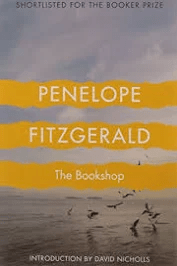
The Bookshop is set in the sleepy coastal Suffolk town of Hardborough — “an island between sea and river”. In 1959 the novel’s ‘heroine’ Florence Green opens a bookshop in the long-vacant property called Old House, one of the oldest properties in the town. There is surprisingly some local opposition to her venture. This opposition centres on local notable Violet Gamart who has been toying with “the idea of converting it (Old House) into some kind of centre — I mean an arts centre — for Hardborough“. Old House is an unlikely location for an arts centre – it has stood empty for years, is quite small (from what we can tell) and is riddled with damp, not to say that it also seems occupied by a ‘tapper’, the local word for a poltergeist. Is there something more to Mrs Gamart’s plans than meets the eye – what is problematic with the idea of a bookshop?
Florence ignores Mrs Gamart and goes ahead and opens her shop, employing a young assistant, ten-year old Christine Gipping, to help out. Christine is by far the liveliest and most interesting character in the novel, although the author’s continual reference to her pre-pubescent state is a little creepy:
“Christine replied that now the evenings were getting longer her elder sister would be up in the bracken with Charlie Cutts… ‘You don’t need to worry about anything like that with me” she added, “I shan’t turn eleven till next April. Mine haven’t come on yet.”’
Lightly comedic episodes ensue as Florence struggles to make a success of her venture. She secures the patronage (of sorts) of Edmund Brundish, who is the nearest thing Hardborough has to aristocracy, and turns to him for advice when trying to decide whether to stock Vladimir Nabokov’s Lolita.The novel is a best-seller but the usual suspects are horrified at both the book’s subject matter and the shop’s subsequent success. I was hoping that the novel might explore the explosive impact Lolita would have had on a small-minded English town in the late 1950’s, but that opportunity is passed by.
I was quite harsh towards The Gate of Angels, Fitzgerald’s 1990 novella about a fictional Cambridge college, not least because of its lack of authenticity. Novels don’t have to be realistic, of course they don’t, and the author can introduce elements of fantasy for many different reasons. But novels that purport to realistically portray a social setting and believable characters need to at least aspire to being authentic, or alternatively to have a really good reason why authenticity is departed from. And time after time Fitzgerald fails this simple test. The poltergeist that haunts the bookshop is an obvious example – perhaps it represents the town’s hostility towards Florence’s enterprise (although it pre-dates the shop’s opening). But there is no real attempt to integrate the ‘rapper’ into the narrative – it is just there, then it is not. Another example relates to the portrait of ten-year old Christine. While she is a well-developed character, are we really expected to believe she chipped/lost her two front teeth by them being hit by frozen washing on the laundry line? That’s just nonsensical and not in the least amusing. Possibly it is intended to show how hard life is for the Gipping family, and how resilient they are despite everything thrown at them – but teeth broken by frozen laundry is such a clumsy unconvincing way of showing this. Similarly we are invited to believe that Christine is the first child in her family to not pass the eleven plus. She is instead assigned to the local technical college, which her mother describes as “what we call a death sentence. I’ve nothing against the Technical, but it just means this: what chance will she ever have of meeting and marrying a white-collar chap ?” Only about one in eight children passed the eleven-plus, so the idea that bright Christine would have been the old child in their family not to pass is hard to credit. There’s also a description of a new housing development built on the edge of quickly eroding cliffs – another instance where the novel forfeits all credibility for the sake of a clumsy metaphor.
Probably most ludicrous proposition in the novel is the idea that a ‘stupid’ backbencher could draft, propose and pass through all its Parliamentary stages a major change to planning law, including late amendments which allow compulsory purchase orders in a wide range of circumstances, which is then implemented in a matter of months, simply to find a mechanism to lever Florence out of her shop. A generous buy-out proposal from Mrs Gamart would have been infinitely simpler. I understand that Fitzgerald wants to demonstrate that life and the powers that be are unfair to well-meaning people like Mrs Green, but this is an incredibly heavy-handed way of making that point.
There are moments in the novel which almost bring it to life. I did enjoy for example Mr Brundish’s encounter with Mrs Gamart, when his lack of an internal monologue leads him to speak his mind openly to her:
‘”You had better offer me something” he said loudly, and then, in precisely the same tone: “The bitch cannot deny me a glass of brandy.”‘
There’s far too little of this character, and Fitzgerald kills him off casually almost immediately after this encounter in order for her primary scheme – the compulsory purchase of the shop – to go ahead. Instead we see far too much of Milo North, a lazy dilettante whose purpose in the novel never really comes into focus.
Fitzgerald is highly thought of and considered by some critics to be under-appreciated. I can’t agree. When you compare this slight, unconvincing novel to J L Carr’s A Month in the Country for example, you can see the huge gulf between them. Both are sketches of life in rural England, but Carr’s characters come alive, are recognisable and have interesting stories to tell. It would be unfair to say Fitzgerald’s don’t come to life in the same way but they are light sketches compared to the vividness of Carr’s portraits.
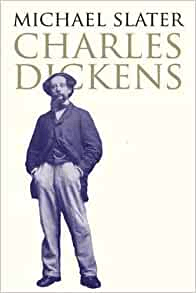
This incredibly authoritative not to say weighty biography of Britain’s greatest novelist left me with a renewed respect for Dickens the author, but some of the revelations left me equally disappointed with Dickens the husband and father.
Slater’s biography follows the traditional format of all such works. Dickens’s early life is recorded in detail elsewhere, not least by Dickens himself in an autobiographical fragment published soon after his death by his close friend and first biographer, John Forster. Slater claims that the period when Dickens’s family went through hard financial times and had to withdraw him from school and send him to work, aged 14, in a blacking factory, was a key turning point in his life. It, Slater argues, haunted him for the rest of his life, and he constantly returns to it in his work, letters, and personal life. That point felt overstated, although I obviously defer to the author’s infinitely more detailed knowledge of Dickens’s life and work. Once these years are over, the text is focussed on composition of Dickens’s 14 novels which provide a structure for the text, although there is a vast amount of other works to be included, recorded, referenced and analysed.
Even if you know Dickens well this book will probably contain some surprises. I didn’t know for example that his early novels – including Pickwick, Oliver Twist, & Nicholas Nickleby – were essentially improvisational. While writing them Dickens had no clear plan where the plot was going, nor in the case of Pickwick whether the text was ever going to be printed as a novel at all, rather than remain as a serial, comparable to modern-day soap-operas. The idea of turning this series of stories with a common theme into a novel seems to have occurred to Dickens quite late in the day. As his work matured Dickens planned his novels more carefully with detailed notes on characters and plot-lines, but he rarely wrote more than a few weeks ahead of publication, sometimes cutting things very close indeed. Publishing his work in this way had an important impact on his plotting decisions. Any large scale editing is virtually impossible. Novelists who prepare their whole work prior to publication (i.e. virtually all of them today) can make substantial changes up until the last minute, deleting characters, going back to the beginning of the novel to provide subtle clues to the outcome, etc. While Dickens could fine tune his choice of words when the novels were published in volume form, major plot changes were impossible. (Authors who publish series of novels face a similar challenge – J K Rowling must surely have wanted to be able to go back to Philosopher’s Stone and add some more clues about Harry’s scar or tidy up the messy timeline of the first chapter, The Boy Who Lived?). This feature of his way of working imposed a discipline on Dickens’ plotting which he never seems to have worried about, but it would be interesting to read the novels in this light and look at his technique for avoiding painting himself into too many corners. One example which Slater points out is the strange opening to The Old Curiosity Shop, which begins in the voice of an unnamed first person narrator (“Although I am an old man, night is generally my time for walking” who quickly fades out of the text to be replaced by an omniscient narrator. According to Slater this is because the story started as a magazine sketch intended for only one or two editions, and when Dickens decided to adapt it as a longer form novel the switch in narrator was made at that point. The reader doesn’t really notice this switch in voice, but in retrospect is does appear unusual.
Dickens’s prodigious work ethic is another prominent feature of this biography. There was no point in his adult life when Dickens wasn’t working virtually flat out, at several points writing two novels at once. His novels are only a small part of his output: his collected journalism and letters run to many volumes, and he seems to take on major new projects even when he is completely overwhelmed with work. His was also a prodigious travellers, criss-crossing the country for his readings and popping over to France to see his young lady friend several times a month. In addition of course he also managed two major tours of the USA.
The weak copyright laws of the time meant that Dickens was openly plagiarised throughout his career, most typically in the form of stage adaptations. Slater tells us that “between March and December 1838 no less than five unauthorised adaptations of Oliver appeared in the London theatres.” (121 – for context, Oliver Twist was published in monthly instalments between February 1837 and January 1839). This issue only got worse – “no fewer than seventeen different stage versions (of his Christmas story The Cricket and the Hearth) appeared in London within a month of the book’s publication.“(239). There was an ironic twist to this plagiarism. In the rush to copy his work theatres would put on productions of his work before their serialisation had finished, forcing them to anticipate the novels’ endings. There is some evidence that Dickens used these versions of his works to give him ideas on how to end them – Slater cites evidence that in his composition of Little Dorrit Dickens “looked back for help with the plotting of an unauthorised dramatisation of the first part of the novel”.
This is an extraordinarily thorough account of Dickens’s life. Slater chooses to structure his text around his subject’s literary life, which his personal life less of a focus. His early romances, his marriage and ten children are all mentioned, as is the end of his marriage and his late romance with Ellen Ternan, but there is a sense of restraint in the narrative, a lack of speculation and a focus on the literary output and Dickens’s creative life. I did wonder whether the biography, structured as it is around the construction of the 14 principal novels, would have been such a compelling read if the reader was not familiar with Dickens’ work? But I guess no-one tackles a 600+ page biography without at least a certain familiarity with the novels.
I have written elsewhere about Dickens’ extraordinary consistency as a novelist. That comment was about his style – he seems to have landed on a discursive, dramatic and comic style of writing early on in his career and it remained with him largely unchanged throughout. My contention was that unless you knew the chronological sequence of his novels you would be hard pressed to tell, based on the writing alone, whether his work was early, middle or late period Dickens. But there is another way in which he was consistent, and that was in the length of his novels. All his novels were published in instalments – either weekly or monthly. The earlier novels did not have a predetermined plot nor number of instalments they were intended to fill, so their length varies significantly – Pickwick is almost twice as long as Oliver Twist. But once the format and number of instalments was settled down, the consistency of the length of the novels is extraordinary. Look at this list:
1.David Copperfield: 357,489 2. Dombey and Son: 357,484 3. Bleak House: 355,936 4. Little Dorrit: 339,870 5. Martin Chuzzlewit: 338,077 6. Our Mutual Friend: 327,727 7. Nicholas Nickleby: 323,722 8. The Pickwick Papers: 302,190 9. Barnaby Rudge: 255,229 10. The Old Curiosity Shop: 218,538 11. Great Expectations: 186,339 12. Oliver Twist: 158,631 13. A Tale of Two Cities: 137,000 14. Hard Times: 104,821 15. The Mystery of Edwin Drood: 96,178 (first 6 of 12 parts only)#
Yes, David Copperfield and Dombey and Son are almost identical lengths, to within 5 words in a total of over a third of a million. That’s an insane level of accuracy. Copperfield was published in 19 monthly one-shilling instalments, containing 32 pages of text and two illustrations, with the last instalment being a double-number (in other words, twenty instalments). Dombey followed the same pattern – 19 + 1 instalments, 32 pages, 2 illustrations. So it’s not surprising they are around the same length. But identical? The <10% variance in the top seven novels in this list can be explained by the length of the monthly instalments and the number of illustrations rather than any variation in Dickens’s plots or characterisations. Other authors were published in the same instalment formats as Dickens, indeed many of them in his magazines (Wilkie Collins and Elizabeth Gaskell, to name but two) and I would imagine their word length would be similar given the circumstances. But I confess I haven’t checked in any detail. (A quick look at the number of pages shown on Collins’s Goodreads page gives a range of 528 pages for The Moonstone to 672 pages for The Woman in White and 748 pages for No Name). There must surely be a strong case for arguing that no other author would have had Dickens’ discipline, to produce content week after week, month after month across almost all his adult life, to such a precise degree of accuracy.
I mentioned at the beginning of this review that I came away from this book feeling a little disappointed with Dickens the man. He discarded his wife with whom he had ten children, and ‘took up with’ a woman twenty years younger than him. We can’t be certain about the precise nature of this latter relationship but we can have a pretty good guess! He estranged his children from his wife, characterising her as a bad mother, and disrespected her in his will. His politics, particularly in relation to the trade union movement and issues of race, were not as progressive as they are often characterised. Slater is very open on this point – he doesn’t try to sugar-coat Dickens’s weak-spots, but neither does he over-emphasise them. Dickens was capable of change, and his approach to the way Fagin is characterised in Oliver Twist is a good case in point. He goes from being an openly hostile anti-Semitic caricature to in later editions a much more nuanced portrait, with far less emphasis on his race.
I’ve some way to go before I can claim to have read all of his novels, but this biography has given me a renewed appetite for continuing my tradition of an annual Dickens.
#(I found these statistics on the internet, and I haven’t separately verified them. I did a spot check of Copperfield and the word count was very close, with a small variation explainable by how you count the index, chapter headings, etc. )
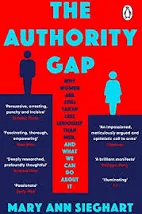
I rarely use the term ‘must-read’, but if ever a book deserved the term it is Mary Ann Sieghart’s wonderfully powerful ‘The Authority Gap‘. It’s a difficult book to summarise, but at the same time one anecdote will tell you almost all you need to know. The author was once at a dinner party. She was sitting next to a banker, who asked what she did. She listed her career – political columnist, former associate editor of the Times, broadcaster, chair of a thinktank. Instead of responding with details of his own CV or with a follow-up question he replied “Wow, you’re a busy little girl!” She was 50.
Women will respond to this story and the many other anecdotes and statistics in this book with (I am sure) recognition and exasperation. Men on the other hand will quite possibly respond with astonishment – are things really that bad, are we really such monsters? Sorry guys, but yes, and yes, and Sieghart has the numbers to prove it.
“The authority gap” – the term Sieghart uses to describe the way women are not taken seriously in public and professional life – is documented by the author in scrupulous detail. We have all by now heard the term ‘unconscious bias’. None of us are free from the insidious effect of this phenomenon, men and women, but what I found genuinely shocking was just how pervasive this gap is. This book is full to the brim of appalling examples where women are undermined, undervalued, and discriminated against in all aspects of their lives – not in some remote primitive country but in the so-called advanced societies in the West. There’s no escape from this phenomenon, from the classroom where boys are given eight times more of their teacher’s attention than girls, to the US Supreme Court where female Justices are interrupted four times more often than male ones, 96% of the time by men?
Any parent can do a simple exercise to test their own bias. How clever are your kids? Are the boys brighter than the girls? I don’t know if this will work if you know the theme of this book, but when (British) parents were asked to estimate their child’s IQ the average score for boys was 115 and the average score for girls was 107? This is a vivid demonstration of the authority gap at work, but the effect is far more pervasive – for example the way children are described can shape their behaviour, as can the toys they are given to play with.
So that the text is not too dryly academic, Sieghart interviewed dozens of women at the top of public life including Hillary Clinton, Julia Gillard, Major General Sharon Nesmith and Lady Hale. All without exception had experienced examples of the authority gap in their public lives, despite having fought their way to the top of their professions. This approach lighten the text but is not without its difficulties – the author recognises that many of these women have risen to such seniority in their professions that they now do not face the barrage of sexism that most women experience – they are listened to when they speak, they are not interrupted or condescended and patronised. Well not always, because even the most senior women in the world reported being overlooked at time, judged on their appearance, or threatened with sexual violence by online trolls.
The text ends with a helpful checklist of things we can all do to address this issue. This final chapter entitled ‘No Need to Despair’ sets out the changes needed to close the gap, such as checking the language we use when speaking to our daughters and our sons, noticing if a woman is being interrupted or ignored in meetings, and yes, reading more books by women. On that final point, I was rude in an earlier post about the novels suggested to address the fact that most men read very few novels by women. What I hadn’t done is check whether I was guilty of this same imbalance in my reading habits. I was shocked when I finally got round to checking my ‘All reviews – by author‘ page to find that more than three quarters of the books I have reviewed over the last ten years were written by men. I wasn’t surprised there was an imbalance, but three quarters! I will ensure I read more works by women in the future, that is a promise to myself.
The Authority Gap is an obvious companion text to Caroline Criado Perez’s Invisible Women. Both books are meticulously researched and evidenced, and both illustrate without the possibility of equivocation the shocking ways in which society is biased towards men. Invisible Women exposed the inherent assumption in much design work that the default model of the human body is male – that it is the male which is important, and any adaptations to suit women are often an afterthought, if they happen at all. The Authority Gap (which I think is a less attention grabbing title, which is my one very minor criticism of the book) shows that women face bias in every aspect of their lives, a bias that is so deeply engrained even in what we like to think of as progressive societies that we often don’t notice it, or taken it for granted. It was shocking to see the extent of this issue laid out so clearly, but encouraging that it can be changed once the issue is acknowledged.
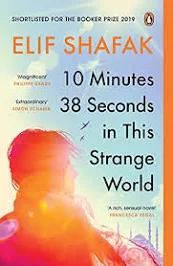
10 minutes and 38 seconds is estimated as the time it takes for a dying brain to shut down. The scientific basis for that estimate is neither here nor there. Shafak uses this as a starting point to explore the dying moments of sex worker “Tequila Leila”, whose body has been dumped in a bin on the outskirts of Istanbul. As her brain begins to shut down, Leila tells her life story in the ten minutes and thirty eight seconds she has left of consciousness.
She recalled things she did not even know she was capable of remembering, things she had believed to be lost for ever. Time became fluid, a free flow of recollections seeping into one another, the past and the present inseparable.
Here memories focus on the people who were important in her life. Along the way we find out how she became a sex-worker, coming from a rural, conservative Turkish family life where independent behaviour by women was severely curtailed, to live in the red-light district of Istanbul where she has a freedom, of sorts, and is able to develop a number of relationships and friendships. As the minutes of Leila’s life tick down we slowly learn more about her life, its tragedies and moments of joy. It’s a touching portrait of a difficult life where Leila’s ebullience manages to somehow overcome all that life can throw at her – until her brutal murder for being in the wrong place at the wrong time.
The second half of the novel has a very different tone and structure. Leila’s disparate group of friends who we have been introduced to in the first half – Sinan, with whom she grew up; Nalan, a trans woman who ran away from her family in Anatolia; Jameelah, a victim of human trafficking from Somalia; Zaynab, a Lebanese refugee with severe health issues; and Humeyra who was born in Mesopotamia and fled an abusive marriage – come together to rescue Leila’s body from the horrible cemetery were it has been effectively dumped, a place for only the poorest and most marginal members of society (a real location – as with most of the novel the places and events referred to are all real). They dig up her body and take it across Istanbul to be buried with proper respect. This part of the novel has a totally different feel to the first half – there’s almost a ‘mad-cap’ adventure aspect to the way the grave-robbing takes place with little planning or discussion of the risks.
This novel is a thought-provoking consideration of gender issues in modern Turkey. It comes as no surprise to read that Shafak has been investigated by Turkish prosecutors for addressing child abuse and sexual violence in her fiction writing, nor that she has moved to the UK recently in order to avoid this potential censorship. On that initial point, I’m not usually a great fan of trigger warnings, but if ever a novel needed a TW flag it’s ’10 minutes and 38 seconds‘. Early on it contains a description of child sexual abuse which plays an important part in the narrative structure of the novel, but which I found hard to read. This novel was shortlisted for the 2019 Booker Prize, and Shafak’s most recent novel The Island of Missing Trees is doing very well and has been shortlisted for the 2022 Women’s Prize for Fiction.
As I have mentioned elsewhere, I am currently reading Michael Slater’s very detailed biography of Charles Dickens. One of my main ‘take-aways’ from the work thus far is that Dickens was so much more than a novelist, even if that is what he is predominantly remembered for today. He wrote an extraordinary volume of work, and no genre was beyond his reach – plays, poetry, short stories, journalism, writing for children, travelogues, and essays, as well as an amazing number of letters. This has encouraged me to explore some of his work outside his novels, which led me to The Chimes.
Following the success of A Christmas Carol (1843) Dickens wrote four further annual Christmas stories. The Chimes: A Goblin Story of Some Bells that Rang an Old Year Out and a New Year In, (1844) is the second in the series (The Cricket on the Hearth (1845), The Battle of Life (1846), and The Haunted Man and the Ghost’s Bargain (1848) complete the list).
The book was written during Dickens’s year-long visit to Italy. Its title is from Faust’s line in Henry 4th part 2 “We have heard the chimes at midnight, Master Shallow!” in which he reminisces about their adventures in their youth. There’s a tone of regret for days past in the line which forms a backdrop to the story. As with virtually all Dickens’s work there is also a campaigning purpose to the text, of sorts, as we shall see.
The story opens on New Year’s Eve. Trotty Veck, an ageing messenger (this is before the days of postmen) is cold and hungry, but cannot leave his post until he has earned something for his family. His work is casual and unpredictable – the gig economy is nothing new. He shelters in the shadow of the local church and his day is measured out by the sounding of the church bells, the chimes. His daughter Meg brings him some food, and announces that she and her fiancé Richard have decided to wait no longer and are to marry the next day. Their happiness is disrupted by the intrusion of the appalling Alderman Cute and his friends who make Meg and Richard feel that being poor they have no right to marry.
Trotty carries a letter for Cute to Sir Joseph Bowley MP. Bowley is spending the last hours of the year settling any debts to ensure a clean start to the new year, and advises Trotty to do the same. When the MP hears that he owes rent and other debts he berates him, showing no understanding of the position of the working poor. Again, sounds familiar? Trotty however tends to agree with him, indoctrinated as he is into thinking that the behaviour of the poor is the problem rather than their condition and circumstances. On his way home Trotty meets Will Fern, an impoverished agricultural worker, and his orphaned niece, Lilian. He kindly takes them home with him and shares what little food he has, in a genuine act of charity.
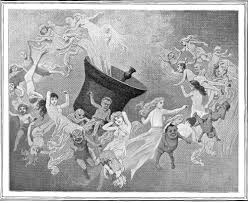
The midnight chimes are no occasion for celebration in this starving household. Instead they call to Trotty, who in a dreamlike state goes to the church and climbs the belltower. There he sees the spirits of the bells and their goblin attendants. This is an hallucinatory vision from something out of Dante or Bosch: these goblins are not bankers (a la Rowling) nor engineers (a la Pratchett) but menacing, supernatural figures who chastise Trotty for his lack of faith in mankind. It slowly becomes apparent that Trotty is now dead, having fallen from the belltower years before. The reader is left to wonder whether this vision is part of his eternal torture, or, as with A Christmas Carol, more in the way of a warning?
In a series of visions very similar to those shown by the Ghost of Christmas Yet to Come, Trotty is shown how the lives of his family play out in the future. Despite their best efforts to make a good life, Richard becomes an alcoholic, Will is unable to earn a living because of his earlier criminal convictions, which lock him into a cycle of imprisonment and brief release, and, in the absence of a loving family around her, Lilian becomes a prostitute. Meg is driven to the murder of her child and suicide, but is rescued at the last minute by Trotty’s ghostly intervention.
The story ends with Trotty waking up as the bells ring in the New Year. All he has seen has been a vision of a possible future, one which is not pre-ordained. Another future, in which Meg and Richard marry and in which his family and friends prosper is open to him, although how he will achieve that future without changes within wider society is unclear. The Chimes seems to suggest Trotty and his family, indeed his class, are masters of their own destiny; the goblins and the spirits of the chimes focus on his sins of condemning the fallen and poor:
‘Who turns his back upon the fallen and disfigured of his kind; abandons them as vile; and does not trace and track with pitying eyes the unfenced precipice by which they fell from good—grasping in their fall some tufts and shreds of that lost soil, and clinging to them still when bruised and dying in the gulf below; does wrong to Heaven and man, to time and to eternity. And you have done that wrong!’
Has he, or is it more Cute and Bowley, representatives of the judiciary and the legislature, that have failed the fallen and disfigured?
It’s hardly surprising that a story of such sinister ambiguity has not prospered compared to its predecessor. Although highly popular in its time – five different productions of The Chimes were on stage within weeks of publication and it sold 20,000 copies in the first three months – the story’s goblins are no longer part of our cultural landscape and have no Christmassy connotations whatsoever. The reader will be happy that Trotty and his family have survived another year, but their problems are as deep-rooted as ever and there’s no suggestion that Alderman Cute or Bowley MP are going to help them any more than they have previously – if help is going to come it needs to come from Trotty and family themselves. The fact that Trotty helps William Fern escape prosecution and offers him shelter offers some hope that by working together they can avoid the worst that Cute and Bowley can throw at them, but this is scant consolation in lives marked by cold, hunger and want.
I am not sure this is more than a curiosity rather than a representative of Dickens’ shorter form of writing – I will need to read more of that to make a call on that – but it’s not a story I could honestly recommend as being either heart-warming or particularly chilling. It has its moment, but the whole is less than the sum of the parts. At least Dickens wasn’t on auto-pilot here, just serving up generic Christmas related stories of poor people over-coming the odds – he genuinely tries to do something very different, although I suspect it may not have seemed as strange to mid-nineteenth century readers as it does to us today.