Book review

Milkman, by Anna Burns, 2018

I decided to end 2020 with a final Booker Prize winner, Anna Burns’ Milkman, which won the prize in 2018. It won from what seems a fairly weak long and shortlist, missing many of the big-hitters in English fiction in recent years, although I would freely admit to not having read any of the short-listed novels, nor indeed anything by any of the short-listed authors.

Set in Northern Ireland during the peak of what was euphemistically called “the Troubles” – that is to say the bitter sectarian violence that dominated daily life for much of the population of Northern Ireland in this period – Milkman is a first person narrative describing a few traumatic weeks in the life of the unnamed narrator.

Milkman: Amazon.co.uk: Burns, Anna: 9780571342730: Books

This narrator is an eighteen year old woman who lives in the heart of the Catholic community in a large town in Northern Ireland. It (along with everything else) is never named, but i think it is safe to assume it is based on Belfast. She is in a relationship of sorts with her “maybe boyfriend” although she tries to keep this relationship secret from her mother and siblings. She has a large family – as it seems do all her friends and neighbours – who are all referred to by their relationships rather than their names – third brother-in-law, oldest sister, etc. Friends and neighbours are also nameless and referred to by their occupation or some other defining feature. This is a world of euphemisms and coded references where proper nouns are forbidden – so the Protestant community is “the other side”, the Irish Republic is “the country down there” and Britain is “the country over the water”.

The Troubles form a backdrop to our protagonist’s daily life, but she does her best to navigate some form of normality despite the rigid code of conduct imposed by her community. This means that some types of rule-breaking are allowed – for example she sleeps over with her maybe-boyfriend without apparently attracting the censure of the community – but other activities such as going to hospital for medical treatment (it might allow the authorities an opportunity to force you into becoming an informer, or worse throw suspicion on you that you are an informer) even when seriously unwell are forbidden.

The narrator’s attempts to get on with her life are disrupted when she meets the Milkman. He does not deliver milk or any other dairy products, and the source of this soubriquet is unclear. He is much older than her and already married. Milkmen are usually perceived as a welcome presence, and a positive part of the daily life of a community. However this milkman however is anything but. He is a senior member of the Provisional IRA (again never mentioned directly) and as such he has certain privileges in this society, one of which appears to be the right to pick a consort of his choosing, irrespective of her wishes in the matter. The narrator is alarmed at being singled out in this way, and doesn’t know how to react. A robust rejection would be dangerous, for her maybe-boyfriend if no-one else, but she has no interest in this creepy figure. She doesn’t know who to turn to for help:

“At the time, age eighteen, having been brought up in a hair-trigger society where the ground rules were – if no physically violent touch was being laid upon you, and no outright verbal insults were being levelled at you, and no taunting looks in the vicinity either, then nothing was happening, so how could you be under attack from something that wasn’t there? At eighteen I had no proper understanding of the ways that constituted encroachment.”

She goes jogging with one of her many brothers-in-law, walks to her evening classes, socialises with maybe-boyfriend, but all the while is conscious of the menacing presence of the Milkman. Her relationship with maybe-boyfriend suffers under this strain, until she discovers his secret relationship with his friend, chef. Chef is bullied for his interest in cooking, which is widely perceived as indicating he is gay – although he is able to put his chef knives to use when the time comes.

The claustrophobic atmosphere of the city, where the authorities lurk behind every bush, snapping pictures of people going about their lives, is profoundly oppressive, and distorts all normal relationships. People accept punishment beatings and shootings as normal, and choose unhappy relationships to avoid the disappointment when happy relationships fail, as they surely must. The control of the terrorist groups and their supporters is however tenuous – freedom seems to be seeping out all over the place, from the children and their embrace of ballroom dancing (when written in this context I know that must appear implausible, but the author does a much better job of making it seem convincing) to romantic relationships being restored, including maybe-boyfriend and his long-standing romantic feelings for chef.

This wasn’t an easy novel to read – the refusal to use any proper nouns combined with the dense paragraphs and complex family relationships made it hard to push through at times. Conveying how language is breaking down with using fractured sentences is difficult, leaving the reader with paragraphs like this:

“Still,’ he said. ‘Ach,’ I said. ‘Ach nothing,’ he said. ‘Ach sure,’ I said. ‘Ach sure what?’ he said. ‘Ach sure, if that’s how you feel.’ ‘Ach sure, of course that’s how I feel.’ ‘Ach all right then.’ ‘Ach,’ he said. ‘Ach,’ I said. ‘Ach,’ he said. ‘Ach,’ I said. ‘Ach.’

But despite this Milkman made a strong impression on me. There are many surprising, almost charming elements, such as the narrator’s young sisters, who are exceedingly intelligent and curious, and blossom in the most difficult of circumstances. Love also finds a way – the narrator’s mother rekindles a childhood romance with the real milkman, her brother runs away with a former girlfriend, and chef and maybe-boyfriend edge towards declaring their feelings for one another. Initially the small-mindedness of the tight-knit community initially seems invincible – no dissent is allowed, and anyone who behaves unconventionally is considered “beyond the pale”, including the narrator. But this begrudging, limited tolerance of unconventional behaviour, such as the “issue women”, a feminist group, and the real milkman himself, who refuses to allow the IRA to bury weapons in his garden, are the seeds for a wider resistance. From such a grim premise Milkman turned out to be surprisingly optimistic.
Standard
Book review

Reading targets for 2021

I have a few books I want to read in 2021, but probably not enough to see me through the year. So the purpose of this post is to try to get the ideas flowing and come up with a few authors that I have neglected.

I haven’t yet decided which, but I am planning to re-read either Mansfield Park or Persuasion. I read both several decades ago so have only the vaguest memories of them. I also plan to read another Dickens novel, again not sure which one, there is such an extraordinarily rich choice. I have narrowed it down to Great Expectations or Bleak House, both of which are pretty substantial books which will probably take me a month or more.

If 2021 is anywhere near as bad as 2020 then I will need some light entertainment. I should finish my Pratchett re-read, with only three novels in the Discworld series (Raising Steam, Snuff, and I Shall Wear Midnight) to go. I am particularly looking forward to Midnight – my admiration for the Tiffany Aching novels has been growing steadily as I work through the series. If things get really bad I might even return to Hogwarts.

Another plan is to read at least two Booker prize winning novels. That way the ratio of books read to books to be read will improve by a factor of one – unless the judges award the prize to two novels again I suppose! I have Milkman and Wolf Hall by my bedside already, but I may also try this year’s winner, Shuggie Bain.

I am not going to put a total books read target on myself this year – it’s pointless, I will read what I read. Remarkably I seem to have read about 70 books last year, which seems an extraordinary number. I read several non-fiction books without any particular pattern or order to them, and I suspect that will happen again in a haphazard way, partly at least depending on what people buy me! One thing I made a conscious effort to do this year was read people I hadn’t read before – authors like Chimamanda Ngozi Adichie, Penelope Fitzgerald, and Maggie O’Farrell – and that worked reasonably well, so I will try to keep that up.

Just one last thing – I am not going to review my reviews from 2020. It is a year to forget and just put behind us, but the best book I read all year, one which blew me away, was Maggie O’Farrell’s Hamnet. I appreciate that it has received a lot of hype over the year, which might put people off, (it certainly would normally have that effect on me) but it was magnificent.

Having said all that I would love some recommendations – what was your favourite book of 2020?

Standard
Book review

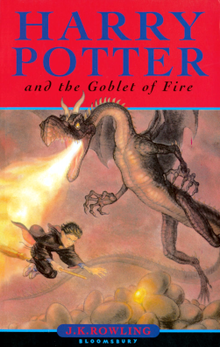
Harry Potter and the Goblet of Fire, by J K Rowling, 2000

Harry Potter and the Goblet of Fire cover.png

In my post on Prisoner of Azkaban I tried to argue that the darkness of that story supported the idea that the novel was the turning point in the series, when they stopped being children’s happy-ever-after tales and became a lot more serious and even disturbing. My evidence rested largely on the role played by Dementors. But the Dementors can be frightened away by a spell; nobody dies in Prisoner, not even Buckbeak, and the only villain present in Hogwarts is a transfigured pet rat. Apart from Pettigrew’s escape and Trelawney’s ominous prediction, everything in Prisoner ends fairly positively. Of course it would have been nicer if everyone had believed in Sirius’s innocence and that Harry could have gone to live with him in Grimmauld Place, but Voldemort still seems a distant, improbable threat.

I was wrong. Goblet of Fire is dramatically darker than any of its predecessors. Real people die in front of our eyes, Voldemort returns to life and to his full powers, together with a band of Death Eaters. Harry seems stripped of the special protection his mother’s sacrifice gave him. The scenes in the Riddle graveyard, when Cedric is brutally and shockingly slaughtered (“kill the spare“), Voldemort rises from the grave and tortures Harry and the Death Eaters return, are difficult to read even now, and only slightly mitigated by Harry’s miraculous escape. This is not a story one would want to read to a young child. Or more specifically these are not chapters one would want to read to a young child – most of the novel is written in the same tone as its predecessors. The level of threat is quite low and Harry is able to master the life-threatening tournament challenges with ease, with lots of people willing to help him.

Obviously another factor is that the novel is significantly longer than the earlier books. This gives Rowling the space to explore and expand upon the magical universe. The international wizarding world is introduced at the Quidditch World Cup, the schools of Beauxbatons and Durmstrang are brought into the narrative, and we learn more about the workings of Hogwarts such as the role of the army of house-elves. While Rowling adheres to her by now very well established story structure spanning the three school terms, this is a year like none other. Here’s a few things I noticed on this read of Goblet of Fire:

SPEW – the Society for the Promotion of Elvish Welfare. What to make of SPEW, Hermione’s campaign to liberate house-elves? The text is unequivocal – with the exception of Dobby, house-elves like being enslaved. They hate the idea of being paid wages, and are horrified by what has happened to Dobby and Winky. There are unsettling echoes of these arguments with the pro-slavery position of the South in America in the nineteenth century – freeing the slaves would be an unkindness, their owners look after them when they are unable to look after themselves, etc. To quote a comment on Reddit “The elves behave like textbook Uncle Toms straight out of Gone with the Wind or Song of the South – the happy servant trope. Other wizards react to their enslavement the same way white people in America reacted to it when people started suggesting it was inhumane: “well, they like being subservient. Serving white people is in their blood.”

Hermione’s campaign is pathetically disorganised and unsuccessful and is perceived by all of her friends, even those closest to her, as an embarrassment. There is very little evidence to indicate her campaign to change attitudes towards the enslavement of house elves has any success. This troubled me because it seems to trivialise the issue for comic purposes, not least in the name of the campaign. Coming from a Muggle family Hermione has a fresh perspective on magical society, and can see the unfairness in the treatment of house-elves than wizarding families are blind to, I just wish her campaign hadn’t been treated as such a joke, an unfunny one at that.

Bertha Jorkins is the witch who plays a pivotal role in the novel (and arguably in the series) but who doesn’t appear in person. She is the Godot of Goblet. I am convinced that she was a late addition to the text, as her only role is to smooth out some of the many wrinkles in the plot. I think the editing process might have gone something like this:

Editor: “OK, love it, great ending, but just a couple of questions. How did Voldemort find out about Barty Crouch Junior having escaped from Azkaban? Also, how did he find out about the Triwizard tournament being staged at Hogwarts this year?

JKR: Good point. I know, I’ll create a character who visits the Crouch family residence, stumbles across Barty Junior hiding there, has her memory modified by Barty Senior so she doesn’t tell anyone that a Ministry of Magic Minister is hiding an escapee from Azkaban, and who then travels to Albania on her holidays, meets Peter Pettigrew, forgets he is supposed to be dead, is lured into a meeting with pre-reincarnated Voldemort who tortures her into revealing Barty Junior’s escape and throws in details of the tournament for good measure. Then he kills her and uses the murder to turn Nagini into a horcrux (as we later learn). There, simples!

The problem with stuffing plot-holes with devices like this (apart from the transparent nature of the process) is that is just opens up more questions. Why wasn’t Bertha’s extended absence in Albania, long-rumoured to be Voldemort’s hiding place, more of a concern for the Ministry? (There are lots of references in the text along the lines of ‘Bertha’s still missing in Albania, goodness I am worried’ but it is never taken that seriously.) Why didn’t Bertha recognise Peter in Albania – not a place one meets many British wizards I assume? It’s all a bit laboured and heavily dependant upon coincidence isn’t it? The film adaptation, forced to make cuts due to the length of the novel, decided to just ignore these problems, cutting out Bertha altogether. No-one bothers to wonder how Voldemort found out about the tournament (it wasn’t exactly a well kept secret, and for that matter there’s no particular reason why it should be) or how he knew Barty Junior had escaped. If he can live in a forest as a disembodied spirit for twelve years he can contact his Death Eaters somehow surely? The film also cuts out two other central characters – Winky, the Crouch family elf, who again is really only there to explain how Harry’s wand is used to conjure the Dark Mark, rather than being a character in his or her own right, and Ludo Bagman, Head of the Department of Magical Games and Sports. Rowling invests a lot of time in building Bagman up as a candidate for Voldemort’s ubiquitous inside man, but Karkaroff does the job perfectly well and Bagman isn’t missed. I don’t think anyone reading Goblet for the first time could have worked out the plot twist re Moody, but few if any would really suspect Bagman either.

The Triwizard Tournament. The tournament is a strange event. It hasn’t been held for a century or more, because it is really dangerous, and student competitors had previously died. So the safety precaution the Ministry introduces (yes, student competitions are governed by the Ministry of Magic) is an age limit? This suggests that previous champions had been younger than seventeen. But if they were chosen by the Goblet it was presumably because they were magically gifted students, most of whom would have been from the senior years anyway. This isn’t much of a precaution, and as it turns out unsurprisingly the tournament is once again lethally dangerous. The other weird thing about the tournament is its duration. It takes all year for just three events, all of which could probably be over in an afternoon and still leave time for tea. Not even a test cricket series takes that long! Rowling seems a prisoner of her school-year format, across which the tournament needs to be stretched irrespective of plausibility.

The challenges themselves are also unusual. The lake-rescue challenge must have been really dull to watch – four champions wade in, nothing happens for an hour, then the champions emerge with their rescued companions. Not exactly an entertaining afternoon down by the lake. There’s some ambiguity about whether the crowd in the Quidditch arena could see what was happening in the maze in the final challenge. People have tried to use trigonometry to work out sightlines by calculating the height of the stands compared to the height of the hedges. But it is fairly obvious they couldn’t see much if anything, because there’s no indication of any reaction when (for example) Krum uses an unforgiveable curse (Crucio) on Cedric, or when Cedric and Harry disappear having touched the trophy. So two out three of the events, with three or four months between them, can’t be watched at all. And why only three challenges? There is time for many more (less dangerous) contests which would have been a lot more entertaining to the audience and allowed the champions to show a full range of magical skills and abilities. A flying for example would have been really fun.

Why is the book called Goblet of Fire? The idea that the “and the” object in each book’s title was an important part of the narrative is pretty obvious, but the goblet of fire only appears briefly to serve as a way of choosing the school champions. It’s a quite unimportant part of the book, but it claims the headline. Perhaps it simply sounded more dramatic than ‘Harry Potter and the Triwizard Tournament‘?

Rita Skeeter. By this point in her writing career Rowling had obviously been on the receiving end of a lot of intrusive press-coverage. Her animosity towards the tabloid press is captured wonderfully in the portrait of the vile Rita Skeeter, and her quick-quotes quill. Rowling’s dislike of the tabloid press is undisguised and vitriolic, and it unbalances the novel slightly – Rita is given a lot more time than she deserves, simply to show her being vile again.

Portkeys. When the Weasley party travels to and from the Quidditch World Cup using a portkey it is clear that they (portkeys) are not simply activated by touch – they travel at specific times. The portkey used to transport Harry and Cedric to the Riddle graveyard is however triggered as soon as it is picked up. Not surprisingly, readers have noticed this apparent anomaly and no doubt drew it to the author’s attention. Subsequently writing on her website, Pottermore, JK explained that there are two different types of Portkey, one pre-programmed, the other triggered on touch. A simple and convincing explanation. Rowling could easily have said “look magic isn’t real so of course it doesn’t follow scientific, rational rules!” but instead she worked really hard to iron out any inconsistencies like these, even long after the series had finished. I suspect this is simply because she enjoys the intellectual challenge.

Goblet of Fire ends on a darkly ominous note – Voldemort is back, and while Dumbledore is going to do all he can to defeat him, he is going to have to do without the Ministry’s support for now.

“Dark times lie ahead of us and there will be a time when we must choose between what is easy and what is right.“

Readers would have to wait three long years to find out what was going to happen next to Hv v         v                                      v                             v                                                          v              v         v                                                   v           v                   v                                                       v           arry and his friends.

Standard
Book review

A Study in Scarlet, by Sir Arthur Conan Doyle, 1887

ArthurConanDoyle AStudyInScarlet annual.jpg

Yep, that’s right – A Study in Scarlet, the first story to feature Sherlock Holmes and Dr Watson, was published in Beetons Christmas Annual, although you will struggle to find anything remotely Christmassy about it! This is the Holmes and Watson ‘origin story’, explaining how they meet (introduced by a common acquaintance), came to live together (they both needed somewhere slightly cheaper to live, and decide quite casually to share the rent with one another) and all about Dr Watson’s background (military doctor wounded in Afghanistan). Almost nothing on the other hand is revealed about Holmes’s background. He emerges fully formed – the meticulous, brilliant private detective with the ability, almost like magic, to use microscopic or incidental details to discern peoples’ lives, occupations and histories.

The short novel is divided into two very distinct narratives. Part I is entitled “The Reminiscences of Watson” and subtitled “Being a Reprint from the Reminiscences of John H. Watson, MD, Late of the Army Medical Department.” This gives the story the appearance of a biographical sketch, with the added authority of coming from an army doctor, so surely trusty-worthy. Perhaps this air of authenticity was part of the reason why people went on to conceive of Holmes are being a real life figure?

Watson, having returned to London from service in the Second Anglo-Afghan War, bumps into an old friend, Stamford. 

I had neither kith nor kin in England, and was therefore as free as air—or as free as an income of eleven shillings and sixpence a day will permit a man to be. Under such circumstances, I naturally gravitated to London, that great cesspool into which all the loungers and idlers of the Empire are irresistibly drained.

Watson explains he has been invalided out of the army and is looking for a more affordable place to live. Stamford mentions an acquaintance who is in a similar position, and might be interested in sharing. This is our first introduction to the great detective:

“…a fellow who is working at the chemical laboratory up at the hospital. He was bemoaning himself this morning because he could not get someone to go halves with him in some nice rooms which he had found, and which were too much for his purse.”

Stamford’ description of Holmes is ambivalent – his recommendation of him as a flat-mate is hardly glowing:

“Oh, I didn’t say there was anything against him. He is a little queer in his ideas—an enthusiast in some branches of science. As far as I know he is a decent fellow enough.”

He takes Watson to meet Holmes in a hospital laboratory, where Holmes (although he doesn’t work there, and seems to have set up shop spontaneously) has just developed a test to detect haemoglobin, for use in criminal investigations. Thus Holmes’s credentials as an eccentric, brilliant scientist are established. Without prompting Holmes greets Watson with the comment “You have been in Afghanistan, I perceive.” This is the first instance of Holmes’s deductive and observational powers, which were to become such a popular feature of the stories.

The two confirmed bachelors set up home together, and quickly become close friends. Holmes is unquestionably eccentric, but Watson is never judgmental, even when he suspects Holmes of drug-taking. It takes Watson some time to work out what Holmes does for a living – Holmes is as usual unnecessarily mysterious about the question. Of Watson himself we really learn little beyond the initial self-portrait – but his role is nevertheless established as the witness of Holmes’ brilliance and as the representative of the reader – always a few steps behind Holmes, struggling to keep up and work out what is apparently so obvious to the great one. Holmes remains enigmatic – there is no mention of any other friends or family, or his previous career.

Holmes is asked to help the Metropolitan Police with a murder investigation. He takes Watson along with him to the scene of the crime, for reasons that are never really established – perhaps he just thought it would be interesting, or an opportunity to get to know one another. Here we first see Holmes’s method in action – a meticulous observation of the house and garden, which appears to reveal much more to Holmes than is apparent to Watson. Another trope is thus established. Inspectors Gregson and Lestrade are introduced (unusual for the Met to allocate two inspectors to a murder; it is interesting to see how Lestrade went on to become a fixed part of the Baker Street universe, whereas Gregson faded into the background, until being spectacularly resurrected in Elementary). Gregson and Lestrade are competitive but largely there to underline even further how astonishingly clever Holmes is by comparison.

The corpse is identified as an American, Enoch Drebber. There is no wound on the body. Documents conveniently left at the scene confirm Drebber is visiting London with his secretary, Joseph Stangerson, an immediate suspect. One a wall, ominously written in blood – apparently not the victim’s – is the word “rache”. This it eventually turns out is the mother of all red herrings. Moving the body, a woman’s gold wedding ring is discovered.

Realising the murderer attempted to return to recover the ring, Holmes sets a trap, advertising its discovery in a newspaper. At the same time he sends telegrams to the US seeking confirmation of his theories about the crime and those involved. A little later Drebber’s secretary is found murdered at his boarding house, again with the word “rache” appearing at the scene. Lestrade also finds a small pillbox containing two pills. Holmes tests the pills on a disposable dog that conveniently just happens to have been in residence at Baker Street. (This is Conan Doyle not trying very hard. Yes, Holmes has to be shown that of the two pills in the box one is lethal, the other harmless. But to have a sick dog on hand just waiting to be put down is pushing the bounds of credibility). The first pill produces no evident effect, but the second kills the hound. Holmes is able to produce and capture the murderer moments later using his trademark ‘sudden reveal’ technique.

Part two of the novel, The County of the Saints, consists almost entirely of a flashback devoid of Holmes or anything Baker Street related. The narrator recounts the story of two people, John Ferrier and a little girl named Lucy, the only survivors of a party of settlers in early nineteenth USA. They are close to death from dehydration and hunger when they are discovered by a large party of Mormons on their way to Salt Lake City. (Warning – one can easily fall down an internet rabbit hole looking into the early history of the Mormons. They were viciously persecuted, which given the founding principles of the USA is a bit ironic). Ferrier and Lucy are rescued on the condition that they become Mormons, and with few choices open to them, they agree. Ferrier prospers, and adopts Lucy as his daughter. Years later Lucy falls in love with a man named Jefferson Hope. Hope is not a Mormon, and a relationship with him is not allowed by her community. Ferrier is given one month to change her mind or face what it is suggested are fatal consequences. Lucy must marry either Joseph Stangerson or Enoch Drebber, sons of members of the church’s Council of Four (and, you will have spotted, the men murdered in part one).

Lucy, Hope and Ferrier try to escape, but are hunted down. Ferrier is killed, and Lucy is dragged back to Salt Lake City and an enforced marriage, with only Jefferson escaping through sheer luck. Lucy pines away and dies, and Hope vows to seek revenge on her and her father’s killers. He hunts them for decades, chasing them across Europe until finally tracking them down in London, where he exacts his revenge by forcing Drebber to choose between a fatal pill and a harmless one. Stangerson is then despatched before the pill choice can be offered. Once captured Hope freely confesses all, knowing he has a conveniently weak heart and is close to death – indeed, he expires the next day, a smile on his face. Holmes then leisurely reveals how he had worked out the identity of the murderer and how he had used his Baker Street Irregulars, his “street Arabs,” to help with the case. Watson is outraged that Gregson and Lestrade are given credit in the newspapers for solving the case, and decides to document the investigation himself. Surprisingly, Holmes does not object.

To what extent does Holmes emerge in this novel fully formed? Almost completely is the short answer. All the features of a traditional Holmes story appear in the summary above. Admittedly, the portrait of Holmes’s weaknesses is over-done. Early in the novel Watson lists the subjects in which Holmes is an expert, and those in which he has little or no knowledge, including astronomy, and the astounding fact that he did not realise that the earth travels round the sun, a fact that is, according to Holmes, of no interest of value whatsoever.

“His ignorance was as remarkable as his knowledge. Of contemporary literature, philosophy and politics he appeared to know next to nothing. Upon my quoting Thomas Carlyle, he inquired in the naivest way who he might be and what he had done. My surprise reached a climax, however, when I found incidentally that he was ignorant of the Copernican Theory and of the composition of the Solar System. That any civilized human being in this nineteenth century should not be aware that the earth travelled round the sun appeared to be to me such an extraordinary fact that I could hardly realize it….

You see,” he explained, “I consider that a man’s brain originally is like a little empty attic, and you have to stock it with such furniture as you choose. A fool takes in all the lumber of every sort that he comes across, so that the knowledge which might be useful to him gets crowded out, or at best is jumbled up with a lot of other things so that he has a difficulty in laying his hands upon it. Now the skilful workman is very careful indeed as to what he takes into his brain-attic. He will have nothing but the tools which may help him in doing his work, but of these he has a large assortment, and all in the most perfect order. It is a mistake to think that that little room has elastic walls and can distend to any extent. Depend upon it there comes a time when for every addition of knowledge you forget something that you knew before. It is of the highest importance, therefore, not to have useless facts elbowing out the useful ones.”

The idea that Holmes was ignorant of simple facts that a schoolchild would know, simply because he needs the space in his memory for more important facts, was quietly discarded by Conan Doyle, and rightly so. But the wider picture, of Holmes being an expert in a wide range of subjects, and having a vast brain ‘attic’ where facts can be stored and retrieved, is a core part of the character.

One other common feature of the Holmes stories is his frustrating refusal to tell Watson and any detectives involved in the case about his deductions until the case comes to fruition. Sometimes this is more a case of neglect that a conscious decision to be obtuse, but here the refusal to share is clearly deliberate:

I’m not going to tell you much more of the case, Doctor. You know a conjuror gets no credit when once he has explained his trick, and if I show you too much of my method of working, you will come to the conclusion that I am a very ordinary individual after all.

Watson is deferential as always:

I shall never do that,” I answered; “you have brought detection as near an exact science as it ever will be brought in this world.

Mrs Hudson has yet to be introduced – here the gentlemen are looked after by an anonymous servant – and of course Moriarty, Mycroft and Irene Adler were all to come, but the Study in Scarlet is otherwise the template which all future Holmes stories were to scrupulously follow.

Is it an enjoyable story, or just a curiosity piece? Certainly the second part of the novel, largely devoid as it is of anything Holmes related, comes in for a lot of criticism from readers (see Goodreads, for example). I actually found the scenes in America more interesting than those in London – the part one murders are pretty pedestrian, solved by Holmes with the minimum of effort. Origin stories are always interesting, offering insights into the way the novelist originally conceived of the characters, but here the interest is actually how incredibly consistent Conan Doyle was with his characterisation of Holmes and his detection techniques.

Standard
Book review

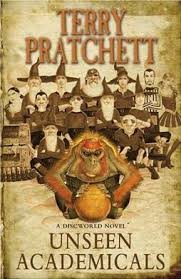
Unseen Academicals, (Discworld 37) by Sir Terry Pratchett, 2009

Unseen Academicals - Wikipedia

Yes, Unseen Academicals is ‘the one with the football’ but it is so much more than that. Pratchett’s extraordinary ability to find new heights and depths to his universe was not dimmed by the fact that he was at this point 37 books into the series and that he was using very familiar characters and settings. His power to reinvent Discworld, and Ankh-Morpork in particular, here rests not on his principal theme, football, but on his exploration of the servant underclass that previously has been largely silent. Almost all the characters we have met thus far have been either fairly high-status – lords, ladies, wizards, guild leaders, etc, – or from the criminal underworld (sometimes both of course), but rarely ordinary working people.

The wizards of the Unseen University face disaster – they will lose a significant endowment unless (for reasons that are somewhat contrived) they play a game of football. The loss of income will restrict them to only three meals a day, an unthinkable deprivation, so the game is afoot. Flimsy though this reason is for introducing sport to that most unsporting of environments, the further complication is that Ankh-Morpork football is nothing like the sport we know today, and much closer in spirit to the medieval village game where everyone takes part, the ball is a wooden block covered in rags, and violence is a key part of any match. It becomes clear that the rules will need to be updated to make this more a gentleman’s sport, where the risk of decapitation and death are reduced and where a winner can eventually be determined.

Previously we have been introduced to a few of the higher status servants that keep the Unseen University running, but here for what I think is the first time we actually go into the kitchens and cellars where all the work is done, and are introduced to the people who do it. A key part of keeping the lights on is, well, keeping the lights on, and at the Unseen University all candles must be expertly dribbled for the right medieval aesthetic effect. The university’s master dribbler is Mr Nutt. Mr Nutt, we are told, is a goblin recently arrived from Uberwald. Parts of the story are told through Mr Nutt’s internal narration, and it becomes clear that he has a secret, hidden to even himself. He is extremely intelligent, physically hugely powerful, and constantly suppressing what seems dangerous instincts and dark, violent impulses. At first he is hidden away in the cellars, but the Arch- Chancellor is aware of his presence there, as is Lord Vetenari.

Mr Nutt starts to explore the working class culture of his friend and colleague Trev Likely. Trev has only one obsession – football. They go to a game and see up close the dangers of the rampant football hooliganism which appears to lead to Mr Nutt being killed, only for him to spring back alive before treatment can even begin at the Lady Sybil hospital. (Of the many things I loved about this novel, the way Sam Vimes and his good lady wife have become part of the language and culture of Ankh-Morpork was both touching and wonderful). At the same time we are also introduced to two of the staff who work in the University’s night-kitchens. Glenda Sugarbean bakes the best pies in Ankh-Morpork and is observant and intelligent. Her kitchen-maid friend Juliet yearns for more than can be found in the boring life below stairs.

Like many stories of working class life, the main theme here is escape. Juliet’s transcendent beauty allow her to go on to become a catwalk model of the new dwarven material, micromail; Trev’s skills with a tin can, a substitute football, win the Unseen Academicals a key game, and Nutt – well Nutt comes to terms with his dark secret, which is that he is an orc. This is the first time orcs have been mentioned in the Discworld series. They are fabled creatures, thought long-extinct, and utterly terrifying. While they are recognisably the creatures of Tolkien’s creation, there is a Discworld twist – they were bred by men as creatures of war, and their inner nature is peaceful and artistic. Mr Nutt writes love poetry, and yearns to be a valuable member of society. His relationship with Glenda blossoms into the most unlikely of romances, until finally he is asked to try to discover any surviving members of his species and re-introduce them to society. If trolls and vampires can live amongst men, why not orcs?

“Many bad things were done under the Evil Empire” she said. “The best we can do now is undo them. Will you assist in this endeavor?”
“In every way that I can” said Nutt.
“I would like you to teach them civilized behavior,” said Ladyship coldly.
He appeared to consider this. “Yes, of course, I think, that would be quite possible,” he said. “And who would you send to teach the humans?”
There was a brief outburst of laughter from Vetinari, who immediately cupped his hand over his mouth. “Oh I do beg your pardon,” he said.”

Unseen Academicals is a joy. Pratchett’s trademark silly jokes still abound – one of the wizards is on exchange from a distant university and is called Bengo Macarona – unsurprisingly he is brilliant at football. As always, the game of spot the reference is rewarding. Pratchett wears his learning lightly, and some lines are almost thrown away. One example is a version of the couplet from Andrew Marvell’s To His Coy Mistress , (summarised (if not dismissed) earlier in the novel along with all other love poetry as “as a means to an end, to wit, getting a young lady to take all her clothes off.”)

“The grave’s a fine and private place,
But none, I think, do there embrace.”

Which comes out as:

“The crypt’s a handsome place to be, But none, I think leave after tea”

Most obviously Trev and Juliet’s whole storyline is a Ankh-Morpork version of Romeo and Juliet, lovers from two bitterly divided families, fanatical supporters of opposing football teams, but at the same time and rather brilliantly Juliet’s story is also that of both Pygmalion and A Star is Born, a beautiful young woman transformed into a supermodel. Mr Nutt’s unusual training techniques – he takes his team to the ballet, and has them practicising blindfold – also reminded me of How Steeple Sinderby Wanders Won the FA Cup. Someone has done a fantastic job of collecting all these references in one spot at https://wiki.lspace.org/mediawiki/Book:Unseen_Academicals/Annotations but don’t spoil the fun and look them up first. The references are often easy to miss but there is a certain satisfaction to be gained from spotting them unassisted.

Ankh-Morpork is changing. Technology is threatening old ways, and in a most striking illustration of the new times one of the wizards of the Unseen University, the Dean, has taken a job in another university as their Vice-Chancellor, an unheard of move that Ridcully sees as a betrayal. It is probably just because I know that the series was to end after four more novels, but I saw a slight sadness in this event, a recognition that all good things must end. Like this review,

Standard
Book review

Harry Potter and the Prisoner of Azkaban, by J K Rowling, 1999

I had the huge pleasure of reading Prisoner to my sons a few years back, and it was that experience which finally persuaded me to take J K Rowling seriously as an author.

Harry Potter and the Prisoner of Azkaban.jpg

Philosopher’s Stone and Chamber of Secrets had been fun, with dark moments but plenty of silliness as well, and it seemed the level of peril Harry was going to face was never going to be that serious. He certainly didn’t seem to need the help of adults to face down Voldemort once a year. His plot armour was unbreakable and extended to all his companions. While there is also a strong case to be made for Goblet of Fire being the turning point in the series, where there are key character deaths and the novels begin to grow much longer, I think Prisoner is equally a significant milestone in the series.

First, Prisoner is a much darker novel than its predecessors. Sirius Black has been built up through out the novel as a psychotic and dangerously powerful killer, the only wizard to ever escape from Azkaban (even though his attempts to break into the castle and the Gryffindor common room and bedrooms have not seen anyone killed or even hurt). Having been told relentlessly that he is an extremely dangerous character, we have no reason to believe he is not the novel’s principal villain. After all, who else could it be? In the novel’s climax n the Shrieking Shack the trio are ‘captured’ by Black, Ron is seriously injured, and the only possible help, Professor Lupin, seems to be a traitor. It’s hard to see a way back for them at that point.

The darkness of the novel is underlined by introduction of dementors, a disturbing new element to the narrative. While much of the landscape of Hogwarts is familiar, drawn from traditional stories – ghosts, goblins, giants, unicorns and centaurs – dementors are something new and very scary.

“Dementors are among the foulest creatures that walk this earth. They infest the darkest, filthiest places, they glory in decay and despair, they drain peace, hope, and happiness out of the air around them… Get too near a Dementor and every good feeling, every happy memory will be sucked out of you. If it can, the Dementor will feed on you long enough to reduce you to something like itself… soulless and evil. You will be left with nothing but the worst experiences of your life.“

What’s worse in many ways is that the dementors are ostensibly on the ‘good’ side – the Ministry employs them to run Azkaban where psychological torture is the state-sanctioned fate of all, to act as security guards around Hogwarts once the threat to Harry from Sirius becomes understood and to execute prisoners without benefit of trial or sentence in the most appallingly cruel fashion, using the Dementor’s Kiss. They are the stuff of nightmares:

Where there should have been eyes, there was only thin, grey, scabbed skin, stretched blankly over empty sockets. But there was a mouth … a gaping, shapeless hole, sucking the air with the sound of a death-rattle.

Fluffy falls asleep when you sing to him, Aragog is Hagrid’s friend, and the basilisk is pecked out of action by Fawkes – but the dementors will eat your soul.

Second, the climax of the novel following Buckbeak’s ‘execution’ is a sustained, extraordinarily breathless series of reveals, twists, and surprises. Reading these chapters (from seventeen to the end of the novel) I found it virtually impossible to find a natural place to find somewhere to pause for the night – each one ends with a cliff-hanger that demands you read on. It’s brilliantly constructed. Prisoner is still an adventure novel for children and young adults, but the shift in tone and quality from the earlier novels is apparent.

Third, complexity. In the course of this novel that Rowling is able to sustain dramatic tension and build a world of depth and complexity, demanding that we look again at the first two novels, re-evaluating references, incidents, and even casual apparently throwaway lines for new importance. You can start to see her cash in some of the investment made in earlier novels. Scabbers, for example, introduced on that first ride on the Hogwarts Express as Ron’s rather pathetic hand-me-down pet, suddenly becomes a much more important character. Equally, the passing reference to Sirius in the opening chapter of Philosopher’s becomes strikingly poignant when it is revealed he is Harry’s godfather. (Incidentally it is surprising that suspicion did not fall on Sirius immediately following the attack at Godric’s Hollow. Dumbledore knew James and Lily were hiding under the protection of a secret-keeper and believed that person to be Sirius – hence his willingness to let Sirius rot in Azkaban for 12 years. But when he hears that Sirius lent Hagrid his motorbike to convey Harry to Privet Drive – no reaction!)

The case against Prisoner revolves mainly around the use of the time-turner as a plot device. It’s a classic deus ex machina, and invites the question why the Ministry allowed a school-girl to casually use such a powerful magical device for relatively trivial purposes. Within the context of the novel however these questions usually don’t occur to the reader, and the time-travel resolution of the plot seems neatly done. Again, if we can suspend our disbelief to allow the existence of magic, magical creatures, and the whole wizarding world, why can’t we allow for time travel as well, and just skate on past any awkward paradoxes?

These elements build into a powerful combination, using the characters, locations and structures that Rowling established in the first two novels, but beginning to explore the wider wizarding world. These are still school-children, struggling with homework, exams, and the awkwardness of teenage friendships (Ron spends a long time sulking when he thinks Crookshanks has eaten Scabbers). Prisoner begins the transition to the darker, more mature themes that dominate the rest of the series.

Standard
Book review

Harry Potter and the Chamber of Secrets, by J K Rowling, 1998

Again, not a review, which would be redundant, but some observations:

  1. The comfort of familiarity. Re-reading Chamber of Secrets I was struck by how similar the story is to Philosopher’s Stone. I am not going to list all the points of comparison here, but (to mention a few) both stories involve:
  • a search for something hidden “miles” beneath the castle
  • a dangerous trip into the Forbidden Forest
  • Hagrid providing clues to the ‘secret’
  • the climax of both novels featuring Harry travelling under the school with his friends, only to be separated from them and having to face You-Know-Who on his own.

The stories are not just similar in terms of their plots. Rowling developed a structure for these novels that was to serve her well and provide a comforting familiarity to her readers. (To be honest it came as a shock when she abandoned that formula in Deathly Hallows). Apart from that one outlier, all the novels start in Privet Drive, feature the journey to Hogwarts, the welcome feast, the three school terms, and culminate conveniently at the end of the summer. Harry’s birthday, lessons, feasts, Quidditch, Halloween, Christmas, Easter and exams are all fixed points of reference in each novel. (It is rare for Rowling to introduce new milestones – so far as I can remember, for example, neither Ron nor Hermione’s birthdays are mentioned or celebrated). This is not an objection, (and I suppose it’s not much of an observation either), but it does mean that each novel was constructed within tightly prescribed parameters, with only limited variations at each outing.

Harry Potter and the Chamber of Secrets By J. K. Rowling

2. Still not sure. Rowling was careful not to assume that readers of Chamber had read Philosopher’s, so provides a detailed if rapid explanation in the opening chapter – Harry is a wizard, he goes to a magic school, he is an orphan, etc. Even the rules of Quidditch get a recap. In later novels Rowling is confident enough to assume that her readers are not joining the series mid-way and dispenses with these summaries, which I suspect were something her editors suggested.

3. Believability. When I first read Chamber I was mildly irritated by some of the plot inconsistencies and absurdities. Would Hagrid really have been carted off to Azkaban just on suspicion of involvement in the opening of the Chamber? Could a massive basilisk have moved freely around the pipes of the school’s medieval plumbing? And why didn’t it eat any of its victims, given how hungry it insists it feels? I could probably explain away these and the many other problematic issues that readers have identified over the years, but I am fairly sure that would be missing the point. This is not a realistic adventure story, and it is wrong to treat it as one. There are ghosts, trolls, centaurs and unicorns for goodness sake, not to mention the giant squid living in the lake! It is a children’s story where suspension of disbelief is required. As the series turns darker a more careful analytical reading can be justified, but for now this is still a bit of a lark.

4. A detective story? One of the pleasures of a re-read of any mystery is spotting the clues one missed the first time round, the misdirection and red herrings. Should I have been able to work out the ending and the plot twists? Most readers assume that the heir of Slytherin is unlikely to be either Malfoy or Harry, following the convention that it is never the more obvious characters ‘whodunnit’. But should I have been able to guess that Ginny was the one opening the Chamber and controlling the basilisk? On a reread the clues are there in plain sight, but the added complication of the diary being haunted by the spirit of Tom Riddle (who mysteriously still has his award for services to the school on display in the trophy room, despite the later difficulty with ahem trying to take over the world) clearly wasn’t guessable, in the same way that Quirrell being the host for You-Know-Who’s disembodied spirit wasn’t work-out-able either. The technique works surprisingly well – Rowling makes us think we should have been able to see the solution while at the same time making it obscurely improbable.

5. Easter Eggs. The other main pleasure of Chamber is seeing some of the skeleton of Half Blood Prince in the bones of the plot. References and objects pop up in passing – the Hand of Glory and the opal necklace from Borgin and Burke’s in Knockturn Alley (one of the many things I still really enjoy from the series are silly little jokes like that), the vanishing cabinet and of course Riddle’s diary.

Chamber isn’t the strongest novel in the series, but there’s still so much to enjoy. The story is told with the wonderful economy that was such a feature of the early novels. The central characters are beginning to come alive and be fully rounded, with the supporting cast also assuming much more depth. New characters such as Dobby are introduced, and the portrait of Lockhart is a wonderfully spiteful sketch. Despite the ghosts and the magic there is a grounded believability about Harry and his friends. They struggle with schoolwork, bullies, unpopularity and peer-pressure – the only thing that no-one seems to suffer from is acne. It’s been a real pleasure to return to Hogwarts, and while I doubt I am going to work my way through the whole series again, I might!

Standard
Book review

How to Stop Time, by Matt Haig, 2017

Time travel is an obvious source of plot material for authors, but it is also inherently problematic – making it plausible is always the challenge. Over the years authors have adopted a range of different approaches to making it believable. None have ever really cracked the central practical problems associated with the idea, but Matt Haig comes close in this novel, mainly by redefining what we mean by time travel. His central character, Tom Hazard, has a rare genetic condition which causes him to age extremely slowly.

I am old. That is the first thing to tell you. The thing you are least likely to believe. If you saw me you would probably think I was about forty, but you would be very wrong.

For every ten to fifteen years of his life his body ages approximately one year of everyone else’s. And this is his story. At the time we are introduced to him he is around 400 years old. Much of the novel is spent revisiting Tom’s memories of his earlier lives, from medieval England to 1920’s Paris. The gift of long-life has not been without its problems. His mother is drowned as a witch because of his eternal youthfulness, and he has to separate from his Elizabethan wife and daughter to prevent something similar happening to them. He is forced to change identity every eight years, can never put down roots, learn a profession, build a family, or settle down. And of course the things he can’t have become the things he wants.

In the present Tom works as a teacher, teaching history from first-hand experience. He becomes attracted to a colleague who comes close to working out his secret, but Tom knows that if he allows that to happen he would be putting her in danger. Because Tom has reluctantly joined a group of ‘albas’ – albatrosses, people with the same long-life gene as Tom – determined to protect their secret from big-tech or anyone who would want to analyse their genes for the secret of near eternal life. This group takes a unequivocal approach to secrecy – anyone who finds out about the albas is murdered.

The central concept of this novel is original and interesting. But the novel never really grabbed me. The main character, Tom, doesn’t realise what an amazing gift he has, and to be honest spends a lot of time complaining. His focus is relentlessly on how difficult long-life is amongst normal people, rather than “Wow, I met Shakespeare!”. The resolution of the plot in which he has to choose between enforcing the secrecy code of the albas or embracing the possibility of love is sentimental and unconvincing.

Sorry – I hate reviewing books that I feel underwhelmed by. I’d rather review a book I full-on hate rather than something that is not that bad. But this was just OK. The author can clearly write, and come up with great ideas, so I genuinely hope he finds the right combination one day.

Standard
Book review

Harry Potter and the Philosopher’s Stone, by J K Rowlng, 1997

I normally flag these posts as book reviews, but this won’t really be a review as such – every word Rowling wrote has been analysed in such microscopic detail that any attempts at a summary would be redundant. But ‘I read it so I write about it’ is the rule here, so here are a few things I noticed on this reading of Philospoher’s:

Compression. At around 220 pages the Philosopher’s Stone is a masterpiece of compression. After a relatively leisurely start the last few chapters fly past. Let’s look at what Rowling squeezes in to the novel’s final three chapters:

Having been caught smuggling Norbert out of Hogwarts, the trio are taken to Professor McGonagall’s office where she deducts 150 points from Gryffindor. Harry becomes a pariah and considers resigning from the Quidditch team. Harry, Hermione, Neville and Malfoy report to Hagrid for their detention in the Forbidden Forest. While in the forest Harry sees a cloaked figure drinking unicorn blood, then is rescued by the centaurs, who reveal who is behind the mysterious goings on at the castle. After the year-end examinations, Harry learns Hagrid has revealed the secret of getting past Fluffy. Dumbledore has been lured away from the castle and Professor McGonagall refuses to take them seriously, so the trio set out to stop ‘Snape’ from taking the stone themselves, immobilising Neville on the way. They get past Fluffy, Devil’s Snare, the room of flying keys, and the giant wizards’ chess game, losing Ron at that point. Hermione works out the potions puzzle and then goes back to help Ron while Harry pushes on to find Quirrell looking into the Mirror of Erised. There are a few pages left for Harry to defeat You-Know-Who, rescue the stone, recover in hospital with the benefit of a visit from Dumbledore, attend the end of term feast, win the House cup, and catch the train back to Kings Cross.

This is breathless, extraordinarily compressed stuff – in the film version almost a third of the 160 minutes running time is occupied with these three final chapters, beginning with the Forbidden Forest detention. There’s not a word wasted. The speed with which events flash past make the book hard to put down – where would one pause? – and don’t allow the reader time to consider the extraordinary recklessness with which the trio proceed – for example what were they planning to do when they caught up with ‘Snape’? The later books in the series unfortunately lose this economy, and while the world-building is mainly fascinating and well done, they become more self-indulgent and much slower.

Frivolity. For a story which starts with the attempted murder of a baby and the actual murder of his parents, and which ends with the death of a teacher, this is a surprisingly light-hearted book. The sense of peril is limited – the bad guys are easily foiled, and the trio deals with them without help from friends, teachers or any adults. This sense of comfort – we know things are going to end with the good guys winning – is emphasised by a strong sense of playfulness running throughout the book. Dumbledore consistently messes about, whether in his opening comments to the school – “Before we begin our banquet, I would like to say a few words. And here they are: Nitwit! Blubber! Oddment! Tweak! Thank you.” – or in his comments about his scar being in the shape of a map of the London Underground (I wonder how they translated that joke in foreign language editions?) Even at the end, when announcing the imminent death of Nicholas Flamel and his wife, he still has time to joke around with Bertie Botts every-flavour beans.

Age-appropriate content. Possibly Rowling’s cleverest idea in terms of the structure of the series is the way the books age with the reader. School stories usually have two ways of handling this issue. One choice – the Simpsons model as I think of it – is for the characters never to age. That way the Secret Seven can enjoy perpetual summer holidays staying with relatives in a variety of unremarkable locations each of which have hidden secrets. The alternative approach, for the characters to proceed through the school years in each episode of the series, can be problematic. The number of stories the author can write using these characters is fixed to the seven secondary school years (none of these stories are ever set anywhere other than in secondary schools). Second, as the children age hormones kick in, more adult themes are introduced, and the author runs the risk of losing younger readers.

Rowling’s chose the latter approach – her characters start school aged eleven, and each story spans one school year. But she was able to write sufficiently quickly – seven books in eleven years (1997-2007) – that the pre-teen readers she captured with this first book aged with her characters, cementing their identification with Harry, Ron, or Hermione. Talk of ‘growing up’ is common among Potter fans (and even her critics), and going through that collective experience, together with all the ceremony that became associated with the later books, made Harry Potter an important part of many people’s adolescence.

Nostalgia. I may have written about this elsewhere in this blog, but I once spoke to a group of primary school children about my experience of going to school in the UK in the sixties and seventies. They all had just the one question – ‘Were the teachers really allowed to hit you?!!’ Rowling is a near contemporary (she was born in 1965) and attended school in Gloucestershire, so would have had a very similar educational experience – and in particular one in which teachers, and adults more generally, were allowed to hit children. (Bear in mind corporal punishment was made illegal in schools in the UK in the1980’s.) Harry’s experience of being hit by his teachers (including the excruciating scenes with Professor Umbridge) are really a reflection of Rowling’s own experience, and something that would alien to children of the late nineties or later. Which point underlies the profoundly nostalgic flavour of the books – they are in the tradition of the boarding school stories of Enid Blyton, Anthony Buckeridge, Angela Brazil and Frank Richards (to name a few). The Potter books are suffused with the atmosphere, themes, values and language of these earlier stories – Malory Towers, Secret Seven, Famous Five, Jennings and Billy Bunter – which I am sure Rowling would have grown up with, but would have been largely unfamiliar to her younger readers. All the cultural references throughout the stories, from lemon drops to the excitement of travelling by steam train, are rooted in Rowling’s childhood.

This is surely part of the incredibly successful formula of Harry Potter – the boarding school story has deeply, rigidly established patterns and structures (crushes, pranks, midnight feasts, inter-house rivalry, letters home, the crusty old janitor, and so on) which will have been well known to adult readers, but felt quaintly historic to most of her millennial audience.

So those were my impressions of this reread of Philosopher’s Stone. It’s aged well, and while you can never recapture the impact of the first read, with all the well-timed surprises and reveals, there are sufficient Easter eggs and signs of how cleverly plotted the whole series was (for example I had forgotten that Hagrid borrows the flying motor-bike he delivers Harry to Privet Drive on from Sirius) to justify one more return to Hogwarts.

Standard
Book review

Making Money (Discworld 36) by Sir Terry Pratchett, 2007

Making Money is the sequel to the transcendent Going Postal. It is the story of the further adventures of Moist von Lipwig as he takes on his next challenge – reforming the Ankh-Morpork banking system. For a choice of topic Pratchett couldn’t have been more prescient, coming as it did just a few months before the international banking crisis which precipitated a decade of economic misery.

Anyone who has read this blog before will know that I rate Pratchett as one of our finest writers, so it pains me to concede that Making Money doesn’t quite meet his usual high standards. Just to be completely clear I don’t think for one second this had anything to do with his diagnosis in the same year – his illness was a form of dementia that left him lucid to the end – this article he wrote about his condition explains it far better than I could. Perhaps it is more a case that Going Postal set such a high watermark that any attempt at a sequel would always struggle to compare.

Banks in Ankh-Morpork are failing, and who better to give them a shot in the arm than an admitted thief and smooth-talking showman? “The city bleeds, Mr Lipwig,” says Vetinari, “and you are the clot.” (It has taken me a very long to realise this, but there is a strong case for Vetinari being Pratchett’s greatest creation.) Lipwig is bored running the Post Office, which no longer needs his buccaneering approach to management. So he takes over the running of the city bank and mint. As you would expect there is a cast of comic characters involved. The bank’s chairman is a fussy little dog, the chief clerk, a mathematical savant, obviously harbours a dark secret, which sadly disappoints when it is finally revealed, and a sinister opponent has ambitions to replace Vetenari. In the basement of the bank (is it a bank, or a mint, or both – I was never really clear, so the powerful sense of place which dominates Going Postal, that extraordinarily evoked abandoned Post Office, stuffed to the rafters with undelivered post, is not recaptured) someone has built the Glooper, a model of the city’s economy that develops a life of its own.

There’s not enough of chain-smoking Adora Belle Dearheart in this novel. She is away finding more buried golems, who eventually appear in large numbers only to walk back off stage almost immediately, consenting to be buried in a most improbable fashion. Would Adora, who has dedicated her life to liberating golems, really be happy with this resolution of the ‘what to do with the golden golems conundrum?

Money is an elusive concept, so I am aware of the irony when I say that Pratchett never quite pins it down. It’s not intrinsically good or bad, so the novel is deprived of a cause (compared to say, its predecessor in which privatisation and modernisation are firmly skewered). Pratchett asks the right questions – of course – such as why we trust banks or what the “tacit understanding that we will honour our promise to exchange a dollar for a dollar’s worth of gold provided we are not, in point of fact, asked to” actually means, but never really gets to grips with the topic, skirting around it before moving on to other more tangible, plot-related issues.

My other disappointment with this novel, however slight, centres on Pratchett’s prose. usually his ability to craft a sentence is unparalleled, but here many of the lines fall flat.

“I wouldn’t trust you with a bucket of water if my knickers were on fire!”

“The only really sane person in there is Igor, and possibly the turnip. And I’m not sure about the turnip.”

“I’m an Igor, thur. We don’t athk quethtionth.”
“Really? Why not?”
“I don’t know, thur. I didn’t athk.”

That’s not always the case of course – I loved this image:

“It seemed to Igor that trouble hit Mr. Lipwig like a big wave hitting a flotilla of ducks. Afterward, there was no wave but there was still a lot of duck.”

Making Money is a fun story featuring many of the Discworld characters that by this stage in the series need to do little more than walk on, say their lines, and move on. Moist and Adora really deserved more than a light retread of Going Postal, but that’s essentially what they got.

Standard