Book review

There are a number of novels buried within Penelope Fitzgerald’s The Gate of Angels struggling for our attention. Juggling such a wide range of themes and structures would be difficult in a novel of conventional length, let alone one of barely 160 pages, and in the end I was not convinced that Fitzgerald pulled it off.

First there is a light academic comedy. The novel is set in 1912 at a fictional Cambridge college, St Angelicus,whereThe Gate of Angels - Wikipedia Fred Fairly, a Junior Fellow, cycles around the city, argues half-heartedly at ‘the Disobligers’, a typically pompous debating club, and falls in love. The locals are all a bit slow-witted, the police bumbling, and the academics fusty and crippled by tradition. The college has a rule that

“no female animals capable of reproduction were allowed on the premises, although the starlings couldn’t altogether be regulated”

The blind Master has such finely tuned hearing that he can detect kittens somewhere in the grounds, and wants them removed as soon as possible.

All in all very reminiscent of something by Tom Sharpe or perhaps early Kingsley Amis. I wouldn’t have minded reading this novel, but the focus swiftly moves on. 

The second element is the novel of ideas. In 1912 physics was in ferment, with Fred’s chosen specialist research field, quantum theory, challenging our ideas of matter, time and space. Not surprisingly St Angelicus is firmly in the traditionalist camp. A novel that looks at the developing ideas about the atom, the debates between scientists, the challenges to faith etc would have been interesting, and from what I can tell was Fitzgerald’s intended focus, but what we get here is only a brief discussion, passing mentions of Rutherford, Geiger and Mach, before we move on to the next component. 

Wikipedia describes The Gate of Angels as an historical novel, and there are certainly elements of this genre here as well. The first world war is imminent, and is going to tear apart everyone’s lives, reshaping the world as we knew it. Everything I have read about this period suggests that a global conflict was expected by just about everyone, and it was really only a question of when, but apart from a quick mention of “the cousins” (the Kaiser and George 5th) this component is passed over quickly enough. The struggle for women’s suffrage features, albeit largely in a comic fashion – the men in the novel are bemused by the concept.

In her biography of Fitzgerald Hermione Lee wrote that her interest in this time period derived from a perception that it was

a time of very great hope… of the coming of the 20th century, hopes of a New Life, a new world, the New Woman, a new relationship between the artist and the craftsman”

We certainly can find some of these themes here, together with the scientific debates I have mentioned, but surely this is an overly optimistic view of the period given the carnage that was to follow so swiftly?

This is also a romantic novel. Fred is involved in a collision between his bicycle and an unlit farmer’s cart. A young woman, Daisy Saunders, is also knocked unconscious in the accident, and they are taken in by a local householder and put into the same bed to recover. The intimacy of this experience causes Fred to immediately fall in love with the young woman. The novel switches to London for several chapters to tell Daisy’s unfortunate story; this is a change of pace which feels at times like a necessary diversion from the academic debates back in Cambridge. Fred’s dogged pursuit of Daisy is quiet sweet in a way, although it’s not exactly Heathcliff and Cathy. There’s also a ghost story thrown in for good measure, before the novel ends abruptly leaving the reader to fill in what we can presume is a happy ending should we choose to do so. 

So as you can see there is a lot going on here. The question I am struggling with is whether the whole is greater than the sum of its parts. The typical clichéd critical description of Fitzgerald’s novels is “polished gems”. I’m not convinced. The writing was uneven and much of the characterisation two-dimensional – a number of Fairly’s academic acquaintances are introduced, but none are developed beyond a quick sketch, and are all forgettable. This is only the second novel by Fitzgerald I have read, and reading my 2017 review of The Beginning of Spring I can see I had similar reservations. The 1990 Booker judges entirely understandably preferred A S Byatt’s much more complex and rewarding Possession. Definitely the right call.


The Gate of Angels, by Penelope Fitzgerald, 1990

Aside
Book review

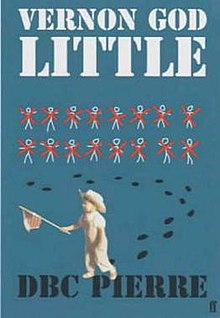
There’s an immense power to DBC Pierre’s 2003 Booker Prize-winning Vernon God Little which with its troubled and intense fifteen year-old narrator has unavoidable echoes of Salinger’s The Catcher in the Rye. In style the novel owes an obvious debt to the energetic first-person participatory traditions of Gonzo journalism.Vernon God Little - Wikipedia

Any summary of the novel will smooth out the wrinkles in the plot and present it as a coherent narrative, one in which the reader knows what is happening at all points and in which the dots are joined up. People’s motivations are explained and secrets and lies are laid bare. Of course the reading experience is very different from that – Vernon is not interested in carefully explaining to us ‘what happened’. Instead he breathlessly tells us what ‘is happening’, as well as articulating his feelings about his experiences. This gives the novel an immediacy but also challenges the reader to construct a coherent whole out of what we are told. Sufficient information is provided to be able to piece things together, but we have to do a lot of the heavy lifting.

There has been a school shooting at Vernon’s school in Martirio, the ‘barbecue sauce capital of America’ in Central Texas. The killer is his friend Jesus, a Mexican student who was mercilessly bullied by the other students. Vernon was not involved in – in fact tried to prevent – the shooting, but he nevertheless is suspected by the local police. Vernon’s alibi – that he was running an errand for a teacher – is hard to prove as the teacher is in hospital, a victim of the attack. Things take a turn for the worse for Vernon when he meets Eulalio Ledesma, probably the most groteque monster of the many in the novel. Ledesma claims to be a reporter, and worms his way into the affections of Vernon’s single mother, promising to help Vernon tell his side of the story. But the chance of a sensational story is too good to miss, and Ledesma runs a story naming Vernon as a participant in the killings. Vernon is arrested and at his bail hearing the court orders a psychiatric assessment.

Vernon realises there is going to be no justice for him in Martirio, so he begins to make plans to abscond to Mexico, eventually rustling up sufficient funds to pay for the trip by blackmailing a local paedophile. This scene is essentially one of several bad taste jokes that have not aged well. Vernon’s journey to Mexico becomes a conventional road-trip across the South, which ends in disaster when he is tricked in a ‘honey-pot’ trap into confessing to involvement in the school shootings. He is dragged back to Texas for a show trial where he is convicted and sentenced to death. Ledesma’s influence has spread on the back of his coverage of Vernon’s story, and he is now able to organise televised executions as part of a reality show where people vote on which convict they want to see executed. Big Brother, just at that point taking off in the US, is referenced. Most of the novel to this point has been relatively realist, albeit with an absurdist element to many events, but this departure into dystopian satire might be perceived as unrealistic – but the pace of the novel at this point is such that for me Pierre gets away with it.

The climax to the novel is wonderfully contrived and enormously satisfying.

Pierre’s descriptive writing is intense, using imagery that only indirectly references its subject, as well as a lot of slang and a fair share of profanity. Combined the effect is often poetic and very effective:

Outside, a jungle of clouds has grown over the sun. They kindle the whiff of damp dog that always blows around here before a storm, burping lightning without a sound. 

The angst of being a teenage boy in America is captured brilliantly. Vernon is constantly both aroused and confused, particularly by his sense of smell:

When the rubbing of her thighs has faded, I crane my nostrils for any vague comfort; a whiff of warm toast, a spearmint breath. But all I whiff, over the sweat and the barbecue sauce, is school—the kind of pulse bullyboys give off when they spot a quiet one, a wordsmith, in a corner. The scent of lumber being cut for a fucken cross.

It is strange that a novel which revolves around a school shooting, sadly now such a commonplace event in the USA, can be so joyful. It helps that there are plenty of really good jokes. At one point Vernon is promised help by a reporter:

“We could turn your situation around three hundred and sixty degrees…”

His response is to the point:

“Learn some fucken math.”

Later when Vernon is on Death Row, his mother tries to commit suicide:

“Mom closed up the house one day, turned the oven on full, and sat by its open door. Apparently, it’s still a Cry For Help, even though our oven’s electric.”

The novel’s satirical intent consistently hits its target. Consumerism in American society is mercilessly mocked. The tragedy of the school shooting is a business opportunity grasped by many in the town of Martirio. The poisonous Ledesma builds a media business out of it. Several of the women in town want to use the media focus on the shootings and Vernon’s trial to launch their own media careers. Even local children sell t-shirts darkly joking about the tragedy:

The Lozano boys are out hawking T-shirts on the corner of Liberty Drive. One design has ‘I survived Martirio’ splattered across it in red. Another has holes ripped through it, and says: ‘I went to Martirio and all I got was this lousy exit wound.’ Preacher Gibbons tuts, and shakes his head.

The local vicar is shocked, not by their tastelessness, but by the prices they are asking:

‘Twenty dollars,’ he says. ‘Twenty dollars for a simple cotton T-shirt.’

Vernon God Little stands out as one of the more unlikely Booker winners of recent years, a brave choice in a year when Brick Lane, Notes on a Scandal and Oryx and Crake were all on the short-list. For once I think the Booker judges called it right.


Vernon God Little by DBC Pierre, 2003

Aside
Book review

“I know all about the facts of life, and I don’t think much of them.”

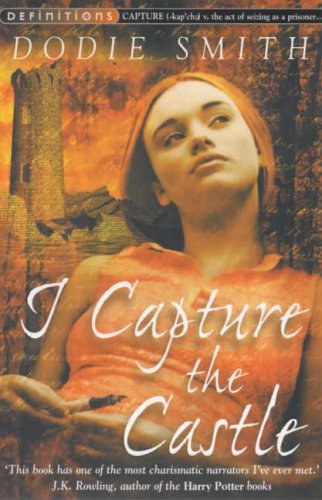
I think I originally read I Capture the Castle about ten years ago, and my impression at the time was that it was charmingly naive. A reread was therefore disappointing – what initially seemed sweet now grated. Much of this derives I suspect from how one reacts to the novel’s narrator, Cassandra (or Cassie, for short) Mortmain.

I Capture The Castle By Dodie Smith. 9780099845003

Dodie Smith’s I Capture the Castle

Cassie’s family is that uniquely English combination of being at once bone-grindingly poor but at the same time too posh to work for a living. They live in a castle for goodness sake, even if it is rapidly decaying into ruin. Cassandra is 17, has left school, and has little to do outside her daily chores. Her father is a writer who has only ever managed to produce one very well-received book, and since being widowed now spends all day avoiding writing – mainly reading trashy detective novels. His new wife, Topaz, is a former artist’s model, who wafts around the castle occasionally going for nude walks in the extensive grounds. Completing the family is Rose, Cassie’s older sister, Thomas, her down-to-earth younger brother, still at school, and Stephen, their lodger and unpaid servant. Stephen is naturally in love with Cassandra, but she is not interested – he is too much like a brother to her, despite his being an adonis. 

Authors from the time of Jane Austen on have had fun with immature narrators. The reader is shown just enough to confirm that the narrator’s interpretation of the events of the novel is incorrect. Piece by piece the reader is helped to work out what ‘really’ is going on – although at the same time enough is withheld to ensure there are a few surprises. Emma is a masterful example of this type of novel, and Austen is obviously a significant influence here in respect to the construction of I Capture. 

When the Cottons, a wealthy American family, become the Mortmain’s neighbours, it comes as very little surprise that there are two eligible sons, Simon and Neil, ideally suited for Cassandra and Rose. The author explicitly acknowledges the similarity between this scenario and Pride and Prejudice. (‘How I wish I lived in a Jane Austen novel!‘) The crucial difference here with anything by Austen is that however naive and innocent Cassie may be, she usually is not self-deluded. She reads people’s intentions and feelings correctly most of the time (not always, but consistently), and is often the only grow-up in the room, particularly given how infantile her father and step-mother can be. Only Thomas sees things more clearly and sensibly. Stephen appears only intermittently, but when he does he can usually also work out what is going on most of the time.

Rose decides to marry the older Cotton brother Simon, irrespective of any feelings she may have for him. Apparently there is nothing she will not do to escape the family’s poverty – nothing that is except get a job. Cassie is quick to discern that her sister is not really in love with Simon. These concerns grow all the stronger when she begins to develop feelings for him herself. The remainder of the novel charts the predictable route of the relationships between the sisters and the Cotton boys. It’s pleasant, amusing, often touching, but if you aren’t enchanted by Cassie by this point the novel is not going to work for you. She can certainly be irritating. She is gratingly positive about her situation. When upset she recommends

“Noble deeds and hot baths are the best cures for depression.”
and she faces up the family’s poverty with Pollyannaish positivity:
“I shouldn’t think even millionaires could eat anything nicer than new bread and real butter and honey for tea.”

There are scenes in the novel that invite comparisons with Cold Comfort Farm – the Mortmain home is ramshackle and with that complex layout and history that Gibbons has such fun with; middle class intellectuals are teased mercilessly; and all the castle’s characters have their own particular happy endings – Mr Mortmain starts writing again, Rose finds true love, and Stephen, like Seth before him, gets a job in the ‘talkies’. All that is of course for Cassie, whose feelings for Simon go unrequited.

When it was first published I Capture was marketed as a work for adults, but over time it has become more widely perceived as a young adult novel, dealing as it does with the coming of age experience. Cassie is a heroine young women will identify with, pouring her heart out to her diary and having innocent romantic adventures with handsome young men. This is a novel from the period when the phrase “making love” could be used by an author without any hint of sex. Published after the war but set in a period before it where there is no hint of what is to come, this works well as escapism and nostalgia, but has little else to say.


I Capture the Castle, by Dodie Smith, 1948

Aside
Book review
The Castle of Otranto by Horace Walpole

Enter a caption

The Castle of Otranto is widely considered the first English gothic novel. It tells the story of Manfred, lord of Otranto and opens on the day of the wedding of his son Conrad to the princess Isabella. Shortly before the ceremony Conrad is crushed to death by an enormous helmet which falls on him. Yes, it does. This is the first of a series of absurd incidents that punctuate the novel, usually involving over-sized body parts for reasons I have yet to come to terms with.

There is a prophecy (of course there is) “that the castle and lordship of Otranto should pass from the present family, whenever the real owner should be grown too large to inhabit it”.

Just in case you are wondering, no, this doesn’t make any sense, at this point in the story nor subsequently. Lord Manfred decides to marry Isabella himself, which will necessitate divorcing his current wife, Hippolita, who has failed to successfully bear him an heir. Isabella is not keen on this idea, having just seen her fiance crushed by a giant helmet, so she flees to a neighbouring monastery with the aid of Theodore, a mysterious peasant and Jerome, an aged friar. Jerome, it turns out, is Theodore’s long lost father. Again, predictably.

This is just the start of a madcap rush of incidents in which long lost relatives and giant body parts are packed into the novel’s just over one hundred pages. There are ghosts, there are mysterious mute knights, plots and mistaken identity, duels and feasts. It’s all rather exhausting, like reading a plot summary for half a dozen Shakespearean comedies all mashed-up together, and all written in a florid, over-the-top style of which the following is a typical example:

“I come,” replied he, “to thee, Manfred, usurper of the principality of Otranto, from the renowned and invincible Knight, the Knight of the Gigantic Sabre: in the name of his Lord, Frederic, Marquis of Vicenza, he demands the Lady Isabella, daughter of that Prince, whom thou hast basely and traitorously got into thy power, by bribing her false guardians during his absence; and he requires thee to resign the principality of Otranto, which thou hast usurped from the said Lord Frederic, the nearest of blood to the last rightful Lord, Alfonso the Good. If thou dost not instantly comply with these just demands, he defies thee to single combat to the last extremity.”

See what I mean? The Knight of the Giant Sabre, who has recently mislaid his Giant Helmet. Is he trying to compensate for something?

It’s really dreadful. One Goodreads reviewer (who actually liked it!) described it memorably as the “kind of story a man hopped up on crack might shout to passersby from beneath a bridge“. It joins Sybil on my list of novels written by MPs, which is mercifully short. Walpole has a lot to answer for, not least a whole genre of similar nonsense. As always I look for redeeming features in particularly bad novels, and I recognise that judging an eighteenth century novel – which I think I can call experimental, in that no-one else had written anything like this before – by twenty-first century standards has its limitations. But I am struggling. The prose is over the top (see above), the characters two dimensional at best, the plot absurd: no, not a single redeeming feature. It was, I suppose, also mercifully short. 

The Castle of Otranto by Horace Walpole, 1764

Aside
Book review

“I don’t know what’s worse: to not know what you are and be happy, or to become what you’ve always wanted to be, and feel alone.”

Published in this edition by Orion books in their Science Fiction masterworks series, Flowers for Algernon is a much loved sci-fi classic. Flowers For Algernon (S.F. Masterworks), Daniel Keyes, Used Excellent Book

Charlie Gordon has an IQ of 68. He enjoys working at his menial job at a bakery. In the evenings he attends a college for “Retarded Adults”. Here he meets Professor Nemur who is looking for a a human guinea pig for his new surgical technique to increase intelligence. The surgery has already been performed successfully on a mouse named Algernon, who is now something of a super-mouse, able to solve maze puzzles with ease.

The novel takes the form of Charlie’s own ‘progress reports’ notes (i.e. his diary). Initially the diary entries are illiterate, full of phonetic spellings and without any punctuation. Following the operation they improve dramatically as Charlie begins to expand his understanding and knowledge. It is never really explained why the researchers try this procedure out on someone of below normal intelligence. Is it because if the surgery doesn’t work they won’t be sued? Or is it because the boost to intelligence will be so dramatic that in a normal human the impact would be too unpredictable?

As Charlie’s IQ soars he quickly leaves his old life behind. He struggles to cope with the dramatic changes to his abilities and understanding. This causes emotional turmoil, and is the basis of a lot of commentary about the apparent trade off between the benefits of intelligence and blissful ignorance. I was hoping that Keyes would have something to say about how a super-intelligent human might see the world differently. Sadly Charlie is more like a troubled teenager, trashing his room, refusing to do his homework and having rows with his family.  There is little else to show for his new abilities. He makes no scientific breakthroughs, discovers nothing.

Or not quite nothing. Charlie takes over the research into intelligence and discovers a flaw in the process meaning his boost in IQ is likely to be temporary. He faces this fate with a degree of resignation, even visiting the depressing institution where he is likely to end up. He tries to use the time left to him wisely, but all too quickly the old Charlie is back. Keyes reflects this degeneration poignantly through Charlie’s reversion to the fractured English used in his original notes.

Flowers for Algernon was originally a short story which Keyes later expanded into novel-form. I think the central concept – artificially enhanced intelligence – is a slight idea that probably fits better into the more straightforward format of the short story. Asking it to carry the weight of a full-length novel without any additional support is too much. Keyes doesn’t seem to know what to do with Charlie once he is super-intelligent, apart from showing him as a bit of a brat. As I mentioned in opening, this novel is much loved. People seems to have a nostalgic affection for Charlie and his mouse. So what are people seeing that I have missed? The novel has almost half a million ratings on Goodreads, scoring overall on average more than 4 (out of 5 – for comparison, Brighton Rock scores lower than 4). Reviews consistently talk about the novel being heartwarming and touching. My heart was neither touched nor warmed. I found the story profoundly predictable – there was never a moment’s doubt that Charlie’s boost in intelligence was going to be temporary. Super-intelligent Charlie is pretty unlikeable. He does nothing tangible with his enhanced powers – he learns languages, writes musical compositions, and so on, but there’s no substance to this, and the hoped-for insight into any of his areas of study never arrive. More to the point there’s no attempt to consider what super-intelligence actually means – is it just being cleverer than every one else, or is it a different level of consciousness? It was this kind of insight I was hoping for. Instead we are invited to feel sentimental for a dead mouse.

Writing in 1981, Philip K. Dick. 1981 defined sci-fi as:

“our world transformed into that which it is not or not yet. This world must differ from the given in at least one way, and this one way must be sufficient to give rise to events that could not occur in our society—or in any known society present or past. There must be a coherent idea involved in this dislocation; that is, the dislocation must be a conceptual one, not merely a trivial or bizarre one—this is the essence of science fiction, the conceptual dislocation within the society so that as a result a new society is generated in the author’s mind.”

This of course is one of many definitions of the genre, but it is one that commanded my attention as being a serious attempt to engage with the problem of genre rather than simply provide a template for is it/isn’t it decisions. Flowers for Algernon satisfies the criteria for science fiction in many of the more narrow definitions of the genre, but fails to make the cut here if Dick’s more comprehensive and compelling definition is used. Super-intelligence doesn’t ever once hint at generating a new type of society. The surgery which improves Charlie’s intelligence is given some credibility – there is talk of enzymes and amino acids – but the researchers could just as easily have given him a “make-you-clever” pill. Nothing else changes in the world – the changes are all within Charlie and his perceptions and abilities. Every other aspect of the society is recognisable, and we are not even given a hint of the way the world might change if the surgery had been successful. In other words, I am not convinced that Flowers is even science fiction, let alone a masterwork.


Flowers for Algernon, by Daniel Keyes, 1959

Aside
Book review

The Loved One by Evelyn Waugh, 1948

This was an umpteenth re-read – I revisit The Loved One (subtitled An Anglo-American Tragedy) for a chuckle every now and again. It’s not a novel (Waugh called it a novelette) that takes itself very seriously, but it is all the better for that. It also has a lot of fun at the expense of both Americans and English ex-pats in America, so what’s not to like?Image result for loved ones waugh

Sir Ambrose Abercrombie, august representative of the British community of ex-pats in Los Angeles, descends upon Dennis Barlow, a minor poet brought to Hollywood to write the script for a film biography of Shelley, to express his concern about Barlow’s new job and how it reflects on the British community in Hollywood. Barlow has abandoned his script writing for something much more valuable to society – he works at the Happier Hunting Ground, a pet cemetery.

Barlow, tasked with the funeral arrangements of his ‘housemate’ who has killed himself having been dismissed from his job in one of the studios, “developing scripts”, (there are a lot of euphemisms and avoidances such as this in this novel) visits Hollywood’s famous funeral grounds, Whispering Glades. There he quickly falls for cosmetician (she puts make-up on corpses) Aimée Thanatogenos. He woos her with quotations from the British classics, passing them off as his own. But he has a rival, the senior mortician Mr Joyboy. Aimee is torn between her feelings for Barlow and Joyboy, but despite the helpful advice columnist of local agony aunt “Guru Brahmin” she gets engaged to Barlow. Subsequently, when she finds out his poems are plagiarised, she dumps him (in fact, she ghosts him!) and returns to Joyboy. The coffin is nailed firmly shut when she attends the funeral of Mr Joyboy’s mother’s parrot at the Happier Hunting Ground, where Barlow is in attendance. The scene is set for a macabre, blackly comic finale.

Waugh was at his comic best when he gave his satirical targets both barrels, holding nothing back. Here his contempt for Hollywood, Americans, ex-pats, you name it, is out in the open and given full rein. This is more a sketch than a fully developed novel, lacking the depth of Waugh’s other work, but it is fun despite the darkness.


Standard
Book review

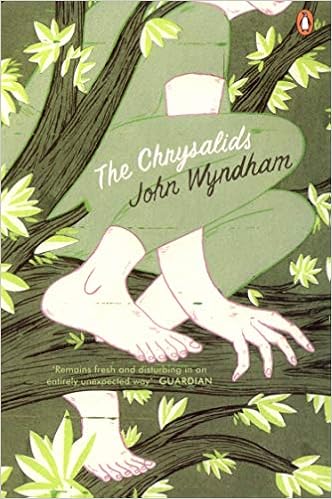
The Chrysalids, by John Wyndham, 1955

KEEP PURE THE STOCK OF THE LORD; WATCH THOU FOR THE MUTANT.

What did novelists do for their plots and settings before the Cold War and the possibility of a post-apocalyptic primitive society? Although writers have always speculated about the end of the world, it was only really once the apocalypse became a practical, foreseeable possibility that science fiction kicked into gear and began imagining how the survivors might live.

In Wyndham’s post-apocalypse Canada, set many years after “the tribulation” which has destroyed most of humanity and caused serious problems with birth deformities, society is slowly recovering, in part by following a strict system of genetic purity. Their form of fundamentalist Christianity (they wear a cross on the front of all clothing) believes that to avoid another Tribulation they must enforce a rigid definition of normality. This inevitably forces them to practice eugenics in which any minor mutation or difference is considered blasphemous. Aberrant crops are destroyed, babies are euthanized if they display the slightest variation and failed to pass inspection. Other human mutations not apparent at birth are subsequently sterilized and banished.

We learn about this society through the narration of David Strorm, a young man from the rural community of Waknuk. David dreams of cities, planes and horseless carts, but he keeps these dreams secret to avoid suspicion – difference even of the imagination is feared. He befriends Sophie, a girl who hides the fact she has six toes on her feet. Sophie’s mutation is discovered and her family are forced to flee. This is how David and the reader learn how difference is treated in Waknuk. But David has another darker secret – he and other local children are telepaths, able to communicate in thought pictures across distance. They are the Chrysalids of the novel’s title, a new advanced form of humanity, a larval form of something more than homo-sapiens, and therefore taboo in their society.

The group keep their powers hidden with the help of David’s sympathetic uncle, Axel, who goes to the extreme of killing the husband of one of the group’s members who was planning to blackmail them. David’s younger sister Petra develops telepathic powers as she grows, and it becomes clear that these are of a different order from the others – when her horse is attacked by a predator she calls telepathically for help across the entire region, stunning those closest to her. This arouses suspicions. Two members of the group are tortured for information, causing David, his cousin Rosalind and Petra to run for their lives.

The future following a nuclear holocaust was never going to be much fun. Wyndham shows humanity slowly recovering, and exercising genetic purity as a difficult but necessary discipline. Any discussion of eugenics only a decade after the Second World War and the holocaust was always going to be difficult topic, but Wyndham doesn’t blink from the upsetting issues it presents. Good science fiction is about more than just technology, but uses the scenario as a springboard for a discussion of moral and philosophical issues. Here Wyndham uses the tribulation as an allegory for the tensions between change and conservatism in post-war 1950’s Britain and a meditation on difference, both visible and hidden.

Is this a novel for young adults? Definitely. It may not have been written as such, but most teens will enjoy the growing awareness of David’s special abilities, the knowledge that he is not alone, and the exciting pursuit of the young telepaths across a landscape peopled by mutants. The novel’s conclusion however is its weak point. Wyndham wraps things up with a brisk deployment of deus ex machina as a rescue party of scientifically advanced telepathic New Zealanders contacted by Petra arrive in the midst of a battle between the Waknuk settlers and their genetically challenged enemies. It’s not quite a happy-ever-after ending – the New Zealanders are in some ways as brutal eugenicists as the Waknuk fundamentalists. But any doubts about the wisdom of their approach are waved aside as David and friends are whisked away to New Zealand where their technological society is presented as a utopia. This is fundamentally an optimistic novel – nuclear war can be survived, and a better world will emerge despite the forces of reaction.

Standard
Book review

Moon Tiger by Penelope Lively, 1987

Penelope Lively won the 1987 Booker Prize for this interesting, eminently readable but ultimately unsatisfying novel. It tells the story of Claudia Hampton, a 76-year-old historian. As Claudia lays dying in hospital she narrates the story of her life in an internal monologue. The narrative is complex, with the point of view changing constantly, and with time and place jumping across the decades and across the continents.

The novel’s title is romantic and mysterious, but the explanation when it comes – a moon tiger is a rather absurd name for an anti-mosquito candle (see picture) which burns slowly through the night – is disappointingly prosaic, involving neither moons nor tigers. The moon tiger is co-opted as a rather heavy handed symbol for the human experience – we all glow brightly and then end up as ashes – but I was still disappointed that something so romantic-sounding could be such an everyday utilitarian object.

Lively creates some vivid characters in this narrative. Claudia’s brother Gordon is for a while her incestuous lover – this is their closely-held for the rest of their lives, but is not portrayed as a damaging or harmful experience.  At the outbreak of the second world war Claudia becomes a war correspondent (as one does) and travels to Cairo, where she meets and begins an intense relationship with Tom Southern, captain of an English armoured tank division. This, we know from the comments of contemporary Claudia looking back on their time together, (although it is narrated in real time) is a doomed war-time affair, and inevitably Tom is killed at El Alamein. 

After the war Claudia meets Jasper, an artistic aristocrat with whom she goes on to have a long-term but sporadic relationship from which she has her only child, Lisa. Lisa is not the free spirit her mother considers herself to be, and their relationship is strained. Later a gay Hungarian student, Lazlo, has a walk-on part in the narrative, although one has the impression that all of life’s events for Claudia after the loss of Tom are an afterthought. This is reinforced by the novel’s finale, when Claudia is sent Tom’s wartime diary which re-emphasises the intensity of his feelings for her. Regret for what might have been her life had he survived is one of her last thoughts before the novel closes.

Despite its innovative structure, this is a very traditional novel. It is a romance, albeit an exceptionally well-written one. There’s nothing wrong with that – Pride and Prejudice is a romance, and it is one of the best novels of all time. But has Moon Tiger got anything interesting to say about human relationships? I’m not sure. Do the characters come alive at all; do they ever go beyond being characters in a novel about whom one never really cares? At one point Claudia reminisces about Lazlo going for a walk in London, and bringing home a nice bunch of flowers, which, it later transpires, he unwittingly picked from a public park. At a dinner party this might be a short, not particularly funny about how foreigners don’t understand English social conventions. But here it is an awkward anecdote, intended to illustrate  Lazlo’s naivety, but never escaping the sense that it is a made-up story intended to play a role in a narrative, rather than something that genuinely happened to someone.

The death-bed format plays a factor here, depriving the narrative of any true surprises. It is probably my failure to engage with the text fully that stopped me caring about Gordon, Lazlo, or Jasper – they felt like background characters in the play of Claudia’s life – and it was only really Claudia and Tom, in the vivid chapters telling the story of their brief moments together, where the story truly felt real. It’s worth reading for that story alone.

Standard
Book review

A Brief History of Everyone who ever lived, by Alex Rutherford, 2016

Genetics is science still in its infancy. The structure of DNA was only identified in the 1950’s, and the human genome was mapped in 2003. Compare that to the study of physics or chemistry where the key building blocks of our understanding have been in place much longer. A lot of what we thought we knew about genetics ten years ago now is considered out of date and inaccurate; what we think in 20 years of what we think we know now, who can say? As such this is more a progress report on genetics in 2016 than a definitive survey of the science, comprehensive though it is.

I have always been fascinated by the puzzle that we all have increasing numbers of great grand parents as you go back each generation, but that the total human population in much higher now than it has ever been. Rutherford calculates that it you go back to the eighth century we will each have required 137,438,953,472 people in our family tree. I make that about 33 generations, but of course many times more than the number of people who have ever lived. It follows that family trees are a misleading presentation of our genealogy. There must be many points across our family history were the lines cross and blend. “What this means is that pedigrees begin to fold in on themselves a few generations back, and become less arboreal, and more mesh or web-like”. Rutherford expresses this point by looking at the genealogy of some of the Royal families of Europe. Charles 2nd of Spain should have had 62 ancestors in his preceding six generations, (2 parents + 4 grandparents + 8 great grand parents and so on). In fact he had only 32 – many of his great aunts were also his great grandmothers, for example. Go back another two generations and instead of over 250 ancestors he had 82. This is obviously an extreme example caused by the shallow gene pool from which the royal families chose their partners, but go back far enough and the same pattern would be seen in all our families.

The other riddle that Rutherford answers definitively here is whether, as is often suggested, we are all eventually related to Attila the Hun. The short answer is if you go back around ten centuries or so then we all share some genetic material from everyone who lived at that point. This is obviously highly counter-intuitive, but Rutherford demonstrates it with precision and statistics. I would struggle to repeat the analysis for myself – it’s complicated – but I take some comfort from knowing where to find it if I need it!

This is an eclectic look at the state of genetics today, including issues as diverse as why the distribution of wet and dry ear wax in humans suggests that the people of South Korea might be the least smelly on earth; why the idea of a Danish Viking conquest of the British Isles involving rape and pillage is not borne out by a genetic legacy; and why monoamine oxidase A, the so-called “warrior gene”, ought not to be a valid defence in criminal trials. Rutherford charts our progression as a species from out of Africa, using evidence provided by ancient DNA. A toe bone of a Neanderthal who died 50,000 years ago in the Siberian reveals our ancestors appetite to mate with other humanoids now extinct, explaining why we all have a little caveman DNA in our genome.

Genetics is complex, and there were pages in the book were my non-scientific eyes glazed over, there’s no point in denying otherwise, however accessible this book was intended to be. The analysis of whether race is a genetic characteristic, or whether it actually exists or not, was a case in point. I think Rutherford concludes that it both does and does not, but I would need to check. The relationship of disease to genetic is equally complex. You start out by looking at the more obvious inherited illnesses such as Tay-Sachs disease or sickle cell anemia, and think yep, that makes sense. But once you start looking at more complex conditions and characteristics, even those most obviously inherited such as height, tracing the precise role our genes play in this process has proven elusive. Or that was what I understood Rutherford to be saying anyway!

I know a little more about genetics than I knew last week, which has got to be a good thing. But I must admit I will return to the comfort of fiction in the coming days with a small sense of relief.

Standard
Book review

A Walk-on Part, Diaries 1995-1999 by Chris Mullin, 2011

Chris Mullin, MP for Sunderland South for 23 years, had a lot more than a walk-on part (a minor role, a metaphor drawn from the theatre) in the New Labour years. These can be dated from the death of John Smith in 1994, and the ascendancy of Tony Blair from that date, which is where this, his third volume of diaries, starts.

Mullin first entered Parliament in 1987, and at the time was widely perceived as a Bennite, that is to say on the hard left of the party. This was a misconception that slowly changed and he would now more typically attract the label “soft-left”, generally supporting the Labour Government but occasionally rebelling on points of principle. His description of himself as having a walk-on part in the political affairs of these years is undermined by the fact that he was appointed (admittedly to the lowest rung of Government) as a Parliamentary Under-Secretary of State at the Department of the Environment, Transport, and the Regions in July 1999, then Parliamentary Under-Secretary for the Department for International Development in 2001, and lastly in June 2003, as a Parliamentary Under-Secretary at the Foreign Office. In addition he chaired the Home Office Select Committee for several years, all of which gave him a ring-side seat for the roller-coaster ride that was New Labour.

Mullin identifies very early on the “fault lines which would come to haunt New Labour in the years ahead – control freakery, a soft spot for rich men, the obsession with spin”. Although astute he is probably being too kind here on New Labour – there was more than a soft spot for rich men for example. He deflects a lot of his concern about the political direction of New Labour on to Peter Mandelson, for whom he has a particular aversion. Like many others in the party at the time Mullin was charmed by Blair and time after time gives him the benefit of the doubt on the basis of his personal persuasion.

Another early entry in January 1997 records Blair addressing the Parliamentary party:

“On top form. Passionate, witty, positive…We had plenty to offer…He listed commitments – work, education or training for 250,000 young people; an end to the internal market in the NHS; reduced class sizes; and end to nursery vouchers; an extension of protection in the workplace; we will sign up to the EU Social Chapter; the right to join and be represented by a union; a minimum wage; a Freedom of Information Act; the incorporation of the European Convention on Human Rights into law.”

This is a useful summary of the relatively modest aspirations of new Labour in opposition. By my count most if not all of those commitments were met, and more, even if there were some major compromises along the way. The events of these years are sufficiently fresh in my memory, and the editing is sufficiently ruthless to make the pages zip past quite quickly. One minor point of interest is to spot early appearance of characters who were to go on and play a much larger role in politics in years to come appear briefly – he meets David Cameron for example, a smooth-skinned self confident advisor to Michael Green at Carlton Communications.

Mullin is relatively astute, but he doesn’t always accurately foresee what way the wind is blowing. Some of the clumsier judgments were no doubt edited out, but his editor Ruth Winstone, who also edited Tony Benn’s diaries, left in his comment We are going to lose. Blair knows it too, I can see it in his eyes” written just two weeks before Labour’s landslide in 1997.

The control-freakery that Mullin diagnoses is evident throughout these years, not least in the ruthless control of candidate selection. A good example appears on late April 1997 with the last minute parachuting-in of a candidate in Dudley where the incumbent was persuaded to take a job in the House of Lords (p271). The machismo atmosphere of New Labour is also apparent. Early on in the first Blair administration a decision was made to restrict single parent benefits. It is interesting to look back on how single parents were demonised at the time and regularly identified as a particular source of society’s ills – now they are almost forgotten as a group. Blair forced through this cut even though there was no evidence it would deliver any savings and possibly ended up keeping this group on benefits longer. Mullin resignedly notes “It is no longer a question of resources, but of virility”. (282). The absence of Cabinet Government is another criticism of Blairism that is fully evidenced here – “Tony has practically abandoned cabinet government. All key decisions are taken by the small cabal around his – Alastair Campbell, Jonathan Powell, Peter Mandelson, and (sometimes) Gordon Brown.” (282/3)

Mullin regularly agonises about the pointlessness of his role as a backbench MP. Factories are closed down in his constituency and all he can do is lobby Government for support. Constituents come to him with intractable personal and social problems – anti-social behaviour and the welfare culture of his area stand out in particular – which he can do little about. The war in Kosovo kicks off and all he can do is vote in favour of the NATO bombing campaign which sparks a refugee crisis. His personal crusades against Freemasonry in public office (especially the police and the judiciary) and for scrutiny of the work of the Security Services are both kicked into the long grass and effectively abandoned by the time he is elevated into junior office.

This is a fascinating inside look at the early Blair years from someone who was very close to the action. It confirms the popular consensus judgment on New Labour, but is no less valuable for that.

Standard