Book review

The Amazing Maurice and his Educated Rodents (Discworld 28) by Sir Terry Pratchett, 2001

My lock-down guilty pleasures Discworld series reread continues with another novel I have not read before.

Let me explain. I discussed at length in my previous post the fact that The Last Hero and Maurice were not originally considered part of the Discworld series of novels. The change, from them being Discworld stories to becoming part of the series happened around 2009 or thereabouts. The Amazing Maurice has even weaker claims to be part of the series than Hero – apart from the setting (Uberwald, although it really could be anywhere vaguely middle-European), a mention of the Unseen University, and a brief appearance by Death and the Death of Rats, this is very much a stand-alone novel. So although I religiously bought each Discworld novel as they were published, from as early as The Colour of Magic, I missed some of the Discworld stories, including, obviously, this one.

The Amazing Maurice is marketed as a children’s or younger reader’s novel. I don’t want to argue with that because what makes a children’s novel is a matter of authorial and publisher’s judgment that I am not in a position to question, But there are dark elements to the story that I will come back to later which could easily upset a younger audience.

The Amazing Maurice is a cat who has acquired the ability to talk. He did this by eating a rat who had the same ability, having lived on a rubbish dump outside the Unseen University, where lots of background magic had accumulated. Maurice works with a troupe of talking rats with the same powers, and their human, Keith, a piper. They travel around from town to town embezzling communities by a minor variation on the Pied Piper scam – the rats make a nuisance of themselves, and then for a modest fee Keith pipes them out of town. We join them as they arrive at a town in Uberwald called Bad Blintz. This, they promise themselves, is going to be their last heist before retirement, the set up line for so many unsuccessful adventures (and bad movies). Maurice is the brains of the operation, keeping the fairly gormless Keith out of trouble as best he can.

Bad Blintz turns out to be a troubled place. Rats have already impoverished the town, and while food continues to disappear there don’t seem to be many surviving rats left. Keith meets the mayor’s daughter Malicia who is obsessed with story-telling, and has a thin grasp on the difference between reality and fiction. For example, when she is searching the town’s rat-catchers’ hut for clues she keeps leaning casually on walls hoping false walls will open. The fact that they do find a hidden trapdoor, leading to a network of cellars full of stolen food and caged rats, naturally encourages this fantasy. Malicia learns about Maurice and the rats ability to talk but is unfazed by it – it’s the sort of things that happens in stories.

At the heart of the novel is the quest to work out what is happening in Bad Blintz – where all the food is going, and what has happened to the rats? In the course of that quest we are introduced to many of the rats in the ‘clan’ – their aging leader Hamnpork, Dangerous Beans a spiritual rat, his assistant Peaches, and Darktan, the trap expert, to name a few. In the nightmarish cellars of the town they meet and confront the sinister Rat King, Spider, who is able to control rats, cats and even humans with the powers of his mind.

Some of the scenes with the rats, caged and cannibalistic, are vivid and scary, and I can only imagine how a pre-teen reader would react to them. There are also some character deaths, not all of which are temporary, and while the happy-ever-after ending is well constructed and satisfactory, the scares and genuine sense of threat along the way contribute to that sense of darkness I mentioned earlier. Pratchett has learned from Roald Dahl and others that stories for children can be nasty.

Pratchett was a wonderfully thoughtful writer, always with something interesting and original to say about the big issues of life, so I should not have been surprised to read such insight and compassion in a children’s story about talking rats. Along with the ability to speak the rats (and Maurice) have developed consciousness, and dare I say it souls. They develop concepts such as the self, an awareness of evil, and debate moral issues such as whether to eat non-talking rats, and what happens to them after they die. The rats are not overly anthropomorphised, certainly not sentimentally. They still widdle on everything, can’t wear clothes because they get in the way, and take their names from the sides of tin cans. In case we miss the point the contrast is emphasised by the snippets from a children’s story which the rats carry around in a manner akin to a holy book. This gave Maurice and the rats a depth of character that you just don’t expect in a story about talking animals, and for a brief moment my lifelong aversion to rats was abated.

Storytelling is an important theme in the novel. Malicia think life is just a story, the kind in which there is always a happy ending. Speaking of endings, I think Maurice has one of the most satisfying and effective endings in the series. The rats work out a purpose in life, which isn’t to run away and live on an island, but to use the power of narrative force to shape their destinies;

“If you don’t turn your life into a story, you just become a part of someone else’s story.”
“And what if your story doesn’t work?”
“You keep changing it until you find one that does.”

The Amazing Maurice and his Educated Rodents

Maurice is an important link in the Discworld chain because it kept the franchise alive and fresh, introducing a whole new group of readers to Discworld, who would of course go on to read the ‘main’ series. It was awarded the Carnegie Prize in 2002. This was Pratchett’s first major award, and in acceptance he gave this wonderful quote reflecting on his ambivalent about the fantasy genre:

Stick in one lousy dragon and they call you a fantasy writer’

Standard
Book review

“The presumption that what is male is universal is a direct consequence of the gender data gap. Whiteness and maleness can only go without saying because most other identities never get said at all. But male universality is also a cause of the gender data gap: because women aren’t seen and aren’t remembered, because male data makes up the majority of what we know, what is male comes to be seen as universal. It leads to the positioning of women, half the global population, as a minority. With a niche identity and subjective point of view. In such a framing, women are set up to be forgettable. Ignorable. Dispensable – from culture, from history, and from data. And so, women become invisible.”

It is difficult to read this book without succumbing to a sense of both rage and frustration. Rage at the endemic discrimination against women which seems hard baked into all areas of society, all deriving from the often-unacknowledged assumption that women are the

deviation from the male norm. And frustration at the speed of change in a society which has known about many of these issues for a long time but seems to have made little progress in addressing them.

“The result of this deeply male-dominated culture is that the male experience, the male perspective, has come to be seen as universal, while the female experience–that of half the global population, after all–is seen as, well, niche.”

The depth and range of research that went into this book is breath-taking. The author’s examples touch on almost every area of life, and consistently return to the same conclusion: women just haven’t been thought about when it comes to the design of the constructed world we live in. It is hard to pick representative examples from the book, but here goes: at Google, which likes to think of itself as a progressive company, they hadn’t realised that parking spaces for pregnant women shouldn’t be at the back of the car park until the Chief Operating Officer fell pregnant; when first launched the Apple Health app didn’t include a menstrual cycle tracker; car crash dummies are 1.7m tall, the size of the average man, leading directly to women being 47% more likely to be seriously injured if they are in a collision; the average smartphone is 5.5 inches long and is too big for most women’s hands; speech-recognition software is trained on recordings of male voices and therefore much more likely to understand men. I could go on – this is not a book short on evidence or examples.

But it doesn’t have to be like that. This is not just a collection of evidence, powerful though that would be on its own. It is a manifesto, a rallying call for change. It is not enough to just witness this inequality; we should not accept women being treated as an anomalous version of masculinity and data collection should recognise sex and always consider how men and women are impacted differently.

“Closing the gender data gap is only step one. The next, and crucial step, is for governments and organisations to actually use that data to shape policy around it. This isn’t happening.

(page 120)

I am well aware that it is going to seem churlish of me to write about one of the very few passages in this book that I disagree with, but I think the issue is sufficiently important to address. In Chapter 12 ‘A Costless Resource to Exploit‘, the author writes about the post-2010 General Election austerity policies of public sector cuts. She describes how these cuts fell on women particularly hard (although you could add people with disabilities, ethnic minorities, Scots, Welsh, Irish, Northerners and the working class to that list) and observes that by comparison “men in the richest 50% of households actually gained from tax and benefit changes since July 2015”. So, an ideologically hard-Right Government cuts benefits, attacks the poor and gives tax breaks to the middle classes – Criado Perez rightly asks “So why is the UK Government enacting policy that is so manifestly unjust?” Her answer I have to say made me splutter:

The answer is simple: they aren’t looking at the data”!!

Really? So it is not that there is a gender-gap in the data, which has been the central thesis of the book thus far, but that the Government and the thousands of civil servants that advise it have either chosen or forgotten to look at the data forecasting the impact of their cuts before implementing them. I can imagine George Osborne sitting in his office at the Evening Standard reading this chapter and saying “If only someone had told me that closing all those children’s centres, shutting down Sure Start, cutting funding to local Government, imposing the bedroom tax etc would have been damaging to working people and women in particular. If I had known that of course I wouldn’t have cut public spending and given tax breaks to the rich.”

This is important, because if we accept Criado-Perez’s idea that the problem is the data gap (which unquestionably exists in many areas) then the obvious remedy is to gather more data. That would no doubt help, but I struggle to believe that it would address the injustices in society on its own. Because there are plenty of situations where we have more than enough data, we just have politicians and people in power who choose not to use that data. Equal pay is an obvious example – we have a vast amount of data about how much people are paid, not least through the income tax system, yet the pay gap between men and women remains shamefully high. Do we need more data as to why that is, or do we just need to do something about it, and if so what? (Incidentally the Office for National Statistics has got a wonderfully detailed report on the gender pay gap on its website.)

Perhaps I am being unfair. Elsewhere the author is much more direct about the issue of whether the problem is missing data, or the willingness to use the data to confront inequality. It’s clearly both, and the motivations ascribed to the Government when imposing austerity were hyperbole.

The only other critical observation I would make is that Criado-Perez is inconsistent in her treatment of unpaid work. In Chapter 12 she points out that it is a political choice to exclude unpaid work, done largely by women, from measurements of national wealth and economic activity, usually expressed as GDP (gross domestic product). She illustrates how much GDP would increase in various countries if unpaid work was included in the measurement. But later she argues that

Increasing the amount of unpaid work women have to do (by closing children’s centres, for example) lowers their participation rate in the paid labour force. And women’s paid labour-force participation rate has a significant impact on GDP.”

Invisible Women, pages 245-6

Enabling women to undertake paid work by providing adequate childcare would only raise GDP if we exclude the economic value of unpaid work from that measurement? Otherwise women would just be swapping unpaid work in the home for paid work outside of it. The actual value generated would be neutral.

These points might seem like nit-picking, but there is a far more serious issue that goes unaddressed here. The author treats data as if it is neutral, objective, the elusive source of answers to any question if it is collected correctly or if just enough data is gathered. But it’s not. It is possible to frame or interpret data in many ways. It isn’t passive – the exact same data set can be read to mean entirely different things (we’ve all seen those drawings – is it a duck or a rabbit?). Data can be twisted to make difference seem less drastic, false correlations can be drawn, how data is collected and presented can make huge differences to what it appears to tell us, and of course numbers can be manipulated depending on the question asked. Ben Goldacre’s Bad Science has some fascinating evidence on this, showing how it is possible to manipulate the results of supposedly double-blind trials simply by how you select your participants. We have seen during the recent Covid 19 epidemic that it is possible to the collect and present data to show how successful the UK Government’s handling has been despite it being seen by the rest of the world as an unmitigated disaster. Data is political.

Criado-Perez doesn’t directly address transgenderism, but it is an underlying topic in many sections of the book. A book called Invisible Women needs a working definition of ‘women’ for starters. One of the structural responses to the public discussion of transgender issues has been the introduction of gender-neutral toilets in public spaces. Criado-Perez is not sure that this is the correct approach. Not only does it reduce the availability of toilets for women (because they need to use stalls) but:

“We have learned from so many mistakes in the past that women are at a greater risk for sexual assault and violence if they don’t have separate bathrooms” (quoting an Amnesty International official).

Page 303

And on the topic of transwomen competing in women’s sport, the author provides the following significant evidence (I have removed the half a dozen or so footnotes from this quote, which provide evidence for each of the statistics quoted, but they are there to be checked if required) :

“Upper-body mass is approximately 75% greater in men because women’s lean body mass tends to be less concentrated in their upper body, and, as a result, men’s upper body strength is on average between 40-60% higher than women’s (compared to lower-body strength which is on average only 25% higher in men). Women also have on average a 41% lower grip strength than men, and this is not a sex difference that changes with age: the typical seventy-year-old man has a stronger hand grip than the average twenty-five-year-old woman. It’s also not a sex difference that can be significantly trained away: a study which compared ‘highly trained female athletes’ to men who were ‘untrained or not specifically trained’ found that their grip strength ‘rarely’ surpassed the fiftieth percentile of male subjects. Overall, 90% of the women (this time including untrained women) in the study had a weaker grip than 95% of their male counterparts.

Food for thought.

This is not a book to be rushed, but one once read to keep on the shelf for reference. It should be compulsory reading for anyone in a position of authority whether in Government or private enterprise. It’s a landmark study that will be looked back on in decades to come, hopefully as a record of how we got things wrong in the bad old days.

Invisible Women: Data Bias in a World Designed for Men by Caroline Criado Perez, 2019

Aside
Book review

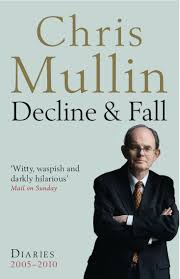
Decline and Fall, (Diaries 2005-2010) by Chris Mullin 2010

These diaries cover the long slow death of the New Labour experiment from Blair’s comfortable third win in 2005 to Labour’s election defeat in May 2010. The diaries were published later that year, which suggests either that Mullin used his self-imposed retirement productively or that he was actively preparing them for publication while still writing them. Is this different from keeping a diary and one day getting round to editing it for publication? I think so, although I recognise the distinction is a narrow one. Mullin’s earlier edition of his diaries A View From the Foothills was published during the period covered by this book, so you have the slightly surreal occurrence of a diary recording the publication of and reaction to a diary. He was later to go on to publish a third edition of his diaries A Walk on Part covering the period 1995 to 1997.

Decline & Fall: Diaries 2005-2010 (Mullin Diaires 2): Amazon.co.uk ...

It goes without saying that on the course of a politician’s day-to-day life they will have lots of conversations about politics. It must be so tempting to just publish those conversations that appear prescient, making one look a wise political forecaster, and edit out any instances where one gets it spectacularly wrong. To be fair to Mullin he studiously avoids this temptation; these diaries book is full of forecasts that make him look like he really didn’t know what was going on. He confidently predicts David Davis will win the contest for leadership of the Conservatives (David Cameron won) for example, and that Gordon Brown will not lead Labour into the 2010 general election (he did). Sometimes he does get it right of course, such as this entry November 2005, only a few months after Blair’s third election victory:

“I think we will lose the next election. The Tories will come to some sort of understanding with the Lib Dems”.

In 2005 that wouldn’t have been an obvious outcome, but I can see why that conversation would have seemed important when editing the diaries in 2010, because of course that is precisely what did happen. This sense of foreboding about Labour’s prospects suffuses almost every entry. Labour seemed to Mullin, and to most people he spoke to, to be in irreversible decline, and he often refers to the inevitability of the party not just losing the 2010 general election but being displaced from power (or office) for good, and it losing its ‘historic purpose’.

The Labour Government of 2005-2010 had a secure majority of over 60, not that much smaller than the current administration. This was the third consecutive Labour Government, and the malaise of all long-term administrations is clearly articulated in these entries. Large numbers of disaffected former Ministers now on the back-benches led to lots of resentment against whips and party leaders. In the early years plotting over the succession to Blair gripped the Parliamentary party. Incompetence ruled – if it could go wrong it did, and the atmosphere was suffused with decay and corruption. This was also the period of the huge expenses scandal, with hundreds of MPs over-claiming their expenses, and several eventually going to prison.

It is hard to see from these diaries whether this administration achieved anything much at all. If it did Mullin didn’t seem to notice, and the best he can say about the Government is that it is not as bad as the Tories. It was obsessed with the idea that to build on the successes of the previous Blair Governments it had to be as right-wing as possible. New Labour as an ideology still gripped the party. The diary is full of daft right-wing proposals that Mullin feels compelled to vote against. The Government tries time and again, expending huge amounts of political capital, to extend the period of detention without charge for terror suspects, without anyone other than Ministers thinking it a good idea. I had forgotten that it was a New Labour idea to privatise the probation service, an idea that the Tories subsequently pushed through and have just had to unpick because it was so stupid. It is almost as if the party had a death-wish, recognising the need for a period in opposition to cleanse itself of New Labour and to put the calumny of the Iraq War behind it. (Incidentally, Ed Miliband features very little – when the surname Miliband is used it almsot always refers to David, always seen as the more senior figure.)

Much of the headline stories of this period are familiar, and Mullin’s observations are more in the way of reminders rather than new insights. This in part is because he was by this time a peripheral figure – he does not appear in any of the extensive memoirs of Tony Blair, Peter Mandelson or Alastair Campbell. This sense of being an observer was partly what drove his decision to stand down at the 2010 election. Revisiting this period does bring home the tragic mismanagement of the opportunities a 60+ majority brings. Mullin records in detail the period when Gordon Brown took over from Blair (in 2007) and flirted with the idea of calling a snap election. At the time it seemed another daft idea, with three years left to run on the Government and a secure majority, but no-one foresaw the banking collapse of 2008 which was to inflict such damage on the Government’s reputation for fiscal rectitude.

With maybe one or two honourable exceptions it is hard to over-state just how catastrophically bad this Government was. Initially the pressure on Blair to stand aside for Brown was hugely damaging, but that is only one small part of the problem. Politically the party was bankrupt; financially things were equally disastrous, with membership in freefall. If a mistake was there to be made the Government embraced it enthusiastically, from the expenses scandal to cash for questions. If bringing Peter Mandelson back into Government was the right answer then you have to wonder what the question was. The sense of decay is compounded by the regular visits by the grim reaper as various Labour figures met their maker – Robin Cook, Michael Foot, and Mo Mowlam to name a few.

For anyone supportive of the Labour Party this is sad but instructive read. The Party was captured by a right-wing faction that was very good at what it set out to achieve – to win elections – but missing many of the other qualities needed to form a successful reformist Government. Lessons for today are there for the taking.

Standard
Book review

The Hound of the Baskervilles, by Sir Arthur Conan Doyle, 1902

Sir Charles Baskerville is found dead of a heart attack, his corpse disfigured by an expression of horror. Next to the corpse the footprints of a gigantic hound are found. There is a sinister curse on the Baskerville family dating back to the brutal abduction of a local girl by one of Sir Charles’ ancestors. The girl died escaping from Baskerville Hall and her abductor was killed by a demon hound which has haunted the family ever since. The curse has now returned to the Baskervilles once more. Can Sherlock Holmes work out what’s going on and save Sir Charles’s heir from the curse?

The Hound of the Baskervilles - Wikipedia

Thus begins the atmospheric classic The Hound of the Baskervilles, the third of Conan Doyle’s four full-length Holmes novels. The formula that Conan Doyle used to construct his detective short stories was well honed by this point, but did not lend itself comfortably to being adapted to novel length. This in part explains why structurally the novel is a mess. But I really don’t want to write a review explaining why The Hound of the Baskervilles is a flawed mystery story, not least because that kind of deconstruction of the novel has been done before. Instead I wanted to focus on at least one of the reasons why the novel works in spite of its plotting weaknesses. Much of its undeniable impact is down to the strong evocation of place created by Watson’s descriptions of Baskerville Hall and the moor.

Watson and Sir Henry, Sir Charles’s successor, newly arrived in the country, travel down to his estate on Dartmoor. They have good reason to feel apprehensive about what they will find. This is Sir Henry’s first visit to Baskerville Hall. He is aware of the family curse, and has been troubled by mysterious events while staying in London which add to the sense of foreboding.

We first see the moor from Watson’s train carriage window:

“Over the green squares of the fields and the low curve of a wood there rose in the distance a grey, melancholy hill, with a strange jagged summit, dim and vague in the distance, like some fantastic landscape in a dream. “

The formal squares of the rural landscape break down into jagged, vague shapes as the train progresses from the farmed countryside to the dream-like moors. The other-worldly quality of the landscape is something Watson returns to time and again.

Our first sight of Baskerville Hall, ancestral home of the Baskerville family, is soon upon us. The point of view narration as Watson provides an almost minute-by-minute account of his journey gives an immediacy to the narrative:

The wagonette swung round into a side road, and we curved upward through deep lanes worn by centuries of wheels, high banks on either side, heavy with dripping moss and fleshy hart’s-tongue ferns. Bronzing bracken and mottled bramble gleamed in the light of the sinking sun. Still steadily rising, we passed over a narrow granite bridge and skirted a noisy stream which gushed swiftly down, foaming and roaring amid the grey boulders. Both road and stream wound up through a valley dense with scrub oak and fir…. a tinge of melancholy lay upon the countryside, which bore so clearly the mark of the waning year. Yellow leaves carpeted the lanes and fluttered down upon us as we passed. The rattle of our wheels died away as we drove through drifts of rotting vegetation—sad gifts, as it seemed to me, for Nature to throw before the carriage of the returning heir of the Baskervilles.

This is fine descriptive writing of a quality not often found in the short stories, where there is rarely the room for Watson to be expansive about landscape or place (although to be fair some of the descriptions of foggy London streets are very evocative). Again the emphasis is on the melancholy atmosphere of the countryside, in which the dying vegetation provides a suitable setting for the scenes that are to follow.

The road in front of us grew bleaker and wilder over huge russet and olive slopes, sprinkled with giant boulders. Now and then we passed a moorland cottage, walled and roofed with stone, with no creeper to break its harsh outline. Suddenly we looked down into a cuplike depression, patched with stunted oaks and firs which had been twisted and bent by the fury of years of storm. Two high, narrow towers rose over the trees. The driver pointed with his whip.

“Baskerville Hall”

(One might reasonably expect a crash of thunder at this point, but sadly, no.) Patched, twisted, stunted, bent – this landscape is described using the language of sickness or illness, and stands in stark contrast to the ordered, productive fields which had come before.

Inside, Baskerville Hall is equally striking, a fine setting for a murder-mystery:

It was a fine apartment in which we found ourselves, large, lofty, and heavily raftered with huge baulks of age-blackened oak. In the great old-fashioned fireplace behind the high iron dogs a log-fire crackled and snapped. Sir Henry and I held out our hands to it, for we were numb from our long drive. Then we gazed round us at the high, thin window of old stained glass, the oak panelling, the stags’ heads, the coats of arms upon the walls, all dim and sombre in the subdued light of the central lamp...the dining-room which opened out of the hall was a place of shadow and gloom. It was a long chamber with a step separating the dais where the family sat from the lower portion reserved for their dependents. At one end a minstrel’s gallery overlooked it. Black beams shot across above our heads, with a smoke-darkened ceiling beyond them. .. A dim line of ancestors, in every variety of dress, from the Elizabethan knight to the buck of the Regency, stared down upon us and daunted us by their silent company.

Again this is impressive descriptive writing. Unusually Watson is not now writing for the magazine readers who follow his accounts of Holmes’s achievements but for Holmes himself, stranded back in London dealing with a tricky blackmail case (or so we are told). So attention to detail, even if it is not immediately clear whether it is relevant to the case or not, is key, and Watson completes his commission diligently. The detailed layout of the Hall is to prove an important aspect of the mystery.

The setting of The Hound of the Baskervilles is a key element of its enduring success as a novel. Holmes fades into the background for much of the narrative, allowing Watson more time to expand his observations and at least start to unpick the mystery.

P.S. On re-reading this post in draft I am conscious that it is mainly extracts from the novel, with little by way of commentary or analysis. That’s not necessarily a bad thing, but I don’t think I can call it a review. I will however let it stand, because the extracts are fine writing, and if they prompt anyone to go on and read the novel itself (free online, or otherwise) then that can’t be a bad thing.

Standard
Book review

Talking to Strangers, by Malcolm Gladwell, 2019

Another ‘popular science’ read. I had previously bought but was unable to read Gladwell’s highly successful Blink, a study of what he termed the ‘adaptive unconscious’. It’s not that I didn’t finish it – it just never got to the top of my to-be-read pile, and is probably still lurking at the back of a bookcase somewhere. So my selection of Talking to Strangers was in part a strange form of apology – I may not have read your earlier book, but I will make up for it with this one. Another reason for this choice was that the title was encouraging – the ability to talk to strangers is a important skill that comes easily to some but causes angst and distress to others, and it would be good to know more about it.

I shouldn’t have worried because the title is misleading – the book is not a how-to guide on speaking to unfamiliar people, but about what happens when people talk to one another for the first time, the different assumptions and mistakes people make when dealing with those that they don’t know. Obviously the mistakes continue even when we know the people quite well – but I suppose “Talking to People” wouldn’t have made as interesting a title. Gladwell has a relaxed anecdotal style. He draws examples from all over the place (although with admittedly an American emphasis) – Cuban spies, dodgy sports trainers, Adolf Hitler, Bernie Madoff, and Amanda Knox, to name just a few. Whether these anecdotes cohere into an overall narrative or line of argument is debatable. My impression at the time was that they were just interesting stories stitched thinly together without a consistent thread. That’s not to say the stories and the analysis aren’t interesting, just that at the end of the book we really can’t say we know that much more about how to talk to strangers. Often the points made are unremarkable – of course we aren’t as good at telling when people are lying as we think we are; of course some people are better liars than others, and of course social norms are important when assessing behaviour.

The book opens and closes with an analysis of the case of a young American woman, Sandra Bland, stopped by the police for a minor traffic violation. Gladwell tries to work out why this routine stop went so badly wrong that it ended up with Bland being arrested and jailed, where three days later she tragically ended her life.

One of Gladwell’s main themes is the ‘default to truth’, our tendency to assume the person we are speaking to is being honest. There are obviously good evolutionary reasons why we trust more than we are suspicious, not least the need to cooperate with one another for common, social enterprises. Gladwell isn’t suggesting the default to truth is a bad thing – just that we need to be aware it happens. Sadly in the Sandra Bland case it did not. The officer did not assume she was telling the truth – quite the opposite in fact. Gladwell argues that the reason this routine traffic stop went the way it did was because the officer had been trained to a) aggressively stop everyone he possibly could, because criminals drive cars, and b) to interpret normal behaviours such as irritation and nervousness as indicators of guilt – guilt about what isn’t clear. But what is almost completely missing in Gladwell’s analysis is any recognition of the role of racism in the Bland case, because almost inevitably Sandra Bland was black. I say almost because the idea that she was treated differently because of her skin colour is raised only to be quickly discounted. It is hard to look back at that traffic stop now since the murder of George Floyd and not make the case for the arrest of Sarah Bland as being part of the systematic attack upon African-American citizens by the state.

This is a book designed to make the reader feel well-informed without learning much other than a series of anecdotes. Here’s an example of the level of analysis in the book:

“The first set of mistakes we make with strangers—the default to truth and the illusion of transparency—has to do with our inability to make sense of the stranger as an individual. But on top of those errors we add another, which pushes our problem with strangers into crisis. We do not understand the importance of the context in which the stranger is operating.

That’s a distillation of some of the central concepts in the book – “we do not understand the context in which the stranger is operating”. Really? That’s it?

There is an excellent demolition of the book in the Atlantic if you want to read more along these lines. One of the very perceptive points made in this article is that readers come to consider Gladwell’s books as:

“the high-journalism version of Bond or Bourne movies, breakneck adventures that take us on a tour of exotic intellectual locales. He introduces us to historical oddities, revisionist interpretations of the past, the frontiers of social science, the backstories behind recent headlines, all strung together along a single provocative thesis.”

This is the approach used in Talking to Strangers – with the difference here that the provocative thesis goes missing, leaving us with a disjointed series of anecdotes. It’s an easy read, but not one of those popular science books that is going to change the way I look at the world in the way that the best of the genre can do.

Standard
Book review

Life of Pi is that rare beast, a post-modernist novel of ideas that is also a wonderful adventure story. In this 2002 Booker prize winning novel Mantel plays with ideas about narrative and the nature of the novel while at the same time keeping the reader fully engaged with an exciting tale of a young man trapped on a lifeboat with only a tiger for company, adrift on the Indian Ocean for over 200 days.Life Of Pi by Yann Martel – Canongate Books

I am guessing you knew that already – the central concept of the novel would once have been a surprising plot twist about a third of the way through, but now the cover illustration, the blurb on the back of the book, and of course the successful film of the novel all means that most readers will know this already. Post-modern might be a label that puts some readers off, but certainly here it shouldn’t. Mantel experiments with form and content within some quite traditional boundaries. This is a novel about an epic journey that stays firmly within the traditions of the genre, a quest for survival where the tension between two antagonists keeps the book in balance. In many ways the novel therefore owes a debt to survival novels going back as far as Robinson Crusoe.

Mantel uses a framing device to open the novel, in which ‘the author’ explains how he exiled himself in India to write a novel about Portugal just before the second world war, and is side-tracked by a meeting with the character who goes on to narrate much of Life of Pi, Piscine Molitor Patel, named after a French swimming pool of all things. Pi grew up quite reasonably resenting his unusual name, and adopts the abbreviated form to avoid the inevitable mockery. He is raised as a Hindu but as a teenager also becomes a Christian and a Muslim, seeing no contradiction in following all three faiths. He is brought up in the family-owned zoo in Pondicherry, once part of a small French territory in coastal India. Seeing political and social problems ahead in India, his father decides to sell the zoo and emigrate to Canada.

Pi is an endearing narrator who tells his story in a very straightforward and engaging way. The chapters in which Pi tells his account of his upbringing are interspersed by descriptions of the author’s interviews with the older Pi, giving glimpses of his settled life in Canada, a world apart from the drama of his youth. Hints are given of what is to follow after what is a fairly happy, prosperous and trauma-free childhood. This reference frame does of course tell the reader that Pi survives being ship-wrecked, which means our interest is engaged in wondering not whether but how he survives. Pi is brought up around the animals of his father’s zoo, and is a quick and resourceful learner, key knowledge and skills that help him survive when the time comes. 

The second section of the novel begins with the fateful journey to Canada on a freighter which is also carrying many of the animals from their zoo being sold to other zoos in north America. The ship sinks suddenly in a storm, and Pi escapes in a lifeboat along with some of the animals from their crates – a hyena, a zebra, and an orangutan. This is never going to end well, and inevitably the hyena kills the zebra and the orangutan. The hyena’s dominance doesn’t last long either, because from under the boat’s tarpaulin emerges another surprising survivor, ‘Richard Parker’, the zoo’s strangely named Bengal tiger. Richard Parker quickly dispatches the hyena, leaving him alone with Pi on the open and lonely seas. 

How is Pi going to survive sharing a small life-boat with a tiger? Surprisingly easily, all things considered. He builds a small raft using oars and life jackets and ties it to the bow of the boat. He sneaks back to the lifeboat periodically to raid its plentiful stores (echoes there of how Crusoe uses the stores and equipment on his shipwrecked ship) and fishes for food, sharing the majority of it with Richard Parker. He has water filtration devices and rain catchers, flares, tinned water and food – even a survival guide. But he quickly realises that keeping a distance from Richard Parker will not be enough – sooner or later he will get peckish and take the short leap to the raft. So he decides to train the tiger as if he was back in the zoo, teaching him to be submissive, using food as a reward, seasickness as punishment, and a whistle for dominance. This seems to work, and Pi and Richard Parker settle down into a unique and bizarre arrangement where the sole aim is survival. 

The novel maintains a strong sense of realism throughout these chapters. There is a focus on the messy practicalities of survival – some of the descriptions of butchering fish and turtles are hard to stomach. But the realism begins to ebb away at the end of this section of the novel. Pi encounters another blind castaway, who tries to kill him but doesn’t get past Richard Parker. Later, they find land, but it is a floating island inhabited by thousands of meerkats. This is a refuge of sorts, but any plans to remain on this island long term are abandoned when Pi discovers its secret – by night it becomes carnivorous, and the meerkats only survive by hiding in the trees. The end of the adventure comes suddenly and without fanfare. The lifeboat washes onto a Mexican beach and Richard Parker disappears into the jungle, leaving Pi to recover with the help of some bemused locals.

The third part of the novel is a form of epilogue. Officials from the Japanese Ministry of Transport interview Pi as part of their investigation into the shipwreck. They query the veracity of his story. so he offers them an alternative account in which he is the animals on the lifeboat are replaced with the ship’s cook, a sailor with a broken leg, and his mother. The suggestion is that the principal story has been an allegory for this ‘real’ version of events, which Pi has invented to protect himself from accusations or the psychological burden of cannibalism and murder. This ending, in which the story we have just been told is thrown into doubt by an alternative account, reminded me of the ending of Ian McEwan’s Atonement, where the central story turns out to be fictitious, as if any parts of the novel had a stronger claim on reality than any other. As a device this effectively reminds the reader this is ‘just’ a story, and we choose which to believe. Pi explicitly calls out this choice, and suggests the same principle applies to religion – “And so it goes with God.”

This makes it sound as if Life of Pi is a pious book, but that wasn’t my reading of it. Neither the bizarre carnivorous island nor the “was it all a lie?” ending spoiled the integrity of the central narrative, which was a sustained feat of imaginative story-telling. Pi is a really enjoyable novel which pulls off the challenge of making the long castaway voyage of a teenage boy and a tiger seem believable, while at the same time having something interesting to say about narrative and religion.  Recommended.


Life of Pi, by Yann Mantel, 2001

Aside
Book review

A Room of One’s Own is Virginia Woolf’s celebrated essay on the position of women in society. In this important landmark text in feminist writing, Woolf confronts the central challenges facing women in Britain in the 1920’s, barely a decade after they were first legally entitled to vote in general elections. While ostensibly about the problems of being a woman writer, the essay has much broader themes. Its central thesis (if it can be said to have one – it is quite discursive) is that “England is under the rule of a patriarchy.” The book’s title derives from Woolf’s argument that to address this oppression

a woman must have money and a room of her own if she is to write fiction”.

Woolf adopts a number of personas to narrate the text, referring to herself in the third person as Mary BetonMary Seton, Mary Carmichael “or by any name you please“. These names are not adopted by chance of course – whether Woolf’s audience would have been aware of their historical significance is possibly irrelevant – the use of the forename Mary to represent an everywoman figure has its own resonance. The style of the narrative has been described as stream of consciousness. There are elements similar to this but it is not quite right. Although it has an informal format far from the traditional structure of a lecture or speech and it does wander to a degree, the narrative thread remains clear.

Categorising this book is not easy. I can’t think of any obvious equals to it in modern literature. It’s certainly a lot more than a lecture or an essay – the imaginative reconstruction of the narrator’s time spent preparing for the lecture reads almost like a novel (and the book is sometimes described as such) in the intensity of its descriptive writing:

I found my way back to my house by the river. Lamps were being lit and an indescribable change had come over London since the morning hour. It was as if the great machine after labouring all day had made with our help a few yards of something very exciting and beautiful – a fiery fabric flashing with red eyes, a tawny monster roaring with hot breath. Even the wind seemed flung like a flag as it lashed the houses and rattled the hoardings.

While the book’s title offers a simple solution to the question Woolf poses – that in order to be able to express themselves freely as authors (and by implication in all other fields) all women need is financial independence – the narrative recognises that the issue is more complex than this solution suggests. Woolf recognises for example that many of the great nineteenth century women novelists had neither rooms of their own nor financial independence. She pays tribute to these women who were able to write magnificent novels despite the constraints of society, who wrote without neither a room of their own nor £500 a year.

Woolf also recognises the importance of women being free in other ways, including to make their own choices in terms of their partners. Describing the work of a fictional woman author Woolf teasingly tells her readers/audience

“Then may I tell you that the very next words I read were these – ‘Chloe liked Olivia …’ Do not start. Do not blush. Let us admit in the privacy of our own society that these things sometimes happen. Sometimes women do like women.”

Here Woolf explicitly refers to  the recent obscenity trial of Radclyffe Hall’s The Well of Loneliness. Before she can discuss the ‘like’ Chloe has for Olivia she rhetorically checks whether Sir Chartres Biron, the magistrate in charge of Hall’s trial, is not listening. Such a check would be meaningless unless there is more to the ‘liking’ than just friendship.

The text’s most resonant chapter reflects on what might have been had Elizabethan women had the opportunity to write as freely as men. Woolf brings to life Judith, Shakespeare’s sister, who is denied an education, banned from the stage, and dies ignominiously without ever having the chance to write freely. What plays or poems are lost to the world by the absence of a room of her own where Judith could write? Sometimes it is just as important to ask the right questions as it is to offer answers, and here Woolf reminds us powerfully of all we have squandered by not allowing writers to write, musicians to play, artists to paint, whether because of their gender, class, disability or ethnicity. 

For this thought alone A Room is an important text. It doesn’t proffer any constructive solutions to the problems it raises: women are unable to express themselves freely because they do not have the independent space or funds to do so. Therefore we should….? We are not told. It sometimes feels as if the core text of the lecture has at a later point been padded to bring the book to a length suitable for publication. Woolf writes from a position of privilege, a position she freely acknowledges. My instinct is that the original lectures, stripped of a lot of the asides, anecdotes and off-the-point observations might have been more impactful that the longer, published text.


A Room of One’s Own, by Virginia Woolf, 1928

Aside
Book review

‘Give a man a fire and he’s warm for a day, but set fire to him and he’s warm for the rest of his life.’

Jingo combines two of Sir Terry’s favourite topics – social commentary, in this case on

Jingo: (Discworld Novel 21) (Discworld Novels): Amazon.co.uk ...

The Corgi paperback cover – note how the weathervane symbols point Hubwards, Rimwards, Turnwise and Widdershins

nationalism, and the men, women and other species of the Ankh-Morpork City Watch. It is silly to have favourites in these things, but if forced to choose I would probably have to opt for the Watch as my preferred set of books within the overall series.

Pratchett’s inspired idea here in order to explore the dangerous attraction of nationalism is that one day an island, Leshp, emerges from under the Circle Sea halfway between Ankh-Morpork and Klatch. Both countries see the island as a important strategical location, and lay claim to ownership of the territory. Chaos, almost inevitably, ensues. What complicates matters is that a Klatchian prince, Khufurah is visiting Ankh-Morpork to receive an honorary degree from the Unseen University. The timing is either an opportunity for some diplomatic discussions about the future of Leshp, or for mischief! Guess which is the more likely to occur? Someone – but this isn’t really a detective novel – tries to assassinate the Prince, and Sir Samuel Vimes, Commander of the City Watch, investigates. Is someone trying to provoke war between Ankh-Morpork and Klatch, or does the attempted assassination arise from an internal Klatchian power struggle?

Vimes, assisted by Captain Carrot and Corporal Angua, the Watch’s only werewolf, makes good progress, but relations between Ankh-Morpork and Klatch deteriorate even more quickly, and war is soon declared. Pratchett writes powerfully how petty nationalism (jingosim) can take hold and drive a country to war, and how poisonous an inflated sense of superiority can be. The ‘enemy’ is seen as weak and cowardly, likely to run away from the proud armies of Ankh-Morpork. Vetinari, Patrician of Ankh-Morpork, unexpectedly stands down, unable to prevent the rush to war but unprepared to sanction it, leaving the dangerous Lord Rust to take over. Rust mobilises the city’s nobility to create their own private regiments, an opportunity which Vimes, now dismissed as Watch Commander, decides to follow. 

From this point the novel divides into a series of parallel plot lines, all converging on the ominously inevitable battle in the deserts of Klatch. Vimes and his newly formed regiment pursue ’71-Hour Ahmed’, a suspect in the attempted assassination, back to Klatch, Nobby and Sergeant Colon travel with Vetinari and his mad-genius inventor, Leonard of Quirm, in Leonard’s “Going-Under-the-Water-Safely Device” to investigate Leshp, where they find out the island is only temporary, and will re-submerge in a matter of days. From here they push on to Klatch, assuming slightly farcical disguises in order to travel incognito. Will they be able to prevent war between the over-confident forces of Ankh-Morpork and the Klatchian desert tribes?

I have mentioned this novel revolves around a discussion of the dangers of nationalism. Please don’t assumes this means the novel is in any way worthy or preachy. The political points are made with a light touch, although there’s no ambiguity in Pratchett’s perspective. The seductive lure of nationalism is exposed, such as here where the Ankh-Morpork leaders discuss the rush to occupy Leshp:

‘Why are our people going out there?’ said Mr Boggis of the Thieves’ Guild.
‘Because they are showing a brisk pioneering spirit and seeking wealth and . . . additional wealth in a new land,’ said Lord Vetinari.
‘What’s in it for the Klatchians?’ said Lord Downey.
‘Oh, they’ve gone out there because they are a bunch of unprincipled opportunists always ready to grab something for nothing,’ said Lord Vetinari.

I am sure I have said this many times before, but I don’t think anyone reads Pratchett for the plots. The joy is in the language – at one point he describes “little crunchy brown bits” (in the context of Sybil’s cooking) as “the food group of the gods” which is just perfect, isn’t it? Elsewhere there is a touching demonstration of the ‘Trousers of Time’ theory first explained in Guards, Guards, where Vimes is able to hear how his life might have played out if he had made different decisions at a key point in the novel. STP’s genius shines through in many other ways, but one I don’t think I have mentioned before is his use of names. I love how he plays with the names of the various Watch stations in Ankh-Morpork for example – Pseudopolis Yard, Treacle Mine Road, Cable Street, and possibly my favourite, Dolly Sisters, each one just simply fun in their own right, irrespective of the wit and intelligence behind the names themselves.

If, 21 novels in, I haven’t won you round to the idea that your life would be richer with a little Discworld in it, I probably am not going to do so, but forgive me for not giving up. Jingo is possibly a shade too long and some of the jokes are laboured – Nobby dressing up as a profoundly unattractive Klatchian women was a bit ‘Carry-On’ at times – but every visit to Discworld is a pleasure, and this was no exception.


Jingo (Discworld 21) by Terry Pratchett, 1997

Aside
Book review

It was the river’s most elusive hour, when darkness lifts off darkness, and from one minute to another the shadows declare themselves as houses or as craft at anchor.

Well, it can’t be said that I haven’t given Penelope Fitzgerald’s fair crack of the whip. This, the third novel of hers I have now read, won the 1979 Booker PrizeOffshore: Amazon.co.uk: Penelope Fitzgerald: 9780007320967: Books. Three I think is more than enough.  When the Guardian’s reviewed the novel in 2009 the kindest thing the reviewer could find to say was that it “isn’t awful”, which is about right.

Offshore is set in early 1960’s London, described more than once as “swinging” although that seems a bit early to me. Post-war, depressed and crime-ridden would be nearer the mark. It focuses on a community of houseboat owners living on the Thames at Battersea Reach.

This was typical Fitzgerald – more a sketch than a novel, with few plot points, little structure, and an entirely open-ended conclusion. I actually don’t have a problem with ambiguous endings, where the details of what happens next is left to the reader to decide. But there is a difference between this and the approach Fitzgerald uses, which is to just simply stop writing once things have just started to get interesting.

I didn’t find her cast of characters that interesting either. Early 1960’s London was not brought to life – this is a marginal community living on the edges of the city and not prospering very well with it. Characters behave eccentrically with little if any explanation of their motives. Nenna, for example, a Canadian woman living with her two children in one of the run-down barges that are home for this group, is separated from her husband, who has returned from working abroad but made no attempt to contact her. She eventually goes to see him, but he rejects her telling her she is “not a woman”. No, I have no idea why.

Maurice, Nenna’s neighbour, is a male prostitute and allows his boat to be used to store stolen goods. There are other neighbours who appear briefly, but I didn’t find it easy to differentiate between them, even though they are given their own idiosyncrasies. Willis is a painter; Woodie is a retired businessman; Richard lives on a converted minesweeper. The only characters that really engage our attention are Nenna’s precocious children Martha, 12 and Tilda, 6. They skip school and go ‘mudlarking’ finding valuable tiles in a wreck which they sell in order to buy Cliff Richard records.

The novel is mainly pre-occupied with the boats in which the characters live and the river on which they float, and occasionally sink. There is, for me, far too much detail about life on the river, such as the various repairs the boats are constantly in need of. The autobiographical elements of the novel seem to be what interested Fitzgerald rather than her characters or anything resembling a plot.

One disturbing scene jumped out as being something that in 1979 an author might get away with, but today would surely not be published. Maurice’s boat is being used as a lock-up for stolen goods by Harry, a lightly sketched villain. While he is trying to fix the hatch to the boat to give “a mild electric shock to anyone who might try to get into it“, he is disturbed by six-year old Tilda:

“Tilda did not understand what he was doing, but she stared at him …until he became conscious of her and turned around. His eyes were curious….

“Want some sweeties?” ‘No’

‘Want me to show you a comic?’ ‘No’

‘Come on, you can’t read, can you?’ ‘I can’

You could get over here, couldn’t you? You can come and sit on my knee if you like, and I’ll show you a comic.’

(The exchange continues, then Harry says)

“You haven’t seen the things I’ve got to show you’

‘What are they like?’ ‘Something you’ve never seen before, love’.

He then chases after her, and while she escapes into a neighbouring barge, there is no doubt he intends her serious harm. This is a disturbing scene when read today, but I wonder how it would have been seen in the late 1970’s? Was it really intended as comic? The tone of the rest of the novel is whimsical and this scene jars alarmingly, irrespective of the author’s intention. The 1970’s were closer to the Second World War than they are to today, and social attitudes have shifted dramatically, but this isn’t funny, and I can’t believe it was thought humorous back then either.


Offshore, by Penelope Fitzgerald, 1979

Aside
Book review

“Red was the blood of the siblings massacred in the North, black was for mourning them, green was for the prosperity Biafra would have, and, finally, the half of a yellow sun stood for thoe glorious future.”

Ngozi Adichie’s ftirst novel, Purple Hibiscus, took as its focus a very personal, i0ntimate look at a troubled Nigerian family. The wider political context of a country “coming to terms with its imperial past” (as it has been described) is there, but it’s in the background, and the precise period of the setting is no5#0*t critical. Half a Yellow Sun is a much more political novel. It is set in the 1960’s following Nigeria’s independence from the UK, and features the tribal and political conflicts that followed, culminating in the Biafran war of 1967-1970.

Half of a Yellow Sun by Chimamanda Ngozi Adichie - Paperback - 01/15/2007 - from Greener Books Ltd (SKU: mon0000034080)

I confess I knew little about this period before reading this novel – the name Biafra was familiar, but I doubt I would have been able to find it on a map. Britain’s role in this conflict derives initially from its construction of Nigeria from a patchwork of different tribal kingdoms and states as a calculated tactic to produce a divided country, to its shameful support for the Nigerian side during the Civil War, including providing arms to the besieging Nigerian Army. I suppose it is hardly surprising that this is not a war that is taught in British schools!

Half a Yellow Sun is not, however, just a history book. The war is the setting and the inspiration for the novel, but the conflict is shown as a personal as well as national tragedy. The complex web of narratives are woven together using three principal narrators: Ugwu, a ‘houseboy’ (servant) to a prosperous university lecturer, his master’s partner, Olanna, and Richard Churchill, an English ex-patriate, boyfriend to Olanna’s twin sister. Thus Adichie captures the perspectives of the Nigerian working-class, the more prosperous middle-class, and an English ‘outsider’ point of view.

Flag of Biafra

The novel uses a non-linear time structure. It starts in the early 1960’s, post-independence years. Teenage Ugwu starts work for Odenigbo, the lecturer boyfriend of Olanna. Ugwu is a naive village boy bewildered by the opulence of Odenigbo’s home and furnishings. But he is bright and Odenigbo is patient, and he quickly learns his duties. Odenigbo hosts intellectual dinner parties in which the post-colonial future of the country is debated. He is sceptical about the concept of Nigeria itself:

“the only authentic identity for the African is the tribe…I am Nigerian because a white man created Nigeria and gave me that identity. I am black because the white man constructed black to be as different as possible from his white. But I was Igbo before the white man came.”

Most of the characters in the novel are also from the Igbo tribe, and it is largely the perspective of this group that is shown throughout the novel. Odenigbo articulates a compelling analysis of imperialism, although it is principally an intellectual, theoretical rather than a practical position:

“The real tragedy of our postcolonial world is not that the majority of people had no say in whether or not they wanted this new world; rather, it is that the majority have not been given the tools to negotiate this new world.”

Through Odenigbo we meet his partner, Olanna Ozobia, daughter of a prosperous and influential Nigerian businessman. Olanna and her twin sister Kainene are strong young women who have to work hard to retain their independence from their parents. Kainene is in a relationship with Richard Churchill, the novel’s third narrator. Richard is an English writer who studies tribal African art and teaches at the local university. Richard is a distanced observer of the events of the novel, only briefly a participant.

Four years later, conflict between the Northern Hausa people and the Eastern Igbo tribe is sparked by a political coup in which Hausa leaders are murdered. A counter-coup leads to massacres of many Igbo people living in the North. The new republic, Biafra, seceedes from Nigeria, ostensibly to create a safe nation for the Igbo people. Olanna, Odenigbo, their infant daughter and Ugwu are forced to flee as refugees. These chapters of the novel contains many cryptic references to a parallel conflict between Olanna and Kainene which has led to a painful separation, references which are only finally explained in the next part of the novel, which jumps back in time to shortly after the first section.

Eventually the secret of this pain is revealed. Odenigbo betrayed Olanna: manipulated by his deeply unpleasant mother he slept with her servant, Amala, who went on to have his baby. Olanna takes revenge by sleeping with Richard, who has been nursing a long-standing crush on her. Odenigbo and Olanna decide to adopt the new-born baby girl, while Richard and Kainene decide to stay together and try to repair their relationship. In anger Olanna also destroys Odenigbo’s manuscript of the book he was working for – throughout the novel books are destroyed, burnt, buried, and frantically repaired and replaced. This emphasises the importance of the conflict being memorialised, and of writing itself.

The final section of the novel is the most compelling and traumatic. I found myself only being able to read a few pages at a time, as the war bears down on the lives of the characters who have become important to the reader. Even though they are relatively prosperous, and therefore protected from some of the more severe deprivations of the war (Olanna and Kainene’s parents fly out to England for the duration), their situation slowly deteriorates. There is finally no escape from the brutality of the war, no ending even after the ceasefire.

Ugwu’s story arc is in some ways the most compelling. He starts as an ‘uncivilised’ village boy who shows great loyalty and love towards his employers. He continues to study throughout the novel and his voice slowly becomes more articulate and educated. Several sections of the novel end in extracts from books about Biafra, and although at first it is implied these are written by Richard Churchill it becomes apparent that they are most likely written by Ugwu, and that he eventually becomes a writer. He is a kind soul, but even he is corrupted by the war, and when he is conscripted he takes part in the gang-rape of a young woman. Despite this complicity in a war crime Adichie still portrays Ugwu more as a victim of the war than a participant or criminal.

This is a wonderful ambitious novel. In addition to the central portraits it contains a wide range of minor characters, all sketched vividly, and while some are archetypes they still come to life, such as Harrison, Richard’s ‘houseboy’, who takes pride in his Englishness and his ability to cook traditional English dishes from local ingredients, and who maintains certain standards of etiquette even in the depths of famine and war. Another important sketch is of Mohammed, a former boyfriend of Olanna. Mohammed is a Muslim from the Hausa tribe, and is therefore technically an enemy of the central Igbo characters, but he rescues her from tribal violence and epitomises the civility of the Hausa aristocracy, providing nuance to the portrait of the conflict.

Although the Nigerian-Biafran War has been written about before Half a Yellow Sun, this novel has an immediacy and relevance. Starvation of civilian populations as an extension of warfare wasn’t invented in Biafra, but it was taken to a cruel and new level. I am sure the war is seen in a different light by Nigerians compared to how it is perceived in the West, and this is an important step in redressing that balance.

While the legacy of colonialism is an important theme in the novel, it is not didactic. The reader doesn’t feel beaten around the head with the politics of the conflict, while at the same time it is entirely clear on the war’s origins in the creation of the nation of Nigeria, and the ongoing complicity of the West. This is a hugely rewarding complex novel which was rightly lauded by critics and with prizes, including the Orange Prize for Fiction (now called Baileys Women’s Prize for Fiction) 2007. I am glad to have finally read it, having seen it on various reading lists many times in the last few years. It marks a dramatic progression from what looks now like an immature first novel in Purple Hibiscus, a graduation to the top level of modern writers.

Half a Yellow Sun, by Chimamanda Ngozi Adichie, 2006

Aside