Book review

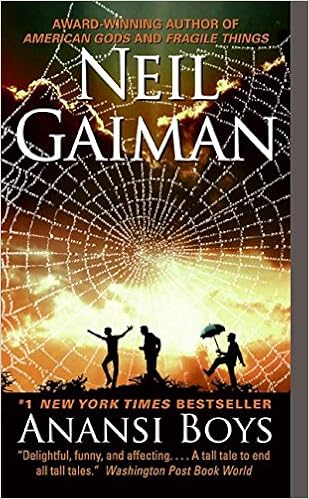
Anansi Boys, by Neil Gaiman, 2005

Anansi Boys tells the story of Charles “Fat Charlie” Nancy. Fat Charlie is an accountant, engaged half-heartedly to Rosie, whose monstrous mother is set on disrupting their engagement. Their wedding preparations are put on hold when Charlie has to travel to the Caribbean to attend his father’s funeral. There Charlie learns that not only was his father an incarnation of the West African spider god, Anansi, but also that he has a brother, and that he can be contacted by asking a spider.

Charlie takes this news relatively well, considering, and returns to his humdrum life in London. Inevitably he can’t resist summoning up his brother, Spider. Spider is everything Charlie is not – confident, charismatic, persuasive. He sets up home in Charlie’s flat, and begins to take over this life, with, as they say, disastrous consequences, losing him both his job and his fiancee.

The supernatural is invoked powerfully in Gaiman’s previous novel, American Gods, because it is taken seriously; here the whimsicality undermines the impact of the narrative. There’s never any genuine threat from the gods who resent Anansi’s status, or from the more earth-bound Grahame Coats, Charlie’s sleazy boss, who has been embezzling his clients for years. Most readers will realise very early on that Charlie is going to end up with the petite officer investigating his case, Daisy, that Charlie and Spider and going to be reconciled, and that Mr Coats is not going to get away with his crimes. This lack of threat, even from the personification of the malevolent tiger god, led to one reviewer describing the novel as “whimsical supernaturalism” which feels about right. The New Your Times review of the novel used a similar phrase, talking of “an Uncle Remus folksiness to the stories that sends the airy blitheness of the farce plummeting down to earth”.  

The other aspect of the novel that I found a little disappointing was the humour. Whimsy is always a tough one to pull off, and stripped of its context just about any joke can fall flat, but the jokes in the novel are consistently weak. Here’s some examples:

Spider: Things came up.
Fat Charlie: What kind of things?
Spider: Things. They came up. That’s what things do. They come up. I can’t be expected to keep track of them all.

More dialogue between Charlie and Spider:

“The ties of blood,” said Spider, “are stronger than water.”
“Water’s not strong,” objected Fat Charlie.
“Stronger than vodka, then. Or volcanoes. Or, or ammonia.”

This isn’t repartee. Ammonia’s not a comedic example of something unexpectedly strong is it?

The narration aims for Pratchett or Adams, but consistently misses.

“It was England in the autumn; the sun was, by definition, something that only happened when it wasn’t cloudy or raining.”

Does this mean anything? Does it say anything about the English weather, or is it just repeating a very tired cliche? Compare how Adams turns that idea completely inside out with the cursed rain god/lorry driver in (I think) Mostly Harmless. 

“There was reality and there was reality; and some things were more real than others.”

“Nothing happened. Nothing continued to happen. More Nothing. The Return of Nothing. Son of Nothing. Nothing Rides Again. Nothing and Abbott and Costello meet the Wolfman…”

Not all the jokes fall flat. Rosie’s mother is a fine portrait of a prospective mother-in-law who could put anyone off the institution of marriage. Here she is allocating guests to tables at the wedding reception, applying the fine judgments of status that matter so much on these occasions:

“I’ll put her down for table H,” said Rosie’s mother. “She’ll be more comfortable there.” She said it in the same way most people would say things like, “Do you wish to die quickly, or shall I let Mongo have his fun first?”

Later there is this fine description of an outraged dragon:

The beast made the noise of a cat being shampooed, a lonely wail of horror and outrage, of shame and defeat.

But these are isolated exceptions of otherwise disappointingly flat

This novel is really aimed at the young adult market. Adults will find it mildly engaging if a bit superficial, but younger readers will be gripped by the story and their hope that it all works out well for Charlie and his family. 

One final quibble – “nancy boy” in idiomatic English is a homosexual slur – was it really necessary to use this phrase in the book’s title?

Standard
Book review

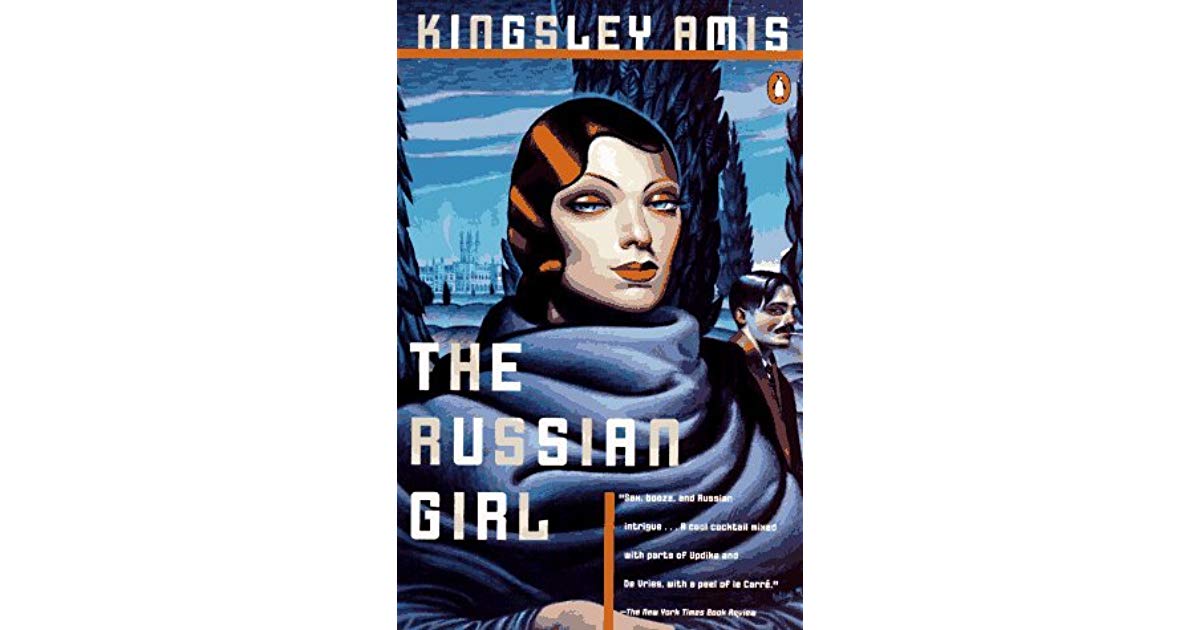
The Russian Girl, by Kingsley Amis, 1992

366437._UY630_SR1200,630_This is late Amis: The Russian Girl was published in 1992, just three years before his death. Amis is one of those novelists who essentially wrote the same novel over and over again, with slight changes of character and the setting thinly disguised. But this novel was an exception to that rule – instead of the older cast of characters bickering, having tired affairs and drinking themselves to death, The Russian Girl’s central character, Dr Richard Vaisey, is in his forties, and vaguely behaves like it. His inevitable love interest, Anna Danilova, the titular Russian girl, is in her twenties. An older academic having an affair with an exotic Russian girl (note girl, not woman; Amis was never going be that up to date) – what an original plot? But the scenario isn’t what redeems this novel.  Continue reading
Standard
Book review

Put Out More Flags, by Evelyn Waugh, 1942

I re-read Scoop, Black Mischief, and Vile Bodies almost annually, yet somehow I had never got round to reading Waugh’s Put Out More Flags, which features many of the characters established in these earlier novels and could be seen as a sequel. Why that is I have no idea, but I have now rectified the omission.

Image result for Put Out More Flags, by Evelyn Waugh, 1942

Waugh’s sixth novel was written and published in 1942 and as we shall see that date is significant. The plot looks back at the first year of the war and contemplates the strange period in which at first little changed for many people followed quickly by the major upheavals thereafter.

Waugh’s characters are as usual wealthy and upper-class, and the war impacts them in (for them) unexpected ways. Country estates lose their servants. Billeting officers have to find accommodation for evacuees. Basil Seal, the louche ne-er do well of earlier novels struggles to find an army commission or any other constructive role in the war. Ambrose Silk, a gay Jewish intellectual looks elsewhere for a role, ideally in the Ministry of Information. Peter Pastmaster, about to go abroad into combat, decides to marry and father an heir in case he is killed in action.

In my eyes, the novel is less than the sum of its parts. There are admittedly some fascinating character portraits. Ambrose Silk for example is an openly gay character who Waugh treats surprisingly sympathetically. In previous novels he would have been an object of ridicule, but here he is treated as the unhappy victim of his sexual desires:

A pansy. An old queen. A habit of dress, a tone of voice, an elegant, humorous deportment that had been admired and imitated, a swift, epicene felicity of wit, the art of dazzling and confusing those he despised – these had been his; and now they were the current exchange of comedians; there were only a few restaurants, now, which he frequent without fear of ridicule, and there he was surrounded, as though by distorting mirrors, with gross reflections and caricatures of himself.

While Waugh may be tolerant of Silk’s sexuality, society is not. He writes a novel about a former lover, a Brownshirt who is now in a Nazi extermination camp. Basil spitefully engineers a situation where this work is interpreted as pro-German and Silk is forced to flee to Ireland, disguised as a priest. Waugh’s writing directly about a gay character without hiding behind euphemism or suggestion was quite transgressive for its time, showing a progression in his treatment of character.

Put Out More Flags captures a very precise moment in time, starting with the weeks before the war (“days of surmise and apprehension which cannot, without irony, be called the last days of “peace”) followed by the phoney war in which nothing seems to change very much, (“Well, we’re at war now. I expect there’ll be a lot to put up with”) and the final grim realisation that the war is starting in earnest, people are dying, and there’s no going back: “There’s only one serious occupation for a chap now, that’s killing Germans. I have an idea I shall rather enjoy it.”

Waugh’s commentary on these phases of the war is, as you would expect, scathing. His characters speculate that the decadence of the 20’s and 30’s, portrayed in his earlier novels and exemplified by his characters, are what lead Germany to believe we would not put up much resistance:

“You can’t blame Ribbentrop for thinking us decadent when he saw people like Basil about. I don’t suppose they’ll have much use for him in the Army.”

The comic elements of the novel are the outstanding chapters, for example when Basil abuses his sister’s position as local billeting officer, finding homes for evacuee children sent to the country to escape the air raids. He uses three horrible working class children to extort money from country folk who pay him to rehouse them. Incidentally there’s a disturbing hint of incest in these scenes. Doris, precocious oldest sister of the profitable evacuees, notices the incipient attraction between Basil and his sister Barbara:

“He’s your boy, isn’t he?” she said, turning to Barbara.

“He’s my brother, Doris”

“Ah” she said, her pig eyes dark with the wisdom of the slums, “but you fancy him don’t you? I saw”.

Waugh makes no attempt to disguise his class hatred – Doris has ‘pig’ eyes, not ‘pig-like’ eyes. He suggests that her ‘wisdom of the slums’ gives her an insight into the attraction between siblings that has previously always been hinted at but never openly acknowledged. Waugh never returns to this topic, but even to open this door the smallest of cracks must have been shocking to contemporary readers.

Put Out More Flags is in many ways just a series of sketches with the barest of plots. I think it is best seen as a portrait of the period, and as a transition novel between the lightly comic, absurbist novels of the pre-war period and the later, more serious Brideshead Revisited and the Sword of Honour trilogy.

Standard
Book review

The Man in the High Castle, by Philip K Dick, 1962

The Man in the High Castle is an alternate history novel. Although the author Philip K. Dick is best known as a writer of science fiction, and despite the setting, the novel isDick 2 realistic in tone, and contains very few sci-fi elements. The scenario of the novel is chilling if not wholly original – the Nazis and their Japanese allies have won the Second World War. They rule over the former United States, where the novel is mostly set, as well as the rest of the world. In the novel’s alternate history, President Franklin D. Roosevelt was assassinated (as he very nearly was) leading to the continuation of the Great Depression and US isolationism during World War II. Without American involvement the Nazis conquer Europe and Africa, and then join with the Japanese to defeat America.

Life under the Nazis is as barbaric as one might expect, although by the time of the events of the novel America is slowly coming to terms with being a defeated and occupied country. Japan has occupied most the Western side of the US and Germany the east, with a buffer zone of the “Pacific States of America” between them and a small Nazi puppet regime to the south. 


While victory was shared by the Japanese and the Nazis, the peace is clearly being won by the technologically superior Germans, who are already (the novel is set in the 1960s) sending men to Mars. This disparity of technology is to prove dangerous. The narrative is told through the eyes of several citizens of occupied America. An antique shop owner sells romanticized and often fake American cultural artifacts to Japanese trade officials and tourists. A high-ranking official visits the shop looking for a gift to impress a visiting Swedish industrialist. Meanwhile Frank Frink (formerly Fink), a secretly Jewish-American veteran, has lost his job and sets up a handcrafted jewelry business with a former colleague. His ex-wife meanwhile now lives in the neutral buffer zone and begins a relationship with a truck driver. Slowly Dick draws these story lines together to reveal the Nazis’ sinister intentions towards their former allies. 

A popular novel, The Grasshopper Lies Heavy, depicting an alternative history in which the Allies won World War II. plays a key role in the narrative – a novel within a novel in which the central conceit is reversed. This inner novel haunts its readers with the suggestion that it in some strange way is actually a true representation of events, and the characters’s lives are themselves the fiction. In some ill-defined way the ‘truth’ is trying to impose itself on the fictional events portrayed. Dick leaves this idea unresolved at the end of the novel. 

It’s an intriguing if not particularly original central concept in the long tradition of invasion/alternate history novels. Not many works in this genre go so far as to imagining the US losing the war – even though Dick makes this plausible enough given the Nazis adapting nuclear technology before the Allies. Having set his scene, Dick seems a little lost where to go with it. This isn’t going to be a patriotic tale of valiant resistance fighters defeating the brutal invaders – in fact the Japanese seem perfectly civil, and there is no suggestion of their being an underground movement of any kind. The tensions between the remaining superpowers is well handled and convincing, and the descriptions of how Europe and Africa have suffered at the hands of the Nazis are chilling even if all-shown in passing references by the American characters. The eponymous Man in the High Castle is a bit of a disappointment – he is the author of the novel within the novel, but the High Castle ends up being just a suburban house, and the author only appears right at the end of the novel. He is not the omniscient, influential figure the title would suggest. 

I found the constant references to the prophetic powers of the I Ching quite irritating. Dick seems to take this nonsense seriously – certainly his characters do and there is nothing to suggest they are wrong to do so. The Japanese characters are all stereotypically inscrutable even when narrating the novel. All in all I couldn’t resist the feeling that there was a compelling story here trying but never quite succeeding to get out here, only appearing in flashes such as when the truck-driver is revealed as a German agent and is stopped by the plucky American judo-instructor. The television adaptation has wisely ignored almost all of the text, just using the central concept as a starting point, and as a result making a much richer, more interesting narrative.

Standard
Book review

The Five – the untold lives of Jack the Ripper’s victims, by Hallie Rubenhold, 2019

The FiveThe central concept of this popular history book (by popular in this context I mean some of the claims are not as strictly evidenced as I would normally expect) is to tell the stories of the five “canonical” victims of the Ripper, the women generally accepted to be the victims of a single murderer operating in Whitechapel in 1888.

Inevitably the author cannot avoid drifting into speculation on how they came to their deaths, and it is here where the book has caused some controversy. Rubenhold disputes the widely held view that all of the victims were prostitutes. Her case seems strong here, although I haven’t read the counter-evidence which I am sure exists. She also argues powerfully that several of the women were killed while rough-sleeping; again this seems to make a lot of sense – they certainly were living a lifestyle where rough-sleeping would have been a necessity on occasion, even if the precise locations of their murders suggest unlikely places in which to bed down. 

But these issues are not the focus of the book. What the author aims to do is to tell these women’s stories – from their births to how they came to be on the street on those nights in 1888. What decisions and events led them there. If you knew nothing about these women and were to guess you would expect drink to play a part, and of course it does. Abusive relationships and personal tragedy are also involved. More widely the author is extremely strong on the social, political and economic context of the mid nineteenth century, including of course the housing and public health crises that were at the heart of these women’s tragic stories. Things were not all consistently bleak for these women – for example some of them were reasonably well educated for their class and generation. All had been in stable relationships (so far as we can tell) and had families from whom they had slowly been alienated. They were given support from employers, charities and housing associations. There was nothing inevitable about their deaths. 

In books of this kind one is always left wondering how much of the author’s reconstruction is speculation or educated guessing. A good example is the claim that Catherine Eddowes, the fourth victim, whilst selling pamphlets and so-called ‘gallows ballads’ was present at the execution of her cousin, Christopher Robinson, at Strafford in January 1866. The evidence that Catherine was present at the execution is flimsy to say the least, but here it is presented as unquestionable fact. (This is one issue were I took a quick look at some alternative sources). The other thing that is is hard to be clear on is how much of the text is the result of independent research, and how much is simply a reheating of existing knowledge about the victims. Because despite the widespread claim that this book is the first attempt to tell these women’s stories, there have been several previous such narratives, and there is arguably not much more to be found out.

Was this a genuine attempt to give a voice to these women, or yet another cynical exploitation of the frisson of excitement caused by the monstrous nature of the murders? I am happy to give the author the benefit of the doubt here. The narratives are all well-constructed, and the decision to end them at the point of the murders removes any hint of titillation. It was nice to see photographs of the victims others than on the mortuary slab. These photographs are remarkable, and if Rubenhold is the first historian to track them down (and I have no way of knowing if that is the case or not) then this in itself was a remarkable piece of historical detective work.

I think there was another way to give some value to these women’s lives, and that would have been to show how – if at all – their murders changed society. Did the way police investigate murders change? Did the way they treated vagrants and prostitutes change? Were the Whitechapel slums cleared? What, in other words, were the political and social impacts of the Ripper murders? But that’s obviously another book entirely.

Standard
Book review

One Hundred Years of Solitude, by Gabriel Garcia Marquez, 1967

“Many years later, as he faced the firing squad, Colonel Aureliano Buendía was to remember that distant afternoon when his father took him to discover ice.”

Great first line. Always going to be a tough act to follow.

There are good ways and bad ways of reading a novel. Carefully, taking one’s time, out loud, all fall in the former category. Ten minutes at a time here and there spread over a month or so is definitely the wrong way to read any book, especially one as dense and complex as Gabriel Garcia Marquez’s One Hundred Years of Solitude. This was more from force of circumstance than a conscious decision, but I wouldn’t recommend it. One practical consequence was a serious problem with following the narrative, even down to the simple task of understanding the differences between the characters. Marquez didn’t make this easy (I say this not by way of complaint – it is not the author’s job to make their novels easy to read!) by having only a handful of recurring names for the novel’s many different characters.

One Hundred Years of Solitude tells the story of seven generations of the Buendía Family in the town of Macondo in Columbia. The story opens with the family patriarch, Arcadio Buendía, facing the firing squad for crimes against the Government. The narrative then takes the reader back to the founding of Macondo by the Buendía family. Initially Macondo is isolated from the outside world, apart from an annual visit by a band of gypsies, who show the townspeople technology such as magnets, telescopes, and ice. Melquíades, the gypsy king, becomes a recurring figure in the novel and the key to its final resolution. When Macondo becomes involved in the affairs of the wider world its troubles begin. A rigged election inspires Aureliano Buendía to join the rebellion against the Conservative government. I know how he feels.

The Buendia family saga feels longer that it is. The large cast of characters grow up, fall in love, or not, then die, to be succeeded steadily by the next generation with their own challenges and successes. It could have been the disjointed way I read this novel, but I found the steady march of the years made it difficult to engage with the characters who never made it off the page and became real for me.

100 years made a huge impact when it was first published, and remains highly thought of. The magical realism motif (I think I did well to get this far without using that term) was almost revolutionary at the time – it would be wrong to say it has become passe, but it certainly doesn’t have the same impact more than fifty years on. I enjoyed the light-hearted aspects of this novel the most, the way science and magic are blended together to prove that Arthur C Clarke saying that “any sufficiently advanced technology is indistinguishable from magic”.  The people of Macondo react in alarm and wonder to things such as films where an actor who dies in one film “reappears alive” in another, but take magic carpets in their stride.

There’s lots to enjoy in this novel. Some characters will appeal, and if they don’t another (probably with the same name) will appear soon enough. The prose is poetic and usually stays the right side of over the top. Some scenes are comic, others more disturbing, but I don’t think it takes itself too seriously despite the serious themes.

Finally I leave you with this review from a reader who took the trouble to post a review online, but didn’t take a lot of trouble with the reading of the novel itself:

“(It) didn’t do much for me; just a load of people sitting on a mat, munching.”

Standard
Book review

Laughter in the Dark, by Vladimir Nabokov, 1932

Laughter in the Dark is a early novel by Vladimir Nabokov that contains some of the ideas and themes that he was to return to in the later Lolita.nabokov

First, a quick plot summary: Albinus is a prosperous middle-aged art critic living in 1920’s Berlin, who in a classic mid-life crisis takes a mistress, the amoral 17-year-old Margot. Margot is interested only in Albinus’s money, and quickly engineers a split between him and his wife. Margot wants to be in the movies, and Albinus indulges this and her every other fantasy, even though she is clearly a dreadful actress. The first of a series of crises then begins to afflict Albinus. His young daughter dies from pneumonia. He unknowingly reintroduces Margot to one of her former lovers, Axel Rex, with whom she almost immediately resumes an ‘intimate’ relationship. A holiday to the south of France accompanied by Rex, who has persuaded Albinus he is gay and therefore not a threat, goes as badly as you might expect, setting them all up for a tragic (if also comic) finale.

This is a relatively slight novel.  While it contains echoes of Lolita, it has none of that novel’s power and compelling characters. This was to me a previously unknown Nabokov, which is always cause for some excitement – I think he is one of the colossus of twentieth century literature – but there is little in Laughter in the Dark to detain the reader for long. The characters do not linger in the memory – they are all either vile and amoral – Margot and Axel in particular are two-dimensional villains without a shadow of nuance – or weak and uninteresting. Even Albinus’s brother in law Paul, who shows a bit of gumption when he finds out he is being defrauded by Margot and Axel, travelling to their holiday retreat and confronting them, is ultimately unable to intervene and prevent tragedy occurring. It’s not really a tragedy however – we don’t care enough about the characters to be upset when they meet their fate – but it’s not that comic either. The scenes where Axel taunts the blinded Albinus are cruel and unsettling, and probably come closest to tragi-comedy.

I keep however coming back to those echoes between this novel and Lolita. The latter is dominated by Humbert Humbert’s lust for his step-daughter, his consuming obsession with her youthful body. Light of my loins, etc. Lolita is portrayed as being indifferent to or even a bit bored by this obsession – she is aware of Humbert’s feelings and is able to manipulate him by using them, but she doesn’t reciprocate them. Or at least that is what the narrator in Lolita, Humbert, tells the reader. In fact it is clear that this is not the case, and that Lolita is repulsed by her abuser (see my review for a lot more on this). Humbert prefers his choice of narrative because it both explains her lack of affection for him and justifies his abuse. So there are two narratives – what Humbert is telling us is happening, and what the author reveals is going on behind Humbert’s self-justification. He is honest about his lust, but dishonest in his portrait of Lolita’s response. He pretends to be harsh on himself – she never really loved me – to disguise the fact he was abusing her all the time.

The relationship between Albinus and Margot is a pale imitation of this later ‘relationship’. Margot casually reciprocates Albinus’s lust. “She on her part was always ready to respond to his lovemaking; it only refreshed her” (note the “only”).

Here she is described after a day on the beach, putting on a show for Albinus:

“In the cool room with the red-tiled floor…Margot, snake-like, shuffled off her black skin, (her swimsuit) and, with nothing on but high-heeled slippers, clicked up and down the room, eating a sibilant peach; and stripes of sunshine crossed and recrossed her body”. (chapter 14).

I can’t think of another writer who would have described the act of eating a peach, in itself obviously sexual, as “sibilant”. Margot uses sex with Albinus as a way of getting what she wants – she tells him not to lay a hand on her until he has spoken to his wife about a divorce. Lolita, several years younger, is unable to exercise this form of power, even though Humbert consistently tries to portray her as behaving that way. So the equivalence between Margot and Lolita that some readers might be tempted to make is utterly wrong, even if both men see them in the same way. Albinus and Humbert are both dirty old men tempted by much younger women, but only one is a step-parent and child-abuser. Laughter in the Dark is at the same time a simpler and less troubling novel than its successor, but doesn’t ever escape from its shadow.

Standard
Book review

Melmoth, by Sarah Perry, 2018

“Perry’s masterly piece of postmodern gothic is one of the great literary achievements of our young century and deserves all the prizes and praise that will be heaped upon it.

That was the Guardian’s lavish view of Perry’s 2018 follow up to the extraordinarily successful The Essex Serpent, although the quote is edited slightly on the front cover of the paperback edition (“One of the great achievements of our century” (see below). See what they did there, cutting out the words “literary” and “young” – I bet they thought they would get away with that, because who would check? Me!). Nevertheless, the bar had been set.Melmoth

Helen Franklin, a translator of tedious technical articles, lives in exile in Prague, trying to put her mysterious past behind her and at the same time paying penance for her unspecified sin. Her social circle is very limited, in fitting with her ascetic life of isolation, but she has two friends Thea and Karel. Karel has been researching the folklore tale of Melmoth, a mythical figure who walks the earth witnessing sin. His collection of manuscripts has begun to haunt Karel, so he leaves Prague, Thea, and pretty much the novel, for a fresh start as an activist against immigration enforcement. Yep, that’s what people do. This is shoe-horned in to make a heavy-handed point – in life we should not just witness wrong being done, but do something about it. Being a passive witness is as bad as being a participant in the offence, as stories from Karel’s collection testify.

The individual stories in this collection are compelling – scenes from the German occupation of Czechoslovakia, and the subsequent retribution towards the occupying forces; memories of the Armenian massacres/holocaust in the first world war, and Helen’s own story, eventually revealed, of a terrible crime in Malaya. But these are relatively brief testimonies that create a fractured narrative. The over-arching story – Helen and her haunting by Melmoth – is not that interesting, and I found the novel only sparked into life when the stories within the story were being told. The supernatural element of the novel left me cold – horror when well done can be effective if it draws upon our deep-rooted fears of the real world, but here it becomes predictable and unthreatening very quickly. We know Melmoth is going to be lurking around somewhere, but don’t really care.

I came extremely close to abandoning this novel at around the three-quarter point, and it was really only the knowledge that I would have to confess to doing so here, together with a dollop of stubbornness, that kept me going. I am glad I did because Helen’s tragic story, revealed toward the end of the novel, and its denouement, was worth the wait, but the effort in getting there was considerable. This novel has none of the pace or compelling characters of the Essex Serpent. It’s not a bad novel, and Perry is not a bad writer, but this misfires and allows the message to drive the story, not the other way round as it surely should be. The experiment with structure is not the problem – it is an absence of characters we have any real interest in that lets the novel down badly. The discussion element of the novel – can we be a bystander in life, or do we have to actively resist oppression, because if we don’t we become complicit in it, however unwittingly – is a serious attempt to engage in this issue, and I am sure has sparked a lot of worthy book-club discussions (this edition had “suggested topics for your book club” as an endpiece) but for me wasn’t enough to redeem the novel or drive the narrative. Sorry! I feel a bit of a cad for being so negative about this novel because there are a lot of positives in there, but the heart of the novel – an interesting story – is missing.

For getting this far, here’s a couple of cookies:

  • Melmoth the Wanderer is the name of Humbert Humbert’s car in Vladimir Nabokov’s Lolita
  • Sebastian Melmoth was a pseudonym used towards the end of his life by Oscar Wilde

And finally, I found this spoof in a Goodreads review which I thought was exquisitely well done and pricks the pomposity of the original – apologies for the plagiarism!

“Melmoth the Wanderer meets Winnie the Pooh

It is I, Melmoth, known as Melmotka, wanderer of the centuries of man’s sufferings. My child, my Winnie, whom I have longed for, from whom my eyes have never wandered, at last I am come, as you knew I must, I who have watched over you from the hour of your birth until now, that you may be delivered from torment! I, Melmoth!

“Would you like some honey?” Said Winnie, known as The Pooh. “I found it, you see, so now I am… eating it. It is nice. You could have a bit. Just a little bit.”

Melmoth the Wanderer meets Mary Poppins

It is I, Melmoth, known as Melmotka, wanderer of the centuries of man’s sufferings. My child, my Mary, whom I have longed for, from whom my eyes have never wandered, at last I am come, as you knew I must, I who have watched over you from the hour of your birth until now, that you may be delivered from torment! I, Melmoth!

“Well now, Mrs did you say Melmoth? It’s an odd name you know. Please don’t stand there like a large fish with legs. You are welcome to accompany us to the Botanical Gardens but you’ll have to move a little faster than that.”

Melmoth the Wanderer meets Shrek

It is I, Melmoth, known as Melmotka, wanderer of the centuries of man’s sufferings. My child, my Shrek, whom I have longed for, from whom my eyes have never wandered, at last I am come, as you knew I must, I who have watched over you from the hour of your birth until now, that you may be delivered from torment! I, Melmoth!

“So let me get this straight. You’re jist gonna stand there and watch me? Well, are ye quite sure about that? Because your likely going to be seeing some pretty disgusting things if you do. You know, I knew a Melmoth once. Oh no, right, I knew Mel the Moth. He was a moth.”

Standard
Book review

A Town Like Alice, by Nevil Shute, 1950

In the early 1950’s the world was full of survivors. Everyone had their own story about the second world war. Many people just wanted to get on with their lives. The UK was being rebuilt and a very different world was emerging. Some people didn’t like the direction the UK was going and decide to start new lives in Australia. A Town Like Alice is Nevil Shute’s response to that period and process.Alice

Jean Paget, a secretary in a leather goods factory, inherits a substantial legacy from her uncle. The money is put in trust until she is 35 – her uncle did not believe young women could be trusted with large sums of money – and it is managed by her solicitor, the novel’s narrator. Jean decides to use her windfall to repay the kindness shown her during the war by some Malay villagers, by building them a well. Jean is aware that the burden of manual work falls upon the women villagers, and she wants to lighten their load, describing the well as “a gift by women, for women”.

This idea leads to an extended flash-back in which she recounts her experiences in the war as a prisoner of the Japanese forces. She leads a group of women and children who are marched across the Malayan countryside. This route-march leaves many of the elderly and children dead of starvation, disease, and exhaustion. During this exodus, based on a true story, Jean meets an Australian soldier, Joe Harman. Joe is also a prisoner of war. He drives a lorry for the Japanese and wants to help Jean and her group. He steals food and medicines for them, but is caught and in a form of punishment said to be widely used by the Japanese he is crucified. The women are marched out of town to their next destination, believing that he is dead.

Back in the present, the well is built, and during its construction Jean learns Joe did not die. She travels to Australia to find him. She visits Alice Springs, the ‘Alice’ of the novel’s title, and is struck by the high quality of life there. (There is a constant emphasis in all her conversations with Australians about the poor rationed diet in the UK. Every meal Jean eats is opulent in the extreme. Shute is trying a little too hard to stress the riches of Australia). She journeys on to Willstown in the Queensland outback, where Joe is manager of a cattle station. Willstown is a shocking contrast to Alice – poor, struggling, almost deserted, with only one general store and a bar. The weather is always stiflingly hot. Joe meanwhile has been on his own journey to find Jean, travelling to the UK to find her once he realises she is single (she carried a toddler when they met, the surviving child of one of their party, so he assumed she was married. Despite Jean bringing this child up for three years he is handed back to his father and the end of the war and heard from no more.)

The third section of the novel records Joe and Jean’s relationship and marriage, and Jean’s attempts to turn Willstown into a ‘town like Alice’. She uses her legacy, which originally derived from gold-prospecting in Australia, to bring life back to the town, opening a small leather goods factory, an ice cream bar, and a number of other businesses. The novel closes three years on with the expansion plans coming along nicely, with Willstown flourishing.

In some respects Alice is a fairly progressive novel. The lead female character is strong and independent, demonstrating that her uncle’s concerns about women’s ability to make business or financial decisions were unfounded. She deals with the trauma of the war in a no-nonsense manner. The Japanese are portrayed as largely honourable soldiers, with the guards helping to carry the children among the party during their long journey. Shute also makes a persuasive case for inward investment into Australia, positioning it as a return for the use of the country’s resources.

But elsewhere the novel’s attitudes towards racial issues will be to a modern sensibility. Aborigines are described using pejorative, insulting terms. They only speak pidgin English, and are given menial jobs suited to what the author appears to believe is their limited intelligence. Aborigines and white people are segregated even in the consumption of ice-cream – Jean’s ice-cream bar has separate rooms for while and aborigine customers. A mixed race marriage is described as a source of humiliation. The earlier war section of the novel is more progressive in its description of racial characteristics. Jean adopts Malay ways of dressing and behaving because they are suitable to her situation, and is quick to abandon expat attitudes and behaviours, particularly the assumption of superiority. She bargains with a Malay village leader citing the Koran to make her point and offering to help with the rice cultivation. It is interesting that Joe behaves differently towards Jean when she is wearing Western dress – he can’t touch her – but when she puts on a sarong she is left bruised by his ‘ardour’.

At its heart Alice is an optimistic book – the war leaves its mark on survivors, in Joe’s case quite literally – but they come through it into a period of prosperity where technology and modernisation holds all the answers. If only Australia’s problems were really all that simple.

Standard
Book review

Maskerade (Discworld 18) by Terry Pratchett, 1995

Regular readers of this blog (should there are any) will notice a pattern emerging in which I alternate between a classic/serious novel and the next book in the Discworld series. Today is a Discworld day, more specifically the wonderful Maskerade. And the good news is that this is one of the best, featuring the extraordinary witches of Lancre.Mask

The plot is a simple parody of the Phantom of the Opera. Agnes Nitt, destined to become a country witch leaves sleepy Lancre to seek fame and fortune at the Ankh-Morpork opera house. (It is perhaps surprising that a city as violent and lawless as Ankh-Morpork has its own opera house, but Discworld is anything but predictable). At the same time the wonderful Granny Weatherwax finds out that the equally wonderful Nanny Ogg has written a popular cookbook – but has not received any royalties from the publisher. They set out for Ankh-Morpork on a mission to collect what Nanny is owed, with an understanding that they will probably pop in and visit Agnes along the way, and if she agrees to join their coven in a firmly junior position that would all work out fine as well (“You needed at least three witches for a coven. Two witches was just an argument.”). There is nothing as definite as a plan here. 

The stage is set for what is a surprisingly tightly written mystery story – although I had read the book before I couldn’t easily work out whodunnit – as well as a wonderfully comic novel. While Pratchett always has a serious point in the back of his mind, here the seriousness never gets in the way of the fun – for example the scene where the senior witches stay in Madame Palm’s house for ladies of negotiable affection, and manage somehow to make it even more disreputable, is glorious!

Maskerade is fantastic. It features two of my favourite characters in the whole of fiction, Nanny Ogg here finally stepping out from the shadow of Esme Weatherwax with her own special brand of magic (in essence, being nice and talking to people), and of course Esme herself. The witches have been on a road trip before, (Witches Abroad) but here they can play uninhibitedly in Ankh-Morpork. Pratchett clearly had a huge amount of affection for these characters – they are immensely endearing and believable. (Re-reading what I have written there I can’t help notice the abundance of superlatives, but it’s a fair reflection of how I feel about the novel.)

Nanny Ogg is a complete nihilist –  her philosophy of life is summarised as “do what seemed like a good idea at the time, and do it as hard as possible.” She gets some great lines, such as:

“Can you identify yourself?
-Certainly. I’d know me anywhere.”
Is it me or is there a hint of the Marx brothers in that joke? This is after all a night at the opera?
There is no reverence whatsoever for the seriousness of the setting:
Well, basically there are two sorts of opera,”
said Nanny, who also had the true witch’s ability to be confidently expert on the basis of no experience whatsoever.
“There’s your heavy opera, where basically people sing foreign and it goes like “Oh oh oh, I am dyin’, oh I am dyin’, oh oh oh, that’s what I’m doin'”, and there’s your light opera, where they sing in foreign and it basically goes “Beer! Beer! Beer! Beer! I like to drink lots of beer!”, although sometimes they drink champagne instead. That’s basically all of opera, reely.”
The quality of the jokes, is as ever, both terrible and wonderful at the same time – such as here when describing Nanny Ogg’s cookbook
“What about this one? Maids of honour?”
“Weeelll, they starts out as maids of honour…but they ends up tarts.”

:

Standard