Book review

The Old Devils, by Kingsley Amis, 1986

It is only human nature to assume that reasonable people will agree with you. So when I finished The Old Devils I looked for reviews in the expectation that they would broadly align with my thoughts – that the novel had stolen the 1986 Booker prize from The Handmaid’s Tale, that it was the work of an embittered writer at the end of his career publicly working out many of his frustrations and grievances with the modern world and his own mortality, and that time would not have been kind to critical reception of the novel.

But I was wrong.

When it was first published The Old Devils was lauded with praise, winning the aforementioned Booker but also being widely recognised as a late-flowering of Amis’s comic genius. John Bayley wrote an extraordinary florid paean to the novel in the London Review of Books which is worth reading in full for its hyperbole, its use of obscure language (fauteuil, donnée), its name dropping (Elizabeth Bowen, William Trevor, Anthony Powell, Henry James, Patrick Hamilton, Jane Austen (whom Amis has never much cared about”), A.N. Wilson and a “long ago purveyor of Gothic novels, Mrs Barbauld” are all name-checked) all without ever managing to put his finger on the elusive nature of Amis’s comic genius.

More recently a reviewer in the Guardian’s book column in 2010 wrote

“Kingsley Amis’s success at the 1986 Booker prize seems like the natural culmination of a long and distinguished writing career. One of the finest comic writers of his generation – century even – had done the natural thing and written a bloody brilliant book”

The Wales Art Review (? me neither) called the novel

“his greatest single creative achievement” and (together with Lucky Jim)

“Two of the greatest novels of the twentieth century without doubt”

V.S. Prichett, writing in The New Yorker described the novel as being in

the old, robust masculine tradition of British comedy from Fielding and Smollett”.

And of course son Martin thought that the novel

stands comparison with any English novel of the century.”

Would that weight of critical opinion sway me?

Not a vast amount happens in The Old Devils. Alun Weaver, a writer and minor celebrity, (we are told he is a writer, but he doesn’t seem to have written very much, and the extent of his celebrity is very much open to debate) returns to his native Wales with his wife, Rhiannon. Many years ago before the Weavers left Wales their friendship group had gone through the various re-configurations that happen among younger people. In particular Rhiannon had once been loved by Alun’s old friend and now enormously, comically fat Peter Thomas. Alun and Rhiannon resume life with their close knit group of friends almost as if they have never been away – there is no suggestion they would look for other social groups – which stirs up long dormant feelings amongst former lovers. That’s pretty much it. Time is spent drinking heroic amounts of alcohol that in the non-fictional world would leave people falling over drunk in a fraction of the time sustained here. not least because there seems little else to do. Amis concludes the novel with a death and a wedding, the latter between two younger characters who have been largely ignored during the previous chapters.

I have always thought of Amis as a good bad writer, one who writes clumsy, poorly constructed sentences simply as a way of drawing attention to their deliberate awkwardness. Take this sentence for example:

“As they stood, or with some minor surgery, they were supposed to be, he had striven to make them, his devout hope was that they were, the opening section of the only really serious piece of prose he had written since his schooldays.”

These are the faltering thoughts of Alun Weaver considering the opening pages of a novel he has just started, and which turns out to be, by consensus, rubbish. No doubt it took a lot of care and craft to make the sentence so unclear and scrappy, and it does admittedly reflect Alun’s thoughts and apparently his gifts as an author. But it’s still a horrible sentence, no matter how many times you read it.

Here’s another example:

All sorts of stuff, for instance what had been taking place a little earlier, seemed much as before, or at any rate not different enough to start making a song and dance about. This state of affairs might well not last for ever, but for the moment, certainly, the less it changed the more it was the same thing, and the most noticeable characteristic of the past, as seen by him, at least, was that there was so much more of it now than formerly, with bits that were longer ago than had once seemed possible.

Ultimately you can choose to read this as a gentle meditation on aging, or the cliche-ridden (song and dance, state of affairs) muttering of someone growing old disgracefully.

The humour in the novel is intended to derive from Amis’s portraits of flawed human nature. People are pompous, lecherous, complacent, stupid, and all manner of human weakness is on display for our entertainment. But I really struggled to care about these largely unpleasant people. There were several points in the novel where I was unable to work out who was speaking in a passage of dialogue, and then suddenly realised it didn’t really matter because I didn’t care.

Here’s Amis’s unflattering portrait of Malcolm, one of the group of friends, dressed to impress an old flame:

“When he had got out of his very shiny bright-blue car and at a second attempt shut its driver’s door, Malcolm revealed himself to be wearing a hacking jacket in dark red, green and fawn checks that were too large by an incredibly small amount, cavalry-twill trousers he must have been uncommonly fond of, a pale green I’m-going-out-for-the-the-day-with-my-old-girlfriend cravat or ascot, and, thank goodness, a plain shirt and ordinary brown lace-up shoes.”

Is this brilliantly observant, or crudely done? Older people don’t dress very smartly, even when they are trying hard to impress. The point of view judgment in this analysis comes from Rhiannon, the old-girlfriend in question, who gives thanks for the plain shirt and ordinary shoes. Amis deploys these subtle changes of point of view with the skill of an experienced writer, unquestionably, but I am not convinced that there is much humour here, even if there is less spite than earlier late Amis either.

I appreciate I am edging round the question of whether I actually thought The Old Devils was any good. Let’s put it this way – I have my doubts. Without question the praise I have referenced earlier in the post is over the top. This is not a classic or a masterpiece or anything like it. Most of the time I managed a wry smile, at best, and much of the time I was bored. The characters are hard to like – Amis goes out of his way to make them unattractive and unappealing, and they are poorly delineated, particularly the women who Amis struggles to distinguish between other than by their physical features.

My principal source of irritation with this novel is its dishonesty. Amis had at this point in his career developed a reputation as a declining writer focused on personal themes – his serial adultery, his alcoholism, his declining health. He has sketched out a series of characters with these qualities or attributes, then ventriloquized through them on his tired personal and political hobby-horses – homosexuality, the ridiculousness of compulsory Welsh/English language public signage, faux-Welshness, trade-unionists and so on. Of course one must always be careful to distinguish between the personal views of an author and their characters, but there is a strong case for concluding that Amis shares many of the prejudices his characters articulate – he repeats these views consistently in a series of later novels, he attempts to make the characters articulating these views sympathetic and invariably shows only the reasons why they are justified in these views – opposing views are ignored. Reviewers seem relieved that this is not the openly misogynistic rant of Stanley and the Women or Jake’s Thing, but that doesn’t make it Lucky Jim either.

Finally, and for me most seriously, there is what I think of as the “shagger” issue. (apologies for the language but it seems appropriate in the context, and any euphemism wouldn’t quite meet the mark). There is a recurring character in many of Amis’s novels who is an appalling chauvinist with nevertheless a mysterious and limitless powers of seduction. He is always on the lookout for an opportunity for random sexual encounters, however inappropriate or untimely, always “up for it” irrespective of time, place or situation. He will sleep with anyone at anytime, and inexplicably has the power to persuade the women in his life, invariably married to someone else – to sleep with him with the minimum of seduction/persuasion/courtship. They just jump into bed with him – because the narrator can portray them doing so, not because these powers are in any way realistic or believable. So Alun Weaver has not been back in Wales many hours before he pops in to visit Sophie, wife of an old-friend, in the expectation of a casual encounter. The conversation is initially hostile but Alun charms his way into Sophie’s bedroom, and slowly the quotation marks are interrupted by rows of dots suggesting intimacy is underway. They only confirmation that the seduction has succeeded is the phrase “Much too late to spoil it the telephone-bell rang on the landing”, “it” in this context being Amis’s coy euphemism for sex.

This is all a long-winded way of explaining why I think the critics I cited earlier in this post were wrong, and why this novel has aged poorly. I looked at the Goodreads reviews for this novel to see if contemporary opinion of the lay reader was closer to mine. This is obviously a question of me seeking evidence for a previously determined position, because if these statistics had not confirmed my conclusions I would probably not have included them, but here they are. Goodreads reviewers gave The Old Devils an average score of 3.33 out of 5. That’s below average for most Booker prize winning novels. I sampled a number of others at random and only Anne Enright’s The Gathering scored lower at 3.07. (Full results as follows:)

The Sense of an Ending Julian Barnes 3.72

The Sea John Banville 3.51

White Tiger Aravind Adiga 3.73

Life of Pi Yann Martell 3.90

How Late it was, how late James Kelman 3.57

Paddy Clarke, Ha, Ha, Ha Roddy Doyle 3.76

Wolf Hall Hilary Mantel 3.86

The Seige of Krishnapur J.G. Farrell 3.90

A Brief History of Seven Killings Marlon James 3.87

The Milkman Anne Burns 3.61

The Sellout Paul Beatty 3.77

Lincoln on the Bardo George Saunders 3.77)

So on average the good readers of Goodreads agree with me, which is a comfort, of sorts.
Standard
Book review

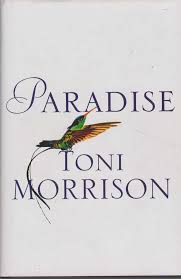
Paradise by Toni Morrison, 1997

Paradise has a gripping opening:

They shoot the white girl first, but the rest they can take their time. No need to hurry out here.

The rest of this complex, challenging novel is all about unpicking this first sentence – what has driven these men to attack these women? 

They are 17 miles from a town which has 90 miles between it and any other. Hiding places will be plentiful in the convent, but there is time, and the day has just begun. They are nine. Over twice the number of the women, they are obliged to stampede or kill, and they have the paraphernalia for either requirement–rope, a palm leaf cross, handcuffs, mace, and sunglasses, along with clean, handsome guns.”paradise

Readers of Morrison’s previous novels might be expecting the “they” in this opening paragraph to be white racists attacking a black community, perhaps in the civil rights period if not earlier. Any expectations of this kind are quickly confounded. It soon becomes clear that this is an exclusively black community brutally cleansing itself of the inhabitants of a troublesome women’s communal shelter.

Ruby, a town of some 360 souls, was founded as a refuge for its inhabitants, in recognition that black communities were always going to face racism from white neighbours and authorities. This retreat into isolation and seclusion followed a brief period after the civil war when some black community leaders rose to positions of prominence, only to be stripped of those roles as part of the removal of civil rights that in turn took many decades to restore. Ruby is a successor community to the earlier Haven, also a black-only town, intended (as the name implies) to create a place free from racism and prejudice. As part of the building of the community the founding fathers constructed a communal oven of brick and iron. This oven carries a heavy symbolic burden representing everything the people of Ruby have achieved. The name of the new town, originally “New Haven” derives from that of a young woman who died when she was refused medical attention because of her race. The town has no jail or cemetery because, it is claimed, it has never needed either, although this is what is known surely as tempting fate?

Anxiety about Ruby’s future comes to crystallise in concerns about the nearby “convent”, a refuge for women with nowhere else to go, a mirror image of the town.  The building sense of crisis comes to be crystallised around  plans to change the slogan on the Oven: though it now says only “… the Furrow of his Brow”, the town elders claim it used to say “Beware” at the beginning, whereas the younger generation wishes to make it “Be the Furrow of his Brow”. In parallel to learning the history of Ruby we learn the back-stories of the inhabitants of the ‘convent’, a mansion ominously designed like the cartridge of a gun. The description ‘convent’ is colloquial but incorrect – the house was originally a boarding school for native American girls until it closed and became the refuge of today. (In writing this post I am struggling with tense – “is” or “was” – this is at least in part because the narrative is so fluid in terms of time, jumping freely from decade to decade.) The tipping point in the troubled relationship between the town and the convent comes when some men in the town are scandalized when the Convent women make a rowdy appearance at a wedding between members of two of Ruby’s founding families

This is a classically “difficult” novel. There is little exposition – a sequence of point-of-view narrators tell their stories, explaining little and only slowly coming to the point at which their lives bring them to Ruby. Some things are never explained – for instance one character, Mavis, flees an abusive husband and family following the death by suffocation of her young twins. These deaths are almost too horrific for her to consider face-on, so we only get brief snippets of information about how they came to die or be killed, and about her culpability or otherwise for their deaths. The memories and reminiscences of the multiple narrators range freely over time, and it can often be hard to tell when and where the events being described happened. It’s a little like looking at a jigsaw before the pieces are assembled. If you read a traditional review of this novel it will normally try to pieces these pieces together for you, or at least join up the edges, and lay them before you in a sequential narrative – this happens, then this happens, etc. But reading the novel is obviously a very different experience – we find things out, if ever, when the author tells us, and it can be many pages between a scene or situation being described and us finding out what may have happened. This complexity is further compounded by the scale and ambition of the novel. There are dozens of characters involved in the narrative, and I defy any reader on a first reading to keep track of who they are and the complex web of family relationships between them. I can only assume that the author knew we would be unable to retain all this information on a first read. So is the experience of reading this novel intended to be muddled and unclear, or are we being invited to return for further readings?

I have written about complexity in novels many times before, such as here, and I should be clear and re-emphasise that complexity isn’t inherently either good or bad. I have tried to read books where the complexity was such I gave up, but that was my failure rather than that of the author. Complex books can be rewarding in ways that straightforward narratives are not, however frustrating they can be at the time. Which is a way of avoiding the question of whether the complex nature of Paradise makes it a rewarding read or not. Initially I couldn’t make my mind up, so I read some reviews.

The New York Times was pretty savage:

“Paradise” is everything that “Beloved” was not: it’s a heavy-handed, schematic piece of writing, thoroughly lacking in the novelistic magic Ms. Morrison has wielded so effortlessly in the past. It’s a contrived, formulaic book that mechanically pits men against women, old against young, the past against the present.

Zoe Heller in the London Review of Books was less strident but still had serious reservations:

 At some point, all Morrison’s major novels seem to lose patience with the finicky business of recording moral blur, choosing to swerve off into the realm of moral fable and preacherly uplift. Often, as in Paradise, the change is marked by an onset of gloopily ‘miraculous’ events.

Adam Mars Jones in the Guardian agreed with the LRB’s concerns about the mysticism in the novel

If Morrison had resisted the temptation to bring in possession, ghosts and amateur miracles, Paradise might have attained the status of masterpiece. As it is, reading the book is too often like standing next to someone with a pair of powerful binoculars trained on a distant view. From her impassioned commentary on what is going on you long to share her vision, but when she passes the binoculars across, the focus wheel is missing or jammed.

This is a novel that confounds readers’ expectations. It is not an easy read, and I am not yet convinced that the complexity works in the way it does in, for example, the work of William Faulkner, of which I kept getting strong echoes throughout the novel. I can certainly understand the reservations of the reviewers quoted here, that frustration with a novel that never fully comes into focus.

It would be wrong of me to close this post without paying tribute to the author who died last month aged 88. Her life was one of remarkable achievement, culminating in the Nobel Prize in Literature in 1993. In 2012 she was also awarded the Presidential Medal of Freedom, and in 2016 she received the PEN/Saul Bellow Award for Achievement in American Fiction. She was unquestionably a giant of American literature, and through her work provided a way for America to come to terms, at least in a small way, with its past.


Standard
Book review

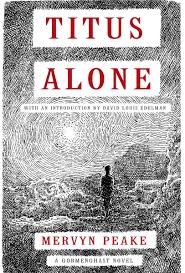
Titus Alone, Mervyn Peake, 1959

This is sometimes a worthwhile exercise – try to imagine what it would have been like to read a novel such as Titus Alone when it was first published. Titus Groan and Gormenghast had been published in 1946 and 1950 respectively, and while the narrative had come to a natural close for many of the characters, Titus’s story is set to continue. You have waited nine long years (almost as long as those waiting for the next book in A Song of Ice and Fire) and finally Mervyn Peake’s sequel is published, picking up almost exactly at the point Gormenghast finished nine years earlier.TA2

But it confounds all expectations. Instead of being another static story set in Gormenghast, it is free roaming. Instead of being set in a quasi-medieval world without mechanisation, it shockingly takes place in a world in which cars and aeroplanes appear, and seem to have existed all along outside the hermetic world of the castle. The novel is as hard to categorise in genre terms as its predecessors, but it is unsettlingly different. 

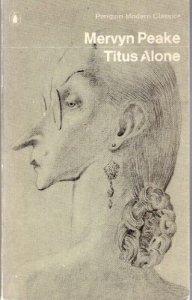
Unsurprisingly the critical reaction when Titus Alone was published was confused. This was compounded by the editorial decisions made at the time. It was not until several years later that a subsequent editor, reviewing Peake’s original manuscript, noticed serious discrepancies between it and the published version. The original editor had butchered the text, making a bewildering number of unnecessary changes. In its restored form the novel proved far better than critics originally supposed. (Incidentally I wonder if the editor or publisher of the Penguin Modern Classics edition illustrated below had read the novel, because while the drawing of Irma Prunesquallor is a wonderful example of Peake’s draughtmanship, she doesn’t appear in the novel.) 

What readers at the time would not have known is that Peake was in the first stages of the Parkinsonism which would eventually take his life. This undoubtedly had an impact on the text – it could account for some of the surreal elements of the narrative, the comparative lack of structure, and the profound difference between this novel and its predecessors. But what it doesn’t do is make it a bad novel. (Incidentally I can only think of one other example – Terry Pratchett’s The Shepherd’s Crown – of a novel written by a dying author where their condition shows on the page. Other authors died part way through the completion of the text, but their illness doesn’t show through. Edwin Drood for example could have been written by Dickens at pretty much anytime during his career, I would argue.)Irma

Titus Alone follows Titus in self-imposed exile from his hereditary prison. Traveling through a wasteland he comes to a mysterious city where he encounters two faceless, silent figures – police officers? –  who want to take him into custody, or worse. He is rescued and befriended by zoo-owner Muzzlehatch, and goes on to explore his new surroundings. A series of disjointed and surreal incidents and adventures follow. There is a Kafkaesque feel to this narrative – Titus is constantly menaced by ill-defined threats, and never feels fully safe, even when Juno, Muzzlehatch’s former lover, agrees to be his guardian and takes him to live with her.

They become lovers, but it can’t last – Titus has a restlessness that compels him to keep moving. He is followed by a mysterious floating orb which he smashes with his piece of Gormenghast flint (his only token of home). The dark adventures continue culminating in an intense scene of destruction which is some of the most intense writing I think I have ever read. It’s certainly impossible to do it justice in a synopsis. The novel’s conclusion has haunted me for years. Escaping the city Titus wanders the wasteland alone for months, until he comes across a outcrop of rock that he recognises from his childhood. Hearing the guns of Gormenghast saluting the missing Earl, he knows he is home. But that knowledge is enough.

If Peake had only written Titus Alone we would of course judge the novel differently, rather than it always being assessed by its differences to its predecessors. It is less claustrophobic and faster paced than the previous two novels, more disjointed and in many ways lighter. Titus is lost without the structure of life in the castle, and bemused by the menace of the wider world, and many readers will share his post-Gormenghast reaction.

Titus Alone is in the words of one blogger “a jewel that possesses more facets than Titus Groan and Gormenghast yet will be elusive to some readers precisely for that reason”. Extremely well put.  It’s also worth looking out Michael Moorcock’s comments on Titus in the introduction to a recent edition from which I have borrowed the information above about the novel’s editorial history. Moorcock knew the Peakes at the time the novel was being written, and has some interesting observations on the creative process involved and the novel’s place in 1950’s Britain.

Titus Alone was Peake’s attempt to take his character and method out of the hermetic world he had created in Gormenghast and Titus Groan and make it confront not only issues of identity, time and human interaction but the problems of modernity and even post‐modernity — the world as it emerged from terrible, unprecedented conflict, confronting the Cold War, nuclear weapons and new forms of authoritarian dictatorship springing up like weeds from the ruins of the old world. In following this path Peake recognized the limitations of the form he had developed with such genius and was consciously seeking a means by which he could expand it to expose his protagonist to the 20th century.

There are certain books you will always love, no matter whatever else you read, and to which you will always return; these three novels would be my desert island choice. They are of such scope and ambition that they reward many, many rereadings. Together they represent an extraordinary achievement and I cannot recommend them highly enough.


Standard
Book review

Gormenghast, by Mervyn Peake, 1950

The second novel in the series, Gormenghast picks up where Titus Groan left off, returning to the castle where the new earl, 77th of his line, grows up in his vast crumbling demesne into a life governed by strict and stifling ritual. Peake reintroduces his cast of extraordinary characters in a leisurely manner – he is in no rush to get the action underway. Titus, who had just turned one when the first novel ended, has to grow up before he can confront the demons that threaten him. 

The florid language that characterised Titus Groan also returns, not least in the descriptions of the castle itself:

Withdrawn and ruinous it broods in umbra: the immemorial masonry: the towers, the tracks. Is all corroding? No. Through an avenue of spires a zephyr floats; a bird whistles; a freshet bears away from a choked river.

Readers will either luxuriate in prose like this, or be irritated by it. I don’t think one can have Gormenghast the adventure story without Gormenghast the prose poem, and I am very glad we have both.

Once the scene is set, and the characters are re-introduced, Peake can spend time on showing Titus’s childhood. He is wonderful at capturing the joy as well as the boredom of infancy: in a phrase that has stayed with me since reading it some 40 or more years ago, Titus is wading through his childhood. 

Or to put it another way

Drear ritual turned its wheel. The ferment of the heart, within these walls, was mocked by every length of sleeping shadow. The passions, no greater than candle flames, flickered in Time’s yawn, for Gormenghast, huge and adumbrate, out-crumbles all. The summer was heavy with a kind of soft grey-blue weight in the sky – yet not in the sky, for it was as if there were no sky, but only air, an impalpable grey-blue substance, drugged with the weight of its own heat and hue. 

Titus begins to chafe at the crippling conventions of castle life and the impositions of the daily rituals he has to undertake. I always read these rituals as Peake’s commentary on the meaningless conventions we surround ourselves with in life. Yes, this novel is thought provoking as well.

Sooner or later an Earl needs to go to school, and here Peake introduces new characters to his cast: the Professors. Professor Bellgrove is elevated to the headmastership following a fatal and grotesque accident which disposes of his predecessor. The other teachers are, as one by now expects, a collection of grotesques, not one of whom should be within a mile of a classroom. Peake is in no hurry with the adventure element of his tale, and introduces a new element to his narrative – romance, albeit a comedy romance between lovers who are getting on in years. The angular spinster Irma Prunesquallor, sister of the castle’s doctor, decides to get married, and throws a party to help her secure a groom from among the eligible teachers of the castle. Bellgrove rises to the occasion and begins to pay her court:

“His staff had shaken hands with her as though a woman was merely another kind of man. Fools! The seeds of Eve were in this radiant creature. The lullabyes of half a million years throbbed in her throat. Had they no sense of wonder, no reverence, no pride?”

I have an immense fondness for the chapters featuring the professors – they add little if anything to the plot, but they flesh out the world of Gormenghast wonderfully.

Meanwhile Steerpike, now assistant to the Master of Ritual, Barquentine, watches and waits for his opportunity. He decides that Barquentine stands in his way of advancement and has to be disposed of. However the plan doesn’t go smoothly – Barquentine puts up an unexpectedly fierce fight. Steerpike is severely injured, suffering extensive burns and almost drowning. As he lies recovering his delirious mutterings give rise to concerns in Dr Prunesquallor’s mind that he was involved in the mysterious disappearance and presumed deaths of Titus’s aunts, the twin sisters Ladies Cora and ClariceSteerpike is now under suspicion, and from this point the novel races to a tragic and bitter conclusion in a chase scene that repays any and all the patience the reader has invested up to this point. An epic manhunt through the rapidly flooding castle ends with Titus having to make the most difficult decision of his young life.

I’ve praised Peake’s use of language, his character creation, his descriptive powers, but really at the heart of this novel is an adventure story. It takes a while to get there but the payoff at the end is extraordinarily exciting.

The question is, however, what happens next?

Standard
Book review

Machines Like Me, by Ian McEwan, 2019

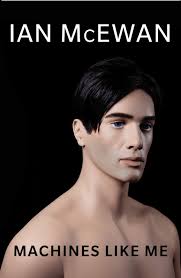
Let’s start with that clever title.  The ambiguity lies between machines that are similar to ‘me’ and machines that feel a form of affection towards ‘me’. In Ian McEwan’s interesting latest novel it’s not clear in what sense if any the machines in question, robots, like the narrator.McEwan1

The narrative is relatively straightforward. Charlie Friend, the narrator, buys one of the earliest personal robots introduced onto the market. These robots are all called either Adam or Eve. His Adam is a very near simulacrum of a human being, although it costs more than the price of an average house (and Charlie still lives in a flat in London). Charlie is attracted to Miranda, his upstairs neighbour , and they soon begin a relationship. This quickly becomes a menage a trois, as Adam first has sex with, then falls in love with, Miranda. Yes, they are that kind of fully-functioning robot.

Charlie, Miranda and Adam are living in an alternate version of the 1980s, one where Alan Turing didn’t take the course of chemical castration ordered by the courts following his conviction for being gay. Turing is the key in this parallel universe to unlocking an extraordinary leap forward in technology in which self-driving cars are commonplace and robot technology has been perfected.

During my reading of Machines Like Me I kept experiencing a nagging sensation that something wasn’t quite right. Unquestionably the novel’s narrator wasn’t telling us the whole story, and I wondered whether there might be a hidden reason for this, in a similar fashion to McEwan’s earlier Sweet Tooth. In Sweet Tooth there are similar moments where things don’t quite add up, where the narrator is clearly getting things wrong or asking us to make intuitive leaps without sufficient reason. There is the same feel to the narrative here – the narrator presents us with a series of events which successively feel ‘wrong’, and asks us to take them at face value.

The sense that Charlie’s account is either misleading or disguising another, perhaps more serious or disturbing narrative, recurs throughout the novel. Things don’t quite add up. Early on Adam tells Charlie that Miranda, at that point only his potential girlfriend, is likely to hurt him. Charlie doesn’t follow this up – surely he would take the earliest possible opportunity to grill Adam on what he means, but he lets it slide, and apparently forgets about the warning, such is the strength of his attraction. The much later explanation of this warning is insufficient. Shortly after this incident Adam breaks Charlie’s wrist when he attempts to turn him off, a clear violation of Asimov’s first law which had been specifically referenced a little earlier in the novel. (1. A robot may not injure a human being or, through inaction, allow a human being to come to harm. Adam also ignores rule 2. (a robot must obey orders given it by human beings except where such orders would conflict with the First Law) freely throughout the novel – he is almost completely autonomous. After the attack, Adam threatens Charlie with the removal of his arm, which Charlie assumes is a joke, although he has little reason for doing – at any time this comment would be unfunny, but coming as it does just after he has broken his wrist, it is clearly a serious threat.

Charlie earns money speculating on the stock exchange. It takes him forever to work out that Adam, with his far superior if not god-like intelligence, might be a little bit better at this than he is. Once he sets him to work he quickly amasses thousands of pounds. While Adam’s intelligence is special, it isn’t unique. If he is able to manipulate the stock and commodities exchanges to swiftly earn thousands, is there any reason to think that others with access to this technology would not have had the same idea, and be using computers to make their trades? Of course they had that idea a long time ago, so the narrative as presented by Charlie loses another element of its credibility.

I thought we were edging towards a revelation during the scene when Charlie is taken for the robot and Adam for the human by Miranda’s father, during a much-delayed visit. Adam easily passes this version of the Turing test, but the mistake is unconvincing – while Charlie is dull, and his small talk is similar to that of an android, it would have been funnier if the mistake had been a deliberate put down by the prospective father-in-law. Was this scene hinting that Charlie is actually the android with implanted memories and Adam the human owner? Or that androids have now assumed their rightful place in ascendancy over man, and this is the method of control, fooling humans that they are the owners, while being in control all along (and therefore able to override the Asimov rules?

But sadly nothing ever come of this line of thought, and it turns out that Charlie isn’t a seriously flawed narrator after all. All the inconsistencies and “off” moments were just lapses in the construction of the narrative, nothing else. Which was a major disappointment.

Some of McEwan’s recent novels, I am thinking of Solar and The Children Act in particular, were weighted down by the extensive research behind them. There was a sense that McEwan had gone to a considerable effort to learn about the topic in question, and was reluctant to let it go to waste, so incorporated large chunks of his notes into the text. Sometimes it felt like I was being lectured and that a test was likely at some point. Machines Like Me has a similar feel – the life of Alan Turing is definitely fascinating but if I wanted to read a biography of the man I would have done so.

McEwan has some fun with the setting and the alternative history in which Britain loses the Falklands War and Tony Benn becomes Prime Minister, but it is hard to see the relevance other than providing a context for and explanation of the advances in technology. There is no real effort to flesh out this world in any detail – apart from the life-like robots and the self driving cars, everything else is familiar, down to the poll-tax riots and the Brighton bomb. It’s just the 1980’s with robots.

I’ve been quite harsh on Machines Like Me thus far, but I did enjoy reading it. I wanted to know what happened to the characters, and while Miranda never really came into focus, I was pleased she earned her happy ending. As a mediation on human consciousness and identity, I didn’t feel the novel had anything new to say – Never Let Me Go is an incomparably more interesting and engaging exploration of many of the same issues.

Standard
Book review

Interesting Times, (Discworld 17) by Terry Pratchett, 1994

Interesting Times, as well as being 17th in the Discworld series, is also the fifth novel to feature the world’s worst wizard, (or should that be wizzard?), Rincewind. So, cards on the table time – despite the enormous respect I have for all things Discworld, Rincewind is one of my least favourite characters. My heart sank a little when I read that this was another Rincewind novel (the fifth). I think there’s a good reason why after making several valiant attempts to resurrect him, Pratchett eventually allowed Rincewind to quietly fade into the background of Discworld.

‘May you live in interesting times’ is commonly thought to be an old curse (don’t we live in them right now?) usually attributed to the Chinese, although wrongly so according to my extensive research (Wikipedia). The phrase provides the inspiration for this adventure in which Rincewind travels to the Agatean Empire, the mysterious continent from which Twoflower, the naive but very rich tourist in The Colour of Magic and The Light Fantastic, came. 

After Pratchett’s traditional framing introduction, the novel opens with the Patrician of Ankh-Morpork receiving a demand from the Agatean Empire to send them a great wizzard. The spelling mistake triggers the idea of sending them Rincewind. Of course this immediately leads to a series of disasters and mishaps from which he always emerges through sheer dumb luck.

The villain of Interesting Times is Lord Hong, a Machiavellian character who has read Twoflower’s book, What I did on my holiday which has inspired vague ambitions to conquer distant Ankh-Morpork. Pratchett’s record on villains is patchy, and Lord Hong doesn’t linger long in the memory – he is a bit of a cardboard-cutout psychopath. Cohen the Barbarian also makes a reappearance, accompanied by a Silver Horde of aging barbarian berserkers. Together with a new “Red Army” of young idealists and Rincewind’s trademark failures at magic, they capture the imperial palace, and with it the Empire. Lord Hong rallies the Empire’s armies, and the scene is set for an epic battle – six aging barbarians and an ex-teacher against 70,000 trained soldiers. What could possibly go wrong?

There are several fairly serious issues with Interesting Times. First, the jokes aren’t that funny. There’s always a high groan quotient in the Discworld novels, but the problem here is repetition. The Silver Horde are old, but really good at fighting. People who under-estimate them usually don’t live to regret it. If that joke is repeated once it is repeated a dozen or more times. Rincewind is a rubbish wizard and a coward, who will run away from danger at any opportunity, but is also a great survivor. Again, point made and repeated over and over again. The word intercourse is funny. Maybe once, but that’s enough.

And then there’s the rape ‘jokes’. The Silver Horde are barbarians, and rape women. Now they are old this is probably not going to happen, but it won’t stop them trying. I know the 1990’s were different times, but it was not funny then, and is certainly not funny now. Terry Pratchett was usually fairly progressive in his values (take for instance the ideas about religion in Small Gods), but this is a horrible mis-step. Am I being pious to find the opening scene – in which castaway Rincewind encounters several buxom Amazons who beg him to help them repopulate their race after a strange and highly specific plague has mysteriously wiped out all their menfolk – both boringly unoriginal and offensive? While I am being offended I may as well throw in the fact that much of the novel is culturally insensitive to the point of racism – Chinese/Asian people are portrayed as inherently funny – they speak strangely, eat weird food, misunderstand things, and are generally different to the citizens of old Ankh-Morpork.

About three quarters of the way through Interesting Times I was thoroughly fed-up – disappointed and un-entertained. And then something strange happened – I started to be engaged. I think I can pinpoint precisely the moment this happened – when it dawns on the Silver Horde that they may not win their battle (even though they quickly recover and offer surrender terms to the army) and begin to come to terms with their mortality – sooner or later all heroes die. There is a poignant scene where Cohen lists all his barbarian horde friends, and is told disbelievingly one by one that they have died, or worse retired into respectability. Old men don’t fear death, but they don’t welcome it either, especially not old heroes who have spent their life avoiding it. Pratchett doubles-down at this point by revealing the tragic back story to Twoflower’s loss of his wife, which is handled with dignity. Pratchett always was at his best when writing about Death.

So Interesting Times isn’t bad, but it hasn’t aged well, and could probably have been about half as long and not suffered. Rincewind fans will enjoy it, but there are few of the great quotable quotes that you can trip over elsewhere in the series. It’s not as thought-provoking or as funny as most other novels in the series, and Rincewind is as un-engaging as ever. Thank goodness the next novel in the series, Maskerade, sees the return of the wonderful witches!

Standard
Book review

Tarzan of the Apes, by Edgar Rice Burroughs, 1912

Tarzan of the Apes is unquestionably pulp fiction, but it is also great fun, if you can stomach the appalling colonialist attitudes. Tarzan has become one of those archetypal characters from fiction – Dracula, Frankenstein, Sherlock Holmes – with a life far beyond the confines of their original story. Rice Burroughs went on to really milk the most possible value from the original success of his story of the ape-man, with around 25 sequels including Tarzan and the Foreign Legion and Tarzan at the Earth’s Core to name just a couple.

I am sure you know the bones of the Tarzan story. Newly-wed Lord Greystoke, an English aristocrat and his young wife are marooned on a deserted African shoreline following a mutiny by the crew. Here they create a mini-Eden, building a thatched hut with all-mod cons. Lady Greystoke gives birth to an heir, only to succumb to a fit of the vapours following a lion attack. Lord Greystoke quickly follows his wife, leaving young Tarzan to be adopted and brought up by the apes of the jungle. Interestingly these are not gorillas – Rice Burroughs is very specific on that point. This (invented) species of ape bears many similarities to the gorilla, but can speak a primitive language. Tarzan grows up among them, acquiring his physical prowess. He also discovers his parents’ hut and his father’s knife, which allows him to win a series of battles with the alpha-males in his troupe, as well as other beasts, finally becoming king of the jungle.

In parallel Tarzan teaches himself (improbably) to read and write and discovers more about his ancestry and the world beyond his jungle. Rice Burroughs was obviously taken with the idea of white people being marooned on the coast of Africa by mutinous sailors, because he re-uses this plot-device to introduce Jane Porter, lovely young American heiress, her eccentric father Professor Porter, and her suitor Clayton, Lord Greystoke. Yes, another Lord Greystoke, Tarzan’s cousin, has pitched up on the same shore in the same manner, twenty years on. This sums up the laziness of Rice Burroughs writing. Why bother inventing a new plot device when there’s a perfectly good one available that is only 15 chapters old?     

You won’t be surprised to hear that this novel is profoundly racist. The African natives Tarzan encounters are uncivilised, superstitious cannibals and they are wiped out by the French sailors towards the end of the novel without compunction.  Jane’s maid, Esmerelda, is a cliched American  lawks-a mercy caricature, always using clumsy malapropisms in a very unfunny manner and fainting every few minutes. The novel appears to accept an evolutionary link between man and beast, but the natural order in which white men are superior to dark-skinned men and beasts, and aristocratic white men are superior to all, is insisted on throughout.

Only in the novel’s portrayal of sex is there any hint of transgression. When Jane is first kidnapped by one of the apes, it is made explicitly clear that he intends to rape her.

“The tribe had kept his women. He must find others to replace them. This hairless white ape would be the first of his new household, and so he threw her roughly across his broad, hairy shoulders and leapt back into the trees” (Chapter 19)

Jane’s response to Tarzan when he rescues her is intensely sexual.

Jane—her lithe, young form flattened against the trunk of a great tree, her hands tight pressed against her rising and falling bosom, and her eyes wide with mingled horror, fascination, fear, and admiration—watched the primordial ape battle with the primeval man for possession of a woman—for her.

As the great muscles of the man’s back and shoulders knotted beneath the tension of his efforts, and the huge biceps and forearm held at bay those mighty tusks, the veil of centuries of civilization and culture was swept from the blurred vision of the Baltimore girl.

When the long knife drank deep a dozen times of Terkoz’ heart’s blood, and the great carcass rolled lifeless upon the ground, it was a primeval woman who sprang forward with outstretched arms toward the primeval man who had fought for her and won her.

And Tarzan? He did what no red-blooded man needs lessons in doing. He took his woman in his arms and smothered her upturned, panting lips with kisses. For a moment Jane lay there with half-closed eyes. For a moment—the first in her young life—she knew the meaning of love.

Note Jane’s response is in part to Tarzan’s muscles, but also to his violence, and she goes to him – indeed springs towards him. This would have been titillating to Rice Burrough’s Edwardian audience. This is not a novel for nice young women, but an adventure story for frustrated young men. The erotic emphasis on Tarzan’s musculature is relentless.

A feeling of dreamy peacefulness stole over Jane as she sank down upon the grass where Tarzan had placed her, and as she looked up at his great figure towering above her, there was added a strange sense of perfect security. As she watched him from beneath half-closed lids, Tarzan crossed the little circular clearing toward the trees upon the further side. She noted the graceful majesty of his carriage, the perfect symmetry of his magnificent figure and the poise of his well-shaped head upon his broad shoulders.

What a perfect creature! There could be naught of cruelty or baseness beneath that godlike exterior. Never, she thought had such a man strode the earth since God created the first in his own image.

However I am not sure how transgressive this actually is – while sexual activity between a young woman and a jungle man would have been taboo, we are never allowed to forget Tarzan’s aristocratic origins.

If you enjoy reading origin stories out of a sense of curiosity (in what way does the popular culture version of the character differ from the original?) Tarzan will keep you diverted for a couple of hours, but I doubt few if any readers will feel compelled to read any further in Tarzan’s adventures, which I suspect are simply reiterations of this template.

Standard
Book review

The Discworld Companion by Terry Pratchett and Stephen Briggs, 1994

By a wonderful act of synchronicity, I stumbled across this £1 charity bookstore treasure very shortly after completing Soul Music. This edition of the Companion (later editions being called the New Discworld Companion, followed by The Turtles Moves..The Discworld Companion…So Far) was published in 1994, ending with the publication of – and therefore fully describing the known Discworld up to – Soul Music.

This is much more than a guide to the Pratchett universe, although it is a very comprehensive one at that, obviously only comprehensive up to 1994 that is. This partiality is in itself is fascinating, as this snapshot of the DW universe reveal that at this point it is surprisingly complete – certainly all the main features you would expect – the Watch, Vetinari, the Witches, Death, a fully developed concept of how magic works, and so on – are all there, fully formed. In one sense the final 25 or so books were about filling in the detail and backstory rather than reinventing DW, and the genesis of several of the later novels are clearly present here. Examples of this include the references to the mysterious world of XXXX, later explored in the Last Continent (Discworld 22) or the writer William de Worde and the fact that moving type has not yet been fully embraced in Ankh-Morpork. de Worde’s entry in the Companion ends with the this sentence:

“It could well be that the future holds great things for young Mr de Worde…”

You really couldn’t ask for a clearer indication that Sir Terry had The Truth, the DW novel about the introduction of printing, planned out in his head, even though it wasn’t to eventually appear until 2000 as DW 25.

The Companion also has lots of canonical additional content found nowhere else – there is a very comprehensive description of the history, working and traditions of the Unseen University for example, in which Unseen Academicals is hinted at in the description of the DW version of football:

“UU records suggest that students from the University have no participated recently, but street football with various rules is still an Ankh-Morpork tradition”.

The sections on magic, DW units of measurement/standards, and Morporkian law, equally all give plenty of background to the DW universe only hinted at in the novels.

At the end of the Companion, after the A-Z section, is some fascinating additional content. In a chapter apparently written by Stephen Briggs, there is what I feel is one of the best summaries of the reasons why the novels are so loved:

“There is a certain quiet optimism (in the books). If there is a struggle, the good win – but not easily, and at some cost. There is a strong dislike of coercion of people, either by other people or gods or some concept of fate or destiny. There’s a very frequent theme which says that what people happen to be doing does not define what they actually are.”

Elsewhere a long and comprehensive interview with Sir Terry reveals that in the mid-90’s in response to the question:

“Do you see yourself still writing Discworld books in ten years’ time?”

he gave a very definitive

“No. Not even in five years time. Certainly not on a regular basis, anyway. There’s only so much I can do with it.”

I am so glad he changed his mind!

P.S. In the very final section of the Companion Briggs write about Pratchett fandom:

“Fan activity is available to anyone with a computer and a modem. There is a Pratchett forum on CIX….and a rather larger one known as alt.an.pratchett on the Internet (the huge worldwide computer network which shifts megabytes of information around the planet”.

Oh so that’s what the Internet is!! Gotta love 1995.

Standard
Book review

Soul Music (Discworld 16) by Terry Pratchett,1994

There’s a disappointing, cut and paste feel to Soul Music which for me makes it the weakest of the Discworld novels thus far (i.e. of the 16 published up to this point). And it is still wonderful! How come? I’ll come to the mitigation, but first this is the plot outline:

A young harpist, Imp Y Celyn, (bud of holly, get it?) from Llamedos seeks fame and fortune in Ankh-Morpork. He forms a band with Lias Bluestone (a troll percussionist) and Glod Glodsson (a dwarf hornblower) along the way acquiring a magical guitar with mysterious powers, more specifically an entity comprising the primordial music which brought the universe into existence. As one does.

Meanwhile, Death, upset at the death of his adopted daughter Ysabell and her husband, Mort, takes another impromptu break from his day job, leaving his granddaughter, Susan Sto Helit to fulfil his soul-gathering function. She fluffs her first job by failing to reap the soul of Buddy when he is scheduled to die while performing at the Mended Drum.

Thus the novel’s two primary threads are established – death takes a break and a family members steps in to cope as best they can, a plotline Pratchett had already used before (Mort and Reaper Man); and in a parallel storyline a new phenomenon/innovation (in this case rock music) takes the Discworld by storm, causing chaos and ultimately threatening the existence of the universe, a theme already explored in some detail in Moving Pictures.

That’s pretty much it – although there are a lot more events, they all fall within this basic template. And that was what I found disappointing by Soul Music, its writing by numbers feel. To be fair to Pratchett he was writing a phenomenal amount of Discworld novels at the time, feeding our voracious appetites for all things DW. (The Colour of Magic was published in 1986,  just 8 years and 15 DIscworld novels earlier. In addition to the eventual count of 41 novels there are also any number of books and other material including short stories, cookery books, maps, guides etc). So it is hardly surprising that to meet deadlines he had to dial it in from time to time.

Fans of dad jokes and clever popular culture references will be spoilt for choice here, beginning with the original cover illustration which echoes the Meat Loaf album Bat out of Hell, rapidly followed by a steady stream of allusions to groups and records, in particular cheesy examples from the seventies and eighties, such as “Pathway to Paradise” (“Stairway to Heaven”) and ”Sex and drugs and Music With Rocks In” (“Sex and Drugs and Rock and Roll“). At first the game of spot the reference is fun, but after a while it palls – it is after all essentially the same joke time after time, however cleverly done. Having said that even I had to applaud the way the groanworthy reference to “There’s a Guy Works Down the Chipshop swears he’s Elvish” is worked in.

Pratchett was at this point over a third of the way into the Discworld saga, and he was still refining his craft. This novel would not have disappointed any DW fan, but neither can it be said to take the series to a new height or in a new direction in the way books such as The Night Watch did. It’s fun, and the jokes consistently work, but I am not sure we care that much about the characters (except Susan perhaps), and the eventual happy-ever-after ending is never in any doubt. The scenes of the band on the road felt like padding, an effort to reach a minimum word-length target. So perhaps I need a Pratchett holiday – but I really don’t want one, because I know what great novels are coming up.


Standard
Book review

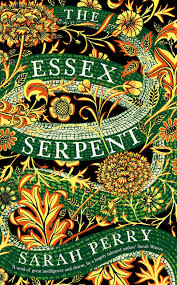
The Essex Serpent by Sarah Perry, 2016

When Cora Seaborne’s bully of a husband thankfully dies, she begins her new life as a widow with a sense of relief. Cora is our story’s heroine, an intelligent free-thinker, interested in the ideas of Marx and Darwin, ill-suited for the role of society wiEssex serpent 2fe. Seeking a change of scenery following the funeral, Cora moves to Essex, first Colchester then coastal Aldwinter, accompanied by her eleven-year old son, Francis, and his nanny, Martha.

Here we are introduced to the legend of the titular serpent, a wonderfully ambiguous and flexible metaphor for the unknown, sexuality, and more. The serpent is rumoured to have returned to haunt the coast after an earthquake brought it back to the surface, a folk-tale which has just enough plausibility to intrigue Cora. She becomes convinced that what the local people think is a mythical sea beast may be a previously undiscovered species. This is a time when the undiscovered was being explored and pinned down by hyper-active Victorians all the time.

The romantic element to the story is introduced when she meets the local vicar Will Ransome, who has a different, faith-based interpretation of the serpent legend. To Will and his flock the serpent has strong echoes of an earlier satanic snake. A strong wider cast slowly introduced to us, and one of the many pleasures of the novel is getting to know the people of Aldwinter and Cora’s other friends and relatives.

There’s much to admire in this novel, a late Victorian Gothic horror/romance. It fizzes with ideas and incident, interesting characters and accurately evoked settings.  Set in 1893, a time in which the ideas of Marx and Darwin were moving from being shocking and challenging to much more accepted and mainstream, but where superstition still governed the lives of many; where human relationships begin to test the boundaries of the constraints of marriage (for example shown here in the relationship between Martha and Edward Burton). Martha can be introduced as a socialist in company without that causing shock or dismay.

This is a society in flux, approaching the end of the Victorian era and the nineteenth century, set just two years before the trials of Oscar Wilde, and where social activism on the state of the slums in East London is much more than a matter of public health. Medicine is also leaping forward into the twentieth century, with Luke Garrett, jokingly (?) nicknamed “the imp”. a surgeon and suitor of Cora’s who begins to explore the possibilities of heart surgery.Essex serpent

The writing is strong. The point of view narration sweeps between characters seamlessly so we can tell from moment to moment how each is feeling as each scene unfolds, something that only novels can really do this well. The influence of Dickens and Hardy in particular is pervasive and explicitly acknowledged. Take this paragraph for example which to my mind is almost heroically Dickensian in its use of pairings and contrasts:

One o’clock on a dreary day and the time ball dropped at the Greenwich Observatory. There was ice on the prime meridian, and ice on the rigging of the broad-beamed barges down on the busy Thames. . . . Time was being served behind the walls of Newgate jail, and wasted by philosophers in cafes on the Strand; it was lost by those who wished the past were present, and loathed by those who wished the present past. . .

In Lincoln’s Inn and Middle Temple lawyers eyed their calendars and saw statues of limitations expire; in rooms in Camden and Woolwich time was cruel to lovers wondering how it got so late so soon, and in due course was kind to their ordinary wounds. Across the city in terraces and tenements, in high society and low company and in the middle classes, time was spent and squandered, eked out and wished away; and all the time it rained an icy rain.

If I have a criticism of this novel, churlish though it may be, it is that the ending is weak. The serpent itself was always going to be a disappointment, but the resolution is anti-climactic, to say the least, and a little ludicrous (the scene with ‘Gracie’). The resolution of the interwoven relationships is also a little disappointing – almost as if the ground is being laid for a sequel. Certainly I felt as if Cora, Michael, Martha and families had more stories to tell, and I would happily read more about their lives. I am equally convinced that this would make a hugely popular television series in the right hands.

If I am honest it was the awkward portrayal of sex in the novel that troubled me the most. The descriptions creep close to being a pastiche or parody of the way Hardy would have written them. Here for example is the time towards the end of the novel (spoiler alert) where Will and Cora finally consummate their relationship:

moving aside the folds of her coat he tugged her shirt where it was tucked into the waist, in the place where once he’d touched her and been disgraced by it. But the disgrace this time kept its distance: it seemed to him that to keep apart from her now would be obscene; how could it be possible to seek out each fold and turn of her mind and not grow familiar with the particular patina of her skin, the scent and taste of it. Not to touch her now would be to breach a natural law. Back she lay against the soft green stair in the thickening dusk and fixed her eyes on his, unsurprised, daring him: he raised he short and there in the split between the black cloth of her clothes he found her soft belly, very white, marked with the silver lines her son had made: he kissed it once and could not stop, and rolled against him in delight.

The sun slid down….She met his gaze then, levelly as she always had, and felt herself go rushing to meet him like a river in spate; ‘Please,’ she said, pulling at her skirt:’Please’, and he heard it like a command. He found her easily, and his hand slipped and moved in her, and her bright head drooped, and she was silent. He showed her his hand, and how she gleamed there; he put a forefinger to his mouth and hers, and they had an equal share”. 

Ignoring the fact that her shirt gets pulled out twice, which I suppose I can forgive, my main reaction to reading this paragraph was – really? They had an equal share?? That’s my nominee for the Bad Sex in Literature Award sorted. I was also irked by the deliberate archaism of “back she lay” rather than “she lay back” – why?

Earlier, Will goes for a long walk, the traditional remedy for sexual frustration, his mind boiling with thoughts of Cora:

He walked on to the mouth of the estuary, not knowing what to do with his desire, only that he could not take it to Stella; he knew he’d touch her and find her for the first time slight and insubstantial – he had in mind something more like fighting, and it appalled him; he went out to the water’s edge and with quick movements spent himself on the black marsh with something like a bark and with a dog’s joy”

The boatload of day-trippers from Clacton would have had something to talk about on the way back that day!

Or here:

“The windows in her room were open and light was fading on the wall. She said, ‘There may be blood,’ and he said, ‘Better that way – better’; and it was Cora’s mouth he kissed, and Cora’s hand he placed where she wanted it most. Each was only second best: they wore each other like hand-me-down coats.”

I am not sure if this is beautiful or over the top. ‘There may be blood’ sounds like a bad western, or an ominous line from a Tarantino film, but the reference to wearing one another like hand-me-down coats is lovely, and picks up on the constant references to Cora wearing a man’s coat (and many other references to the coats people wear – in fact there is probably a whole essay to be teased out of clothing in this novel alone, such is its depth and richness).

This is not the only example of overwriting, spectacular though it is. 

“He felt his faith deeply, and above all out of doors, where the vaulted sky was his cathedral nave and the oaks its transept pillars: when faith failed, as it sometimes did, he saw the heavens declare the glory of God and heard the stones cry out.”

But I am being churlish. Writing of this nature always tiptoes on the edge of hyperbole, and it is easily forgiven. I will close with a positive example of how the author evokes the Essex countryside – has it ever been described with such affection?

“Then it carried me in spate to the Essex shore, to all the marsh and shingle, and I tasted on my lips the salt air which is also like the flesh of oysters, and I felt my heart cleaving, as I felt it there in the dark wood on the green stair and as I feel it now: something severed, and something joined.”

Perry is a writer of enormous promise. The Essex Serpent was massively popular throughout 2016 and beyond, and has won prizes and sold huge amounts of copies – at times you couldn’t turn around in a bookshop without bumping into piles of it. One of the benefits of such ubiquity is that second hand copies are easy to find, and my £1 charity bookshop copy was a gleefully pounced upon treasure.


Standard