Book review

This Census-Taker by China Miéville, 2016

I’m usually pretty comfortable with novels that ask the reader to do all the heavy-lifting; that only give the barest context and leave it to us to fill in the gaps. Mieville takes this idea close to if not beyond its limits in This Census-Taker, a 2016 novella in which almost all of the details that a reviewer would normally set out in this point in a review are missing.

This is a first-person story where the narrator unsettlingly changes voice (from third to first person) and tense, but eventually settles down to a more conventional narrative about an unnamed child (the narrator) and a series of disturbing incidents from his childhood. Throughout the tale we are left with a series of unresolved questions – what has happened to his mother, is his father a murderer and what are the mysterious, quasi-magical keys that his father makes all about? The novella uses a combination of the fantastical, such as the scenes where the inhabitants of the local town suck mildly narcotic blood from the legs of giant beetles, or what one reviewer described as

“an unspecific but eerily well-realised terrain of soft apocalypse”

and a more realistic element in which the boy’s experience are recognisably those of a sad, lonely refugee or perhaps survivor. There is a lot of narrative incident, but little of it serves much apparent purpose – things just happen, then other things happen; in particular people disappear regularly, with the father looming menacingly over all events. If he is a murderer nothing can be proven, so after the mother disappears things return to a strange version of normal. The protagonist finds a substitute family of street children but they cannot replace his missing mother, and he remains trapped with his father. This is bleak indeed. The entrance of the enigmatic census taker at the close of the novel does little to resolve this mystery or sense of tension.

Eventually through a brief reversion to a future present, we are shown that the events of the novel are being recorded by a a much older version of the narrator, although what his future holds is frustratingly ambiguous, like so much else of this novel. This is not the grand reveal or resolution we may have optimistically been hoping for.

Fantasy is a wonderfully flexible genre, that can accommodate novels such as this at its fringes, and at the extreme the work of a much more mainstream writer such as Terry Pratchett, who I will be returning to next with, I admit, a small and undignified sense of relief after the challenges of This Census Taker.

Standard
Book review

Upheaval, how nations cope with crisis and change, by Jared Diamond, 2019

Diamond wrote the excellent Guns, Germs and Steel and Collapse, so I had high hopes and expectations of Upheaval. I have found myself repeating in conversation some of the points Diamond makes in these earlier books, not least the axiom that guns, germs and steel were the central components of the conquest of much of the world by the European powers in the later centuries of the second millennium. But sadly Upheaval is fundamentally and quite seriously flawed. That’s not to say that there aren’t interesting things to be found here, but before I go on to identify these I need to explain this central point.

Diamond argues that nations (and he doesn’t spend sufficient time in identifying what he means by this concept, which to my mind is much more fluid than he suggests) go through crises from time to time, and the way those nations respond to those crises can be compared to the way individuals respond to similar situations in their personal lives (e.g divorce, bereavement, etc). Using the work of psychiatrists he breaks these responses into twelve different categories. Just to offer one example, he argues that people who are able to isolate the problematic issues in their lives – building a psychological fence around the issue – move on more successfully than people who don’t. Similarly, countries bounce back from national crises and prove more resilient if they deploy similar responses.

I think I have represented Diamond’s thesis accurately. I hope so. He spends the bulk of the book considering crises in a series of seven countries. These potted histories – of the military coup against Allende in Chile, the Suharto anti-communist atrocities in Indonesia and the experience of Finland during and after the Second World War to give three examples – are interesting. I learned something. After each of these accounts Diamond then laboriously goes through the 12 techniques he identified at the beginning of the book, and tries manfully to explain in what way they can be applied to the case study. It goes without saying that very quickly he find the analysis pointless – either it is simply a way of categorising the response (so for example Finland could not rely on its neighbours for help in the Winter War against the Soviet Union, unlike people who turn to their friends when they are going through a divorce) without adding anything in the way of understanding, or the comparison does work but is trite. These analytical sections are without doubt the weakest part of the book, and I quickly learned to skim read them. Here’s an example of the knots he finds himself tied in:

“Individuals in crisis often receive help from friends, just as nations in crisis may recruit help from allied nations. Individuals in crisis may model their solutions on ways in which they see other individuals addressing similar crises; nations in crisis may borrow and adapt solutions already devised by other nations facing similar problems. Individuals in crisis may derive self-confidence from having survived previous crises; so do nations.” 

Do these parallels help at all? Do you feel you know more about how nations respond to crises because of these points? “These things are like these things but not like these other things” seems to be the sum total of the analysis.

Even had Diamond’s thesis been accurate, and national crises could usefully be compared to individual crises, there would still have been a massive “so what” to overcome. But nations aren’t people, and Diamond is forced to acknowledge that many of the typical responses he identifies simply don’t and can’t apply on a national or global scale. For example, countries respond more successfully to crises if the population is united in its response – this just doesn’t have a counterpoint in individual situations.

There were other issues. Diamond’s prose is often clumsy and laboured. He often appears to be working backward from a predetermined position. His defence of Finlandization for example, whereby Finland has aligned itself with the USSR and allowed Russian meddling in domestic Finnish political issues, is obviously driven by his affection for the country rather than any serious pretence that this is a successful strategy. Russian has plenty of other neighbours that don’t adopt this craven submission and seem to survive.

Diamond constantly assumes his readers are all Americans. I found this so irritating. It is understandable that an author’s work should reflect their national prejudices and perspectives. But I don’t think I have ever seen this done so openly and yet unthinkingly. And by the way Jared, the claim that the USA is responsible for the invention of the television and the internet is tenuous to say the least!

Diamond is quite open about that fact that the seven countries he chooses to analyse in this book are those he has lived in and knows extensively. In order to justify his case study choices he has to pretend that Australia has gone through a crisis comparable to that of Chile or Indonesia, when of course it hasn’t. Diamond has form here – in Collapse he argued that the Australian economy was on the brink of disaster, and while of course the country has some challenges to face, its economy is very resilient and it hasn’t been through a recession since the early 1990s.

I said earlier that despite some serious issues there were some positives in the book. The case studies are interesting, even if you have to wade through a lot to find the nuggets of value. The insights in the history of Japan in particular were new to me. Diamond is concerned about the prospects for his home country, rightly so, although his statistics lacked conviction and he didn’t seem to be up to date with the progress that has been made in third world economies for example. Ultimately this was a disappointing book, made all the worse by the strength of Diamond’s earlier work. The New York Times reviewer demolished it pretty comprehensively here if you are interested in another perspective.

Standard
Book review

The Spy Who Came in From the Cold, by John Le Carre, 1963

I read ‘The Spy Who Came in From the Cold’, as a standalone novel, without realising that it is to all intents and purposes a sequel to A Call for the Dead, Le Carre’s 1961 debut novel. Reading the novels out of sequence meant that the central plot twist – which I won’t give away here even though I usually very relaxed about spoilers – was kept disguised for much of the novel, even if on reflection it was fairly guessable.

Why read a Cold War spy novel now? Is it in any way still relevant? Certainly the political context of the novel has changed dramatically – when The Spy was first published it had an immediacy and relevance it has now lost. It exposed the dark underside of the world of Cold War espionage, in which each side, East and West, were both morally equivalent and ambivalent, where murder was commonplace, and where the only justification for one’s actions was the final outcome. Now it is just a historically based adventure novel, with as much relevance as The 39 Steps or The Riddle of the Sands.

Alec Leamas runs the Berlin office of the British secret service. Berlin is divided between East and West by the recently constructed Wall (a landmark point was passed recently when the time the Wall has been down became longer than the time it stood).  The novel opens as Leamas’s operation loses its last double agent, shot whilst defecting from East Berlin. Leamas is recalled to London by his boss, ‘Control’ and is given one last mission: to fake his defection to East Germany and to undermine their ruthlessly efficient secret service. There is very little exposition setting all this out – we learn of this plot only gradually as it unfolds.

I am not sure Leamas would have made a convincing potential defector. Yes he is fired, starts drinking, has money problems and serves a short prison sentence. But there are surely flags that this is a trap. He falls into the clutches of the East Germans far too easily. A menial job in a library leads him to meet Liz Gold, who just happens to be secretary of her local cell of the Communist Party of Great Britain. This obviously isn’t a coincidence – Liz is unknowingly part of the plot. After his release from jail Leamas is approached by an East German recruiter and with little pause for breath he defects and sells all his country’s secrets – or what little he purports to know – for a few thousand pounds.

During his interrogation Leamas mentions British payments to a double agent in the East. This, we later come to understand, is part of the plot to sow discord among the East German spy operation, which culminates in a trial of the Communist spymaster Mundt. During the trial the British plot is exposed when Liz is called as a surprise witness, only for a secret underlying plot, to which Leamas has been oblivious, to be revealed. The novel’s tragic denouement comes swiftly thereafter with a degree of inevitability.

This is a well-written page-turner. Le Carre evokes the seediness of Leamas’s world with very precise prose and imagery:

“They walked to her flat through the rain and they might have been anywhere—Berlin, London, any town where paving stones turn to lakes of light in the evening rain, and the traffic shuffles despondently through wet streets.”

Although there is a moral ambivalence about the novel’s portrait of espionage, Le Carre still takes sides – he is disgusted by intellectual, moral and actual poverty of the East. Although the world Le Carre portrays is now gone, this didn’t feel like an anachronism (in the way the Buchan and Childers books now do). In part this is because of the enduring popularity of Le Carre’s work to film and television adaptations, which keep it current, and in part due to his cynicism and amorality which is very modern in its sensibility. I am glad I have now read Le Carre – he was a novelist I have skirted around many times but never quite got round to – but I suspect his other spy novels will be very similar to this one. But next time I am looking for a book to help pass a train journey I will know not to overlook Le Carre.

Standard
Book review

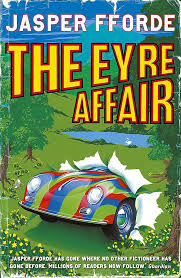
The Eyre Affair, by Jasper Fforde, 2001

When I was drafting my review of Fforde’s recent novel, Early Riser, I planned to refer back to an earlier review of his first published novel, The Eyre Affair – only to find that in fact I hadn’t written it! I must have read this novel before I started my blog, although I have reviewed some of the later novels in what was to go on to become the Thursday Next series.Fforde

The Eyre Affair is a brilliantly original genre-busting novel. It follows the adventures of Literary Detective Thursday Next, on the trail of a genuinely sinister villain, Acheron Hades. The novel is set in a strangely recognisable parallel universe, in which England and Imperial Russia are still fighting the Crimean War, Wales is an independent nation, and where literature is given its rightful value by society (one of my favourite scenes is where Thursday and her on/off boyfriend Landen Parke-Laine go to a performance of Richard III which is a parody of the audience-participation showings of the Rocky Horror Picture Show).

Some of the jokes – a character is called Braxton Hicks, for example – are groan-inducing, but the literary references are very clever. There’s a throw-away joke about Cardenio and the repartee about the Shakespearean authorship “question” for example shows a depth of knowledge and love of literature you won’t find in many mystery/adventure/detective novels, let alone comedies.

Thursday is a strong central character around which Fforde builds his narrative. She is a veteran of the Crimean war, where she lost her brother in a modern version of the Charge of the Light Brigade. She is in the career doldrums when she is unexpectedly recruited to track down criminal mastermind Acheron Hades, her former university professor.  Hades is a formidable and ruthless criminal, kills without hesitation or any trace of remorse, and nearly kills Thursday herself until the fortunate intervention, and this is where it gets really wild, of Mr Rochester from Jane Eyre. Yes, that Mr Rochester. Because in this universe it is possible, somehow, to move from the world of literature to what I am going to refer to as the round world, and vice-versa.

This fluidity between worlds allows Thursday and others to intervene in texts and change their outcomes. Some of what happens to Thursday, such as the supernatural message that leads her to change her life, is paralleled in the events of Jane Eyre, but Thursday is no Jane. She is not a passive figure but a woman of action and ideas.

Fforde’s achievement is that he doesn’t just parody genres, he delivers a series of interwoven narratives that all succeed in their own right. The detective story is an enjoyable mystery; the adventure elements are exciting, and the romance between Thursday and Parke-Laine, albeit kept in the background, is believable and touching, and plays its part in the novel’s finale. Fforde’s world building relies on the contrast between the familiar and the bizarre – for example in this world the dodo has been genetically re-engineered. Best of all, for me, were the literary jokes, which are done with respect for the source material. Both of the novel’s endings, one in Jane Eyre, the other in the ‘real world’ are borrowed from the Bronte text but with a clever twist.

Basically, I loved it. I can’t understand why it’s not been adapted for television I will never know, I can see it working brilliantly.


Standard
Book review

Paris Echo, by Sebastian Faulks, 2018

Have you ever got the end of a novel and asked “What was the point of that, then?” In a sense I know this is a futile question – there is no ‘point’ to Van Gogh’s Sunflowers or Beethoven’s Fifth. Equally not all novels have a point – they exist as a work of the author’s creativity and can’t be judged for their utility. I can think of some exceptions to this rule – there is a very definite point to Gulliver’s Travels, for example, or Animal Farm, but most novels are not didactic – they just tell a story, introduce some characters, and tell us something about the human experience. Continue reading

Standard
Book review

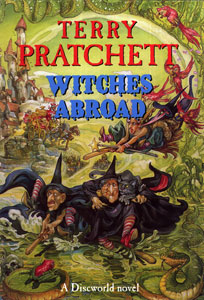
Witches Abroad, (Discworld 12) by Terry Pratchett, 1991

Is it possible to have two favourite Discworld books? I have three favourite children after all, so conceptually it should be possible. Were it to be deemed so by the powers that be, then ‘Witches Abroad’ would definitely be my joint favourite Discworld novel alongside Witches-abroad-cover‘The Night Watch’. Granny Weatherwax, Nanny Ogg, her perfect foil, and Magrat Garlick on a road trip across the Disc, travelling through a landscape of fairy stories brought to life by Lilith de Tempscire, Granny’s evil sister. Just perfect!

Granny and Nanny are two of my favourite Discworld characters – Magrat is a wet hen, and I can take her or leave her – and together they are wonderful. Nanny Ogg is sometimes overshadowed by Granny’s awesomeness, but her she is in full flow, a force of nature that bulldozes its way across the Disc, all the way to Genua. Genua is a coastal town with an annual celebration called Fat Lunchtime, a tradition of cooking based around gumbo and, and all in all bears a strong resemblance to New Orleans.

Witches Abroad also contains the greatest Discworld story Sir Terry never wrote. At the end of this novel, when the bad guys have been defeated and order restored, the witches have a choice – to go home, or to go and “see the elephant”, a colloquial expression for going home the long way, continuing their holiday as much as possible. They agree to see the elephant, and the reader is left to picture what a glorious, outrageous adventure that would have been. (If it turns out that this novel was actually written, and I have just forgotten it, which is quite possible, I will be both deeply embarrassed and hugely delighted).

So what is it about this novel that makes it so full of wonder? It can’t be the jokes, because they almost all qualify as ‘dad’ jokes – even the title is a pretty silly play on words (Witches Abroad = witches out and about, and also in foreign lands). Or try this schoolboyish fun with the fact that in some languages words have gender, which might be funny if you are 11

“‘S called the Vieux River.”
– “Yes?”
– “Know what that means?”
– “No.”
– “The Old (Masculine) River,” said Nanny.
– “Yes?”
– “Words have sex in foreign parts,” said Nanny hopefully.”

Or here’s another joke, when the witches see a stuffed lion’s head:

By gor’, that’s a bloody enormous cat.’
‘It’s a lion,’ said Granny Weatherwax, looking at the stuffed head over the fireplace.
‘Must’ve hit the wall at a hell of a speed, whatever it was,’ said Nanny Ogg.
‘Someone killed it,’ said Granny Weatherwax, surveying the room.
‘Should think so,’ said Nanny.  ‘If I’d seen something like that eatin’ its way through the wall I’d of hit it myself with a poker.”

OK, silly jokes yes, but slapstick can be funny?

Is it the ‘world building’? (“The process of constructing an imaginary world, sometimes associated with a whole fictional universe. The resulting world may be called a constructed world.”) I think this is getting closer. STP made no attempt to make the basic concept of Discworld anything other than fun, but over time he developed a geography and history for the world that within its own constraints – it is balanced on a turtle carrying four elephants after all – is believable. Is it the story-telling? Definitely not. One of the joys of rereading these novels is rediscovering (and then quickly re-forgetting) what happens, because what happens is usually not very important. We know the good guys are going to win, and the demons from the Dungeon Dimensions are going to be defeated in that somewhat vague way that most of these novels deploy to resolve matters. In the tradition of most great story writers STP borrows plot lines freely and openly, even going so far in this novel to make that borrowing itself part of the plot. Dracula, The Wizard of Oz, Little Red Riding Hood, Cinderella, – you name it, STP borrows from it.

So what’s left? It would be wrong to use the term “philosophy”, but the underlying humanism of the author’s perspective on the world shines out from every one of his novels. He has profound insights into the human (and dwarven, troll and other life-forms) condition. You really have to read the books to get this point properly, but for now how about this from Granny Weatherwax?

“You can’t go around building a better world for people. Only people can build a better world for people. Otherwise it’s just a cage.”

Lastly, there are the novel’s extraordinary, deeply loved, characters. I’ve written at length in previous Discworld reviews about Granny, Nanny and Sam Vimes in particular, so I am not going to repeat myself too much other than to say they are utterly magnificent, utterly believable, and full of the humanity that makes these novels some of my favourites on the planet. Sorry, roundworld.


Standard
Book review

If on a Winter’s Night a Traveller, by Italo Calvino, 1979

Post-modernist. There, I’ve said it. It’s impossible to review this novel without using this term, so I might as well get it out of the way, and hopefully not come back to its constraining definitions.

Published in the original Italian in 1979 and translated into English shortly thereafter, If on a Winter’s Night a Traveller is a boldly experimental novel that parades its cleverness, but tiptoes at times close to disappearing up its own narrative fundament.

It’s hard to describe what the novel is about, mainly because it is about itself. It begins with a discussion on what it means to read a novel, a discussion that continues intermittently throughout the book. What narrative structure there is concern events that the narrator describes as happening to the reader and your adventures in reading Italo Calvino’s novel, If on a Winter’s Night a Traveller. Got that? This self-consciously subverts every tradition of story-telling, even though novels about novels are actually not that new. The structure of the novel sees the hypothetical reader begin reading a series of texts, each abruptly brought to a close, followed by an attempt to find the next chapter, introducing a new text at each attempt.  This quickly settles down to a predictable formula – we know the text is going to be incomplete and a new one will start soon.

I found this a hard read. Yes, I managed to finish it, but I was hoping to be dazzled. I have had this novel on my shelves for literally decades, always trying to find the right time to read it, and never quite getting there. My mistake I believe was to try and read it in short bursts on my commute. This is a demanding novel that needs the full force of your concentration, preferably with a pen and notebook to hand, not snatched ten or fifteen minute reads over two weeks or more. It just doesn’t flow as easily as most novels, fragmented as it is. I kept hoping at one point the pieces would click into place and a whole would be revealed to be so much more than the parts. Perhaps if I had read it more carefully that would have happened, but as it was it felt predictable and at times even puerile. Commentary on the experience of reading is interesting, but on its own does not have enough substance to create a novel, however much you mix it with many brief introductions to stories. What probably seemed revolutionary and exciting in 1979 seemed dated and forced in 2019.

I have enjoyed many meta-narratives before now, such as David Mitchell’s Cloud Atlas to give one obvious example, so I am certainly open to the idea, but the funny, clever, intelligent novel I was hoping for never turned up. Perhaps my yearning for a story is childish. One day I hope to reread If on a Winter’s Night a Traveller again, this time with the care it demands, and maybe then I will eat my words.

Standard
Book review

Reaper Man (Discworld 11) by Terry Pratchett, 1991

As the reaction to my Facebook post about Pyramids (Discworld 7) attests, the Discworld novels are hugely loved by a community of readers across the world. People love the novels for many reasons, but I think one of the most common reason is the enormous empathy that Sir Terry shared with his readers. He knew our weaknesses and frailties, 220px-Reaper-man-coverand saw the inner strength in the most abject of us, the deluded, the vulnerable. No-one is so much of a misfit that they don’t have a place in Ankh-Morpork’s Watch; no-one is beyond redemption, as Moist von Lipwig’s story shows. And the weakest and frailest of us all know that one day we will face death, or perhaps Death. So it is his crowning achievement that he made Death such a human, kind character, and that novels such as Reaper Man which are all about Death and death, can be so warm and touching.

Ok, I get it, enough fan-boying, if that’s a word. In this the eleventh Discworld novel, the Auditors of Reality object to Death developing a personality, so decide to ‘retire’ him. In facing up to the death of Death he leaves his job collecting souls, and spends his remaining days working as a farm hand imaginatively named Bill Door for the elderly Miss Flitworth, another of STP’s astonishingly well realised older female characters.

But the absence of death is not entirely unproblematic. A ‘life force’ (of some kind, STP is vague on the detail) starts to cause poltergeist activity and lots of other weirdness. Windle Poons a senior wizard is disappointed not to be met by death on his passing, and becomes a charmingly polite but determined zombie, joining an undead-rights group. The ‘action’ scenes in which Ankh-Morpork is slowly invaded by a parasitic lifeform which evolves into a shopping centre are heavily cut between the Bill Door scenes, but this doesn’t effectively disguise their clumsiness as satirical comment on consumerism. In the novel’s touching climax Death is given a little more time and spends it on a last dance with Miss Flitworth.

One of the many joys of a Discworld reread is rediscovering the origin stories of some of Sir Terry’s wonderful characters. Reg Shoe, undead rights activist, first appears here, although it is not until much later in the glorious Night Watch that we discover how he came to zombiedom. The Death of Rats also first appears in this novel. But Death takes centre stage here, rightly so, and carried the novel on his bony shoulders. Another triumph Sir Terry.

Standard
Book review

Raffles, the Amateur Cracksman, by E W Hornung, 1899

Raffles: The Amateur Cracksman has not aged well. While his contemporary Sherlock Holmes has prospered in the twenty-first century, with films, television adaptation and yet more ‘inspired by’ novels, Raffles languishes largely forgotten. In this post I am going to explore the reasons for this neglect and suggest a possible way back into the stories.Raffles

Raffles, conceived by Hornung as a counterpoint to his brother-in-law Conan-Doyle’s master detective, is the archetypal gentleman thief. By day, he is a member of London society, and a noted cricketer. By night he is a burglar – a ‘cracksman’. His accomplice and biographer is Bunny Manders, who narrates these stories and looks up to Raffles, one might even say adores him. But more of the homo-erotic undertones of the stories in a moment.

In his wonderful essay Raffles and Miss Blandish, George Orwell compared the Hornung stories with a more contemporary detective tale which offended his sensibilities. He described Raffles as

still one of the best-known characters in English fiction. Very few people would need telling that he played cricket for England, had bachelor chambers in the Albany and burgled the Mayfair houses which he also entered as a guest.

That was in 1944, but the same could certainly not be said now. Orwell’s anatomy of Raffles centres on the acute observation that the

“truly dramatic thing, about Raffles, the thing that makes him a sort of byword even to this day… is the fact that he is a gentleman. Raffles is presented to us and this is rubbed home in countless scraps of dialogue and casual remarks — not as an honest man who has gone astray, but as a public-school man who has gone astray. His remorse, when he feels any, is almost purely social; he has disgraced ‘the old school’, he has lost his right to enter ‘decent society’, he has forfeited his amateur status and become a cad…In making Raffles a cricketer as well as a burglar, Hornung was not merely providing him with a plausible disguise; he was also drawing the sharpest moral contrast that he was able to imagine.

But this is not all, because with his laser-like precision on matters of class, Orwell identifies that while Raffles may be a gentleman, his position in society is less secure than a casual reader might think:

Raffles…is a story of snobbery, and it gains a great deal from the precariousness of Raffles’s social position. A cruder writer would have made the ‘gentleman burglar’ a member of the peerage, or at least a baronet. Raffles, however, is of upper-middle-class origin and is only accepted by the aristocracy because of his personal charm. ‘We were in Society but not of it’, he says to Bunny towards the end of the book; and ‘I was asked about for my cricket’. Both he and Bunny accept the values of ‘Society’ unquestioningly, and would settle down in it for good if only they could get away with a big enough haul. The ruin that constantly threatens them is all the blacker because they only doubtfully ‘belong’. A duke who has served a prison sentence is still a duke, whereas a mere man about town, if once disgraced, ceases to be ‘about town’ for evermore. 

Well, as we will see, there are different forms of disgrace.

Much, perhaps too much, has been made of Raffles’s relationship with Holmes. Hornung didn’t help this reflex reaction by dedicating this book to “ACD” and suggesting the stories were a form of flattery. A criminal version of Holmes would indeed have been fascinating, but Raffles doesn’t fit the bill. He is far too clumsy a thief, relying on crude strategems including violence, and is very nearly caught by the police, something that would never happen to Holmes. In the second story in this collection, ‘A Costume Piece” Raffles tries to steal jewels from the millionaire Reuben Rosenthall. He breaks into his house, only to be captured red-handed by the alert Rosenthall and companions who were waiting for him all along. He escapes by the simple strategem of running away, although he does come back later to rescue the hapless Bunny, disguised as a policeman. In another story, ‘Gentlemen and Players’, Raffles secures an invitation to a country house party. The rich visitors seem easy pickings, but a complicating factor involves a successful burglary by some professional thieves. Raffles takes the opportunity afforded by the theft of walking into the victim’s bedroom and taking her remaining jewels. No bravery, cunning nor skill required, just an invitation to the right kind of house party.

We are constantly told Raffles is a gentleman, but his code of ethics is not as clear cut as you would expect. He is quite prepared to murder his blackmailer for example, and only avoids doing so because someone has beaten him to it. In fact the scene where Raffles first contemplates murder is chilling in its amorality; Raffles seems alive with the thrilling prospect of the crime:

The biggest man alive is the man who’s committed a murder and not yet been fund out… Just think of it! Think of coming in here and talking to the men, very likely about the murder itself, and knowing you’ve done it; and wondering how they’d look if they knew! Oh it would be great, simply great! 

Bunny – and what a childish nickname for a grown man to have – adores him. The Wikipedia entry for Hornung  claims that Raffles and Bunny were “were based partly on his friends Oscar Wilde and his lover, Lord Alfred Douglas”. By 1898, the year the first Raffles story was published, Wilde had already completed his prison sentence for perjury, and was living in Paris. His name became synonymous with homosexuality, and it would have been a brave author who openly used Wilde’s relationship with Douglas as a model for his characters. But the homo-eroticism between Raffles and Bunny, albeit a somewhat one-sided attraction of the younger man for his hero, is undeniable. They first meet at school, where Bunny is Raffles’s “fag”; when the stories begin Bunny has lost all his money gambling, is facing disgrace, and is considering suicide. Raffles offers him a way out of his troubles – an exciting and seductive new life of sin and crime.

Once Raffles and Bunny’s ‘crimes’ are seen as a metaphor for gay love, the stories come alive as an “in plain sight” confession of “the love that dare not speak its name”. In fact it is hard to read many of their exchanges without spotting a gay sub-text.

I’ll do it again…I will…I’ll lend you a hand as often as you like! What does it matter now? I’ve been in it once. I’ll be in it again. I’ve gone to the devil anyhow. I can’t go back, and wouldn’t if I could. Nothing matters another rap! When you want me I’m your man.

Bunny repeatedly tries to break away (break up?) from Raffles – he knows what he represents is wrong, but finds it compellingly attractive, both hating and wanting it at the same time. When in “The Return Match” Raffles seeks him out, lays his hand on his arm and says “Come up to my place”, Bunny can’t resist:

“To me, at all events, there was never anybody in the world so irresistible as Raffles…I made my excuses …but his arm slide through mine…and even while I argued we were on his staircase in the Albany.”

Elsewhere Bunny is openly affectionate towards Raffles, and comes close to accepting his feelings:

It was Raffles I loved. It was not the dark life we led together, still less its base rewards; it was the man himself, his gayety, his humour, his dazzling audacity, his incomparable courage and resource. And a very horror of turning to him again in mere need of greed set the seal on my first angry resolution. But the anger was soon gone out of me, and when at length Raffles bridged the gap by coming to me, I rose to greet him almost with a shout.

This affection burns at its brightest when Bunny is tortured by jealously seeing Raffles flirt with a young Australian women on their ill-fated cruise in The Gift of the Emperor:

What he could see in her—but that begs the question. Of course he saw no more than I did, but to annoy me, or perhaps to punish me for my long defection, he must turn his back on me and devote himself to this chit from Southampton to the Mediterranean. They were always together. It was too absurd. After breakfast they would begin, and go on until eleven or twelve at night; there was no intervening hour at which you might not hear her nasal laugh, or his quiet voice talking soft nonsense into her ear. Of course it was nonsense! Is it conceivable that a man like Raffles, with his knowledge of the world, and his experience of women (a side of his character upon which I have purposely never touched, for it deserves another volume); is it credible, I ask, that such a man could find anything but nonsense to talk by the day together to a giddy young schoolgirl? I would not be unfair for the world.

I think I have admitted that the young person had points. Her eyes, I suppose, were really fine, and certainly the shape of the little brown face was charming, so far as mere contour can charm.

I admit also more audacity than I cared about, with enviable health, mettle, and vitality. I may not have occasion to report any of this young lady’s speeches (they would scarcely bear it), and am therefore the more anxious to describe her without injustice. I confess to some little prejudice against her. I resented her success with Raffles, of whom, in consequence, I saw less and less each day. It is a mean thing to have to confess, but there must have been something not unlike jealousy rankling within me.

References to their physical attraction for one another, the compelling nature of their relationship, the enjoyment of one another’s company, and the recognition that what they are engaged in is wrong by the moral code of society, but thrilling and rewarding nonetheless, crowd the stories’ pages. Raffles toys with Bunny’s affection, keeping him guessing at all times about his motivation. Bunny blindly follows wherever Raffles leads, even when it ends up in a prison cell.

I suspect the simple reason why Raffles is no longer read widely, is that despite this interesting element of modernity, the stories are just not very good. Raffles rarely has a cunning plan of any kind, and Bunny is so dim that the fun of understanding more than him about what is going on palls quickly. Raffles isn’t half as charming or interesting as he thinks he is. Add to that some appalling racism which yes, is of its time, but which Conan Doyle somehow managed to largely avoid, and these stories are not yet ready for a revival. Perhaps when this inevitably happens it will involve a degree of reinvention that they sorely need.

Standard
Book review

Moving Pictures (Discworld 10) by Terry Pratchett, 1990

Moving Pictures

At this point (1990) in his writing career, Terry Pratchett was producing two Discworld novels a year. He’d published Sourcery (Discworld 5) and Wyrd Sisters (DW 6) in 1988, Pyramids (DW 7) and Guards! Guards! (DW 8) in 1989, and Eric (DW 9) already in 1990, before he produced Moving Pictures for the Christmas sales at the end of the year. By any reckoning this is an extraordinary sustained level of output, all the more so given that Moving Pictures is such a rich and cleverly written novel.

I am fairly sure when Sir Terry was writing these novels there was no overall grand plan in his head. (I may have read that somewhere). People have retrospectively tried to impose some order on the novels, and grouped them around the principal topics – the Witches series, the City Watch series, and so on. Several of the Discworld novels use as their inspiration the coming of round world technology to the Disc – The Truth (printing), Going Postal (Clacks/telegrams), Raising Steam (trains) and so on. Monstrous Regiment is sometimes included in this group but I am not sure why – maybe it will become clearer when I eventually reread it!) These groupings can be contentious, but they do make the series more accessible to new converts to the cause of all things Pratchett, so are therefore a good thing. Moving Pictures is the first in the Industrial Revolution series of novels, and is a quite affectionate satire on the rise of cinema in the early part of the twentieth century, the Century of the Fruitbat.

Pratchett isn’t interested in subtly disguising his targets, so the small out of the way coastal area where movies begin to be made is called Holy Wood. Holy Wood is watched over by a guardian who performs strange rituals to protect the site from the strange spirits that are trapped in the hill. When the guardian dies, sand starts to trickle away from Holy Wood Hill, allowing the spirits or some kind of unpleasant entity to escape. It quickly infiltrates the vulnerable minds of the alchemists of Ankh-Morpork. Alchemists are a disgruntled group of marginalised not-quite wizards, best known for blowing themselves up and turning gold into less gold. Without quite understanding how, the alchemists quickly invent cinema – moving pictures – and decide to decamp to Holy Wood, starting a gold-rush of sorts as people head out to the coast in search of stardom, bedazzled by the glamour of Holy Wood. One such ingenue is Victor Tugelbend, the oldest student in the Unseen University, skilled at not passing his exams. He sets out to become a star, followed by numerous citizens of the capital including Cut My Own Throat Dibbler, Detritus, a troll bouncer from the Mended Drum, and Gaspode the Wonder Dog, who between them represent some of Discworld most popular secondary characters.

Victor breaks into the movies, literally, with the help of the talking Gaspode, and is introduced to Ginger, his co-star. All the while people are largely unaware of the strange magic that Holy Wood is casting over them. There’s a lot of scene setting as Pratchett lays the ground the novel’s finale, but it’s worth it. The pay off is a magnificent parody of King Kong and Gone With the Wind. Pratchett scatters funny references to movies throughout the novel – this is probably the richest novel for this feature, often with several clever little references to cinema or other aspects of popular culture on every page. This must make it a nightmare to translate!

Moving Pictures is of course much more than an affectionate parody of the film industry. Cinema is in any event something of a soft target – the early days of the movies in particular were ridiculous in so many ways, but they did give us some great films. They did cause people to behave out of character, but was there really any great harm done? So this is not a satire with any significant purpose, more a very light-hearted, at times even silly, commentary on the industry. There’s so much to enjoy here, from spotting the references to the wonderfully strong cast of characters, many such as Gaspode making their first substantial appearance in the series. There is a darker element to some of the Discworld novels, but it is almost completely missing here – whatever it is that escapes from Holy Wood Hill and infects the minds of men, women and animals, is ill-defined but relatively easily defeated.

Pratchett always has something interesting to say even when his is being at his most light-hearted, such as this wonderful paraphrasing of A Room of One’s Own:

“You know what the greatest tragedy is in the whole world?… It’s all the people who never find out what it is they really want to do or what it is they’re really good at. It’s all the sons who become blacksmiths because their fathers were blacksmiths. It’s all the people who could be really fantastic flute players who grow old and die without ever seeing a musical instrument, so they become bad plowmen instead. It’s all the people with talents who never even find out. Maybe they are never even born in a time when it’s even possible to find out. It’s all the people who never get to know what it is that they can really be. It’s all the wasted chances.” 

Eric was undoubtedly a blip, something that had all the hallmarks of a rush job, but Moving Pictures was equally obviously written with love and care. It’s wonderful, and a great place to start the collection if you have spurned the chances offered by Wyrd Sisters or Guards! Guards!

Standard