Book review

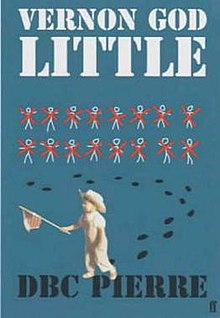
There’s an immense power to DBC Pierre’s 2003 Booker Prize-winning Vernon God Little which with its troubled and intense fifteen year-old narrator has unavoidable echoes of Salinger’s The Catcher in the Rye. In style the novel owes an obvious debt to the energetic first-person participatory traditions of Gonzo journalism.Vernon God Little - Wikipedia
Any summary of the novel will smooth out the wrinkles in the plot and present it as a coherent narrative, one in which the reader knows what is happening at all points and in which the dots are joined up. People’s motivations are explained and secrets and lies are laid bare. Of course the reading experience is very different from that – Vernon is not interested in carefully explaining to us ‘what happened’. Instead he breathlessly tells us what ‘is happening’, as well as articulating his feelings about his experiences. This gives the novel an immediacy but also challenges the reader to construct a coherent whole out of what we are told. Sufficient information is provided to be able to piece things together, but we have to do a lot of the heavy lifting.

There has been a school shooting at Vernon’s school in Martirio, the ‘barbecue sauce capital of America’ in Central Texas. The killer is his friend Jesus, a Mexican student who was mercilessly bullied by the other students. Vernon was not involved in – in fact tried to prevent – the shooting, but he nevertheless is suspected by the local police. Vernon’s alibi – that he was running an errand for a teacher – is hard to prove as the teacher is in hospital, a victim of the attack. Things take a turn for the worse for Vernon when he meets Eulalio Ledesma, probably the most groteque monster of the many in the novel. Ledesma claims to be a reporter, and worms his way into the affections of Vernon’s single mother, promising to help Vernon tell his side of the story. But the chance of a sensational story is too good to miss, and Ledesma runs a story naming Vernon as a participant in the killings. Vernon is arrested and at his bail hearing the court orders a psychiatric assessment.

Vernon realises there is going to be no justice for him in Martirio, so he begins to make plans to abscond to Mexico, eventually rustling up sufficient funds to pay for the trip by blackmailing a local paedophile. This scene is essentially one of several bad taste jokes that have not aged well. Vernon’s journey to Mexico becomes a conventional road-trip across the South, which ends in disaster when he is tricked in a ‘honey-pot’ trap into confessing to involvement in the school shootings. He is dragged back to Texas for a show trial where he is convicted and sentenced to death. Ledesma’s influence has spread on the back of his coverage of Vernon’s story, and he is now able to organise televised executions as part of a reality show where people vote on which convict they want to see executed. Big Brother, just at that point taking off in the US, is referenced. Most of the novel to this point has been relatively realist, albeit with an absurdist element to many events, but this departure into dystopian satire might be perceived as unrealistic – but the pace of the novel at this point is such that for me Pierre gets away with it.

The climax to the novel is wonderfully contrived and enormously satisfying.

Pierre’s descriptive writing is intense, using imagery that only indirectly references its subject, as well as a lot of slang and a fair share of profanity. Combined the effect is often poetic and very effective:

Outside, a jungle of clouds has grown over the sun. They kindle the whiff of damp dog that always blows around here before a storm, burping lightning without a sound. 

The angst of being a teenage boy in America is captured brilliantly. Vernon is constantly both aroused and confused, particularly by his sense of smell:

When the rubbing of her thighs has faded, I crane my nostrils for any vague comfort; a whiff of warm toast, a spearmint breath. But all I whiff, over the sweat and the barbecue sauce, is school—the kind of pulse bullyboys give off when they spot a quiet one, a wordsmith, in a corner. The scent of lumber being cut for a fucken cross.

It is strange that a novel which revolves around a school shooting, sadly now such a commonplace event in the USA, can be so joyful. It helps that there are plenty of really good jokes. At one point Vernon is promised help by a reporter:

“We could turn your situation around three hundred and sixty degrees…”

His response is to the point:

“Learn some fucken math.”

Later when Vernon is on Death Row, his mother tries to commit suicide:

“Mom closed up the house one day, turned the oven on full, and sat by its open door. Apparently, it’s still a Cry For Help, even though our oven’s electric.”

The novel’s satirical intent consistently hits its target. Consumerism in American society is mercilessly mocked. The tragedy of the school shooting is a business opportunity grasped by many in the town of Martirio. The poisonous Ledesma builds a media business out of it. Several of the women in town want to use the media focus on the shootings and Vernon’s trial to launch their own media careers. Even local children sell t-shirts darkly joking about the tragedy:

The Lozano boys are out hawking T-shirts on the corner of Liberty Drive. One design has ‘I survived Martirio’ splattered across it in red. Another has holes ripped through it, and says: ‘I went to Martirio and all I got was this lousy exit wound.’ Preacher Gibbons tuts, and shakes his head.

The local vicar is shocked, not by their tastelessness, but by the prices they are asking:

‘Twenty dollars,’ he says. ‘Twenty dollars for a simple cotton T-shirt.’

Vernon God Little stands out as one of the more unlikely Booker winners of recent years, a brave choice in a year when Brick Lane, Notes on a Scandal and Oryx and Crake were all on the short-list. For once I think the Booker judges called it right.
 

Vernon God Little by DBC Pierre, 2003

Aside
Book review
Possession (Byatt novel) - Wikipedia

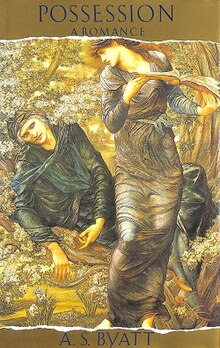
Possession was Byatt’s breakthrough novel, the first to attract significant levels of attention and sales, not least for winning the 1990 Booker Prize. I have a lovely hardback first edition of the novel with this gorgeous painting of the “Beguiling of Merlin” by Edward Burne-Jones used to illustrate the front and back covers.

Possession is a wonderfully rich, complex literary detective story and romance. That may sound an uncomfortable combination of genres, but Byatt makes it work. The novel is set partly in the pre-Internet 1980’s, where researchers haunt the Reading Room of the ‘London Library’ in search of insights into the greats of the nineteenth century. Roland Mitchell is a postdoctoral researcher into the life and works of Victorian poet and man of letters Randolph Henry Ash (widely understood to be based on Robert Browning, although no knowledge of the poet or his work is required to appreciate the novel). Mitchell accidentally finds some previously undiscovered draft letters hidden in the pages of a book that once belonged to Ash:

‘The book was thick and black and covered with dust. Its boards were bowed and creaking; it had been maltreated in its own time. Its spine was missing, or, rather, protruded from amongst the leaves like a bulky marker. It was bandaged about and about with dirty white tape, tied in a neat bow.”

This is a find to be treasured, the equivalent of a map with a large X on it, and is the jumping off point for a frantic search for the untold story of a great Victorian love affair.

Byatt carefully recreates the detail of this literary detection, including the pleasure to be derived from the excitement of the hunt. The letters Mitchell finds are written but unaddressed to an unknown woman, and suggest a relationship of some kind. He quickly identifies the mystery woman as Christabel LaMotte, a minor Victorian poet previously not known to have been acquainted with Ash. This is the moment in Mitchell’s otherwise disappointing life that he has been looking and waiting for, a stepping stone to a new world of romance, excitement and success – if he can ‘crack the case’. He impulsively steals the letters and travels to Lincoln to consult with the leading scholar on LaMotte, Dr Maud Bailey. (Byatt gives her primary modern characters Roland and Maud distinctly archaic and literary names to emphasise their connection with their subjects, Christabel and Randoph). Bailey is a feminist academic, and Byatt has some high-brow fun with the politics of late twentieth century academia.

Mitchell and Bailey are bound together into their clandestine investigation – Mitchell knows that if he were to report his discovery to his supervisor he would have the search taken out of his hands. They target a local country house owned by descendants of LaMotte as the most likely location of any surviving private papers. The discovery of a bundle of letters found in a doll’s cot is the breakthrough they have been looking for. The correspondence between the poets reveals a blossoming friendship and tantalising clues. For a while this parallel couple – Byatt spends quite some effort spelling out the many and varied similarities between the Victorian poets and their twentieth century counterparts – take centre stage, and the novel within the novel tells the touching story of their romance. Ash is trapped in an affectionate but celibate marriage, while LaMotte’s relationship with friend and possible lover Blanche Glover is no less troubled.

In an impressive feat of literary ventriloquism Byatt creates a huge volume of letters, poems, notebooks and diaries between and about the couple. She “quotes” whole extended poems by Ash and LaMotte. I confess these left me unmoved and my eye often slide down the page in that way the brain has of refusing to cooperate with the will. For me the novel works despite these creations rather than because of them. no matter how impressive they are as an authentic recreation of the past.

Mitchell and Bailey’s discovery is uncovered, and other academics begin to track down the story. The novel builds to a climax in that most stereotypical of Victorian settings, a graveyard on an dark and stormy night. Byatt cleverly uses the drama of the still recent real-life Great Storm of 1987 to provide a suitably tempestuous setting for the finale in which the secret at the heart of the investigation is revealed.

The literary mystery drives the narrative, but it’s mainly hokum – the box of papers buried with Ash which finally reveals the ‘truth’ about his relationship with LaMotte is known about from the beginning, and all the intervening steps of discovery are in both senses of the word academic. But the investigation allows the relationship between Maud and Roland to slowly mature and finally blossom, leading to a happy-ever-after of sorts for both the twentieth century couple and their nineteenth century counterparts.

Byatt teases the reader with a progression of uses of the term ‘possession’. Yes, it is the kind of novel where pleasure can be derived from games of this kind should you choose to do so. At first the term suggests obsession: in interviews Byatt has talked about seeing

“a well-known Coleridge scholar in the British Museum Library:. ”I thought, it’s almost like a case of demonic possession, and I wondered – has she eaten up his life or has he eaten up hers?”.

Certainly an obsession with Ash and LaMotte consumes not just crime-fighting duo Mitchell and Bailey, but also most of their colleagues. Sad Dr Nest has spent her life working on the diaries and notebooks of Ellen Ash, Randolph’s wife, even though she is really more interested in the works of Randolph himself; deep-pocketed American Cropper is the novel’s true villain, with his quasi-sexual interest in objects previously owned by Ash; Professor Leonora Stern, a brash sexually predatory American LaMotte scholar (Americans don’t come out well in this novel) unwittingly provides a clue to what happened to LaMotte after her romantic holiday with Ash; and Professor James Blackadder has been editing Ash’s Complete Works in ” for over 30 years (Incidentally, I checked, and the television series Blackadder predates this novel by seven years, so the choice of name is presumably deliberately comic?).

Later ‘possession’ comes to assume its meaning of ownership of property. I learnt more about the law of copyright than I expected in what is at its heart a romantic novel, as lawyers struggle over ownership of the key papers in the narrative. Finally, at the very end of the novel, the term possession is introduced in its sexual context:

“And very slowly and with infinite gentle delays and delicate diversions and variations of indirect assault Roland finally, to use an outdated phrase, entered and took possession of all her white coolness”.

There are other literary games to be played in Possession. The text is sprinkled with unattributed quotes, reference and allusions – I am sure I only spotted a few of the many lurking there, such as the reference to Marvell’s To His Coy Mistress, or the quote from Milton (“Thrones, Dominations, Princedoms”) used in Ash’s ‘Mesuline’. All of the characters in the novel are literary people who include references like this in their everyday speech as a matter of course, but it is fun spotting them, and will no doubt one day keep a researcher/PhD student fully occupied for a few months. There are many references to 19th Century authors, poets and other public figures – George Eliot is mentioned at least three times in the first 100 pages alone. Another source of interest is the way Byatt suffuses her text with motifs – fish in particular are everywhere (I spotted references to koi, octopi, sea creatures, flying fish, electric eels and mermaids, to mention a few). The novel is also vividly flooded with colour – there are mentions of every shade of the rainbow throughout the text.

I can remember being blown away by Possession when I first read it 30 years ago. It’s not the novel I read then, obviously, but it retains a similar impact. Jay Parini in the New York Times review described it as “a tour de force that opens every narrative device of English fiction to inspection without, for a moment, ceasing to delight“ which is a wonderful summary of the novel’s achievement. I can remember being a bit cross that this novel beat Beryl Bainbridge’s wonderful An Awfully Big Adventure to the 1990 Booker Prize but on more mature reflection I can recognise the decision was just. Byatt once said that she was aiming for “the kind of warmth of a Shakespearean comedy” and I think it is fair to say that this is a case of mission accomplished.

Possession, by A S Byatt, 1990

Aside
Book review

I am having a really poor run at the moment – this was the latest of a series of disappointing novels, in many ways the worst of the lot! It was Coetzee’s first Booker Prize winner, the other being Disgrace in 1999.

Life & Times of Michael K is set in a dystopian South Africa in which a civil war is being fought. The protagonist Michael K is born with a hare lip. He is also what was once thought of as “simple” and although not an orphan was effectively abandoned as a child and sent to live in an institution. A doctor who later treats him explains:

He is a simpleton, and not even an interesting simpleton. He is a poor helpThe Life and Times of Michael K, J. M. Coetzee, Good Bookless soul who has been permitted to wander out on the battlefield, if I may use that word, the battlefield of life, when he should have been shut away in an institution with high walls, stuffing cushions or watering the flower beds

In many ways this is a simple journey story. Michael works as a gardener and his mother is an ailing domestic servant. Law and order is breaking down in the coastal city where they live. Michael’s mother persuades him to help her escape the conflict and privations of the city and take her on a biblical exodus to her home town near the mountains. She dies during the journey, but Michael continues his pilgrimage alone, carrying her ashes with him. He settles in an abandoned farmstead, living off the land and making rudimentary attempts to grow food.

Michael’s time in the wilderness also has biblical overtones – his attempts to scratch a living from the surface of the earth is a hard, unremitting grind for the reader. The allegorical nature of Michael’s suffering is subtle but nevertheless unavoidable – this must be an allegory because otherwise it would be utterly meaningless.

Eventually he is captured as an undocumented citizen, suspected of working for the resistance, and sent to a prison camp. By now his fragile health has deteriorated further, and he appears to be starving. I haven’t been able to locate the original source of this claim, but I have read that Coetzee has said in interviews that the inspiration for this novel was a newspaper article about a captured panda that refused to eat the food it was fed in captivity. Once captured Michael K adopts the same approach, although there is no suggestion that this is a hunger strike or anything other than an illness. It is more an inability to eat than a refusal. He continues to lose weight, and the doctor who narrates the novel’s second section struggles unsuccessfully to understand his motivation for refusing food. I wasn’t comfortable with the portrayal of an illness as a philosophical protest or existential statement.

Michael eventually escapes from the camp, and in the last section returns to the city. He meets some vagrants who appear more attuned to life outside civilisation, and who effectively adopt him. At this point, with no suggestion that Michael has come to any resolution of his situation, the novel ends abruptly and inconclusively.

It is hard to care for Michael K. He is passive and has nothing of interested to say about his experiences. It is possible we are intended to see him as a Forrest Gump-like figure, with his simple lifestyle and even simpler thought processes giving us insights into the human condition. If that was the intention then I can’t say it worked. Towards the end of the novel Michael acquires a more analytical monologue which for some reviewers sits unconvincingly with his former passivity and incomprehension. His thoughts become positively philosophical:

How fortunate that I have no children, he thought: how fortunate that I have no desire to father. I would not know what to do with a child out here in the heart of the country, who would need milk and clothes and friends and schooling. I would fail in my duties, I would be the worst of fathers. Whereas it is not hard to live a life that consists merely of passing time. I am one of the fortunate ones who escape being called.

Michael is an innocent adrift in a world of sin and corruption, but my appetite for parables is a bit jaded at the moment – perhaps I need some escapism and an interesting story instead? The New York Times said in a review that Coetzee’s theme in this novel is “the wild and merciless power of inanity.” If you are looking for a novel about the inane then look no more, this is the one.


Life & Times of Michael K, by J M Coetzee, 1983

Aside
Book review

Notorious for being described by one of the 1994 panel of Booker judges* as “crap”, How Late is Was, How Late is a stream of consciousness novel written in ‘Glaswegian demotic’. It spans a week in the life of Sammy, a shoplifter and ex-convict, who gets drunk, fights with the police, and is beaten by them so badly that he is blinded. The assault happens in the opening weekend leaving the bulk of the novel to relate his clumsy and sometimes tragi-comic attempts to come to terms with his condition, to navigate the streets of Glasgow, and make a half-hearted claim for disability benefit. He refuses almost all help despite desperately needing it, and slowly reveals a small amount about his past, including two long spells in prison.
The language of the novel will be a challenge for many readers. Here’s a short extract by way of illustration:

Ye wake in a corner and stay there hoping yer body will disappear, the thoughts smothering ye; these thoughts; but ye want to remember and face up to things, just something keeps ye from doing it, why can’t ye no do it; the words filling yer head: then the other words; there’s something wrong; there’s something far far wrong; ye’re no a good man, ye’re just no a good man. Edging back into awareness, of where ye are: here, slumped in this corner, with these thoughts filling ye. And oh christ his back was sore; stiff, and the head pounding. He shivered and hunched up his shoulders, shut his eyes, rubbed into the corners with his fingertips; seeing all kinds of spots and lights. Where in the name of fuck…”

You will note how the narrative point of view and tense wanders. Initially the narrative is in the first person, but then the text starts referring to Sammy as “he” – illustrating, I suppose, his sense of alienation – he sees himself as a secondary character. If you read that and thought it was relatively easy to follow, just think of the cumulative impact of nearly 400 pages of its unrelenting incoherence. The 4000 “fucks” weren’t really a problem for me – people do speak that way – but the question was do I want to listen to them? Did Sammy have anything interesting to say, or is he just a confused incompetent?

How Late sat on my bookshelves unread for what was probably decades. I was put off by the extraordinarily dull cover (see above) and more seriously by the ferocious dialect. In truth it really only takes a few pages to understand the conventions Kelman uses, such as “the gether” for “together”, “sodjers” for police, and so on, and to get into the rhythm of the Glaswegian voice.

I was hoping some coherence would be brought to the narrative – that we would find out more about why his girlfriend has disappeared for example. But we never do, and puzzlingly Sammy never makes any attempt to find out. He is anxious to ensure that family and friends don’t find out about his blindness, and even when he eventually consults a doctor there is no serious discussion on whether the condition is temporary or permanent, possible referral to a specialist, or any treatment. Earlier the police arrest Sammy for reasons that are never explained but may be something to do with an associate who has a more substantial criminal record. Any hope that these threads will combine or end up making any sense are left unfulfilled. 

I kept waiting for the book I hoped Kelman was writing to emerge from the shadows, but to my huge disappointment it never did. There is clearly a lot Sammy decides not to tell us – although why he would conceal it from himself is not obvious – and while we do find more out about him over the course of the novel, much is left unsaid. What I expected to happen is that the slow reveal would finally piece together, and that pieces would fall into place, revealing the explanation for the randomness of Sammy’s life, why he refuses to seek help for his blindness, where his girlfriend has gone and why he doesn’t seem that interested in finding out. Late in the novel his teenage son Peter is introduced. He obviously cares for his father and is anxious to help him, but Sammy rejects his offers of help (apart from his money) and lies comprehensively to him, swearing him to secrecy about his sight loss for reasons which seem more to do with pride than anything else. Perhaps it is just middle-class of me to expect Sammy’s like to have some structure or reason, rather than just being the one big mess it is.

Overall this was hard work. Sammy is profoundly unlikeable, showing occasional glimpses of intelligence which are misleading – he quickly reverts to a bovine refusal to accept any assistance or attempt to improve his desperate situation. I appreciate that in creating Sammy Kelman wanted to give a voice to the oppressed working class, and Sammy’s independent streak and refusal to accept assistance is in some ways admirable, but in fact the novel does the working class a disservice. Most working people simply would not behave in the irrational way Sammy does throughout the novel. They accept help when needed, and their relationships are important enough for them to ask after their partner when they disappear. Their lives may be chaotic and disorderly, but they are not without reason.


*Julia Neuberger. In a later, generally positive review, the Guardian called the novel “a miserable slog” and in a masterly understatement “unlikely to improve anyone’s beach holiday”!

How Late it Was, How Late, by James Kelman, 1994

Aside
Book review

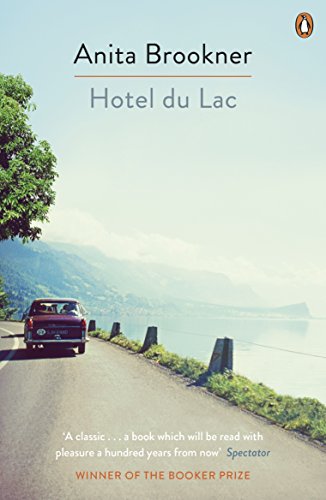
Hotel du Lac, by Anita Brookner, 1984

I am sure there are exceptions, but most great novels have great opening lines. “It was the best of times”, “All happy families”, “It was a bright cold morning” and so on. Anita Brookner by contrast chose to open Hotel du Lac with the following:

“From the window all that could be seen was a receding area of grey.”

Which won’t be going into any collections of great opening lines any time soon. This self-consciously down-beat opening sets the tone of the novel – this is going to be a mono-chromatic sketch where the reader is going to have to do a lot of the work.Image result for Hotel du Lac, by Anita Brookner, 198

Edith Hope, author of romantic novels such as Beneath the Visiting Moon and The Stone and the Star, has fled from London to the Hotel du Lac in disgrace. Initially we are not told the reasons for this flight – some sort of scandal is hinted at. It emerges she has been having an affair with a married man, to whom she pens forlorn love-letters. We are initially led to believe that this is the cause of her exile, although it later emerges that it is her decision to leave her groom (another man entirely, naturally) at the altar that has outraged her friends and led to her banishment. Why deciding not to go through with an ill-advised wedding is considered such a cause of outrage is never made clear.

The hotel is a suitable location for Edith’s contemplation of her future:

“The Hotel du Lac was a dignified building, a house of repute, a traditional establishment, used to welcoming the prudent, the well-to-do, the retired, the self-effacing, the respected patrons of an earlier era.”

“As far as guests were concerned, it (the hotel) took a perverse pride in its very absence of attractions, so that any visitor mildly looking for a room would be puzzled and deflected by the sparseness of the terrace, the muted hush of the lobby … There was no sauna, no hairdresser and certainly no glass cases displaying items of jewellery; the bar was small and dark and its austerity did not encourage people to linger.”

The portraits of the other guests at the hotel provide Edith with illustrations of the choices before her (and, we might reasonably extrapolate, many women in her position) as she considers her next steps. They are all lonely in their different ways. There is the overbearing widow Mrs Pusey, who has made a vocation out of shopping, so empty is her life; her devoted daughter Jennifer, secretly far less docile than her mother believes her to be (the novel hints at sexual liaisons between Jennifer and Alain, the hotel’s waiter, and later Mr Neville); Mme de Bonneuil, who lives in isolation at the hotel, expelled from her chateau, now inhabited by her son and his wife, and Monica, living alone the hotel on the instructions of her husband to fix her “eating disorder” and become fertile enough to bear him an heir.

“She (Monica) hates and fears her husband, but only because he has not protected her, and she sees herself condemned to loneliness and exile. In this she is prescient. I see her, some years hence, a remittance woman, paid to live abroad, in such an hotel, in various Hotels du Lac, her beautiful face grown gaunt and scornful, her dog permanently under her arm. ”

Edith also has a friend back in London, Penelope – “a handsome woman of forty-five and would remain so for many years” (one of the novel’s better lines).

To Penelope, men were conquests, attributes, but they were also enemies; they belonged to the species that must never be granted more than the amount of time and attention she considered they deserved.”

The boorish Mr Neville presents Edith with a final choice: a marriage without love or respect, No matter that he has only known her for a matter of days. Neville is looking for a “safe” wife who will maintain his home and offers to turn a blind eye to any lovers she might take. Possibly the absurdity of this proposal is intentional, although Edith seems close to accepting despite her disastrous engagement itself only weeks earlier.

There is something quite circular about romantic novels about romantic novelists. At several points it is not clear whether Brookner is writing about her character, or about the novel itself. When Mr Neville, in an extraordinarily clumsy attempt at seduction, insults her, Edith

“to contain her anger…tried various distancing procedures..the most productive of which was to convert the incident into a scene from one of her novels”.

In her sad letters to her silent lover Edith adopts the role of narrator of the novel, recounting various scenes of minimal activity by the other guests (indeed this is a novel where so very little happens other than walks being taken and coffee drunk that we might almost be in a Virginia Woolf novel, whom we are constantly told Edith looks like). Later Edith consoles herself with the thought that

“Fiction, the time-honoured resource of the ill-at-ease, would have to come to her aid.”

Is this what we are reading – simply an act of consolation, a distraction for the ill-at-ease? Intended or not I can’t think of a way in which Brookner could have more clearly reminded the reader that this is just a novel, her characters are not real, and all this never really happened, something that other novelists are at pains to conceal. This is not some Brechtian ultra-realistic narrative however, but a story about a woman thinking about her life.

The tone and pace of the novel are consistently grey and slow, but there was one scene towards the end of the novel which jarred acutely. Mr Neville is proposing marriage to Edith. He is essentially a well-groomed thug, and manages to insult her throughout the proposal. (If this is intended to remind readers of the clumsy first proposal in Pride and Prejudice, it doesn’t). Upset, Edith starts to weep, and his response is startling:

“Edith, said Mr Neville. Please don’t cry. I cannot bear to see a woman cry; it makes me want to hit her. “

If that wasn’t bad enough, and it is, a few moments later, while she sobs on his shoulder, he muses:

“You are very thin…I am afraid that I might break you in half”.

It is possible Brookner did not intend the threat of sexual violence explicit in this line, but it is hard to imagine otherwise. Most women would I suspect want to get as far away as possible from this man, but Edith meekly accepts his proposal.

Brookner is not a bad novelist. Her use of language is controlled and precise. The Penguin edition of the novel mentions that Brookner “is the author of 24 novels, many of which are available in Penguin” – that “many” is quite poignant. It is however a puzzle why this novel was considered the best written or published in 1984. It’s not the first unusual decision by the Booker panel, but it is one of the strangest.


Standard
Book review

Moon Tiger by Penelope Lively, 1987

Penelope Lively won the 1987 Booker Prize for this interesting, eminently readable but ultimately unsatisfying novel. It tells the story of Claudia Hampton, a 76-year-old historian. As Claudia lays dying in hospital she narrates the story of her life in an internal monologue. The narrative is complex, with the point of view changing constantly, and with time and place jumping across the decades and across the continents.
The novel’s title is romantic and mysterious, but the explanation when it comes – a moon tiger is a rather absurd name for an anti-mosquito candle (see picture) which burns slowly through the night – is disappointingly prosaic, involving neither moons nor tigers. The moon tiger is co-opted as a rather heavy handed symbol for the human experience – we all glow brightly and then end up as ashes – but I was still disappointed that something so romantic-sounding could be such an everyday utilitarian object.

Lively creates some vivid characters in this narrative. Claudia’s brother Gordon is for a while her incestuous lover – this is their closely-held for the rest of their lives, but is not portrayed as a damaging or harmful experience.  At the outbreak of the second world war Claudia becomes a war correspondent (as one does) and travels to Cairo, where she meets and begins an intense relationship with Tom Southern, captain of an English armoured tank division. This, we know from the comments of contemporary Claudia looking back on their time together, (although it is narrated in real time) is a doomed war-time affair, and inevitably Tom is killed at El Alamein. 

After the war Claudia meets Jasper, an artistic aristocrat with whom she goes on to have a long-term but sporadic relationship from which she has her only child, Lisa. Lisa is not the free spirit her mother considers herself to be, and their relationship is strained. Later a gay Hungarian student, Lazlo, has a walk-on part in the narrative, although one has the impression that all of life’s events for Claudia after the loss of Tom are an afterthought. This is reinforced by the novel’s finale, when Claudia is sent Tom’s wartime diary which re-emphasises the intensity of his feelings for her. Regret for what might have been her life had he survived is one of her last thoughts before the novel closes.

Despite its innovative structure, this is a very traditional novel. It is a romance, albeit an exceptionally well-written one. There’s nothing wrong with that – Pride and Prejudice is a romance, and it is one of the best novels of all time. But has Moon Tiger got anything interesting to say about human relationships? I’m not sure. Do the characters come alive at all; do they ever go beyond being characters in a novel about whom one never really cares? At one point Claudia reminisces about Lazlo going for a walk in London, and bringing home a nice bunch of flowers, which, it later transpires, he unwittingly picked from a public park. At a dinner party this might be a short, not particularly funny about how foreigners don’t understand English social conventions. But here it is an awkward anecdote, intended to illustrate  Lazlo’s naivety, but never escaping the sense that it is a made-up story intended to play a role in a narrative, rather than something that genuinely happened to someone.

The death-bed format plays a factor here, depriving the narrative of any true surprises. It is probably my failure to engage with the text fully that stopped me caring about Gordon, Lazlo, or Jasper – they felt like background characters in the play of Claudia’s life – and it was only really Claudia and Tom, in the vivid chapters telling the story of their brief moments together, where the story truly felt real. It’s worth reading for that story alone.

Standard
Book review

Play review: Cleo, Camping, Emmanuelle and Dick, by Terry Johnson, 1998

I rarely review plays, but this is after all a reading diary, and I did read this play recently, so I am including it here for completeness. Plays should be seen, not read. Of course read them as well, but the text will only come to life once it is staged, blocked, and performed, when you work out what people are doing while other actors are saying their lines, where people are on the stage, and so on. You can do all that from a read through, but it is a very different experience from reading a novel. I didn’t read Cleo, etc that way – I just read the lines. Which probably took two hours, at most, and may well explain why I was underwhelmed by the experience.

Cleo, etc is a behind the scenes look at the lives and romances of the central characters of the Carry On films – Sid James, Kenneth Williams, and Barbara Williams. Imogen Hassall, who appeared in only one of the Carry On movies, also has a brief appearance intended to bring some pathos to the slapstick and show that all the rampant sexism is not without a price. The play spans a decade or more from when the movies were first popular – Cleo in 1964, the tenth film in the series, regarded sometimes as the best, to Emmanuelle (30) in 1978 in which the already well-scraped barrel was given a final going over.

If you are fan of the Carry On movies, or feel a sense of nostalgia for their amateurish slapstick and smuttiness, this play will act as a reminder of all that was awful about them, as well as their darker side – they seem to have been a bleak experience to make. It is not a coincidence that Johnson has Kenneth Williams sign-off with the line that was to be the last sentence in his diary – “Oh, what’s the bloody point” – before his suicide. There is also a passing reference to murder suicide of Joe Orton and Kenneth Halliwell in 1967.

I can imagine that in performance this play would have its amusing and touching moments, although the central figure, Sid James, is the least likeable of the cast. But on the page it fails to take off. The challenges of staging this play must be considerable. Most of the action takes place inside the caravan that Sid uses as his dressing room. At one point it rocks side to side as he has sex; on another occasion as a scene climax it collapses. It can imagine this would appear cramped on a large stage with most of the space unused.

Johnson is covering some very familiar territory here – few will be surprised that the clowns of the films had a melancholic side, or that extra-marital affairs and other misdemeanours were commonplace. The point that the smuttiness of the films covered an unhealthy attitude towards sex is hardly a revelation. So ultimately I am not sure there’s much more to say than to echo Kenny’s question – “what’s the bloody point?”

Standard
Book review

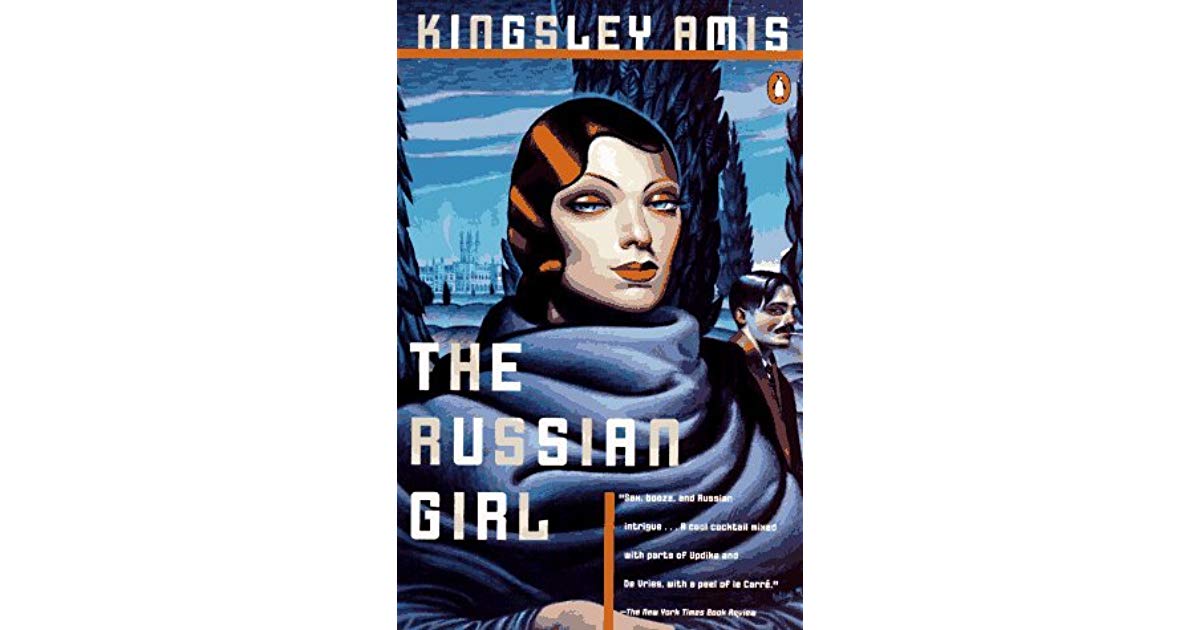
The Russian Girl, by Kingsley Amis, 1992

366437._UY630_SR1200,630_This is late Amis: The Russian Girl was published in 1992, just three years before his death. Amis is one of those novelists who essentially wrote the same novel over and over again, with slight changes of character and the setting thinly disguised. But this novel was an exception to that rule – instead of the older cast of characters bickering, having tired affairs and drinking themselves to death, The Russian Girl’s central character, Dr Richard Vaisey, is in his forties, and vaguely behaves like it. His inevitable love interest, Anna Danilova, the titular Russian girl, is in her twenties. An older academic having an affair with an exotic Russian girl (note girl, not woman; Amis was never going be that up to date) – what an original plot? But the scenario isn’t what redeems this novel.  Continue reading

Standard
Book review

The Old Devils, by Kingsley Amis, 1986

It is only human nature to assume that reasonable people will agree with you. So when I finished The Old Devils I looked for reviews in the expectation that they would broadly align with my thoughts – that the novel had stolen the 1986 Booker prize from The Handmaid’s Tale, that it was the work of an embittered writer at the end of his career publicly working out many of his frustrations and grievances with the modern world and his own mortality, and that time would not have been kind to critical reception of the novel.

But I was wrong.

When it was first published The Old Devils was lauded with praise, winning the aforementioned Booker but also being widely recognised as a late-flowering of Amis’s comic genius. John Bayley wrote an extraordinary florid paean to the novel in the London Review of Books which is worth reading in full for its hyperbole, its use of obscure language (fauteuil, donnée), its name dropping (Elizabeth Bowen, William Trevor, Anthony Powell, Henry James, Patrick Hamilton, Jane Austen (whom Amis has never much cared about”), A.N. Wilson and a “long ago purveyor of Gothic novels, Mrs Barbauld” are all name-checked) all without ever managing to put his finger on the elusive nature of Amis’s comic genius.

More recently a reviewer in the Guardian’s book column in 2010 wrote

“Kingsley Amis’s success at the 1986 Booker prize seems like the natural culmination of a long and distinguished writing career. One of the finest comic writers of his generation – century even – had done the natural thing and written a bloody brilliant book”

The Wales Art Review (? me neither) called the novel

“his greatest single creative achievement” and (together with Lucky Jim)

“Two of the greatest novels of the twentieth century without doubt”

V.S. Prichett, writing in The New Yorker described the novel as being in

the old, robust masculine tradition of British comedy from Fielding and Smollett”.

And of course son Martin thought that the novel

stands comparison with any English novel of the century.”

Would that weight of critical opinion sway me?

Not a vast amount happens in The Old Devils. Alun Weaver, a writer and minor celebrity, (we are told he is a writer, but he doesn’t seem to have written very much, and the extent of his celebrity is very much open to debate) returns to his native Wales with his wife, Rhiannon. Many years ago before the Weavers left Wales their friendship group had gone through the various re-configurations that happen among younger people. In particular Rhiannon had once been loved by Alun’s old friend and now enormously, comically fat Peter Thomas. Alun and Rhiannon resume life with their close knit group of friends almost as if they have never been away – there is no suggestion they would look for other social groups – which stirs up long dormant feelings amongst former lovers. That’s pretty much it. Time is spent drinking heroic amounts of alcohol that in the non-fictional world would leave people falling over drunk in a fraction of the time sustained here. not least because there seems little else to do. Amis concludes the novel with a death and a wedding, the latter between two younger characters who have been largely ignored during the previous chapters.

I have always thought of Amis as a good bad writer, one who writes clumsy, poorly constructed sentences simply as a way of drawing attention to their deliberate awkwardness. Take this sentence for example:

“As they stood, or with some minor surgery, they were supposed to be, he had striven to make them, his devout hope was that they were, the opening section of the only really serious piece of prose he had written since his schooldays.”

These are the faltering thoughts of Alun Weaver considering the opening pages of a novel he has just started, and which turns out to be, by consensus, rubbish. No doubt it took a lot of care and craft to make the sentence so unclear and scrappy, and it does admittedly reflect Alun’s thoughts and apparently his gifts as an author. But it’s still a horrible sentence, no matter how many times you read it.

Here’s another example:

All sorts of stuff, for instance what had been taking place a little earlier, seemed much as before, or at any rate not different enough to start making a song and dance about. This state of affairs might well not last for ever, but for the moment, certainly, the less it changed the more it was the same thing, and the most noticeable characteristic of the past, as seen by him, at least, was that there was so much more of it now than formerly, with bits that were longer ago than had once seemed possible.

Ultimately you can choose to read this as a gentle meditation on aging, or the cliche-ridden (song and dance, state of affairs) muttering of someone growing old disgracefully.

The humour in the novel is intended to derive from Amis’s portraits of flawed human nature. People are pompous, lecherous, complacent, stupid, and all manner of human weakness is on display for our entertainment. But I really struggled to care about these largely unpleasant people. There were several points in the novel where I was unable to work out who was speaking in a passage of dialogue, and then suddenly realised it didn’t really matter because I didn’t care.

Here’s Amis’s unflattering portrait of Malcolm, one of the group of friends, dressed to impress an old flame:

“When he had got out of his very shiny bright-blue car and at a second attempt shut its driver’s door, Malcolm revealed himself to be wearing a hacking jacket in dark red, green and fawn checks that were too large by an incredibly small amount, cavalry-twill trousers he must have been uncommonly fond of, a pale green I’m-going-out-for-the-the-day-with-my-old-girlfriend cravat or ascot, and, thank goodness, a plain shirt and ordinary brown lace-up shoes.”

Is this brilliantly observant, or crudely done? Older people don’t dress very smartly, even when they are trying hard to impress. The point of view judgment in this analysis comes from Rhiannon, the old-girlfriend in question, who gives thanks for the plain shirt and ordinary shoes. Amis deploys these subtle changes of point of view with the skill of an experienced writer, unquestionably, but I am not convinced that there is much humour here, even if there is less spite than earlier late Amis either.

I appreciate I am edging round the question of whether I actually thought The Old Devils was any good. Let’s put it this way – I have my doubts. Without question the praise I have referenced earlier in the post is over the top. This is not a classic or a masterpiece or anything like it. Most of the time I managed a wry smile, at best, and much of the time I was bored. The characters are hard to like – Amis goes out of his way to make them unattractive and unappealing, and they are poorly delineated, particularly the women who Amis struggles to distinguish between other than by their physical features.

My principal source of irritation with this novel is its dishonesty. Amis had at this point in his career developed a reputation as a declining writer focused on personal themes – his serial adultery, his alcoholism, his declining health. He has sketched out a series of characters with these qualities or attributes, then ventriloquized through them on his tired personal and political hobby-horses – homosexuality, the ridiculousness of compulsory Welsh/English language public signage, faux-Welshness, trade-unionists and so on. Of course one must always be careful to distinguish between the personal views of an author and their characters, but there is a strong case for concluding that Amis shares many of the prejudices his characters articulate – he repeats these views consistently in a series of later novels, he attempts to make the characters articulating these views sympathetic and invariably shows only the reasons why they are justified in these views – opposing views are ignored. Reviewers seem relieved that this is not the openly misogynistic rant of Stanley and the Women or Jake’s Thing, but that doesn’t make it Lucky Jim either.

Finally, and for me most seriously, there is what I think of as the “shagger” issue. (apologies for the language but it seems appropriate in the context, and any euphemism wouldn’t quite meet the mark). There is a recurring character in many of Amis’s novels who is an appalling chauvinist with nevertheless a mysterious and limitless powers of seduction. He is always on the lookout for an opportunity for random sexual encounters, however inappropriate or untimely, always “up for it” irrespective of time, place or situation. He will sleep with anyone at anytime, and inexplicably has the power to persuade the women in his life, invariably married to someone else – to sleep with him with the minimum of seduction/persuasion/courtship. They just jump into bed with him – because the narrator can portray them doing so, not because these powers are in any way realistic or believable. So Alun Weaver has not been back in Wales many hours before he pops in to visit Sophie, wife of an old-friend, in the expectation of a casual encounter. The conversation is initially hostile but Alun charms his way into Sophie’s bedroom, and slowly the quotation marks are interrupted by rows of dots suggesting intimacy is underway. They only confirmation that the seduction has succeeded is the phrase “Much too late to spoil it the telephone-bell rang on the landing”, “it” in this context being Amis’s coy euphemism for sex.

This is all a long-winded way of explaining why I think the critics I cited earlier in this post were wrong, and why this novel has aged poorly. I looked at the Goodreads reviews for this novel to see if contemporary opinion of the lay reader was closer to mine. This is obviously a question of me seeking evidence for a previously determined position, because if these statistics had not confirmed my conclusions I would probably not have included them, but here they are. Goodreads reviewers gave The Old Devils an average score of 3.33 out of 5. That’s below average for most Booker prize winning novels. I sampled a number of others at random and only Anne Enright’s The Gathering scored lower at 3.07. (Full results as follows:)

The Sense of an Ending Julian Barnes 3.72

The Sea John Banville 3.51

White Tiger Aravind Adiga 3.73

Life of Pi Yann Martell 3.90

How Late it was, how late James Kelman 3.57

Paddy Clarke, Ha, Ha, Ha Roddy Doyle 3.76

Wolf Hall Hilary Mantel 3.86

The Seige of Krishnapur J.G. Farrell 3.90

A Brief History of Seven Killings Marlon James 3.87

The Milkman Anne Burns 3.61

The Sellout Paul Beatty 3.77

Lincoln on the Bardo George Saunders 3.77)

So on average the good readers of Goodreads agree with me, which is a comfort, of sorts.

Standard
Book review

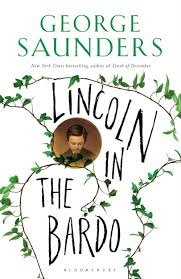
Lincoln in the Bardo, by George Saunders, 2017

lincoln

When Lincoln in the Bardo won the 2017 Booker prize, much of the media coverage focused on the apparent ‘difficulty of the novel’, probably encouraged by Saunders’s interviews on the topic. In fact the novel is wonderfully accessible, once the reader has adapted to the slightly unusual narrative technique.

The novel has many different narrators – by one count over 160 – and it cuts quickly between these different voices. On the page it is presented like this:

An exceedingly tall and unkempt fellow was making his way toward us through the darkness.
hans vollman

This was highly irregular. It was after hours; the front gate would be locked.
the reverend everly thomas

The boy had been delivered only that day. That is to say, the man had most likely been here –
roger bevins iii

Quite recently.
hans vollman

As you can see, the author has helpfully indicated which character is speaking, which is normally fine – I found myself quickly adapting to this technique, which seems a commonsense way of avoiding the “he said, she said” reporting of conversation which can be dull. Often it is not particularly important which character is narrating, because the three above act largely as a kind of chorus to the action, finishing one another’s sentences, as here, but when it matters it is simple enough to check. Less frequent narrators are usually given distinctive voices, speech patterns, or language. Note incidentally that it is virtually impossible to describe this approach without using the language of the spoken word – voice, speech, speaking, etc. This is because these sections of the novel are effectively a script. If the text was written this way it would not be a cause for comment or seen in any way as difficult:

Hans Vollman: “An exceedingly tall and unkempt fellow was making his way toward us through the darkness.”

The reverend Everly Thomas: “This was highly irregular. It was after hours; the front gate would be locked.”

Roger Bevins III: “The boy had been delivered only that day. That is to say, the man had most likely been here.”

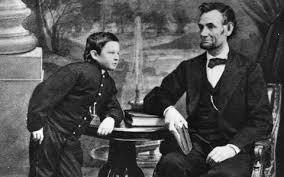
Lincoln in the Bardo takes as its inspiration the death from typhoid of Abraham Lincoln’s 11-year-old son, Willie, in 1862, as the civil war was beginning to take a toll on both sides. In his grief Lincoln visited the crypt where his son was interred. Saunders cuts between historical details of the event taken from what appears to have been a lot of research with a much stranger story in which Willie’s spirit is received by the ghosts of the cemetery, who in turn reveal their own personal accounts of how they died. “Bardo” is apparently the Tibetan Buddhist name for a form of purgatory, a transition period between death and rebirth which is where these ghosts choose to remain, mostly refusing to accept the fact of their deaths.

lincoln2

Abraham and Willie

They instead believe themselves to be injured, but with a chance of exiting their “sick-boxes” (a euphemism for coffins) and returning to their former lives. They argue that as they are able to think and feel, they cannot be dead, although the word itself is scrupulously avoided. The principal narrators, quoted above, are Hans Vollman, who longs to return to his unconsummated marriage, forever cursed him with a freakishly engorged member, Roger Bevins iii, ashamed of his gay feelings, who cut his wrists only to change his mind moments too late, and Reverend Thomas, hiding in the Bardo from the threat of eternal damnation, and trying to find in his memories the reason for his fall.

The arrival of young Willie provides a distraction from the eternity of waiting they face, as they struggle to persuade him to move on. He is reluctant to do so because of his grieving father’s visits. Saunders builds a compelling portrait of these and the other inhabitants of the bardo, a cast of desperate, sad, lonely and disturbed “survivors” refusing to accept the fact of their own deaths, under regular siege from recruiters – angels or demons – from the next world. Many of the ghosts are hideously deformed with physical representations of their moral failings or the worries that tie them to the world of the living: for example a miser is “compelled to float horizontally, like a human compass needle, the top of his head facing in the direction of whichever of his properties he found himself most worried about at the moment”. These sections of the novel are often disturbing – the idea of death as something that can be ignored by strength of will alone is not in itself original, but the troubled lives of so many of Saunders’s characters are sometimes not easy to read. The portrait of Lincoln, a devastated father trying to continue his burdensome duties as President, is convincing, and strikes a different tone from the strangely light, almost comic scenes in the cemetery. Lincoln comes to see his bereavement as the price he must pay for committing his country to a war in which so many other sons and fathers were to die.

I can see why this novel won the Booker, although I confess I have not read any of the other short-listed candidates. This was a £1 charity shop buy of a near immaculate copy – someone obviously wasn’t that impressed – which always makes the read that little bit sweeter!


Standard