Book review

G. by John Berger, 1972

The Bad Sex prize was set up in 1993 by Auberon Waugh, with the intention of “gently dissuading authors and publishers from including unconvincing, perfunctory, embarrassing or redundant passages of a sexual nature in otherwise sound literary novels”. It’s such a pity that the award wasn’t around when John Berger published G., because he would have run away with it. Perhaps they should introduce a retrospective prize?

Set at the end of the nineteenth and early twentieth century, G. is the story of a modern Don Juan, someone totally focussed on the pursuit of sex, to the exclusion of any other concerns or interests. Women fall out of their clothes and sleep with him at the first opportunity – he is irresistible to them. Strange how women only behave like that in novels written by men, isn’t it? Contemporary historical events, such as the outbreak of the First World War, are used as a backdrop to his sexual adventurism.

Trigger warning for very badly written sex:

“She opens her legs. He pushes his finger towards her. Warm mucus encloses his finger as closely as if it were a ninth skin. When he moves the finger, the surface of the enclosing liquid is stretched – sometimes to breaking point. Where the break occurs he has a sensation of coolness on that side of his finger – before the warm moist skin forms again over the break. She holds his penis with both hands, as though it were a bottle from which she were about to pour towards herself.” (109)

Berger was an art critic, and apparently developed the concept of the male gaze, (in feminist theory, the male gaze is usually defined as “the act of depicting women and the world, in the visual arts and in literature, from a masculine, heterosexual perspective that presents and represents women as sexual objects for the pleasure of the heterosexual male viewer”) which makes it all the more remarkable that his writing about sex is completely from the male perspective, devoid of any empathy with women. Reddit has a forum called “Men writing about Women” which collects examples of men demonstrating their ignorance of female anatomy. Berger would fit right in there as well:

When he enters her, when this throbbing, cyclamen headed, silken, apoplectic fifth limb of his reaches as near to her centre as her pelvis will allow, he, in it, will be returning, she believes, to the origin of his desire.” (204)

If this cyclamen headed monstrosity wasn’t enough, the scene is illustrated by a childish sketch of a “fifth limb” that would not be out of place on a bathroom wall.

Later Berger pontificates on the differences between men and women:

If a woman threw a glass on the floor, this was an example of how she treated her emotion of anger and so of how she would wish it to be treated by others. If a man had done the same, his action would only have been an expression of his anger….This subjunctive world of the woman, this realm of her presence, guaranteed that no action undertaken within it could ever possess full integrity”. (150)

I’d like to think our understanding the differences between the sexes has matured somewhat since the early 1970’s!

I appreciate this all makes me sound very prudish, but to be clear, my concern isn’t with the fact that Berger describes sex, it is that he describes sex so very badly. But this isn’t just a bad sex novel. It’s a bad everything novel. The sex is as bad as the rest of the novel I am sorry to say. There are scenes of such intense embarrassment that I very nearly gave up –only the most stubborn completist streak in me kept me going. In a clumsy attempt at post-modernism, random fourth wall breaks are introduced into the text with irritatingly pompous asides by the author or narrator, such as

Some say of my writing that it is too overburdened with metaphor and simile: that nothing is ever what it is but is always like something else. This is true, but why is it so? Whatever I perceive or imagine amazes me by its particularity.” (136)

I know of course that this is intended, along with the fragmented narrative and various other ostentatious techniques to tell the reader that this is a post-modern novel where their expectations will be regularly confounded. It tries hard to be innovative and European, but underneath it all is a rewarmed version of a traditional sexual adventurer’s story.

I have written about this before, but one thing I can’t stand in realist novels is inauthenticity. Characters behaving in a mannered, unrealistic and obviously fictional way, not because the author wants to make it clear this is a non-realist text but because the author can’t write realistically. There is one scene in G. where this point was illustrated perfectly. G. is buying a woman, Camille (he endearingly calls her Camomile) a pair of Italian leather gloves, as part of his whole flawless, irresistible seduction technique:

“The Italian woman blew into the second glove before passing it to Camille. Filled with her breath, the glove took on the form of a hand which suddenly and deeply frightened Camille. It was a languid boneless hand, a hand without will, a hand floating in the air like a dead fish with its white stomach uppermost.” (172)

If you can persuade me that anyone, ever, was frightened by a glove, however fragile and nervous they might be, while buying a pair of gloves then I will give up reading this minute. It’s the second glove as well – it’s not like the gloves loomed up at her unexpectedly. This irritated me far more than it ought to have done, but for me it is the cardinal sin of the novelist. The characters become themselves mere puppets, tools of the novelist to display archetypal feelings or reactions, all to further the novel or avoid a plot complication. It’s not absurdist or experimental, it’s bad. Defenders of this novel will claim this alienation technique is deliberate, and that I am being far too literal in my reading. Which of course is quite possible. Is this a clumsy technique to ensure the reader pays attention to the construction of the novel as a cultural artefact? Or is it just bad writing? Some authors have earned the benefit of the doubt, and I will usually try to work out what really is going on when I am pulled up short by some apparently awful writing. But Berger, an English art critic, essayist, novelist, painter and author, hasn’t earned that degree of commitment from me as a reader.

Time can be cruel to a novel and novelists. G. was once deemed by a Booker prize jury to be the best novel written in 1972, albeit against a pretty forgettable shortlist (Susan Hill’s The Bird of Night, Thomas Keneally’s The Chant of Jimmie Blacksmith, and David Storey’s Pasmore. Both Keneally and Storey were to go on and win the prize themselves. Susan Hill said of her The Bird of Night that it “was a book I have never rated. I don’t think it works, though there are a few good things in it. I don’t believe in the characters or the story.”) Now G. is largely forgotten, unread except by Booker winner completists, and sometimes not even then. It’s not all bad, there are moments of interest – the description of the battles of World War One are actually readable. But these are brief interludes in the otherwise stultifying descriptions of G.’s attempts to seduce yet another young woman interspersed with the author’s pontifications on whatever idea had briefly captured his attention.

P.S. Goodreads says of Berger that “One of the most common themes that appears on his books is the dialectics established between modernity and memory and loss”. (That should be in his books surely?) Anyway, does anyone know what “the dialectics established between modernity and memory and loss” means?
Standard
Book review

The Testaments, by Margaret Atwood, 2019

This review is going to get me into trouble, at home if nowhere else. Because The Testaments was such a disappointment! While living up to the standards of her earlier works was always going to be difficult, some elements of the novel were reminiscent of fan-fic – based in the world so chillingly described in The Handmaid’s Tale, but unevenly written with poorly conceived characters and an implausible plot.

Of course I could self-censor, write about the things in the novel that I did like – Gilead is no less a scary dystopia than it was before, and of course Atwood hasn’t become a bad writer overnight – but what would be the point of that? If this blog has any purpose at all it is to act as a place where I record my authentic impressions of what I read, not what I am supposed to think. Having said that, I also owe any author, let alone one of such distinguished status as Margaret Atwood, the effort of trying to recognise the strengths in their work. So let’s start there.

Atwood’s political analysis of the oppression of women hasn’t fundamentally changed from Handmaid’s, but it remains as sharp as ever. For example, where she identifies what made women particularly vulnerable when Gilead first took over:

“All that was necessary was a law degree and a uterus: a lethal combination.”

Young women growing up in Gilead are brain-washed into thinking their bodies are the source of all sin:

“We were precious flowers that had to be kept safely inside glass houses, or else we would be ambushed and our petals would be torn off and our treasure would be stolen and we would be ripped apart and trampled by the ravenous men who might lurk around any corner, out there in the wide sharp-edged sin-ridden world.”

What has changed from Handmaid’s is that Atwood identifies the role of women as instruments of their own oppression. Some women are zealots who seem to genuinely believe men are the stronger sex who have the right to control women’s bodies; others simply do what they have to do to survive. As Aunt Lydia tells us:

Two roads diverged in a yellow wood, and I took the one most travelled by. It was littered with corpses, as such roads are. But as you will have noticed, my own corpse is not among them.”

The threats to women’s autonomy remain as significant as they were when Handmaid’s was written – but arguably that just makes the original novel all the more pertinent rather than requiring a sequel. Atwood’s reasons for writing this follow-up may well be as much to do with the success of the television adaptation as a burning desire to explore further the complexities of Gilead. I can’t blame her for that, and to be fair she doesn’t just write Handmaid’s Tale 2.

The original novel has an ambiguous ending. We know, due to the appendix, that Gilead doesn’t survive, but we don’t know how the regime ends, and we know nothing about the fate of the central character, Offred. We don’t even know her real name. Atwood has returned to Gilead to answer some of these questions. The novel uses the always popular multi-narrator approach, threading the testimonies of three key women. We hear more from Aunt Lydia about the circumstances in which Gilead and its institutions were founded, how it survived despite conflict on all its borders, and how eventually it fell. I haven’t worked out a clear timeline for the events of the novel, but the whole period seems little more than a few decades from creation to fall.

We also learn about life outside Gilead, in Canada and elsewhere, and the efforts of Mayday, an underground organisation, to rescue women from Gilead. Their work is consciously modelled on the Underground Railroad.

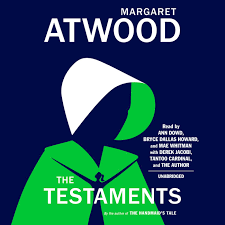
The Testaments by Margaret Atwood | Penguin Random House Audio

As well as Aunt Lydia’s narrative the novel interweaves testimonies – testaments – by two teenage girls, Agnes, the adopted daughter of Commander Kyle and his wife Tabitha, and Daisy, growing up in Toronto with her adoptive parents, Neil and Melanie, who run a second-hand clothes store. The three narrators alternate in short chapters which gave considerable pace to the narrative. It was obvious early on that the secrets about Daisy and Agnes’s parentage would be revealed, and how the threads of the narrative would eventually join.

Aunt Lydia is the dominant character in the novel – shrewd, knowledgeable, and a survivor. She is not above suspicion, but is able to manipulate (a little too easily) the characters around her to protect herself, while all the time working to undermine Gilead. The teenage girls show two completely different views of Gilead – Agnes has been born and raised in the country and has adopted its worldview unquestioningly. She has been taught that women must cover up to avoid inflaming male passions, and that reading is a source of sin. Her body is dangerous and she must be married at an early age to fulfil her purpose of having children. She is profoundly religious and keeps her faith even when her belief in the ideals of Gilead are shaken. Daisy on the other hand, having been raised in Canada, is an atheist and is opposed to everything Gilead stands for. She happily volunteers to go undercover into Gilead to recover some damning information about the regime, despite the obvious dangers.

Despite its status as a feminist novel of ideas, The Testaments works most effectively as an action novel. The climax of the narrative features a breathless escape from Gilead, with speedboats and helicopters thrown in for good measure, secret information hidden in a micro-dot (how very 1970’s!) hidden under one of the girl’s skin, disguised by a GOD/LOVE tattoo.

Atwood’s skill as a writer is without question, but her ability to craft a phrase stands out:

“The truth can cause a lot of trouble for those who are not supposed to know it.”
“how easily a hand becomes a fist.”
“No one wants to die…but some people don’t want to live in any of the ways that are allowed.”

That skill falters slightly when she writes as a teenage girl, where an element of inauthenticity appears. Would a teenage girl, even when writing in later life, write “Nobody is any authority on the fucks other people give“? Much quoted (in reviews) phrases such as “You don’t believe the sky is falling until a chunk of it falls on you” or “As they say, history does not repeat itself, but it rhymes” sound quite impressive on a first reading but I am not sure they actually mean anything.

So what’s the problem with The Testaments? I’ve touched on some of the issues above. But my main concern was with the action elements of the novel. Perhaps they would work better on television, but on the page they came across as a parody of a spy novel. What is more they didn’t really make any sense. I found Daisy’s decision to return to Gilead disguised as a Pearl Girl (a missionary) completely unconvincing, and Commander Judd’s decision to keep quiet about her return was baffling. Of all the people you would send back to Gilead to recover some vital intelligence, Daisy would be the very last choice. And once her return to Gilead was known why the Commander would keep it quiet and allow her to escape back to Canada I have no idea.

Other elements such as the casually announced death of one of the minor characters suggested a rush to end the novel and tie up loose ends without thinking through the detail. There were other signs of this, such as how trainee aunts, totally illiterate when they arrive at Ardua Hall in their mid teens, are fluent readers in a few months despite starting with modestly coloured-in Dick and Jane books.

Despite all this I enjoyed reading this novel. I recognise I should probably consider it on its own merits rather than as the sequel to an iconic classic. It’s ironic that this won the Booker rather than the original, which is probably the judges’ way of correcting history. I am pretty sure that Handmaid’s will be read in decades if not centuries to come as an important statement of protest at society’s treatment of women, while The Testaments will be remembered as a less interesting addendum.

Standard
Book review

Girl, Woman, Other by Bernadine Evaristo, 2019

When is a novel not a novel? When it is, as here, a collection of loosely related narratives, or a “collage of well-composed individual stories” as one reviewer described it, without much in the way of plot. Is the distinction an important one? I think so, but let’s come back to that question.

Girl, Woman, Other tells the stories of the lives of the novel’s 12 principal characters. Most the large cast of characters are black and mixed race women, and of course their stories focus on this aspect of their lived experience. The book is divided into four chapters each telling the stories of three women who are connected to one another in some way. Although each story is a separate and often compelling narrative in its own right, they slowly interweave to create the overall narrative. The novel’s focal point to which it returns from time to time is the opening night of a ground-breaking new play, The Last Amazon of Dahomey. The implicit point is that all of the women portrayed in the novel are one way or another Amazons themselves, warrior women who have had to fight for everything they have achieved.

While GWO has been widely lauded, and of course won the 2019 Booker prize (jointly with Margaret Atwood’s sequel to The Handmaid’s Tale, The Testaments), the author’s choice to not use capitals and full stops to signal the start and end of sentences has upset some readers disproportionately. A good example is this passionate post from the Orangutan Librarian. For me, this wasn’t really an issue. Rules are there to be broken by writers and I found I quickly adjusted to the convention the author used to signal a new sentence, namely a line break. To an extent this made the choice to abandon full stops etc fairly pointless (sorry). I assume the author was aiming for a free-flowing representation of the characters’ internal monologues, something akin to stream of consciousness. Because my mind reconstructed the sentence structure fairly easily, and after while without noticing, this effect was largely lost.

It is hard to write this without sounding spiteful, but my main concern with GWO was not the choices around punctuation, but the quality of the writing. As an experiment I opened my copy of the text at random half a dozen times, and noted the following:

“he sold the farm for a song” (178)

“the two love-birds sat holding hands on the sofa” 269

“over time Shirley became an experienced schoolteacher who remained committed to giving the kids a fighting chance” (sorry forgot to note page number!)

“Mummy went through the roof, literally exploded like a rocket” 205

“it’s way too early for the youngsters to begin their death-defying leaps and twists without helmets or knee-pads” (23)

“apparently Tyrone, Section Manager of Electronics and Appliances, has a thing for her” (213)

(Incidentally, I can’t resist pointing out that the author’s rejection of capitals doesn’t extend as far as names and job titles!)

The weight of cliché here is, for me, problematic. Of course it is difficult to represent people’s internal monologues without using cliché if that’s how you think they would express their thoughts. But do people really think in clichés? In any event most writers would try and find a way around that issue rather than just weighing down the narrative with an accumulation of stale expressions.

The text only really takes off and becomes lyrical and expressive when political views are being discussed. Some reviewers have found this aspect of the novel didactic. I didn’t see it that way – each character represented is shown as having their own prejudices and biases, and there is no single perspective that is endorsed as being definitive, simply that we all carry our own burden of experiences and ideas, which change over time. That’s not to say the novel is entirely neutral, respectful of all views. Right wing readers will struggle with the representation of the progressive portrayal of oppression in all its forms that the women in the novel experience. The discussion of white privilege between the students in the novel is entertaining as well as being informative:

People won’t see you as just another woman any more, but as a white woman who hangs with brownies, and you’ll lose a bit of your privilege, you should still check it, though, have you heard the expression, check your privilege, babe?
Courtney replied that seeing as Yazz is the daughter of a professor and a very well-known theatre director, she’s hardly underprivileged herself, whereas she, Courtney, comes from a really poor community where it’s normal to be working in a factory at sixteen and have your first child as a single mother at seventeen, and that her father’s farm is effectively owned by the bank
Yes but I’m black, Courts, which makes me more oppressed than anyone who isn’t, except Waris who is the most oppressed of all of them (although don’t tell her that)
In five categories, black, Muslim, female, poor, hijab bed
She’s the only one Yazz can’t tell to check her privilege
Courtney replied that Roxane Gay warned against the idea of playing ‘privilege Olympics’ and wrote in Bad Feminist that privilege is relative and contextual, and I agree, Yazz, I mean, where does it all end? Is Obama less privileged than a white hillbilly growing up in a trailer park with a junkie single mother and a jailbird father? Is a severely disabled person more privileged than a Syrian asylum-seeker who’s been tortured? Roxane argues that we have to find a new discourse for discussing inequality

While many characters are well rounded in all their flawed humanity, others are more lightly sketched and less convincing. One example is Roland, Yazz’s father, who at one point describes his partner’s disturbing way of rejecting homophobia:

“Sylvester shouting Take that, Maggie T! at the point of ejaculation was quite off-putting” (407)

Did anyone ever call Mrs Thatcher “Maggie T”? Surely it was either Maggie or Mrs T? This lack of authenticity in a novel grounded in attempts to accurately reflect the experience of black and mixed race women growing up and growing old in the UK was disappointing but probably the exception, although this lack of authenticity is echoed elsewhere by some of the exchanges on race and feminism:

“We should celebrate with that many more women are reconfiguring feminism and that grassroots activism is spreading like wildfire and millions of women are waking up to the possibility of taking ownership of our world as fully-entitled human being how can we argue with that?” (said after two bottles of red wine and 4 lines of coke!) or elsewhere “Her mother was unthinkingly repeating patterns of oppression based on gender”

To return to the question I posed at the start of this post, is the novel taken as a whole greater than its constituent parts? I can certainly see each portrait as a separate sketch being published in serial form in a magazine without any loss of impact. (And to be clear, I mean no disrespect by this. Dickens published his novels in serial form in magazines, and he was a fairly good writer!). Part of the problem is a failure or inability to draw the stories together – the links between them are fragile, and the attempt to introduce a surprise ending falls flat given how clearly it has been telegraphed earlier in the novel (one mixed-race character is adopted as a baby and doesn’t know anything about her birth parents; another has her mixed-race baby removed from her by her parents and placed for adoption – who could guess how this development would be resolved? One review described this approach as:

“too many delicious starters without a truly satisfying main course.

Which I think is about right.

Standard
Book review

Shuggie Bain, by Douglas Stuart, 2020

About a third of the way through Shuggie Bain I found myself once again questioning the wisdom of the Booker Prize panel, concerned that this 2020 winning novel was not much more than a standard misery memoir. Because it certainly starts that way. This openly autobiographical novel tells the story of the author’s distressingly difficult childhood in all its awful detail. All the traditional features of the misery memoir genre appear in quick succession. Young Shuggie Bain’s family is desperately poor (although arguably no poorer than the rest of his decimated working class Glaswegian community). His father is a philanderer and his mother is an alcoholic. Shuggie is gay, well spoken (mysteriously missing the broad Glaswegian accent of his family and neighbours) and artistic, and bullied relentlessly at school. The urban environment is empathetically grim:

“So Shuggie sat in stilted silence as the taxi rounded the corners of a brutal-looking council scheme. Each street was a scarred field of burnt-out off-licences dirty canals, and cars on bricks…Five or six tall high-rises pinned the heavy sky in place…the high-rises were ringed with low, boxy concrete houses… What was once built to be new and healthful now looked sick with a poverty of hope. There was no grass and no greenery; every flat surface was concreted over or covered in large, smooth round boulders.”

As is the weather:

“Rain was a natural state of Glasgow. It kept the grass green and the people pale and bronchial.”

Child, domestic and sexual abuse is so common it is not even recognised as such, or more precisely that there is not the language to describe it as such. Unemployment is almost universal, the mines and dockyards having been closed by the Thatcher Government. When the family moves to a grimy pit village outside of Glasgow in a futile attempt to escape, the community are hostile and unwelcoming. His father leaves home for another woman and his mother descends into even further alcoholic abuse. Catholic and Protestant sectarianism provides a final layer of nastiness to daily life. Shuggie’s sister leaves home as soon as she can, and his older brother can do little to help. He goes hungry most days and becomes his mother’s primary carer. It was a hard, depressing, unrelenting read, and I worried what else could go wrong for Shuggie, especially as the novel had opened with a chapter showing him living alone and having left school before his sixteenth birthday.

But then, amazingly, I found myself slowly coming to admire Shuggie’s extraordinary resilience. Despite the overwhelming challenges he faces everyday, he does his best to care for his alcoholic single-parent mother, goes to school when he can, keeps himself smart and ignores the bullies. Look most young carers he grows up quickly, learning to dress and undress his mother when she is in an alcoholic stupor:

“Shuggie gently lifted her foot, first unbuckling the tiny ankle clasp and slipping off each high heel and then carefully pulling the hard seam of her black tights out from between her toes. He rubbed the balls of her cold feet tenderly, and then he set each foot gently back on the floor. He talked to her quietly as he did…He set her high heels to the side of her chair and stood over her again. With skill he searched under the soft sag of her breasts until he found the centre of her chest, and through her thin jumper he undid the butterfly hook of her bra… Hooking his fingers he found each bra strap. He moved them on her shoulder line and freed her burdened flesh from the digging pressure of the nylon. Agnes stirred but did not wake. She coughed again, a deep damp cough that was the miners’ houses and mould, warm lager and now a cold night by the river.”

This scene jumped out at me, not just because of how it is resolved. Shuggie looks after his mother with such care – “gently, carefully, tenderly, with skill” – and has obviously done this many times before. More, it is written with an attention to detail that tells me the author has almost certainly had to do the same thing himself – sometimes scenes have an authenticity that is more than just a careful imagining of an event.

Agnes, his alcoholic mother, is in many ways the central tragic figure of this novel. She battles with her demons, and for one brief period seems to recover from her addiction, succumbing only to prove to her latest boyfriend that she is not the slave to alcohol she most obviously is. She is unable to give her children the care they need, but Shuggie’s love for her is indomitable. He is not perfect – he loses his temper and lies to her, but these are moments in years of devotion. And although Shuggie can’t in the end rescue his mother from her demons and comes to terms with the hopelessness of his task, the novel closes with scenes of him caring for another seemingly lost cause.

The New York Times described Shuggie as living in a “world of pain made bearable by love” which I think captures it right.

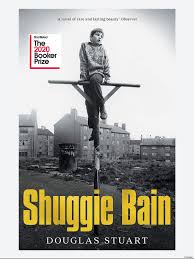
Finally, just a quick word about the novel’s cover images. The cover of the Picador hard back edition carries an extraordinary image (left) of a young boy perched on a cross-shaped post, a vivid crucifixion metaphor set against the backdrop of a desolate urban landscape. The first edition used this (right) tender picture of a young son cradling his mother’s head, locking eyes with her, both characters with a half-smile of recognition, his bare stick-thin arms showing his young age. It’s rare for an author to be so well served by such inspired and at the same time very different choices.

Douglas Stuart′s ″Shuggie Bain″ wins 2020 Booker Prize | Books | DW |  20.11.2020
Shuggie Bain (Douglas Stuart).png

Standard
Book review

Milkman, by Anna Burns, 2018

I decided to end 2020 with a final Booker Prize winner, Anna Burns’ Milkman, which won the prize in 2018. It won from what seems a fairly weak long and shortlist, missing many of the big-hitters in English fiction in recent years, although I would freely admit to not having read any of the short-listed novels, nor indeed anything by any of the short-listed authors.

Set in Northern Ireland during the peak of what was euphemistically called “the Troubles” – that is to say the bitter sectarian violence that dominated daily life for much of the population of Northern Ireland in this period – Milkman is a first person narrative describing a few traumatic weeks in the life of the unnamed narrator.

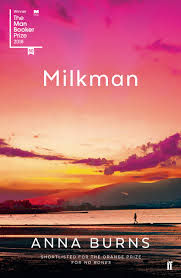
Milkman: Amazon.co.uk: Burns, Anna: 9780571342730: Books

This narrator is an eighteen year old woman who lives in the heart of the Catholic community in a large town in Northern Ireland. It (along with everything else) is never named, but i think it is safe to assume it is based on Belfast. She is in a relationship of sorts with her “maybe boyfriend” although she tries to keep this relationship secret from her mother and siblings. She has a large family – as it seems do all her friends and neighbours – who are all referred to by their relationships rather than their names – third brother-in-law, oldest sister, etc. Friends and neighbours are also nameless and referred to by their occupation or some other defining feature. This is a world of euphemisms and coded references where proper nouns are forbidden – so the Protestant community is “the other side”, the Irish Republic is “the country down there” and Britain is “the country over the water”.

The Troubles form a backdrop to our protagonist’s daily life, but she does her best to navigate some form of normality despite the rigid code of conduct imposed by her community. This means that some types of rule-breaking are allowed – for example she sleeps over with her maybe-boyfriend without apparently attracting the censure of the community – but other activities such as going to hospital for medical treatment (it might allow the authorities an opportunity to force you into becoming an informer, or worse throw suspicion on you that you are an informer) even when seriously unwell are forbidden.

The narrator’s attempts to get on with her life are disrupted when she meets the Milkman. He does not deliver milk or any other dairy products, and the source of this soubriquet is unclear. He is much older than her and already married. Milkmen are usually perceived as a welcome presence, and a positive part of the daily life of a community. However this milkman however is anything but. He is a senior member of the Provisional IRA (again never mentioned directly) and as such he has certain privileges in this society, one of which appears to be the right to pick a consort of his choosing, irrespective of her wishes in the matter. The narrator is alarmed at being singled out in this way, and doesn’t know how to react. A robust rejection would be dangerous, for her maybe-boyfriend if no-one else, but she has no interest in this creepy figure. She doesn’t know who to turn to for help:

“At the time, age eighteen, having been brought up in a hair-trigger society where the ground rules were – if no physically violent touch was being laid upon you, and no outright verbal insults were being levelled at you, and no taunting looks in the vicinity either, then nothing was happening, so how could you be under attack from something that wasn’t there? At eighteen I had no proper understanding of the ways that constituted encroachment.”

She goes jogging with one of her many brothers-in-law, walks to her evening classes, socialises with maybe-boyfriend, but all the while is conscious of the menacing presence of the Milkman. Her relationship with maybe-boyfriend suffers under this strain, until she discovers his secret relationship with his friend, chef. Chef is bullied for his interest in cooking, which is widely perceived as indicating he is gay – although he is able to put his chef knives to use when the time comes.

The claustrophobic atmosphere of the city, where the authorities lurk behind every bush, snapping pictures of people going about their lives, is profoundly oppressive, and distorts all normal relationships. People accept punishment beatings and shootings as normal, and choose unhappy relationships to avoid the disappointment when happy relationships fail, as they surely must. The control of the terrorist groups and their supporters is however tenuous – freedom seems to be seeping out all over the place, from the children and their embrace of ballroom dancing (when written in this context I know that must appear implausible, but the author does a much better job of making it seem convincing) to romantic relationships being restored, including maybe-boyfriend and his long-standing romantic feelings for chef.

This wasn’t an easy novel to read – the refusal to use any proper nouns combined with the dense paragraphs and complex family relationships made it hard to push through at times. Conveying how language is breaking down with using fractured sentences is difficult, leaving the reader with paragraphs like this:

“Still,’ he said. ‘Ach,’ I said. ‘Ach nothing,’ he said. ‘Ach sure,’ I said. ‘Ach sure what?’ he said. ‘Ach sure, if that’s how you feel.’ ‘Ach sure, of course that’s how I feel.’ ‘Ach all right then.’ ‘Ach,’ he said. ‘Ach,’ I said. ‘Ach,’ he said. ‘Ach,’ I said. ‘Ach.’

But despite this Milkman made a strong impression on me. There are many surprising, almost charming elements, such as the narrator’s young sisters, who are exceedingly intelligent and curious, and blossom in the most difficult of circumstances. Love also finds a way – the narrator’s mother rekindles a childhood romance with the real milkman, her brother runs away with a former girlfriend, and chef and maybe-boyfriend edge towards declaring their feelings for one another. Initially the small-mindedness of the tight-knit community initially seems invincible – no dissent is allowed, and anyone who behaves unconventionally is considered “beyond the pale”, including the narrator. But this begrudging, limited tolerance of unconventional behaviour, such as the “issue women”, a feminist group, and the real milkman himself, who refuses to allow the IRA to bury weapons in his garden, are the seeds for a wider resistance. From such a grim premise Milkman turned out to be surprisingly optimistic.

Standard
Book review

The Sea, The Sea, by Iris Murdoch, 1978

I’ve just spent a week in the company of a monster, and I didn’t enjoy it.

I really hated The Sea, The Sea. Or rather I really hated the novel’s protagonist, which on this occasion amounted to the same thing. For a novelist with a reputation for labyrinthine plots, this narrative is fairly straightforward. Theatre director Charles Arrowby the novel’s narrator, retires to the seaside to write his memoirs. Arrowby is utterly self-absorbed. His life has seen a succession of women throwing themselves at him and this pattern continues as he is visited by a series of former lovers, actresses of different degrees of fame, all wanting to resume their relationships. He is not interested, principally because he prefers to steal married women away from their husbands. As soon as each conquest has been mastered he loses interest. His latest obsession is Hartley, a childhood friend who he happens to meet in the village, who he sets about trying to persuade to leave her mild-mannered husband. He even goes to the extreme of kidnapping her, and only releases her once it is obvious she is not going to relent. To justify his obnoxious and criminal behaviour he persuades himself that Hartley is the long lost love of his life, although she clearly sees their friendship in a different light.

Charles’s magnetic attractiveness to women is not however just in his imagination – even at the end of the novel he received letters from a 17 year-old young woman offering him her virginity and to bear his child. But it is mysterious, because he is a bully and a bore. He is always having epiphanies, supposedly profound insights into what is really going on in people’s heads, insights which are invariably wrong. Undeterred he pushes on to the next revelation. When he finds out that his cousin James and his former lover Lizzie have been meeting for coffee occasionally, he throws a tantrum, reacting as if they have been betraying him. Instead of telling him to grow up they indulge his hurt feelings, apologise and withdraw. When he is pushed into the sea and nearly drowns the list of possible suspects is long – I think I would have been tempted!

So we’ve established that Charles is a deluded ego-maniac who is a danger to all around him. Just in case this point needs reinforcing, Murdoch has him see a monster in the choppy waters around his house. This monster is quickly dismissed as a LSD flashback, but later Charles reflects that “I let loose my own demons, not least the sea-monster of jealousy” (528) just in case anyone had missed the heavy-handed symbolism in the preceding 527 pages,

We are supposed to find Charles’s pretentious approach to food amusing. He prepares various mildly eccentric meals for himself and others. At first they are very slightly comic – I stress slightly:
Anchovy paste on hot buttered toast, then baked beans and kidney beans with chopped celery, tomatoes, lemon juice and olive oil… Then bananas and cream with white sugar. (Bananas should be cut, never mashed, and the cream should be thin.) Then hard water-biscuits with New Zealand butter and Wensleydale cheese. Of course I never touch foreign cheeses.

But there’s a relentlessness to this, and we get descriptions of meal after meal:

Lentil soup, followed by chipolata sausages served with boiled onions and apples stewed in tea, then dried apricots and shortcake biscuits… Fresh apricots are best of course, but the dried kind, soaked for twenty-four hours and then well drained, make a heavenly accompaniment for any sort of mildly sweet biscuit or cake. They are especially good with anything made of almonds, and thus consort happily with red wine.

OK, we get the point.

Murdoch is a hugely respected writer, but even her greatest fans seem prepared to acknowledge her flaws. Here the greatest sin is simply repetition – if something is worth saying it is repeated time after time. The scenes where Arrowby tries to persuade Hartley to leave her husband, and she asks to be allowed to leave, go on for page after page with little variation. The conceit that the novel is Arrowby’s memoir is inconsistently maintained – the struggle of having to construct time for him to draft his recollection of the previous events gets tiresome and is quietly dropped. Murdoch’s (alright, Arrowby’s) technique for building suspense is limited:

“Something happened which was so extraordinary and so horrible that I cannot bring myself to describe it” (1)

“Something rather odd and distressing has just occurred”

“I was sitting writing the above late last night in my drawing room when something very disconcerting happened” (74)

“Shortly after this something very disconcerting happened”. (107)

Obviously this is equally a reflection on Charles’s limited ability to express himself, but the end result is wearying.

It should be possible to enjoy and appreciate a novel where the central character is obnoxious or deluded (Pale Fire?) but I didn’t find it so here. Arrowby is a pompous bore who desperately needs to wake up to his own short-comings, but never. Even someone trying to kill him doesn’t make him pause for reflection! There’s no development in Charles’s character – he remains as deluded and ignorant at the end of the story as he was in its beginning. Is it my shortcoming in not being able to enjoy this widely revered novel(ist)?

Standard
Book review

The Elected Member by Bernice Rubens, 1970

This 1970 Booker winner opens with the following quote:

“If patients are disturbed, their families are often very disturbing.”

This really tells you all you need to know about this novel. The central character, Norman Zweck, is mentally ill, and his illness can be traced directly back to his profoundly dysfunctional family.

The Elected Member by Rubens, Bernice Paperback Book The Cheap Fast Free Post

Norman comes from a traditional Jewish family. His father came to London from Lithuania with just a suitcase and a name and address written on a scrap of paper. Despite being forty Norman lives at home (and indeed has never left) with the ghost of his controlling mother and his weak-willed father. His older sister, Bella, still lives at home as well and wears ankle socks every day as a vivid reminder of her frozen adolescence. Younger sister Laura left home and married outside their religion, and has therefore been expelled from the family circle – mention of her name is forbidden.

The primary symptom of Norman’s mental illness is that he sees silverfish crawling everywhere. It’s a horribly and vividly realised psychosis, and it cripples him, leaving him unable to leave his bedroom, work, or sustain a relationship.

We slowly learn the details of the family history through the reminiscences of the characters as they react to Norman’s most recent breakdown. He is addicted to amphetamines, although the precise cocktail of drugs and childhood trauma that leads to his illness is not ever entirely resolved. However his family are unable to cope, so on the advice of the family doctor they have him committed to a psychiatric hospital for treatment. Here he quickly finds someone ready to sell him more amphetamines, meaning any treatment is unlikely to work. Back home his family suffers feelings of guilt that they have not been able to help him. Bella, we eventually find out, had an incestuous relationship with her brother. Laura ran away from a relationship with Norman’s best friend, David, who we are given to understand (without it ever being made explicit) was his lover. Thoughts of and actual suicides haunt the novel, giving it a structure in which we come to see that the mental institution Norman is committed to is very similar to the home he was unable to leave.

The novel’s title is puzzling. One of Norman’s fellow inmates in the hospital has delusions he is in the Cabinet, although he is always referred to as Minister rather than the elected member, or any variation thereof, and in any event is a relatively peripheral character upon which to name the novel. The title could refer to Norman being the chosen one, the golden boy on whom the hopes of his family came to rest – he was gifted with languages, and qualified as a barrister – although the ‘member’ element of the title still escapes me.

Bernice Rubens had a long writing career, and most of her many novels remain in print, so there must be an audience for them somewhere. But whilst I found The Elected Member a largely inoffensive read, it left me with no appetite for following up with anything else by this author.

Standard
Book review

The Blind Assassin, by Margaret Atwood, 2000

Novel the blind assassin cover.jpg

The structure of this novel is fascinating. The principal thread holding it together is a first person narration by the novel’s central character, Iris Chase. In her old age she writes a memoir for her grand-daughter. Her narrative recalls memories of her childhood and the early years of her unhappy marriage to a Toronto businessman, Richard Griffen. She also describes her present-day life in Port Ticonderoga, her Canadian home-town, dependent on the goodwill of her friend Myra for her everyday needs. Interspersed with this narrative is the text of a novel, The Blind Assassin, apparently written by Iris’s sister Laura, and published posthumously just after the end of the second world war. The Blind Assassin itself contains a third narrative, a pulp science fantasy story – and it is this story which is the tale of the eponymous blind assassin. This might sound an overly complex structure, but it is easy to follow once you understand the conventions Atwood uses to signal which of the stories we are being told.

Intertwined narratives of this kind are not that new or innovative – A S Byatt’s 1990 Possession does something quite similar. What is so striking about this novel is the way Atwood draws together the threads of her stories and step by step reveals the truth underlying the initial presentation. It will come as no surprise to hear that Iris is an unreliable narrator and it is the contrast between her account and her sister’s novel, slowly revealed to be based on real life, which allows a truth to emerge. Again, this concept of there being a ‘true’ narrative hiding behind the lies and misrepresentations offered by the narrator is not entirely new, but it is done with considerable skill here.

Atwood uses one other device to drive the narrative. Key moments of the story are revealed through newspaper stories. We are told about the premature deaths of central characters. The novel therefore becomes a mystery story – we are less interested in what happens, but why, and how the events are related to one another.

The temptation in reviews of this kind is to take a retrospective view of the events of the novel and to flatten them out – to present them in a linear chronological fashion, whereas the presentation within the novel is complex and at times even chaotic. So if I were to tell you the story of the Chase sisters, their wealthy manufacturing family, Iris’s unhappy marriage to Toronto manufacturing tycoon Richard Griffen, etc, it would all be true, but it would give a distorted version of the novel. Sometimes such summaries are useful, when it is hard to follow the plot or where there is uncertainty about some of the detail (this is particularly true of those novels spanning generations where everyone seems to have at least three different interchangeable names!). But here I think I will pass – plot summaries are easy to find online if required, but would reduce this novel to a story, which would be reductive and misleading.

I found it interesting to compare this novel in all its complexity to Atwood’s 1972 novel Surfacing, It clearly demonstrates her growth as a novelist – while Surfacing is a convincing portrait of one woman’s mental deterioration, the contrast with The Blind Assassin makes it look superficial and incomplete.

I have disagreed with the choices of the Booker judges many times over the years, but this must have been one of the simpler choices they ever had to make.

Standard
Book review

Life of Pi is that rare beast, a post-modernist novel of ideas that is also a wonderful adventure story. In this 2002 Booker prize winning novel Mantel plays with ideas about narrative and the nature of the novel while at the same time keeping the reader fully engaged with an exciting tale of a young man trapped on a lifeboat with only a tiger for company, adrift on the Indian Ocean for over 200 days.Life Of Pi by Yann Martel – Canongate Books

I am guessing you knew that already – the central concept of the novel would once have been a surprising plot twist about a third of the way through, but now the cover illustration, the blurb on the back of the book, and of course the successful film of the novel all means that most readers will know this already. Post-modern might be a label that puts some readers off, but certainly here it shouldn’t. Mantel experiments with form and content within some quite traditional boundaries. This is a novel about an epic journey that stays firmly within the traditions of the genre, a quest for survival where the tension between two antagonists keeps the book in balance. In many ways the novel therefore owes a debt to survival novels going back as far as Robinson Crusoe.

Mantel uses a framing device to open the novel, in which ‘the author’ explains how he exiled himself in India to write a novel about Portugal just before the second world war, and is side-tracked by a meeting with the character who goes on to narrate much of Life of Pi, Piscine Molitor Patel, named after a French swimming pool of all things. Pi grew up quite reasonably resenting his unusual name, and adopts the abbreviated form to avoid the inevitable mockery. He is raised as a Hindu but as a teenager also becomes a Christian and a Muslim, seeing no contradiction in following all three faiths. He is brought up in the family-owned zoo in Pondicherry, once part of a small French territory in coastal India. Seeing political and social problems ahead in India, his father decides to sell the zoo and emigrate to Canada.

Pi is an endearing narrator who tells his story in a very straightforward and engaging way. The chapters in which Pi tells his account of his upbringing are interspersed by descriptions of the author’s interviews with the older Pi, giving glimpses of his settled life in Canada, a world apart from the drama of his youth. Hints are given of what is to follow after what is a fairly happy, prosperous and trauma-free childhood. This reference frame does of course tell the reader that Pi survives being ship-wrecked, which means our interest is engaged in wondering not whether but how he survives. Pi is brought up around the animals of his father’s zoo, and is a quick and resourceful learner, key knowledge and skills that help him survive when the time comes. 

The second section of the novel begins with the fateful journey to Canada on a freighter which is also carrying many of the animals from their zoo being sold to other zoos in north America. The ship sinks suddenly in a storm, and Pi escapes in a lifeboat along with some of the animals from their crates – a hyena, a zebra, and an orangutan. This is never going to end well, and inevitably the hyena kills the zebra and the orangutan. The hyena’s dominance doesn’t last long either, because from under the boat’s tarpaulin emerges another surprising survivor, ‘Richard Parker’, the zoo’s strangely named Bengal tiger. Richard Parker quickly dispatches the hyena, leaving him alone with Pi on the open and lonely seas. 

How is Pi going to survive sharing a small life-boat with a tiger? Surprisingly easily, all things considered. He builds a small raft using oars and life jackets and ties it to the bow of the boat. He sneaks back to the lifeboat periodically to raid its plentiful stores (echoes there of how Crusoe uses the stores and equipment on his shipwrecked ship) and fishes for food, sharing the majority of it with Richard Parker. He has water filtration devices and rain catchers, flares, tinned water and food – even a survival guide. But he quickly realises that keeping a distance from Richard Parker will not be enough – sooner or later he will get peckish and take the short leap to the raft. So he decides to train the tiger as if he was back in the zoo, teaching him to be submissive, using food as a reward, seasickness as punishment, and a whistle for dominance. This seems to work, and Pi and Richard Parker settle down into a unique and bizarre arrangement where the sole aim is survival. 

The novel maintains a strong sense of realism throughout these chapters. There is a focus on the messy practicalities of survival – some of the descriptions of butchering fish and turtles are hard to stomach. But the realism begins to ebb away at the end of this section of the novel. Pi encounters another blind castaway, who tries to kill him but doesn’t get past Richard Parker. Later, they find land, but it is a floating island inhabited by thousands of meerkats. This is a refuge of sorts, but any plans to remain on this island long term are abandoned when Pi discovers its secret – by night it becomes carnivorous, and the meerkats only survive by hiding in the trees. The end of the adventure comes suddenly and without fanfare. The lifeboat washes onto a Mexican beach and Richard Parker disappears into the jungle, leaving Pi to recover with the help of some bemused locals.

The third part of the novel is a form of epilogue. Officials from the Japanese Ministry of Transport interview Pi as part of their investigation into the shipwreck. They query the veracity of his story. so he offers them an alternative account in which he is the animals on the lifeboat are replaced with the ship’s cook, a sailor with a broken leg, and his mother. The suggestion is that the principal story has been an allegory for this ‘real’ version of events, which Pi has invented to protect himself from accusations or the psychological burden of cannibalism and murder. This ending, in which the story we have just been told is thrown into doubt by an alternative account, reminded me of the ending of Ian McEwan’s Atonement, where the central story turns out to be fictitious, as if any parts of the novel had a stronger claim on reality than any other. As a device this effectively reminds the reader this is ‘just’ a story, and we choose which to believe. Pi explicitly calls out this choice, and suggests the same principle applies to religion – “And so it goes with God.”

This makes it sound as if Life of Pi is a pious book, but that wasn’t my reading of it. Neither the bizarre carnivorous island nor the “was it all a lie?” ending spoiled the integrity of the central narrative, which was a sustained feat of imaginative story-telling. Pi is a really enjoyable novel which pulls off the challenge of making the long castaway voyage of a teenage boy and a tiger seem believable, while at the same time having something interesting to say about narrative and religion.  Recommended.


Life of Pi, by Yann Mantel, 2001

Aside
Book review

It was the river’s most elusive hour, when darkness lifts off darkness, and from one minute to another the shadows declare themselves as houses or as craft at anchor.

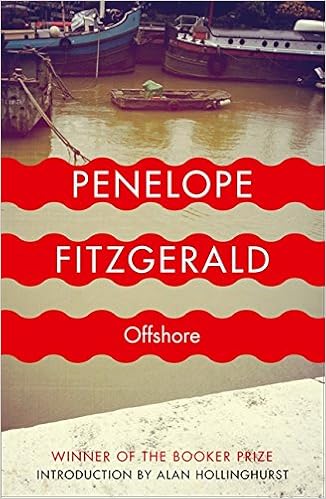
Well, it can’t be said that I haven’t given Penelope Fitzgerald’s fair crack of the whip. This, the third novel of hers I have now read, won the 1979 Booker PrizeOffshore: Amazon.co.uk: Penelope Fitzgerald: 9780007320967: Books. Three I think is more than enough.  When the Guardian’s reviewed the novel in 2009 the kindest thing the reviewer could find to say was that it “isn’t awful”, which is about right.

Offshore is set in early 1960’s London, described more than once as “swinging” although that seems a bit early to me. Post-war, depressed and crime-ridden would be nearer the mark. It focuses on a community of houseboat owners living on the Thames at Battersea Reach.

This was typical Fitzgerald – more a sketch than a novel, with few plot points, little structure, and an entirely open-ended conclusion. I actually don’t have a problem with ambiguous endings, where the details of what happens next is left to the reader to decide. But there is a difference between this and the approach Fitzgerald uses, which is to just simply stop writing once things have just started to get interesting.

I didn’t find her cast of characters that interesting either. Early 1960’s London was not brought to life – this is a marginal community living on the edges of the city and not prospering very well with it. Characters behave eccentrically with little if any explanation of their motives. Nenna, for example, a Canadian woman living with her two children in one of the run-down barges that are home for this group, is separated from her husband, who has returned from working abroad but made no attempt to contact her. She eventually goes to see him, but he rejects her telling her she is “not a woman”. No, I have no idea why.

Maurice, Nenna’s neighbour, is a male prostitute and allows his boat to be used to store stolen goods. There are other neighbours who appear briefly, but I didn’t find it easy to differentiate between them, even though they are given their own idiosyncrasies. Willis is a painter; Woodie is a retired businessman; Richard lives on a converted minesweeper. The only characters that really engage our attention are Nenna’s precocious children Martha, 12 and Tilda, 6. They skip school and go ‘mudlarking’ finding valuable tiles in a wreck which they sell in order to buy Cliff Richard records.

The novel is mainly pre-occupied with the boats in which the characters live and the river on which they float, and occasionally sink. There is, for me, far too much detail about life on the river, such as the various repairs the boats are constantly in need of. The autobiographical elements of the novel seem to be what interested Fitzgerald rather than her characters or anything resembling a plot.

One disturbing scene jumped out as being something that in 1979 an author might get away with, but today would surely not be published. Maurice’s boat is being used as a lock-up for stolen goods by Harry, a lightly sketched villain. While he is trying to fix the hatch to the boat to give “a mild electric shock to anyone who might try to get into it“, he is disturbed by six-year old Tilda:

“Tilda did not understand what he was doing, but she stared at him …until he became conscious of her and turned around. His eyes were curious….

“Want some sweeties?” ‘No’

‘Want me to show you a comic?’ ‘No’

‘Come on, you can’t read, can you?’ ‘I can’

You could get over here, couldn’t you? You can come and sit on my knee if you like, and I’ll show you a comic.’

(The exchange continues, then Harry says)

“You haven’t seen the things I’ve got to show you’

‘What are they like?’ ‘Something you’ve never seen before, love’.

He then chases after her, and while she escapes into a neighbouring barge, there is no doubt he intends her serious harm. This is a disturbing scene when read today, but I wonder how it would have been seen in the late 1970’s? Was it really intended as comic? The tone of the rest of the novel is whimsical and this scene jars alarmingly, irrespective of the author’s intention. The 1970’s were closer to the Second World War than they are to today, and social attitudes have shifted dramatically, but this isn’t funny, and I can’t believe it was thought humorous back then either.


Offshore, by Penelope Fitzgerald, 1979

Aside