Book review

The Ghost Road, by Pat Barker, 1995

I think it would be fair to say that my experience of reading Booker prize winning novels has so far been patchy, to say the least, certainly recently having focussed on some of the earlier winners. Along the way there have been some incredible novels, but also a fair share of stinkers. I am delighted to say that The Ghost Road was very much in the first category. It was outstanding – original, touching, and very well written.

The Ghost Road

The Ghost Road is the third novel in the Regeneration trilogy. I found this out after buying the novel, which put me in a bit of a quandary – do I read the previous two novels or just push ahead with this one on its own? In the end I decided to read this novel first – which I now regret. If it had been a stinker then I could just tick it off the Booker list and move on, but it was such a well-written book that I really think I ought to read the first two in the trilogy. But of course that’s a daft way to read any series of books! So I just have to live with my decision.

Ghost Road follows the continuing adventures of Billie Prior, who in the earlier books had served in the trenches in World War One and been hospitalised suffering from shell-shock. This novel sees his recovery and return to the front. It opens with a scene in which Prior leers at women sun-bathing on the beach (a reference to the Nausicaa chapter in Ulysses?). He is keen to return to France despite being offered the opportunity to serve out the rest of the war in a desk job in the Ministry of Munitions, while at the same time accepting fatalistically that his chances of being killed are high. Prior is a sexually adventurous and ambivalent young man – Barker recounts his numerous encounters graphically without ever being salacious.

The battle scenes in the last days of the Great War are reserved for the final chapters of the book and arrive with huge impact. A futile war becomes even more pointless as the armistice is just days away; readers will be aware of that ticking clock and the imminent death of Prior’s fellow officer, Wilfred Owen. These powerful scenes are hard to read but incredibly well written.

The other main thread of the novel interwoven with the story of Prior’s return to France is told by his former doctor, Rivers. While continuing to care for his patients as the Spanish flu begins to take grip, Rivers recalls his time on an anthropological expedition to the Solomon Islands to study the local culture. This section is based on the work of the real-life character of Dr Rivers. Throughout the novel Barker draws on factual accounts and experiences, but integrates them seamlessly into the narrative to the extent that it is impossible to tell which is fiction and which fact, nor that it really matters. This is one of those novels that sends the reader down a series of internet rabbit-holes as passing references to the executor of Oscar Wilde’s estate for example, or the gay sub-culture of the Edwardian era appear in the narrative. The Solomon islanders culture, dying out due to the imposition of European ‘law and order’, is focused on the capturing of prisoners from local tribes and beheading them. This death cult is implicitly contrasted with the industrialisation of death on the Somme and Passchendaele, and seems almost civilised by comparison.

The First World War is very familiar ground for novelists, but Barker has used this setting with a highly original approach to create a powerful novel. I caught some echoes of Catch 22 in the descriptions of the struggles to capture an insignificant piece of land days before the Armistice. I could have done with more Prior and less Rivers in the overall balance of the novel – I found Billie the more interesting character – a working class officer recovering from shell-shock with an out of control libido and friends with some of the greatest poets of the twentieth century, what’s not to like?

This is a brave and interesting novel and a worthy winner of the 1995 Booker, a self-conscious and stunningly successful attempt to break away from the northern, working class, feminist stereotypes Barker previously found herself constrained by. The novel addresses the profound contradiction of the heart of the Great War – that it was at once terrible and, for some, exciting and worthwhile or rewarding. Barker explained in an interview:

I think the whole British psyche is suffering from the contradiction you see in Sassoon and Wilfred Owen, where the war is both terrible and never to be repeated and at the same time experiences derived from it are given enormous value”.

Prior thinks he is mad to have come back to France, but would equally have been mad not to. The novel’s ending is hard to read after all that has come before, as the attempt to cross the canal is beaten back:

“Prior was about to start across the water with ammunition when he was himself hit, though it didn’t feel like a bullet, more like a blow from something big and hard, a truncheon or a cricket bat, only it knocked him off his feet and he fell, one arm trailing over the canal.

He tried to turn to crawl back beyond the drainage ditches, knowing it was only a matter of time before he was hit again, but the gas was thick here and he couldn’t reach his mask. Banal, simple, repetitive thoughts ran round and round his mind. Balls up. Bloody mad. Oh Christ. There was no pain, more a spreading numbness that left his brain clear. He saw Kirk die. He saw Owen die, his body lifted off the ground by bullets, describing a slow arc in the air as it fell. It seemed to take forever to fall, and Prior’s consciousness fluttered down with it. He gazed at his reflection in the water, which broke and reformed and broke again as bullets hit the surface, and then, gradually, as the numbness spread, he ceased to see it.”

Is this not wonderful, under-stated writing?

Standard
Book review

Saville, by David Storey, 1976

There weren’t any whippets or homing pigeons in David Storey’s Saville. Apart from that I don’t think there was a single cliché about Northern working class life that it avoided, from trouble at mill, musically gifted lad bullied by his dad for being in touch with his feminine side, people dying of rickets and on and on and on – it was just so overwhelming the It’s Grim up North relentlessness of it all.

It all starts so well:

“Towards the end of the third decade of the present century a coal haulier’s cart, pulled by a large, dirt-grey horse, came into the narrow streets of the village of Saxton, a small mining community in the low hill-land of south Yorkshire.”

This has strong echoes of D H Lawrence, but equally of an earlier novelist of rural working class lives, Thomas Hardy:

“On an evening in the latter part of May a middle-aged man was walking homeward from Shaston to the village of Marlott, in the adjoining Vale of Blakemore or Blackmoor.”

But it doesn’t last, and we are quickly pitched into the minutiae of depressingly deprived life in the Yorkshire mining villages. Colin Saville is the bright but emotionally stunted son of the coal-miner and his timid wife, who passes the eleven-plus and sees education as a possible route out of the poverty-stricken life of his parents. My guess is that the narrative is principally autobiographical, because nothing else would seem to justify the sheer volume of pointless detail crammed into the novel’s 550 pages. For most of the novel Colin is a passive figure – events happen to him but he seems to have no agency, no personality. Towards the end of the novel a personality of sorts emerges, and Colin becomes a distinctly less-likeable individual, fighting with his family and treating the women in his life with disrespect and contempt.

While there are events in the novel – the Second World War starts in the background and continues to its conclusion while only minimally intruding on Colin’s day to day life – they are largely a distraction from the recording of every last detail of his existence. To be fair, if one grew up in a mining village in the thirties and forties I am sure the war would have seemed very distant, especially as miners were exempt from conscription. Colin seems to spend most of the novel either riding on a bus (trains being too expensive), waiting for a bus, going to catch a bus, or talking about all of the above. No detail of his tedious life is too irrelevant to be excluded from the narrative. He goes for a walk in the park, cleans the windows, washes the dishes, meets a girl – but feels nothing, or reveals nothing about what he thinks and feels.

The novel does a good job of capturing the confusion and mysteriousness of childhood. Things happen and are accepted without explanation. Colin’s mother, for example, suffers several illnesses and hospital spells which are never explained. Colin is warned that when he goes to grammar school that older boys will flush his head in the toilets. He spends hours practising holding his breath in preparation for this ritual, but when school starts and the threatened humiliation never happens, the danger is quickly forgotten.

There’s an ambivalence about working class life in Saville best encapsulated by the obsession with dirt and cleaning. Miners and their families are both perpetually filthy and constantly cleaning:
“A bucket of water stood by the hearth; in the top of it floated a wooden scrubbing-brush. The carpet had been rolled up in front of the fire and the stone floor between there and the door opening to the yard scrubbed clean. There was a smell of soap in the room, overlain by the musty, almost stifling odour which came from the bed.” This duality of dirt and cleanliness/cleaning comes to act as a symbol for Colin’s relationship with his family and his community – he is desperate to escape, but feels chained to home and parents. He turns down the chance to go to university, instead opting for a local teacher training college which allows him to remain at home, contributing to family income.

Misery memoirs became more popular later in the twentieth century – Saville is an early example of the genre. Some reviewers have seen the novel as a political statement, but if it is it is highly ambivalent. Communism is mentioned cynically as being irrelevant to the lives of the miners. There is no suggestion that the Attlee government of the post-war years had any impact on their lives apart from a passing mention of the nationalisation of the mines, which surely can’t have been right – free healthcare for the miners and families would have been transformative, and the state of Colin’s mother’s health meant it would have had an immediate beneficial impact.

I haven’t said this for a while, but sometimes I read these novels so you don’t have to. Saville was grim and cliched and while not a hard read it did make me want to bury myself in something joyful and entertaining for a week or so before returning to the Booker winners of the 1970s.

Standard
Book review

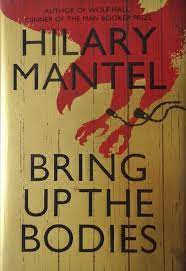
Bring Up the Bodies, by Hilary Mantel, 2012

There are certain authors I feel a sense of guilt about not admiring. Coetzee is the obvious example – everyone tells me Disgrace is a masterpiece, but it left me cold. Hilary Mantel’s novels fall into the same category – even as I was reading Bring up the Bodies I could feel the pressure to enjoy the craftsmanship and characterisation, to marvel at the wealth of detail, and to ignore some of the problematic issues (which of course I am not going to do.)

Bring up the Bodies is the second novel in Mantel’s series about the life of Thomas Cromwell, a sequel to Wolf Hall. It recounts the dramatic events running up the end of Henry the Eighth’s marriage to Anne Boleyn. It imaginatively recreates these events from Cromwell’s Machiavellian perspective, using his inner monologue as the narrative voice. The novel is prefaced by five pages of characters and several family trees, which I referred to throughout the novel (‘Which one is he?’). This should give you some idea of the complexity of the narrative. I certainly know more now about the history of this period than I did previously!

I confess I did not know what happened to Cromwell after he engineered the end of Henry’s second marriage – but I was sure that it did not work out well (spoiler – it does not). I think we are intended to see he, Cromwell as a master manipulator, someone pulling all the strings, carefully orchestrating the downfall of the Boleyns, serving the interest of the king but at the same time ensuring his own position is secured. But actually he is not in control of events in any sense. Henry is volatile and dangerous. While Cromwell is on the right side of the king he prospers, but it is clearly only a matter of time before he falls out with him and is used as a scapegoat for all the king’s crimes and misdemeanours. He’s simply too convenient an excuse – ‘Cromwell made me do it’ – not to be used sooner or later, not to mention the fact that his money and his offices of state could then be redeployed around the court for more influence and favour. As he becomes more powerful at court, he accrues more enemies, and comes closer to the day of his eventual demise. He is a threatening figure at Court, and dangerous people are likely to be brought down sooner or later. No-one can be more powerful than the king. As Call-me Wriothesley puts it:

“If this is what Cromwell does to the cardinal’s lesser enemies, what will he do by and by to the king himself?”

Henry is dangerous and ruthless, and there is no way this is going to end well for Cromwell. He seems to sense this himself – it’s hardly the most profound of insights:

“You can be merry with the king, you can share a joke with him. But as Thomas More used to say, it’s like sporting with a tamed lion. You tousle its mane and pull its ears, but all the time you’re thinking, those claws, those claws, those claws.”

There is a lot we do not know about the end of Anne and Henry’s marriage. At its most basic, we do not know if she was guilty as charged. She was charged with and convicted of adultery with a number of other men, including George Boleyn, her brother. It seems highly unlikely that she would have risked her life for – what? The chance of another pregnancy, or simply because Henry was an inadequate lover? For perfectly understandable reasons Mantel does not try to answer this – she leaves it ambiguous as to whether Boleyn was guilty or not. The obvious answer – that Henry was bored with Anne and didn’t want to go through another protracted divorce, so turned to Cromwell to fix the problem – is avoided, I suspect simply because it is not that interesting an answer. Instead the solution presented to the reader is that this outcome is the result of Cromwell’s deviousness.

At the heart of the novel is his investigation into this allegation. As part of his enquiry he, Cromwell, invites one of the suspects, Mark Smeaton, to supper. Mark is a Flemish lute-player, the most junior of the suspects, and a member of the queen’s court. Court gossip has implicated him as one of the queen’s lover. Here he jokes with him (he, Cromwell) and in the course of the conversation Smeaton confesses to sleeping with the Queen. Smeaton must have been profoundly stupid to think he could boast of cuckolding the King, a man not known for his patience or understanding, to a senior minister with a fearsome reputation for being the King’s enforcer, and that there would be no consequences. The traditional or conventional explanation of Smeaton’s confession is that he was brutally tortured, but that would make Cromwell seem more of a brute and less of a manipulator, able to coax a damning confession out of a man using flattery and suggestion.

The passage where Smeaton confesses is key to the novel’s denouement. For Cromwell this is an interrogation; Smeaton thinks it is an informal chat, a delusion Cromwell fosters:

(Cromwell to Smeaton): “I ask your charity… I come to you because you are close to the queen, and the other gentlemen will not help me.

(This is of course flattery. Cromwell gives Smeaton the title of ‘gentleman’ even though he is a commoner, and appeals to his sense of importance as someone close to the queen.)

I have the power to reward you, and will make sure you have everything you deserve, if only you can give me some window into the queen’s desires.

(Cromwell makes it clear he is the one in control of the conversation (I have the power), but hints he wants to reward Smeaton rather than punish him. Smeaton should have noticed the reference to him having what he deserves rather than desires. The next reference to the queen’s desires introduces the idea of her as someone with bodily appetites).

I need to know why she is unhappy, and what I can do to remedy it. For it is unlikely she will conceive an heir while her mind is unquiet. And if she could do that: ah, then all our tears would be dried.’

Mark looks up. ‘Why, it is no wonder she is unhappy’, he says. ‘She is in love’.

‘With whom?’

‘With me.’

He, Cromwell, leans forward, elbows on the table: then puts a hand up to cover his face. (To disguise his reaction)

‘You are amazed’ Mark suggests.

That is only part of what he feels. I thought, he says to himself, that this would be difficult. But it is like picking flowers.” (273/274)

There’s no question this is subtly done – Cromwell flatters the young man and gives him a false sense of security. He implies he is acting in the queen’s best interests, and that if he is able to help he will get everything he ‘deserves’, a dangerous ambiguity. Later Cromwell encourages Smeaton to be more explicit about his relationship with the queen by suggesting he thought he was a ‘sodomite’.

But despite all this, it still beggars belief that Smeaton would confess so casually and freely. This is not a bar-room boast, but a conversation with the King’s most senior and most dangerous advisor. Smeaton is aware that Cromwell is not his ally, and realises his mistake, but far too late, and he is placed under arrest. From this point the whole case against the queen and the others accused is constructed, and leads quickly to their conviction and execution. In the moment this account is a plausible explanation for the known historical events, but when one takes a step back and considers the conversation in context it seems highly unlikely that Smeaton would have blurted his confession out with nothing more than flattery to persuade him to cooperate.

That is one example, but the rest of the historical interpretation of the novel is often equally hard to swallow. The popular myth that the queen had six fingers on one hand and was therefore condemned at trial as a witch is demonstrably untrue, (none of her contemporaries mention any such feature, nor do any of the paintings of her show it – it’s not something that would have been easy to hide!) but instead of treating it with the contempt it deserves Mantel nods to the idea, suggesting that the myth may have had its origins in the belief that Boleyn had in some way enchanted the king.

ButB is an easier read than Wolf Hall. The irritating over-use of the personal male pronoun is not dropped, but Mantel clarifies who the ‘he’ is where it is ambiguous by persistently inserting the phrase ‘he, Cromwell’. I would rather she did this than spending half the novel wondering what is going on/who is speaking, but as a device it seemed clumsy given how flexible English is in telling us who is doing what.

I would never say never, but I doubt I am going to read The Mirror and the Light, the third in the trilogy, any time soon. For one thing it is around 800 pages long, and I know how it ends! I appreciate that sounds infantile, but with so many books and so little time this is all about choices. Historical novels always have to address the fact that the outcome of the novel is known. There’s no suspense about how it ends. Mantel deals with this by imaginatively showing us events through the eyes of a character who previously has not been given a central role in earlier histories, and by speculating on details of the key turning points in these tumultuous and dangerous times. Cromwell always remains just out of reach, never the hero, never entirely sympathetic. His cold-bloodedness is excused, even justified, but is harm to stomach at times.

Struggling to put my finger on the source of my mild dissatisfaction with this novel, I thought back to Maggie O’Farrell’s Hamnet. Set only a few decades later, this historical novel aims to do much of what Mantel aspires to with Bring up the Bodies – to bring to light some historical events through the eyes of a character who previously has not been a focus of analysis compared to the major protagonists, and to speculate about some of the questions that have puzzled historians for so long. Both authors bring to life their narrators and imaginatively recreate what living at this time must have been like. Perhaps O’Farrell simply chose a more sympathetic narrator, but Hamnet has a vitality and authenticity that BuTB does not. I can’t be sure but I suspect it all comes down to the fact that I found the lives of Warwickshire working people more interesting than Tudor court intrigue, however much more ostensibly dramatic and historically significant the latter may have been.

Standard
Book review

Heat and Dust by Ruth Prawer Jhabvala, 1975

Heat and Dust continues the early Booker fascination with post-colonial Britain. ‘Losing’ the Empire must have been more traumatic than we now realise looking back from the perspective of the twenty-first century: the novels of the time suggest that there was a lot of processing to be done to come to terms with the trauma involved. Was colonialism really such a damaging, dehumanising process for both the peoples being governed and the generations of British men and their families who served overseas?

Told in alternating chapters the book moves between the 1920s and the 1970s as the unnamed narrator recounts the scandalous history of her step-grandmother and her own parallel experiences in India either side of independence. In the 1920s thread of the novel, Olivia, a young and rather vacuous English bride, becomes bored with the narrow life of a imperial civil administrator’s wife, and seeks adventure in the company of the Nawab, a dangerously charming minor royal, described as “the worst type of ruler – the worst type of Indian – you can have“. Their relationship leads to a scandal that echoes down the decades to the narrator’s generation. She sets out to explore the places where the family secrets were first played out, armed with some papers and letters from Olivia to her sister Marcia, letters which are retold as the earlier part of the story. As she does so she shares some of Olivia’s experiences, and makes some of her own mistakes.

I must admit I made the rookie mistake of assuming that the author was from India due to her name. In fact Ruth Prawer Jhabvala was European, but married an Indian man and lived there for 25 years. Does that matter? Very much so as it happens. The novel’s entire point of view is that of the white settler. It concerns itself with the problems of living in a hot and dusty country when one is not used to the weather, the food, the religion or the customs. The focus is on the impact living in India has on the English men and women in the country, rather than the impact of being governed by Englishmen has on India and Indians:

“Although the Major was so sympathetic to India, his piece sounds like a warning. He said that one has to be very determined to withstand–to stand up to–India. And the most vulnerable, he said, are always those who love her best. There are many ways of loving India, many things to love her for…but all, said the Major, are dangerous for the European who allows himself to love too much. India always, he said, finds out the weak spot and presses on it. …Yes, concluded the Major, it is all very well to love and admire India–intellectually, aesthetically, he did not mention sexually but he must have been aware of that factor too–but always with a virile, measured, European feeling. One should never, he warned, allow oneself to become softened (like Indians) by an excess of feeling; because the moment that happens — the moment one exceeds one’s measure– one is in danger of being dragged over to the other side. … He who loved India so much, knew her so well, chose to spend the end of his days here! But she always remained for him an opponent, even sometimes an enemy, to be guarded and if necessary fought against from without and, especially, from within: from within one’s own being.”

Of course there are Indians in the novel, and they are given voices, but they are almost all secondary characters, and mostly remain enigmatic. The women in purdah in the Nawab’s palace are almost entirely voiceless. But the essential theme of the novel is the question of what it means to be a white colonialist woman in India, not what it means to be Indian. Jhabvala wrote several screenplays for the film directors Ivory and Merchant, who are notorious for their sanitised, romanticised portraits of colonial India, so it really shouldn’t come as a surprise that the picture we are shown here is of an India that is unthreatening, picturesque, at times almost quaint.

I suspect that the narrative technique of telling essentially the same story twice, once in the 1920s and again in the 1970s, is intended to invite the reader to consider what has changed. The narrator is unmarried, and her discrete affair with a local married man does not seem to cause the scandal it once had done. (I am not sure why English authors found sex between Indian men and English women so fascinating) But any connection between the Englishwomen and their Indian lovers remains unconvincing. There’s a suggestion of sexual tourism in the relationships. The end of empire allows the narrator to embrace India in a way Olivia was unable to – for example she sleeps outside at night because of the heat, which for Olivia would have been unthinkable.

‘I lie awake for hours: with happiness, actually.  I have never known such a sense of communion.  Lying like this under the open sky there is a feeling of being immersed in space – though not in empty space, for there are all these people sleeping all around me, the whole town and I am part of it. How different from my often very lonely room in London with only my own walls to look at and my books to read.’    

This is progress of sorts, but I don’t think we ever forget that the narrator character is living off savings (presumably) and will leave India as soon as she either gets bored or runs out of money (there’s no suggestion she ever considers getting a job).

Jhavbvala drops some heavy hints that the Nawab is bisexual. He certainly exerts a powerful influence over Harry, a young Englishman who forms part of the Nawab’s entourage. The Nawab treats Harry like a pet – “he is like a child that doesn’t know what it wants! We others have to decide everything for him’ . This and his involvement with the local dacoits makes the Nawab a sinister character. We are constantly reassured of his seductive charm but I was completely immune to it personally. Harry’s equivalent in the 1970s narrative is Chid, a young English man in search of enlightenment in India, who moves in with the narrator and

needs sex very badly, and seems to take it for granted that I will give it to him the same way I give him my food. I have never had such a feeling of being used…I don’t know why I let him go ahead. I’m much bigger and stronger than he is and could easily keep him off…But he has constant erections and goes to a tremendous size”.

I genuinely have no idea if this image is more disturbing or hilarious.

When the Guardian revisited this novel as part of a review of the Booker prize winners it described it as

the literary equivalent of Coldplay; securely pedestrian, slightly patronising, tinged with the exotic, referencing far better work, but ultimately dull and pointless. It is, in short, literature for people who hate literature.”

Harsh words, and not entirely fair. I am quick to judge novels that ignore the diversity of voices (see here for example) but for all its faults Heat and Dust was not a travelogue. It doesn’t romanticise India and attempts to describe the impacts of colonialism, even if the perspective remains solidly that of the colonial power. I have never seen the film adaptation of Heat and Dust, but instinctively it seems a better medium for capturing the scale and beauty of India compared to the restrictive pages of this novel.

Standard
Book review

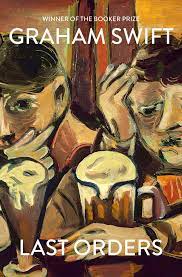
Last Orders, by Graham Swift, 1996

Last Orders, by Graham Swift, 1996

Four men take the ashes of a friend, Jack Dodds, to Margate, to scatter them off the end of the pier. Last Orders is the story of their journey. Along the way all four are given time to tell their stories as internal monologues and through their conversations, as are some of the women in their lives. It’s a strikingly simple story where little happens, but where we warm to the frailty and vulnerability of these flawed, human characters as we learn more about them.

Ray, the character who is given the most space to develop his narrative, works in an insurance office, but always wanted to be a jockey. His friends know him as Lucky; he is a very successful gambler. However the nickname was originally given to him during his years in the African desert during the Second World War, when luck was needed to survive. Together with his friends Lenny, a greengrocer, Vince, Jack’s adopted son, and Vic, a funeral director, they stop at various points along the way from Bermondsey to Margate as a way of saying farewell to their late friend. We learn that all the men served in the army, missed out on careers they would have preferred to have pursued, and troubled relationships, especially with their daughters who they have all in one way or another lost. All have secrets that will remain unspoken. Their shared experiences bond them together. Their pilgrimage, underlined by a brief stop in Canterbury, ends with them casting their friend’s ashes to the turbulent April winds.

I enjoyed Last Orders. Its structure meant I had to invest time in working out who was who, the various family relationships etc, but once those were clear the short chapters and the alternating perspectives meant the narrative had a lot of pace, despite the relative lack of incident. I did have one quibble with the text, which will take some time to describe but shouldn’t be given too much emphasis despite that. My concern was with the use of the vernacular. Each character ‘speaks’ – including in internal monologue – in a form of South London Cockney. There’s thankfully no real attempt to transcribe the accent – no dropped h’s and glottal stops – but Swift tries to catch the cadences and slang of working class Bermondsey.

The reviews quoted in the edition I read were full of praise for the success of this attempt and the authenticity of the language:

“He has succeeded in elevating the demotic to an elegiac level of which Wordsworth could only dream; here is language such as men do use” (This quote is cited as coming from The Guardian, although it is not to be found in the paper’s original review of the novel).

The novel’s hero is the English language as spoken by ordinary people. ” Sunday Times.

And several others along similar lines. It’s ironic that the Guardian reviewer apparently used the awkward phrase “such as men do use” to describe authentic everyday speech. I’ve ranted here before about authenticity in novels – if an author is aiming to represent something as authentic then they need to get it right. When the Guardian revisited the novel in 2012 the reviewer shared my concern:

“I did have a problem though, right from the very first sentence, which reads: “It aint like your regular sort of day.” It’s a striking enough opening and, viewed retrospectively, a witty summary of the rest of the book, which takes place over the course of one fraught day. Yet, for me, that sentence didn’t ring true. Graham Swift grew up in south London, and presumably knows the local habits and speech patterns better than – say – Martin Amis knows Lionel Asbo’s. But there’s something that doesn’t quite click. His colloquialisms and slang and deliberately simplistic language all seem a bit cor-blimey-guvnor. I’ll be amazed if I ever read a novel with more “aints” per page. (I just turned to page 63, for instance, and found: “June aint my sister. I aint got no sister … I aint going to be a butcher never, it aint what I’m trying to be.”)

As John Mullan delicately put it: “In Last Orders, there is sometimes the danger of hearing the TV demotic of Only Fools and Horses or EastEnders.” Or as AN Wilson noted more bluntly in the same letter to the Independent quoted above: “The ersatz Bermondsey ‘characters’ had as much plausibility as Kipling’s Cockney rhymes. One began to imagine the embarrassment of reading this stuff to a real Bermondsey butcher.” This time, Wilson has a point. The novel’s voice is flawed.” 

Graham Swift grew up in South London” – well yes and no. He was hardly a Bermondsey boy! He went to school at Dulwich College, a so-called ‘independent’ i.e. private school, and from there to Cambridge. Which of itself doesn’t mean he is unable to capture the way working class people speak, it just makes it harder. Generally speaking Swift carries this act of impersonation off quite well, but at times he tries too hard (“it aint never gone nowhere”) and at others Swift the author takes over the voice of the character in the course of their internal monologue, so they start speaking in elegant imagery – Ray at one point describes the aroma of the seaside at Margate as “It smells like memory itself, or the inside of a lobster pot”. To be fair, capturing the precise language and cadences of former soldiers from Bermondsey, with its very specific slang informed by the years in the desert, would have been incredibly difficult. I thought the flawed nature of the novel’s voice would be an issue for me, would possibly even spoil the novel, and I know I have made the point at some length, but once I tuned in to the language I came to terms with it and was able to pass over the moments when it all went a bit Eastenders.

The title of the novel is a play on the phrase “last orders”, called out by publicans just before closing, and the instructions given by Jack about the disposal of his ashes. In other words closing time in the pub comes to represent the end of life. This is not a new insight of course – Eliot used this image much earlier – ‘hurry up please it’s time’. But the theme of death pervades the novel, with the final journey to Margate to scatter Jack’s ashes allowing the characters time to reflect on their own mortality and lives. The narrative point of view shifts constantly although Ray’s is the dominant voice – when chapters are given place name headings his is the narrative voice.

“What might have been?” is a question we all ask ourselves as we get older. Jack dreamed of being a doctor; Ray a jockey. Amy, Jack’s wife, had an affair with Ray but never wavered in her devotion to June, her profoundly disabled daughter. (Incidentally I noticed that the 1996 Guardian review called June a ‘moron’. Such insensitive language would of course not be acceptable now. Things do change.) But they are bound by the expectations of their families and society. Vince, coming from the following generation, is able to break the bonds of family expectation – he refuses to follow his adoptive father into the butchery trade and sets up as an independent car salesman.

The second world war is another important theme in the novel. It is easy for us to forget in the twenty-first century that even in the 1990’s most old men would have served in the conflict in one way or another. The friendship between Jack and Ray started when they met in the North African desert, where Lenny served as well – he still half-jokingly refers to himself as “Gunner Tate.” Vic was in the navy, and while Vince is of the next generation he also spent five years in the army in Aden. The trip to Margate includes a stop for Vic to pay his respects at the Naval Monument at Chatham. The army shaped a whole generation of men, creating strong bonds between them, and this novel acknowledges the passing of that generation, another variation on the last orders theme

I try and avoid playing the ‘did the Booker jury get it right in (year)?’ game, because it’s fairly futile. Margaret Atwood (Alias Grace), Rohinton Mistry and the perennial Booker bridesmaid Beryl Bainbridge were all shortlisted the year Last Orders won, but I think it can hold its ground amongst that competition. It’s a finely crafted novel, slight on incident and plot development, as modern novels so often are, its structure is quite predictable, and I am not sure how long it will dwell in the memory (especially if I hadn’t written this post) but the characters were strong, believable and well-defined, and the mournful meditations on life, death and the road not taken weren’t overly depressing as they could have been. There was a five-minute kerfuffle about the novel’s debt to William Faulkner’s As I Lay Dying shortly after Last Orders was first published. While my instinct is to ignore such nonsense I mention it only because the much more powerful Faulkner novel works as an illustration of how a story about a final journey can have such an impact.

.

Standard
Book review

The Conservationist, by Nadine Gordimer, 1974

The Conservationist is set during the period in which the racist apartheid regime governed South Africa. This deceptively simple but immensely powerful novel is a devastating portrait of a South African businessman who is unable to ‘conserve’ his position in society, and which foreshadows the eventual demise of the apartheid regime. Not for nothing was the novel banned in South Africa at the time of its publication.

Conservationist.jpg

The novel’s protagonist and principal narrator, Mehring, is a successful industrialist who has bought a farm a few miles outside the city where he lives. He drives out to the farm most weekends, past the ‘location’, the blandly neutral term for the township where most local black South Africans are forced to live. The farm is looked after for him by Jacobus, an obsequious black farm-manager, and a largely anonymous population of farm-hands and their families. Mehring has no interest in farming – he sets any losses he makes against his tax liabilities – and has no real links to the land. His farmhouse is a sterile empty sleeping place, luxurious compared to the damp quarters where the farmhands and their families are forced to sleep.

Gordimer narrates the events of the novel through Mehring’s stream of consciousness. This creates a dense narrative jumping freely between topics and time periods. This gives the text a dense, layered complexity. Mehring’s history including his divorce and his detached relationship with his teenage son, slowly emerges. As most readers will identify with the narrator, who presents all events from the most sympathetic point of view possible, it takes time for us to see Mehring as the unpleasant and unstable character he really is. His casual relationships with women for example are portrayed as adventurism rather than exploitative, and it is not until we are shown him assaulting a teenage girl during an aeroplane flight (he convinces himself the ‘encounter’ is consensual) that his predatory nature is fully exposed.

Similarly his racism is revealed slowly. He mainly avoid overtly racist language but is completely dismissive of the concerns of his workers, and accepts the status quo of apartheid without question. Progressive challenges to his ideas from his son and ex-wife are casually dismissed. (It was such a pleasure to read about the struggle to liberate Namibia as an independent country – Mehring dismisses even the name – knowing that a few years later it was to become a reality.) As well as being a lonely racist predator, Mehring is also a shell of a man devoid of any particular interests. The choice of him to carry the narrative weight of the novel almost completely on his own was a bold one. He’s not a nice man to spend a great deal of time with.

What elevates the novel from a simple portrait of an unpleasant, unthinking South African businessman is the incident which sparks the events of the narrative. One day a dead body is found on the farm. The death is clearly murder, but the police refuse to investigate – it’s just another dead black man – and bury the body where it was found, on Mehring’s farm. Although outraged by this – his farm isn’t a morgue! – Mehring does nothing to resolve the situation, and the body remains where it was buried in a shallow grave with no marker or memorial. As the novel progresses the body haunts Mehring, even though he is not apparently aware of the impression it has had on him. He returns obsessively to the field where it is buried, and the language of burial, death and decay starts to take over his thoughts and speech. At one point he even sleeps near the body, seeming to start to identify with the corpse. One night while walking in the field his foot gets caught in some mud, and he imagines the dead man is grabbing his leg, refusing to let him go, in a fairly literal playing out of his nightmares.

At the novel’s climax, as Mehring’s personal life continues to deteriorate and his state of mind crumbles, a biblical flood forces the remains of the body back to the surface, as was always going to happen one way or another. The metaphor is plain – the bodies of black South Africans will haunt the white supremacists until they are forced to confront their crimes and responsibilities. Without consulting Mehring Jacobus decides that the man deserves a proper burial this time and he is finally laid to rest.

This novel is a dramatic contrast to its fellow 1974 Booker prize winner, Holiday. Although there are superficial similarities – both are fairly thin in terms of events, both use a first person narrative structure – The Conservationist is dramatically more ambitious and bold in its scope and execution. It would be fascinating to contrast this novel with that of Gordimer’s fellow Nobel Laureate J M Coetzee, Disgrace. One is set years before the end of apartheid, where the way forward in terms of the dismantling of the racist South African regime was hard to navigate; the latter is set after the end of apartheid where people like Mehring are having to face the damage they have wrought on the country.

Standard
Book review

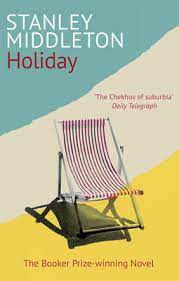
Holiday by Stanley Middleton, 1974

Recent reviews of Stanley Middleton’s novel Holiday all mention the same handful of things – his prodigious output of work (over 40 novels published in his life), the journalistic stunt when the first few chapters of the novel were sent to publishers and comprehensively rejected, and of course the joint award of the 1974 Booker Prize.

Holiday is worth more consideration than these easy references. It is a portrait of a man in the course of a mid-life crisis. Edwin Fisher, a lecturer in Educational Philosophy, has recently experienced the death of his two-year old son Donald. His wife has been unable to cope with the trauma of Donald’s death and their marriage has reached breaking point. Edwin responds bizarrely, as we often do when under great stress – he books a week at the seaside in a boarding house hotel.

His internal monologue gives few clues to his distress. Mundane activities fill his day – sitting on the beach, eating lunch, whiling away the hours until dinner, chatting to strangers, all the time avoiding the real reason for his presence in this depressing seaside town. Fisher is well educated and teaches at the local university, but he has no problem in mixing with the people he meets. He flirts with various women, at one point coming close to having a brief fling with one of the other residents of his boarding house.

Not much else happens. Seaside towns have rarely been more humdrum; whiling away the hours between meals seems the main challenge. Edwin’s parents-in-law arrive at one point to attempt to rescue his failing marriage, all the time insisting on the fact that they are not there to interfere. They engineer a reunion of sorts between Edwin and his wife, although without any attempt at resolving the issues that forced them to part there seems little prospect of the reconciliation being successful in the long term.

I am at a loss to explain why Holiday won the Booker Prize. As well as its fellow joint winner, Nadine Gordimer’s much more interesting The Conservationist, it was short-listed alongside novels by Kingsley Amis, Beryl Bainbridge and C.P. Snow. The cover of this edition quotes the Telegraph describing Middleton as “the Chekov of suburbia”, which is preposterous. Holiday is little more than an extended sketch showing how disappointing the English seaside can be, making this locked-down reader yearn all the more for a return to foreign holidays.

P.S. I don’t normally comment on the edition of the novel I am reviewing, which usually seems fairly irrelevant. But the quality of this Windmill edition was appalling. (Windmill appear to be an imprint of Penguin – why the need for the subsidiary I don’t know!) It was full of mistakes and littered with typos. I don’t faint at the site of an out of place apostrophe, but this was something else. It spoke of a carelessness and cheapness – did they employ a proof-reader or just use an automated transcription service of some kind to save costs? Either way it isn’t good enough.

Standard
Book review

In a Free State by V S Naipaul, 1971

The version of In a Free State which won the 1971 Booker prize consists of a framing narrative and three short stories – “One out of Many,” “Tell Me Who to Kill,” and the title story, “In a Free State.” In his introduction to the edition of the novel that I have just read, Naipaul explains that he was originally advised by his editor to publish just the core narrative as a stand-alone novella, without the supporting stories and text, but how at the time he over-rode her advice, and obviously felt vindicated given the Booker award. However, he goes on to say that he eventually came to realise that her advice was correct. In a Free State is now published on its own without the supporting text, and that was the version I read for this review. Part of me thinks that might constitute taking a short cut, and that I ought to go back and read the longer, prize-winning version, but that would be sadistic. The stand-alone version works fine.

This image has an empty alt attribute; its file name is images

In a Free State is set in an unnamed African country that has recently acquired independence from a colonial power. The king has been deposed in an ongoing coup, with the President about to take power. The king and the President are from different tribes, and the delicate balance of power introduced by the colonial government has started to collapse almost immediately after independence.

The narrative is told by Bobby, a Government official. We are never told his role or status, but we are led to understand that he is white and has decided for now to remain in the country. He has been attending a conference in the capital city in the north of the country, the President’s power-base, and he plans to drive back to the south where the King is based. He offers a lift to Linda, the wife of a colleague, who wants to make the same journey.

The night before the journey begins Bobby tries to pick up a young man in the hotel bar. The bartering over price goes badly, and the young man spits in his face. This is a disturbing scene: Bobby has obviously been comfortable paying for sex before now, when his role in Government gave him a position of authority, but now his status is beginning to slip:

“Bobby thought: this boy is a whore. Bobby was nervous of African whores in hotel bars. But he was prepared to bargain. He said

“You are a brave man. Going about with all that cash. I never carry more than sixty or eight shillings on me.”

“You need two hundred to do anything in this town”.

“A hundred at the outside is enough for me”.

The rest of the novella is a traditional road journey across the divided country, with strong echoes of Conrad’s Heart of Darkness. While the Conrad novella is a portrait of a primitive Africa in the early stages of colonialisation, In a Free State is set at the end of Empire. The novel is dominated by images of the decay of the ‘civilisation’ that the white settlers have constructed. The landscape is reclaiming the towns and settlements built by the Europeans and reverting to a more ‘natural’ state, reversing the process of colonisation:

Many of the houses that looked abandoned were occupied, by Africans who had come in from the forest and had used the awkward, angular objects they had found, walls, doors, windows, furniture, to re-create the shelter of the round forest hut. Within drawing-rooms they had built shelters; they had raised roofs on verandah half-walls. Fires burned on pieces of corrugated iron; bricks were the cooking stones.. ..On the sidewalk grass had grown around rubbish from the houses, things that couldn’t be used and had been thrown out: cracked squares of picture glass, fragments of upholstered chairs, mattresses that had been disembowelled for their springs, books and magazines whose pages had stuck together in solid, crinkled pads.

The 2001 Nobel Committee described Naipaul as “Conrad’s heir as the annalist of the destinies of empires in the moral sense: what they do to human beings…His authority as a narrator is grounded in the memory of what others have forgotten, the history of the vanquished”. I’m struggling to relate this comment to In a Free State, which is dominated by the voices and perspectives of the white settlers, with the black characters often sullenly mute, or saying what they are ordered to say. The central characters’ attitudes towards the African people they meet are consistently negative; they are nameless, mostly fat, and there are persistent references to how they “stink,” and smell like “rotting vegetation.” That in itself doesn’t invalidate the novel – what Empire does to the imperialists is something worth exploring – but it doesn’t feel like a history of the vanquished.

Bobby is a unlikeable character. His recent experience of mental illness is mentioned but not explained – as a representative of the colonial power I read this as suggesting that colonialism itself is sick. It is possible that Naipaul intended the same suggestion by making Bobby gay (there is one bizarre episode where he is repulsed by the concept of a vaginal deodorant!). Midway through their increasingly difficult journey Bobby and Linda, (such bland European names) spend the night at a hotel run by a colonel who treats his African servants like slaves. The hotel was built to attract European tourists to the area, and is in an obvious and accelerating state of decay, with only muddy water coming out of the taps. (The echoes of these scenes with J G Farrell’s Troubles, another portrait of a military figure trapped in a decaying hotel at the end of Empire, are inescapable. Did this theme, also central to Something to Answer For, really dominate the English novel of the 1960s and 70’s, or is this a coincidence?) The Colonel fully expects to be murdered one day by the servants he abuses. Bobby has another unsuccessful attempt to pick up a young man for sex; he also seems trapped in a cycle of failure and frustration.

The road journey format of the novel works well, building the suspense as the military presence in the area increases and they approach their destination. Towards the end of the journey Bobby is beaten by some soldiers at an army checkpoint, a beating he accepts stoically as the price of his presence in this part of the world. Finally the compound is reached, and while the rest of the town and countryside is in flames, the area preserved for white settlers seems untouched. Perhaps this suggests that the real price of being in a Free State is paid by the freed rather than by the colonialists?

I didn’t enjoy In a Free State at first. The central characters are unappealing. The descriptions of the countryside are repetitive and a bit flat.

The verges widened; a few tarnished villas were set in large gardens. There was a roundabout, its garden still maintained, and the highway entered the town. Cross-streets, each with a new black-and-white board bearing the name of a minister in the capital, could be seen to end in mud after two or three hundred yards. The town had been built to grow. It hadn’t grown. It remained a collection of old tin-and-timber buildings, its flimsiness pointed by the small new bank building, the motor car and tractor showroom. The mud-splashed police barracks, low white concrete sheds flat to the ground, already looked like the hutments of the African quarter in the capital.

But while this is without doubt a book that is hard to warm to, my instinct is that it will grow on me.

Standard
Book review

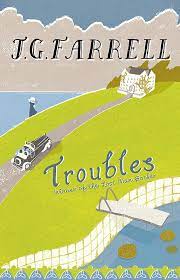
Troubles, by J G Farrell, 1970

It’s really nice to now be able to give an early Booker prize-winning novel a positive review, after having severely panned John Berger’s G., followed by the indifferent Something to Answer for.

Because Troubles was wonderful. (OK, strictly speaking Troubles isn’t an ‘early’ Booker prize winner. It won the Lost Booker Prize in 2010, when the absence of a book published in 1970 in the series, caused by a change in the qualification rules, became too difficult for people who don’t like interrupted sequences to bear. But it was published in 1970, which in my book counts as early.)

Troubles tells the story of the final years of a once grand Irish hotel, the Majestic, during the years of the Irish War of Independence (1919–1921). It is the first instalment in what is sometimes described as Farrell’s ‘Empire Trilogy’, preceding The Siege of Krishnapur and The SIngapore Grip, although I am not sure the term ‘trilogy’ is appropriate for three novels that are only loosely connected. It was widely praised when first published, and rightly so.

The novel opens in 1919, when, after surviving the horrors of the First World War, although not without some psychological wounds, Major Brendan Archer travels to Ireland to try and discover whether he is engaged to Angela Spencer, a young woman who he met while on leave in England, and who wrote to him thereafter describing herself as his fiancé. (“He remembered declaring that he would come back to her, but not very much else.”) Angela’s Anglo-Irish family owns the ramshackle and ironically named Majestic Hotel. The hotel is enormous, with hundreds of rooms and just about every facility you can imagine, from swimming pools to squash courts and ballrooms, all of which are derelict and out-of-order. (One of the more surreal aspects of the novel is the way the hotel seems to expand in scale all the time, with new floors, cellars, grounds etc constantly being revealed.) The hotel is falling apart. It barely functions as a hotel with only a handful of guests. Herds of cats have taken over the upper stories. The term “herding cats” is used in this novel to describe the difficulty of getting a large group of cats to do what you want them to do – it is possibly the origin of the phrase, although all online references refer to later origins:

“It is impossible to control a herd of cats; each one makes up its own mind where it wants to go.”

The Majestic quickly becomes the dominant character of the novel, a symbol of both Empire and Ireland. While it is a hotel, it might be easier to think of it as a castle. That way the novel’s place in the tradition of gothic novels makes a lot more sense. What is unusual if not unique about Troubles is that there is no attempt to underplay or disguise the use of symbolism. The hotel may as well have been called ‘The Empire’ or ‘The Symbol’! Most novels which use symbolism as central features of the narrative are far less direct – the reader is left to do some of the work, and the symbol is more elusive than a shameless X = Y. Any close correlation between the symbol and the symbolised often leads to the narrative becoming a parable. (I am thinking for example of Animal Farm). Troubles is the only novel I can think of where there is no attempt to separate the symbol from its signifier. The novelist places the equation front and centre and constantly draws explicit parallels between the two components. A good example of this is the cats with orange fur and green eyes which breed in vast numbers, over-run the upper floors of the hotel and die violently at the hands of the Major and Edward Spencer, the hotel’s Anglo-Irish owner. A reader would have to be particularly dim-witted to not notice the (uncomplimentary) parallels between the cats and Ireland’s Catholic population. If any such reader were to be in need of further help interpreting the novel, Farrell intersperses the narrative with a series of increasingly dark news articles about the Troubles and the decay and breakdown of colonial order throughout the Empire.

I’ve already mentioned the slightly surreal nature of the narrative. This is a hotel where the Addams Family would have felt at home:

In the foyer at the foot of the vast flowing staircase there stood a statue of Venus; a dark shading of dust had collected on her head and shoulders and on the upper slopes of marble breasts and buttocks. The Major screwed up his eyes in a weary, nervous manner and looked round at the shabby magnificence of the foyer, at the dusty gilt cherubs, red plush sofas and grimy mirrors.
“Where can everyone be?” he wondered. Nobody appeared, so he sat down on one of the sofas with his suitcase between his knees. A fine cloud of dust rose around him.
After a while he got to his feet and found a bell … The sound echoed over the dusty tiled floor and down gloomy carpeted corridors and away through open double-leafed doors into lounges and bars and smoking rooms and upwards into spiral after spiral of the broad staircase (from which a number of brass stair-rods had disappeared, causing the carpet to bulge dangerously in places) until it reached the maids’ quarters and rang in the vault high above his head … from this vault there was suspended on an immensely long chain, back down the middle of the many spirals from one floor to another to within a few inches of his head, a great glass chandelier studded with dead electric bulbs … all was silent again except for the steady tick-tock of an ancient pendulum clock over the reception desk showing the wrong time.

The plants in the Palm Court begin to take on a life of their own and tear apart the hotel. Animal deaths abound – cats are shot and have their heads smashed against the wall, a peacock is throttled for its feathers, and the piglets are slaughtered by ‘Shinners’ (Sinn Fein supporters). Murphy, a sinister servant lurks in the darker corridors, muttering to himself, while the hotel’s owner, Edward Spenser, plans to conduct medical experiments on him. The old ladies who constitute the hotel’s few surviving guests play whist and act as a chorus to the action of the novel, while Edward’s elderly mother seems to live in a cupboard, emerging once a day for dinner clutching an unloaded revolver. It’s quite mad! I read that it has been filmed once, but I would love to see a series made of it, Downton Abbey on acid. There’s enough material for several series in fact.

There are a couple of scenes that over-step the mark. In one, a soldier tries to rape one of the teenage Spenser twins, who is unconscious having drunk too much. He fails because she is wearing multiple layers of under-garments:

“It’s not at all easy to undress someone who is unconscious – and Charity was wearing a great many layers of clothes. Fortunately Matthews was deft and experienced at removing ladies’ garments”

The scene is played as dark humour; in the neighbouring bedroom her twin is with another soldier who is desperate to avoid sex because of what appears to be his latent homosexuality, possibly scarred by an unpleasant experience in a brothel in France:

“He had only to close his eyes to see glittering-ringed fingers parting thick white curtains of fat to invite him into some appalling darkness”.

The other scene which has not aged well is in which Padraig, a friend of the family, is encouraged by the twins to dress up in women’s clothing, and thereafter habitually dresses a woman. His change in appearance is accepted and even welcomed by the hotel’s residents, but towards the end of the novel he is thrown into the hotel’s abandoned swimming pool (fortunately still filled) by some rowdy soldiers. Again this is written largely as a comic scene, but the homophobic/transphobic bullying is uncomfortable reading to a modern reader.

It is a coincidence that I read this novel immediately before Something to Answer for, which addresses the end of the next phase of colonialism. Troubles makes a great companion piece to the Newby novel, sharing a similar structure – a colonial possession seen through the eyes of an Englishman abroad as the period of English rule draws to an end. But while Something is unstructured and a mess, Troubles is a carefully controlled dark farce. It’s one of the best, most original novels I have read in a long time. it could so easily have descended into chaos but manages to balance all the elements with considerable skill. The romantic elements – the Major develops an unrequited love for a local woman who flirts with him but avoids any further attempts at intimacy – are probably the least successful, and the dramatic ending is revealed in the opening pages and are therefore devoid of any suspense. But the success of the novel is in the portrait of the decaying, mad hotel and its inhabitants, as the try to avoid the inevitable and almost succeed.

Standard
Book review

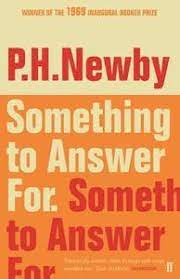
Something to Answer For, by P H Newby, 1969

Let’s be honest – this novel would be out of print and gathering dust if it wasn’t for it being the winner of the inaugural Booker prize in 1969. That’s really its only point of interest. Otherwise the plot is banal to the extent that it exists at all, the characterisation outside the handful of central characters is slim, and the commentary on the Suez Crisis (as it is euphemistically known in the UK) is worthy but dated.

Set in 1956 at the time of said ‘crisis’, the unappealing central character, Townrow has returned to Port Said in Egypt, a place he first visited when in the army in the Second World War. He now works for a charitable trust which he finds it much easier to embezzle than to administer. He has returned to Egypt at the request of Mrs Khoury, the widow of an Egyptian friend Townrow had made during the war. Mrs Khoury believes her husband was murdered and wants Townrow to investigate. Townrow has no intention of doing any investigating – instead he is interested in drinking, womanising (in a very disinterested, lazy way) and looking for opportunities to con Mrs Khoury out of her estate. On his first night back in Egypt he gets drunk, is attacked and suffers a head injury which leaves him dazed and disorientated for the remainder of the novel.

In parallel, Egypt nationalises the Suez Canal precipitating said crisis, which unfolds around Townrow as he stumbles through the various staged incidents which pass for a plot. Townrow is confused about his nationality, underlining the ambiguity of his status as a representative in the novel of the occupying powers. He recalls a conversation he had with a passenger he met on route to Egypt who accuses Britain of having been aware of the holocaust but doing nothing to warn European Jews of the threat to their lives, a claim he rejects forthrightly. It is not clear if we are intended to take this claim seriously – is British guilt by association for the holocaust linked with the creation of Israel? Decoding the politics of this novel is difficult given the distance of the decades, even if Newby’s overall point is relatively clear.

The humour of the novel, which relies mainly on farce, has faded badly since the late 1960’s. The imperial mindset in which one waved a British passport and shouted loudly at foreigners in obviously not completely a thing of the past, but it is no longer much of a target for satirists either, to the extent of incomprehensibility. Newby’s satirising of the British imperial mindset is simply ineffective – the fact that the Suez crisis marked the end of Empire was hardly much of an insight, even in 1969. The farcical elements of the novel are clumsy and unconvincing confusion, ostensibly the result of his knock on the head, muddles the narrative to the extent that not only can the reader not work out what is happening, whether what we are being told is one of his dreams, memories or ‘real’ events, to the extent that one quickly stops caring.

There probably is a novel to be written about the Suez Crisis and its impact on British attitudes to its colonial past. There are many examples of ‘an Englishman Abroad’ novels, the confused, well-meaning and mild-mannered ex-pat trying his best not to be racist (for example, this example from the inevitable Kingsley Amis) and being successful in his seduction efforts simply on the strength of his Englishness. But Newby’s decision to write a psychedelic novel in which the reader is constantly disorientated, however modern and experimental it may have been in the 1960’s, now falls flat. Yes, I get it that Townrow’s head injury, the resulting confusion and his loss of faith in British decency is an effective symbol of the changing nature of the national psyche following the post-war loss of Empire – but it doesn’t make it a good novel.

As a central character, Townrow is pretty unappealing. He’s a crook, has very dated views towards women, Jews and Egyptians, and has few redeeming features. Some novels with anti-heroes at their centre are successful because the protagonist is charming, a rogue, etc – we like them despite their failings. But I’m afraid I can’t say the same of Townrow – there’s simply not enough substance to the character to like.

There are a lot of bloggers out there who start out with the intention of reading all of the Booker prize winners, but who don’t make it. Part of the reason for this might be because some of the early winners are duds, which haven’t stood the test of time. Something to Answer for falls into that category I’m afraid – I can imagine a lot of readers thinking “sixty more novels like that – no thanks!”. The good news is there are a lot more strong novels in the list of winners than duds, so the reward is there for the persistent. But outside the ranks of Booker completists or would-be completists I can’t imagine this novel will have retained much of a wider audience at all.

Standard