Book review

When Ibsen’s Hedda Gabler opens, Hedda and her husband Jorgen have just arrived in their new home from an extended – five or six months – honeymoon. Jorgen’s aunt, Julle, is keen to know whether Hedda is already pregnant and drops many hints on the subject, such as “I don’t expect you wasted your time on your honeymoon, did you, Jorgen?”. At first Jorgen completely ignores her. When he later wonders what they are going to do with their spare rooms, Julle says “You might find a use for them, when the time comes”. He perks up at the idea that the rooms could be used to store his books and papers! As she is preparing to leave, Jorgen says of Hedda, who has by this point joined them, “Have you noticed how well and bonny she looks? I declare she’s filled out beautifully on the trip.” “Filled out” is a strange expression to use of a 29 year old woman (obviously a potential translation issue) but is typical of the way Jorgen infantilises Hedda. It would not be surprising for a nineteenth-century couple to fall pregnant on their honeymoon given the lack of readily available effective contraception (and the long cold Scandinavian nights!). But Hedda angrily rejects any such suggestion: “Oh, do you have to…“. When Julle leaps eagerly on the hint: “Filled out?“. Tesman replies “Yes, Aunt Julle, you don’t notice it so much when she’s wearing that dress. But I…well, I have occasion to….” Tesman is scandalously suggesting he has seen her naked and is therefore better able to judge whether she has ‘filled out’. Hedda again rejects the idea, insisting “I’m exactly the same as I was when we left“. Is this because she is indeed not pregnant, or is she in denial?
Act One ends with Hedda playing her favourite game of winding up those around her. She says to her husband “Oh well, I’ve got one thing at least that I can pass the time with“. He leaps to the assumption that she is hinting at a pregnancy and is crushed when she reveals she is talking about “My pistols, Jorgen“. This scene is also the reveal that Hedda was Lovberg’s secret lover, the punchline to Mrs Elvert’s earlier reference to “a shadow of a woman that stands between us (her and Lovberg). Someone from his past…He said that when they parted, she threatened to shoot him with a pistol”.

In Act two, the Judge joins in the hectoring of Hedda about her putative pregnancy, condescendingly telling her that her boredom with married life will pass “When you’re faced with…what may I … perhaps a little pompously…refer to as a sacred and ….and exacting responsibility? (Smiles). A new responsibility, my little lady.” Such language again infantilises Hedda, denying her agency, and once again, she rejects the idea immediately: “(angry) Be quiet! You’ll never see anything of the sort!” The Judge is as keen as Julle on the idea and won’t let it lie, responding “(carefully) We’ll talk about it in a year’s time… at the very latest”. This is met with yet another absolute rejection: “(shortly) I’ve no aptitude for any such thing, Mr Brack, No responsibilities for me, thank you!” And when he tries to continue the conversation, she shuts it down once more: “Oh, be quiet I say!”

If Hedda treats her pistols as substitute children, for Lovborg and Thea, the manuscript is their ‘baby’, one Hedda manically destroys, saying as she does so: “Now I am burning your child, Thea!—Burning it, curly-locks! [Throwing one or two more quires into the stove.] Your child and Eilert Lovborg’s. [Throws the rest in.] I am burning—I am burning your child.”

Lovborg and Thea agree that this manuscript was their child: (Mrs Elvsted): “Do you know, Lovborg, that what you have done with the book—I shall think of it to my dying day as though you had killed a little child.

Lovborg. Yes, you are right. It is a sort of child-murder.

Mrs Elvsted. How could you, then—! Did not the child belong to me too?”

In the play’s final act, there is a scene which is almost universally interpreted as confirmation that Hedda is indeed pregnant. She has just confessed to Tesman to having burnt Lovborg’s manuscript and continues:

“Well, I may as well tell you that—just at this time— [impatiently breaking off.] No, no; you can ask Aunt Julle. She will tell you, fast enough.

Tesman. Oh, I almost think I understand you, Hedda! [Clasps his hands together.] Great heavens! do you really mean it! Eh?

Hedda. Don’t shout so. The servant might hear.

Tesman. [Laughing in irrepressible glee.] The servant! Why, how absurd you are, Hedda. It’s only my old Berte! Why, I’ll tell Berte myself.

Hedda. [Clenching her hands together in desperation.] Oh, it is killing me, —it is killing me, all this!”

If this ‘confession’ is intended to ensure Jorgen’s continuing devotion, it is short-lived, as he almost immediately throws himself into the attempt to recreate the burnt manuscript with Mrs Elvsted. His hypothetical child-to-be is quickly forgotten. But it is far from explicit.

If you google ‘Is Hedda Gabler pregnant?’ all the online sources agree – yes, she is pregnant, but she is in denial about it. But wait a minute – have you spotted the irony there? This argument suggests that Hedda doesn’t know her own body. All the characters who assume she must be pregnant after her honeymoon are quick to pick up on any indications she might be gaining weight (and some productions add detail such as her having morning sickness, to press the point home). Both characters within the play and critics seem to agree on this point – but Hedda herself has no agency in this issue. We are told very little about the honeymoon or the characters’ intimate life, other than the fact that Hedda finds her husband “horribly tedious”, (his academic focus is on “An Account of the Domestic Crafts of Medieval Brabant”) but we go along with the nods and the winks, the innuendo implicit in phrases such as ‘blossoming‘. Are we the audience being cast as avatars of Aunt Julle and others, clucking over an anticipated ‘happy event’ without ever once listening to Hedda?

Why does this matter? Hedda’s decision at the end of the play is usually interpreted as a form of escape, a decision to leave a situation in which she feels trapped without any other option. I tis worth remembering that the murder (as they would have seen it) of an unborn child would have been an abomination to a Victorian audience. Norway was a largely Evangelical Lutheran society (so the internet tells me) but most nineteenth century audiences would have been shocked and appalled at Hedda’s actions, both towards herself and her unborn child. While generalisations are difficult I expect she would have attracted little sympathy. This is borne out by the initial critical reactions to the play which were a mixture of bewilderment and hostility, with critics calling its 1891 premiere in Munich a “hideous nightmare of pessimism,” ‘immoral’, and Hedda herself a “beast”. Despite this reception audiences kept coming, compelled by the drama of the piece.

This is of course one of those literary puzzles to which there can never be a definitive answer. Ibsen leaves enough evidence for the reader to conclude that Hedda both is and isn’t pregnant, with the actors and producers being given a form of casting vote in terms of how they portray the character. But I would suggest this is not a simple choice and is one which can potentially influence the impact of the whole play on audiences.

Postscript

It occurred to me a while after writing the above that it treats the issue of pregnancy in a very binary way. Technically that may be true – a woman is either pregnant or she is not – but in reality the situation can be and often is more complicated. For instance, a woman may be pregnant but not realise it – quite possible in Hedda’s case. Equally the reverse can be true. More commonly, a woman might simply not be sure whether she is pregnant or not. In the days before modern pregnancy testing that must have been an almost universal experience in the early weeks of pregnancy. It is also quite possible that Hedda is unable to have children – this would explain her attempted ‘confession’ to Jorgen in Act Four – or that she had been pregnant but had miscarried – again, something that she would probably feel merited a confession. It is also not beyond the bounds of possibility that Jorgen is not the father of Hedda’s hypothetical baby, which would go some way to explaining her cry that it is killing her. So the ‘Hedda is pregnant but in denial’ interpretation of this aspect of the play is one of many supported by the text if the reader and performers are prepared to open themselves up to alternative and arguably more interesting readings.
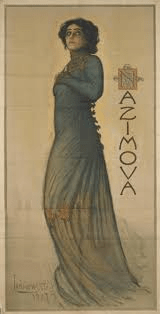
Is Hedda Gabler pregnant?

Aside
Book review

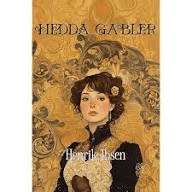
Ibsen’s Hedda Gabler is a psychological portrait of the central character, a young wife tortured by the restraints of social expectation, bored silly by married life and dreading the future. She attempts to find relief from her stifling marriage – even though this is a life of privilege compared to those of many – by manipulating the weaker minds around her, not least her rather dim husband. The play opens with Hedda and Jorgen Tesman arriving home from an extended honeymoon. They are soon visited by Tesman’s aunt, Julle (in many translations this is written as Julie), who is her sister’s carer, and soon thereafter by Mrs Elvsted, a friend whose marriage is in trouble. Later Judge Brack, a friend of Tesman’s, comes to invite him to a drinking party. The ensemble is complete by Ejlert Lovborg, (“a poor depraved creature”) a writer, reformed alcoholic and former lover of Hedda’s, who is now in a new relationship with Mrs Elvsted.

In other hands this would be the stuff of drawing room comedy. But Ibsen’s vision is dark, and things start to get complicated very quickly. From the moment she is introduced it is clear Hedda is what we would now call ‘high maintenance’. She complains that there are too many flowers in her sitting room and she bosses Berte the maid around: “All the things the young mistress wanted unpacked before she could get off to bed”. She tells Berte off for forgetting to use her husband’s academic title and is then sharp with her husband’s aunt, saying “Such an early visit” and teases her quite cruelly about her new hat, pretending to mistake it for the maid’s. But she reserves her seriously sadistic side for her ‘friend’ Thea Elvsted.

Thea’s story is an important analogue of Hedda’s. She was once romantically involved with Jörgen. Thea is now trapped in a loveless marriage, to a man twenty years her senior, looking after his children by his first wife who she was originally employed to care for. By her marriage she has simply become an unwaged servant. Lövborg came to their house in the country as a tutor for the children and they quickly became romantically involved. When the play opens Thea has left her husband to join Lovborg, ignoring the inevitable scandal that will follow. She went to school with Hedda – this is a close knit community – where Hedda obviously bullied her, pulling her hair. She reminds Hedda that “you once said you were going to burn it off”. Later Hedda says “I think I’ll burn your hair off after all“. Is this a sick joke, or a serious threat? Thea has the courage to do what Hedda seemingly cannot, that is to leave her unhappy marriage and follow her lover.

Hedda is jealous of and angered by Thea’s relationship with Lovborg. When she and Lovborg were lovers, he lived a life of excess, and she lived vicariously through him. But now he has found some stability with Thea, has sobered up, and has published a successful book, with another nearly complete. Hedda attempts to undermine this relationship, goading him into drinking despite his well-known struggles with his sobriety. Initially she tries this by offering him punch, which he declines. When he proves strong enough to resist this temptation she argues that he should drink “otherwise people might so easily get the idea that you are not…not really confident, really sure of yourself“. In other words you need to drink to show you are not an alcoholic! This distresses Thea, causing her to cry “Oh God, Oh God, Hedda! What are you saying? What are you trying to do?” I think it is very clear what she is trying to do – she is pulling the wings off flies, just because she can. Hedda may not be a monster, but she does some monstrous things. At the end of the Act the Judge, Tesman and Lovborg head off for a party at the Judge’s house, while the womenfolk stay at home, waiting for them to return.

Hedda: [Rising.] Are you going through the garden?

Brack: Yes, it’s a short cut for me.

Act Three opens the morning after the party – ‘almost an orgy’, in Tesman’s eyes at least, but clearly the scene of some excess. Hedda and Thea have been up all night, waiting for their men to return in good time, as promised. Some of the members of the party, Lovborg included, have headed off to a brothel to continue drinking (and, it is implied, so on.) Tesman comes home, but quickly goes out again on receipt of news about his ailing aunt. He only has time to give Hedda the manuscript of Lovborg’s brilliant new book, which he has lost during the night’s bacchanalian excesses. (When I go drinking I always take with me the only copy of a precious manuscript for some light reading). Lovborg does not know he has found the manuscript. He leaves Judge Brack and Hedda to chat. She tells him that she understands that he has aspirations to be “the only cock in the basket” an expression meaning dominant male in a group of females. He admits “Yes, that’s what I want. And I’ll fight for that end with every means at my disposal“. Hedda responds “I’m content, so long as you don’t have any sort of hold over me“. As Brack goes to leave, this innuendo-laden (and at the same time ominous) exchange concludes their conversation:

Hedda: And then it is a back way, too.

Brack: Quite so. I have no objection to back ways. They may be piquant enough at times.

Hedda: When there is ball practice going on, you mean?

Brack: [In the doorway, laughing to her.] Oh, people don’t shoot their tame poultry, I fancy.

Hedda: [Also laughing.] Oh no, when there is only one cock in the basket—

The Judge is quickly replaced by Lovborg and then Thea. The Tesman’s drawing room is the centre of much coming and going throughout the play – the only person who never leaves is Hedda, emphasising how trapped she is. Lovborg confesses he has lost his manuscript, although he lies to Thea saying he has deliberately destroyed it. When she leaves Hedda gives him one of her pistols, explicitly encouraging him to kill himself. When he then leaves, she quickly and impulsively burns the manuscript, saying “Now I am burning your child, Thea!—Burning it, curly-locks!… Your child and Eilert Lovborg’s. [Throws the rest in.] I am burning—I am burning your child”

Act Four sees Hedda face the consequences of her actions.When told of Lovborg’s suicide (between the acts), she initially celebrates:

Hedda. [In a low voice.] Oh, what a sense of freedom it gives one, this act of Eilert Lovborg’s.

Brack. Freedom, Mrs. Hedda? Well, of course, it is a release for him—

Hedda. I mean for me. It gives me a sense of freedom to know that a deed of deliberate courage is still possible in this world,—a deed of spontaneous beauty.

But when Brack reveals he knows that she gave Lovborg the pistol, and that he intends to use this knowledge to exert control over Hedda, effectively to blackmail her, she realises she is running out of options:

Hedda. [Looks up at him.] So I am in your power, Judge Brack. You have me at your beck and call, from this time forward.

Brack: [Whispers softly.] Dearest Hedda—believe me—I shall not abuse my advantage.

Hedda. I am in your power none the less. Subject to your will and your demands. A slave, a slave then! [Rises impetuously.] No, I cannot endure the thought of that! Never!

I won’t spoil the ending, just in case you haven’t seen or read it, but it won’t come as a surprise.

So that’s what happens. But is it any good? Is the play entertaining, thought provoking, profound? Is Hedda theatre’s ‘female Hamlet’, as often claimed? (Incidentally I haven’t been able to find a source for this much-repeated claim). Is Ibsen really one of modern theatre’s greatest playwrights? There is no question of his dominant status in modern theatre. Equally there’s no question that the play is densely packed and full of incident, complex characters, drama and back-story. Yet the same time it is very static, set in just the one location. Many of the play’s most dramatic incidents occur off-stage. And the complex web of relationships between the characters has little time to further develop – the total elapsed time in the play is at most forty-eight hours.

Ultimately, the play stands or falls on whether the reader/audience finds the ending convincing or not. Is Hedda driven to such a state of extreme distress that she sees no way out, or is her decision (like many of the others she takes in the course of the play) taken capriciously? On the page, I didn’t find her decision was understandable. That may well be my problem – a failure to fully empathise with the character – rather than Ibsen’s. I also completely recognise that on the stage this concern could be swept away by a compelling portrait of Hedda and the rest of the cast. But in the absence of those factors, on the page alone, Hedda is hard to empathise with and even harder to understand. I recognise that the impact of the play on a Victorian audience would of course have been dramatically different to the way the play lands today. All stories age and change with time, and I can’t begin to imagine how a Victorian audience would have reacted to Hedda, other than it would almost certainly have been very different. (Of course I don’t need to guess because the contemporary reaction is fairly well recorded, but empathising with that reaction is almost impossible). Can the play be brought up to date in production? Well it continues to be performed at the highest theatrical level, so this surely isn’t a text that has aged badly. I confess that as of now, not having seen the play on the stage, the secret of what makes it so highly regarded eludes me.

Finally, a quick word on translation. I used two different translations in preparing this post: the Gutenberg project ebook translated by Edmund Gosse and William Archer, and the World’s classics edition translated by James McFarlane and Jens Arup. The internet tells me that the Archer translation is one of the oldest available, but neither of these appear when searching for the ‘best’ translation. But I make no comment on the value of either of these translations – I am the last person who could comment on such matters – the point is they are strikingly different. The Gosse/Archer translation uses the phrase ‘cock of the basket’ to translate Hedda’s last words; the McFarlane/Arup version translates this idiomatic phrase as “the only cock in the yard”. Neither phrase means very much in English – cock of the walk probably comes closest, but it means dominant in any group rather than a dominant male amongst a group of females. It is difficult to imagine the performance making the meaning of the phrase much clearer. If therefore any of the quotes used above do not appear in your copy of Ibsen, I blame the translation!

Hedda Gabler by Henrik Ibsen, 1891

Aside
Book review

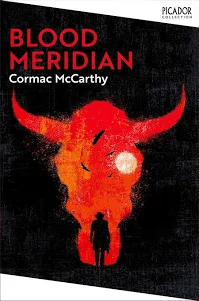
Blood Meridian by Cormac McCarthy, 1985

Blood Meridian is an extraordinary novel. It is profoundly violent, and at the same time quite lyrically beautiful. It reminded me at various points of The Odyssey, The Inferno, and even Don Quixote, without ever being self-consciously ‘literary’.

The events of the novel take place in the aftermath of the Mexican-American War of 1846-1848. During that war, the US effectively conquered the north of Mexico, which eventually became the South Western states including Texas, New Mexico and California. But despite this victory US control of this area was limited. Native tribes including the Comanche and Apache were still active and represented a threat to Mexicans and ‘Americans’ alike. Effectively this vast area of land was lawless. Settlers were vulnerable to raids by these tribes, so local governments in both northern Mexico and the Southwestern US employed mercenaries to hunt down these tribes, offering a bounty for each grisly proof of a kill.

The novel follows the adventures of an unnamed, troubled teenager known only as ‘the kid’. Born in Tennessee, by the age of fourteen he has “a taste for mindless violence”. He runs away from home and soon meets Judge Holden – the Judge – a character who haunts the rest of the novel. When he first encounters the Judge he incites a crowd to attack a preacher. This incident could be the trigger for the kid’s subsequent life of violence. He joins a militia planning to travel into Mexican territory: this is presented as a campaign to protect American settlers but it is clearly just an excuse for the gang to go looking for plunder. However, the gang is poorly prepared and under-equipped and is quickly wiped out by a war party of Comanches. This is not going to be a straightforward Western where the superior firepower of the Americans can overwhelm the poorly equipped ‘natives’. Blood Meridian is informed by many of the tropes of the tropes of the traditional Western narrative but consistently subverts them in this way.

The kid survives the massacre and sets out through the desert looking for somewhere to rest and recover, the first of many such aimless journeys. When he does eventually reach a town he is arrested by Mexican soldiers and jailed without trial. His time on a chain gang ends when he signs up for another gang of scalp-hunters led by Captain Glanton (closely based on a real historical figure). Glanton’s gang (although it is never described as such, that’s clearly what it is) includes the Judge that the kid had met earlier in the novel.

Much of the rest of the narrative follows the gang’s campaign of mindless violence through the increasingly hostile landscapes of this part of Mexico. In theory the gang are authorised by the Mexican authorities to kill Native Americans and return their scalps for a bounty. But they quickly work out that it is hard to tell Native American scalps from those from Mexicans, and begin killing and scalping people indiscriminately. Some of the scenes of the massacres, including those in which women children and babies are slaughtered, can be hard to stomach. Consider that your trigger warning.

The narrative point of view McCarthy uses to tell his story is chillingly calm and totally non-judgmental. The massacre scenes are stripped of adjectives and atmosphere, emphasising their brutality. The gang have no conscience, no sense of humanity at all. People are just products to be harvested.

As the long journeys to find more people to kill continue, we learn more about the Judge. One of the gang members tells a story about how he once helped an earlier version of the gang manufacture gunpowder which they then used to massacre the Apaches chasing them. The Judge is an enigmatic, almost supernatural figure. At times he is an avenging angel, at others he takes an academic interest in his environment, making sketches of the landscapes. the flora and fauna, and the native American artefacts that litter the landscape. He is perhaps Western colonialism personified, wreaking huge damage on the peoples and countryside under the guise of academic analysis.

Although largely operating with impunity, the gang eventually goes too far – after a fight at a cantina they attack a group of Mexican soldiers. Their contract with the local government is cancelled and a bounty is posted on Glanton’s head. The gang leave the area and travel to a neighbouring state, where they pick up another contract for Apache scalps. This is the cue for further scenes of brutality, although this time the gang meets more substantial opposition from both Native American warriors and Mexican soldiers. Eventually, at the Colorado River, they seize control of a key ferry crossing, and grow rich exploiting and robbing their passengers. This good life is abruptly ended by another attack from a local tribe, and most fo the gang are killed, including Glanton himself. The kid survives, albeit seriously wounded, and along with another survivor tries to escape. But now they are being tracked by the Judge, who has turned against them, and pursues them relentlessly.

Blood Meridian is shocking in its brutality, but also lyrically beautiful. McCarthy evokes the stark beauty of the landscape:

“They rode on and the sun in the east flushed pale streaks of light and then a deeper run of color like blood seeping up in sudden reaches flaring planewise and where the earth drained up into the sky at the edge of creation the top of the sun rose out of nothing like the head of a great red phallus until it cleared the unseen rim and sat squat and pulsing and malevolent behind them.

But as the novel unfolds the landscape becomes increasingly hellish, with more and more bodies littering the ground. This is a journey into hell.

The only element of the novel that for me fell a little flat was the Judge’s philosophising. He is presented to the reader as a guru, someone whose thoughts on life and existence are worth listening to.

“Whatever exists, he said. Whatever in creation exists without my knowledge exists without my consent. He looked about at the dark forest in which they were bivouacked. He nodded toward the specimens he’d collected. These anonymous creatures, he said, may seem little or nothing in the world. Yet the smallest crumb can devour us. Any smallest thing beneath yon rock out of men’s knowing. Only nature can enslave man and only when the existence of each last entity is routed out and made to stand naked before him will he be properly suzerain of the earth.”

Or

“Men are born for games. Nothing else. Every child knows that play is nobler than work. He knows too that the worth or merit of a game is not inherent in the game itself but rather in the value of that which is put at hazard. Games of chance require a wager to have meaning at all. Games of sport involve the skill and strength of the opponents and the humiliation of defeat and the pride of victory are in themselves sufficient stake because they inhere in the worth of the principals and define them. But trial of chance or trial of worth all games aspire to the condition of war for here that which is wagered swallows up game, player, all.

Rather than these being profound meditations on power, good and evil, and so on, for me they were trite and out of place in the narrative. They weren’t needed. This didn’t in any way spoil the novel for me – I was more than happy to accept these speeches as brief interruptions soon passed by, but they felt heavy-handed, when everything the author wanted to say was already very clear. The wild west was not a place of adventure but a war-zone, devoid of morality. McCarthy has a bleak vision of humanity, but this is what makes him a prophet for our times.

Blood Meridian or the Evening Redness in the West by Cormac McCarthy, 1985

Aside
Book review

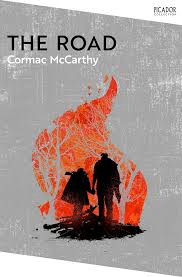
The Road by Cormac McCarthy, 2006

The Road is a pretty traumatic read – if books came with trigger warnings, this would have lots of them. It is set in the nearish future after an environmental or some other disaster that has wiped out almost all plant and animal life on earth. The sun is blocked by clouds and ash covers everything. The landscape is hellish, blasted and burnt. The few human survivors hunt one another for food.

The story is told through the eyes of ‘the man’ and his son, survivors in an unremittingly bleak and hostile landscape. The only other survivors they meet want to kill them and eat them, or are enslaved and due to meet the same fate. At one point they see from a hiding point

“An army in tennis shoes, tramping. Carrying three foot lengths of pipe with leather wrappings. Lanyards at the wrist. Some of the pipes were threaded through with lengths of chain fitted at their ends with every manner of bludgeon…The phalanx following carried spears or lances tasselled with ribbons, the long blades hammered out of trucksprings in some crude forge upcountry…Behind them came wagons drawn by slaves in harness and piled with goods of war and after that the women, perhaps a dozen in number, some of them pregnant, and lastly a supplementary consort of catamites illclothed against the cold and fitted in dogcollars and yoked each to each.”

The son was born just after the end of the world. Initially his mother was with them for some time, but in one of the novel’s many disturbing scenes the man remembers his final conversation with her where she confirms her decision to take her own life:

“Sooner or later they will catch us and kill us. They will rape me. They’ll rape him. They are going to rape us and kill us and eat us and you won’t face it. You would rather wait for it to happen. But I can’t. I can’t.”

The novel is a dystopian version of the classic journey/quest story, its title ironically referencing Kerouac’s On the Road. While Kerouac’s characters travelled freely through a sunny, prosperous American landscape, the man and his son are on foot, hunted and starving. They travel south looking for a warmer climate, with the vague destination of the coast, when they can go no further, and an equally vague hope that they might meet a community of non-cannibals willing to take them in and help them. They carry their small amount of food and possessions in a shopping trolley, which explains the need to stay on the road rather than heading across country. The road is largely deserted but also very dangerous – it is where they are most likely to meet other, equally hungry and desperate people.

The boy – he is around ten years old – constantly asks his father questions, principally to seek reasurance and comfort. He believes his father when told that they will find food, somewhere warm, and people to help them, even though every day proves how profoundly unlikely this seems. As all plant life is dead, the only food left is tinned and this is obviously in very short supply. All the other necessities of life, including shelter, clothes and clean water, are equally hard to come by. At several points they come close to starvation; at many others they are nearly captured or killed. After every step they get colder, hungrier, thirstier. The world they live in is so vividly realised that the reader shares in the feeling of trauma. Hellish doesn’t begin to describe it. The only thing that keeps them going is one another, and the small, unspoken hope that somewhere there is a place of refuge. Extraordinarily, at one point they find just such a place, an emergency bunker full of food and other resources, but the man refuses to stay, refusing to believe they will be safe, even though the road is a much more dangerous environment.

Despite everything, the boy preserves a core of integrity. He wants to help people they encounter, and cannot accept the hard decisions his father has to constantly make. He is the voice of compassion, the conscience of a lost world he knows only through the memories of his father, which in hindsight seems a paradise:

“Once there were brook trout in the streams in the mountains. You could see them standing in the amber current where the white edges of their fins wimpled softly in the flow. They smelled of moss in your hand. Polished and muscular and torsional. On their backs were vermiculate patterns that were maps of the world in its becoming. Maps and mazes. Of a thing which could not be put back. Not be made right again. In the deep glens where they lived all things were older than man and they hummed of mystery.”

I enjoy dystopian fiction, and will watch just about anything involving zombies or end of the world catastrophes. Usually these involve a suspension of disbelief – the characters often survive for long periods without any obvious sign of food or water, for example, or find weapons in abundance just when they are needed. The Road offers no such false comforts. This is a terrifying world in which death seems an attractive alternative to the hardships of daily life. I read The Road compulsively in just over a day, all the time anticipating the end which I thought was inevitable – this novel was not going to have a happy ending. I am going to avoid spoilers and let you decide what you think about the ending, but whatever you do don’t read The Road unless you are feeling quite psychologically strong. Keep telling yourself it is only a story.

The Road by Cormac McCarthy, 2006

Aside
Book review

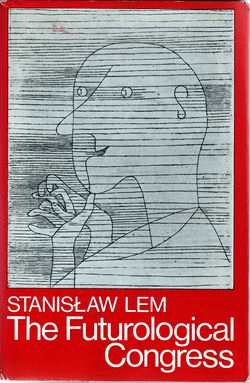
It has been a long time since I have read any science fiction, but while browsing in my local library, The Futurological Congress, a black humour science fiction novel by Polish author Stanisław Lem, caught my eye. I’ve long been interested in dystopian novels – 1984, Brave New World, etc – and I wondered what the future looked like in the early 1970’s, when 2026 seemed an impossibly long way away. It wasn’t a surprise that like most novels of its kind, some aspects of the future are captured with eerie precision and others are wildly wrong. Which always makes me wonder which of the technological innovations we think are inevitable – the rise of AI, self-driving cars, etc – will actually happen, and instead what undreamt of changes will occur in our future?

In The Futurological Congress, Lem’s protagonist, Ijon Tichy, attends the Eighth World Futurological Congress in Costa Rica. The novel is set in an indeterminate future (but not too far ahead, because a later time jump takes Tichy to 2039). The conference is being held to consider the world’s population crisis. Futurologists predict the future from existing trends – and at this point in humanity’s story all predictions for the future of the world are bleak.

Lem’s description of this future is at first dominated by absurdity. Tichy’s hotel room is ‘guaranteed bomb-free’ and includes a palm grove and an orchestra. Conference papers are distributed in hard copy (paper always seems very resilient when people thought about the future of business or education) but speakers call out paragraph numbers to save time. The hotel’s water supply is drugged with a chemical that makes the user profoundly good-natured.

Shortly after the start of the congress, the hotel it is being held at comes under attack by protestors. After an attempt to ignore the bombs Tichy and some other attendees and hotel staff take cover in a sewer beneath the hotel. From here he is evacuated only to realise he is still hallucinating. The next rescue attempt ends with the helicopter taking him away crashing. He wakes up in a hospital to find his brain has been transplanted into the body of a young black woman. This then happens all over again – waking up from a hallucination, attack by mysterious forces, rescue and body transplant – which would I suspect make most people wonder about the nature of reality they are experiencing, but Tichy seems accustomed to a world in which bizarre things happen as a matter of course. Finally, in yet another hospital, he is cryogenically frozen (cryonics was just becoming a ‘thing’ in the US in the late 60’s) and wakes up (in scenes familiar from Austin Powers, Futurama and Sleeper – take your pick) in the year 2039.

When the novel jumps forward to 2039, the tone switches dramatically from being a freewheeling comedy to a rather bleak dystopia. From this point the novel is written in the format of a journal. Initially, 2039 (presumably 2039 Costa Rica?) seems utopian. Everyone is happy, all society’s ills have been cured, war is no more, and everything is abundant. Drugs are used to control everyone’s perception of reality and can do just about anything:

“The most recent of the iamides, heavily advertised – authentium. Creates synthetic recollections of things that never happened. A few grams of dantine, for instance, and a man goes around with a deep conviction that he has written The Divine Comedy. Why anyone would want that is another matter and quite beyond me.”

But slowly Tichy becomes disillusioned with this chemically enhanced ‘paradise’. He stops taking any drugs but doesn’t realise that the air itself is suffused with perception-altering chemicals. Finally his friend, Professor Trottelreiner, tells him a terrible secret:

“By introducing properly prepared mascons (reality-masking chemicals) to the brain, one can mask any object in the outside world behind a fictitious image—superimposed—and with such dexterity, that the psychemasconated subject cannot tell which of his perceptions have been altered, and which have not. If but for a single instant you could see this world of ours the way it really is — undoctored, unadulterated, uncensored — you would drop in your tracks!”

A small dose of an unmasking drug allows Tichy to see the world as it really is: instead of being in a five-star restaurant he is in a dank concrete bunker eating “the most unappetizing gray-brown gruel, which stuck in globs to my tin“. No-one drives a car – they run in the road believing they are doing so, and instead of travelling up and down in lifts they climb the empty elevator shafts. Everyone lives in abject squalor eating horrible muck, all the time believing they are living in luxury. The world is being destroyed by over-population – the very problem that the original Futurological Congress was intending to address. Only a small number of soothseers know the real state of the world. This is Tichy’s red pill moment – the terrifying realisation that the world is actually squalid and disgusting. When finally he is returned to his original time, hiding in the sewers from the bombers attacking the conference, we are left in doubt as to whether this is a return to reality or yet another chemically induced nightmare.

As well as its bleak portrait of the future, the other predominant feature of The Futurological Congress is its experimental use of language. I can imagine that translating the text from Polish to English must have been challenging to say the least, and many of the words must surely be approximations, given that Lem made many of them up in the first place. Take a paragraph like this for example:

In just the last issue of Science Today there had been an article on some new psychotropic agents of the group of so-called benignimizers (the N,N-dimethylpeptocryptomides), which induced states of undirected joy and beatitude. Yes, yes! I could practically see that article now. Hedonidil, Euphoril, Inebrium, Felicitine, Empathan, Ecstasine, Halcyonal and a whole spate of derivatives. Though by replacing an amino group with a hydroxyl, you obtained instead Furiol, Antagonil, Rabiditine, Sadistizine, Dementium, Flagellan, Juggernol and many other polyparanoidal stimulants of the group of so-called phrensobarbs (for these prompted the most vicious behavior, the lashing out at objects animate as well as inanimate—and especially powerful here were the cannibal-cannabinols and manicomimetics).

In the 1970s Poland was still part of the Soviet bloc. The Futurological Congress is (at least in part) a commentary on the communist state that told its citizens they were living in a socialist utopia, but where their actual experience of life was of hardship and want. In 1984 George Orwell makes a similar point – in that novel, instead of chemicals, the state uses terror to force its citizens to believed that rations are being increased even as they are cut. Perhaps Lem was telling us to wake up and take over-population seriously, and not put our faith in political ideologies?

The Futurological Congress by Stanisław Lem, 1971

Aside
Book review

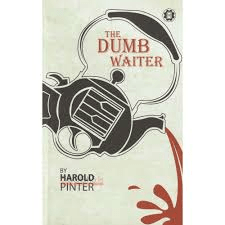
The Dumb Waiter, by Harold Pinter, 1957/1960

I think I am going to try and read, and review, more plays this year, even though I remain steadfast in my view that plays are for watching not reading. Sure you can read them, but in doing so you could easily miss much of the nuance and subtlety of a play that would be brought out in performance.

Just to explain the dates above, the internet tells me that The Dumb Waiter was written in 1957 but not performed until 1960. Either way that makes it one of Pinter’s earliest works. It is a short one-act play in which two men, Ben and Gus, wait in a basement. Ben, apparently the senior member of the two, reads a newspaper, while Gus fusses around nervously. Tea is mentioned but never quite made. As their conversation progresses it emerges that they are hit-men, waiting for an assignment and instructions on who to kill. Their conversation is dominated by mundane, everyday nonsense such as the difference between the phrase ‘light the kettle’ and ‘put on the kettle’. There is almost a vaudeville, back and forth element to their conversation, but at the same time there is a sinister undertone.

Pinter’s stage directions are very detailed and one of the reasons for this emerges when the men realise that at the back of the room is a dumbwaiter, a small lift for carrying food between floors. The waiter starts to deliver a series of food orders, as if to a restaurant kitchen – at first for plain café food – soup of the day, liver and onions, jam tart – and then for more complex orders – macaroni pastistsio, ormitha macaroundada, and scampi. Ben and Gus are dumbfounded by this turn of events, but are so used to doing what they are told that they send up what food they have – milk, biscuits, crisps and chocolate – in a pathetic attempt to comply. . In production I can imagine that this part of the play would be essentially comic, but on the page the tragic element also comes across – they are unable to understand what is happening to them, but still try to do their best. Next to the dumb waiter is a speaking tube which they try to use to communicate with whoever is sending down the orders, but to no avail.

In a break from the dumb waiter’s interruptions, the men start to rehearse the impending assassination, which complies with a strict sequences of events. In doing so they casually but shockingly reveal that their last ‘job’ was to kill a girl.

The impact of Beckett’s Waiting for Godot on this early work by Pinter is immediately obvious – two anonymous characters waiting in a remote location for something to happen, passing time with inane chat that reveals their concerns about their purpose in life. There is no conventional narrative or storyline (although in Pinter’s play there is a dramatic denouement) and absurd and unexplained events challenge the characters’ ideas. Long periods of silence allow space for the claustrophobic tension of the setting to develop. The Dumb Waiter is often produced alongside another of his one-act plays, but I can’t help wonder whether a contrasting text – something by Joe Orton for example – might work as effectively? If you want to read more British post-war plays then The Dumb Waiter is an excellent starting point. Pinter was a key figure in post-war British drama and went on to be awarded the Nobel Prize for literature in 2005, being cited for work that “”uncovers the precipice under everyday prattle and forces entry into oppression’s closed rooms”.

The Dumb Waiter, by Harold Pinter, 1957/1960

Aside
Book review

I have a theory: I suspect that early drafts of The Long Shoe were planned as a sequel to The Satsuma Complex (2022) and The Hotel Avocado (2024) – in all probability with a fruit-based title. But this plan had to be abandoned, because The Long Shoe‘s plot needed the central female character, Harriet (Emily in the first two novels) to have a job that runs the risk of her being kidnapped, and Mortimer just couldn’t make the plot work within the constraints of her ‘legacy’ occupation.

So a new context and setting was required. Apart from the change of occupation the novels are strikingly similar, with the protagonist Matt (Gary) a rather feckless character drifting through life (he is a recently unemployed bathroom salesman) living in a London suburb, taking walks in the park, drinking coffee, talking to his pet cat/pigeon/quirky animal of choice, and enjoying a casual relationship with his girlfriend while taking her commitment for granted. The novels’ themes are also similar – mysteries involving organised crime, a violent villain who is physically menacing and a bit disturbed, and a climax in which Gary confronts the bad guys in a clumsy, endearing manner.

This theory would also explain the irrelevance of the novel’s title. The long shoe referred to here is a comically long wooden model of a shoe, purchased from a market stall specialising in quirky conversation pieces. It could have easily been swapped into the novel on a find and replace basis for a whimsical fruit-based object of a similar scale.

Having said all that, it really doesn’t matter if this theory is right or not. The Long Shoe works well enough as a standalone novel, just one that will feel very familiar if you have read the author’s previous two. The premise is simple, if familiar: Matt’s relationship with Harriet is in trouble, as she questions whether they have a long-term future together. She leaves him for a short break to consider her feelings. While she is away Matt is offered out of the blue a caretaking job. which comes with the benefit of a heavily discounted flat in Satsuma Heights, (a little nod to novel one, of course). The new job and flat are all the more welcome as they were having to leave their existing flat in a few weeks. Harriet’s farewell note is ambiguous and Matt is not sure if she has left him for good, or is just taking some time out. Improbably she has also neglected to tell her employer, the Crown Prosecution Service, that she is taking leave, and she stops answering her phone. Instead of reporting her absence to the police, Matt tries to track her down.

The novel’s minor characters include Carol, a deeply unpleasant neighbour who has designs on Matt, Hot Dog, one of Matt’s new neighbours in Satsuma Heights, and a very underwritten waitress who never really emerges as a distinctive character at all (in my alternative version of this novel this character has a more fleshed out role but with all the old plot elements stripped from her she is left hollowed out(.

Around halfway through the novel we discover that Harriet has been kidnapped and over the course of the rest of the novel her predicament is revealed and her rescue effected. The mystery – who has kidnapped her, and why – is well-managed, and the novel’s rather violent climax is genuinely exciting. The novel’s humour is more whimsical than laugh out loud – with Bob I think much of the charm of his humour is in the performance, so on the page the jokes are wryly amusing rather than belly laughs. So overall this novel is amusing and a pleasant enough read, but will not linger long in the mind.

The Long Shoe, by Bob Mortimer, 2025

Aside
Book review

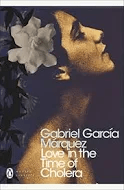
Love in the Time of Cholera by Gabriel Garcia Marquez, 1985

Love in the Time of Cholera is a dense and complex meditation on love and the process of aging. It also contains some very troubling content, of which more later. It is not an easy read and I am still unsure whether it merits the adulation it receives in many quarters.

Set at the end of the nineteenth century in an unnamed but volatile country in the Caribbean, the novel tells the decades long love story of Fermina Daza and Florentino Ariza. As a young man Florentino falls in love with a young woman who lives with her possessive and suspicious father. So far so Romeo and Juliet. After secretly wooing Fermina for months Florentino finally secures her promise to marry him.

But the ‘affair’ is discovered. Fermina’s father refuses to consider the marriage, considering Florentino unsuitable for his daughter and takes her on a years’ long trip through the country’s interior, hoping that this will make her forget him. During the journey scenes of the long-running civil war and the ravages of cholera simply form a background to everyday life and are considered normal. When they finally returns to the city, Florentino attempts to resume the relationship, having continued to write to her using his contacts in the telegraph service. But Fermina suddenly realises that their relationship was just a childish infatuation. Shortly afterwards she marries a local doctor, Juvenal Urbino, and lives a long and moderately happy life with him, raising a family and surviving the normal traumas of married life, until his tragically comic death in old age, a death with which the novel opens.

At the funeral, Florentino, now in his seventies, renews his affection claiming he has never stopped loving her. At first she is not interested – more than fifty years has passed – but gradually he wears her down. Much of the body of the novel consists of the story of how Florentino has spent his time while waiting for Fermina to be free. His career with a riverboat company is the background to his all-consuming passion, seduction. Florentino is a prodigious and undiscriminating lover of women of all backgrounds, ages and class. He has no problem in squaring this lifestyle with waiting for his true love.

Although Florentino is the novel’s central character and sees himself as man of principles, a tragic lover waiting all his life for his one true love, in reality he is simply depraved. He sleeps with over 600 women, many of them vulnerable. One is killed by her husband after he discovers her affair. Later, he conducts an abusive relationship with a 14-year-old girl who is his ward. The author’s portrait of this abuse is as disturbing as anything written by Nabokov:

“She was still a child in every sense of the word, with braces on her teeth and the scrapes of elementary school on her knees, but he saw right away the kind of woman she was soon going to be, and he cultivated her during a slow year of Saturdays at the circus, Sundays in the park with ice cream, childish late afternoons, and he won her confidence, he won her affection, he led her by the hand, with the gentle astuteness of a kind grandfather, toward his secret slaughterhouse.”

He has no insight into how wrong this relationship is – she is a child, he is more than fifty years older than her and in a position of parental responsibility – and when he ends the abusive relationship she commits suicide. In short, he is a scumbag. The novel ends with a reconciliation between the two ‘lovers’. A boat trip into the interior of the country, ravaged by industrialisation, war and disease, provides the novel’s ending and a metaphor for aging and loss.

The novel’s title suggests this is a book about love, but it is not (any more than Lolita is a love story). Two people spend their lives apart and eventually come together in a facsimile of elderly, incontinent married love. Florentino thinks of himself as one of the courtly knights of old who would love his lady from afar, sacrificing all for just one smile. In reality he is a disturbingly lascivious paedophile, a dirty old man whose idea of love is distorted in the extreme. I finished Love in the Time of Cholera with a sense of disquiet that has only worsened the more I think about what actually happens in the book. I accept I am probably missing something, but I am keen to move on as quickly as possible to something that isn’t full of bodily functions slowly breaking down, of sexual abuse, and death.

Love in the Time of Cholera by Gabriel Garcia Marquez, 1985

Aside
Book review

While doing some background reading for my review of Graham Swift’s short story collection, Learning to Swim, it occurred to me (and I accept this might be a banal statement of the obvious) that the short story form of writing is by far the most neglected when compared to others such as the novel, poetry, and drama.

It will come as no surprise that the Wikipedia entry for ‘short story’ defines the form primarily by its length, saying that it “can typically be read in a single sitting”. Can you imagine defining any other form of writing in this way? (of course I know sonnets have 14 lines and haiku have 17 syllables, but these are very specific forms within the much wider genre of ‘poetry’.) In terms of content, the entry goes on to say that a short story usually “focuses on a self-contained incident or series of linked incidents, with the intent of evoking a single effect or mood. The short story is one of the oldest types of literature and has existed in the form of legends, mythic tales, folk tales, fairy tales, tall tales, fables, and anecdotes in various ancient communities around the world.” This definition is flawed in several respects – Norse sagas were very long compared to other forms of prose, for example – but is probably as good a definition as we are going to get.

Are short stories neglected? Staying with statements of the obvious, the form doesn’t have a special word or term to describe it. Novels, poetry and plays are not ‘long stories’, ‘short stories that often rhyme’, and ‘stories told on stage by actors’. Well, they are, but the point is we have special words for them, whereas with short stories, that’s it. With the possible exception of Katherine Mansfield and Alice Munro there are very few writers who are best known for their short stories. By comparison I guess most people could name half a dozen novelists, poets and playwrights. Few writers specialise in the short story format. Many will have at one point or another written a short story, but there are few for whom it is their preferred format. And yet perversely the short story is probably the most common form of creative writing. The cliché that we all have a novel in us may or may not be true, but if creative writing groups are anything to go by we all have a couple of dozen short stories in us as well!

So why is this? When short stories are the form we are most familiar with from childhood, when many of the greatest stories ever told are short, why is this form of writing considered ‘less’ in so many ways? Is the issue one of length, that longer is better? Certainly with plays and poems that is not the case – Ode to a Nightingale is a better poem that Endymion (a 4000 line epic poem also by Keats and if you have not heard of it that makes my point); Daffodils is better than The Prelude. While plays have a ‘Cinderella’ length – too short and the audience can feel cheated, too long and we get bored and restless, novels can be too long – I would certainly put the nine volumes of Samuel Richardson’s Clarissa into that category. So no, longer is not better, and we therefore need to look elsewhere for an explanation for the neglect of this form of story-telling.

It’s possible that short stories are read more often than we think, simply that they are not read in book or collected form. Many short stories are published in magazines and will not feature in any charts or tables of book sales. The role of agents, editors and critics in pressuring writers to move away from the short story format and into novels may play a part in the marginalisation of this format. Lots of authors start out with short stories, finding it easier to have them published in magazines than getting a novel published, subsequently moving on to writing novels and abandoning the short story format.

All literary forms have periods of supremacy. In Shakespeare’s day poetry was consumed by the upper classes and plays were watched by the unwashed. The novel started its long march to ascendancy in the Eighteenth century, and became dominant when Dickens was publishing his works a chapter at a time (there might be a case for arguing that these were all short stories linked by a common set of characters and themes, and certainly the Pickwick Papers would fit that characterisation, but that can’t really be sustained as Dickens’s preferred form of publication was the exception rather than the rule). There was some speculation that the decreasing attention span brought about by social media and the advent of doom-scrolling might see a revival in popularity (and status) of the short story, but this hasn’t materialised. Perhaps short stories of a few thousand words are just too long for the tik-tok generation?

Short Stories – a neglected form of writing?

Aside
Book review

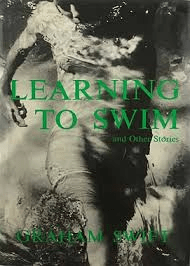
Learning to Swim and other stories by Graham Swift, 1982

I think it is more common than not for a modern short story to conclude without a formal ending. The reader is not told what ‘happens’ to the characters nor how any issues identified have been resolved. When did that start to be the case? Don’t Victorian short stories almost always have a formal ending in which murders are solved, mysteries unravelled and the problems or issues explored in the course of the story resolved? In the early decades of the twentieth century Modernist novelists rejected the idea that novels were just stories, but nonetheless formal endings remained the norm. There are of course always going to be exceptions to generalisations of this kind (there are a few modern novels that simply end, leaving everyone frozen in time and with their story lines unresolved, such as Penelope Fitzgerald’s Offshore or The Gate of Angels) but these are very much the exception), Look at it this way: would Ulysses have been the same novel if Leopold Bloom’s day ended before he returned home and without Molly’s dreams? The ending of Heart of Darkness may be ambiguous, but there’s no doubting that it is an ending rather than just an end. Nick Carraway leaves West Egg not really understanding the experience he has been through, but Gatsby’s story has ended. And so on.

Whereas with many modern short stories, the opposite is the case. The stories are sketches of a time and place, portraits of characters and situations, but there is no instinct for completion, no need to tell the reader what happens to the people who have been introduced. In many cases the stories simply stop. This is more challenging for the reader more familiar with novels that have formal endings. They may be left with a sense of frustration, wanting to know what happens next.

Which brings me to Graham Swift’s short story collection, Learning to Swim and other stories. These stories were published in various magazines from 1977 to the early 1980’s and predate Swift’s primary career as a novelist. His first novel The Sweet Shop Owner was published in 1980, and while today he is best known as a novelist, not least because his Last Orders won the Booker prize in 1996, he still writes short stories, and had the collection Twelve Post-War Tales published as recently as 2025.

Learning to Swim, named after the final story in the collection, is made up of eleven very varied tales. Some of the stand out stories include:

Seraglio is a portrait of an unhappy, childless marriage. A husband and wife are on holiday in Istanbul. Childless, they have frequent and expensive holidays as some form of compensation. The husband who narrates the story cannot understand his wife’s behaviour and when she tells him she has been assaulted by a hotel employee and wants to go home, he shows a lack of empathy in response. Swift almost taunts the reader wanting to know whether the couple remain together, or to know more about the assault in the hotel, saying “All stories are told, like this one, looking back at painful places which have become silhouettes, or looking forward, before you arrive, at scintillating facades which have yet to reveal their dagger thrusts, their hands in hotel bedrooms… One wants the moment of the story to go on for ever, the poise of parting or arriving to be everlasting. So one doesn’t have to cross to the other continent, doesn’t have to know what really happened, doesn’t have to meet the waiting blade.” The absence of a resolution in other words is the point of the story, rather than an omission.

In The Tunnel a narrator watches some youths digging a tunnel from the playground of a closed school out to wasteland. The tunnel acts a metaphor for pointless employment, the progress of children from school to the wider world, as well as invoking scenes from the first and second World Wars. This is a closely observed story in which every word counts. I wanted to know more about what happened to the narrator, his relationship with his runaway girlfriend, her mysterious uncle who may or may not be leaving her some money, and many other unresolved plot lines.

Hotel is a strange tale. A man recovers from a stay in a psychiatric hospital following his mother’s death. He then decides to run a hotel, which he eventually achieves. But when two guests who may be father and daughter, but the precise nature of their relationship is unclear, arrive, the foundation of his business begins to crumble. The narrator hints at the possibility of abuse or incest, but the story ends without an explanation of the couple’s situation.

The Watch is not really a science fiction story, but it does rest upon an element of the fantastic. A Polish watchmaker creates a pocket-watch which never needs winding and appears to grant eternal life to the owner. As it is passed down the generations to the current owner, the story’s narrator, it appears more of a curse than anything, as its owners all meet grisly fates. This is an almost Victorian horror story reminiscent of something by Edgar Allen Poe. It sits uncomfortably among the other modern sketches in the collection. Chemistry is a very similar, old-fashioned horror story in which the narrator accidentally causes the death of his grandfather. The story also features the ghost of the narrator’s father with other strong echoes of Hamlet (shipwreck, accidental poisoning, resentment of a step-father) thrown in for good measure.

The collection’s title story, Learning to Swim features another unhappy couple on holiday, thereby forming an effective bookend with the opening story, Holiday. While on vacation in Cornwall Mr Singleton is trying to teach his son Paul to swim, watched as he does so with judgment and contempt by his sunbathing wife. This felt as if it may have been an autobiographical story in which learning to swim becomes as symbol of a difficult childhood, in which the narrator finally decides to strike out on his own. The collection therefore ends on a positive note despite all the gloom and darkness that has come before.

Is it possible, just about, to make some generalisations about this collection and identify some overall themes. They all, to a greater or lesser extent, leave the reader with questions. Most of the stories are dark, featuring unhappy people. Infidelity and sexual trauma is hinted at in several of them and while never directly confronted, other stories feature the possibility of incest, bestiality and murder. Despite these topics this is not in any way a lurid collection – this is a sideways, oblique look at these issues.

Learning to Swim is still in print, more I suspect as an early work by someone who went on to write better things rather than in its own right. The 24 reviews of the collection on Goodreads, a tiny number by any measure, barely do it justice. I am not sure whether I am ever going to completely escape the need for a resolution and ending in the stories I read, and until I do I am always going to work hard to find positive things to say about this form. I appreciate that is my problem, not the authors, but I don’t think I am alone in that regard. The weaknesses of the short story format is something I will look at more closely on another day. For now I think I am going to return to the novel for my next read, albeit with a slight sense of guilt.

Learning to Swim and other stories by Graham Swift, 1982

Aside