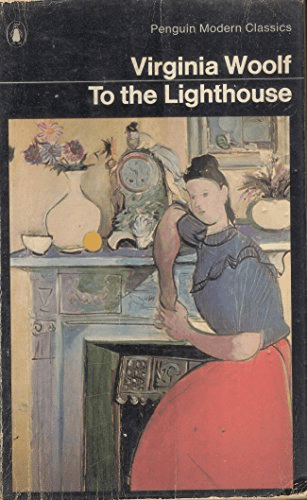
“Yes, of course, if it’s fine tomorrow,” said Mrs. Ramsay. “But you’ll have to be up with the lark,” she added.”
The narrative style of To the Lighthouse is usually described as ‘stream of consciousness’. While there is no strict definition of this term, it struck me while reading the novel that this term is not quite right. Stream of consciousness, as demonstrated by Molly Bloom at the end of Ulysses for example, is a direct representation of the thoughts of the character in the first person. (“Yes, I said yes, I will, yes” etc). Whereas To the Lighthouse has an omniscient narrator who sits on the shoulders of Woolf’s characters and transcribes their thoughts in the third person. Normally this transcription is unfiltered and may as well be in the first person, but very occasionally the narrator interprets or passes comment on the character’s thoughts and feelings. The representation of consciousness is one of the most striking features of this novel – thoughts are chaotic, easily interrupted or distracted, and sometimes include intrusive or unwelcome. But the narrator is always there, inserting a slight distance between the character and the narrative. Take for example the opening paragraph of chapter 12. The narrator is watching Mrs Ramsay and her husband, and describes what they do as well as what they think:
“She folded the green shawl about her shoulders. She took his arm. His beauty was so great, she said, beginning to speak of Kennedy the gardener, at once he was so awfully handsome, that she couldn’t dismiss him. There was a ladder against the greenhouse, and little lumps of putty stuck about, for they were beginning to mend the greenhouse. Yes, but as she strolled along with her husband, she felt that that particular source of worry had been placed. She had it on the tip of her tongue to say, as they strolled, “It’ll cost fifty pounds,” but instead, for her heart failed her about money, she talked about Jasper shooting birds, and he said, at once, soothing her instantly, that it was natural in a boy, and he trusted he would find better ways of amusing himself before long. Her husband was so sensible, so just. And so she said, “Yes; all children go through stages,” and began considering the dahlias in the big bed, and wondering what about next year’s flowers, and had he heard the children’s nickname for Charles Tansley, she asked. The atheist, they called him, the little atheist. “
It is Mrs Ramsay who thinks her husband is sensible and just, not the narrator, but the slim distance between the two perspectives is important. Crucially it allows the point of view to flit between characters, so within a few lines of this paragraph the narrative is assumed by Mr Ramsay, a much more introspective, internally focussed point of view. What the narrator does not do is step away from the characters’ thoughts and provide any exposition. We are thrown into the middle of the Ramsay family holiday without being told who the family members are, who are their guests and servants, their occupations, or indeed anything to provide us with context. Who are these people? Slowly, through the narration and the conversation the reader is able to piece together an overview of the setting. The Ramsays are a large middle-class family on holiday in the Isle of Skye in Scotland. As well as their eight children they have several house-guests and a number of domestic servants. The house is on the coast and overlooks a bay where a large lighthouse is situated. Some of the children want to take a boat-trip out to the lighthouse the following day, but it is a long and rough journey and cannot happen unless the weather is fine, which it usually isn’t. Mr. Ramsay—a professor of philosophy—harshly tells the children the trip will be impossible.
In the first, longest section of the novel, the Ramsays are hosting a diverse group of intellectuals and artists at their holiday home. The narrative focuses on a single day during which Mrs Ramsay match-makes between her guests, reads her youngest son, James, a story, flatters the ego of her grumpy husband, and floats around the house noticing things. In the evening a grand dinner is served (more on which below) and the day ends with Mr and Mrs Ramsay reading alongside one another but failing to connect or communicate. The sketch is predominantly autobiographical – Mrs Ramsay is thinly-disguised a portrait of Woolf’s mother who died when Woolf was only 11, and was obviously deeply missed. To the Lighthouse is in many ways Woolf’s way of exorcising her grief at the loss of her mother.
The second, much shorter section of the novel, “Time Passes” was described by Woolf as a corridor between the The Window, set before the first World War, and The Lighthouse, the third section of the novel set some ten years later. The holiday home is viewed through the eyes of the domestic servant employed by the family to act as a caretaker for the house, and when they eventually decide to come back to renovate and clean it. Time Passes is a quite literal description of what happens. In the intervening decade Mrs Ramsay and two of her children die, and the house deteriorates badly in apparent sympathy with the family:
For now had come that moment, that hesitation when dawn trembles and night pauses, when if a feather alight in the scale it will be weighed down. One feather, and the house, sinking, falling, would have turned and pitched downwards to the depths of darkness. In the ruined room, picnickers would have lit their kettles; lovers sought shelter there, lying on the bare boards; and the shepherd stored his dinner on the bricks, and the tramp slept with his coat round him to ward off the cold. Then the roof would have fallen; briars and hemlocks would have blotted out path, step and window; would have grown, unequally but lustily over the mound, until some trespasser, losing his way, could have told only by a red-hot poker among the nettles, or a scrap of china in the hemlock, that here once some one had lived; there had been a house.
Here the abandoned home symbolises the state of the nation, damaged to the point of destruction by World War I. In casual, almost brutal parenthesis, the deaths of Mrs Ramsay and two of her children are announced. Alongside so much death in the Great War, in which almost no town, village or family was untouched, these announcements act as reminders of the everyday losses that the country suffered.
[A shell exploded. Twenty or thirty young men were blown up in France, among them Andrew Ramsay, whose death, mercifully, was instantaneous.]
In the final section of the novel, some of the surviving family members and a few former guests return to the reopened summer home. A grieving Mr Ramsay insists that the family must finally complete the long-delayed boat trip to the lighthouse and forces his now-teenage children, James and Cam, to join him. The teenagers deeply resent their father’s tyrannical, mourning behaviour and form a silent pact of resistance against him. The trip to the lighthouse is both an attempt to recover the lost pre-War days which in hindsight seemed so peaceful and to reconnect with his children, who as moody teenagers no longer respect their mourning father. Much of this section of the novel is told from the perspective of Lily Briscoe, one of the original house guests, a painter who sets up her easel in the exact spot she did a decade earlier. Remembering her earlier visit she also mourns for Mrs Ramsay. The novel ends as the fishing boat reaches the lighthouse and they disembark. The lighthouse is a multi-faceted symbol that works in a number of ways during the course of the novel, but here for me represents death or the end of life’s journey.
I wanted to take a closer look at some of the minor characters in To the Lighthouse, more specifically the domestic servants. The cook, Muriel, is first mentioned in chapter 10. Mrs Ramsay is wondering whether some of her house guests have returned from their walk, so she asks one of her children (Cam) to “ask Mildred if Andrew, Miss Doyle, and Mr. Rayley have come back?” She wonders “What message would Cam give the cook?” which tells us, indirectly that Muriel is not a family member or guest but a member of staff, and specifically the cook. Cam returns to tell her “that there was an old woman in the kitchen with very red cheeks, drinking soup out of a basin” whose message is that “”No, they haven’t, and I’ve told Ellen to clear away tea.” Ellen is another servant who is part of the support team that the household relies on but takes for granted. Chapter 10 ends with Mrs Ramsay finishing her reading of a story to James, and “In a moment he would ask her, “Are we going to the Lighthouse?” And she would have to say, “No: not tomorrow; your father says not.” Happily, Mildred came in to fetch them, and the bustle distracted them. But he kept looking back over his shoulder as Mildred carried him out, and she was certain that he was thinking, we are not going to the Lighthouse tomorrow; and she thought, he will remember that all his life.” James is six at this point, a bit old for being carried out by an old woman I would have thought, but this does suggest that Mildred is not just a cook but has child-caring responsibilities as well.
Mildred is next referred to during dinner preparations, where the main dish, a boeuf en daube, is described as “Mildred’s masterpiece”. When this dish is finally served (and there is strong suggestion that the cook has exaggerated its complexity to Mrs Ramsay – it is just a slow cooked stew) Mrs Ramsay accepts her guests praise for the dish without acknowledging Mildred’s hard work:
“an exquisite scent of olives and oil and juice rose from the great brown dish as Marthe (another anonymous servant), with a little flourish, took the cover off. The cook had spent three days over that dish. And she must take great care, Mrs. Ramsay thought, diving into the soft mass, to choose a specially tender piece for William Bankes. And she peered into the dish, with its shiny walls and its confusion of savoury brown and yellow meats and its bay leaves and its wine, and thought, This will celebrate the occasion–a curious sense rising in her, at once freakish and tender, of celebrating a festival, as if two emotions were called up in her, one profound–for what could be more serious than the love of man for woman, what more commanding, more impressive, bearing in its bosom the seeds of death; at the same time these lovers, these people entering into illusion glittering eyed, must be danced round with mockery, decorated with garlands.
“It is a triumph,” said Mr. Bankes, laying his knife down for a moment. He had eaten attentively. It was rich; it was tender. It was perfectly cooked. How did she manage these things in the depths of the country? he asked her. She was a wonderful woman. All his love, all his reverence, had returned; and she knew it.“It is a French recipe of my grandmother’s,” said Mrs. Ramsay, speaking with a ring of great pleasure in her voice.“
Later, after dinner, Mrs Ramsay wanders ethereally away from her guests to go and check on the children.
“She turned the handle, firmly, lest it should squeak, and went in, pursing her lips slightly, as if to remind herself that she must not speak aloud. But directly she came in she saw, with annoyance, that the precaution was not needed. The children were not asleep. It was most annoying. Mildred should be more careful. There was James wide awake and Cam sitting bolt upright, and Mildred out of bed in her bare feet, and it was almost eleven and they were all talking. What was the matter? It was that horrid skull again. She had told Mildred to move it, but Mildred, of course, had forgotten, and now there was Cam wide awake, and James wide awake quarreling when they ought to have been asleep hours ago. What had possessed Edward to send them this horrid skull? She had been so foolish as to let them nail it up there. It was nailed fast, Mildred said, and Cam couldn’t go to sleep with it in the room, and James screamed if she touched it.”
Cam is the youngest Ramsay daughter, at seven only a year older than her brother James. In this home (at least) they share a bedroom. Mrs Ramsay is annoyed with Mildred “out of bed and in her bare feet” because the children are not asleep. So as well as being the family cook, we can infer that Mildred is directly responsible for putting the children to bed. I doubt she sleeps in the same room as them, so the fact she is ‘out of bed’ suggests she has heard the children arguing and has got up to try and calm them down, when Mrs Ramsay walks in and blames her for the children’s misbehaviour and arguing. This reveals a contemptuous attitude towards a senior member of staff, which is compounded by the comment that Mildred “of course” had forgotten to move the skull. The ‘of course’ suggests Mrs Ramsay expects to be disappointed by her servants, as if Mildred hasn’t been busy cooking a stew for three days! Later in this paragraph Mildred explains that the skull is nailed fast, making it clear that she had not forgotten about it all, just that she was unable to move it. Of course, no apology is even considered. Servants are there to do as they are told.
The domestic female staff of the Ramsay household are ignored, neglected, taken for granted, disrespected, and under-valued. So what we have to try and work out is whether this is a subtly drawn portrait by Woolf of entitled middle-class people treating their servants – their employees – with a lack of respect, or whether this is a reflection of the way Woolf herself took her family servants for granted. It is a difficult call to make – we have to read the text closely to work out who the servants are (as opposed to the eight children and the various house guests) and Mrs Ramsay’s inner monologue doesn’t really help us. But there is another portrait of a servant in the novel that throws light on this issue. In Time Passes, we are introduced to Mrs McNab. Although she is the family’s housekeeper, she does not merit a mention in The Window. The portrait of her in Time Passes is largely unsympathetic. She walks with a lurch, rolling like a ship at sea. The narrator doesn’t explain why she walks this way, but it could have been caused by rickets, a common condition for working people at the time (particularly Hebridean people with limit access to some foodstuffs) caused by a calcium deficiency. What Woolf’s narrator is noticing is that old servants walk in a ‘funny’ way without considering why. She also ‘leers’ instead of looking directly at things, which we are told is because she is ‘witless’. And as working class people often do (when written by middle-class authors) she sings to herself:
“As she lurched (for she rolled like a ship at sea) and leered (for her eyes fell on nothing directly, but with a sidelong glance that deprecated the scorn and anger of the world–she was witless, she knew it), as she clutched the banisters and hauled herself upstairs and rolled from room to room, she sang.,,, a sound issued from her lips–something that had been gay twenty years before on the stage perhaps, had been hummed and danced to, but now, coming from the toothless, bonneted, care-taking woman, was robbed of meaning, was like the voice of witlessness, humour, persistency itself, trodden down but springing up again, so that as she lurched, dusting, wiping, she seemed to say how it was one long sorrow and trouble, how it was getting up and going to bed again, and bringing things out and putting them away again.”
Not satisfied with patronising and caricaturing this hard-working housekeeper, Woolf continue to denigrate her. She is “bowed down … with weariness…. creaking and groaning on her knees”. Her “sidelong leer which slipped and turned aside even from her own face, and her own sorrows, stood and gaped in the glass, aimlessly smiling”. The narrator attempts to capture Mrs McNab’s thoughts, but for once the attempt falls flat:
“Visions of joy there must have been at the wash-tub, say with her children (yet two had been base-born and one had deserted her), at the public-house, drinking; turning over scraps in her drawers. Some cleavage of the dark there must have been, some channel in the depths of obscurity through which light enough issued to twist her face grinning in the glass and make her, turning to her job again, mumble out the old music hall song….Mrs. McNab continued to drink and gossip as before.”
Even the washer-woman, the narrator speculates, must have some fond memories of her children, even though two of them were illegitimate. A kind interpretation would be that Woolf is here acknowledging that even working class woman, condemned to a life of drudgery and child-bearing, have an internal life, hopes and dreams – but I am not convinced, and that final dismissive summary – “Mrs McNab continued to drink and gossip as before” – makes me wonder whether Woolf really thought of her servants as authentic, valuable human beings. There is evidence to suggest her relationships with her own servants were troubled – see Alison Light’s account in Mrs Woolf and the Servants for example.
I appreciate this aspect of the novel is simply one part and should not be given overdue emphasis. It certainly didn’t spoil the novel for me. But equally I did not want to ignore it, when the more obvious aspects of the novel – the Modernist exploration of consciousness, the complex narrative point of view, and the abundant use of symbolism – have been so thoroughly explored elsewhere. To be fair to Woolf she does not ignore her servant characters completely, as was often the case in earlier novels (see this post for more on the invisibility of servants in nineteenth century novels), they are given names and thoughts, but they are marginalised and disrespected, which is not much better.
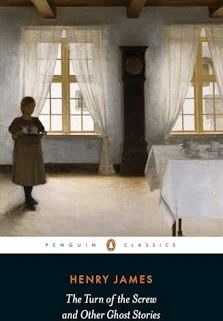
The Turn of the Screw was initially published as a serial in an American weekly magazine from January to April 1898. In many ways it is a simple, old-fashioned ghost story. Stories featuring the supernatural and ghosts in particular were immensely popular in the nineteenth century. They were a way of helping people cope with the grief arising from high mortality rates (especially infant mortality) and sudden deaths from what are today simple, curable conditions. In other words ghost stories offered a way to process grief. The dead aren’t gone, they are just in another place. (Hence also the creepy Victorian tradition of taking photographs with the dead posed as if they were alive). It was also the case that the advance of science in the nineteenth century challenged traditional religious belief and ghost stories provided a way of reconciling the two apparently contradictory ideas. Science can’t, they say, explain everything. Supernatural tales satisfied the need to prove the soul survived after death, and that we are not just animals, even if we are descended from them. Add to all that the explosion of periodical presses and mass-produced magazines in this period which fuelled demand for short, thrilling stories. These stories were particularly popular at Christmas time, and of course Dickens had both tapped into and amplified this association with A Christmas Carol and others.
James follows this tradition by setting the framing narrative of his story on Christmas Eve (which is otherwise irrelevant to the rest of the story). His unnamed narrator and friends gather around a fire. One of them reads a manuscript telling the story of a governess hired by a man who has recently been appointed the guardian of his young niece and nephew following the deaths of their parents. He lives in London but has a country house in Essex where the children live.
The governess assumes the narration from this point. She tells of her interview with the children’s guardian in which he explains he wants no involvement in their care. Arriving at his grand country house in Essex she meets Flora, the beautiful and well-mannered young girl for whom she will be responsible, and Mrs. Grose, the housekeeper. There are a number of other unnamed servants who remain peripheral figures. She quickly learns that Miles, Flora’s brother, has just been expelled from his residential school and will be returning home shortly. The reasons for his expulsion remain mysteriously sinister. Both children are apparently delightful and well-behaved, and the governess cannot imagine what Miles could have done to lead to his expulsion.
For a short period everything seems normal, and the governess establishes a simple domestic routine revolving around the care and tutoring of the children. But one evening while out for a walk, she sees a strange man looking out from one of the house’s towers. (A house with towers? Well yes, in traditional ghost stories all houses follow a gothic architectural template which contribute to the creepy atmosphere). This causes her to wonder:
“Was there a “secret” at Bly—a mystery of Udolpho or an insane, an unmentionable relative kept in unsuspected confinement?”
These references are carefully chosen. The Mysteries of Udolpho is widely considered the Ur-text of the gothic genre, and serves to manage the reader’s expectations of the story they are reading. Charlotte Bronte’s 1847 Jane Eyre built on this tradition by cementing the insane relative in the attic trope into gothic fiction. The important element of the latter story is that the apparently supernatural events of the novel are eventually shown to have a naturalistic explanation. In Northanger Abbey published eighty years earlier Jane Austen had already effectively parodied the conventions of this genre, pointing out that a young woman’s heightened expectations of mysterious events in a strange setting could be self-fulfilling. So our expectations are that there will be a normal explanation for the stranger in the tower, and anything else creepy that the governess experiences. Or will there?
The strange man reappears to the governess one afternoon, staring at her through a window. She tells Mrs. Grose about this man, describing him in detail. Mrs. Grose identifies him as Peter Quint, a servant on the estate who died recently. (Some critics interpret the ghosts in The Turn of the Screw as figments of the governesses imagination. Of course that’s a perfectly valid interpretation, but James leads the reader away from that explanation at this point in the story by having the governess able to identify the man very accurately. Can he be imaginary if she can describe him so clearly. If the reader wants to they can imagine a scenario in which someone else has previously told her about Quint, but there is no textual evidence for this.)
It is not long before a second ghost appears. While walking by the estate’s lake with Flora, the governess sees a woman dressed in black. Back at the house she describes this woman to Mrs. Grose who tells her it had to be Miss Jessel, the children’s previous governess who died in mysterious circumstances. It is then also revealed that Quint and Miss Jessel were involved in a relationship that scandalised the staff of the house. They were also very close with the children. Further encounters with the ghosts leads the governess to be convinced that there is a relationship of some kind between them and the children, but the nature of that relationship is never clear.
The governess does not know what to do. Speaking to the children’s guardian has been forbidden. They do not appear to be in any immediate danger, but she never lets them out of her sight. A final encounter with the ghost of Miss Jessel, which Flora and Mrs Grose both claim to be unable to see (fuelling the idea that the ghosts are figments of the governesses imagination) leads to Flora becoming very distressed. Finally Flora is sent away from the house, accompanied by Mrs Grose to London to seek shelter with her guardian, leaving the governess and Miles alone with the ghosts. The governess sees Quint and she grabs Miles, apparently to protect him. In the novel’s closing sentence he dies in her arms and the text stops suddenly with this revelation. The unexplained death of Miles is lazy writing of the worst variety as far as I am concerned, simply a way to end the story rather than acting as any kind of effective resolution.
Is this a successful ghost story? Is it spooky, disturbing? James’s technique to build the atmosphere is simple – everything is left implied, ambiguous and opaque. Almost all sentences in which the supernatural events of the story are discussed trail off unfinished. Ideas are hinted at but the reader is left to fill in the gaps. As ghost stories go this is highly effective. James uses the innocence of the children as a powerful symbol of the potential of evil, even in the young. The ambiguity of the social place of the governess, not a servant but not a member of the family, occupying that undefined space in between the two, is used as a further source of narrative tension, complicated by the fact that the governess in this story is effectively the acting head of the house. It is revealed that Miss Jessel and Peter Quint were romantically involved and their relationship scandalised the household:
“And he so dreadfully below,” said Mrs. Grose. I felt that I doubtless needn’t press too hard, in such company, on the place of a servant in the scale; but there was nothing to prevent an acceptance of my companion’s own measure of my predecessor’s abasement.“
James sometimes – too often – uses the technique of ambiguity and implication to leave the reader having to follow the narrative thread. At times this makes the story difficult to follow. I wrote about this feature of his writing in my review of The Golden Bowl which I found to be extremely difficult to read. James’s sentence structures were often so ridiculously complex that they lost, to me, all meaning. I was reassured by some commenters that this was a feature of James’s writing towards the end of his career and his earlier work was more accessible. However The Turn of the Screw was published only six years before The Golden Bowl, so I should have been prepared. Despite this, some sentences from this novella left me completely at a loss:
It took of course more than that particular passage to place us together in presence of what we had now to live with as we could—my dreadful liability to impressions of the order so vividly exemplified, and my companion’s knowledge, henceforth—a knowledge half consternation and half compassion—of that liability.
I think what James is saying here that now that the narrator and Mrs Grose both knew that the house was haunted, they had to live with it. It’s not just that this sentence is totally unclear, it is also ugly. I have no problem with writing that makes the reader pause, reread, and reconsider, but this doesn’t do that – it just confuses and irritates.)
It’s not just long rambling sentences that are the only issue here – James can make even shorter sentences totally confusing.
The good thing, after all, was that we should surely see no more of him. This was not so good a thing, I admit, as not to leave me to judge that what, essentially, made nothing else much signify was simply my charming work.
Or how about?
Nothing was more natural than that these things should be the other things that they absolutely were not.
I have said all I want to say on this feature of James’s writing in the post linked to above, so I am not going to labour the point, but at the same time I couldn’t ignore it.
The bottom line is this – if you enjoy ghost stories you will love The Turn of the Screw. It is an extremely effective example of the genre. If you don’t appreciate this type of thing, and find it childish, you won’t be converted and it will leave you cold and perhaps even slightly irritated.
In an interview in 1960, Muriel Spark gave this account of the origins of Memento Mori:
“It happened that a number of old people I had known as a child in Edinburgh were dying from one cause or another, and on my visits to Edinburgh I sometimes accompanied my mother to see them in hospital. When I saw them I was impressed by the power and persistence of the human spirit. They were paralysed or crippled in body, yet were still exerting characteristic influences on those around them and in the world outside.”
Author’s stories about the origins of their novels always have to be taken with a pinch of salt, but if this account is correct then it suggests that Spark approached her story and her characters with empathy and compassion. Older people, in this account, are impressive and even dignified, they are “exerting characteristic influences on those around them” – which is rather an ambiguous turn of phrase don’t you think? Spark went on to say “I saw a tragic side to this situation and a comic side as well”.
I think anyone who has spent time with people coming to the end of their lives can appreciate that the tragedy of death can on occasion be illuminated by moments of black or even absurd comedy, which relieves the sadness of the situation. But dying people are still people and I am not sure that Spark delivers on her intention of illustrating the complexity of this situation in her portraits of her characters, many of whom are rather awful. To be fair the smaller number of younger characters are all pretty appalling as well!
The plot of Memento Mori revolves around a group of older (aging, but not dying, other than in the sense that we are all dying sooner or later) metropolitan people: brothers and sisters, husbands and wives, and friends and lovers. The extensive cast includes at its core Dame Lettie Colston, her brother Godfrey, retired head of a brewing company, his wife Charmian, a successful novelist, and Charmian’s former maid, Jean Taylor. Apart from Mrs Taylor, these are upper-middle class people who can afford maids and housekeepers. Mrs Taylor is bedridden and lives in a nursing home, the ‘Maud Long Medical Ward’, with eleven other “grannies”. Grannies is the slightly disparaging title given to the patients by the staff, not all of who are happy with the description:
“Miss or Mrs Reewes-Duncan threatened for a whole week to report anyone who called her Granny Duncan. She threatened to cut them out of her will and to write to her MP. The nurses provided writing paper and a pencil at her urgent request.”
Calling someone by a title they don’t choose or like is disrespectful and a mild form of bullying. The ‘grannies’ exercise the little autonomy they have in their lives by threatening to change their wills whenever anyone crosses them, even though most of them have little or nothing to bequeath. Life in the ward is reduced to the bare essentials, a dull routine of meals and conversation, most of which revolves around discontent with the nursing staff or the daily horoscopes read out for them all by Granny Valvona. These characters act as a form of chorus to the rest of the events of the novel. Outside the ward, former lovers and old friends call in for tea and something stronger and little happens to disturb their calm and pleasant existence – until the day Lettie starts to receive anonymous phone calls with the message “Remember you must die.” Instead of taking this reminder as an encouragement to live life to the full while you can, Lettie finds it menacing and upsetting. Other members of the group start to receive similar calls and respond in the same way. The police are baffled and begin to suspect that no such calls are being made. Is this a shared delusion or just a childish prank? A retired policeman is hired to investigate, but makes no progress and falls under suspicion himself. Eventually a new normal emerges in which the calls are mostly accepted as part of the routine of life, and any menace they contained is thus neutralised.
Most readers will have anticipated that one of the peripheral characters – and there are plenty of possible suspects – would at some point be exposed as the mystery caller, but this never happens. The caller is never identified nor caught. It is suggested that there might be a supernatural or psychological explanation for the calls, but this is not followed up. I felt rather short changed by this lack of a resolution. If you build your novel round a mystery then surely you need to have an outcome in which the mystery is explained? I appreciate that is very old-fashioned of me. I know Godot never arrives, that the world is not neat and tidy and mysteries remain unsolved. But this is not an existential novel on the unknowingness of the universe, it is a domestic comedy in which the anonymous calls are a central part of the plot. Imagine reading a version of The Hound of the Baskervilles, at the end of which Holmes and Watson wander off shrugging their shoulders saying, “Yeah, it might have been a dog, who knows”.
Other subsidiary plot lines are less frustrating and in some respects compensate for this decision. Lisa Brooke, a friend of the group, dies early in the novel, leaving a substantial estate to be argued over by her husband, her siblings and her housekeeper, Mrs Pettigrew. Mrs Pettigrew is the novel’s villain, blackmailing the people she looks after, nosing her way into their secrets and forcing them to change their will or risk exposure.
Writing in the Guardian in 2010, David Lodge agreed with Martin Stannard’s conclusion in his 2009 biography of Spark that Memento Mori “remains one of the great novels of the 1950s,” I can’t agree. I admire Spark as a writer but this is one of the least interesting of her novels that I have read. It patronises and looks down on the elderly and treats them as disposable objects rather than well-rounded characters. Instead of giving a voice to the elderly, rarely centred in fiction, it objectifies them. I kept being reminded of Kingsley Amis’s The Old Devils, which has many of the same flaws but at least invests the elderly characters with some passion and lust for life. It is not a coincidence that Amis was a lot closer in age to his characters than Spark was, and could therefore portray them with more empathy. To illustrate this point consider the following exchange between Godfrey, his wife Charmain and his sister Lettie. Bear in mind that Charmian has suffered a stroke, possibly several, and is struggling with cognitive decline, made all the worse by the fact that she was once a successful author:
“Would you like me to read you the obituaries, dear?” Godfrey said . . .
“Well, I should like the war news,” Charmian said.
“The war has been over since nineteen forty-five,” Dame Lettie said. “If indeed it is the last war you are referring to. Perhaps, however, you mean the First World War? The Crimean perhaps . . .?”
Is this funny, in a ‘you have to laugh’ way, or is it mocking someone with memory loss? Arguably Charmian has the last laugh – her books are reissued, she is ‘rediscovered’ and becomes popular, and recovers much of her cognition. Spark ends her novel with a quick summary of what happens to all her characters after the events of the novel, and unsurprisingly (almost) all of them die one way or another. Memento Mori indeed.
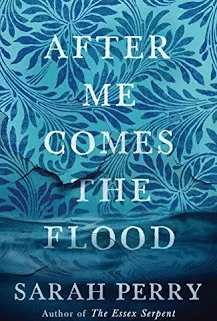
After Me Comes the Flood was Sarah Perry’s promising first novel, published two years before her breakthrough work, The Essex Serpent. After Me tells a deceptively simple story: five weeks into a heatwave, the novel’s central character, John Cole, shuts his customer-less London bookshop and sets out to visit his brother on the Norfolk coast. When his car breaks down somewhere in Norfolk, he leaves his car and wanders into a wood where he stumbles upon a large house. Knocking with the intent of asking for help, he is welcomed by the members of the household – strangely it seems he is expected and is welcomed by name. They mystery is quickly explained – this is a group of friends who previously lived together in a mental health clinic nearby and who now look after one another. A new group member with a very similar name to John’s was due to arrive, although has been delayed and John is mistaken for him. He sustains the idea that he is the other John Cole, although there is every indication that the household would have welcomed him if he explained the misunderstanding.
There is a mysterious gothic quality to John’s stay at this house. The residents are introduced slowly, telling how they came to live in this unusual sanctuary. Hester is in her sixties and is the matriarch of the house. John consistently describes her as ugly, saying she appears “poorly assembled, as though she had been put together from left over pieces” (which is a bit mean!). Eve is a pianist; Elijah a former preacher who has lost his faith; Claire and Alex, brother and sister, are childish and childlike (John initially mistakes Claire for a young girl) and finally there’s Walker, an accountant who met the others at the hospital but who was not a patient there. Near the house is a reservoir and Alex is frightened that the bank holding it in place might at some point burst, and that the house will be swept away in the ensuing biblical flood. This threat looms over the rest of the novel increasing the sense of menace.
It would be fair to say that After Me is definitely an atmospheric and character-driven novel, but at the same time not very much happens. The events of the novel, such as they are, are spread over one week, with each chapter representing a day. John gets to know the residents, and slowly gets comfortable with his deceit, reminding himself daily to either tell them the truth or leave, but never quite getting round to doing either. One day the household takes a trip to the coast and Alex briefly goes missing with a young boy he had befriended while playing innocently on the beach. The suspicion cast on him by the boy’s mother throws a shadow over the day and upsets Alex more than the others realise. This is probably the nearest the novel comes to anything that could be described as incident.
Perry’s subsequent novels rest heavily on supernatural themes. Here such things are hinted at but there are naturalistic explanations for all the strangeness John initially encounters. There is also an under-developed theme running through the novel relating to the short Anglo-Saxon poem Wulf and Eadwacer which is never really resolved. We find out who has been sending the poison-pen letters to Alex which have caused him so much distress, but the reasons for the obscure classic illusion remain unclear.
I do have a issue with the novel’s ending. The threatening reservoir looms over the novel like the sword of Damocles and it would have been a shock had it not played a central role in the novel’s resolution. It is hard to resist the impression that having assembled her characters, drawn all the lines between them, and placed them in a moderately interesting setting, Perry was at a loss as to what to do with them all next. The novel’s ending felt far too convenient and obvious, a simple way to bring matters to a close.
I am conscious that I haven’t found anything interesting to say about After Me, which I am disappointed about. But I can’t help wondering whether the problem is mine as a reviewer or the author’s as a novelist. This is after all a novel in which not much happens, the characters are not really engaging and where the ending is very predictable. The prose is perfectly adequate, but I don’t think I can recall a single line or phrase that jumped out and asked to be remembered. If I appeal to the jury of the internet to decide where the problem lies I think it is revealing that on Goodreads this novel has an average reader score of 2.78, by far the lowest score for any of her subsequent novels, and has twice as many one-star reviews as five-star.. Many of those one-stars will have been by disappointed readers of The Essex Serpent looking for more of the same, which is of course a bit unfair. If you have read After Me and found more in it than I managed to find, I would love to hear from you in comments. What am I missing?
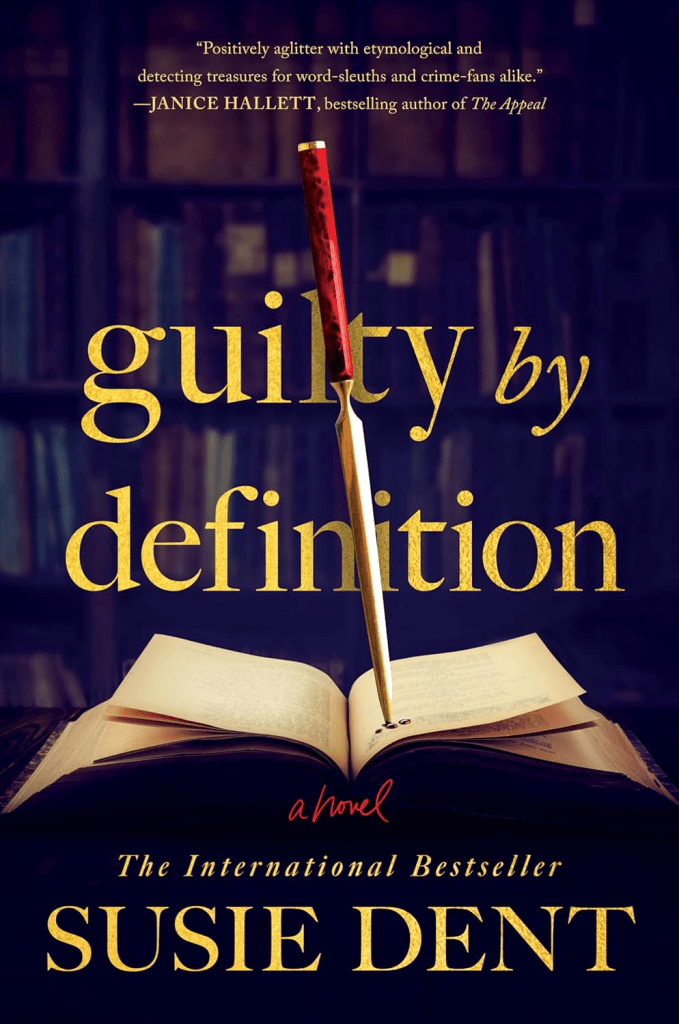
If you had to guess what a novel by tv’s lexicographer Susie Dent would be about I think most people would assume that it would be a) in the cosy crime genre, b) feature a main character who is a lexicographer, or a related profession, and c) involve word puzzles and clues that lead to the resolution of the mystery. And the author obviously hates to disappoint her audience, because that is exactly what she has produced. I was expecting the novel to be a lazy, genre-driven cash-in on the author’s public persona (of which there are many out there at the moment) but I am delighted to say it was so much better than that. There are still some predictable elements, of course, including the loving descriptions of academic Oxford, the word puzzles, and the short chapters that keep the pages turning. But these are more than compensated for by the high quality writing and the well constructed plot.
Set in Oxford and featuring a team of lexicographers working for the Clarendon English Dictionary, the setting and structure of Guilty by Definition also provides the author with plenty of opportunities to weave into the text anecdotes about the origins of words and phrases, keeping the fans of Countdown and Dictionary Corner satisfied. These word-related anecdotes are sometimes rather obviously shoe-horned into the narrative (often something about a word or phrase will just occur to the narrator and have to be explained) but I think Dent just about keeps on the right side of this not being irritating or distracting.
The plot follows Martha Thornhill, senior editor of the Clarendon English Dictionary. She and her team seems to have gloriously relaxed jobs tracing the origins of words and phrases. Also working for the CED but not part of Martha’s team is Jonathan Overton, a Shakespeare expert who has published widely on the bard’s coinages and who is a minor media celebrity. One day they receive a letter from an anonymous correspondent who signs themself ‘Chorus’. This letter contains a word puzzle, which when solves leads to the answer 2010, which is the year that Martha’s sister, Charlie, went missing. Thus begins a reopening of the investigation into Charlie’s disappearance. This moves along at a fair pace, with new developments and discoveries about Charlie’s past every few pages. Further letters and puzzles from Chorus move the action along every time the investigation begins to lose focus. It is revealed that Charlie was on the trail of a literary discovery, which as well as being hugely valuable would rewrite much of what we know about Shakespeare’s invention of new words. In lexicography terms this could be up there with the Rosetta Stone or the double helix structure of DNA.
Guilty by Definition is well plotted and well written. The final reveal of what happened to Charlie and what she had discovered hits exactly the right balance between not being too obvious but at the same time not too obscure. I was able to work out ‘whodunnit’ fairly early on, the list of possible suspects being quite small, but this didn’t spoilt the read for me in any way. The novel has lots of independent women characters who are not defined by their appearance or sexuality and who are not traditional stereotypes, which was a refreshing change from much genre fiction. The three main lexicographers, Safi, Martha and Alex form a strong team that would translate very well onto the television screen (with Oxford as a photogenic background) and I would be astonished if they do not reappear in further word-based mystery sequels. I look forward to them.
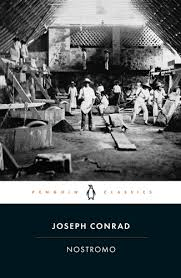
Nostromo, A Tale of the Seaboard, by Joseph Conrad, 1904
I came perilously close to abandoning Nostromo and it was only sheer bloody-mindedness that kept me going. This was a result of a combination of Conrad’s prose style and his poorly defined characters. I found the prose wooden and the characters spent far too much time pontificating about abstract concepts:
“Action is consolatory. It is the enemy of thought and the friend of flattering illusions. Only in the conduct of our action can we find the sense of mastery over the Fates”
or
“There is no peace and no rest in the development of material interests. They have their law, and their justice. But it is founded on expediency, and is inhuman; it is without rectitude, without the continuity and the force that can be found only in a moral principle.”
The novel’s cast of characters is wide, but many of them were often hard to differentiate from one another, especially given the frustrating practice of giving them multiple, interchangeable names (so for instance, the central character, Nostromo, is also known as Giovanni Battista Fidanza or Capataz de Cargadores). Conrad also adopts a narrative structure which eschews traditional chronology and tells some of the story in retrospect, some in the present. None of these techniques are objectively wrong or even particularly challenging, but Conrad’s execution of them is leaden. Although the novel is only 450 or so pages long it took me several weeks to read. You know you are struggling when you start to count the number of pages to go, and 20 pages read was a good day. To what extent this is my failure as a reader and Conrad’s as an author I cannot be sure.
The first two hundred pages (almost half the novel) are a meandering build-up to the point in the story at which the action properly begins, revolving around the struggle over ownership and control of a silver mine in the fictional South American country of Costaguana. Costaguana is an archetypal South America banana republic, with a long history of political instability. Charles Gould owns Costaguana’s primary natural asset, a silver mine, near the port of Sulaco. Revolutionary force invade Sulaco with the aim of capturing the mine. Nostromo, the head longshoreman of the port, escapes with the mine’s recently retrieved cargo of silver. Nostromo, an Italian expatriate, is a leading figure in Sulaco, with influence among the wealthy Europeans who control much of the city, but also widespread support from the working people of the town. Accompanied by a journalist, Martin Decoud, Nostromo smuggles the silver out of Sulaco, but is only able to make it as far as a small island at the head of the harbour, where he and Decoud hide the silver. The revolutionaries and the resident townspeople all believe the silver has been lost at sea and after Nostromo swims back to shore he does nothing to make them think otherwise. He avoids capture by the revolutionaries and rides out to seek help from the Government forces.
A jump forward in time shows the reader that Nostromo’s intervention has led to the creation of the independent state of Sulaco, which is now prospering. He has kept the location of the silver a secret. His partner, Decoud, left stranded on the island with only the silver for company, eventually lost his mind and drowned himself weighed down with some of the silver ingots. Over time Nostromo slowly grows rich, ostensibly because of his successful trading, but mainly because he collects the silver a little at a time so as to not arouse suspicion. But wealth does not bring happiness. Several years pass, and the independent Government decides to construct a lighthouse on Great Isabel. Nostromo fears this will lead to the remaining silver being discovered, but there is little he can do other than keep a close eye on the construction. He recommends an old friend, the widower Giorgio Viola, as the lighthouse keeper. The novel concludes dramatically with the resolution of these plot lines, but I won’t give away the ending.
I have read that Nostromo was originally conceived as a short-story, but over time the novel expanded in scale and scope. This could have had something to do with the publication in instalments of course, but also explains its rambling unfocussed structure. Conrad apparently found writing it almost as difficult as I found reading it, saying “it is like a kind of tomb which is also hell where one must write, write, write.” Nostromo was not very popular or successful when it was first published, with many finding the plotting byzantine and over-elaborate. Online you can find many people praising the novel as the best ever written, but this is surely hyperbole. When I did eventually finish it was with more of a sense of relief than anything else.
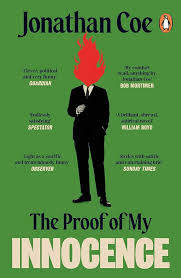
In his summary of The Proof of My Innocence, Jonathan Coe tells us that ” I felt like writing something contemporary, ironic and harder-edged. I wanted to return, if possible, to the tone of What a Carve Up!, with some kind of metatextual crime story which would also reflect on the current political situation.” If we judge the novel by these criteria, then I think that while certainly the metatextual crime story box can definitely be ticked, I would struggle to describe this as ironic or harder-edged. I will try to explain why in this review, but the good news is that the lack of a hard-edge is not a serious problem nor does it detract from the overall enjoyability of the novel.
Coe’s well-established method is to use contemporary real-life political events as a backdrop to his stories. The Proof of My Innocence follows this pattern by being set in the tumultuous period of Liz Truss’s premiership in the autumn of 2022. It opens with her election and ends with her resignation just seven weeks later, the shortest term of office of a British Prime Minister by some considerable distance.
The novel opens with a woman detective following a suspect on a train. Just as she is about to arrest him she is interrupted by a See It Say It Sorted announcement. Being infuriated by these announcements and then making a plot point out of them, is the kind of thing an observational stand-up comedian might ‘notice’, and pretend to get worked up about, when they really aren’t that obtrusive. This scene is then swiftly followed by an apparently unrelated story-line in which Phyl, who has recently graduated from university, works in a minimum wage job at a sushi bar at Heathrow Airport. She lives with her parents and misses the freedom of university life. Phyl watches old episodes of Friends as a means of reducing the anxiety caused by the lack of direction in her post-graduate life. The friction between millennials and their Boomer parents is one of the sources of humour in the novel. Coe is unquestionably one of the latter and I am not sure his portrait of the younger generation is entirely accurate, but the Friends obsession (or insert comedy programme of your choice – another favourite is the US version of The Office) seemed spot on.
The arrival of a guest disrupts the family dynamic. Christopher Swann, a friend from her parents’ time at Cambridge University in the 80’s, writes a blog on contemporary political issues. He is planning on attending TruCon, a conference organised by a dubious right-wing group pressure group. The conference is being held at a nearby stately home, Wetherby Hall. Chris is joined by his adopted daughter, Rashida, who quickly bonds with Phyl over a shared frustrating experience with the lifts at terminal 5. Phyl is toying with the idea of writing a novel, and in discussion with Rashida about this idea she jots down three possible genres for her work: cosy crime, dark academia (such the The Secret History) and auto-fiction. The bulk of the remainder of the novel is written in the form of these three genres. The reader can’t immediately tell whether these are fictions written by Phyl or by Coe, although this is eventually revealed.
The cosy crime third of the story is set at Wetherby Hall, the venue for the TruCon conference, which opens on the day Liz Truss becomes prime minister. This section opens with a parody of this genre which is somewhat over the top:
“Christopher Swann carefully steered his car between the yellowing drystone walls of the quaint old bridge that carried the road over the brook….Just a few hundred yards after crossing the brook he entered the village of \Wetherby Pond itself. At the sound of his engine (even though he was driving a quiet, hybrid model) the ducks on the eponymous body of water took flight with a volley of complaining quacks. Christopher followed the road around the edge of the pond, his eyes taking in every unlikely detail of the old post office, the red telephone box standing outside the village shop, the row of trimly thatched cottages and an elderly resident reading a copy of the Times while sitting on a weathered oak bench.”
I genuinely can’t tell if this is deliberately bad genre writing or not, but I will give Coe the benefit of the doubt and assume it is part of the parody. I particularly liked the description of his Swann’s ‘eyes’ taking in every detail as if any other body part could have fulfilled the same function! Swann is treated as an outsider by most conference delegates, which of course he very much is. Rather than keeping a low profile he goes out of his way to antagonise the various right-wingers present, all of whom feel jubilant at Truss’s appointment, feeling this is their moment. The conference is interrupted by the news of Queen Elizabeth 2nd’s death, quickly followed by Christopher’s brutal murder. Coe is treading a fine line here – he is incorporating all the cosy crime tropes he can think of – the rural setting, a locked room mystery, secret passages, a cryptic note from the victim, etc etc – and at the same time telling the underlying story of Swann’s forty-year pursuit of the far right in the UK and their plans for the day they finally take power, which seems to have arrived.
The next section of the story is told as an example of the ‘dark academia’ genre and is based around a manuscript memoir of one of Swann’s friends at university in the 1980’s. This section continues the delicate balancing act between parody – the author’s memories of his days at Cambridge in the 80’s include love affairs, glamorous young women, hidden identities, secret societies and a sinister conspiracy to support the Thatcher Government – and advancing the narrative, leaving clues about the present-day mystery. The final section written as auto-fiction completes the murder mystery element of the novel but leaves some loose ends dangling. These are picked up in what is in effect the novel’s postscript, which reveals that much of the preceding story has been a fiction within the fiction – hence the sound of the metatextual box being ticked.
The Proof of My Innocence is full of things that the reader is encouraged to notice for themselves, the novelists equivalent of Easter eggs. Clues to the identify of the murder form part of these things we are encouraged to notice, but there’s much more – references to contemporary culture, running jokes (the laboured joke about whether an Cambridge don had a harpsichord or a clavichord in his rooms is repeated about a dozen times) wordplay, and so on. Each time we spot one of these we get a small hit of dopamine – ‘clever me!’ – that keeps us reading. And The Proof of My Innocence was eminently readable – I got through it in just over two days. By way of example, the murder mystery element of the story has the victim surviving his attack just long enough to write a few cryptic symbols before expiring (this trope goes back to at least A Study in Scarlet. The message is “r 8 / 2.” Is this a reference to someone staying in room 8 (2)? Or something happening on 8th February? Or possibly even something happening on 2nd August (those pesky Americans with their different conventions for writing dates). Or something else entirely? (Clue, it’s something else entirely). Earlier a pub Swann visits is called theFresh Lettuce, a wry reference to the tabloid joke that haunted (haunts?) Truss as to whether her premiership would last longer than a lettuce (it didn’t). I was patting myself on the back when I spotted the fact that a plot point would revolve around a novel within the novel called My Innocence and changes made to the proof copy (hence, the Proof of My Innocence, a clever play on words). Is the enjoyment of these ‘noticeables’ a feature of the genres Coe parodies, or of his writing more generally?
Sadly, the novel slightly fizzles out. The big conspiracy Swann is planning to expose, the far-right’s plan to privatise the NHS, never sees the light of day. A memory stick with details of the plan is stolen and back up copies are quietly forgotten after his death. An alternative right-wing plan revealed within the 1980’s memoir, to defeat a strike by the NUM, is also forgotten (this was hardly a secret plan, more a statement of the obvious). Coe’s portrait of the far-right of British politics, and the extent to which it is influenced by the American right, is usually spot on, but the absence of any reference to Farage or Reform was puzzling. Wagstaff, a Tory politician who plays the role of villain in the novel, is the nearest we come to a portrait of Farage, but he is a Cambridge graduate and a life-long Tory, so not anywhere near an equivalent. Reform need the Jonathan Coe treatment. Once the meta-fictions end and the novel switches to the principal storyline we find out that the murder-mystery narratives were Phyl’s attempts at making sense of Swann’s death in a car crash before he even reached the conference. Not a particularly sensitive way of processing someone’s death I would have thought.
Coe is an author I have been meaning to read for some time. He is quite prolific having published 15 novels, roughly one every three years. His writing style is engaging and accessible. So I will definitely be reading more of his work in future. I enjoyed TheProof of My Innocence and look forward to reading Coe’s thoughts on Starmer’s Labour.
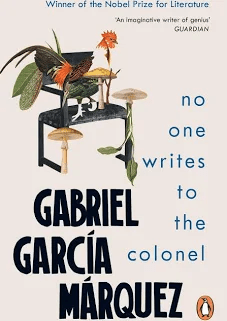
No-one writes to the Colonel, by Gabriel Garcia Marquez, 1958
No One Writes to the Colonel is a long short story or short novella, coming in at under 70 pages. Famously Marquez said that he had to write One Hundred Years of Solitude so that people would read No One Writes to the Colonel. Which is really a throwing down of the gauntlet, challenging any reader who admires his longer form work to love this short story.
An unnamed retired Colonel, a veteran of earlier Colombian wars, lives in poverty with his wife and his rooster. The rooster has been bred to fight on cock-fights, and could potentially be worth a lot of money, either in prize money or sold on to other trainers. The rooster previously belonged to the colonel and his wife’s son, who has been killed in the political violence gripping the country.
For fifteen years the Colonel been waiting for the Government pension he was promised (or perhaps more accurately he believes he was promised, because his lawyer seems to be very unsure of his eligibility). Every week he meets the mailboat and each week he is sent home empty handed, because no-one writes to the Colonel. His wife has asthma, making their daily lives all the more difficult and miserable. The story opens with the colonel preparing to go to the funeral of a town musician. The reader is told that this death is significant because he was the first to die from natural causes in many years. Initially it is unclear why natural causes deaths should be so unusual, but it soon becomes apparent that most other deaths have been as a result of political violence. Their small village is under martial law – there is a nightly curfew at 11, and the funeral procession is forbidden from passing in front of the police station.
The centre of the story is dominated by the decision as to whether or not to sell their prize rooster. Potentially it could be very lucrative once the cock-fighting season starts in the new year, but they have to find a way to get through the winter first and without jobs or the long-awaited pension, they fear they may starve before that happens. So they are forced to consider selling the rooster for well below its actual value just to survive. There is also the complication that the rooster itself eats a lot of corn, taking food out of their mouths. The Colonel’s wife sometimes has to boil stones to try to convince their neighbours that they have something to eat. So this is not a community where the old and hungry feel able to ask for help from others – whether or not that help would be offered.
Despite the eternal non-appearance of his pension, the Colonel still lives in hope, hope that one day a letter will arrive, one day his rooster will win. The story ends on a defiant upbeat note. Having decided to keep the rooster until the cock-fighting season starts, he is berated by his wife who asks
“And meanwhile what do we eat?”.
“It had taken the Colonel seventy-five years – the seventy-five years of his life, minute by minute – to reach this moment. He felt pure, explicit, invincible at the moment when he replied:
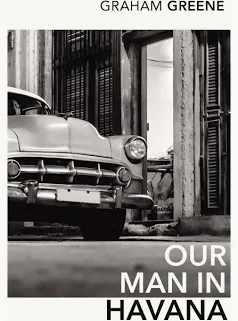
The central plot point of Graham Greene’s 1958 novel Our Man in Havana involves an unlikely spy, James Wormold, a middle-aged English vacuum salesman, making up details of secret military installations he claims are being built in the mountains outside Havana. Absurdly he sends his handlers in London detailed drawings of the rocket base using the schematics of the vacuum cleaners he sell, presciently named the Atomic Pile Suction Cleaner. What is strange is that I knew this detail before I opened the book, and it was one of the very few things I know about Greene’s work. But I found it frustrating that I can’t for the life of me remember how I knew that fact! There is a wider point here about how novels work their way into the cultural subconscious (so that, for example, Kate Bush could write a song about Wuthering Heights without ever having read the novel). I suspect the main reason this detail stuck in my head for so long (however it got there) is because of the way the novel strangely anticipated the 1962 Cuban Missile Crisis which brought the world to the brink of nuclear war.
The novel draws its humour from the gullibility of MI6. The central character, Wormold, is a vacuum cleaner salesman, selling only one company’s product (he seems to have only two different models of vacuum available). It shouldn’t matter, I know, but the idea of an Englishman selling vacuums in 1950’s Cuba just struck me as profoundly improbable. Who is buying these things? Greene himself had worked for British Intelligence during the war, and came to realise how easy it was for spies to file fictitious reports – who could check them for accuracy? This idea seems to have originated with the notorious case of Garbo, a Spanish double agent who pretended to have up to 27 agents working for him all over England, and who came to play an important role in misleading the Germans about the location of the 1944 landings. Greene wrote a first draft of the story in 1946 but it was the outbreak of the Cold War that gave the novel a new, more absurd, dimension.
The novel opens with our rather pathetic anti-hero struggling to keep his head above water, financially, mainly due to the demands of his spoilt teenage daughter. His wife has long since left him, leaving him to bring up his strictly Catholic daughter on his own. When he is clumsily approached by Hawthorne, an English spymaster, he becomes a spy himself almost accidentally. His initial doubts about the job are quickly overcome when he realises that this could be a lucrative profession if he recruits enough fictitious agents and claims enough expenses. His masterstroke comes when he concocts the idea of a secret mountain missile base using drawing of vacuum cleaner parts. Although British Intelligence is presented in this novel as incompetent and overly-trusting, it is very hard to see how else they could have dealt with the situation Wormold presents them with. They take his reports seriously – to do otherwise would have been reckless – and insist on him providing proof, suggesting different ways he can do so. They also send other agents out to Cuba to help him. That all seems fairly reasonable to me. Of course their main mistake is there inability to notice drawings of a vacuum clear when presented with them.
Up to the point at which Wormold starts his campaign of deception, the novel has been lightly comic, with Wormold being an accident-prone loser who is making things up as he goes along. He seems destined to be exposed as a fantasist at any point. But he reveals an inner strength when his improvised plans start to fall apart. Back in London, nobody knows he sells vacuum cleaners and has no reason to suspect his worrying reports. A secretary, Beatrice, and a radio assistant are sent out to join him and scale up his operation. As his lies become more outrageous Beatrice comes to suspect his elaborate fictions. She asks to speak to one of his agents, a pilot named Raúl. When a real-life pilot named Raul is killed in a ‘car accident’, but which is almost certainly an assassination, Wormold begins to panic. It is almost as if his lies are becoming reality and he sets out to save his fictional contacts, exposing himself to real danger while doing so. The reader is able to infer that his reports to London have been intercepted and decoded and his ‘operation’ is now under attack. Things get real very quickly and in the novel’s climax Wormold only narrowly escapes an attack on his own life.
An accidental spy who finds himself in the thick of an adventure, surviving encounters with assassins through dumb luck, sounds like a summary of a James Bond parody such as Johnny English or Austin Powers. Our Man in Havana was published only a few months after Dr No, the sixth in the James Bond series which started with Casino Royale in 1953 and seems to have been influenced by many of the tropes Fleming uses. I think it is best seen in this light – as a response to the portrayal of English spies as suave, sophisticated and almost unstoppable. But both Bond and Wormold get the girl in the end, and both beat the bad guys when it matters. Wormold discovers a surprising inner core when he and his family are threatened.
As I have mentioned several times before, I am not a massive fan of trigger/content warnings, but it comes as a shock when Greene uses the n-word in the novel’s opening sentence. The word is used casually by a character rather than the narrator and emphasises his background (he is a refugee from Germany). Other than the general contempt that British people casually treat all ‘foreigners’ in books from this period, the racism shown here does not reappear regularly, so if you can get past this instance you should be able to stick with the rest of the book. This is not Greene’s most sophisticated or complex novel and it is hard to warm to the principal characters, especially Wormold, but it has moments of light comedic touch, and is an interesting portrait of pre-revolutionary Cuba. Never has vacuum sales been more interesting.
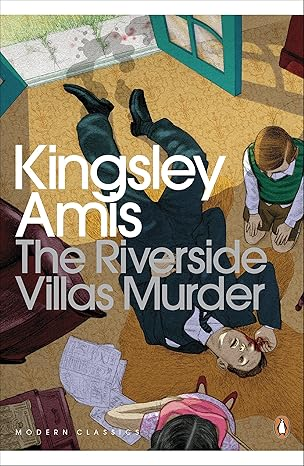
The Riverside Villas Murder by Kingsley Amis, 1973
The Riverside Villas Murder was written in the 1970’s, is set in the 1930’s, and is infused with the dominant social attitudes of the 1950s. Which all adds up to an uncomfortable mix. The story is told principally through the eyes of 14-year-old schoolboy Peter Furneaux. He is a typical 14 year-old, unable to go more than a few minutes at a time without thinking about sex. The mystery element of the story begins with a burglary at a local museum, where a mummified body and some Roman coins are stolen. Later, at a village dance, one of the Riverside Villas residents, a Mr Inman, provokes his neighbours by suggesting he has damaging information about them. During the dance, Mrs Trevelyan, a bored housewife, dances with Peter. Later she invites him to tea at her home, where she ‘seduces’ him. In the 1970’s this may have seemed comical, but fifty years on the scene is quite shocking in many ways. While it is Peter’s first sexual experience, Amis treats it as slapstick comedy: “What he had imagined so often and so long, and what actually happened on Mrs Trevelyan’s bed, resembled each other about as much as a fox-terrier and a rhinoceros.”
A few days later, Inman is murdered. He staggers into the Furneaux home, soaking wet from having fallen into a nearby river and bleeding from a head wound. Peter calls Mrs Trevelyan for help, but Inman dies shortly after. The rest of the novel comprises the police investigation, led by a cast of policemen who I think we are supposed to find comic but to me were one-dimensional and unconvincing and whose investigation is chaotic.
As a murder-mystery the novel is dull – the explanation as to whodunnit, when it is finally revealed, manages to be both predictable, because it follows the traditions of the genre, and at the same time impossible to deduce, given that the murder weapon turns out to be an improbable Heath-Robinson contraption that no-one could possibly have foreseen. The murderer’s motives are also transparently thin.
But there is a much more serious problem with the novel. Amis clearly set out to write a traditional detective novel, with the central character being a young teenage boy. It follows all the tropes of the genre quite carefully, as if the novel were an exercise in nostalgia. The 1930’s setting – Amis was born in 1922, so would have been a teenager himself in the thirties and therefore very familiar with the popular culture reference which litter the novel – allows him to wallow in nostalgia for an England where murderers are executed, housewives are almost invisible unless they are sexual predators and gay men are the object of scorn and disgust. The novel also contains a scattering of casual uses of the n-word and gay slurs, which, when placed in the mouths of old-fashioned men such as Peter’s father or the police provide the excuse of authenticity but at the same time allow Amis to break social taboos. In other words the novel is pointedly offensive. This isn’t social observation, it is autobiography.
Which poses two questions: why read a book with such objectionable ideas, and why review it? I loved Lucky Jim, and while I have developed a much better understanding of some of its problematic aspects, I still have a fondness for it. Amis can craft a striking phrase – the fox-terrier/rhinoceros quote above for example – and he did go on to win the Booker Prize. So it is hard to dismiss him as an author, and I still read him occasionally to see if he could ever recapture the brightness and humour of Lucky Jim. So far there have only been glimpses. As to the question of why one would review a book that deserves to go out of print and remain so, that’s more straightforward. These are not recommendations but posts noting what books I have read. No more no less. I don’t post about every single book I read (although I should according to my self-imposed rules) but I try to miss as few as possible. And if I have saved anyone the experience of reading the Riverside Villas Murder then it will have been worth it.


 The Reading Bug