My track record for predicting how celebrity novelists are going to pursue their novel series is poor. I predicted Richard Osman would kill off one of his main characters in the second instalment of theThursday Murder Club, but after four novels in the series they are still all going strong. Then n my review of The Satsuma Complex I forecast that it would be a one-off and we would hear no more of Gary, Emily and Grace – which was equally off-target!
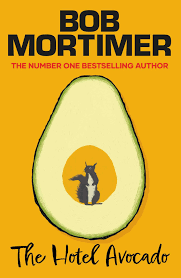
The Hotel Avocado is the sequel to The Satsuma Complex (are we going to see a series of fruit based novel titles from television’s latest national treasure?) Set almost immediately after the events of Satsuma, Emily has inherited her father’s hotel in Brighton and started to renovate it. Gary remains working in his law firm in London, travelling down to see Emily at the weekends. He has to decide whether to commit to his relationship with Emily and move down to live with her in Brighton, leaving his neighbour Grace to a rather lonely life, or whether he tries to make a long(ish) distance relationship work. Emily seems content with the relationship as it is – she is working flat out on preparing the hotel for opening and has no time in the week for romance or relationships. Her plans for the hotel are greatly helped by Mark her very hard working but socially awkward facilities manager and Pete, her super-efficient painter and decorator. Things are complicated by the fact that Emily and Pete once dated and clearly retain a residual attraction for one another.
Both Gary and Emily flirt with breaking relationship boundaries. Gary invites a work friend, Roma, to sleep over at his flat, and Emily gets uncomfortably close to Pete. While neither are unfaithful the implication is that their relationship is vulnerable. All that becomes rather redundant when the main plot line of The Satsuma Complex resurfaces. The end of that novel left Gary waiting to be a key witness in the trial of several corrupt Metropolitan police officers. He is visited by the menacing Mr Sequence and his equally violent sidekick Brian, and offered money not to testify at the forthcoming trial. It is made very clear what will happen to him if he refuses. He can’t go to the police over these threats and attempts to pervert the course of justice, because the corrupt officers have friends still on the Force. Gary flees to Brighton, but Sequence and Brian track him down – they always seem able to predict his movements – and Emily and her hotel are dragged into the affair.
For a comic novel, the scenes in which Gary and Emily are menaced with increasing ferocity by Sequence and Brian are quite dark and slowly come to dominate the novel. People get hurt with the promise of a lot more to come. The bad guys are convincingly violent and uncompromising and there’s little Gary can do to protect himself and his loved ones other than comply with their threats. The whimsy that dominated the first novel fades into the background as Emily and Gary are bullied, menaced and beaten. In a sub-plot Emily applies for planning permission to hang a massive avocado sign outside her hotel as an advertising feature and bribes the chair of the planning committee to ensure permission is granted. When it is refused she installs it anyway and the sign quickly goes viral.
Surprisingly I actually preferred the crime elements of this novel compared to the quirky comedy. They don’t always sit together comfortably and while we know that Gary and his friends will be OK in the end, there aren’t many laughs in these scenes. But I thought they showed signs of more care and attention from the author – once freed from the burden of trying to make the reader laugh he can get on with telling what became a quite gripping story. The element of peril was real – or as real as it can get in a comic novel. We also see fewer autobiographical elements in the novel (unless the author once ran a hotel in Brighton) as the author moves away from his source material, which helps give the narrative more freedom. Slowly the potential of the author as a serious novelist, rather than (god-forbid) someone cashing in on his celebrity, is emerging.
My first review of 2025 is of Sandra Newman’s compelling Julia, a retelling of the events of George Orwell’s 1984 from the perspective of Winston Smith’s young lover, whom he betrays in the novel’s bitter climax in Room 101 “‘Do it to Julia! Do it to Julia! Not me! Julia! I don’t care what you do to her. Tear her face off, strip her to the bones. Not me! Julia! Not me!'”
Which poses the very simple question as to whether 1984 needs to be retold from Julia’s perspective. The source novel is told from Winston’s point of view. Through Winston (and bearing in mind his relationship with her is quite short and comprises a few snatched moments and afternoons) we learn a little about her background and childhood, her life as a mechanic in the Fiction Department of the Ministry of Truth, and her living arrangements, sharing a hostel room with thirty other young women.
Julia sent me back to 1984 to try and ascertain how much was the author’s creation, filling in the gaps left by Orwell’s account, and how much was based on the source material. I was surprised at how much the original novel does actually tell us about Julia – she certainly isn’t the two dimensional character some critics would have you believe, and I don’t think she necessarily needed to be re-imagined by this novel to be made more believeable or rounded. Of course the original novel doesn’t contain her full life story or her internal monologue – Winston’s point of view narration precludes this. More honestly, Winston isn’t that interested in Julia’s background or history. Their relationship is not simply one of an older man being sexually attracted to a younger, more independent woman – Winston is genuinely interested in Julia’s ideas and is guided by her in acts of rebellion other than ‘sex-crime’ – “In some ways she was far more acute than Winston, and far less susceptible to Party propaganda. Once when he happened in some connexion to mention the war against Eurasia, she startled him by saying casually that in her opinion the war was not happening. The rocket bombs which fell daily on London were probably fired by the Government of Oceania itself, ‘just to keep people frightened’. This was an idea that had literally never occurred to him. She also stirred a sort of envy in him by telling him that during the Two Minutes Hate her great difficulty was to avoid bursting out laughing.”
A lot of the critical commentary on Julia is based on the assumption or claim that the original novel is in some way unfair to her. The Guardian put it this way: “This ambitious retelling from Julia’s point of view gives Winston Smith’s lover the agency she lacked. ” Is this fair? Did Orwell have a ‘women problem’? And does 1984 underplay Julia’s role, reducing her to a sexual partner and victim, requiring this attempt to rehabilitate her? Certainly women play only minor roles in most of his earlier novels, and the one exception, Dorothy in A Clergyman’s Daughter, is a largely unconvincing portrait used principally as an avatar for Orwell to recycle some of his journalism. But I think there is a case to made for Julia being one of his most fully-rounded female characters. She is independent, brave, forthright, and kind. The Julia we are introduced to in Newman’s novel is very closely modelled on Orwell’s original – Newman has been very respectful to the source material, and only made one significant change. Fairly early in in the novel Julia is recruited into the Thought Police, and in addition to her relationship with Winston she is instructed to seduce a number of other Outer Party members and encourage them to commit thought- and sex-crimes.
The idea that Orwell’s version of Julia lacks agency is unfair and wrong – it is Julia who initiates the affair with Winston, finds them somewhere to go to have sex, and has previously had many other lovers. She is a strong woman who knows what she wants and is perfectly willing to take calculated risks. Newman’s Julia is not significantly more independent than Orwell’s – arguably her early recruitment into the Thought Police actually reduces her agency. From that point she is compelled to follow their instructions and cannot freely pursue her own choices.
Day to day life in Airstrip One is vividly described in 1984. These descriptions would have been painfully familiar to Orwell’s original audience in a Britain only slowly emerging from the hardships of the Second World War. Newman builds upon this portrait, giving more detail on the petty humiliations that young women have to face. She describes the Party’s ArtSem (artificial insemination) programme which is used as cover when women fall pregnant outside of marriage and other aspects of women’s lives which the original novel did not describe or consider. Overall the Airstrip One she describes is vividly recognisable and very faithful to Orwell’s portrait.
As long as Julia remains safely within the guide rails of the source material, the novel remains on track, but the text fails to convince as soon as it goes beyond the undeniably bleak ending of 1984. Newman understandably chooses to omit Orwell’s suggestion that Julia has been lobotomised during her torture and goes on to suggest that the end of Big Brother’s rein of terror is imminent. This is nowhere suggested in the source text – quite the opposite, Orwell suggests that Big Brother is unbeatable (although the appendix on Newspeak implies that one day IngSoc’s rule comes to an end).
Orwell’s handling of Winston’s torture, and in particular the climax of this process in Room 101, is a very hard read. Newman takes this several steps further – the descriptions of Julia’s abuse is really hard to stomach. Orwell would not have been allowed by his publishers to be this explicit, but sometimes less is more. Newman doesn’t blink and follows through with the implication that the ultimate torture conceived for Winston is applied instead to Julia. The horror of this is undermined by the deus ex machina resolution Newman applies, which is that Julia survives the torture because the time each victim has in Room 101 is limited to fifteen minutes, because of the sheer volume of torture candidates. This is a serious misstep – I understand why Newman wanted to show the horrific consequences of Winston’s betrayal and at the same time keep Julia alive, but this resolution is deeply improbable in a world of bitterly realistic situations.
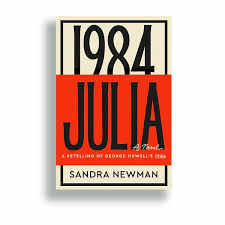
Novels based on and inspired by well-known original texts need to overcome some high hurdles to avoid being dismissed as mere fan-fiction. They need to be respectful to the source material – in most respects Newman does this, with some important exceptions. They need to have a clear reason for returning to the source material, and I think Newman ticks that box as well, giving a clear and recognisable voice to a character who often appears enigmatic in the source text, and exploring what life on Airstrip One would be like for women, a subject Orwell is largely silent on. The tightrope between simply being an attempted impersonation of Orwell’s voice and being faithful to his creation is an awfully difficult line to tread and I think for the most part, with one or two significant exceptions, Newman achieves this. It often felt like I was reading an authentic description of life under Big Brother, chapters that Orwell would have not disowned. For these good reasons alone Julia is definitely worth reading. I did have just one minor complaint – the cover design is awfully drab. It tries to suggest the relationship between the novel and the source text but I am sure there must be better ways of doing it.
I reviewed 35 books in 2024, which is about average for me in a typical year, but a little disappointing nonetheless. One book every ten days, read and reviewed, doesn’t sound too bad, and that does include Dombey and Son – but almost all the other books were either average length or shorter. Definitely a ‘must try harder’ year. Likes and views were slightly down on 2023, but still better than any other year. My five most popular posts were my reviews of Bob Mortimer’s underwhelming The Satsuma Complex, Richard Osman’s The Last Devil to Die, fourth in the Thursday Murder Club series, Ben Okri’s The Famished Road, and Graham Greene’s The Third Man. The other post in my top five is one in which I discuss Clothing in Jane Eyre, which was posted back in 2016 and which is by some considerable distance my most visited post of all time. I can just about understand why the Mortimer and Osman reviews are popular – these were both huge sellers from the end of 2023 – but the persistent popularity of the other posts are baffling. Not that I am complaining!
My reading in the first quarter of the year is as always going to be focussed on the outstanding selection of books received as presents, including new novels by the aforementioned Mortimer and Osman, as well as a book I am very much looking forward to, the latest Jasper Fforde novel. My 2025 Dickens is going to be his last completed novel, Our Mutual Friend. Beyond that I do not have any specific reading targets, but I would like to improve on this year’s total if possible. While I have abandoned my attempt to read all the Booker Prize winning novels – I was left with a small residue which I simply didn’t like the look of – I will be catching up on one or two of the more recent winners this year. Above all I will be trying to recapture the reading bug, that love of reading that is such a blessing and which gives this blog its corny name.
Invisible Man appears on many lists of the best novels of the twentieth century. It is a powerful and often disturbing account which challenges many of the conventional ideas of the form and structure of the novel.
It opens with the narrator, an unnamed black man, living in an underground room lit by hundreds of electric lights powered by electricity stolen from the city’s grid. He tells his story in flashback, attempting to explain why he feels socially and sometimes literally invisible.
“I am an invisible man. No, I am not a spook like those who haunted Edgar Allan Poe; nor am I one of your Hollywood-movie ectoplasms. I am a man of substance, of flesh and bone, fiber and liquids — and I might even be said to possess a mind. I am invisible, understand, simply because people refuse to see me. Like the bodiless heads you see sometimes in circus sideshows, it is as though I have been surrounded by mirrors of hard, distorting glass. When they approach me they see only my surroundings, themselves, or figments of their imagination — indeed, everything and anything except me.”
Born in the American South, he lives in a highly segregated society, in which black people live in fear and subjugation. He intends to escape the poverty which defines black lives in this community and wins a scholarship to an all-black college. Integrated education in the South at this time was unheard of. He works to support himself by taking a chauffeuring job. One day, while chauffeuring Mr. Norton, a trustee of the college, he makes a series of disastrous decisions. Norton, a white man, is curious about the lives of local black people. The narrator takes him to the old slave-quarters near the college campus. The fact that there even are old slave quarters still standing shows that slavery is still part of people’s lives, despite it formally ending almost a century beforehand. Here Mr Norton meets Jim Trueblood, a notorious local figure who has got both his wife and his daughter pregnant ‘in his sleep’. This is an uncomfortable portrait of black poverty in which people live little better than slaves and ignore social conventions regarding incest. Norton is appalled and asks to be taken somewhere for a stiff drink. Inexplicably the narrator takes him to a local brothel, where a riot breaks out caused by a surreal day-outing of patients from a nearby mental hospital. (There is an echo of this scene in One Flew Over the Cuckoos Nest, where the patients are taken out for the day, with similarly disastrous consequences).
The narrator is summarily expelled from college. He sees it as an unfair punishment but his principal is appalled that he has exposed the dark side of black people’s lives behind the civilised facade of the campus. The narrator travels to New York and finds work in a paint factory. More chaos ensues – he is a magnet for trouble and has no control over his life. He unwittingly causes an explosion at the factory, is hospitalised and given electric shock treatment. He escapes the hospital and stumbles into the next, decisive phase of his life. Happening across the eviction of an elderly black couple he makes an impassioned speech in their support, accidentally inciting the crowd to attack the bailiffs and triggering yet another riot. His oratorical skills are recognised by a group known as “the Brotherhood” which appears to be a black nationalist movement. He signs up and quickly becomes one of the group’s keynote speakers. Internal politics eventually turns this sour, and he becomes disillusioned with the group. Its message of gradual change and co-operation with whites is challenged from the left by more radical voices, led by a figure known as Ras the Exhorter. The novel reaches its climax with the narrator getting caught up in a race riot in Harlem. He narrowly escapes being lynched by supporters of Ras the Exhorter who perceive him as a traitor to his race.
Invisible Man is vivid, impressionistic, and unconventional. Superficially it follows a traditional narrative structure but the narrator’s adventures and mishaps are chaotic and often appear random. It charts a very specific time in Black American history at the birth of the Civil Rights movement, when many of the debates about how best to combat segregation and oppression were at their fiercest. It’s not a comfortable read but it is an important, unique book.
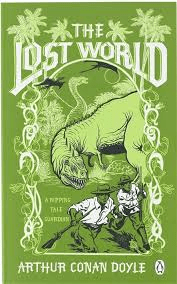
The Lost World is an unashamedly escapist adventure story. Although published shortly before the outbreak of the First World War, there is barely a hint of the looming conflict. There is one brief glimpse of the real world – when celebrating the success of the stories of Malone, the plucky young reporter for the Daily Gazette, his editor tells him “What a three column article for the paper! What a foundation for a career! A correspondentship in the next great war might be within my reach.” As with so many other texts of this period, the inevitability of a future ‘great war’ is accepted as a matter of fact. I also find it interesting that it was referred to as ‘the great war’ even before it had started! – great here is simply a reference to scale rather than the later suggestion that it was glorious in any way.
You will be familiar with what happens in The Lost World because it is the source of many of the tropes of the genre to which it gives its name. Malone, the reporter mentioned above, asks his editor for an assignment to somewhere exotic and challenging in order to impress Gladys, the woman he loves. In rejecting his marriage proposal she tells him that she will only marry a man of action and achievement:
“He must be a man who could do, who could act, who could look Death in the face and have no fear of him, a man of great deeds and strange experiences. It is never a man that I should love, but always the glories he had won; for they would be reflected upon me. Think of Richard Burton! When I read his wife’s life of him I could so understand her love! And Lady Stanley! Did you ever read the wonderful last chapter of that book about her husband? These are the sort of men that a woman could worship with all her soul,”
Malone takes this rejection at face value, and decides to find a way of meeting her expectations. His editor is sceptical as to whether such great deeds and strange experiences can be found any more:
Dear me, Mr. Malone, this is very—very exalted. I’m afraid the day for this sort of thing is rather past. The expense of the ‘special meesion’ business hardly justifies the result, and, of course, in any case it would only be an experienced man with a name that would command public confidence who would get such an order. The big blank spaces in the map are all being filled in, and there’s no room for romance anywhere.
The mention of an ‘experienced man with a name to command public confidence’ gives him an idea. He suggests that Malone approaches Professor Challenger for a place on his next expedition. Challenger is a blimpish, cartoon-like figure who challenges to a fist-fight anyone who cast doubt on his account of his recent expedition to the Amazon, where he claims to have discovered a lost world where dinosaurs still roam.
At a rowdy public meeting Challenger announces he is going back to the Amazon, and Malone volunteers to join him, along with Professor Summerlee, a zoologist who has publicly questioned Challenger’s claims and Lord John Roxton, a professional adventurer. It is not long before the Atlantic has been crossed and the party of explorers sets off up the Amazon in search of the Lost World. Their party, along with the ubiquitous native guides, quickly reaches the isolated plateau, cut off from the surrounding countryside, where the prehistoric wildlife is to be found. There’s an economy to the narrative – not much time is wasted with exposition, speculation or character development. The cliffs to the plateau cannot be climbed, but the party is able to scale a nearby spire of rock. Using a tree as a bridge they cross over to the plateau.
A treacherous guide, seeking revenge on Roxton for a grudge held from a previous adventure, pushes the tree-bridge off the pinnacle, stranding the party of four, who have no choice but to set off and explore this lost world. They encounter dinosaurs and other animals, insects and plants previously thought extinct, many of which are highly dangerous. It’s not just the wildlife they have to be cautious about, because while Malone is off one night exploring the plateau’s central lake, his companions are taken prisoner by some ape-men, referred to by Malone (acting as the novel’s narrator) as the missing link. Roxton escapes and with Malone’s help rescues the others, together with some indigenous cave people who are at war with the ape-men. A battle royale ensues in which the white men’s guns tip the bitter long-running struggle in the favour of the cave men, wiping out the ape-men and enslaving their women and children.
Eventually the explorers find a tunnel leading off the plateau and on to civilisation. The novel ends with a rerun of the public meeting in which Challenger’s claims about the lost world are repeated and once again challenged, the difference being when he produces a young pterodactyl as proof, triggering a small riot. The novel doesn’t quite end there. Two final scenes close the show. First, Malone returns to Gladys, who had married a banker in his absence, the very opposite of the man of action she described. I think the reader is meant to conclude women are fickle from this scene, but my reaction was that she was letting Malone down gently. At a private celebratory dinner Roxton then reveals that he has brought back £200,000 worth of diamonds from the expedition, making them all rich. With nothing to keep him in London Malone he decides to accompany Roxton back to the lost world. If this was the cinema the ending would be a great set-up for Return to the Lost World, but Conan Doyle obviously thought better of the idea (Hollywood disagreed, and Return to the Lost World is actually a real film!)
You may be wondering why I am reading Edwardian adventure novels? I think the simple answer is that they give an insight into how people – not everyone of course, but in particular the educated novel-reading and -writing classes – were thinking about the Empire and Britain’s place in the world at the close of the Victorian era. There was a nervousness about a decline in military strength relative to countries like Germany, France and Austro-Hungary. The Boer War had exposed serious weaknesses in the strength of the British army, particularly if conscription were ever to be needed. The trade unions were flexing their muscles and had set up the Labour Party. The world was changing and the extent to which these changes were reflected in the books people wrote and read at the time, and how their feelings about these changes are worked through in the stories, fascinates me. The Lost World is mainly an exercise in escaping the chaos that was about the erupt across Europe – but it doesn’t always succeed. When Malone and companions are fighting for their lives in the decisive battle between ape-men and cave-men, the struggle is a visceral matter of life and death:
For an hour or more after we entered the wood, there was a desperate struggle in which for a time we hardly held our own. Springing out from among the scrub the ape-men with huge clubs broke in upon the Indians and often felled three or four of them before they could be speared. Their frightful blows shattered everything upon which they fell. One of them knocked Summerlee’s rifle to matchwood and the next would have crushed his skull had an Indian not stabbed the beast to the heart….Once our allies broke under the pressure, and had it not been for the execution done by our rifles they would certainly have taken to their heels. But they were gallantly rallied by their old chief and came on with such a rush that the ape-men began in turn to give way… I was emptying my magazine as quick as I could fire, and on the further flank we heard the continuous cracking of our companion’s rifles.
War is brutal and lethal, as Europe (and Conan Doyle) were about to fight out.
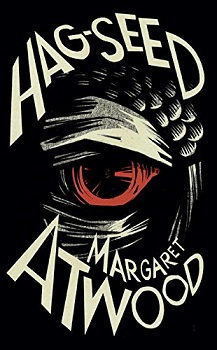
Hag-Seed was part of the Hogarth Press’s ambitious project to commission authors to rewrite and reimagine Shakespeare’s plays as novels. It was an interesting project that Hogarth planned to coincide with the four-hundredth anniversary of Shakespeare’s death. But it does mean that Atwood was commissioned to write the book. It’s not a labour of love or a story she felt compelled to tell. When artists are commissioned to paint a portrait nobody thinks this sullies the purity of their creativity, but when authors take on a similar project there is a slight whiff of commercialism that leaves a bad taste and a lingering thought that the author might not be fully committed to the project. Would Atwood have written this novel if there wasn’t the promise of a cheque at the end of it? Was she at her best, or just getting the project done?
Briefly, Hag-Seed is a retelling of The Tempest. Felix Phillips, a theatre producer, is working on a production of The Tempest as part of the Makeshiweg Theatre festival, when he is unexpectedly sacked and replaced by Tony Price, his assistant. He disappears from public view in a form of exile, living in a secluded shack miles from anywhere. Felix lost his daughter when she was three, and to keep her memory alive he imagines she is with him in his shack, keeping him company.
After several years he secures a teaching position at the Fletcher County Correctional Institute as part of a literacy programme. His work proves an unexpected success. Four years into the programme, having successfully produced Macbeth, Richard the Third and Julius Caesar, Felix ambitiously decides to stage The Tempest. Fortune casts an opportunity for revenge in his way – Tony is now a politician and plans to visit the prison to see the literacy programme in action, totally unaware of Felix’s involvement. The novel climaxes in a chaotic performance of the play with Felix being restored to his former position
There are multiple versions of The Tempest in this novel. Attwood provides a synopsis of the original play at the end of the text – to be honest, if it were needed it would have been better placed at the beginning. There is then the production Felix is working on when he is deposed from his role as artistic director of the Makeshiweg theatre festival by his assistant, Tony. Attwood mocks modernist staging of the play in which “Ariel, he’d decided, would be played by a transvestite on stilts who’d transform into a giant firefly at significant moments. His Caliban would be a scabby street person – black or maybe Native – and a paraplegic as well, pushing himself around the stage on an oversized skateboard.”
The third version of the play is the one Felix inhabits – his story closely follows the plot of the play. In this version Felix is Prospero, deposed Duke of Milan, (Felix applies for this teaching position using the name Mr Duke) his daughter is both Miranda and Ariel, and other roles are filled by his friends, associates and acquaintances. Attwood doesn’t follow the plot of the play mechanically – there isn’t an exact correspondence between Felix’s life and the events of the play – but there is a broadly similar story arc. Caliban is one of the most interesting characters in the Tempest, but he is the one character who does not have a clear equivalent in the novel. Aspects of his role are taken by the prisoners, but they are perfect inmates who engage in the dramatic process, learn their lines, obey Felix’s rule about only swearing using curses found in the play (not something you would get professional actors to comply with I suspect!) and never once threatening any form of rebellion or misbehaviour.
A fourth version of the play is performed by the inmates of the Fletcher County Correctional Institute who participate in the literacy programme. In fact the inmates put on two versions of the play – one which is recorded and broadcast throughout the prison and another ‘immersive experience’ version (the fifth) acted out while everyone is watching the video of the first (or is it the fourth?) version.
The initial ending of the novel falls a little flat. Felix’s cunning plan to get his old job back succeeds flawlessly. End of story. No possible recriminations or attempts at revenge from the powerful people that he has crossed and bested. Attwood then uses an interesting theatrical device to give the reader an improved, secondary ending. The inmate players are invited to present their ideas about what happens to the play’s characters (and by inference the lives of their equivalents in Felix’s world) after the play ends. They come up with some really imaginative ideas that I thought showed Attwood finally breaking free from the constraints of the structure she has imposed on herself.
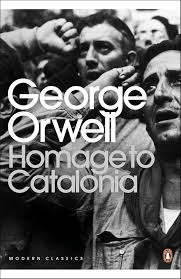
Homage to Catalonia is Orwell’s memoir of his time fighting in the Spanish Civil War. Covering the period between December 1936 and June 1937, he tells how he stumbled into the war having originally intended to observe the conflict and ‘write newspaper articles’, but then quickly got caught up in the revolutionary atmosphere in Barcelona and signed up to fight. After some rudimentary training he describes his uneventful but miserable time on the front lines in Aragon and then his involvement in the May Days conflict in Barcelona. Although he returned to the front line after this short break, his time in Spain was brought to a sudden end when he was shot through the throat. A further close shave followed quickly when the political group he was serving in, the POUM, was declared an illegal organisation causing Orwell and his wife to flee for their lives, following closely by the police. The memoir elements of the book are interspersed with Orwell’s commentary on the war and the May Days conflict, in which he is heavily critical of the actions of the Government forces.
This analysis of the May Days conflict is central to this narrative and all subsequent commentary on the book. Orwell saw the May Days as a microcosm of the struggle between revolutionary socialism and communism. This isn’t some obscure metaphorical parallel but a real time playing out of the conflict between Trotskyism and Stalinism , fatally undermining the ability of countries such as Spain to resist fascism. Orwell comes down firmly and unambiguously on the side of revolutionary socialism and against Communism as represented by the Soviet Union and its counterparts in Spain and elsewhere. You could argue that as an almost accidental member of the POUM militia (he joined because it was aligned with the Independent Labour Party) it would have been impossible to imagine him taking any other position – who cheers on the people who are trying to arrest you and who are killing your friends and comrades. all the while telling the world that you are a fascist collaborator?
A common accusation levelled against Orwell’s non-fiction is that it is to a greater or lesser extent made up. He didn’t shoot an elephant, witness a hanging, etc. This accusation is almost never expressed as simple dishonesty – instead critics talk about things being ’embroidered’ and of ‘journalistic licence’ – but that’s what they mean. Homage to Catalonia was attacked on this basis from the moment it was published – instead of being an honest eye-witness account of the six-month period Orwell was in Spain, it is alleged that it is a carefully edited and at times simply untrue portrait of the war, most contentiously the street fighting in Barcelona. One critic who takes this position on HtC is Paul Preston, an academic at the London School of Economics. His Light and Shadows in George Orwell’s Homage to Catalonia dissects HtC in meticulous detail and gives credit for the book’s vivid descriptions of the conflict, but is assiduous in picking up on contentious issues in the account. To take one fairly minor example, early on in the book Orwell contrasts the food shortages being experienced by the ordinary citizens of Barcelona with the food being wasted in the barracks. Preston observes
“If Orwell’s POUM unit could really afford to waste food, it must have been a rarity among the Republican forces.“
To support this rather snide comment (it is implied that Orwell is lying, but not directly stated), Preston refers an extremely hostile essay on HtC by Bill Alexander called George Orwell and Spain. This essay was part of a collection of critical attacks on Orwell published in 1984 called Inside the Myth (see what they did there?) Why Alexander’s account is considered reliable and Orwell’s dishonest is not explained. But if Orwell was lying about the food shortage situation, Preston implies, his other observations might also be untrue or unreliable.
There’s fundamental category error in many of Preston’s cricitisms of HtC. For example he claims
Orwell’s eye-witness testimony guarantees the inclusion of Homage to Catalonia in any list of important books on the war. However, it would certainly not be there as a reliable analysis of the broader politics of the war and particularly of its international determinants.
Whereas of course it never claims to be a reliable analysis of the broader politics of the war, as a few minutes spent reading it will clearly demonstrate. Orwell goes out of his way to stress the partisan and incomplete nature of his account:
In case I have not said this somewhere earlier in the book I will say it now: beware of my partisanship, my mistakes of fact, and the distortion inevitably caused by my having seen only one corner of events. And beware of exactly the same things when you read any other book on this period of the Spanish war. (HtC)
Another accusation repeated by both Preston and Alexander is that Orwell was some kind of literary tourist, travelling to Spain simply to collect content and material for future books and articles and was not really interested in the Spanish or their struggles.
“Orwell had no understanding of the world wide significance of the struggle in Spain, he knew little of the national efforts of the Popular Front government to achieve a united front against fascism, he had never seen the Republican flag, he did not agree with the actions of the POUM – he took the rifle in the role of an outsider, a journalist looking for different experiences to figure in a future book.” (George Orwell and Spain, Bill Alexander, 1984).
Again Orwell anticipated this criticism. Initially it was the case that he had gone to Spain to write, but the sincerity of his subsequent conviction – he returned to the fighting despite the betrayal (as he saw it) of the May Days, was shot in the throat and came very close to death – is hard to doubt. In fact Orwell wrote very little about his time in Spain outside of HtC, and the book struggled to find a publisher and was famously a commercial and literary failure. You can question the accuracy of some of his writing, but surely the authenticity of his convictions cannot be questioned.
Some of the other claims made against Orwell, crafted solely to undermine his analysis of the war, are petty in the extreme. For example Preston casts doubt on the record of events at the end of the book when he is at risk of being arrested for his association with the POUM, claiming he (Orwell) couldn’t speak Spanish. There is however unambiguous eye-witness evidence that contradicts this allegation. It is also not disputed that Orwell commanded a group of young Spanish volunteers who presumably had little English. Orwell was a bright man and a quick learner and surrounded by Spanish speakers I can easily imagine he learnt the basics of the language quickly. The alternative – that he did not learn any significant amounts of Spanish during his months there and subsequently invented conversations to fit in with his anti-Government narrative – is surely far less likely?
I don’t want to spend to much time on the case for the defence, because frankly Homage to Catalonia doesn’t need it. It is superbly written and an important snapshot of pre-war European politics. It explains very clearly why Orwell become a convinced socialist and I would argue that it adds significantly to any reading of 1984 in its portrait of Stalinism. I challenge anyone to read his description of revolutionary Barcelona and not be moved, even if you accept that in doing so Orwell was overlooking the bloodshed of the early days of the conflict:
It was the first time that I had ever been in a town where the working class was in the saddle. Practically every building of any size had been seized by the workers and was draped with red flags or with the red and black flag of the Anarchists; every wall was scrawled with the hammer and sickle and with the initials of the revolutionary parties; almost every church had been gutted and its images burnt. Churches here and there were being systematically demolished by gangs of workmen. Every shop and café had an inscription saying that it had been collectivized; even the bootblacks had been collectivized and their boxes painted red and black. […] And it was the aspect of the crowds that was the queerest thing of all. In outward appearance it was a town in which the wealthy classes had practically ceased to exist. Except for a small number of women and foreigners there were no ‘well-dressed’ people at all. Practically everyone wore rough working-class clothes, or blue overalls, or some variant of the militia uniform. All this was queer and moving. There was much in it that I did not understand, in some ways I did not even like it, but I recognized it immediately as a state of affairs worth fighting for.
The book ends with this wonderful and profoundly prophetic description of returning to England, an experience any English tourist will recognise:
“And then England—southern England, probably the sleekest landscape in the world. It is difficult when you pass that way, especially when you are peacefully recovering from seasickness with the plush cushions of a boat-train carriage underneath you, to believe that anything is really happening anywhere. Earthquakes in Japan, famines in China, revolutions in Mexico? Don’t worry, the milk will be on the doorstep tomorrow morning, the New Statesman will come out on Friday. The industrial towns were far away, a smudge of smoke and misery hidden by the curve of the earth’s surface. Down here it was still the England I had known in my childhood: the railway-cuttings smothered in wild flowers, the deep meadows where the great shining horses browse and meditate, the slow-moving streams bordered by willows, the green bosoms of the elms, the larkspurs in the cottage gardens; and then the huge peaceful wilderness of outer London, the barges on the miry river, the familiar streets, the posters telling of cricket matches and Royal weddings, the men in bowler hats, the pigeons in Trafalgar Square, the red buses, the blue policemen—all sleeping the deep, deep sleep of England, from which I sometimes fear that we shall never wake till we are jerked out of it by the roar of bombs.”
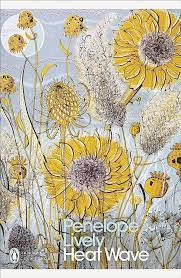
Penelope Lively’s Heatwave is set during the course of a long hot summer in rural Oxfordshire. The narrator, Pauline rents one of a pair of cottages; the other is the home of her daughter Teresa, Teresa’s husband Maurice and their young son Luke. The pair of cottages are somewhat ominously called World’s End, not a reference to the Edgar Wright film but portentous nonetheless. Pauline is a proof-reader; Maurice an author, while Teresa cares for Luke. Maurice is writing what sounds like a very pretentious history of English tourism and as part of his working routine he regularly goes back to London for meetings. He is also visited from time to time by his publisher, James and James’s girlfriend, Carol. The other inhabitants of World’s End also travel up to London from time to time – while secluded it is obviously not that remote, and these are urban, middle class people comfortable with popping off to Paris for the weekend or Venice for a month.
It is obvious from early on that Maurice is a ‘bad un’. Think Martin, the sleazy brother-in-law from Fleabag. He (44) is quite a bit older than Teresa (29) who hero-worships him. Teresa’s archetype, the long suffering wife who accepts her lot without protest, is established early – on the very first page Pauline compares her to a Hardy heroine “betrayed no doubt”. Pauline, long divorced from her philandering husband Harry, recognises the signs of Maurice’s likely adultery well before Teresa does, although the reader is given even earlier clues of his wandering. Pauline is reluctant to tell her daughter of her suspicions, waiting for some concrete evidence. She recalls the details of her own marriage to a serially unfaithful husband, who now writes to her occasionally from America where he is a college professor. Other than the slow passage of the summer and occasional trips out to cheesy tourist attractions as ‘research’ for Maurice’s awful book, the action is slow. Pauline remains watchful towards Maurice but never confronts him, and time is marked by the changing agricultural landscape and the steadily warming weather. Slowly Teresa begins to develop her own suspicions, but is also reluctant to face the issue or even discuss it with her mother. We are offered other relationships for comparison – Pauline’s bookseller friend and his agoraphobic wife, and the author of the book Pauline is proof-reading, stranded in remote Wales. Happy relationships in Heatwave are rare.
The novel opens on a warm May day, with everyone apparently “poised for this agreeable summer of industry and companionship“. Or so they believed, the narrator silently suggests. As summer passes the stresses within Maurice and Teresa’s relationship are exposed and his infidelity becomes all the more obvious. Pauline spends much of her time reminiscing. Some reviewers – in fact most, I think – claim that the damage caused by Harry’s infidelity is inter-generational and is in some obscure way the cause of Maurice’s unfaithfulness, as if Teresa has sought out a father figure for a husband who will repeat his behaviour. I am not convinced we are fated to repeat our parents’ mistakes, but Heatwave certainly seems to suggest it is unavoidable unless a dramatic break with the past is made.
Heatwave reminded me of Howards End in its portrait of a rural idyll threatened by modernisation, the way the characters live halfway between town and country and the novels’ sudden melodramatic ending in which a brutal and arbitrary form of justice is meted out. Another novel I was reminded of was J L Carr’s A Month in the Country which follows a similar structure, but is much more gentle and perhaps even kind in its treatment of its equally flawed characters.
Often, finding a way to end these reviews can be the hardest part of writing them. You can’t just stop (as some novelists do, irritatingly) – you are always on the lookout for a way of summing things up neatly with an appropriate sign-off. Many bloggers end with an invitation to readers to comment and provide their own thoughts. But one option that is not open to us it the deus ex machina out of the blue approach to ending that Lively uses in Heatwave. It was such an abrupt conclusion that it left me feeling a little cheated if I am honest.
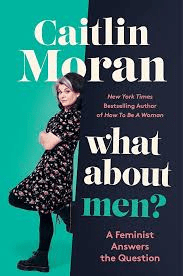
What indeed? Caitlin Moran is an excellent columnist. I enjoy her writing; it is usually insightful and broadly progressive. But does her style of writing – pithy, with a punchline every few hundred words – convert well into a book that grapples with the serious question of the crisis of modern masculinity?
There are multiple issues with this book that undermine its overall impact and effectiveness. Stuart Jefferies, reviewing the book in the Guardian, does an extremely good job of identifying these issues and I am not going to try and duplicate his points, almost all of which I support (although re-reading the review at a later date he does give Moran both barrels and doesn’t take much time looking for any redeeming features). While reading the text I constantly found myself disputing Moran’s observations and not in a good way. They were not thought-provoking so much as smugly wrong. To offer one example, when the author uses the term ‘men’ she appears to refer to a very specific sub-set of men, largely defined as ‘blokes I know’. They are almost all in her age group, heterosexual, and British. A chapter about porn-addiction, based on an interview with a twenty-something young man, stands out because it gives a voice to a different group. Claims such as “your T-shirt collection is, to you, as your wife’s lovingly collated wardrobe of second-hand Chanel, designer jeans and Zara brogues is to her” just aren’t funny because they don’t derive from any observable reality. Isn’t that observation only true of Moran’s husband and their mates? Not many women I know have a collection of second-hand Chanel designer jeans and I am reasonably close to Moran’s demographic. I appreciate this is intended as tongue in cheek humour, but it falls at the first hurdle because it is neither funny nor relatable.
Which is a huge pity, because the subjects Moran writes about – the crisis of toxic masculinity in this country – is profoundly serious. It is literally killing men, through suicide, differential life expectancy, and poor health care. Moran addresses all these subjects, but rarely gets to grips with them before a punchline is required.
Perhaps the fault is mine, in reading this book as a text rather than a series of chapters grouped around the same topic. A fine distinction perhaps but what I mean is What About Men might work better if read one chapter a week rather than straight through like a novel. Some of the more
There is, unquestionably, a dialling it in aspect to this book. Her habit of twitter-sourcing content doesn’t inspire confidence that the book has been carefully researched for example. Most of the conclusions she draws about men are simply stating the obvious – the amount of original insight is minuscule. As a quick gallop through the main issues of modern masculinity, a starter text if you like, this would be fine for someone who hadn’t read a newspaper or spoken to a man in the last few years. Perhaps that’s the real audience – teenagers? But the problem with that idea is that in my experience teenagers are profoundly better informed on issues of sexuality and gender that 99.9% of people of Moran’s generation. I think, in fact I am pretty sure, that most teenagers would be appalled if they read her generalisations on sex, gender and masculinity. Her real audience is obviously the people who buy books and give them to one another for birthdays and Christmas without really expecting them to be read. Why would you bother properly researching a book if you know most people are going to skip to the chapters about sex?
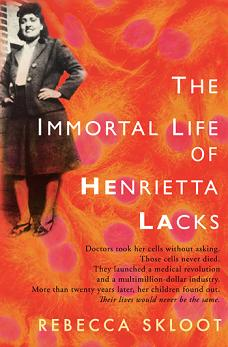
The Immortal Life of Henrietta Lacks by Rebecca Skloot, 2010
The premise of this book is that the extraordinary story of Henrietta Lacks – and more specifically, her cells which (for reasons I am still not clear about) continued to multiply after they were removed from her body, shortly before her death from cancer in 1951 – needs to be told. In other words, that this is the most
comprehensive account of Henrietta’s life, death, and subsequent ‘life’. But you don’t have to read very far into “The Immortal Life” to establish clearly that is an overstatement – in fact one of the complaints of Henrietta’s surviving family is that they are constantly being badgered for interviews by journalists and scientists. Skloot’s account may well be the most comprehensive but it is not a revelation of a lost story. Since 1996 the main School of Medicine in Atlanta has held an annual Women’s Health Conference in recognition of Henrietta and “the valuablecontribution made by African Americans to medical research and clinical practice”. In 1996 the mayor of Atlanta declared a ‘Henrietta Lacks Day’. In 1997 U.S. Congressman Robert Ehrlich presented a congressional resolution recognizing Lacks and her contributions to medical science and research. Also in 1996 the BBC made a documentary about Henrietta’s story, ‘The Way of all Flesh’. Skloot writes that the documentary team “covered the Lacks family story in more detail than anyone ever had, filling dozens of hours of interviews”. In other words, hers is a very well known and comprehensively researched story and the suggestion that this account is anything other than a detailed retelling – albeit with some new elements relating to Henrietta’s family – is misleading. Which is a pity because this is a perfectly worthwhile retelling, as far as it goes, just not anything revolutionarily new. To be fair I have to accept that I can’t pin down a quote where this claim is made explicitly, but it is strongly implied throughout the text, as well as the presentation and marketing of the book.
Henrietta’s story is definitely worth retelling. She came from a literally dirt-poor African American family only two generations away from slavery. Brought up by her grandmother and married at 14 to a cousin, she grew up in an America where African Americans had few civil rights. She was only 31 years when she died in 1951 in a “coloured ward” in hospital in Baltimore. She left behind a husband and five children – and a slice of her tissue, cut from the cancer that went on to kill her. These cells duplicated and kept on duplicating despite being outside a host living organism. Scientists had known this was technically possible, and I am not sure if Henrietta’s cells were the first ever kept alive in this way, but they were undoubtedly the most prolific. The cells went on to be used across the world in numerous different laboratories and environments, including being sent into space. Their origins were largely forgotten. An industry developed around the production of these cells and it seems as if the question of compensating Henrietta’s family and heirs for her extraordinary, if entirely accidental contribution to medical research simply didn’t occur to anyone.
Henrietta’s family are as much a part of this story as her own short life. Her deaf daughter, Elsie, was committed to an institution despite there being any evidence of mental illness. The hospital she was committed to sounds an incredibly grim place. Henrietta’s other children grew up without much in the way of parenting and suffered horrible abuse from family members. Skloot invites us to pity this resilient family, suggesting that they struggled to understand the difference between their mother’s death and the survival of her cells – “Nobody round here ever understood how she dead and that thing still living. That’s where the mystery’s at” – which feels… improbable. Henrietta’s youngest son Joe served time for homicide and remains a menacing presence in this narrative, but the central role is taken by Deborah, Henrietta’s daughter, whose obsession with her mother’s legacy comes to dominate the final chapters of the book. Whether that would have been the case without Skloot’s intervention is unclear, but it’s no surprise that in the television film adaptation of this book it was this role that was taken by Oprah Winfrey rather than Henrietta herself. Skloot even goes so far as to suggest that Deborah believed her mother had been cloned and that she was suffering the pains of all the diseases that her cells had helped to cure, and links these delusions to the more understandable suspicions of African Americans of the medical establishment. Central to this belief was growing awareness of the brutal Tuskegee project in which black men were allowed to die from syphilis so that the progress of the disease could be studied. While the extent to which the medical establishment could abuse African American people is hard to over-state, the idea that Henrietta’s family thought she might still be suffering through her surviving cells feels far-fetched.
There are three main components to this book – Henrietta’s story, the discussion of the various medical ethics issues suggested by what was done to her, and the account of the writing of the book itself. The ethical issues chapters are some of the weaker elements of the book. At points Skloot conflates serious ethical scandals (such as the Tuskagee experiments mentioned earlier) with the taking of tissue samples without informed consent. It is hardly surprising that the paper trail for Henrietta’s consent (if any) to the procedures she underwent is impossible to trace and I struggle the idea that it is a scandal that someone didn’t obtain her informed consent to the tests that were done on her tissue samples and their eventual commercial exploration. She was in intense pain and dying of cancer – the last thing she would have needed is someone trying to explain what they were planning to do with her tissue after its removal. Such consent is not required even to this day, and the case for it being so is very weak.
It is the third element of the narrative, the diary-like description of the creation of the book itself, that comes to dominate the narrative, providing an element of drama, specifically whether Deborah will withdraw her support for the project. Henrietta’s story ends chapters earlier. The space Skloot devotes to her travels and time with Deborah feels self-indulgently ‘meta’ – a book about the writing of a book – and doesn’t contain anything of substance. I felt that at over 350 pages the book could easily have been 100 pages shorter without losing any of its impact. Arguably in the end the author eventually becomes the story herself, which is rarely a good thing, not least in a popular science book. Despite all these reservations, Henrietta’s story is worth retelling and stands on its own as a fascinating combination of science and ethics set against a backdrop of racism and the experience of black people in the period immediately before the civil rights movement.

 The Reading Bug