Book review

Gormenghast, by Mervyn Peake, 1950

The second novel in the series, Gormenghast picks up where Titus Groan left off, returning to the castle where the new earl, 77th of his line, grows up in his vast crumbling demesne into a life governed by strict and stifling ritual. Peake reintroduces his cast of extraordinary characters in a leisurely manner – he is in no rush to get the action underway. Titus, who had just turned one when the first novel ended, has to grow up before he can confront the demons that threaten him. 

The florid language that characterised Titus Groan also returns, not least in the descriptions of the castle itself:

Withdrawn and ruinous it broods in umbra: the immemorial masonry: the towers, the tracks. Is all corroding? No. Through an avenue of spires a zephyr floats; a bird whistles; a freshet bears away from a choked river.

Readers will either luxuriate in prose like this, or be irritated by it. I don’t think one can have Gormenghast the adventure story without Gormenghast the prose poem, and I am very glad we have both.

Once the scene is set, and the characters are re-introduced, Peake can spend time on showing Titus’s childhood. He is wonderful at capturing the joy as well as the boredom of infancy: in a phrase that has stayed with me since reading it some 40 or more years ago, Titus is wading through his childhood. 

Or to put it another way

Drear ritual turned its wheel. The ferment of the heart, within these walls, was mocked by every length of sleeping shadow. The passions, no greater than candle flames, flickered in Time’s yawn, for Gormenghast, huge and adumbrate, out-crumbles all. The summer was heavy with a kind of soft grey-blue weight in the sky – yet not in the sky, for it was as if there were no sky, but only air, an impalpable grey-blue substance, drugged with the weight of its own heat and hue. 

Titus begins to chafe at the crippling conventions of castle life and the impositions of the daily rituals he has to undertake. I always read these rituals as Peake’s commentary on the meaningless conventions we surround ourselves with in life. Yes, this novel is thought provoking as well.

Sooner or later an Earl needs to go to school, and here Peake introduces new characters to his cast: the Professors. Professor Bellgrove is elevated to the headmastership following a fatal and grotesque accident which disposes of his predecessor. The other teachers are, as one by now expects, a collection of grotesques, not one of whom should be within a mile of a classroom. Peake is in no hurry with the adventure element of his tale, and introduces a new element to his narrative – romance, albeit a comedy romance between lovers who are getting on in years. The angular spinster Irma Prunesquallor, sister of the castle’s doctor, decides to get married, and throws a party to help her secure a groom from among the eligible teachers of the castle. Bellgrove rises to the occasion and begins to pay her court:

“His staff had shaken hands with her as though a woman was merely another kind of man. Fools! The seeds of Eve were in this radiant creature. The lullabyes of half a million years throbbed in her throat. Had they no sense of wonder, no reverence, no pride?”

I have an immense fondness for the chapters featuring the professors – they add little if anything to the plot, but they flesh out the world of Gormenghast wonderfully.

Meanwhile Steerpike, now assistant to the Master of Ritual, Barquentine, watches and waits for his opportunity. He decides that Barquentine stands in his way of advancement and has to be disposed of. However the plan doesn’t go smoothly – Barquentine puts up an unexpectedly fierce fight. Steerpike is severely injured, suffering extensive burns and almost drowning. As he lies recovering his delirious mutterings give rise to concerns in Dr Prunesquallor’s mind that he was involved in the mysterious disappearance and presumed deaths of Titus’s aunts, the twin sisters Ladies Cora and ClariceSteerpike is now under suspicion, and from this point the novel races to a tragic and bitter conclusion in a chase scene that repays any and all the patience the reader has invested up to this point. An epic manhunt through the rapidly flooding castle ends with Titus having to make the most difficult decision of his young life.

I’ve praised Peake’s use of language, his character creation, his descriptive powers, but really at the heart of this novel is an adventure story. It takes a while to get there but the payoff at the end is extraordinarily exciting.

The question is, however, what happens next?

Standard
Book review

Titus Groan, by Mervyn Peake, 1946

God I loved this book and its sequels. They enchanted me in a way that very few other books have done in my lifetime – possibly only teenagers can really feel this way about novels. Decades on I can look at them a bit more dispassionately and see their (very minor) flaws, but they remain high on my top ten list, and will always do so. It’s not going to be easy explaining this obsession. You either love these books (or at least the first two, the third is more complicated as I will explain in a bit) or you don’t – indifference is rare.

Peake was a writer of extraordinary flair and confidence. This is how he opens Titus Groan:

Gormenghast, that is, the main massing of the original stone, taken by itself would have displayed a certain ponderous architectural quality were it possible to have ignored the circumfusion of those mean dwellings that swarmed like an epidemic around its outer walls. They sprawled over the sloping arch, each one half way over its neighbour until, held back by the castle ramparts, the innermost of these hovels laid hold on the great walls, clamping themselves thereto like limpets to a rock. These dwellings, by ancient law, were granted this chill intimacy with the stronghold that loomed above them. Over their irregular roofs would fall throughout the seasons, the shadows of time-eaten buttresses, of broken and lofty turrets, and, most enormous of all, the shadow of the Tower of Flints. This tower, patched unevenly with black ivy, arose like a mutilated finger from among the fists of knuckled masonry and pointed blasphemously at heaven. At night the owls made of it an echoing throat; by day it stood voiceless and cast its long shadow.

I wonder at the assurance and skill of an author who can open with a parenthesis like that. This is our introduction to the huge castle of Gormenghast, a “vast landscape of crumbling towers and ivy-filled quadrangles” that has for centuries been the hereditary residence of the Groan family. I have only limited evidence for this but I am personally convinced that as Peake wrote the novels the castle grew in his imagination, starting from a modest, realistic setting and with it finally ending larger than a city. Titus Groan, the first of the series (not strictly a trilogy as it was not conceived as such, more a 3 book series) opens in an extraordinarily cinematic way – taking the reader from the outside of the castle where the Bright Carvers reside to the Hall of Bright Carvings, through corridors and passageways into the heart of the castle, focussing down to a small eye-hole in a painting through which we see the novel’s newly born hero, Titus, heir to the crumbling towers of Gormenghast.

Slowly Peake introduces the cast of his drama. Lord Sepulchrave, seventy-sixth Earl of Groan, a melancholy man, a prisoner of the rituals that govern life in the castle.

Sepulchrave, 76th Earl to the house of Gormenghast and lord of those tracts of country that stretch on every hand, in the North to the wastelands, in the south to the grey salt marshes, in the East to the quicksands and the tideless sea, and in the West to knuckles of endless rock.

His wife Countess Gertrude shuts herself away with her birds and her multitude of white cats. Their daughter is 15-year-old Fuchsia.

a girl of about fifteen with long, rather wild black hair. She was gauche in movement and in a sense, ugly of face, but with how small a twist might she not suddenly have become beautiful. Her sullen mouth was full and rich – her eyes smouldered.”

Fuchsia is a typical teenager, moody, self-absorbed and selfish. Sequestered in the south wing of the castle are Sepulchrave’s identical twin sisters Cora and Clarice:

dressed in purple, with gold buckles at their throats by way of brooches, and another gold buckle each at the end of hatpins which they wore through their grey hair in order apparently to match their brooches. Their faces, identical to the point of indecency, were quite expressionless, as though they were the preliminary lay-outs for faces and were waiting for sentience to be injected.

Both suffered from ill-defined fits in their youth which left them with limited mobility and even less intelligence. They crave power and blame Gertrude for robbing them of their rightful place in the castle’s heirarchy.

This is the ruling Groan family. Their lives are supported by numerous servants. These include Mr Flay, Lord Sepulchrave’s personal assistant, who is obsessively dedicated to his master. Swelter, the castle’s enormously fat chef, is Flay’s arch-nemesis:

Swelter, as soon as he saw who it was, stopped dead, and across his face little billows of flesh ran swiftly here and there until, as though they had determined to adhere to the same impulse, they swept up into both oceans of soft cheek, leaving between them a vacuum, a gaping segment like a slice cut from a melon. It was horrible. It was as though nature had lost control. As though the smile, as a concept, as a manifestation of pleasure, had been a mistake, for here on the face of Swelter the idea had been abused.”

Nanny Slagg is the down-trodden Groan family carer, looking after Fuchsia and now Titus. Doctor Prunesquallor is the castle’s physician. Rottcodd cares for the Bright Carvings. Sourdust is the Master of Ritual.

Into this arcane, decaying, isolated world, comes Steerpike, a young kitchen boy who could give Machiavelli a run for his money, Rescued by Flay from the kitchen, mainly to irritate Swelter, Steerpike immediately starts scheming his rise to power. This is as much his story as Titus’s. Steerpike is the worm in the apple of Gormenghast, who slowly comes to corrupt the whole body-politic of the castle.

In some ways the castle itself is almost a character in the novel. Peake is endlessly fascinated by its eccentric architectural detail:

Most of these buildings had about them the rough-hewn and oppressive weight of masonry that characterized the main volume of Gormenghast, although they varied considerably in every other way, one having at its summit an enormous stone carving of a lion’s head which held between its jaws the limp corpse of a man on whose body was chiseled the words: “he was an enemy of Groan’; alongside this structure was a rectangular area of some length entirely filled with pillars set so closely together that it was difficult for a man to squeeze between them.

Some readers have struggled to allocate Titus Groan and its sequel to a particular genre. While often described as fantasy, there are no witches, dragons or magical spells here, nothing supernatural or other-worldly at all. We perhaps cannot tell where or when Gormenghast is, but the people who live there obey strictly the internal rules of the narrative. It is best read as a gothic adventure story, a romance. Yes it is peopled by grotesques who you are unlikely to meet in everyday – but you might. There are stranger people out there. Not that long ago the Guardian carried an article comparing the novel to its near contemporary The Lord of the Rings, trying to understand why it was not as well known or loved as Tolkien’s trilogy. This was surely a category error – one work is a quest trilogy peopled by dragons, dwarves, wizards and elves; in Titus we remain rooted in Gormenghast, and the only menacing creatures hiding in the shadows are the men and women of the castle.

Readers may struggle with Peake’s florid language. Without question some passages are over-written. The novel also has probably the slowest start of any classic – it takes an age to reach Titus’s birth and Steerpike’s escape from the kitchen. All I can say is that once you get past this point the pace picks up and the narrative is gripping across the two main novels. Steerpike is a compelling character – while he is clearly monstrous, we cannot help but sympathise with him for at least some of his journey.

Titus Groan and its sequels are wonderful, life-changing, superb novels. Peake creates memorable characters you come to genuinely care about, and who will stay with you. There is a Shakespearean quality to the tragedy that unfolds in this novel and its sequel, a tragedy compounded in a remarkable way by the turn of events in Peake’s own life that are reflected in the third and final novel in the series. They may not be universally popular – some readers may find it hard to find a hero to identify with, and the language over-indulgent – but I love them.

Standard
Book review

Collected Short Stories, by E. M. Forster, 1947

Having recently broken my short story review duck, I decided to read another collection, this time by the Edwardian modernist E. M. Forster. This edition, available as a Penguin 20th Century classic, is a good introduction to Forster, because it so clearly demonstrates what is wrong with his work, avoiding the need (if you are lucky enough to start here) to go on and read the novels.

The problem is essentially one of perspective. All of these stories, and I think this comment also applies to many if not all of the novels, are written from the narrow upper-middle class point of view from which Forster is never able to move away, no matter how he tries. All his point of view characters are to a greater or lesser extent prosperous, never seem to have to work, have servants or paid companions, and can afford long, indulgent if apparently unenjoyable journeys across southern Europe. Working class people and foreigners do appear in Forster, but the world is never seen from their perspective, and to be blunt they always seem two-dimensional participants.

Forster does, to be fair, consistently side with the people who are polite and condescending to these “others”. In novels such as Howards End and Where Angels Fear to Tread this extends as far as being able to contemplate relationships across class and national divides, but these relationships almost always end in tragedy or violence. Howard Bast is murdered, (Howards End) Gino loses his wife and baby (Where Angels) and Dr Aziz (Passage to India) has his life ruined by the false accusations made against him. Here the Greek family who are kind to Mr Lucas in The Road from Colonus are wiped out in a freak accident the day he moves on.

I don’t know whether Forster was unable to see the world through the eyes of the people who obviously fascinated and attracted him, or simply chose to write about what he knew. The relentlessness of yet another group of fussy English people settling into yet another picturesque Southern European town, with its hotels, its funny foreigners, the stereotypical alpha-male trying to assert himself by speaking English loudly, the older women, often in pairs, fussy about their luggage, eventually becomes wearisome.

Forster kept his sexuality a well-guarded secret in his lifetime, refusing to publish Maurice until after his death, but the homo-erotic gaze is also apparent here, not least in The Story of the Siren where a young Italian diver entrances the narrator:

With a jerk he became alive, seizing my arm and saying “…I will show you something beautiful”….He drew me away from the light till I was standing on the tiny beach of sand…there he left me with his clothes…for a moment he stood naked in the brilliant sun…the man is past all description. His effect was that of a silver statue.”

(I’ve edited some text here to emphasis the point. Quite why he needs to be naked to go diving to recover a book, which surely would have floated anyway (thus avoiding the need for the naked diving) is unclear.)

These stories differ from the novels in one important way, and that is in their handling of the supernatural. In the introduction to the 1947 edition Forster describes them as “fantasies”. An element of the other-worldly is introduced in most tales. In some it is creatures such as Pan, fauns or sirens; in others it is the afterlife – one character goes to heaven, finds it boring, and leaves. Another character escapes from a boorish fiance by becoming a tree. At some points these injections of fantasy seem largely whimsical, and to this reader at least a little nauseatingly so. Elsewhere the allegorical nature of the tale is more obvious. In The Other Side of the Hedge for example, life is described in Bunyanesque terms as a walk beside a hedge, on one side of which is a hard-paced race with no obvious end in sight, and on the other an Elysian paradise of fields and recreation.

The Story of a Panic, the first story in the collection, demonstrate many of the inherent problem in Forster’s use of the fantasy genre. It is a silly melodramatic story about a sulky teenage boy, Eustace, (possibly the inspiration for Eustace Scrubb?) who one day, while on a walk in the ubiquitous Italian countryside, is possessed by the spirit of Pan. Instead of narrating the story in a way that is at least marginally sympathetic to the child, giving us some insight into what happens to him, Forster narrates the tale through the eyes of an older English tourist, who insists on being addressed formally, and looks sneeringly down on the Italians working in the hotel.  This strange little mis-firing tale establishes the template for many of the other stories in the collection, where essentially the same mystical experience is predictably repeated using the same set of characters and features. The tiresome and repetitive nature of these motifs almost became too much for me by the end of the collection, to the point where I didn’t want to read on because a) I knew what was coming, and b) I felt patronised by it. The most interesting story in the collection, The Machine Stops, which I reviewed earlier this year, is an exception to the fantasy genre, and is all the more refreshing for it.


Standard
Book review

The Discworld Companion by Terry Pratchett and Stephen Briggs, 1994

By a wonderful act of synchronicity, I stumbled across this £1 charity bookstore treasure very shortly after completing Soul Music. This edition of the Companion (later editions being called the New Discworld Companion, followed by The Turtles Moves..The Discworld Companion…So Far) was published in 1994, ending with the publication of – and therefore fully describing the known Discworld up to – Soul Music.

This is much more than a guide to the Pratchett universe, although it is a very comprehensive one at that, obviously only comprehensive up to 1994 that is. This partiality is in itself is fascinating, as this snapshot of the DW universe reveal that at this point it is surprisingly complete – certainly all the main features you would expect – the Watch, Vetinari, the Witches, Death, a fully developed concept of how magic works, and so on – are all there, fully formed. In one sense the final 25 or so books were about filling in the detail and backstory rather than reinventing DW, and the genesis of several of the later novels are clearly present here. Examples of this include the references to the mysterious world of XXXX, later explored in the Last Continent (Discworld 22) or the writer William de Worde and the fact that moving type has not yet been fully embraced in Ankh-Morpork. de Worde’s entry in the Companion ends with the this sentence:

“It could well be that the future holds great things for young Mr de Worde…”

You really couldn’t ask for a clearer indication that Sir Terry had The Truth, the DW novel about the introduction of printing, planned out in his head, even though it wasn’t to eventually appear until 2000 as DW 25.

The Companion also has lots of canonical additional content found nowhere else – there is a very comprehensive description of the history, working and traditions of the Unseen University for example, in which Unseen Academicals is hinted at in the description of the DW version of football:

“UU records suggest that students from the University have no participated recently, but street football with various rules is still an Ankh-Morpork tradition”.

The sections on magic, DW units of measurement/standards, and Morporkian law, equally all give plenty of background to the DW universe only hinted at in the novels.

At the end of the Companion, after the A-Z section, is some fascinating additional content. In a chapter apparently written by Stephen Briggs, there is what I feel is one of the best summaries of the reasons why the novels are so loved:

“There is a certain quiet optimism (in the books). If there is a struggle, the good win – but not easily, and at some cost. There is a strong dislike of coercion of people, either by other people or gods or some concept of fate or destiny. There’s a very frequent theme which says that what people happen to be doing does not define what they actually are.”

Elsewhere a long and comprehensive interview with Sir Terry reveals that in the mid-90’s in response to the question:

“Do you see yourself still writing Discworld books in ten years’ time?”

he gave a very definitive

“No. Not even in five years time. Certainly not on a regular basis, anyway. There’s only so much I can do with it.”

I am so glad he changed his mind!

P.S. In the very final section of the Companion Briggs write about Pratchett fandom:

“Fan activity is available to anyone with a computer and a modem. There is a Pratchett forum on CIX….and a rather larger one known as alt.an.pratchett on the Internet (the huge worldwide computer network which shifts megabytes of information around the planet”.

Oh so that’s what the Internet is!! Gotta love 1995.

Standard
Book review

Soul Music (Discworld 16) by Terry Pratchett,1994

There’s a disappointing, cut and paste feel to Soul Music which for me makes it the weakest of the Discworld novels thus far (i.e. of the 16 published up to this point). And it is still wonderful! How come? I’ll come to the mitigation, but first this is the plot outline:

A young harpist, Imp Y Celyn, (bud of holly, get it?) from Llamedos seeks fame and fortune in Ankh-Morpork. He forms a band with Lias Bluestone (a troll percussionist) and Glod Glodsson (a dwarf hornblower) along the way acquiring a magical guitar with mysterious powers, more specifically an entity comprising the primordial music which brought the universe into existence. As one does.

Meanwhile, Death, upset at the death of his adopted daughter Ysabell and her husband, Mort, takes another impromptu break from his day job, leaving his granddaughter, Susan Sto Helit to fulfil his soul-gathering function. She fluffs her first job by failing to reap the soul of Buddy when he is scheduled to die while performing at the Mended Drum.

Thus the novel’s two primary threads are established – death takes a break and a family members steps in to cope as best they can, a plotline Pratchett had already used before (Mort and Reaper Man); and in a parallel storyline a new phenomenon/innovation (in this case rock music) takes the Discworld by storm, causing chaos and ultimately threatening the existence of the universe, a theme already explored in some detail in Moving Pictures.

That’s pretty much it – although there are a lot more events, they all fall within this basic template. And that was what I found disappointing by Soul Music, its writing by numbers feel. To be fair to Pratchett he was writing a phenomenal amount of Discworld novels at the time, feeding our voracious appetites for all things DW. (The Colour of Magic was published in 1986,  just 8 years and 15 DIscworld novels earlier. In addition to the eventual count of 41 novels there are also any number of books and other material including short stories, cookery books, maps, guides etc). So it is hardly surprising that to meet deadlines he had to dial it in from time to time.

Fans of dad jokes and clever popular culture references will be spoilt for choice here, beginning with the original cover illustration which echoes the Meat Loaf album Bat out of Hell, rapidly followed by a steady stream of allusions to groups and records, in particular cheesy examples from the seventies and eighties, such as “Pathway to Paradise” (“Stairway to Heaven”) and ”Sex and drugs and Music With Rocks In” (“Sex and Drugs and Rock and Roll“). At first the game of spot the reference is fun, but after a while it palls – it is after all essentially the same joke time after time, however cleverly done. Having said that even I had to applaud the way the groanworthy reference to “There’s a Guy Works Down the Chipshop swears he’s Elvish” is worked in.

Pratchett was at this point over a third of the way into the Discworld saga, and he was still refining his craft. This novel would not have disappointed any DW fan, but neither can it be said to take the series to a new height or in a new direction in the way books such as The Night Watch did. It’s fun, and the jokes consistently work, but I am not sure we care that much about the characters (except Susan perhaps), and the eventual happy-ever-after ending is never in any doubt. The scenes of the band on the road felt like padding, an effort to reach a minimum word-length target. So perhaps I need a Pratchett holiday – but I really don’t want one, because I know what great novels are coming up.


Standard
Book review

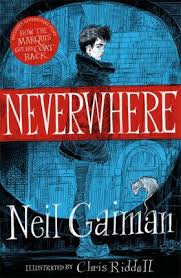
Neverwhere by Neil Gaiman, 1996

I don’t think you would be able to guess that Neverwhere is a novelisation of a television series – it has a dramatic range and scope ideally suited to the novel form, and must have been a challenge to film. It is rare for novelisations to be more than their original format, but here it is almost as if the novel was existing in concept all along, and it just took the development of the television series for it to come out.Neverwhere

In the introduction to this edition, which was published to coincide with the publication of American Gods, Gaiman describes editing the text to make it more accessible to American readers – explaining that Oxford Street is a main shopping thoroughfare for example. I suspect he was wasting his time, because this is a novel firmly rooted in place, written by a writer with considerable and obvious affection for the London landmarks that appear in the book: Blackfriars, Baron’s Court, the Angel Islington and Old Bailey, among many others.

Three years in London had not changed Richard, although it had changed the way he perceived the city. Richard had originally imagined London as a gray city, even a black city, from pictures he had seen, and he was surprised to find it filled with color. It was a city of red brick and white stone, red buses and large black taxis, bright red mailboxes and green grassy parks and cemeteries. It was a city in which the very old and the awkwardly new jostled each other, not uncomfortably, but without respect; a city of shops and offices and restaurants and homes, of parks and churches, of ignored monuments and remarkably unpalatial palaces; a city of hundreds of districts with strange names – Crouch End, Chalk Farm, Earl’s Court, Marble Arch – and oddly distinct identities; a noisy, dirty, cheerful, troubled city, which fed on tourists, needed them as it despised them, in which the average speed of transportation through the city had not increased in three hundred years, following five hundred years of fitful road-widening and unskillful compromises between the needs of traffic, whether horse-drawn, or, more recently, motorized, and the need of pedestrians; a city inhabited by and teeming with people of every color and manner and kind.” 

The novel’s springboard is the hidden issue of homelessness – how rough sleepers can live in cities such as London and be effectively invisible to the rest of the population. Gaiman takes this idea and has the homeless become residents of ‘London Under’ – a city existing in plain sight alongside London Above. I was reminded of China Meiville’s The City and the City  which is based on a very similar concept. But Gaiman’s hidden world is magical, peopled by fantastical characters and where the normal rules of time and space do not apply. In this it is closer to the Rivers of London series which I believe it directly inspired.

Neverwhere’s central character is the Arthur Dent-like everyman beloved of fantasy writers. Richard Mayhew is a young businessman, who one day helps a mysterious young girl, Door, who appears before him, bleeding and weak, on a London street. Gaiman makes Richard a Scotsman exiled in London – he already feels a sense of alienation from his environment, so when his contact with the people of the Underworld makes him effectively invisible to other Londoners the process is complete. Door, only surviving member of a family of underworlders with the power to open any door, sends Richard to find the Marquis de Carabas who in turn can help her escape her pursuers. They hire a bodyguard, the Amazonian Hunter, and set off to find out why Door’s family was slain by the infamous assassins Croup and Vandemar, who are now on their trail. They criss-cross London Under in their quest, meeting a series of fantastical characters in extraordinary places. This is an action-packed adventure full of twists and turns and incident – it’s a great story.

I was a little uncertain as to Gaiman’s target audience with this novel. There is a horrific element to the novel’s casual and brutal violence, particularly that of Mr Croup and Mr Vandemar, the former all refinement and elegance, the latter the complete opposite, usually to be found munching on the remains of a puppy or a pigeon. Some characters die and don’t come back, and the happy ever after ending is not guaranteed. But while the peril in the novel is serious it is resolved quickly, and the one main character who is killed is resurrected with minimum suspense that it is not going to happen.

There’s a lot to enjoy in Neverwhere. The dialogue is outstanding, if fizzes with ideas, the aesthetic as evoked in Gaiman’s prose is wonderful, and the central relationship between Door and Richard is sweet, understated, and touching. There is a darkness to much of the humour (“Do you like cat?” she said. “Yes,” said Richard. “I quite like cats.” Anaesthesia looked relieved. “Thigh?” she asked, “or breast?” ) that is entirely unsentimental. Gaiman has promised a sequel, which would be fantastic although this novel stands up well on its own. Highly recommended if you enjoy fantasy.

Standard
Book review

Lords and Ladies (Discworld 14) by Sir Terry Pratchett, 1992

“In the beginning there was nothing, which exploded”. I suspect most readers would identify this as something Douglas Adams wrote, rather than his successor in genius, Sir Terry Pratchett.  It sets the tone for this wonderful novel. But perhaps I shouldn’t use this term, because as Lords and Ladies points out

“Elves are wonderful. They provoke wonder.
Elves are marvellous. They cause marvels.
Elves are fantastic. They create fantasies.
Elves are glamorous. They project glamour.
Elves are enchanting. They weave enchantment.
Elves are terrific. They beget terror.
The thing about words is that meanings can twist just like a snake, and if you want to find snakes look for them behind words that have changed their meaning.
No one ever said elves are nice.” 

This is just one aspect of the genius of Sir Terry – his ability to use language creatively to make us think deeply about language and beyond, to a very serious discussion about power and responsibility within society.

Of course there is a lighter side to this novel. It includes one line much loved by Discworld fans:

“Nanny Ogg looked under her bed in case there was a man there. Well, you never knew your luck.”

I first read Lords and Ladies a long time ago. I have a vague memory of being slightly disappointed. But one of the many wonderful things about STP as a writer is his re-readability; I honestly can’t think of another writer whose novels retain their freshness and originality on multiple re-readings in the way Sir Terry’s do. In a word, I was wrong, Lords and Ladies is magnificent.

It follows chronologically immediately following the events of Witches Abroad. I could easily be wrong about this but I think this is one of the few times in the series that STP does this (The Colour of Magic/The Light Fantastic being the other example that springs to mind.) This gives the reader the impression that they are enjoying a continuing narrative, an adventure in real time. Granny Weatherwax, Nanny Ogg, and Magrat Garlick return from their adventure in Genua to find that while they have been away the people of Lancre have neglected their defence against the dark arts lessons. In particular the witches’s warnings about the Dancers, a mysterious stone circle outside the village have been ignored. With Lancre’s magical protections weakened and unguarded, a portal to the world of the elves is opened.

But as you will have seen above, these elves are not the noble creatures of MiddleEarth- they are amoral monsters that use “glamour” to alter human’s perceptions of them. The elves break into the Discworld and cause carnage at Magrat’s wedding, to be confronted (and OK, yes, spoilers, ultimately defeated) by a feat of magic that only Granny W could pull off. There is a sub-plot featuring a visit by the Arch-Chancellor and the Librarian to the wedding, but otherwise that is pretty much it – a fairly unsubstantial piece in terms of the plot. But reading STP for this plotting would be very much missing the point – you need to read him for his characterisation and his ideas.

STP really hit his stride at this point in the Discworld history, and never really took a misstep thereafter. So many great novels to come.


Standard
Book review

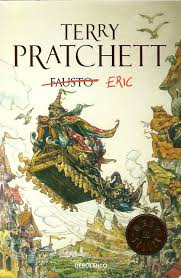
Eric, by Terry Pratchett, (Discworld 9) 1990

Eric, the ninth Discworld novel, was originally published as a Discworld story to distinguish it from its predecessors in the series. It came in a large format with illustrations throughout by Pratchett’s then cover illustrator, Josh Kirby.eric

This is going to make me hugely unpopular with Pratchett fans everywhere, but I have never been a big fan of Kirby’s work on the Discworld covers. For a start the emphasis seems always on under-dressed young women in various states of peril. If this was done tongue in cheek then he might have got away with it now and again, but the covers are essentially childish, and the books are not. I think this didn’t help Pratchett get the recognition his work deserved, and although a new illustrator took over when Kirby died in 2001, by then a lot of the damage had been done. Brandon Sanderson once famously wrote of STP (in an essay which described the Discworld novels as “the highest form of literature on the planet” which even I think it a bit of a stretch) that

“I’m embarrassed by how long it took me to discover Terry Pratchett. I avoided him during much of my early reading career”.

Could it be that Sanderson was put off by the covers perhaps?

(Incidentally, since writing this I have also found this quote from Sir Terry himself on LSpace.org, The Annotated Pratchett file:

The next UK paperback reprint of TCOM (they do a couple a year) will not have a Kirby cover. This is an experiment — there’s been feedback to me and to Transworld that suggests there are a large number of potential DW readers out there who think they don’t like fantasy and don’t get past the Kirby covers.”

Well there you have it.)

Anyway, Eric is now available widely without the art work, as are all the Discworld novels, so each to his own. Eric is a gently humorous retelling of the story of Faust, as the front cover of most editions with the word Faust struck through and replaced by the word Eric leaves little doubt about. It’s part of the continuing adventures of Rincewind, the original Discworld hero, who we left trapped in the Dungeon Dimensions at the end of Sourcery.

Rincewind is summoned out of these dimensions by a teenage demonologist, Eric, who like all teenagers wants to meet the most beautiful woman in the world, live forever, etc. Rincewind is compelled to play the part of the world’s least convincing demon, although strangely he does seem to have powers to fulfil Eric’s wishes. A very unfunny parrot provides a form of chorus as they travel to Klatch, followed shortly behind by the luggage, to Troy, or the Discworld equivalent Tsort, and finally Hell. There’s a ‘doing it by numbers’ feel to the plot, closely following as it does the source story, with only glimpses of the humour and thoughtfulness that characterises a typical Discworld novel. After they escape from Hell – of course – and go on their way, the story pretty much peters out rather than ending with any satisfying conclusion.

Normally I am falling over quotes to use in a post about a Discworld novel – with Eric that’s more of a challenge. For example:

“What’re quantum mechanics?”

“I don’t know. People who repair quantums, I suppose.”

just isn’t that funny, is it, let alone telling us something essential about life as the best STP quotes often do. Or take this below-par use of the word ‘horology’, I hesitate to call it a pun, which only Eric would be amused by:

“The Tezuman priests have a sophisticated calendar and an advanced horology,” quoted Rincewind.
“Ah,” said Eric, “Good.”
“No,” said Rincewind patiently. “It means time measurement.”

“Oh.”

I am not going to labour the point, this was a bit of a dud, and I am going to move swiftly on to the wonders of some of later novels.


Standard
Book review

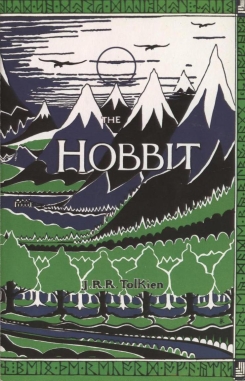
The Hobbit, or There and Back again, by J R R Tolkien 1937

It was a pleasure returning to Tolkien’s ‘The Hobbit’ after a break of several decades (plus the three Peter Jackson films of course). It’s a lovely young person’s novel – the description on the blurb of it being a children’s novel is a little imprecise for my liking, as anyone under the age of approximately 10 may not appreciate the length of the text, or some of the moments of peril and violence. To be honest, I suspect the complete absence of any female characters whatsoever might be off-putting to younger female readers as well. 

The novel famously opens with a description of the habits and domestic life of Bilbo Baggins, a hobbit with a family line inclined to most un-hobbit like adventuring. Gandalf the wizard (as opposed to all those other Gandalfs you know) uses Bilbo’s comfortable little home to host a gathering of dwarves setting out on a long-planned quest to recover their family treasure and home from the dragon, Smaug. On Gandalf’s recommendation, Bilbo is recruited as the expedition’s burglar. And so the quest begins the long journey east, past peckish trolls, to the last Homely House in Rivendell, which Tolkien does a wonderful job of making sound so alluring, across and into the Misty Mountains, where  Bilbo finds a certain ring, through Mirkwood, and on to the Lonely Mountain, their final destination.

It is an epic journey, full of wonderful adventures. Tolkien packs a lot into a short book. The final resolution is darker than one expects, as the novel grapples with the reality of the quest, its risks and danger, rather than simply using magic or another narrative trick to resolve the travellers’ problems. There is a very serious consideration of the problem of what to do when your dreams come true, how to be brave when your friends go astray, and how to honour your responsibilities to others. If that makes it sound worth it is anything but. 

The quest format is enduringly popular for good reason, and Tolkien writes with considerable economy – the events of the novel occur at a rapid pace, with little of the self indulgent diversions that marred the films. The one obvious exception to this is the fairly awful poetry that Tolkien seems unable to resist. 

The novel builds brilliantly to the climactic Battle of the Five Armies. Here younger readers’ sense of peril will be put to the test, because while the narrator takes care to reassure us of Bilbo’s eventual fate, some of his fellow adventurers are not so lucky. This is a great introduction to fantasy literature for younger readers, and as the genesis story to the much weightier ‘Lord of the Rings’ it is a good starting point for anyone thinking of pitching into the trilogy. Adult readers will enjoy the quest as well – I know I did. 

Standard
Book review

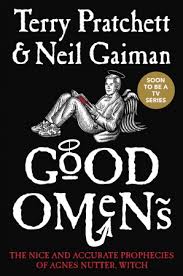
Goods Omen by Terry Pratchett and Neil Gaiman 1990

Why haven’t I read “Good Omens” before now? That’s not a rhetorical question – tell me why no-one has thrust this book into my hands and said “You love Terry Pratchett and you think Neil Gaiman is pretty good as well, so read this, now”? As you can tell I feel slightly narked at the fact that this wonderful book has not made it onto my reading list until now. Good omens

One reason might be that collaborations, especially on novels, have at best a patchy record. Name me a novel written by two people that is as good as any of the novels written by either of the co-authors? That one is a rhetorical question btw. “Good Omens” is the only co-authored novel on the BBC Big Read list of 100 best novels, if you needed any evidence on that point. But something about the way these two worked together, across different continents and time zones, just worked, producing something as good as if not better than their best solo work. It could easily have been written by Douglas Adams, and if you have been paying any attention to anything I have written in the last 5 years or so you will know that there is no higher compliment.

“Good Omens” started life as a Just William parody, and if I were to find a fault with the novel, the extended sections of the prepubescent schoolboys and schoolgirl getting up to no good in an essentially well behaved way are some of the weaker parts of the novel. But that doesn’t really matter, because the cornucopia of ideas and characters that fizz from every page of the rest of the novel more than compensate. Quite how a schoolboy story became a parable about the end of the world I am not sure, but it tells you something about Pratchett and Gaiman’s imaginations. There so much to enjoy here – utterly believable eccentric characters, such as the angel and demon working together to avoid Armageddon, Witchfinder General Shadwell and his assistant Newton Pulsifer, the witch Anathema Device (was/is there any author better at producing fantastic names for his characters than Terry Pratchett was – I give you Cut My Own Throat Dibbler in evidence), a breathless plotline that genuinely leaves it open to doubt whether the world is going to end or not, and on every page some of the best and at the same time wisest jokes you will find in any modern novel.

“It may help to understand human affairs to be clear that most of the great triumphs and tragedies of history are caused, not by people being fundamentally good or fundamentally bad, but by people being fundamentally people.”

“An Angel who did not so much Fall as Saunter Vaguely Downwards.”
“She was beautiful, but she was beautiful in the way a forest fire was beautiful: something to be admired from a distance, not up close.”
This is Pratchett at his very best, and whatever Neil Gaiman contributed to the process and outcome – the appendix at the end of this edition contains interviews with the authors that are frustratingly vague on this point, including the possibility that some of the text was written by neither of them – the combination just worked. I suspect it made Terry a better author in the long run, although I don’t think he ever wrote anything better.
Finally some good news – the novel is being adapted for television by the BBC, with two of Britain’s best actors, Michael Sheen and David Tennant, in the lead roles, and with a wonderful supporting cast. Should be (the light) fantastic.
Standard