Book review

Harry Potter and the Deathly Hallows, J K Rowling, 2007

(Last post on Harry Potter for a while – promise!)

And so it all came down to this, the final novel in the series, in which J K Rowling was faced with the monumental task of drawing together the threads of the previous six novels, resolving all the puzzles and storylines and giving everyone an ending, of sorts.

The earlier novels adhered to a format structured around the school year – they start during the summer holidays, Harry has an adventure of some sort before returning to Hogwarts, and then his life is dominated by the demands of lessons, homework, sports and meals in the Great Hall. This is the backdrop against which all his adventures have been set, and it became familiar and comforting – no matter what happened, you knew in a few months/chapters Hagrid would be decorating the school with trees from the forest, Christmas jumpers from Mrs Weasley would arrive, and the clock continue to tick down to the denouement with whichever iteration of Voldemort was in play that year.

So it was quite a shock that Rowling abandoned this structure in Deathly Hallows. I didn’t expect it at all, although in hindsight how Harry could have returned to Hogwarts after the end of Half Blood Prince I am not sure. The opening is one of those rare (and therefore all the more striking) non-Harry scenes I mentioned in my review of Half Blood Prince. Set at Malfoy Manor it sees Voldemort revelling in his return to power, surrounded by sycophantic Death Eaters, killing the Hogwarts Muggle Studies Professor, Charity Burbage and feeding her body to Nagini. If Hogwarts professors are unsafe this is obviously a dangerous world – this is reinforced quickly by the deaths of Hedwig and Mad-Eye Moody. A taste of things to come obviously, but I wonder how younger children would have reacted to the unmitigated bleakness of these chapters? There’s no ambiguity about the choices Rowling made here. She could have written seven children’s stories using the template of Philosopher’s Stone, but instead decided to age the novels with her readers. This was a really innovative approach and had the effect of ensuring that her core readership didn’t grow away from the series, even if it did mean a possible loss of readers at the younger end of the scale.

After a brief moment of relaxation at Bill and Fleur’s wedding, the trio are off hunting the four remaining horcruces (or is it horcruxes?) (two, the diary and the ring, already having been destroyed) with only the barest amount of information to go on. As well as the memories and training provided by Dumbledore, they also have three gifts from their headmaster’s will – his deluminator, the first snitch Harry ever caught, and a copy of the Tales of Beadle the Bard. I am sure Rowling will have explained why Dumbledore didn’t give them as much help as possible, but the reader shares the trios frustration at how difficult he made this task. Remus Lupin offers to help, but Harry sends him back to his new family – for Harry, who never really had one, family is everything. With so little to go on the trio spend a long time aimlessly travelling around the country, and it is in these scenes where the novel lags, although all is forgiven and forgotten when the action accelerates at the end of the novel.

Speculation prior to the novel’s publication focussed on discussing the many clues – and of course red herrings – that were scattered through the previous six novels. I can remember being convinced that one of the horcruxes would be found in Borgin and Burkes, where Voldemort worked after leaving Hogwarts. Wrong, of course. The central mystery of the series, the relationship between Voldemort, Harry, and his scar, was workoutable, but everything else including the location of the remaining horcruxes and the identity of the Deathly Hallows was virtually impossible to guess, which was typical of the way Rowling had structured her puzzles throughout the series.

There is an element of ‘greatest hits’ about some of the scenes in Deathly Hallows – a return to several of the key locations (eg the Shrieking Shack, the Chamber of Secrets, Gringotts) and characters (eg Ollivander, Dobby, Griphook) encountered in previous novels. But there are also new locations, notably Godric’s Hollow, new characters (Aberforth finally emerges from the shadows) and Dumbledore’s extensive back story is explored. The novel’s climax, the long-awaited Battle of Hogwarts, is epic and memorable. Rowling is ruthless in despatching much-loved characters from the series, her justification being ‘this is war, people die’. The political themes of the novels finally emerge unambiguously – Voldemort and the Death Eaters are racists, blood-purists, and have to be beaten no matter the cost.

I know some readers were disappointed with the epilogue set nineteen years after the battle, in which Harry and friends are shown seeing their children off on the Hogwarts Express to continue the story. However this scene matters because it gives the author the chance to quell any doubts about the outcome: “The scar had not pained Harry for nineteen years. All was well.”

The Harry Potter series was a phenomenon, and I suspect we have yet to see the end of it – the Fantastic Beasts films, the stage play The Cursed Child, (which must be turned into a film soon, surely?) and numerous other commercial ventures have all contributed to keeping the revenues rolling in and the franchise alive.

For years now I have been trying to work out why a series that is in many ways so wholly unoriginal had such an impact. It could be that the magic of Harry Potter is actually derived from that lack of originality. I wouldn’t go so far as to say even non-magical Harry is an everyman character, but he is in many ways unexceptional – a point he constantly makes in fact. When he enters the magical world we Muggles go with him, and see the magic with the same renewed sense of wonder, even if we have seen wizards waving wands so many times before. This world is at the same time both extraordinary and everyday, rooted in the things we all have to deal with, combining the fantastical with the ordinary and created something unique. Her decision to make the novels darker and more mature as Harry passes through the school years was also unquestionably a master-stroke. Seven different versions of The Philosopher’s Stone would have been fun eventually quite boring.

Just one last thought – is there a best way to read the Harry Potter novels? As a teenager? As they were published? In audio-book form? Unusually I think there is a right answer to this one, which is: out loud, to a child or children of the right ages. If you are privileged enough to be able to do this you will experience the wonder Rowling weaves through their eyes, as well as being able to appreciate the novels in your own terms.

Standard
Book review

Harry Potter and the Methods of Rationality, Eliezer Yudkowsky

Harry Potter and the Methods of Rationality is free to read online at http://www.hpmor.com/

J K Rowling’s Harry Potter series generated a huge amount of fan-fiction – literally hundreds of thousands of stories were written by fans of the series, set in the wizarding world and featuring the characters Rowling created. Many of these stories were inspired by the phenomenon of ‘shipping’ – imagined relationships between different characters.  Of all the attempts to explore the Potterverse that I have come across Eliezer Yudkowsky’s Harry Potter and the Methods of Rationality is by far and away the most innovative and thoughtful.

The Harry Potter novels can be looked upon as an extended thought experiment – ‘what if magic was real?’ Rowling creates a world that is largely separate from the non-magical world – to avoid persecution wizards have gone underground, and avoid interaction with ‘muggles’ wherever possible. Everyday objects – radios, cars and telephones – are treated as bewilderingly complex and amusing. So the two worlds occupy the same space, but are very distinct. But within a version of our world that is very recognisable, down to using quite routine settings such as Kings Cross station, the magical world has a complex set of rules that govern how magic works. We aren’t encouraged to consider the underlying principles of magic in any detail – how does non-verbal or wandless magic work for example? – but within limits it kind of makes sense. Some magic is used for fairly ordinary purposes, for many of which there are straightforward non-magical alternatives.  A post-it note would usually be more effective than a Remembrall, and how many times would characters in the novels have benefitted from a decent mobile phone! Even some advanced dark magic is no more effective than real-world equivalents, such as a handgun instead of Avada Kedavra. But generally the magical world is one of vast possibilities, which the Hogwarts students really only begin to explore before the series ends.

Methods of Rationality takes this one step further and asks – if magic does exist, how would a rational person, steeped in scientific method and knowledge, explore and interact with that world? How would they come to terms with the fact that everything they thought they knew about the laws of time, space and matter was wrong, that matter can be created from nothing, and that eternal life and time travel are possible? And what would they do with magic given its almost limitless potential?

Yudkowsky imagines that instead of being brought up in the abusive Dursley household, Harry is adopted by his aunt Petunia and her scientist husband Michael Verres-Evans and raised in a loving and positive household where independent thought and learning are encouraged. This version of Harry is a precocious genius. Once faced with the undeniable facts of the wizarding world, Harry reacts in the only way he knows how – he tries to apply the scientific method to magic. Where does it come from? Is it formed by the words of the spell, the gesture of the wand, the wizard’s mental energy or some combination of all three? Is magic in the world really fading as pure-blood fanatics claim? And perhaps most importantly of all how can magic be used to benefit the non-magical world?

In other words, what would have happened in Harry Potter’s first year in Hogwarts, had he (and almost everyone around him) not been so unquestioning? Rowling’s Harry takes everything he is told on trust (recall the scene in his first potions lesson where he simply writes down what Snape tells him) and the reader follows suit – suspension of disbelief means we are not encouraged to ask the difficult questions that Yudkowsky investigates. It is only in later books that we consider issues such as the wizarding government and whether there are magical folk in other countries. Rowling’s Harry is obviously a lot more believable and likeable than this version– most 11 year-olds if told they were wizards would react with a mixture of excitement and disbelief, rather than attempting to pick apart the structures of magical theory. MoR’s Harry is far more adult that Rowling’s, and it is fair to say far less appealing. But his uncompromising personality acts as an explanation for his determination to interrogate the world of magic, asking the difficult questions that may have occurred to older readers of the original series but would not be a problem for the original target audience. If time-travel is possible, why is it only used to help with schoolwork rather than defeating Voldemort? If the Philosopher’s Stone really does granted eternal life, why doesn’t everyone work towards having one, (or at the very least why doesn’t Flamel make more than one?). And what on earth is going on with the rules of Quidditch?!

Not all of the changes in this version of the wizarding world are not purely driven by the ‘methods of rationality’. Professor Quirrell is a dramatic improvement on his original. His Defence Against the Dark Arts lessons are exciting role-playing adventures, in which teams of students battle against one another in the Castle, grounds and forest. Other characters are given additional depth – Draco Malfoy isn’t just the stereotypical bully of the early novels, but more the Draco of Half Blood Prince and Deathly Hallows, trapped by the expectations of his family upbringing, trained to be a death-eater from an early age but capable of change despite the pressures of his caste.

MoR Harry is not always as smart as he thinks he is. At one point he is manipulated into helping break Bellatrix L’Estrange out of Azkaban. There’s no question that having Dementors, dark, irrational monsters that they are, running a prison that leaves most of its prisoners mad “within weeks” and many others dead before the end of their sentence, was an appalling scar on the face of the wizarding world, made even worse by the casual way in which wizards and witches are despatched there without trial or for trivial offences. So attempting to break someone out of it is more than just an intellectual challenge, it is a moral obligation. But choosing Bellatrix as the sole target for escape is hard to justify, particularly as once she is released she is quietly dropped from the story-line.

MoR can’t avoid pointing out some of the more extreme absurdities of the original series – for example the decision to turn the Tri-Wizard tournament trophy into a portkey, meaning that Moody/Crouch has to try to manipulate the outcome of the tournament over the course of a school year, when the alternative, to turn a random object into a portkey and just pass it to Potter, would have achieved the same end far more easily. But this critique is done with a light touch rather than as part of a full-scale demolition of the original series – which would have been pretty impolite in the circumstances.

Yodkowsky makes some interesting choices in developing their version of the wizarding world. Harry and Hermione are sorted into Ravenclaw, where intellect is prized over courage. Harry is entirely uninterested in Quidditch which he dismisses as a waste of time. Ron is portrayed as an unintelligent oaf (canon-Ron may not be as sharp as Harry and Hermione, but he is far from stupid – look at his chess playing abilities for example) and largely disappears from the narrative. Draco Malfoy on the other hand is someone Harry spends a lot of time trying to get to know, even though he is clearly very dangerous . Is Slytherin’s support for the imminent wizarding war really that important?

At time MoR felt a little like a psychology lecture, in which another yet another research paper or experiment in human behaviour or game theory is explained by Harry and applied to the problem in hand. But when these got wearing I felt comfortable with skipping to the next chapter. Overall this was a refreshing version of the wizarding world, a lively consideration of the internal logic of magic which addresses many of the questions older readers of the original series would have considered. It avoids many of the pitfalls fan-fic often falls into and remains largely true to the spirit of the original series. And it’s free to read online!

Standard
Book review

Harry Potter and the Half Blood Prince, 2005

Reading the Harry Potter books as they were published, with two or three year gaps between each (and with the films already being made of the earlier novels as the later novels were being published) was a great, collective experience. I can remember telling my sons on the night Deathly Hallows was published, a night of absurd media over-reaction, that they should savour the moment, because no-one was ever going to be able to read Deathly Hallows for the first time ever again – every subsequent reading of any of the novels would be in a world where the ending of the series was known.

Harry Potter and the Half-Blood Prince - Wikipedia

Speculation prior to the novel being published as to the identity of the Half Blood Prince (once the title had been confirmed, which was a media event all of its own) was rife. The revelation at the novel’s climax shows that Rowling once again set her readers a puzzle that they could not reasonably have been expected to solve – we are never told that Snape is a half blood nor that his mother’s maiden name is Prince, and while both are guessable, that’s not really the way literary puzzles work is it? Similarly futile speculation surrounded the book cover imagery when it was revealed – what are Harry and Dumbledore doing?

When chapters of the Harry Potter series break away from the concentrated focus of the central character, readers know to pay particular attention. These chapters are few and far across the seven novels – arguably there is only one other outside Half Blood Prince, the opening scenes of the Philosopher’s Stone, following Vernon Dudley to work (the opening scenes of Goblet of Fire, in which the caretaker Frank Bryce is murdered, is later shown to be Harry’s dream/vision). So the initial chapters of Half Blood Prince stand out. The first – The Other Minister – is a comic scene which could have been included in almost any one of the preceding novels. The Minister for Magic pays an impromptu visit to the British Prime Minister to brief him on the disturbing developments in the wizarding world. The second chapter is far more significant for the plot arc of the series. Narcissa Malfoy, Draco’s mother, and her sister Bellatrix Lestrange, pay a visit to Spinner’s End, the bleak Northern city which is the out of term home to Severus Snape. (As an aside, I just wanted to say that some of the casting decisions in the films were debatable, but the actor playing Bella, Helena Bonham Carter, was brilliantly cast). Despite Bellatrix’s opposition, Narcissa begs Snape to help Draco in the mysterious task he has been given by Voldemort. Snape is cross-examined by the sceptical Bellatrix, and explains his role as a double agent within Hogwarts and the Order of the Phoenix. Snape makes an Unbreakable Vow, swearing to assist Draco and if necessary complete the task he has been given should he fail. The detailed wording of this Vow was pored over by readers at the end of Half Blood Prince, trying to understand Snape’s true role in the conspiracy against Dumbledore.

Harry’s storyline in the novel opens when Dumbledore arrives at the Dursleys to escort him to the Burrow, home of the Weasley clan. On the way they take a detour to meet Horace Slughorn, a former Potions teacher, where Dumbledore not so subtly uses Harry’s notoriety to persuade Slughorn to return to Hogwarts. Dumbledore also tells Harry that this year he will be giving him private tuition. It is these ‘lessons’ (although they can only be thought of as lessons in the loosest terms) that form the spine of the novel. In them Dumbledore shows Harry a collection of memories he has collected in his research into the life and times of Tom Riddle, starting with a disturbing visit to the Gaunt family home (again notionally a non-Harry chapter, although seen by him in the Pensieve). Outside the Potterverse Dumbledore could have told Harry these anecdotes and explained their significance in an afternoon, but the demands of the narrative require them to be spread out across a whole school year (Harry recaps the scenes to Ron and Hermione fairly quickly after each ‘lesson’ without too many complications.)

There are several other threads to the novel in addition to the slow reveal of Voldemort’s plans. The discovery of an old annotated potions textbook, previously owned by ‘the Half Blood Prince’, allows Harry to excel at potions, taught this year by Slughorn, Snape having finally secured the Defence Against the Dark Arts post. His new-found brilliance at potions allows Harry to win a bottle of Felix Felicis, so called “Liquid Luck”. Another thread is Harry’s strong suspicion that Malfoy is now a death eater and is working on a task set for him by Voldemort. He trails him using the Marauders’ Map, without success. Meanwhile the romantic storylines that have been brewing throughout the series start to come to fruition, with Ron and Hermione growing closer despite Ron’s comically inept romance with Lavender Brown. Harry’s feelings for Ginny are also growing harder to deny.

Finally, the secret that Dumbledore has been edging towards all year is revealed – Voldemort has created six horcruxes, magical objects containing a portion of his soul. Only if these artefacts are destroyed will Voldemort become mortal. We later find out that Dumbledore reveals this information to Harry alone (rather than telling his trusted allies in the Order of the Phoenix) on the tenuous grounds that he wants to ensure Voldemort doesn’t realise his horcruxes are under threat and take steps to protect them. Voldemort’s vanity is his fatal flaw – instead of just using a pebble on a beach, his horcruxes are valueable, significant objects that have a connection to the founders of Hogwarts. Harry and Dumbledore apparate (alone? Why no magical escort, guards, weapons!) to a sinister seaside cave to retrieve a Horcrux. The novel’s sustained climax is well known, but I will avoid pointless spoilers – suffice to say the adventure and excitement in the novel are at a different level from Order of the Phoenix (saving its final chapters in the Department of Mysteries). Schoolwork is relegated to its correct place.

Half Blood Prince is a well constructed adventure story where dark magic takes centre stage. The central and supporting characters are all now very well established, and Rowling’s world-building begins to pay off – we really feel as if we are inhabiting a complete world. New additions to the Potterverse, such as liquid luck, horcruxes, and spells such as sectumsempra are all inspired, and the revelations about Harry and Voldemort’s past begin to throw the earlier novels in the series into a new and darker light. The pieces are now all in place for the series’ astonishing climax. Lucky readers that can now read the whole series without the suspenseful two year waits!

Standard
Book review

Harry Potter and the Order of the Phoenix, 2003

Returning to Harry Potter and the Order of the Phoenix after almost 20 years was an interesting experience. Since reading the novel when it was first published I have seen the film version several times, so it is that version that dominates my memory. Broadly speaking the film is true to the spirit of the book, and many of the cuts made to accommodate the running time are for the better.

Order of the Phoenix is in some ways misnamed (as of course are others in the series – Goblet of Fire is really not about the goblet at all, which makes one brief appearance and plays no functional role in the novel; the deathly hallows are a wild goose chase which bear little relevance to the struggle to track down the horcruxes. But I am getting ahead of myself!). It’s not really about the Order – neither Harry nor his schoolmates are members, and they are excluded from knowing much if anything about its wider membership, activities or purpose. Off-screen the order is no doubt busy recruiting and trying to disrupt the work of the Death Eaters, but we hear very little about this. Sticking firmly to Harry’s point of view, we instead focus for large parts of the novel on the fairly mundane minutiae of boarding school life – lessons and homework (incidentally, I noticed that each lesson follows the same pattern – the teacher sets a task, often by writing magically on the blackboard (no fancy whiteboards for Hogwarts!), the children then complete the task throughout the rest of the lesson either reading or practising a spell. The amount of teaching done is minimal – only Professor Binns, the ghostly History of Magic teacher, delivers lessons in the former of lectures, and these lessons are universally considered deathly dull.)

This is Harry’s year fifth year at Hogwarts in which he is due to sit his first set of exams, and for long periods this becomes a traditional school story in which the pressures of homework, avoiding fights with bullies and the first stirrings of teenage hormones combined to make Harry an extremely grumpy teenager. The point about this being a traditional boarding school story needs to be emphasised, because Rowling sticks rigidly to the conventions of a genre that many of her younger readers will be unaware of – the novels of Angela Brazil, Enid Blyton and others. You see this reflected in what Rowling doesn’t mention as much as what she does – the children never use the bathroom (despite their importance in plot terms within several of the novels) or shower at the start or end of the day; teenage romances are described very hesitantly, and while girls are allowed in the boy’s dormitories we find out in this novel that any boy trying to go up the stairs to the girls’ dorm finds the stairs transform into a slide – a little nod to the slippery-slip in the Faraway Tree?

The food served in the Great Hall is (I suspect) the diet of Rowling’s childhood – sausages and mash, liver and onions, pork chops, Yorkshire puddings and treacle tart. Not a pizza or pasta dish in sight. There’s even one incident where someone uses a dial-phone, which I am certain younger readers around the world would need to have explained to them but would look something like this. 

The opening of the novel is very similar to Deathly Hallows – Harry is collected by a group of Order of the Phoenix members who escort him on broomsticks to a safe location, in this case the Order headquarters in Grimauld Place. I always enjoyed Rowling’s ‘dad’ joke puns like this – Diagon Alley and Knockturn Alley being two other obvious examples – and Grimmauld Place is a fine addition to the Potterverse, the ancestral Black family home, haunted by the screeching portrait of Sirius’s mother and their horribly grumpy house elf, Kreacher. As in The Chamber of Secrets, Harry is accused of breaking wizarding laws by using magic while under-age – (the Ministry’s ability to detect the use of magic to a precise location, but not work out who did it, is one of those discrepancies that younger readers won’t care a damn about). This time the Ministry’s response is a lot less understanding, and the fascistic tendencies of the Wizarding World (we never hear about elections of any kind, for example) come to the fore. Harry is cleared at a full hearing of the Wizengamot, despite the obvious attempts to convict him. The Minister for Magic, Cornelius Fudge, refuses to believe Voldemort has returned to his powers, and is doing everything he can to undermine Harry and Dumbledore.

As part of this campaign Fudge appoints Dolores Umbridge to the role of teacher of Defence Against the Dark Arts. Umbridge is one of children’s literature great monsters, and I found the scenes were she tortures Harry extremely uncomfortable. Harry just accepts his ‘punishment’ in silence. I worry that this sent the wrong message to the millions of young children who saw him as a role model – children should be taught that if an adult hurts them they should tell someone in authority they trust, not just allow the abuser to continue and hurt others. It’s a rare misstep for Rowling who almost always teaches children to do the right thing in these stories. Fred and George’s resistance to Umbridge’s tyranny is one of the highlights of both the novel and the film, and shows that bullies can be stood up to.

Harry is having increasingly troubling dreams in which the connection between him and Voldemort is becoming all the more inescapable. While dreaming he sees the corridors of the Ministry of Magic through Voldemort’s eyes, and comes to realise these are not just dreams when an attack on Mr Weasley occurs in real-life as well as his dreams. Lessons with Snape in Occlumency, to try to close his mind to external intrusion, go disastrously badly, and are abandoned.

Phoenix is often described as the transition novel in the series, when Rowling stopped “writing the stories for children and start writing them for everyone, as Mark Twain did when he moved from Tom Sawyer to Huckleberry Finn and Lewis Carroll did when he moved from Alice in Wonderland to Through the Looking-Glass”. This quote is from the Stephen King review where he describes the “process — mostly subconscious — that began with volume 3 (Azkaban) and hit warp speed in volume 4 (Goblet of Fire). By the time we finish The Order of the Phoenix, with its extraordinary passages of fear and despair, the distinction between “children’s literature” and plain old “literature” has ceased to exist.”

In the same review King memorably described Order of the Phoenix as “The Catcher in the Rye, minus the dirty words and the drinking”. Certainly Harry is at his hormonally grumpiest in this novel, and that, combined with the novel’s length (it is the longest of the series, and that’s saying something) and the absence of any significant action for large parts of the school year, means it drags at some points. This is all forgotten in the novel’s extraordinary climax, in which all the elements Rowling has been putting into place during the slow build up finally pay off. The battle scenes in the Department of Mysteries, sadly truncated in the film version, end in tragedy. In many ways this has been a wasted year – the prophecy is not that important in the wizarding war, certainly not a weapon as it is described at several points, and most readers will wonder what Voldemort has been up to since coming back to life at the end of Goblet. The final scenes of the novel are anti-climatic, with a return to the Dursley’s and a conspicuous absence of any counselling for a clearly traumatised Harry and friends.

It’s important to always remember these are novels written principally for children. Rowling chose – subconsciously or otherwise – to age the novel with her readers and her characters, meaning that at moments there is a tension between her story-writing instincts – to increase the tension and horror in the novel – and the setting. Magic can always be invoked to make any problem disappear (where are the time turners when you need them!) so when magic finally proves futile, and a good shotgun or pistol would be much more effective, the suspension of disbelief comes under increasing pressure. There is much for younger (say 8-12) readers here, moments of slapstick and silliness (Flitwick is often the target of these jokes, and the novel also sees the introduction of the wonderful Luna Lovegood) but the darkness is closing in, and there is worse to come.

Standard
Book review

The Mind is Flat, by Nick Chater, 2018

The Mind is Flat, by Nick Chater, 2018

“almost everything we think we know about our own mind is a hoax, played on us by our own brains.”

The Mind is Flat is one of those disturbing books that makes you change the way you look at the world. It certainly did for me anyway. Whether that change will be permanent, or whether I will relapse into the comforting delusion of an inner life, remains to be seen.

This book asks the question you probably haven’t even asked yourself – do we as humans have a different level of consciousness from animals? (Chater doesn’t phrase it this way or even consider animals as an alternative to human consciousness, but the parallel works for me.) If you watch animals they live in the moment, responding to their environment and their needs and instincts, almost nothing more. If they want to kill something, they kill it – no hesitation or equivocation. (There might be hesitation about the best way to execute the hunt, but that’s just practicality not more ambivalence). We think of ourselves as existing on a higher plane – we have an inner life of values, thoughts, experience and principles, and respond to our world very differently. But do we? Chater’s thesis – and I have no idea to what extent this is original work or something that has been around for centuries – is that we construct our perception of the world as we go along. We have no beliefs, desires, fears, personality, or “inner life”. The brain makes everything up responding to the world as we experience it through our deeply flawed senses.

Chater focuses on sight in this book although I suspect similar analysis could be applied to our other senses, and shows how unreliable sight can be – how partial our view of the world is, how little we actually see, and how much the brain sketches in the rest of the field of vision. There are some fascinating studies referenced here (some of which quite obviously were intended for a colour version of the book, and which don’t work as well in the black and white paperback version). One is the Ninio experiment where the black dots on this image drop in and out of our sight as our eyes move across the screen or page. We can only see one or two of these at a time, even though our brain is telling us we can see the rest of the image – in reality we can’t, we are just better at filling in the grid than we are the dots. (People reading this will say “I can see all the dots”. They can’t – what is happening is that their eyes are making those micro-adjustments we make all the time but are barely aware of. 

Ninio, J. and Stevens, K. A. (2000) Variations on the Hermann grid: an extinction illusion. Perception, 29, 1209-1217

It might seem a big leap from ‘our eyes can play tricks on us’ to ‘consciousness is an illusion’, but Chater draws the lines between the two carefully and convincingly.

“The brain is such a compelling storyteller that we are fooled into thinking that it is not creating our thoughts ‘in the moment’ but fishing them from some deep inner sea of pre-formed colours, objects, memories, beliefs or preferences, of which our conscious thoughts are merely the shimmering surface. But that world is a… fiction created in the moment by our own brain. There are no pre-formed beliefs, desire, preferences, attitudes, even memories, hidden in the deep recesses of the mind. Indeed the mind has no deep recesses in which anything can hide. The mind is flat: the surface is all there is.”

This is all so profoundly counter-intuitive that the normal response is denial. ‘Your mind may be flat but mine is fully-rounded, with values, intelligence, principles and a whole lot of other stuff going on, most of which is going on in the background while I eat, sleep, walk etc’. Perhaps, but the case for this being just a story we tell ourselves to explain the world as we experience it is compelling.

Looking at the counter-argument for a bit, first we aren’t animals. We don’t just kill people when angry (not all of us anyway), steal when we want something, sleep with anyone at any time. But of course some people do. And perhaps the reason we don’t all respond that way is not because of some internal policeman, but because we have better memories than animals – we know that there are consequences from killing, stealing etc. If these consequences weren’t there, would we be so restrained? This is why we need laws, police, courts etc in the first place. Perhaps this also explains why a civilised society like Germany in the 1930’s could inflict the holocaust on the Jewish people (and the other minority groups involved) – remove the consequences and we will do pretty much anything, however barbaric and inhuman.

This theory also explains the feeling that many people have of being dead inside, meat robots, acting a part and waiting for their lives to start. We watch other people having their complex lives, their relationships and romances, adventures and achievements, and assume they are whole people rather than just acting out their parts in some bizarre version of the Truman Show.

If this is all feeling far too depressing, here’s some consolation, I hope. Firstly, we aren’t just responding to our environment moment by moment. We have instincts that dictate how we respond without even engaging our thoughts. Some of these instincts are primeval and we lose them as we grow older. Then there are the aspects of our behaviour and personality that are determined by our genes (which explains how twins separated at birth often develop along closely aligned pathways, unless of course that is an urban myth!). We still get to make choices about what we do, it’s just those are choices we make, not the person living secretly inside us. Once you accept that the mind is flat, that we don’t have a subconscious to which we can ascribe anything negative or unpleasant in our personalities, that is in a way liberating.

There are some pathways Chater could have gone down in this book, some avenues of exploration, which I wish he had. Firstly, how do people who are blind from birth and perhaps have restrictions in their other senses experience the world? How do they make things up moment to moment? Second, if we have no secret inner identity what are the implications for gender and sexuality? Perhaps even more significantly what does this mean for the study and practice of psychiatry, and even for religion – the idea that people have souls? These are deep waters I accept, and the author only had so many pages to play with, but it would have been interesting to read a discussion of these issues.

This was a challenging book that I would recommend to anyone who is interested in the mind – which is everyone surely? It may not be a comfortable read, and there were many moments where I had to stop and retrace my steps to ensure I had got what the author was trying to say (and I am not sure I succeeded at each point), but in the end it gave me a lot to think about, and some insights into many issues that I hadn’t even considered were issues before. I’d love to know what others thought about it (or think they think about it!)

Standard
Book review

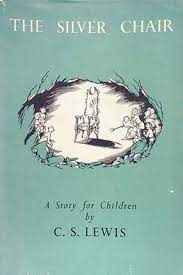
The Silver Chair by C.S. Lewis

The Silver Chair was the fourth Narnia novel to be published (and just to reiterate, this should also be the reading order – ignore any other attempts to resequence the novels), and marks the beginning of the decline in the series. But that’s not to say it is without its moments.

I particularly enjoyed the opening of the novel, flavoured as it was by nostalgia from childhood readings of the series. Eustace Scrubb, fresh from the adventures of The Voyage of the Dawn Treader, and classmate Jill Pole attend the awful ‘Experiment House’. This is a progressive school and Lewis’s conservative views on progressive education are given free rein, including his shock that there should be such a thing as a female headteacher:

“there was an inquiry into the whole thing. And in the inquiry all sorts of things about Experiment House came out, and about ten people got expelled. After that, the Head’s friends saw that the Head was no use as a Head, so they got her made an Inspector to interfere with other Heads. And when they found she wasn’t much good even at that, they got her into Parliament where she lived happily ever after.”

Before this however Experiment House is run by bullies, and while hiding from them Eustace tells Jill about his Narnian adventures. To escape from the bullies, more in hope than in expectation, they try the handle of a door in a wall which has always been previously locked. Magically it opens and leads then not into Narnia but Aslan’s Country, which towers above all other lands. Alsan appears and gives Jill a quest, to find the missing Prince Rillian of Narnia, son of King Caspian. Their quest includes a series of ‘signs’ Jill has to memorise. Things are never made easy for quest followers.

Jill and Eustace travel to Narnia by falling off a cliff, which is only slightly less unlikely than through the back of a wardrobe, blown to safety on a magical wind stream of some kind by Aslan. They arrive and Cair Paravel, and watch as an elderly Prince Caspian (as they later find him to be) sails away. Their first task was to have spoken to Caspian, so they have already failed, as they are to do throughout the story – this is a story about persevering against the odds even when you mess up.

Seventy years have passed since the events of Dawn Treader. Caspian has left Trumpkin the dwarf in charge. Jill and Eustace are given rooms in the castle, but the arrival of a long lost comrade from another world is met with a very muted underwhelmed response. This is mainly because of the uncertainty about the future of the realm – Caspian is old and may not return, and his son Prince Rilian disappeared a decade earlier while searching for the magical serpent that killed his mother.

Jill and Eustace set off on their quest to find the missing prince the following day, led by their guide, Puddleglum. Puddleglum is a gloomy marsh-wiggle, a humanoid figure of Lewis’s invention characterised by a relentless determination to see the dark side of any situation.

And you must always remember there’s one good thing about being trapped down here: it’ll save funeral expenses.

They head north to the giant-lands of Narnia. There they meet the Arthurian ‘Lady of the Green Kirtle’ accompanied by a mute knight in black armour. She directs them to Castle Harfang, the home of the “Gentle Giants”, who ‘would be glad to have them at their Autumn Feast’. Even younger readers will spot the ambiguity in that suggestion, and unsurprisingly the children are intended as the centrepiece, a delicacy, of the celebratory meal. Discovering the giants’ intentions from a cookbook in the kitchen they escape into a cave under the ruined city next to the castle, scene of the latest missed sign. Taken prisoner they are escorted deep into a world ruled by the Lady of the Green Kirtle, and are finally introduced to her attendant, a young man who explains that he is burdened by a curse. Each night he must be tied to a silver chair; if this doesn’t happen he will turn into a serpent.

The ‘mystery’ of the young man’s identity is quickly revealed, and his captors defeated. The trio with their rescued prince return to the surface and there is time for a quick traditional Narnian party, a reunion with the ailing Caspian, before goodbyes and a return to school, where the bullies are given a beating (with the help of a magically restored Caspian) and any loose ends are tied up.

While this was all good a fun in the Narnia tradition, The Silver Chair had many echoes of fan fiction. It uses all the traditional characteristics of the series – the unexpected voyage to Narnia, the quest format, the late intervention of Aslan to help resolve the struggle with a wicked witch, and most importantly of all the character forming experience for the young people involved, the 1950’s version of a gap-year – but there’s a suggestion of Lewis going through the motions, trapped by the conventions of his format. The outcome of the novel is heavily telegraphed very early on and is in no doubt at any point, so when the prince is rescued and the wicked witch dispatched it is anti-climatic (although to be fair the same could be said of the death of the White Witch in The Lion, the Witch and the Wardrobe). The Christian allegory elements of the novel are by this point in the series easily ignored – they are definitely there, with Caspian being revived by a drop of Aslan’s blood for instance – but I never found them intrusive (excepting of course the Last Battle, of which we do not speak). I wonder how children brought up in today’s world of Harry Potter and video games react to the childish joys of these trips to Narnia?

Standard
Book review

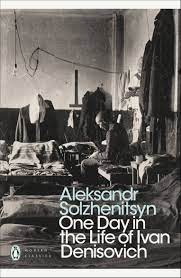
One day in the life of Ivan Denisovich, by Alexander Solzhenitsyn, 1962

After the title of each of these reviews I include the publication date, blithely suggesting that the novel appear complete and final in the year given. Clearly, that is often a simplification – the publication history of many novels is more complicated than this would suggest. The appear in instalments spread over years, are significantly revised, appear in underground magazines then remain banned for years before a final glorious emergence. One day in the life of Ivan Denisovich has a complex publication history which is an important element of the novel’s overall historical significance. Solzhenitsyn served almost ten years in a prison camp of the kind described in this novel. In 1957 he was released from the exile that followed his imprisonment and began writing One Day. In 1962 he submitted the novel to a literary magazine. He must have been aware that its content – a devastating description of life on a soviet labour camp – was going to be contentious, and that publication in the Soviet Union was improbable. Although Stalinism had officially ended with his death in 1953, the USSR remained an authoritarian society where criticism of the state was discouraged.

Instead of summarily rejecting it, the magazine’s editor submitted the manuscript to the Communist Party Central Committee for permission to publish. It ultimately reached the desk of Nikita Khrushchev who approved its publication. I can’t be certain but I think this decision was part of a conscious attempt to demonstrate that post-Stalin Russia had moved on from the labour camps and oppression of Stalinism, presenting a new face to the world. If that was the plan I think you can say it succeeded, although some critics have drawn a causal line between the book’s publication and the eventual collapse of the Soviet Union (although I have to say that feels quite a stretch to me.).

According to his dossier Shukhov was in for treason. He’d admitted it under investigation – yes, he had surrendered in order to betray his country and returned from a POW camp to carry out a mission for German intelligence. What the mission could be, neither Shukhov himself nor his interrogator could imagine. They left it at that – just “a mission”. The counter-espionage boys had beaten the hell out of him. The choice was simple enough: don’t sign and wear a wooden overcoat, or sign and live a bit longer…

Like thousands of his fellow Russian soldiers, Ivan Denisovich Shukhov has been sent to the Gulag – a prison labour camp – as ‘punishment’ for surrendering to the Germans as a prisoner of war during World War II. This was seen as a betrayal of the USSR and a lack of ideological commitment. The novel – as the title suggests – follows Ivan across the course of one typical day. He wakes feeling unwell, but is reluctant to try to get medical help – he knows this is unlikely to help. Punished for lateness he goes to work with his squad, the 104th, on a construction site. Here the winter cold freezes the mortar if it is not applied quickly enough. Shukhov is an experienced prisoner and knows all the best ways to keep warm, avoid the punishments of the guards, and find enough to eat. His focus is always on survival – he often notes other prisoners without the skills to survive the privations of the camp, forecasting that they are going to die sooner or later.

One day is one of those novels that has become an important cultural and historical artefact. It has moulded the way people think, write and speak about Soviet and other labour camps – cold, brutal and unforgiving, even if ultimately and barely survivable. It shows the extent to which literature, even novels that are simply descriptive rather than polemical, can have a significant impact on national political affairs and public opinion.

Shukhov is a consummate survivor, but his life is exhaustingly hard. The novel ends on a note of the slightest bitter-sweet hope – one day Shukhov’s sentence will end, and he will be free. Perhaps the same will happen for Russia:

“The end of an unclouded day. Almost a happy one. Just one of the 3,653 days of his sentence, from bell to bell. The extra three were for leap years.”

Standard
Book review

Inside the Whale and other essays, by George Orwell

Inside the Whale and other essays was first published in this format in 1957, but the individuals essays are drawn from across Orwell’s most productive journalistic years, 1936 to 1947. There are nine essays in this collection – first date of publication shown in brackets:

Inside the Whale (1940) starts as a discussion of Henry Miller’s Tropic of Cancer, but uses this topic as a springboard to roam far and wide across the literature of the first half of the twentieth century;

Down the Mine (1937) originally formed a chapter in The Road to Wigan Pier and is what is says it is, a description of the physical hardships involved in working down a coal mine;

England Your England (1941) is a discussion of nationalism in the context of the early years of the second World War;

Shooting an Elephant (1936) – in this well-known essay Orwell describes the possibly fictional experience of shooting an elephant while serving in Burma in the Indian Imperial Police, where he went immediately after Eton instead of the more traditional route of university;

Lear, Tolstoy and the Fool (1947) is a discussion of Tolstoy’s essay on Shakespeare;

Politics in Literature (1946) is an extended review of Jonathan Swift’s Gulliver’s Travels;

Politics and the English Language (1946) is a surprisingly conservative discussion of how debased the English language has become due to the declining political situation;

The Prevention of Literature (1945) works well as a companion piece to the previous essay as it discusses the impact of totalitarianism on literature;

Boys’ Weeklies (1940) which is a more light-hearted review of the comics published for boys in the first decades of the twentieth century.

Each essay had previously been published elsewhere and had also been collected in different formats. They work well together in this collection, completing one another and giving a examples of some of Orwell’s best journalism of this his defining period.

Taking these essays as a whole, my first impression was how incredibly interesting Orwell must have been as a person to speak to. His mind jumps across so many different topics and he always has a contentious, well-framed position. He never sits on the fence. Some of the positions he sets out here, such as his arguments about the use of plain English in political writing, have stayed with me since I first read them in the 1970’s. You might not agree with what he says – and sometimes I think he is just adopting a position to be controversial for its own sake – but it’s always interesting. It’s also possible to open a page at random and find dozens of thoughtful comments on an important issues. Here are some examples – but the book is absolutely full of them, and choosing some representative examples was incredibly difficult:

It was an age of eagles and of crumpets, facile despairs, backyard Hamlets, cheap return tickets to the end of the night. Inside the Whale

“He (Henry Miller) is fiddling While Rome is burning, and, unlike the enormous majority of people who do this, is fiddling with his face towards the flames“. Inside the Whale

“As I write, highly civilized human beings are flying overhead, trying to kill me.
They do not feel any enmity against me as an individual, nor I against them. They are ‘only doing their duty’, as the saying goes. Most of them, I have no doubt, are kind-hearted law-abiding men who would never dream of committing murder in private life. On the other hand, if one of them succeeds in blowing me to pieces with a well-placed bomb, he will never sleep any the worse for it. He is serving his country, which has the power to absolve him from evil.”
England Your England

(On the impact of imperialism on the ‘white man with his gun’) “He wears a mask and his face grows to fit it” Shooting an Elephant.

These essays are very specific to the time and place from which they were published – the end of Empire and the outbreak of the second World War; the rise of the dictators and for a while what looked like it might be the end of civilisation as we knew it. They are dominated by the oppressive political climate in which internationally things looked very bleak, the war loomed and then broke, and progressive ideas struggled to survive.

“While I have been writing this essay another European war has broken out. It will either last several years and tear Western civilisation to pieces, or it will end inconclusively and prepare the way for yet another war which will do the job once and for all.” Inside the Whale.

It is interesting how little Orwell seemed to have celebrated or been inspired by the election of the radical Labour Government at the end of the war. Although he obviously wrote about these events none of his great journalism touches upon the creation of the NHS, the nationalisation of swathes of British industry, and the introduction of the modern welfare state, even though these steps were an attempt to address many of the social injustices he had written about in, for example, The Road to Wigan Pier. His focus by then was the international situation, and in particular the spread of Soviet Communism. The extent to which Orwell was rehearsing themes that would come to dominate his last two great novels, Animal Farm (1945) and 1984 (1950) comes across very strongly in these essays. For example in The Prevention of Literature he speculates on what kinds of reading matter would survive in a rigidly totalitarian society. “Perhaps some kind of low-grade sensational fiction will survive, produced by a sort of conveyor belt process that reduces human initiative to the minimum? It would not be beyond human ingenuity to write books by machinery.” This theme was brought more vividly to life in 1984 with the creation of the ‘ficdep’ and ‘pornosec’ departments. That’s one of the great strengths of these two masterpieces – they bring together complex political ideas that Orwell had been writing about for some time, and express them in a wonderfully clear way.

I think it’s appropriate that the collection ends with Boys’ Weeklies. This is a class based analysis of boys’ comics, with particular reference to the Billy Bunter Greyfriars stories. It was originally published in the monthly literary magazine Horizon, and argues that the rigid structure these stories employ was needed because “a series lasting thirty years could hardly be the work of the same person every week. Consequently they have to be written in a style that is easily imitated — an extraordinary, artificial, repetitive style, quite different from anything else now existing in English literature.” While Orwell was unquestionably right about the repetitive style the stories used, he was completely wrong in his speculation that the author – Frank Richards – was a pseudonym used by a series of writers. The following month Horizon published one of the most devastating ripostes to an essay I have ever seen which includes a line by line reply to virtually every point made, plus this magnificently understated take down:

“Mr Orwell finds it difficult to believe that a series running for thirty years can possibly have been written by one and the same person. In the presence of such authority I speak with diffidence: and can only say that, to the best of my knowledge and belief, I am only one person, and have never been two or three people”

I highly recommend reading Richards’ reply in full (to be fair it was included in Orwell’s collected essays letters and journalism when they published by Penguin in four volumes a few years/decades back) as an example of how to write a dignified demolition of what to be fair was just an attempt to write something interesting about a light-hearted subject.

Finally, I wanted to close on Down a Mine. Orwell has rightly been condemned in recent times for his casual homophobia – he often used homophobic language to describe gay men in particular. But even he was not immune to the attractions of the male form:

“It is only when you see miners down the mine and naked that you realize what splendid men, they are. Most of them are small (big men are at a disadvantage in that job) but nearly all of them have the most noble bodies; wide shoulders tapering to slender supple waists, and small pronounced buttocks and sinewy thighs, with not an ounce of waste flesh anywhere. In the hotter mines they wear only a pair of thin drawers, clogs and knee-pads; in the hottest mines of all, only the clogs and knee-pads.” Down a Mine.

Standard
Book review

The English Patient, Michael Ondaatje, 1992

The English Patient has given me doubts about my whole approach to reading. How can a novel so widely, almost universally praised, leave me so cold? What am I missing? Am I reading just for the sake of meeting some arbitrary blog-related target (bad) or for pleasure (good). Do I need to rethink how I read these novels? Sometimes it is interesting to spend time working out precisely why the novel in question missed the mark, but it would be nice from time to time to be able to write about what it did well. Perhaps I am just on a bad streak, missing the Terry Pratchett novels which were such a release from ‘literature’.

The English Patient: Winner of the Golden Man Booker Prize

The novel is set in Italy at the end of the Second World War. The text has a complex narrative structure in which events are told out of sequence. A severely burned “English” patient in the bomb-damaged Villa San Girolamo an Italian monastery, is being cared for by Hana, a Canadian nurse. He is the only patient left after the rest of the hospital has been evacuated at the end of the war in Europe. His only possession is a battered copy of Herodotus’s The Histories. Also in the villa/hospital is an Italian/Canadian/British thief and spy, Caravaggio. Of all the novel’s characters Caravaggio is the least well realised. The descriptions of him burgling various properties in the nude were bizarre and when he has his thumbs cut off as a punishment for his thieving it seems a fairly light sentence in the circumstances. Eventually these disparate and troubled characters are joined by Kip, an Indian bomb disposal engineer working with the British Army in the area. 

The English patient is horrendously burnt and will almost certainly die, but is lucid and able to recall some of his experiences leading up to his accident. His memory comes back to him intermittently, although he can never remember his name nor confirm his nationality. (We eventually discover he is not English at all – one of the many instances in the novel where things are not what they seem). He seems to have been slowly dying for several years, although the little I know about severe burns cases suggests that would be highly unlikely if not impossible. Previously he was part of a group of explorers mapping the North African desert. His adventures and those of the other inhabitants of the villa are the focus of the novel – little happens in the villa itself until the very end of the war.

In The English Patient Ondaatje has constructed a complex, elusive novel. It has some finely drawn characters, plenty of incident, and a mystery which is slowly revealed. It was quickly translated into an award winning film. The director made some striking choices about the way the narrative is presented, which highlighted some of the weaknesses in the novel’s construction. Incidents which are central to the film and prove heart rending and dramatic are almost thrown away in the novel. The most obvious example of this is the scene which forms the climax of the movie. The English patient is involved in a plane crash in the middle of the desert. His lover is seriously injured and her husband who was piloting the plane, dies. It is suggested that the crash may have been a deliberate attempt by the husband to kill his wife, and possibly her lover, in revenge for her infidelity. The patient rescues the wife and carries her into a nearby cave. She is seriously wounded but might survive, although the nearest town is three day’s journey away, and without the plane the patient has no way of getting help any faster. He walks to the town where he is immediately taken into custody on suspicion of being a spy. No-one will listen to his pleas, that he has left an Englishwoman out in the desert without food or drink, and she will surely die if he doesn’t go back to her.

In the novel, instead of this scene providing a heart-breaking climax to the patient and his lover’s affair, it is simply one of many fragmented recollections that surfaces during the morphine injections used to control his pain. It is not given any particular emphasis within the narrative structure. Of course I appreciate this was a deliberate choice by the author – war is full of tragedy – but the different choice made by the film director was clearly more impactful. The film also evens the novel’s timeline out, making the structure more straightforward while retaining the multiple flashbacks that are at its core.

Just to be clear, I appreciate that Ondaatje’s decisions to structure the novel in the way he did, to foreground some events and leave others in shadow, were obviously carefully thought through. They all add to the elusive nature of the novel in which the reader has to invest thoroughly in the narrative in order to construct the whole. Hence my feelings of guilt that I didn’t come to the novel prepared to do this work, put this effort in, and as a result didn’t benefit from the reward that would have brought. Putting it simply, I didn’t pay sufficient attention. And that’s entirely down to me.

Having offered that mea culpa, the novel is weakened from the uneasy combination of different narratives. As well as the present day events in the villa, described in the present tense, there are the patient’s memories of time spent exploring the desert, Caraveggio and Hana’s personal reminiscences, and Kip’s training as an unexploded bomb disposal engineer in England. These last scenes in particular, full of technical bomb-making detail, for which Ondaatje obviously did a lot of research, seemed lifted from an entirely different novel and grafted onto this narrative. 

And finally there is the prose. Much praised for its lushness, its vibrancy, its – well, pick the adjective of choice. But I found much of it just pretentious. I know it is unfair to quote the novel and make fun of the empty sentences, having emptied them myself of context and meaning, but how else can I demonstrate the point? You will either enjoy this style of writing or not – and I found it vacuous and empty. Worse at times it descends into meaninglessness.

“We die containing a richness of lovers and tribes, tastes we have swallowed, bodies we have plunged into and swum up as if rivers of wisdom, characters we have climbed into as if trees, fears we have hidden in as if caves.”

“I wish for all this to be marked on my body when I am dead. I believe in such cartography – to be marked by nature, not just to label ourselves on a map like the names of rich men and women on buildings. We are communal histories, communal books. We are not owned or monogamous in our taste or experience.”

“I believe this. When we meet those we fall in love with, there is an aspect of our spirit that is historian, a bit of a pedant who reminisces or remembers a meeting when the other has passed by innocently…but all parts of the body must be ready for the other, all atoms must jump in one direction for desire to occur.”

“There are betrayals in war that are childlike compared with our human betrayals during peace. The new lovers enter the habits of the other. Things are smashed, revealed in a new light. This is done with nervous or tender sentences, although the heart is an organ of fire.”

“Her hand touched me at the wrist. “If I gave you my life, you would drop it. Wouldn’t you?”

In most cases these are the author’s characters speaking rather than the narrator, so it is the characters who are being over the top, pompous, or plain ridiculous. But when everyone speaks like this, more or less (Kip is the primary exception) then I can be forgiven for finding it wearying. It certainly didn’t leave me wanting to read more of this author.

Standard
Book review

The Secret History by Donna Tartt, 1992

The Secret History was Donna Tartt’s debut novel. It opens ominously with the announcement of a murder, with this gripping first line:

“The snow in the mountains was melting and Bunny had been dead for several weeks before we came to understand the gravity of our situation.“

Much of the rest of the novel is dedicated to describing the circumstances leading up to the killing, and to answer the question: how did five educated, cultured and relatively genial young people come to kill someone they once considered their friend?

The novel’s narrator is Richard Papen, a student from California who escapes an unhappy childhood home to go to university the other side of the country in Vermont. Richard becomes part of a close-knit group of classics students, taught almost exclusively by a charismatic professor, Julian Morrow. (Morrow is perhaps a nod to Dr Moreau, another creator of monsters, and suggests Julian may share the burden of responsibility for what happens in the novel). As a character Richard has strong echoes of Nick Carraway, the narrator of the Great Gatsby, witness to another tragic east Coast story of rich people and how their money spoils them. The novel is told several years after the event, and Richard’s testimony makes it clear that the group were never convicted for their involvement in the killing of their friend Edmund “Bunny” Corcoran.

Richard is in no hurry to rush to the details of the murder. This is a confessional, and he believes it is important we understand the full background to what happened, their ‘secret history’. We are introduced to Julian’s small group of students: twins Charles and Camilla Macaulay, Francis Abernathy, Henry Winter, and Edmund “Bunny” Corcoran. Francis and Henry are both independently wealthy, but while Bunny’s family has money he is always borrowing from his friends. The others are cultured intellectuals but Bunny is an outlier, crude and unsophisticated, who takes advantage of his friends and tells unfunny jokes at their expense.

For Bunny’s murder to be portrayed as something the group were forced to do, but for the reader at the same time to feel some sympathy for the victim and understand why he was initially their friend, Tartt has to have Bunny undergo something of a personality change over the course of the novel. Bunny’s faults, at first either not mentioned or tolerated as eccentricities, slowly become magnified to the point of being unbearable. Instead of just sponging off his friends for an occasional meal, he eventually forces them to spend thousands of dollars on him every week, to the extent that their families all think they have drugs problems. None of this would have mattered if Bunny did not know that the group – excluding Richard – had a dark secret which if exposed would ruin their lives. It is the knowledge that sooner or later he will deliberately or otherwise expose them which causes them to act.

The Secret History, front cover.jpg

Bunny’s murder – they push him into a ravine, breaking his neck – is described at the climax of the first half of the novel, and once the deed is done the pace of the narrative almost inevitably begins to flag. There is no suspense as to whether they are investigated or arrested – Richard’s narration has already made it clear that they get away with the murder. Because it appears Bunny has accidentally fallen to his death, and because the body is not discovered for ten days, the inquest finds that he died accidentally, and there is no murder investigation. Things don’t go entirely smoothly – the extended search leads to suspicions that Bunny has been kidnapped (at one point ‘arabs’ are implicated) or was involved in drugs. The FBI is called in, but any threat to the group quickly evaporates once his body is found.

Despite the lack of legal consequences, the impact of their involvement in the murder of their friend is felt by the group nonetheless.

But walking through it all was one thing; walking away, unfortunately, has proved to be quite another, and though once I thought I had left that ravine forever on an April afternoon long ago, now I am not so sure. Now the searchers have departed, and life has grown quiet around me, I have come to realize that while for years I might have imagined myself to be somewhere else, in reality I have been there all the time: up at the top by the muddy wheel-ruts in the new grass, where the sky is dark over the shivering apple blossoms and the first chill of the snow that will fall that night is already in the air.”

Charles begins to drink heavily (as to some extent do all the others), and he eventually becomes unstable and abusive towards his sister. Henry arranges for Camilla to move into a hotel to get away from Charles. It emerges that Camilla and Charles have had an on-off incestuous relationship, and jealousy of Henry causes Charles to threaten him. At the same time Julian discovers the group’s responsibility for Bunny’s murder when he receives an incriminating letter from Bunny that had gone missing in the university’s arcane internal post system. Instead of reporting the crime, Julian walks out of the college and leaves the students to their fate.

The classics – Ancient Greek and the authors of the period – play an important part in the atmosphere of the novel. The students consider themselves an elite because of the subject they study, and hold themselves accountable to a different set of standards from the rest of the student body. Mainly this comes across as pretentiousness:

“Mais, vrai, J’ai trop pleure! Les aubes sont navrantes. What a sad and beautiful line that is. I’d always hoped that someday I’d be able to use it.”

Richard remains something of an outsider because he has friends outside the group, “somehow despite my efforts, I am never able to blend myself in entirely and remain in some respects quite distinct from my surroundings, in the same way that a green chameleon remains a distinct entity from the leaf upon which it sits, no matter how perfectly it has approximated the the subtleties of the particular shade.” But while Richard can at least approximate the behaviour of his waspish friends, Bunny’s involvement in the group is a complete anomaly. Most of the time he behaves like a typical undergraduate, drinking, taking drugs, and generally being boorish, completely out of place amongst his cultivated ‘friends’.

The Secret History is an ambitious novel. It introduces the reader to a close and complex group of friends and I think we are supposed to find them fascinating – Henry the savant, the enigmatic twins, and so on. I struggled to identify with them – they are all dependent on prosperous parents, and the extent to which they rely on the bank of mum and dad is exposed when Francis, openly gay when with his friends, feels forced to agree to an arranged marriage to a woman he despises just so he can ensure his allowance and inheritance. The novel is slightly less than the sum of its parts – the discussions of Ancient Greek literature and philosophy feel more important and profound at the time than when recalled at the end of the novel – are they just pretentious, spoiled students showing off and attempting to justify their homicidal tendencies?

Tartt is clearly an accomplished writer. She publishes approximately one novel per decade which shows how complex and immaculately crafted her novels are. Why The Secret History has never been adapted for the cinema of television is one of those mysteries that will never make sense, because it is incredibly filmic (I can imagine Bunny and Henry’s Christmas break in Rome would translate particularly well to the screen) , but hopefully one day one of the streaming services will pick it up.

Standard