Book review

How to Stop Time, by Matt Haig, 2017

Time travel is an obvious source of plot material for authors, but it is also inherently problematic – making it plausible is always the challenge. Over the years authors have adopted a range of different approaches to making it believable. None have ever really cracked the central practical problems associated with the idea, but Matt Haig comes close in this novel, mainly by redefining what we mean by time travel. His central character, Tom Hazard, has a rare genetic condition which causes him to age extremely slowly.

I am old. That is the first thing to tell you. The thing you are least likely to believe. If you saw me you would probably think I was about forty, but you would be very wrong.

For every ten to fifteen years of his life his body ages approximately one year of everyone else’s. And this is his story. At the time we are introduced to him he is around 400 years old. Much of the novel is spent revisiting Tom’s memories of his earlier lives, from medieval England to 1920’s Paris. The gift of long-life has not been without its problems. His mother is drowned as a witch because of his eternal youthfulness, and he has to separate from his Elizabethan wife and daughter to prevent something similar happening to them. He is forced to change identity every eight years, can never put down roots, learn a profession, build a family, or settle down. And of course the things he can’t have become the things he wants.

In the present Tom works as a teacher, teaching history from first-hand experience. He becomes attracted to a colleague who comes close to working out his secret, but Tom knows that if he allows that to happen he would be putting her in danger. Because Tom has reluctantly joined a group of ‘albas’ – albatrosses, people with the same long-life gene as Tom – determined to protect their secret from big-tech or anyone who would want to analyse their genes for the secret of near eternal life. This group takes a unequivocal approach to secrecy – anyone who finds out about the albas is murdered.

The central concept of this novel is original and interesting. But the novel never really grabbed me. The main character, Tom, doesn’t realise what an amazing gift he has, and to be honest spends a lot of time complaining. His focus is relentlessly on how difficult long-life is amongst normal people, rather than “Wow, I met Shakespeare!”. The resolution of the plot in which he has to choose between enforcing the secrecy code of the albas or embracing the possibility of love is sentimental and unconvincing.

Sorry – I hate reviewing books that I feel underwhelmed by. I’d rather review a book I full-on hate rather than something that is not that bad. But this was just OK. The author can clearly write, and come up with great ideas, so I genuinely hope he finds the right combination one day.

Standard
Book review

Harry Potter and the Philosopher’s Stone, by J K Rowlng, 1997

I normally flag these posts as book reviews, but this won’t really be a review as such – every word Rowling wrote has been analysed in such microscopic detail that any attempts at a summary would be redundant. But ‘I read it so I write about it’ is the rule here, so here are a few things I noticed on this reading of Philospoher’s:

Compression. At around 220 pages the Philosopher’s Stone is a masterpiece of compression. After a relatively leisurely start the last few chapters fly past. Let’s look at what Rowling squeezes in to the novel’s final three chapters:

Having been caught smuggling Norbert out of Hogwarts, the trio are taken to Professor McGonagall’s office where she deducts 150 points from Gryffindor. Harry becomes a pariah and considers resigning from the Quidditch team. Harry, Hermione, Neville and Malfoy report to Hagrid for their detention in the Forbidden Forest. While in the forest Harry sees a cloaked figure drinking unicorn blood, then is rescued by the centaurs, who reveal who is behind the mysterious goings on at the castle. After the year-end examinations, Harry learns Hagrid has revealed the secret of getting past Fluffy. Dumbledore has been lured away from the castle and Professor McGonagall refuses to take them seriously, so the trio set out to stop ‘Snape’ from taking the stone themselves, immobilising Neville on the way. They get past Fluffy, Devil’s Snare, the room of flying keys, and the giant wizards’ chess game, losing Ron at that point. Hermione works out the potions puzzle and then goes back to help Ron while Harry pushes on to find Quirrell looking into the Mirror of Erised. There are a few pages left for Harry to defeat You-Know-Who, rescue the stone, recover in hospital with the benefit of a visit from Dumbledore, attend the end of term feast, win the House cup, and catch the train back to Kings Cross.

This is breathless, extraordinarily compressed stuff – in the film version almost a third of the 160 minutes running time is occupied with these three final chapters, beginning with the Forbidden Forest detention. There’s not a word wasted. The speed with which events flash past make the book hard to put down – where would one pause? – and don’t allow the reader time to consider the extraordinary recklessness with which the trio proceed – for example what were they planning to do when they caught up with ‘Snape’? The later books in the series unfortunately lose this economy, and while the world-building is mainly fascinating and well done, they become more self-indulgent and much slower.

Frivolity. For a story which starts with the attempted murder of a baby and the actual murder of his parents, and which ends with the death of a teacher, this is a surprisingly light-hearted book. The sense of peril is limited – the bad guys are easily foiled, and the trio deals with them without help from friends, teachers or any adults. This sense of comfort – we know things are going to end with the good guys winning – is emphasised by a strong sense of playfulness running throughout the book. Dumbledore consistently messes about, whether in his opening comments to the school – “Before we begin our banquet, I would like to say a few words. And here they are: Nitwit! Blubber! Oddment! Tweak! Thank you.” – or in his comments about his scar being in the shape of a map of the London Underground (I wonder how they translated that joke in foreign language editions?) Even at the end, when announcing the imminent death of Nicholas Flamel and his wife, he still has time to joke around with Bertie Botts every-flavour beans.

Age-appropriate content. Possibly Rowling’s cleverest idea in terms of the structure of the series is the way the books age with the reader. School stories usually have two ways of handling this issue. One choice – the Simpsons model as I think of it – is for the characters never to age. That way the Secret Seven can enjoy perpetual summer holidays staying with relatives in a variety of unremarkable locations each of which have hidden secrets. The alternative approach, for the characters to proceed through the school years in each episode of the series, can be problematic. The number of stories the author can write using these characters is fixed to the seven secondary school years (none of these stories are ever set anywhere other than in secondary schools). Second, as the children age hormones kick in, more adult themes are introduced, and the author runs the risk of losing younger readers.

Rowling’s chose the latter approach – her characters start school aged eleven, and each story spans one school year. But she was able to write sufficiently quickly – seven books in eleven years (1997-2007) – that the pre-teen readers she captured with this first book aged with her characters, cementing their identification with Harry, Ron, or Hermione. Talk of ‘growing up’ is common among Potter fans (and even her critics), and going through that collective experience, together with all the ceremony that became associated with the later books, made Harry Potter an important part of many people’s adolescence.

Nostalgia. I may have written about this elsewhere in this blog, but I once spoke to a group of primary school children about my experience of going to school in the UK in the sixties and seventies. They all had just the one question – ‘Were the teachers really allowed to hit you?!!’ Rowling is a near contemporary (she was born in 1965) and attended school in Gloucestershire, so would have had a very similar educational experience – and in particular one in which teachers, and adults more generally, were allowed to hit children. (Bear in mind corporal punishment was made illegal in schools in the UK in the1980’s.) Harry’s experience of being hit by his teachers (including the excruciating scenes with Professor Umbridge) are really a reflection of Rowling’s own experience, and something that would alien to children of the late nineties or later. Which point underlies the profoundly nostalgic flavour of the books – they are in the tradition of the boarding school stories of Enid Blyton, Anthony Buckeridge, Angela Brazil and Frank Richards (to name a few). The Potter books are suffused with the atmosphere, themes, values and language of these earlier stories – Malory Towers, Secret Seven, Famous Five, Jennings and Billy Bunter – which I am sure Rowling would have grown up with, but would have been largely unfamiliar to her younger readers. All the cultural references throughout the stories, from lemon drops to the excitement of travelling by steam train, are rooted in Rowling’s childhood.

This is surely part of the incredibly successful formula of Harry Potter – the boarding school story has deeply, rigidly established patterns and structures (crushes, pranks, midnight feasts, inter-house rivalry, letters home, the crusty old janitor, and so on) which will have been well known to adult readers, but felt quaintly historic to most of her millennial audience.

So those were my impressions of this reread of Philosopher’s Stone. It’s aged well, and while you can never recapture the impact of the first read, with all the well-timed surprises and reveals, there are sufficient Easter eggs and signs of how cleverly plotted the whole series was (for example I had forgotten that Hagrid borrows the flying motor-bike he delivers Harry to Privet Drive on from Sirius) to justify one more return to Hogwarts.

Standard
Book review

Making Money (Discworld 36) by Sir Terry Pratchett, 2007

Making Money is the sequel to the transcendent Going Postal. It is the story of the further adventures of Moist von Lipwig as he takes on his next challenge – reforming the Ankh-Morpork banking system. For a choice of topic Pratchett couldn’t have been more prescient, coming as it did just a few months before the international banking crisis which precipitated a decade of economic misery.

Anyone who has read this blog before will know that I rate Pratchett as one of our finest writers, so it pains me to concede that Making Money doesn’t quite meet his usual high standards. Just to be completely clear I don’t think for one second this had anything to do with his diagnosis in the same year – his illness was a form of dementia that left him lucid to the end – this article he wrote about his condition explains it far better than I could. Perhaps it is more a case that Going Postal set such a high watermark that any attempt at a sequel would always struggle to compare.

Banks in Ankh-Morpork are failing, and who better to give them a shot in the arm than an admitted thief and smooth-talking showman? “The city bleeds, Mr Lipwig,” says Vetinari, “and you are the clot.” (It has taken me a very long to realise this, but there is a strong case for Vetinari being Pratchett’s greatest creation.) Lipwig is bored running the Post Office, which no longer needs his buccaneering approach to management. So he takes over the running of the city bank and mint. As you would expect there is a cast of comic characters involved. The bank’s chairman is a fussy little dog, the chief clerk, a mathematical savant, obviously harbours a dark secret, which sadly disappoints when it is finally revealed, and a sinister opponent has ambitions to replace Vetenari. In the basement of the bank (is it a bank, or a mint, or both – I was never really clear, so the powerful sense of place which dominates Going Postal, that extraordinarily evoked abandoned Post Office, stuffed to the rafters with undelivered post, is not recaptured) someone has built the Glooper, a model of the city’s economy that develops a life of its own.

There’s not enough of chain-smoking Adora Belle Dearheart in this novel. She is away finding more buried golems, who eventually appear in large numbers only to walk back off stage almost immediately, consenting to be buried in a most improbable fashion. Would Adora, who has dedicated her life to liberating golems, really be happy with this resolution of the ‘what to do with the golden golems conundrum?

Money is an elusive concept, so I am aware of the irony when I say that Pratchett never quite pins it down. It’s not intrinsically good or bad, so the novel is deprived of a cause (compared to say, its predecessor in which privatisation and modernisation are firmly skewered). Pratchett asks the right questions – of course – such as why we trust banks or what the “tacit understanding that we will honour our promise to exchange a dollar for a dollar’s worth of gold provided we are not, in point of fact, asked to” actually means, but never really gets to grips with the topic, skirting around it before moving on to other more tangible, plot-related issues.

My other disappointment with this novel, however slight, centres on Pratchett’s prose. usually his ability to craft a sentence is unparalleled, but here many of the lines fall flat.

“I wouldn’t trust you with a bucket of water if my knickers were on fire!”

“The only really sane person in there is Igor, and possibly the turnip. And I’m not sure about the turnip.”

“I’m an Igor, thur. We don’t athk quethtionth.”
“Really? Why not?”
“I don’t know, thur. I didn’t athk.”

That’s not always the case of course – I loved this image:

“It seemed to Igor that trouble hit Mr. Lipwig like a big wave hitting a flotilla of ducks. Afterward, there was no wave but there was still a lot of duck.”

Making Money is a fun story featuring many of the Discworld characters that by this stage in the series need to do little more than walk on, say their lines, and move on. Moist and Adora really deserved more than a light retread of Going Postal, but that’s essentially what they got.

Standard
Book review

The Power, by Naomi Alderman, 2016

Many of the great dystopian novels have at their centre what amounts to a thought experiment – a ‘What If….?’ What if women were enslaved and used to breed children? What if totalitarianism ruled our lives? What if our obsession with technology distorts society to remove all meaningful human relationships? And so on. Alderman’s master-stroke in ‘The Power‘ is to imagine a new and compelling ‘What If?’ – what would happen if women had the ability to generate electric shocks from their bodies? What if they literally had ‘the power’? What would that do to gender relationships in society? Would women be free from sexism, oppression, sexual violence and so on? Ultimately, would the world be a better place?

Alderman uses a rather clumsy framing device to provide a structure to the narrative. The novel is book-ended with correspondence between a male historian turned author and a female editor. He seeks her comments on and support for his novel, ‘The Power’. He is attempting to find a wider audience for his archaeological findings by turning them into a novel, recreating the world he has discovered . She patronises him, finding the scenes of female on male sexual violence and the idea of male soldiers “sexy”. She suggests the novel is published under a male pseudonym, in an ironic inversion of a practice in publishing that still survives to this day. Their letters are written several thousand years after the central events of the novel. The historian’s theory, given imaginative form in the novel, is that women have not always had ‘the power’, and in earlier pre-power societies men were the dominant sex. He describes the period when women’s electrical abilities first emerged, and the events leading up to the global war which followed.

This framing technique is not new of course – Margaret Atwood (who mentored Alderman during the writing of this novel) does something similar at the end of the Handmaid’s Tale, as does Orwell at the end of 1984, but the impact of the device in both is different, distancing the reader from the grim dystopias, and offering hope that the world has changed. In The Power, Alderman both opens and closes the novel with the correspondence, so we are aware while reading the novel that things don’t end well – chapters headings even have a grim countdown to the apocalypse to emphasise the point. Between chapters are illustrations of archaeological finds. The historian ‘author’ speculates on their purpose, often wildly inaccurately. Alderman has some fun here – for example she talks about the mysterious meaning of the ‘bitten fruit logo’, although this ignorance of twenty-first century technology is not really consistent with the story within the story, in which email and smart-phones are fully understood.

The central narrative is told through the intersecting stories four main characters: Roxy, the daughter of a British drug baron; Margot, mayor of an unnamed city in the United States; Allie, a teenage girl in an abusive foster home in Alabama; and Tunde, a young male Nigerian journalist. Tunde stumbles into journalism driven by a need to understand ‘the power’, and through his efforts the reader sees the its impact on countries around the world. In some countries, such as Saudi Arabia, the changes are literally revolutionary. Allie is at the heart of the development of a new religion focussed on women and their new powers, reinterpreting Christian theology with a fresh emphasis on the role of women. Margot’s story shows the impact of the power on politics and the military-industrial complex – the military possibilities of the power are quickly identified. Finally Roxy’s story shows how organized crime reacts to the opportunities of the changes within society. These disparate narratives converge, improbably, on the newly declared central European nation of Bessapara, which becomes the focus for their stories and the stage on which a new world order begins to emerge.

At first, the power liberates women. No longer frightened of the men in their lives, they begin to take control. The reversal of roles happens quickly – stripped of their power to physically dominate women, men become subservient. This is shown in some obvious ways – there is a scene when women soldiers rape some young men – but also in subtler ways, such as the male newsreader who claims not to understand the political stories he is covering, and is relieved to turn to lighter news or the traffic reports.

The central concept of ‘The Power‘ is remarkably effective. It is thought-provoking and challenging. It locates the oppression of women in their physical weakness relative to men, and asks what would happen if that situation were to be reversed? Whether women’s oppression is solely down to this issue or is rooted in other causes is probably beyond the scope of this review, but what is interesting to me is that Alderman argues quite explicitly that once women have the upper hand, they behave just as badly and oppressively as men. They abuse their physical superiority to strip men of their human rights, to demean them, to torture, humiliate and assault them. Women are not the gentle sex here, they are just weaker, and as soon as that changes they exact revenge. As a mediation on the relationships between the sexes and their capacity to change, this is therefore ultimately a pessimistic book. It argues that human power is not located in the rules by which we agree to conduct civil society, but in our brute strength and ability to harm one another:

“It follows that there are two ways for the nature and use of human power to change. One is that an order might issue from the palace, a command unto the people saying “It is thus.” But the other, the more certain, the more inevitable, is that those thousand thousand points of light should each send a new message. When the people change, the palace cannot hold.”

Furthermore that physical power cannot be trusted in the hands of either sex. Women’s liberation in these circumstances becomes impossible. Their oppression is caused by their physical weakness relative to men (the author suggests) and there is no mysterious electrical power that is going to spontaneously emerge and liberate them – but even if there were, that freedom would be at the expense of men, civil society, and peace.

The contrast with ‘The Handmaid’s Tale‘ is stark. We believe that Atwood’s world is possible, not least because it is drawn from the real-life oppression of women. Women can be freed from Gilead not through any superhuman or supernatural external forces, but through their own actions (and those of their allies). Atwood’s novel is therefore at the same time both more chilling and more optimistic about the future of our species.

I am left wondering, worrying – have I misunderstood the allegory of ‘The Power‘? Does a novel that ostensibly seeks to imagine a world in which women do not have to fear men really end up by concluding that such a world is impossible, unattainable? In a way I hope so.

Standard
Book review

Hamnet, by Maggie O’Farrell, 2020

It feels as if I am the last book blogger on the planet to get round to reading this magnificent novel. I am more than happy to join in with the praise this wonderful book has been showered with, because it is extraordinarily powerful, easily the best novel I have read this year.

Even if you had managed to avoid any of the publicity about this novel, you would know its subject matter from the title. Described in the Guardian review as the “tragic tale of the Latin tutor’s son” (which cleverly highlights the novel’s way of looking at the story with a fresh pair of eyes) Hamnet is about many things, but at its heart this is a novel about grief. How people process loss, how it impacts us differently (particularly poignant was the scene when Judith, Hamnet’s twin sister, asks her mother what the word is for a bereaved twin – after all we have words for orphans and widows). I have never read a book where the rawness of grief is conveyed so powerfully – I sobbed. Written in the present tense it has an immediacy that gives the scenes of loss such impact, and of course the fact we are now living through another pandemic, gladly one a lot less dangerous than the plague of the middle ages, goes to emphasise the tragedy in an unexpected and dramatic way.

But it’s not just about grief. It is an extraordinarily evocative recreation of late sixteenth century rural Warwickshire (London is also summoned up vividly, but it is not the focus of the novel). The extended Shakespeare and Hathaway families are brought to life – and while this novel sent me back to the internet time after time to check various details of their lives (those we know, of course) I didn’t resent that in the slightest. One of its many strengths is that this book isn’t over-researched – it takes the little we know about Shakespeare’s family background and life, and fills in the gaps imaginatively and convincingly. O’Farrell is happy to take risks and present less popular versions of the story – the idea that Will and Anne met while he was tutoring her step brothers in Latin for example. I loved the way the novel rescues Anne Hathaway from the condescension of history and reinvents her as a wise confident young woman. I also think it was a brave decision to foreground Anne (known here as Agnes, the name her father uses for her in his will, apparently) rather than Shakespeare, who remains unnamed throughout the novel.

The mystery of the relationship between Hamnet and the play in his name written just a few years later (O’Farrell mentions only briefly the fact that Shakespeare is believed to have written some of his best comedies in between the two events) is one that invites speculation. Was Shakespeare simply callous, indifferent to the feelings of his family, or (as O’Farrell compellingly speculates here) using the play to explore his grief for his lost son? Other family relationships and characters – the bullying glove-maker John Shakespeare, or Will’s mysterious brother Edward (here Edmond) are all brought to life vividly.

There are many gaps in what we know about Shakespeare. Why did he live long parts of his life in London and not bring his family to live with him, even when he was financially successful? What impact did these long periods of separation have on his marriage. How did he go from being the son of a glove-maker to a phenomenally successful playwright? Why on earth did he leave his second-best bed to his wife in his will? And most of all, what impact did the loss of his son have on his work? Although this is not Shakespeare’s story, along the way O’Farrell acknowledges these many mysteries and provides thought-provoking answers. Which means you can enjoy this novel if you know all there is to know about Shakespeare, or nothing.

I can’t recommend this novel highly enough. I suspect it will go on to win many more awards than the entirely merited Women’s Prize for Fiction it was awarded earlier this year against stiff opposition.

PS The season finale of series three of Upstart Crow, the David Mitchell/Ben Elton BBC sit-com about Shakespeare featured Hamnet’s death. In this episode Judith falls in first, Shakespeare is sent for from London, and between this message being sent and his arriving home Judith recovers and Hamnet has fallen ill and died, the exact sequence O’Farrell follows here. It’s well done in both versions, but I can’t find any evidence or source for this version other than here. I wonder whether the television programme acted as a spark of inspiration for this part of O’Farrell’s story? The programme ends with this apposite and poignant speech from King John:

Grief fills the room up of my absent child,
Lies in his bed, walks up and down with me,
Puts on his pretty looks, repeats his words,
Remembers me of all his gracious parts,
Stuffs out his vacant garments with his form;
Then, have I reason to be fond of grief?
Fare you well: had you such a loss as I,
I could give better comfort than you do.
I will not keep this form upon my head,
When there is such disorder in my wit.
O Lord! my boy, my Arthur, my fair son!
My life, my joy, my food, my all the world!
My widow-comfort, and my sorrows’ cure!

King John, Act 3 scene 4

Standard
Book review

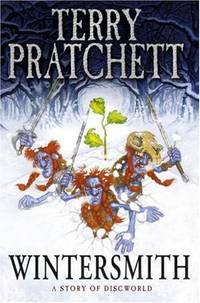
Wintersmith, (Discworld 35) by Sir Terry Pratchett, 2006

Wintersmith (Discworld Novels) by  Sir Terry Pratchett - Paperback - from World of Books Ltd (SKU: GOR001210366)

The Tiffany Aching series of novels gave Discworld a wonderful burst of new life – almost half of the last dozen novels in the series were Tiffany stories. We have followed Tiffany’s story since she was nine, and her training as a witch now sees her placed with Miss Treason, a 113-year old witch renowned for her dark and mysterious powers (which Tiff quickly works out are simply “boffo”, or as Granny Weatherwax would put it, headology. )

Unusually for Pratchett the novel opens with the novel’s climax, and then takes the reader back to the story’s origins. This structure isn’t a problem – it allows the reader to navigate the plot more easily when we know the destination, and is one of the more telling signs that this is a story for younger readers. Tiffany’s problems begin when she goes to observe the traditional “dark morris” dance which welcomes in the winter, Tiffany spontaneously joins the dance, interrupting the passage of the seasons between the two elementals, the Wintersmith and the Summer Lady—the personification of summer. The Wintersmith has never met anyone like Tiffany before, and once the dance is over determines to become a mortal and seek her out, using their spiritual connection forged over Tiff’s silver horse pendant.

This disruption of the natural order of things isn’t going to go well. With the help of the Feegles, and the loving support of Granny Weatherwax and Nanny Ogg, Tiffany has to put things right. It’s not easy when you are being wooed by someone who can make all snowflakes in your image – and icebergs as well! At first Tiff takes refuge in Lancre, and the warm embrace of Nanny Ogg’s cottage, but the elemental Wintersmith is going to track her down.

Like most young adult novels, Wintersmith is really about growing up. Teenage Tiffany has to work through many of the problems and issues young teenagers face. Her fledgling romance with Roland, the Baron’s son (who she rescued in the first novel in the series, The Wee Free Men) is coming along nicely, but she has to battle to keep it private from the feegles and the witches. Speaking of battles, maintaining any sense of privacy from feegles (who take their geas to protect their ‘big wee hag’ very seriously) and witches who can see through her eyes isn’t easy. Later she has to come to terms with the death of an older character. Her place in her peer group is delicately balanced, and she manages to do the right thing and find her place in that hierarchy despite being aware of the subtle manipulations of Granny Weatherwax. Finally, she takes responsibility for her own actions when the temptation to shift the blame or hide behind others is overwhelming. While she may be flawed we are never in any doubt that Tiff will do the right thing and that will bring its own reward:

“It was lonely on the hill, and cold. And all you could do was keep going. You could scream, cry, and stamp your feet, but apart from making you feel warmer, it wouldn’t do any good. You could say it was unfair, and that was true, but the universe didn’t care because it didn’t know what “fair” meant. That was the big problem about being a witch. It was up to you. It was always up to you.”

I love it when Pratchett has the confidence to make such epic characters as Granny Weatherwax and Nanny Ogg minor players in Tiffany’s story. The feegles are an endless delight, and there are some interesting new characters, not least 113 year-old Miss Treason, who wonderfully calls Granny “the girl Weatherwax”. Arguably the novel’s only weak spot is its fairly innocuous ending, but as I always say whoever reads Pratchett for his plots is really missing the point. I don’t think I read these novels with any particular care when they were first published, unwisely seeing them as books for younger readers, (which of course they are) but wrongly concluding there would be little in them for older readers. I am so glad to have got that wrong.

Standard
Book review

The Sea, The Sea, by Iris Murdoch, 1978

I’ve just spent a week in the company of a monster, and I didn’t enjoy it.

I really hated The Sea, The Sea. Or rather I really hated the novel’s protagonist, which on this occasion amounted to the same thing. For a novelist with a reputation for labyrinthine plots, this narrative is fairly straightforward. Theatre director Charles Arrowby the novel’s narrator, retires to the seaside to write his memoirs. Arrowby is utterly self-absorbed. His life has seen a succession of women throwing themselves at him and this pattern continues as he is visited by a series of former lovers, actresses of different degrees of fame, all wanting to resume their relationships. He is not interested, principally because he prefers to steal married women away from their husbands. As soon as each conquest has been mastered he loses interest. His latest obsession is Hartley, a childhood friend who he happens to meet in the village, who he sets about trying to persuade to leave her mild-mannered husband. He even goes to the extreme of kidnapping her, and only releases her once it is obvious she is not going to relent. To justify his obnoxious and criminal behaviour he persuades himself that Hartley is the long lost love of his life, although she clearly sees their friendship in a different light.

Charles’s magnetic attractiveness to women is not however just in his imagination – even at the end of the novel he received letters from a 17 year-old young woman offering him her virginity and to bear his child. But it is mysterious, because he is a bully and a bore. He is always having epiphanies, supposedly profound insights into what is really going on in people’s heads, insights which are invariably wrong. Undeterred he pushes on to the next revelation. When he finds out that his cousin James and his former lover Lizzie have been meeting for coffee occasionally, he throws a tantrum, reacting as if they have been betraying him. Instead of telling him to grow up they indulge his hurt feelings, apologise and withdraw. When he is pushed into the sea and nearly drowns the list of possible suspects is long – I think I would have been tempted!

So we’ve established that Charles is a deluded ego-maniac who is a danger to all around him. Just in case this point needs reinforcing, Murdoch has him see a monster in the choppy waters around his house. This monster is quickly dismissed as a LSD flashback, but later Charles reflects that “I let loose my own demons, not least the sea-monster of jealousy” (528) just in case anyone had missed the heavy-handed symbolism in the preceding 527 pages,

We are supposed to find Charles’s pretentious approach to food amusing. He prepares various mildly eccentric meals for himself and others. At first they are very slightly comic – I stress slightly:
“Anchovy paste on hot buttered toast, then baked beans and kidney beans with chopped celery, tomatoes, lemon juice and olive oil… Then bananas and cream with white sugar. (Bananas should be cut, never mashed, and the cream should be thin.) Then hard water-biscuits with New Zealand butter and Wensleydale cheese. Of course I never touch foreign cheeses.”

But there’s a relentlessness to this, and we get descriptions of meal after meal:

“Lentil soup, followed by chipolata sausages served with boiled onions and apples stewed in tea, then dried apricots and shortcake biscuits… Fresh apricots are best of course, but the dried kind, soaked for twenty-four hours and then well drained, make a heavenly accompaniment for any sort of mildly sweet biscuit or cake. They are especially good with anything made of almonds, and thus consort happily with red wine.”

OK, we get the point.

Murdoch is a hugely respected writer, but even her greatest fans seem prepared to acknowledge her flaws. Here the greatest sin is simply repetition – if something is worth saying it is repeated time after time. The scenes where Arrowby tries to persuade Hartley to leave her husband, and she asks to be allowed to leave, go on for page after page with little variation. The conceit that the novel is Arrowby’s memoir is inconsistently maintained – the struggle of having to construct time for him to draft his recollection of the previous events gets tiresome and is quietly dropped. Murdoch’s (alright, Arrowby’s) technique for building suspense is limited:

“Something happened which was so extraordinary and so horrible that I cannot bring myself to describe it” (1)

“Something rather odd and distressing has just occurred”

“I was sitting writing the above late last night in my drawing room when something very disconcerting happened” (74)

“Shortly after this something very disconcerting happened”. (107)

Obviously this is equally a reflection on Charles’s limited ability to express himself, but the end result is wearying.

It should be possible to enjoy and appreciate a novel where the central character is obnoxious or deluded (Pale Fire?) but I didn’t find it so here. Arrowby is a pompous bore who desperately needs to wake up to his own short-comings, but never. Even someone trying to kill him doesn’t make him pause for reflection! There’s no development in Charles’s character – he remains as deluded and ignorant at the end of the story as he was in its beginning. Is it my shortcoming in not being able to enjoy this widely revered novel(ist)?

Standard
Book review

Thud! (Discworld 34) by Sir Terry Pratchett, 2005

I read Thud! when it was first published, and can still remember the slightly puzzling feeling of disappointment. Pratchett’s recent novels – Going Postal and Monstrous Regiment for example – had been imperious, but this was a slight mis-fire. Or so I remembered. But memory can be misleading – would the novel have the same impact some fifteen years on?

Yes and no. On the one hand this is a Watch novel, featuring Sam Vimes and his team. It’s also in many ways an exceptionally well-constructed detective novel, albeit in a fantasy setting featuring dwarves, trolls, vampires and werewolves. Some critics have found the pastiche of The Da Vinci Code a little heavy-handed, but I thought the references were just right, not such that you knew what was coming next, but that you could see the parallels. So what’s not to like? I think partly the problem is that Pratchett had set such high standards in his recent work that something that doesn’t quite reach those levels is likely to disappoint. Because I don’t think Thud! ever quite comes to the boil; there is a lot of time spent setting up a climax that never really arrives.

The plot is more complex than most Discworld stories. A dwarf, Grag Hamcrusher, has been murdered, and a troll is the prime suspect. The radicalisation of the dwarven community that had been suggested in earlier novels has accelerated, and all-out conflict with their eternal enemies, the trolls is imminent. Hamcrusher was a deep-downer, someone who believes dwarves should remain underground and avoid contact with other races. His murder couldn’t come at a worse time for Sam Vimes and the Watch, because it stokes tensions between Ankh-Morpork’s troll and dwarf communities just as the anniversary of the Battle Of Koom Valley approaches. This battle (or series of battles) happened centuries ago, but is still a cause for resentment between trolls and dwarfs, who now come into close daily contact on the streets of Ankh-Morpork. At first it looks like the deep-downers will obstruct the Watch’s enquiries, preferring to deal with it themselves, but Vimes persuades them to accept an investigation by Captain Carrot, human by birth, dwarf by upbringing. Carrot is assisted by the new recruit, Lance-Constable Sally von Humpeding, the Watch’s first vampire, as well as his werewolf partner, Sergeant Angua. Vampires and werewolves are traditionally the fiercest of rivals leading to tension between Angua and Sally.

Elsewhere in the city a painting has been stolen. This is a job for Corporal Nobbs and Sergeant Colon, Ankh-Morpork’s finest. The fifty-foot painting, The Battle of Koom Valley by Methodia Rascal, is believed to hold a clue to the treasure of Koom Valley. (Because as well as being the site of many battles between trolls and dwarves, Koom Valley also hides some lost treasure). Vetinari could not have chosen a worse time to send an auditor, A.E. Pessimal, into the Watch. This is one of the novel’s misfires – Vetenari has shown every evidence previously of having confidence in Vimes and being willing to let him get on with his job, but now with Vimes at the head of a massively expanded Watch he sends in a book-keeper? Vetenari would already know everything he needed to know about the Watch and sending in an auditor would be an admission of failure. Vimes would almost certainly have sent him packing instead of, as he does, meekly accepting his presence. The same applies for Vetenari and Vimes’s acceptance of someone who is obviously a spy into the Watch – they just wouldn’t have done that in previous novels.

And so it goes on – people not behaving quite like the characters Pratchett has spent years developing. Carrot goes missing from the text, with his investigation largely happening off-screen. Angua behaves like a spoiled child and Vimes manages to completely ignore a summons from Vetenari, something that would have been unthinkable previously. There is a supernatural element to the novel – the Summoning Dark – which has strong echoes of the hiver in A Hat Full of Sky but which here seemed superfluous. The novel’s finale falls flat – the happy ever after resolution manages to be both predictable and unconvincing.

A mis-firing Pratchett is still head and shoulders above most novelists, and there is plenty to enjoy here. Sam Vimes’s character development is almost complete – he is now father to young Sam and takes his story-reading duties just a little too seriously. Minor characters, such as Willikins, Sam’s dead-pan butler, are a joy (“‘My gods, man, you’re covered in blood!’ Sybil burst out. ‘Yes, your ladyship,’ said Willikins smoothly.  ‘May I say in mitigation that it is not, in fact, mine.’) and A E Pessimal the auditor turned blood-thirsty Watch recruit shows promise. Other more familiar characters seem to be on auto-pilot or go missing in action completely, and Tawnee, Nobby’s pole-dancing girlfriend is a mis-judged caricature.

Thud! is much loved by the vast majority of Discworld fans. It’s the only book I have ever seen with 0% one star ratings on both Goodreads and Amazon, which shows how well it is regarded. So who knows, I am probably missing some of the wonders of this novel, one of which is jokes like this variation on the Monty Python “What have the Romans ever given us?” sketch:

“War, Nobby. Huh! What is it good for?”
“Dunno, Sarge. Freeing slaves, maybe?”
“Absol-well okay.”
“Defending yourself against a totalitarian aggressor?”
“All right, I’ll grant you that, but-“
“Saving civilization from a horde of-“
“It doesn’t do any good in the long run is what I’m saying Nobby, if you’d listen for five seconds together.”

Standard
Book review

A Hat Full of Sky, (Discworld 32) by Sir Terry Pratchett, 2004

Books can help us navigate our way through life. People who don’t read can get on well of course, but having books with you along the way can help hugely. I can’t think of a greater challenge in life than the transition to adolescence, and I equally can’t imagine how amazing it would have been to have made that journey with the Tiffany Aching novels by my side. Because this series is about growing up, not in a self-conscious ‘so here’s how to deal with bullies’ way, but by sharing Tiffany’s story.

A Hat Full of Sky is the sequel to the Wee Free Men. Tiffany, now eleven, is leaving family and home to train as an apprentice witch. Leaving her beloved Chalk, the land of her childhood, is hard for her, leaving behind everything that is comfortable and familiar. She goes to live with Miss Level, a witch who has two bodies ( a nice twist on the split personality idea) and a poltergeist named Oswald who cleans the house (another clever inversion).

Tiffany’s powers are such that unknown to her she is being hunted by a dangerous magical creature, a hiver, an ancient parasitical paranormal entity. She is particularly vulnerable when she uses her powers to step outside her body, which she does innocently to look at herself.

Settling in to her new home she meets a group of apprentice witches – far from dying out, witchcraft in this part of the world seems to be thriving. As the new girl she faces the usual struggles of fitting in. The patronising and rude self-appointed leader of the group, Annagramma could be found in any playground in the world. Tiffany represents a potential challenger to her top-dog status, having already met Discworld’s greatest witch, Granny Weatherwax, and been given a hat by her, albeit an invisible one (hence the novel’s title). The other girls don’t believe her, and are mean. Upset by this encounter, Tiffany is vulnerable and is taken over by the hiver. Being possessed by the hiver makes her feel powerful but dangerous, almost like taking drugs?

You can read Tiffany’s struggles with the hiver as a metaphor for depression, anorexia, or any other mental health problem. Young women in particular are vulnerable to doubts about their value, even their identity. That vulnerability can leave them open to ideas or other things that are superficially empowering but nonetheless harmful. Pratchett doesn’t overwork this concept – Tiffany doesn’t self harm for example – but she does struggle internally with the hiver, trying to assert her identity. Her small cries for help aren’t heard by her friends, although the Feegles quickly work out what has happened. Without ever being patronising or spelling things out, I think Pratchett gives his readers some practical ideas on how to deal with these issues in a way that is probably far more helpful than the self-help books that address these issues head-on.

Fortunately, Tiffany has a trump card, the Nac Mac Feegles, wonderful, unruly pictsies, sworn under a geas to defend her from harm. I love the fact that Pratchett is happy to make the geas/geese pun (more than once), even though it is such a terrible dad-joke. Rob Anybody, fearless leader of the Feegles, magically travels into Tiffany’s mind to help her fight the hiver. He works out that smells from her past will allow her to break from the hiver’s control (the scenes where the Feegles collect the items needed – tobacco, alcohol and wool – are a wonderful diversion). Tiffany wrests back control but is left with the memories of the hiver’s previous victims, which she uses to give her strength, drawing on them for support. With the help of Granny Weatherwax, visiting for the Witch Trials, Tiffany comes to understand that the hiver is not something that she needs to defeat but to come to terms with. I think this all works really well as an extended metaphor for how to deal with mental health problems.

I’ve talked a lot about this book being a guide to growing up. But as with all Pratchett’s novels the wisdom it contains is for all ages. I found this paragraph on leaving home quite poignant:

Why do you go away? So that you can come back. So that you can see the place you came from with new eyes and extra colours. And the people there see you differently, too. Coming back to where you started is not the same as never leaving.

And there’s also this advice, which initially appears to be quite witch-specific, but perhaps not:

“Always face what you fear. Have just enough money, never too much, and some string. Even if it’s not your fault, it’s your responsibility. Witches deal with things. Never stand between two mirrors. Never cackle. Do what you must do. Never lie, but you don’t always have to be honest. Never wish. Especially don’t wish upon a star, which is astronomically stupid. Open your eyes, and then open your eyes again”.

Finally, I have written many times about Pratchett’s ability to make me laugh out loud. Once again he managed to achieve this in the scene when Death appears, and is confronted by the pugnacious and profoundly loyal Rob Anybody:

“I WAS NOT EXPECTING A NAC MAC FEEGLE TODAY, said Death. OTHERWISE I WOULD HAVE WORN PROTECTIVE CLOTHING, HA HA.”

Glorious, precious, stuff. It’s easy to overlook the Tiffany Aching Discworld books as just for children, or ‘stories’ rather than novels, and I was probably guilty of this first time round, but now I am coming to appreciate them far more as fully-rounded additions to Sir Terry’s body of work.

Standard
Book review

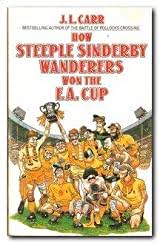
How Steeple Sinderby Wanderers won the FA Cup, by J L Carr, 1975

J L Carr’s A Month in the Country is an under-appreciated masterpiece. The slightly earlier How Steeple Sinderby Wanderers won the FA Cup shows some of the promise seen in full bloom in the later novella, but has a comedic, not to say comic, premise that holds the author back from revealing his full potential.

How Steeple Sinderby Wanderers Won The F. A. Cup by J L Carr

The idea of a small village team winning the FA Cup is drawn directly from the pages of virtually every comic for boys ever written (the whole sub-genre is brilliantly caricatured in Viz’s Billy the Fish). Steeple Sinderby features every cliche from the genre going – the washed up ex-pro, the gifted midfielder with a tragic backstory, the unnaturally talented goalie with prehensile abilities, and the mysterious east European tactical genius.

I read once that J K Rowling hated having to write the scenes in her Harry Potter novels describing Quidditch matches (which explains why they were often called off). Carr may have felt trapped by the same logic of his scenario, because as the story progresses and the club proceed relentlessly to the final, the football games themselves become almost a sideshow. There is some fun with parodies of different commentary and reporting styles (In their primal gladiatorial tourney N. Baddesley jousting on their own bailiwick encountered the full and furious blast of Steeple Sinderby’s New Look Lads spearheaded by Sid Swift, long-lost Shooting Star idol of Brum fans a handful of time ago. The Ringers clocked up eleven strikes and only the inexorable march of time muffled a full peal of twelve), but there’s only so many ways you can describe an imaginary match.

But this really isn’t a football story. There are far more interesting things going on in the margins of the narrative, or perhaps along the touchlines. The narrator, Joe Gidner, having “had this trouble and left theological college”, lives in the village schoolmaster’s house, combining the writing of greetings-card verses and looking after his host’s invalid wife. He is also the club’s secretary, and is chosen to write the first draft of the history of the club’s victory, which this novel purports to be. He is an engaging almost whimsical narrator, and proves a helpful guide to the club’s adventures, the players’ and others’ back-stories, and the less than glamorous mid-1970’s setting in which football supporters’ violence is taken for granted.

Steeple Sinderby itself is a stereotypical English village, with all the charm but also all the flaws. Gidner tells us about its inhabitants, its entry in Pevsner’s Buildings of England and its one notable previous inhabitant, the peasant poet Thomas Dadds. The club’s chairman, Mr Fangfoss, is not interested in football but assumes the role because he is used to running everything. He is a bigot but sympathetically portrayed nonetheless, including his unorthodox marital arrangements.

Despite the team’s inevitable victory in the final, the novel ends in a downbeat manner.

“I often wish I could have known the end at the beginning, so that each detail could have been savored as it happened. But then, life isn’t a gramophone record one can play again and again […] It is Now or Never for most of us, and we haven’t the time.”

Everyone leaves either the club or the village, or both, Joe’s attempts to woo a young lady he is attracted to come to naught, and the club is wound up, in recognition that such heights will never be reached again. Joe’s story is one of missed opportunities, and the subtle whimsy of the story is overlaid with what felt like a somewhat manufactured nostalgia – the 1970’s were the present day when the book was written, village life was not really under threat, and football violence and the bigotry of Enoch Powell and the like with which it was often associated is nothing to be nostalgic about. So I was left unconvinced by this novella despite its many charms.

Standard