Book review

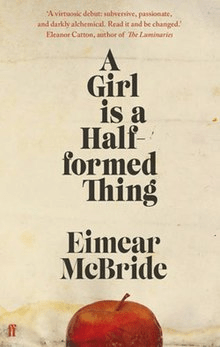
A Girl is a Half-Formed Thing, by Eimear McBride, 2013

I read Eimear McBride’s extraordinary first novel, “A Girl Is a Half-Formed Thing” in summer 2022, but have struggled over several different drafts to do it justice in the form of a review. It is in some respects a traditional family story – of a young Irish woman whose life takes a dark turn when she is raped by her uncle. She is thirteen when this happens, and despite the narrator not describing it as a sexual assault she clearly does not give consent to what happens (appallingly the Guardian’s 2013 review of the novel talks about this as being a sexual ‘encounter’; the New Yorker review uses the term ‘sexual relationship’, seemingly ignoring her age and their family relationship). This response has echoes of the way Lolita is sometimes referred to as a teenage seductress or other, similar terms, when she is simply a child sex abuse survivor. Just because the character doesn’t see herself as a victim it doesn’t mean she isn’t one.

Within this conventional framework, the novel is daringly original. All the characters are unnamed, and the narrative takes place in an Ireland devoid of dates and obvious historical context. But this is a minor issue compared to the narration. The novel is told by the “half-formed” girl of the title, and begins when she is two years old. It is presented in a barely recognisable version of the English language, taking stream of consciousness to a new level. It is intense and fractured, full of invented words and phrases and old words used in new ways. I initially assumed this was the author’s (successful) attempt to mimic the disordered thought patterns of a young child, and that the text would soon (as she grew older) settle down into more familiar patterns and structures. Oh no! If anything the disorder increases as the narrator grows up and experiences the world in more complex ways. It is usually possible, with care, to work out what is happening at any particular point. This example, chosen at random, is fairly easy to follow:

“We were moving off now. From each other. As cannot be. Helped. I didn’t want it from that time on. You know. All that. When you said sit with me on the school bus. I said no. That inside world had caught alight and what I wanted. To be left alone. To look at it. To swing the torch into every corner of what he’d we’d done. Know it and wonder what does it mean. I learned to turn it off, the world that was not my own. Stop up my ears and everything. Who are you? You and me were never this. This boy and girl that do not speak. But somehow I’ve left you behind and you’re just looking on.”

Almost conventional, no? Some complete sentences, and a vague says of who is saying what, to whom. But when the narrator is agitated, drunk or upset, or when her identity is breaking down, the best the reader can hope for is to just derive a general sense of the narrative. Any detailed deconstruction of whose speech is being reported and who is doing what is almost impossible:

“Puk blodd over me frum. In the next but. Let me iar. Soon I’n dead I’m sre. Loose. Ver the aIrWays. Here. mY nose my mOuth I. VOMit. Clear. CleaR. He stopS up gETs. Stands uP. Look. And I breath. ANd I breath my.”

Far too the narrative features episodes of distressing sexual violence, which I won’t quote here but needs a trigger warning for virtually all readers I would have thought. McBride is unflinching in her descriptions of her character’s search for degradation as a form of self-harm. This can make the novel a difficult read especially when combined with the complex narration, and arguably there’s just one too many instance of brutal sex with a random stranger. But experimental literature is by definition transgressive – maybe one day this will seem quite conventional?

A Girl is a Half-Formed Thing, by Eimear McBride, 2013

Aside
Book review

The Marriage Portrait opens with the following ‘Historical Note’:

“In 1560, fifteen-year-old Lucrezia di Cosimo de’ Medici left Florence to begin her married life with Alfonso II d’Este Duke of Ferrara.

Less than a year later, she would be dead.

The official cause of death was given as ‘putrid fever’, but it was rumoured that she had been murdered by her husband”.

This note is followed by a quote from Robert Browning’s chilling poem “My Last Duchess‘. Although only a few lines from the poem are quoted, together with the introduction on the hardback edition’s cover they are sufficient breadcrumbs for the reader to have a clear understanding of the novel they are about to read, one in which the finale has, apparently, already been spoiled for them by the author themselves. So either these clues are actively misleading, or this is a novel where the interest lies not in what happens, but how it comes to happen.

Most reviews of this novel mention these items of context, but ignore the quote from Boccaccio’s Decameron that comes immediately after the Browning:

“The ladies…are forced to follow the whims, fancies and dictates of their fathers., mothers, brothers and husbands, so that they spend most of their time cooped up within the narrow confines of their rooms, where they sit in apparent idleness, wishing one thing and at the same time wishing its opposite, and reflecting on various matters…”

This quotation manages our expectations effectively – as well as a murder story, (if not a mystery) this is also going to be about a world where young aristocratic women are traded like livestock between the houses of their parents and their prospective husbands, with the clear expectation that their role is solely to produce offspring. They will have little individual liberty, and while they will want for nothing in the way of material things, freedom will be unattainable. Sex will be a matter of duty with the sole aim of procreation, practiced in Lucrezia’s case under the advice of a doctor with strange ideas about fertility and conception. (“No excitement, no dancing, no music, no creative endeavours, no reading, except for religious texts”). Uxoricide is a very real threat if they misbehave or fail to produce any offspring.

The novel is narrated by Lucrezia and opens one year into her already strained marriage. She has a sudden realisation that her husband intends to kill her. While this feels implausible from a historical perspective – Alfonso would have abandoned any attempt to conceive after just a year as well as risked conflict with the powerful Medici dynasty, when sudden death was a fact of life for all medieval people, irrespective of their status (Lucrezia’s sister dies suddenly from a chill early in the novel) – but we are not invited to question this conclusion. Lucrezia is treated as her husband’s disposable possession and we are invited to think it entirely possible that he would kill her if she did not meet his requirements. Much of the rest of the novel is told in flashback showing us her pampered but constrained childhood and the early days of her marriage.

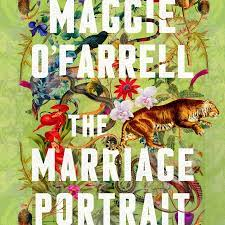
O’Farrell’s 2020 novel Hamnet was one of the best things I have read in a very long time, so my expectations for The Marriage Portrait were very high. The hardback edition is beautifully illustrated with a brightly coloured jungle scene full of birds, flowers and snakes. The tiger that plays an important symbolic role in Lucrezia’s childhood tiptoes off the side of the page, and the inside is illustrated with another wonderfully real and dangerous snake. O’Farrell’s prose is sumptuous and she handles the suspense and atmosphere of Renaissance Italy with authority.

But the Guardian’s review expressed some serious and (partially) valid concerns that need to be addressed:

“high production values cannot disguise the fact that this is melodrama reworked to appeal to a progressive 21st-century audience. The book’s evil deeds are committed by evil people because they are evil. No one acts unpredictably or without foreshadowing….I couldn’t help marvelling at how a novel that’s so richly descriptive could feel so limited in its range of expressiveness.”

This review is not an outlier – a number of critics has similar reservations about the novel’s structure and plausibility. Let’s look at these comments:

“Melodrama” – “a sensational dramatic piece with exaggerated characters and exciting events intended to appeal to the emotions”? I’ve got to concede that some characters were two-dimensional, particularly the evil Duke Alfonso, who switches quickly from being an attentive husband to being a brutal tyrant, and who has his chief of guards strangled to death for having an affair with his (the Duke’s) sister. There’s no real attempt to understand Alfonso’s motivation, the difficulty of ruling over a troubled country threatened on all sides by enemies, menaced from within by assassins, and all the time under pressure to produce an heir when he feels much more comfortable in the company of his male friends. No I’m not hinting he is presented as gay – he’s not really presented at all, other than a sinister villain. But there are many other characters with a lot more depth to them, not least the painter brought in to produce the marriage portrait that gives the novel its title, and his fascinating crew of assistants, including one, Jacopo, who everyone assumes is mute but just stays silent because no one speaks his native dialect. Alfonso’s sisters – Elisabetta and Nunciata – are admittedly straight out of Cinderella, but other secondary characters including Lucrezia’s caring maids are brought to life more fully.

“Reworked to appeal to a progressive 21st-century audience”? This charge is unconvincing. Audiences from most centuries would surely support the young woman sold into marriage and suffering an early death over her husband. This is not a politically correct novel. Renaissance people are convincingly imagined and their different ways of looking at the world are recognised and acknowledged. At the same time they are still people with fears and ambitions like our own.

“No-one acts unpredictably or without foreshadowing”? If foreshadowing is done in a heavy-handed way I completely accept it can be irritating. But I didn’t feel that was the case here, It’s hard to accuse a novelist of foreshadowing (which isn’t automatically a bad thing – we need to understand why people make the choices they make and do the things they do) when we have been told the novel’s outcome on the opening page. Yes we know the likely outcome from the start. This is not a novel of many plot twists or surprises, but it never pretends or aspires to be.

“Limited in its range of expressiveness”? I’m not entirely sure what this means to be honest, but if the critic is suggesting that O’Farrell’s writing is in any way dull or repetitive then that is absolutely not the case. This was an enjoyable read. At moments it is slightly over-written, but arguably this was necessary to describe the opulent of aristocratic renaissance life. Here for example we experience Lucrezia’s discomfort in her fantastical wedding dress:

“The gown rustles and slides around her, speaking a glossolalia all of its own, the silk moving against the rougher nap of the underskirts, the bone supports of the bodice straining and squealing against their coverings, the cuffs scuffing and chafing the skin of her wrists, the stiffened collar hooking and nibbling at her nape, the hip supports creaking like the rigging of a ship. It is a symphony, an orchestra of fabrics, and Lucrezia would like to cover her ears, but she cannot.”

Any suspense in the novel was admittedly deflated by the author’s spoiler – I think we would have ben a lot more engaged as readers if we were left wondering what happens to Lucrezia – but this gives the novel’s surprise ending an even greater impact. The novel is lushly illustrated throughout with vivid imagery. We have already met the tiger that seems to prowl through the novel’s pages, but there is also for example the use of embroidery as a metaphor for Lucrezia’s ability to see beyond the world as it is presented to her:

“She has always had a secret liking for this part of the embroidery, the ‘wrong’ side, congested with knots, striations of silk and twists of thread. How much more interesting it is, with its frank display of the labour needed to attain the perfection of the finished piece.”

I’d also like to acknowledge what I think O’Farrell is trying to do here and in Hamnet: to give a voice to women who while not forgotten by history, have not been able to tell us their version of events. We know very little about Anne Hathaway other than in relation to the works of her husband, and we know even less about Lucrezia de Medici other than the rumours about her death. She – and the class of brave women she represents – are brought to life in the Marriage Portrait. This is much more than the conventional novelisation of historical events, it is a vivid recreation of those events through the eyes of its participants.

The Marriage Portrait by Maggie O’Farrell, 2022

Aside
Book review

There was some controversy about The Curious Incident of the Dog in the Night-Time when it was first published, a controversy which has died down but rumbles on to this day. The central character and narrator of the novel is Christopher Boone, a 15-year-old young man who has ‘some behavioural difficulties’. This is a deliberate understatement – Christopher struggles with the everyday world, despite his obvious acute intelligence, and when he suffers from sensory overload he starts screaming, hitting out at people, and losing control of his bodily functions. This is not a flattering portrait of this condition, whatever the condition may be. Christopher’s exact medical diagnosis is never made clear in the novel, although the book’s blurb (when it was first published – later editions have corrected this) refers to Asperger syndrome (which the internet reminds me today would be described as an autism spectrum disorder). Some years after publication Haddon attempted to correct this perception, writing “The Curious Incident is not a book about Asperger’s…if anything it’s a novel about difference, about being an outsider, about seeing the world in a surprising and revealing way. The book is not specifically about any specific disorder”. Subsequently he further wrote about his regret that the term was used in the blurb at all.

In this ambition – to show the word in a surprising and revealing way – I think he undoubtedly succeeds. Christopher is a compelling guide to the incidents that form the core of the narrative – the ‘murder’ of his neighbour’s pet dog, and the unexpected fallout from that crime. His different way of experiencing the world and the challenges he faces in doing so does reveal events unlike that of any conventional narration. It is also a source of humour, although this is mostly kindly done – Christopher is laughed at by some characters he meets, but not by the reader. If the situations he finds himself in are potentially amusing they are also potentially tragic, not least the disintegration of his family who he depends on so completely. At the same time I can understand the concerns people have about the portrayal of autism – Christopher is violent and aggressive towards people who try to help him, including menacing them with a pocket knife (even if Haddon blunts this threat somewhat by making it the saw blade of a Swiss Army knife). The portrait of autism is also inconsistent – Christopher is at pains to explain that he cannot understand any language that is indirect or uses imagery – “metaphors are lies” but he also uses imagery in his narrative. And of course there is a fundamental contradiction in the idea of a novel written by an autistic person who claims “this is another reason why I don’t like proper novels, because they are lies about things which didn’t happen and they make me feel shaky and scared. And this is why everything I have written here is true” – when clearly it is not.

The mystery element of the narrative is a parody or pastiche of the Sherlock Holmes stories, suggesting that Holmes and Christopher share some of the same ways of looking at the world. Christopher is certainly intelligent and he remembers virtually everything he sees (the myth of eidetic memory is incredibly strong) although elsewhere in the novel Christopher accurately describes how people don’t actually’ see everything all the time – our eyes aren’t video recorders, and our brains have limited storage, which contradicts this aspect of his characterisation. Like Holmes Christopher has substantial gaps in his knowledge and his understanding of the world, particularly in relation to people and human behaviour, and is extremely scornful of others who have a different interests and views.

Sympathetic portraits of people (especially children) with learning or behavioural difficulties, which present the world from their point of view with the intention of helping the reader understand that different perspective, are few and far between. So I think we can forgive Haddon for any mistakes (or vagueness) in his characterisation of this condition. Sometimes the pressures of the narrative require Christopher to be able to do things (such as travel on the tube) when this would clearly have been beyond the abilities of the character a few chapters earlier. (To be fair, he does find this extremely difficult, but he’s not alone in that!) But a flawed autistic hero is still a hero, achieving things far beyond the expectations of others (for example he is the first person at his school to pass an A level).

The novel ends on a positive note – Christopher’s family situation settles down and he appears to be coming to terms with his father’s decisions that have caused him so much distress. Adult readers will no doubt empathise more closely with Christopher’s parents and the difficulties they faced in raising him, while younger readers will be supportive of Christopher himself. He is given a puppy, passes his Maths A Level, and has a plan for the next few years of his life – he will take two more A levels and go to university. Young readers will cheer him on and be hopeful that this can happen – older readers will worry for Christopher, knowing the hurdles he faces and the demands this will put on his already worn down parents.

The Curious Incident won several prizes including the Whitbread Book Awards for Best Novel and Book of the Year, the Commonwealth Writers’ Prize for Best First Book and the Guardian Children’s Fiction Prize. It has also been adapted as a very successful stage play. Although it was originally published in separate editions for both children and adults, I think it ideal audience would be young adults, who will be charmed by Christopher’s unique way of looking at the world and recognise in themselves some of the same challenges such as how to navigate their way through a complex, noisy world. If Christopher can make it, with the support of his parents, perhaps we all can?

The Curious Incident of the Dog in the Night-time by Mark Haddon, 2003

Aside
Book review

“Do you not know that a man is not dead while his name is still spoken?“

Going Postal

In some ways A Life with Footnotes is really two books. The first few thousand words are based on autobiographical notes dictated by Sir Terry during the final years of his life, as a side project between the completion of his many other activities, principally the last few Discworld novels. This part of the book is a very traditional autobiography, with lots of focus on Sir Terry’s early years, his family, his adventures in reading which lead to his becoming the author of the wonderful Discworld series, and his early jobs in local newspapers, reporting on funny vegetables at village fetes etc.

The second part of the book is written in a somewhat different style and is more of a a memoir. While the whole book is by Rob Wilkins, this section is obviously him alone rather than him plus STP. Wilkins was Sir Terry’s long time assistant, amanuensis, and business manager and was the obvious person to choose to write this biography – Rob was beside him every step of the way throughout the last fifteen years of his life, probably his most productive period as an author, He cared for him following his diagnosis and was the co-author (with Pratchett’s daughter, Rhianna) of the extraordinary tweets that announced Sir Terry’s death, which can still bring a lump to my throat. He also became ‘keeper of the anecdotes’ as Terry’s memory began to falter, and read for him at public events. Few people can ever have had the privilege of being this close to such a successful author, and this book is a respectful and comprehensive account of their time together.

The one thing that you won’t find here is anything salacious or revealing. I doubt whether this is this kind of material in STP’s personal life exists anyway, but there’s no hint of any revelations – this is not that kind of book. Rob does reveal that STP was occasionally a bit grumpy if things didn’t go well – a badly arranged book reading for example – but that’s about it. His private life remains a closed book, and his long and happy marriage only provides a backdrop to his career as an author,

One of the many good things about this book is that it describes in some detail the books that influenced STP’s career – the books he loved and which stayed with him over the years. So it makes a great, slightly off-beat reading list, full of recommendations for science fiction and fantasy authors and books, some of which I had beard of but many which were entirely new to me.

I think I knew some of the background to STP’s career already, having been buying his books since the 80’s. For years he didn’t fully commit to his writing. He worked for the Central Electricity Generating Board in a media role long after The Colour of Magic was published, (1983). Becoming a full time author (which of course isn’t just about writing – it’s about book tours, conventions, merchandising, and all the rest, virtually a full-time business in itself) was something he held back from for a long time. It must have been obvious at some point that having administrative assistance – someone to open and reply to all the fan letters, requests for interviews etc – would allow him to focus on the actual job of writing, but it wasn’t until he heard the author Jilly Cooper talk about her invaluable PA that Pratchett was filled with ‘staff envy’ and hired Wilkins.

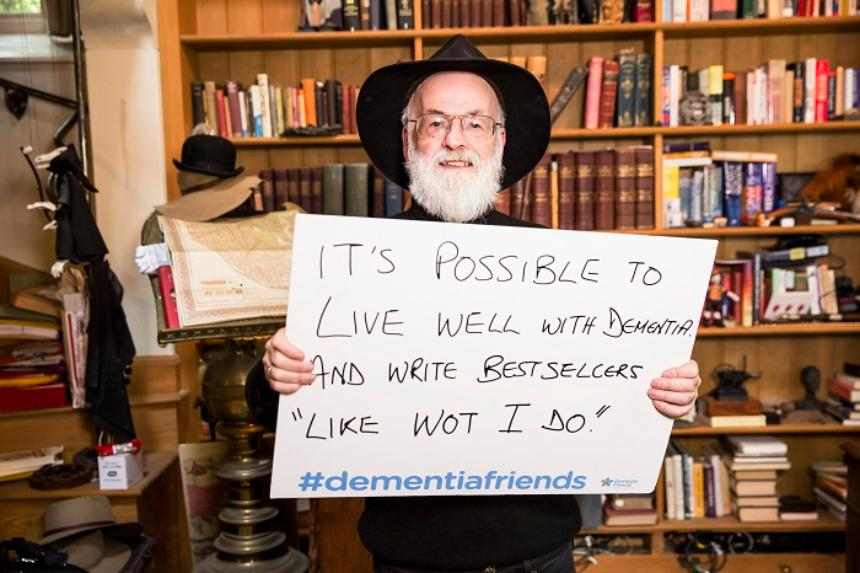
Inevitably the latter section of the text is dominated by what became know as ‘the embuggerance’, his diagnosis of a rare form of young-onset Alzheimer’s disease, posterior cortical atrophy. Over time he needed more and more assistance, and Rob was there every step of the way to step up and provide this support, at first just “tidying up” pages of text (was this just dealing with layouts and fonts?) to taking dictation and towards the end guiding him through his last explorations of Discworld.

Another well-known fact about STP is covered in additional detail here. He left clear instructions that there were to be no authorised further Discworld novels or books and that the hard drive from his computer containing all his work in progress be run over by a specific steam engine at the Great Dorset Steam Fair. (Whether this was backed up or not we may never know). Wilkins gives a painful glimpse of what was lost, including ideas for novels such as The Lost Incontinent; a police procedural based on the goblin characters in Raising Steam called The Feeney (leaving us groan-inducing puns to the last) and Cab’s Well – the story of the creature at the bottom of a well whose job it is to make wishes come true. What a loss.

The other painful element to this account is a personal one – all those years I was a STP fan, but I never once took the time to go to one of his readings, book-signings, or any of the conferences or other events he attended and spoke at. Why not? What a missed opportunity. It made me resolve not to make this mistake again, and to make sure I take the opportunity to go and listen to living authors while I still have the chance. There was a recent thread on twitter you may have seen where an author complained that no-one came to one of their book signings, and a whole host of extremely well know writers chimed in to say ‘me too’. Neil Gaiman kindly wrote: “Terry Pratchett and I did a signing in Manhattan for Good Omens that nobody came to at all… We were meant to have been there for 2 hours. After an hour of nobody in the store we told the store manager that we were going back to our hotel and that we would be in the bar, and if anyone came to get a book signed to send them there to us. Nobody came.” (Margaret Atwood had a similar experience, tweeting: “Join the club. I did a signing to which Nobody came, except a guy who wanted to buy some Scotch tape and thought I was the help.”) Let’s make sure no-one sits through that indignity again, even if they are a local author with a self-published vanity project and you really don’t want to buy their book!

I’ll end this post with a variation of the way I end all my posts on Terry Pratchett – read him, You won’t regret it.

Terry Pratchett: A Life With Footnotes by Rob Wilkins

Aside
Book review

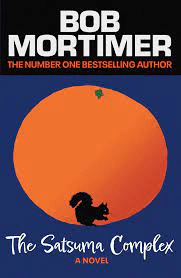
The Satsuma Complex, by Bob Mortimer, 2022

If someone told you the engagingly daft comedian Bob Mortimer had written a novel, what would you expect? Wonder no more, because the answer is The Satsuma Complex. It is impossible to find a review of this novel which doesn’t use the word quirky, so let’s get that out the way up front – this is a quirky, funny crime novel full of the surreal humour which is Bob’s trademark. The challenge the author must have faced when sitting down to write this was whether this humour could be sustained over the length of a novel, or whether the more serious elements would be seen as ‘padding’.

The Satsuma Complex (possibly a reference to A Clockwork Orange?) is narrated by Gary Thorn, a lonely, 30-something solicitor’s assistant drifting through life. His only friends are his irascible next-door neighbour, Grace, and a squirrel he talks to in the park. Work is boring and unengaging, and he has only been on two dates since he moved to London. Anyone who has read Mortimer’s autobiography, And Away will recognise this description of a less than happy period of Bob’s life, pre-comedy, down to the cheap shiny suit and the spartan flat. Write what you know is the template being used here.

The novel opens with Gary getting out of his depth when an innocuous drink with a work acquaintance gets him entangled in an investigation into police corruption and organised crime. The acquaintance goes missing, presumed dead, but not before he has told Gary that he is investigating police corruption in their patch of South London. Shortly thereafter Gary meets and is smitten by Emily, who, it turns out, is also involved in the crime operation and is also out of her depth, being coerced into following him to find out what he knows about the investigation. Details of the police corruption are recorded in a memory stick which comes into Gary’s possession, making him a target of both the criminals and the corrupt police. (I think Mortimer drew inspiration from the Daniel Morgan murder case for this element of the narrative – some details have been changed but there are plenty of similarities as well).

This is not a particularly promising or original set up for a crime novel, even a comedy crime novel – the ‘someone goes missing and a memory stick with key details of the case needs to be kept safe by our unwitting hero’ scenario has been done before. When the police call round to tell Gary his friend is dead, he is ill-equipped for his part in what follows. Mortimer stresses the fact that Gary has no heroic elements to his character – and this isn’t going to be a situation where any hidden heroism emerges either. When threatened by the criminals who want the memory stick he is quite ready to hand it back, even though he knows it means his friend’s murderers will escape unpunished. His focus is really on pursuing a developing relationship with the fragrant Emily, undeterred by revelations about her involvement with the aforementioned gang,

The plot may be deeply unoriginal, but Gary is an engaging anti-hero. His comedic asides and internal monologues (especially the conversations with the friendly local squirrel) are pure Mortimer. You would have thought that absurd comedy and hard-boiled crime novels are an uncomfortable combination unlikely to work, but Mortimer just about pulls it off. If you aren’t a fan of Mortimer’s carefully judged silliness then you won’t find much to entertain you here. The crime novel element of the book is quite heavily cliched, from the femme fatale to the hyper-violent but well-spoken villain. The charms of the book are elsewhere – in the banter between Gary and his irascible neighbour, the surreal descriptions such as the cologne ‘Electricity’ by Seb Longcoq being ‘on the banana-y side of road-works’ or dogs named Zak Briefcase and Lengthy Parsnips.

Would this have been published if the author was not a celebrity? Honestly, I doubt it. The characters aren’t strong enough and the plot is predictable. Is the humour strong enough to compensate for these weaknesses? Yes – but only because we know and love Bob and appreciate his sense of humour. Without that context it would have struggled.

I think the good news is that there’s unlikely to be a series here. I am sure Mortimer’s publishers will be pushing his for more of the same to capitalise on his current high profile and the considerable success of this novel. But a career investigating crime doesn’t seem in store for Gary Thorn – perhaps he will discover the world of stand-up comedy, which I think will be much more his kind of thing.

The Satsuma Complex, by Bob Mortimer, 2022

Aside
Book review

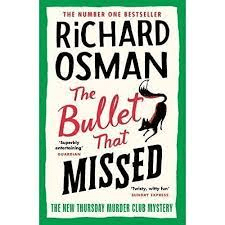
(NB I’ve tried to avoid spoilers in this review but I am not sure I have succeeded, so if you are planning to read The Bullet that Missed and want to have a spoiler-free experience, best not to read on.)

Any author setting out to construct a crime novel will need to decide fairly early on in the process the amount of peril they want to include. Are the characters going to be at serious risk of harm or death, or will they be able to slip away from danger effortlessly? Authors writing for children will usually avoid anything where their characters come to ‘real’ harm, and any deaths are usually ‘off-screen’ or reversed very quickly – I know I have said this before, but I have a theory that you can work out the age group a film is targeted out by the number of seconds between the moment a character ‘dies’ and then suddenly coming back to life. When J K Rowling kills one of her characters in front of us – Cedric Diggory of course – and he doesn’t come back to life, we know she is now writing for a new, more mature audience, even if it is the same one that initially read Philosopher’s Stone three years earlier.

Richard Osman seems to have made a different choice and gone in the opposite direction, ratcheting up the ‘cosy’ element of the Thursday Murder Club series and removing all sense of peril whatsoever. At no point are his senior citizen investigators under any more threat than the Jigsaw Club. Highly skilled assassins can be persuaded not to go through with their threats over a cup of tea, a chocolate biscuit and a nice little chat with someone telling them they really didn’t want to kill anyone, did they? A hardened gang-leader in prison for murder can be persuaded to help the gang investigate the current crime simply through being asked nicely. Another lonely gangland crime boss trades secrets for another game of snooker.

Which makes it hard to take the novel at all seriously. Osman introduces several new characters in this latest incarnation of the Thursday Murder Club, which it goes without saying will sell in its millions. There’s a Swedish crypto-billionaire money launderer who tries to do his own easily-foiled assassinations (even though he has a crew to conduct kidnappings for him). He shows Elizabeth, retired spy, around his baronial lair in Staffordshire (why Staffordshire – is it home to many Swedish crypto-currency billionaires?) and the only thing missing is a white cat being slowly stroked for the Bond villain caricature to be complete. Victor is the ubiquitous retired Russian KGB colonel who always turns up in this kind of novel and would be played by Brian Cox (the actor, not the astronomer) in the inevitable film adaptation. He is also a complete sweetie and wants to join the gang, moving into the retirement community from his lonely luxury apartment in a tower block with it’s own suspended swimming pool.

The novel’s whodunnit puzzle – the gang are investigating a mysterious death of a reporter ten years earlier – is not that interesting. The red herrings are capitalised, in bold, and underlined to remove the risk of them being missed, and the resolution is, unusually for this series, a bit messily handled. The clues include some clunky anagrams which are hard to avoid – because arch-criminals obviously disguise their bank accounts anagrammatically, don’t they?

The element of pathos in the novel, the recognition that these are the last years of the characters’ lives and that death and infirmity come for us all, remains a theme, but is kept firmly in the background. Stephen, Elizabeth’s husband, is suffering from rapidly deteriorating dementia, but remains lucid enough most of the time to be able to assist with the investigation. Overall old-age is presented as rather pleasant golden years rather than those of infirmity, poverty and loneliness.

That’s the negative aspects of the novel – the cosiness is dialled past 11 and any sense of peril is entirely absent. Joyce, Elizabeth, Ron and Ibrahim (and Victor?) are going to all live to 100 and run out of cases before they run out of time. But the 400+ pages pass by pleasantly enough nonetheless. Joyce remains the star of the show, navigating her way through the complexities of the modern world including Instagram and losing her savings by investing them in BitCoin and Etherium. Her murder mystery story, submitted to the local paper as a competition entry and included in full as a bonus item in the Waterstones edition of the novel (but I am sure available online) is hilarious and shows just how hard it is for crime-writers to avoid cliché. The humour in the novel is cleverly done. I particularly enjoyed the observation that “he eats salmon and broccoli now. He eats so much broccoli he can spell it without looking it up” given how hard it usually is to get this one right. Jokes about technology also land well – one character admits “I got so desperate I even used Bing, but the results were the same, if a bit slower.” There are plenty of quotable nuggets of wisdom scattered through the text – Victor in particular is wise in the manner of most Russian spies in this genre:

“It’s the people, in the end, isn’t it?” says Viktor. “It’s always the people. You can move halfway around the world to find your perfect life, move to Australia if you like, but it always comes down to the people you meet.”

There are enough points of entertainment to keep the pages turning and one’s interest engaged. The extra-large font the novel is printed in tells you everything you could want to know about Osman’s target readership, if that was ever in any doubt! I just wonder if perhaps Osman is losing focus and interest, and whether diminishing returns are beginning to set in? Eventually all long-running series run the risk of self-parody (a risk Osman explicitly acknowledges in the short story Joyce writes). He will need to find a new element or character in the inevitable Thursday Murder Club 4 due out this autumn this series becoming oppressively comfortable and we all doze off. This is a book to listen to while doing an uncomplicated jigsaw. There is a place in the world for that kind of book and I am sure I will read TMC4 when it comes out – but I can’t avoid thinking that Osman could do better than this.

The Bullet that Missed by Richard Osman, 2022

Aside
Book review

My most popular post in 2022, for the second year running, was the supplementary post I wrote on clothing following my review of Charlotte Bronte’s Jane Eyre. Which is strange, because it was very much an incidental almost throwaway post on a subject that had caught my eye rather than something I have any particular interest or expertise in. Other popular posts include the comparison between Pride and Prejudice and Sense and Sensibility and my review of H G Wells’ The Invisible Man, the most popular post in 2020. The clothing post is not particularly long, has only a few illustrations, and a handful of comments. So why so popular? My best guess is that entirely by coincidence this is a topic sometimes set for examination or essay questions, and as such it provides a useful if accidental resource for students. If that’s right then you are more than welcome, random stranger.

Given that I went into a serious reading slump at the end of the year, my overall output of nearly 50 novels read isn’t that bad at all considering, especially as one of these was Vikram Seth’s very long (over 1000 pages) A Suitable Boy. My annual Dickens was Great Expectations, which was an important novel to tick off the list, although I am a little daunted at just how far I have to go to finish his novels. I also reviewed Persuasion, the last of Austen’s major novels (I have no plans to read her minor works such as Sanditon, although happy to hear the case for the defence if you think they are worth reading). I also read a few non-fiction works, of which my favourite was probably Michael Slater’s biography of Dickens. Looking at my reading plans for 2022 which I set out in a post at the beginning of the year, I read all but one of the novels on my list. Overall not a bad year’s work – although I am brought back to earth by the realisation that I have only read (and not yet reviewed) one of the Guardian’s best fiction novels of 2022.

In 2023 I have immediate plans to read the wonderful and diverse range of books I received as presents, three of which I have already completed and am working on their reviews. These will keep me busy for some time but later in the year the challenge will be to retain my reading mojo – it is easy once something knocks you out of the pattern of reading to just doom scroll and/or watch box sets rather than using the time wisely. I haven’t chosen this year’s Dickens, but I am tempted by Our Mutual Friend, of which I have only the dimmest recollection from a read more than 40 years ago.

I’d love to hear your thoughts on how to read more wisely in 2023.

Looking back at 2022 and forward to 2023

Aside
Book review

I don’t normally review plays, but this is a legitimate exception I think given the strong literary link. Having said that I haven’t read this play’s source material, Virginia Woolf’s 1928 novel of the same name although I did have a fair idea what it was about.

The play’s website sets the scene for the audience like this:

In the court of Queen Elizabeth I, the young nobleman Orlando begins his search for identity as he embarks on one of the greatest adventures in all of literature. Travelling through time and place he is catapulted into the court of King James, falls in love with a Russian princess, witnesses London freeze over and wakes up under the blazing sun of Constantinople transformed into a young woman. She continues her journey up to the present day in search of happiness, self-knowledge and the courage to answer one fundamental question … who am I? ​​ 

Our guide – and to an extent Orlando’s guide as well – is their maid or dresser, Mrs Grimsditch, who acts as a chorus, explaining events and giving background context. This comic character has a much more central role in this play than in the novel, and is almost a pantomime dame, breaking the fourth wall and directly addressing the audience as “boys and girls, or whatever”. This evocation of the spirit of panto wasn’t fully committed to – there were several points when the character addressed the audience, pressing for a reply, only to either ignore or talk over the hesitant responses that emerged. I think you either need to lean into the audience participation/interaction or not, but half in half out is neither up nor down. There was a similar hesitancy to some of the timing of the performance, with slight delays in people coming in, or coming in a little too early. These were very minor issues which I assumed were due to the performance still settling down in its run.

The play runs for 90 minutes without an intermission. That might explain why the second section of the play seemed rushed – Orlando falls in love and marries in a just few lines, and their husband leaves almost immediately never to reappear. Centuries swish past and before you know it we are in 1928, then 1941 and moments later in the present.

The part of Virginia Woolf is played by nine identically dressed actors who swap smoothly in and out of other roles. The play’s programme suggest these roles represent different aspects of Woolf’s character – if that was the intention then it didn’t work. It was impossible to differentiate between the Woolf’s other than through obvious physical characteristics, and they seemed to largely serve as a handy standby cast of personnel ready to take on the next walk-on character in Orlando’s life story.

The play aspires to be a serious discussion of the role of gender and sex in society. There was a really strange decision early in the performance to show Orlando as having male genitalia which undermined any suggestion that their sex change halfway through the play was a conscious change in gender roles rather than a supernatural or magical transformation. I appreciate that Orlando’s 400 year life-span means the character is a symbolic representation rather than a realistic portrait of a young man or woman. But this production choice meant that the character literally changes their sex rather than their gender identity – in other words reducing them to their genitalia rather than the much broader interpretation of gender roles that the play discusses at other points. I think the play will still have inspired many discussions about the role of women in society – for example when Orlando returns from Turkey they find themselves disenfranchised and dispossessed of their property and position in society – but there was a literalness about this performance decision that I thought risked undermining the narrative.

I hesitate to comment on the central performance because I don’t really feel qualified to do so. I’m on the same page as the Time Out reviewer who said “There are lots of good things about this ‘Orlando’, but it’s just too brief, to not enough end. It’s fun, but it’s not doing full justice to either Virginia Woolf’s book or Emma Corrin’s performance.” I’m also unsure whether the reference to Woolf’s suicide was gratuitous or poignant (clearly what was being aimed at) – one the one hand ignoring the author’s fate might have been disrespectful, but it wasn’t given the time or space to be properly explored in the context of Woolf’s (rather than Orlando’s) life. It wasn’t just a spontaneous, out of the blue impulsive act but the end of an almost life-long mental health struggle which complex origins, none of which were referenced.

The play is at its best when it remembers and respects its source material. The evocation of the Great Frost of 1608/9 is extraordinary. This quote is from the novel, because I haven’t got access to the text of the play, but from what I remember it is accurately and closely followed, and needs little more by way of performance, set or special effects:

“Great statesmen, in their beards and ruffs, despatched affairs of state under the crimson awning of the Royal Pagoda … Frozen roses fell in showers when the Queen and her ladies walked abroad … Near London Bridge, where the river had frozen to a depth of some twenty fathoms, a wrecked wherry boat was plainly visible, lying on the bed of the river where it had sunk last autumn, overladen with apples. The old bumboat woman, who was carrying her fruit to market on the Surrey side, sat there in her plaids and farthingales with her lap full of apples, for all the world as if she were about to serve a customer, though a certain blueness about the lips hinted the truth.”

Orlando, Garrick Theatre, 2022

Aside
Book review

I was disappointed with The Twyford Code, Hallett’s second novel, so was planning to give The Appeal, her first, a miss – but a pristine second hand copy for £1 proved hard to resist. Without wanting to sound mean, I am glad I didn’t pay full price, because it was equally unsatisfying. Just as a heads up – I find it hard to review mystery novels without spoilers, so if you are planning to read this probably best to move on.

The novel takes an unusual form. A barrister sends two of his pupils (junior or trainee lawyers) a collection of emails and messages about a case. These messages constitute the bulk of the novel. He gives them no other information about the files other than they relate to a case he is concerned with. But enigmatically this isn’t a case file: no indication is given of the crime, or crimes involved, nor any other background. He asks them to read the messages and try to spot the relevant or important information hidden within them. The fact that they don’t know what they are looking for is deemed essential – is some way it will make their insights, when they come, all the more significant and unpolluted by preconceptions about the case. Of course it actually just makes the case more confusing whereas a one page summary would have helped enormously! This is a contrivance of course which allows the author to set the reader puzzles that would otherwise be obvious. If you are OK with such contrivances then you won’t might this otherwise frustrating structure.

The novel opens with the planning of a production of Arthur Miller’s All My Sons. An ambitious challenge for the Fairway Players, a small amateur company who have just completed their short run of Blithe Spirit. The company’s characters are revealed through the messages they share while discussing the casting and production of the play. Issy, a local nurse, introduces two new members, friends from work: Sarah and Kel Greenwood. Tensions between characters emerge: who likes who, who tolerates who etc. There are large number of characters to keep track of, and the author helpfully gives us a list of names and relationships/roles. Some characters are given a lot of coverage – others lurk in the shadows. In particular the Greenwoods, having moved back to the UK from Africa recently following some unpleasantness regarding abuse by fellow charity workers, only appear in the messages of others.

The cosiness of the setting is disrupted when Poppy, granddaughter of the Haywards, owners of ‘The Grange’ (it’s never entirely clear if The Grange is a hotel, golf course, both or something similar, not that it hugely matters: it’s a large building with high running and maintenance costs) and principal movers of the company, is diagnosed with a brain tumour. The community immediately swings into action, fundraising for an experimental American treatment not available on the NHS, and costing hundreds of thousands of pounds. This is immediately suspicious – such experimental treatments are usually options of last resort once all other treatments have been exhausted, not something rushed into shortly after diagnosis. Suspicions about the appeal (and credit has to be given to Hallett for the title with its double meaning) quickly mount – there is never an accurate record of how much is raised, despite their apparent wealth the Haywards don’t contribute and even charge the appeal £20k for use of their venue at a fundraising event, and £80k goes missing to an alleged fraudster. The fact that the Haywards are embezzling their own charity fund couldn’t be clearer, and the obvious corollary, that the rudely healthy Poppy has not got any form of cancer, is unavoidable. Most readers will arrive at these conclusions fairly quickly, and other mysteries within the novel are equally transparent.

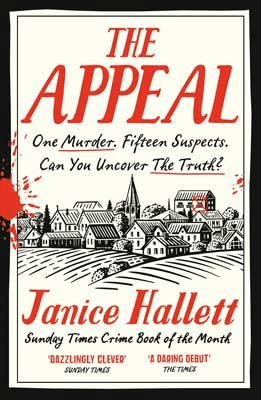
The novel’s cover (at least in the paperback edition) explicitly sets out the challenge to readers: “One murder, fifteen suspects. Can you uncover the truth?” To which the inevitable answer is no, because on the basis of what the reader is told there are multiple potential murderers (probably 15 although I didn’t count) and any one of them could be guilty because of some unrevealed information that only emerges in the closing pages. Spotting the many other crimes and misdemeanours along the way – virtually no-one is entirely well-meaning and innocent – is straightforward enough, but the final resolution, the big reveal as to ‘whodunnit’ was deeply disappointing and unconvincing, requiring as it does someone to take the blame for the crime, then quickly change their mind about doing while at the same time refusing to tell anyone who actually was the murderer. A lot of effort goes into making this plausible behaviour for the character involved, but I wasn’t convinced.

Another mystery within the novel relates to the character of Helen Hayward. We never hear from Helen directly, but we eventually learn that she was responsible for the death of her five year old child when she lived in America, long before meeting her present husband. She moved to the UK to avoid the scandal of a trial in which she was accused of infanticide. The novel becomes muddled on this point, because it suggests that Poppy’s illness is another example of Helen’s child abuse. In fact Poppy isn’t ill at all, and her ‘brain tumour’ is simply a way of scamming money from the community. Helen isn’t Poppy’s carer, and the opportunity for her to induce illness in the child would be limited. So the history of child medical abuse is simply not relevant, and the suggestion that this revelation is in some way an insight into the solution of the mystery (or this particular mystery) is misleading. The novel is full of similar false red herrings which don’t really stand up to much scrutiny. This invites a superficial reading of the text – mysteries are clearly flagged, solutions presented, but scrutiny or careful consideration best avoided. Which presents an inevitable tension with the whole premise of the novel itself in which a careful reading is encouraged to work out the ‘solution’ to the murder.

Having said that this is in other ways a clever novel. Its observations of the British class structure – “they’re an insular bunch. Repressed, judgmental—and they don’t like strangers” – is spot on, and the small-mindedness of many of them is well sketched (if this doesn’t put people off amateur dramatics nothing will). The structure of texts, Whatsapp messages and emails breaks the narrative down into very digestible chunks which keep the pages turning. There is also a contemporary feel to some of the storylines, such as those featuring Fabricated or Induced Illness Syndrome (formerly Munchausen’s Syndrome by Proxy) and the overseas charity sexual exploitation scandal. But ultimately novels like this stand or fall on their conclusion, and the fact that this was so unconvincing and arbitrary was a real disappointment given the effort taken to get us to that point. The author has another mystery novel coming out in the new year (The Mysterious Case of the Alperton Angels – “another labyrinthine, twist-laden mystery focusing on a true-crime writer investigating the historic case of a disturbing cult) which sounds like it will be more of the same. Unless another £1 bargain presents itself, I’ll pass.

The Appeal by Janice Hallett, 2021

Aside
Book review

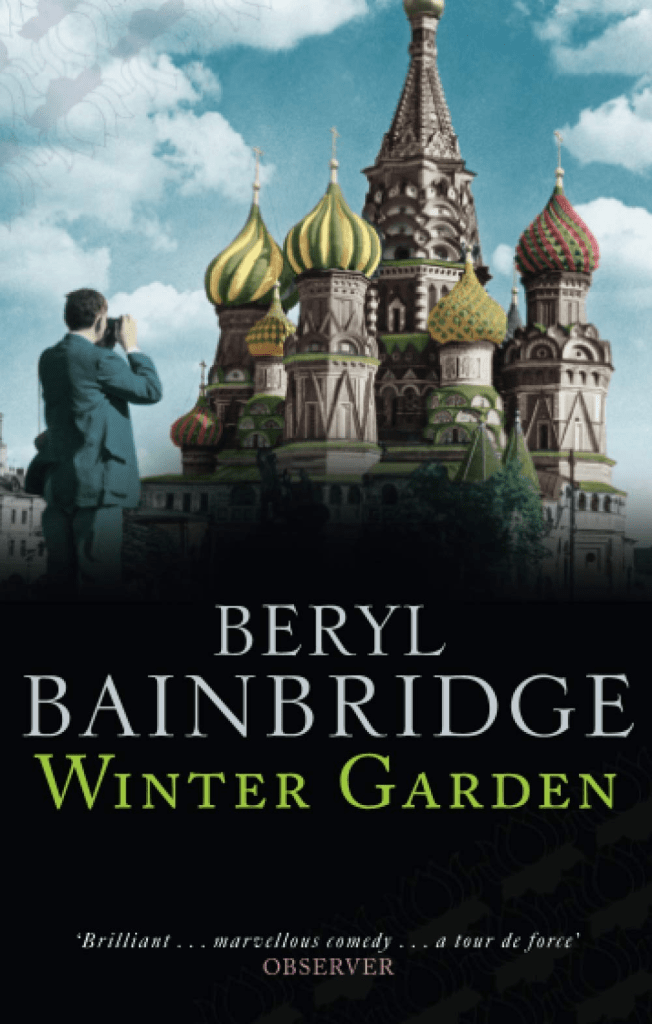
Virtually every review of Winter Garden that I’ve found online says a variation of the same thing – ‘I am not sure what was going on’! Me too I’m afraid. I had the strong impression that if I had invested more time and care in reading the novel I would have found patterns and depths that I missed. But sadly this was one of those ’20 pages a day when the opportunity arises’ reads, rather than a focussed session which probably would have finished of the just over 150 pages in an afternoon. As a result I came away feeling a bit of a failure as a reader.

For context, the novel follows Douglas Ashburner, an everyman figure if ever there was one, setting off on an adventure. He leaves his wife tucked up in bed thinking he is going on a solo fishing expedition to Scotland. In fact, and quite improbably, he is setting off for Moscow as a guest of the Soviet Artists’ Union. He is travelling (and looking forward to some extra marital sex) with Nina St Clair, an artist with whom he has been having an affair. The other two members of the party are Bernard, an uncompromising artist, and Enid, whose role on the trip is never entirely clear, or not to me anyway!

On arrival in what was still the pre-glasnost USSR, in some ways enemy territory, Ashburner’s luggage goes missing. Shortly afterwards so does Nina. The party’s interpreter and guide drives them through a series of increasingly uncoordinated and unlikely visits, some vaguely arts related, others more in the way of social visits. There’s a lot of drinking and a huge amount of ‘business’ about Douglas’s fishing rods, taken along to sustain the trip to Scotland story. The novel descends quickly into a increasingly Kafkaesque swirl of events few of which make any sense. For example one night Ashburner receives a sinister phone call:

“‘I am your brother’ shouted the voice. ‘It is Boris. Listen to me please. Tomorrow night there is an exhibition of Zamyotov’s work in the people’s Institute behind Bolotnaya Square. You will go there. I have fixed it all. Do not listen to them when they tell you something else is specified. Tell them to jump in the lake, yes? Beforehand there will be a lecture. Unfortunately I myself cannot be there until later. You will like the etchings, I think. Have you understood?’”

Is this a coded message? A wrong number? The incident is quickly forgotten as the party move on to the next stage of the tour, still without Nina, but similar incidents pile up. making it hard to follow the narrative thread. On a train to Leningrad Douglas has a disturbing sexual encounter but can’t be sure whether or not it was a dream. For no particular reason he is then taken to watch a brain operation. They go to the opera. He thinks he sees Nina several times, but each time she quickly disappears, and I soon found myself not really caring whether she finally emerged or not.

Just to give a sense of my confusion with this novel, there is a sentence in the penultimate chapter where Douglas uses an everyday phrase which reminds him of “his conversation with Tatiana’s husband in the forest”. There’s no point in being dishonest about this – not only did I not remember the conversation referred to, thereby losing any significance the comment may have had, but I also couldn’t bring to mind either Tatiana herself, or her husband. It’s conceivable that there was no Tatiana and this is just the author’s sense of a meta-joke; equally Tatiana may have been a significant figure that I just overlooked – I am certainly not going to reread to find out! The point of this anecdote is to underline how much I struggled to engage with the text in the way it needed to be read.

The novel ends with Douglas (and this reader) no closer to understanding what has happened to Nina. There is a suggestion that Bernard was using the trip as cover to sketch military bases, but this is thrown away in a sentence. The Flamingo edition I read has a quote from the Sunday Times on its back cover: “I wish it had not stopped”. So did I – I wish it had had an ending of sorts rather than just stopping!

Thematically Winter Garden could so easily have been written by Kingsley Amis, featuring as it does that stock Amis character, an unprepossessing, morose male central figure who is strangely successful with women but a bit of a failure at life. The late Soviet-era backdrop, dominated by drinking, confusion and cold weather would have been a classic Amis setting. If I had read this without knowing the author I would have staked a lot of money on it being by Amis senior.

It’s conceivable that one day I will reread it and all the missing pieces will fall into place, but for now I am happy to move on.

Winter Garden, by Beryl Bainbridge, 1980

Aside